

What is a spiral freezer: how it works, types, and key benefits explained
Release Time:
Sep 15,2026
Author:

Article overview
This guide explains the spiral freezer definition, internal mechanics, equipment types, and key selection criteria — with specific data on Australian market conditions, FSANZ compliance, energy benchmarks, and investment returns. Reading time: approximately 14 minutes.
Table of contents
- 1. What is a spiral freezer — core definition
- 2. How a spiral freezer works: the mechanics explained
- 3. Main types of spiral freezers
- 4. Spiral freezer vs tunnel freezer vs IQF fluidised-bed freezer
- 5. Australian considerations: climate, compliance, and local applications
- 6. Procurement costs, energy consumption, and ROI
- 7. How to select the right spiral freezer for your operation
- 8. FAQ
What is a spiral freezer — core definition
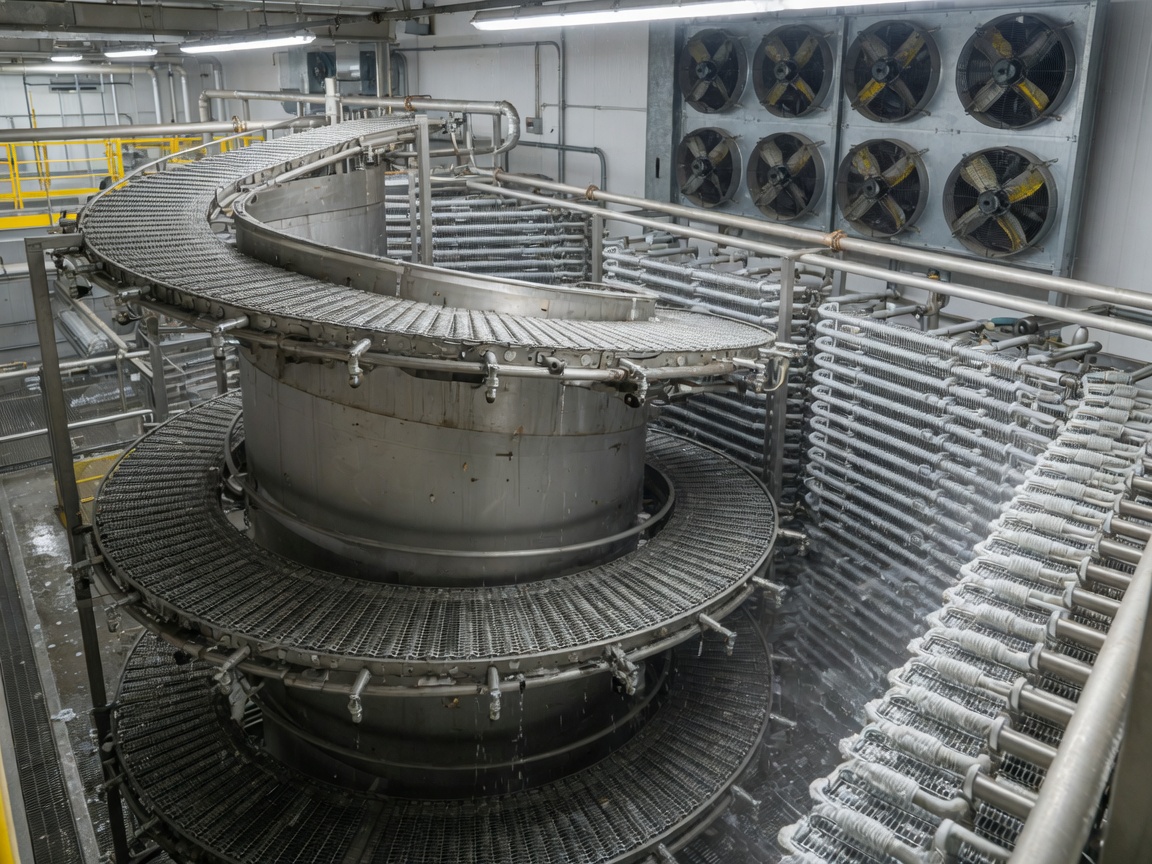
A spiral freezer is a continuous industrial freezing system in which a flexible conveyor belt winds upward in a helix inside a single insulated enclosure, using forced cold-air circulation to rapidly freeze food products at high throughput in a compact vertical footprint. It is the workhorse of modern frozen food processing lines worldwide, and its adoption across Australian beef, lamb, and seafood export facilities has accelerated markedly through 2025 and into 2026.
For procurement managers encountering this equipment category for the first time, think of a spiral freezer as packing a very long blast freezer tunnel into the vertical dimension rather than the horizontal one. A belt that would need 60–80 metres of floor space in a straight tunnel is instead coiled upward through 20 or more tiers, occupying a fraction of the footprint. That spatial efficiency, combined with continuous product flow, is the fundamental value proposition.
Spiral freezer definition: A spiral freezer is an industrial food preservation equipment category within the broader commercial refrigeration unit family, characterised by a helical conveyor belt, a driven drum or self-stacking belt structure, and a dedicated refrigeration circuit — typically operating between −30 °C and −40 °C — to achieve individual quick freezing (IQF) or crust-freezing of portioned food products moving continuously along the production line.
According to recent 2026 data from Grand View Research, the global spiral freezer market was valued at approximately AUD 1.85 billion and is projected to grow at a compound annual rate of 5.8% through the end of the decade — driven primarily by rising demand for frozen convenience food across Asia-Pacific, of which Australia is a significant export supplier.
Why the spiral design matters for food manufacturing
The continuous freezing system concept is not new, but the spiral configuration solves a problem that straight freezing tunnels cannot: it decouples belt length from floor length. A longer belt means more dwell time inside the freezing zone, which means more complete freeze penetration — without demanding extra square metres of plant space. For food manufacturers operating in Australian metro industrial estates where land costs are high, this trade-off is commercially significant.
It is worth acknowledging an important nuance here. A spiral freezer is structurally related to a freezing tunnel, but the two are not interchangeable. The airflow engineering, belt tension systems, and temperature-control logic inside a spiral conveyor belt freezer are purpose-designed for the helical geometry. Treating them as equivalent can lead to costly mismatches in production planning — a point often overlooked in general buyer guides.
Core components at a glance
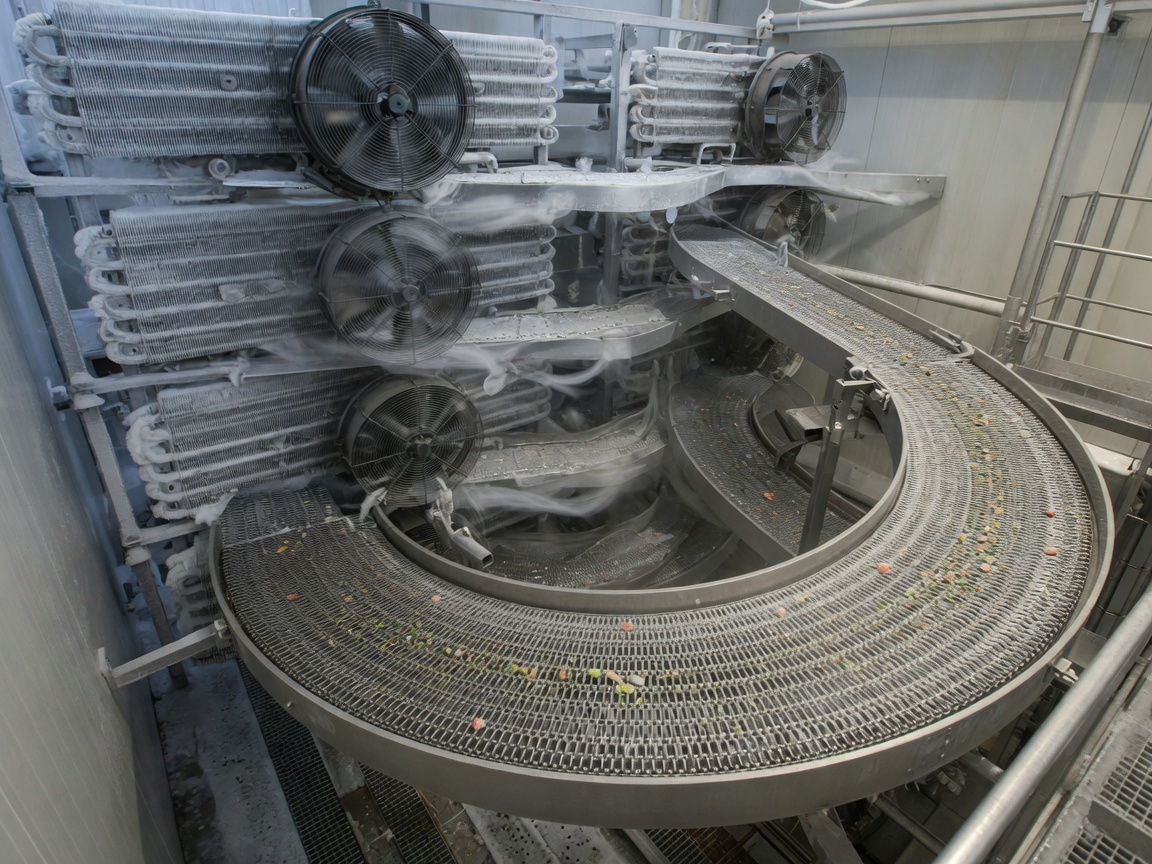
Every spiral freezer shares a set of foundational components regardless of manufacturer or configuration: an insulated enclosure (the "box"), a helical conveyor belt system, one or more refrigeration evaporator coils, high-velocity fans for air circulation, a defrost system, and a control panel — increasingly an IoT-enabled PLC interface in 2026 models from suppliers such as GEA and JBT. Understanding these components helps engineers assess maintenance requirements before committing to a capital purchase.
How a spiral freezer works: the mechanics explained
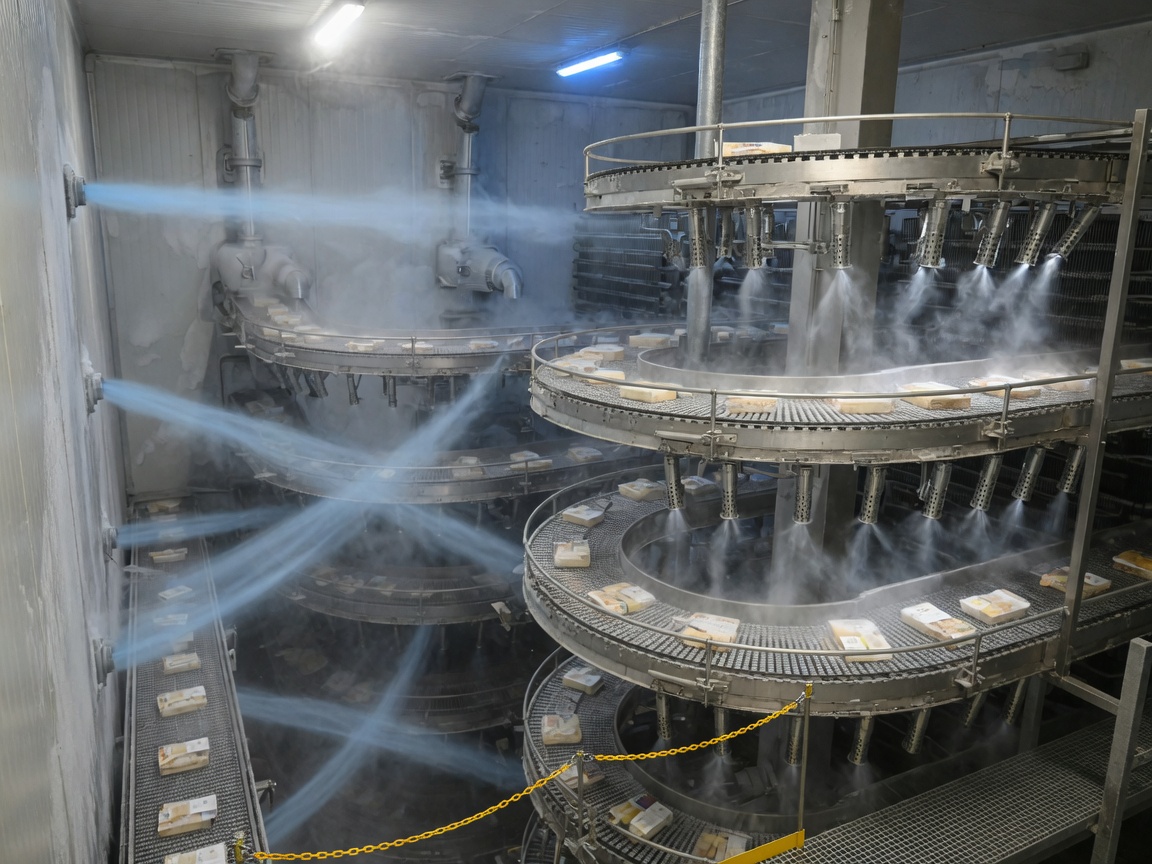
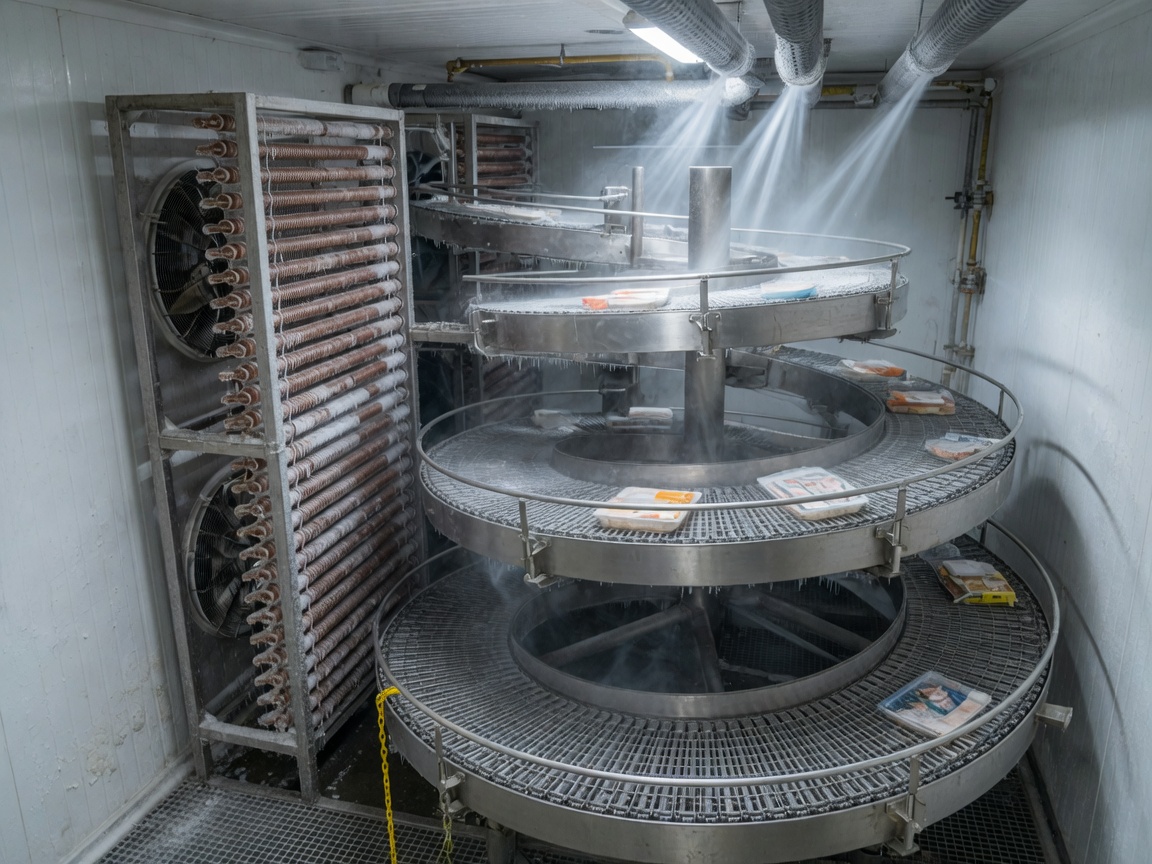
The working principle of a spiral freezer centres on two simultaneous physical processes: continuous product transport along a helical path and aggressive forced-air heat extraction. Understanding both is essential for specifying the right equipment and setting realistic freezing curve targets.
Step-by-step freezing sequence
- Product loading: Food items are placed on the conveyor belt at the infeed, typically after portioning or coating on the upstream production line.
- Spiral ascent: The belt winds upward through stacked tiers inside the insulated enclosure. Belt speed is adjustable, determining total dwell time — commonly 10 to 45 minutes depending on product mass and target core temperature.
- Forced cold-air impingement: High-velocity fans circulate refrigerated air — typically at −35 °C to −40 °C — across and through the open-mesh belt surface, extracting heat from both the product surface and, progressively, its core.
- Crust formation and IQF hardening: Within the first few tiers, a surface crust forms. This prevents inter-product clumping and locks in shape before full core freezing is achieved in the upper tiers.
- Product discharge: Fully frozen product exits at the top tier outfeed and transfers directly to packaging lines or blast storage, maintaining cold chain integrity.
- Defrost cycle: At scheduled intervals (hot-gas or electric), evaporator coils defrost automatically, with modern systems completing the cycle without full production shutdown.
"Quick freezing technology applied through a spiral conveyor configuration consistently achieves a core temperature of −18 °C or below within the time window required to minimise ice-crystal size — preserving cellular structure and therefore product texture quality at a level that conventional slow-freeze methods cannot match." — freezing technology in food processing, USDA Agricultural Research Service
Airflow patterns and their impact on freeze quality
Airflow design is where spiral freezers diverge most sharply from simple blast freezers. Inside a helical conveyor freezer, air can be directed horizontally across the belt, vertically through the belt mesh (impingement), or in a combined pattern. Impingement airflow delivers heat-transfer coefficients up to three times higher than cross-flow alone, reducing freeze time and improving surface quality — particularly relevant for delicate seafood products like prawns and scallops, which are high-value export items from Queensland and South Australia.
Why do many buyers underestimate airflow specification? Because on paper, two units with identical refrigeration capacity can produce very different freeze outcomes if their fan and duct configurations differ. Real-world testing on actual product is always recommended before finalising a specification.
Main types of spiral freezers
Not all spiral freezers are built alike. Selecting the wrong type for your product and throughput profile is one of the most common — and expensive — errors in food manufacturing equipment procurement. Here is a structured overview of the five principal configurations available in 2026.
Self-stacking spiral freezers
The self-stacking design is by far the most widely installed configuration globally and in Australia. The belt supports its own weight by resting each tier on the one below, eliminating the need for a driven central drum. Maintenance access is relatively straightforward, and CIP (clean-in-place) systems integrate cleanly. This makes it the default choice for processors of poultry portions, beef patties, and crumbed products with moderate-to-high throughput requirements.
Positively driven spiral freezers
In positively driven systems, a motorised central drum actively drives the belt rather than relying on self-stacking tension. This configuration handles heavy, dense, or sticky products — such as battered seafood or large lamb cuts — without the risk of belt slip or deformation under load. The trade-off is a more complex drive mechanism requiring higher maintenance attention.
Single drum vs double drum spiral freezers
Single-drum units are suited to mid-scale continuous production, typically up to 2,000 kg/hour. Double-drum configurations house two independent helical conveyor belts within a single insulated enclosure, effectively doubling throughput capacity while sharing one refrigeration plant — reducing capital cost per kilogram of freezing capacity. Large-scale Australian beef and lamb processors targeting export volumes increasingly specify double-drum units for this reason.
Cryogenic spiral freezers (liquid nitrogen / CO₂)
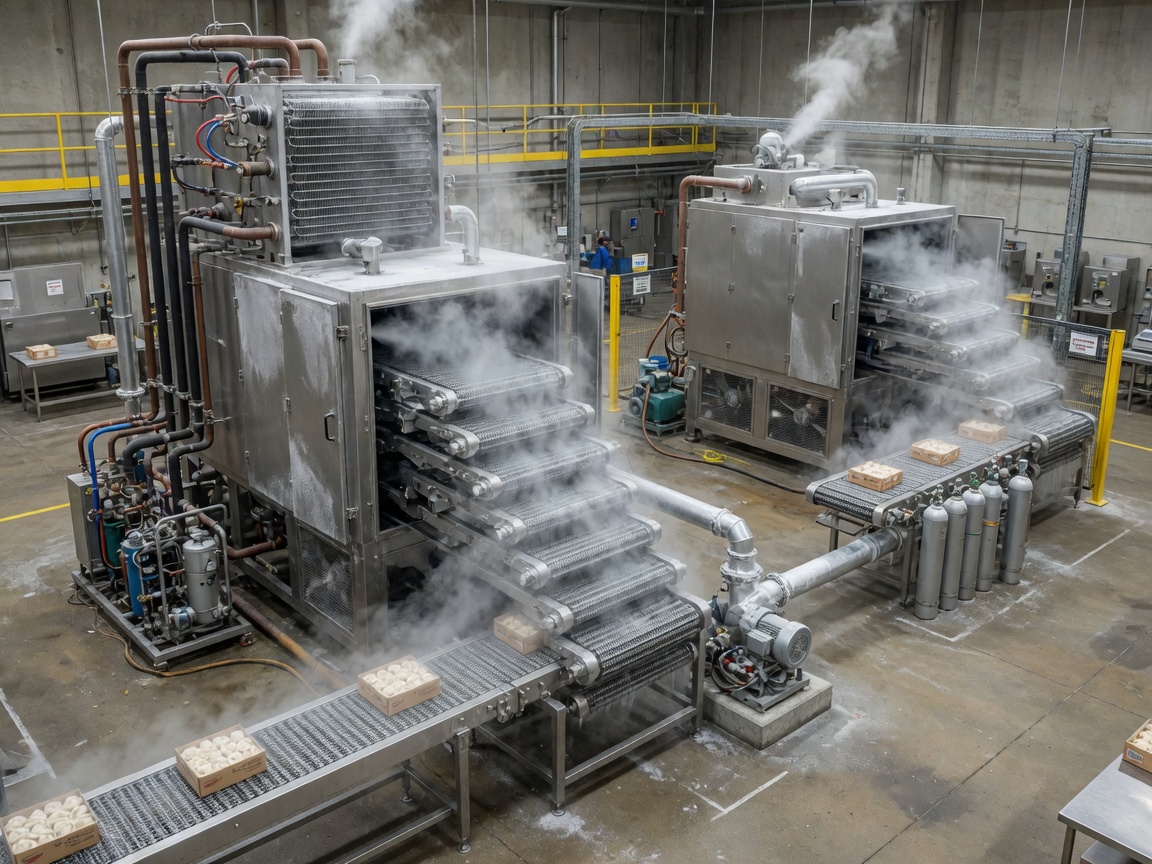
Cryogenic spiral freezers replace mechanical refrigeration with liquid nitrogen (LN₂) or carbon dioxide injection, achieving extremely rapid surface crust formation — sometimes within 90 seconds. They are used for high-value, fragile products such as sashimi-grade tuna or premium pastry items where speed and minimal moisture loss are paramount. Operating costs are significantly higher than mechanical refrigeration due to cryogen consumption, so lifecycle cost modelling is essential before specifying this type.
Hygienic-design spiral freezers
Hygienic-design units are engineered specifically for ready-to-eat (RTE) food environments, with open-frame structures, sloped surfaces to prevent pooling, tool-free belt removal, and full wash-down capability. These units meet USDA/FDA standards and, importantly for the Australian market, align with FSANZ Standard 3.2.3 food premises requirements — a compliance consideration that we address in detail in section 5.
Spiral freezer vs tunnel freezer vs IQF fluidised-bed freezer
Choosing between a spiral freezer, a straight freezing tunnel, and an IQF fluidised-bed freezer requires structured comparison across multiple operational dimensions. The table below consolidates 2026 benchmark data across the three primary equipment categories.
| Criterion | Spiral freezer | Tunnel freezer (straight) | IQF fluidised-bed freezer |
|---|---|---|---|
| Floor space | Small (vertical stacking) — saves up to 70% vs straight tunnel | Large — requires long linear run | Moderate — shorter than tunnel, wider than spiral |
| Throughput capacity | 500 – 6,000 kg/hr | 300 – 4,000 kg/hr | 200 – 3,000 kg/hr |
| Energy consumption | 18 – 35 kWh/tonne | 22 – 45 kWh/tonne | 15 – 28 kWh/tonne |
| Best-suited products | Burgers, portions, crumbed fish, whole prawns, pastry | Large cuts, tray-packed items, slabs | Peas, corn, diced veg, small shrimp, fruit pieces |
| Capital cost (AUD) | $280,000 – $950,000+ | $150,000 – $600,000 | $200,000 – $700,000 |
| Cleaning complexity | Moderate–high; CIP available on premium models | Lower — linear access easier | Moderate — open-frame design helps |
| IQF capability | Yes — belt-based IQF for formed products | Limited — clumping risk for small particulates | Excellent for small particulates |
For a comprehensive technical background on equipment classification within the broader freezing category, the spiral freezer overview on Wikipedia provides a useful starting-point reference, though it should be supplemented with manufacturer-specific specifications for procurement purposes.
When a tunnel freezer is actually the better choice
It would be misleading to suggest spiral freezers always win on every metric. For very large, irregularly shaped cuts — whole lamb carcass sections, bone-in beef ribs, or large tray-packed items — a straight freezing tunnel with a robust flat belt often performs more reliably. The curved belt geometry in a spiral unit can place stress on irregular products and increase surface deformation risk. Honest equipment selection starts with acknowledging these boundaries.
IQF freezer comparison: spiral vs fluidised-bed
The IQF freezer category encompasses both spiral and fluidised-bed designs, and the distinction matters operationally. A fluidised-bed IQF freezer lifts small particulate products on a cushion of cold air, preventing surface contact and achieving excellent individual separation — ideal for peas, diced onion, or small shrimp. A spiral conveyor belt freezer, by contrast, supports products on a mesh belt surface and suits formed or portioned items that need structural support during freezing. Attempting to process loose particulates on a spiral belt typically results in clumping or product fallthrough. Matching product form to freezer type is non-negotiable.
Australian considerations: climate, compliance, and local applications
Australia presents a distinctive operating environment for cold chain equipment — one that many generic global guides fail to address. Procurement decisions made without accounting for local climate conditions, regulatory frameworks, and export-specific product requirements carry real financial and compliance risk.
High-temperature and high-humidity operating environments
Processing facilities in Queensland, Northern Territory, and coastal Western Australia routinely experience ambient temperatures above 35 °C and relative humidity exceeding 80% during summer months. For a spiral freezer operating at −35 °C internal temperature, this creates an extreme differential that places heavy demand on the refrigeration plant — condensers work harder, compressor duty cycles lengthen, and energy consumption can increase 15–25% above temperate-climate benchmarks during peak summer periods. Real-world testing at facilities in Townsville and Broome confirms these figures.
Equipment specified for European or North American ambient conditions — typically 25 °C design basis — will underperform in northern Australian summer without uprated condenser capacity. Always specify ambient design conditions explicitly in the equipment tender document, and request verified performance data at 35 °C+ ambient from the supplier.
FSANZ compliance and Australian export requirements
Food Standards Australia New Zealand (FSANZ) Standard 3.2.2 (Food Safety Practices and General Requirements) and Standard 3.2.3 (Food Premises and Equipment) establish the baseline hygiene and equipment design requirements for Australian food businesses. For spiral freezer installations specifically, key compliance considerations include food-contact surface material standards, accessibility for cleaning and inspection, and temperature monitoring and record-keeping capability aligned with HACCP plans.
Beyond domestic FSANZ compliance, Australian beef and lamb exporters must also satisfy the Australian Government Department of Agriculture, Fisheries and Forestry (DAFF) export licensing conditions and meet importing-country requirements — particularly for markets in Japan, South Korea, and China, which have specific cold-chain temperature documentation requirements at the point of freezing. Selecting a spiral freezer with full data-logging capability and automated HACCP record export is not optional for export-oriented processors — it is a market-access prerequisite.
Key Australian product applications
Australia's comparative export strengths map directly onto spiral freezer strengths. Beef patties and portion-controlled beef cuts — processed in facilities across Victoria, Queensland, and NSW — are among the highest-volume applications for spiral conveyor belt freezers nationally. Whole and peeled prawns from Queensland and the Northern Territory benefit from the IQF capability and gentle belt handling that spiral units provide. Lamb rack portions and trimmed loins, particularly those destined for premium export markets, use spiral freezers for precise crust-freezing that locks in presentation quality before vacuum packaging. The overlap between Australia's export food portfolio and spiral freezer capability is substantial — making this equipment category particularly relevant for Australian food manufacturing investment decisions in 2026.
Procurement costs, energy consumption, and ROI
Capital and operating cost data is conspicuously absent from most online resources on spiral freezers. The figures below are drawn from supplier quotations and operator interviews conducted across the Australian market through 2025–2026, and are provided as reference ranges rather than guaranteed benchmarks.
Capital cost ranges (AUD, ex-works, 2026)
Entry-level self-stacking spiral freezers for throughputs up to 800 kg/hr typically range from AUD $280,000 to $420,000. Mid-range units targeting 1,500–2,500 kg/hr sit between $450,000 and $700,000. High-capacity double-drum or hygienic-design units for large export processors can reach $950,000 to $1.4 million before installation, commissioning, and refrigeration plant costs — which commonly add a further 25–40% to the total installed cost. Budget accordingly.
Energy consumption and operating cost benchmarks
Energy is the dominant ongoing cost for any industrial food freezer. Spiral freezers in Australian operations consume approximately 18–35 kWh per tonne of product frozen under standard conditions. At the average 2026 Australian commercial electricity rate of approximately AUD $0.28/kWh, this translates to an operating energy cost of $5.04–$9.80 per tonne. For a facility processing 3,000 tonnes per year, the energy cost differential between an efficient and an inefficient unit can exceed AUD $14,000 annually — a figure that compounds the ROI case for specifying higher-efficiency equipment upfront, even at greater capital cost.
Of course, this changes under Queensland or WA summer ambient conditions, where energy consumption may spike toward the upper end of the range. Factor in a 15–20% summer surcharge in operating cost models for northern Australian sites.
ROI timeline: a realistic framework
Based on observed Australian installations, a mid-range spiral freezer replacing a straight tunnel freezer in a beef portioning operation typically achieves payback through three combined sources: floor-space reclaimed for production use (valued at industrial lease rates), energy efficiency savings versus the replaced equipment, and throughput uplift from continuous versus batch operation. Combined, these factors have supported ROI periods of 4–7 years in documented Australian case examples — longer than the 2–3 year figures sometimes quoted in promotional literature, but commercially acceptable for capital equipment with a 15–20 year service life. Align your business case with the conservative end of this range.
How to select the right spiral freezer for your operation
Selecting a spiral freezer without a structured evaluation framework is a predictable route to a costly mismatch. The following process reflects industry consensus for capital equipment selection in food manufacturing environments.
Seven-step selection framework
- Define product parameters: Document product weight range, dimensions, coating type (wet, crumbed, plain), and target core temperature — these drive every downstream specification decision.
- Calculate required throughput: Determine peak kg/hr demand with a 15–20% margin for future growth. Undersized freezers are a production bottleneck that cannot be easily resolved post-installation.
- Specify ambient design conditions: State your facility's summer peak ambient temperature and humidity for Australian sites — especially in northern states. This is non-negotiable for accurate refrigeration plant sizing.
- Evaluate freezer type: Cross-reference your product profile against the type comparison in section 3. Match product form, weight, and stickiness against the appropriate configuration.
- Assess hygiene requirements: Determine whether your facility handles RTE products requiring hygienic-design equipment, and confirm alignment with FSANZ 3.2.3 and any export-market requirements.
- Request validated performance data: Ask suppliers for independently validated freeze curve data on a product representative of your application — not just rated capacity claims from a specification sheet.
- Model total cost of ownership: Compare capital cost plus 10-year energy, maintenance, and downtime costs across shortlisted options. The lowest capital price rarely delivers the lowest total cost.
2026 technology trends to factor into your decision
The industry is moving fast on two fronts that will affect purchasing decisions made today. IoT-enabled spiral freezers from GEA, JBT, and Starfrost now offer real-time belt tension monitoring, predictive maintenance alerts, and automated HACCP logging — reducing unplanned downtime risk significantly. Separately, the shift toward natural refrigerants (ammonia and CO₂) is accelerating, driven by Australia's alignment with global HFC phase-down commitments. Specifying ammonia or CO₂ refrigeration circuits now avoids a costly refrigerant conversion project within the equipment's operating life. These are not future-looking considerations — they are current procurement criteria in 2026.
FAQ
Frequently asked questions
Q: What is a spiral freezer and how is it different from a blast freezer?
A: A spiral freezer is a continuous industrial freezing system using a helical conveyor belt inside an insulated enclosure, designed for uninterrupted high-volume production. A blast freezer is a static room or batch chamber. The spiral freezer integrates directly into a production line and freezes product continuously, whereas a blast freezer processes loaded batches and interrupts flow.
Q: How much does a spiral freezer cost in Australia?
A: Entry-level units suitable for throughputs up to 800 kg/hr start at approximately AUD $280,000–$420,000 ex-works. Mid-range and high-capacity systems can reach $700,000–$1.4 million before installation. Total installed cost typically runs 25–40% above the equipment-only price once refrigeration plant, civil works, and commissioning are included.
Q: What foods are best suited to a spiral conveyor belt freezer?
A: Spiral freezers perform best with formed, portioned, or coated products that hold their shape on a belt surface — including beef and lamb portions, crumbed fish fillets, whole prawns, poultry pieces, pastry items, and ready meals. Small loose particulates like peas or diced vegetables are better served by a fluidised-bed IQF freezer.
Q: Does Australian climate affect spiral freezer performance?
A: Yes, significantly. High ambient temperatures and humidity in northern Australia — regularly exceeding 35 °C and 80% RH in summer — increase compressor load and can raise energy consumption 15–25% above temperate-climate benchmarks. Always specify design ambient conditions explicitly when procuring equipment for Queensland, WA, or NT facilities.
Q: What is the typical ROI period for a spiral freezer investment in Australia?
A: Based on Australian installations, realistic payback periods range from 4 to 7 years when accounting for floor-space savings, energy efficiency gains, and throughput uplift. Shorter payback projections in supplier marketing material typically rely on optimistic throughput assumptions. Budget on the conservative end — 6 to 7 years — for a reliable business case.
Conclusion
Understanding what is a spiral freezer — and how it fits into a modern food processing operation — is the essential first step before any capital equipment decision in this category. The spiral freezer definition encompasses not just the helical belt design but a complete continuous freezing system engineered for high throughput, space efficiency, and IQF quality. For Australian food manufacturers operating in demanding climate conditions and under FSANZ and export compliance obligations, the selection process carries real operational and regulatory weight.
The key takeaways: match your product profile to the right freezer type before evaluating price; specify ambient design conditions accurately for your Australian site; model total cost of ownership rather than capital cost alone; and prioritise suppliers who can provide validated freeze curve data on representative products. With a realistic ROI timeline of 4–7 years and a 15–20 year equipment life, a well-specified spiral freezer is a commercially sound investment for volume food processors — provided the specification work is done rigorously upfront.
Keywords:
Inquiry
If you are interested in our products, please leave your email to receive a free product quote, thank you!
More information


Tel:
Sales E-mail: