

Spiral blast freezer buying guide: how to choose the right system for your facility
Release Time:
Sep 13,2026
Author:

Article overview
This guide compares spiral blast freezer configurations, Australian compliance requirements, product-specific freezing parameters, full lifecycle cost modelling, and local service considerations — giving procurement teams a single authoritative reference for the 2026 buying cycle.
Table of contents
- 1. What is a spiral blast freezer?
- 2. Spiral vs tunnel freezer: a detailed comparison
- 3. Australian compliance: FSANZ, AQIS and food safety standards
- 4. Freezing parameters for Australian product categories
- 5. Total cost of ownership and ROI analysis
- 6. Choosing the right configuration for your facility
- 7. After-sales service and spare parts in Australia
- 8. FAQ
What is a spiral blast freezer?
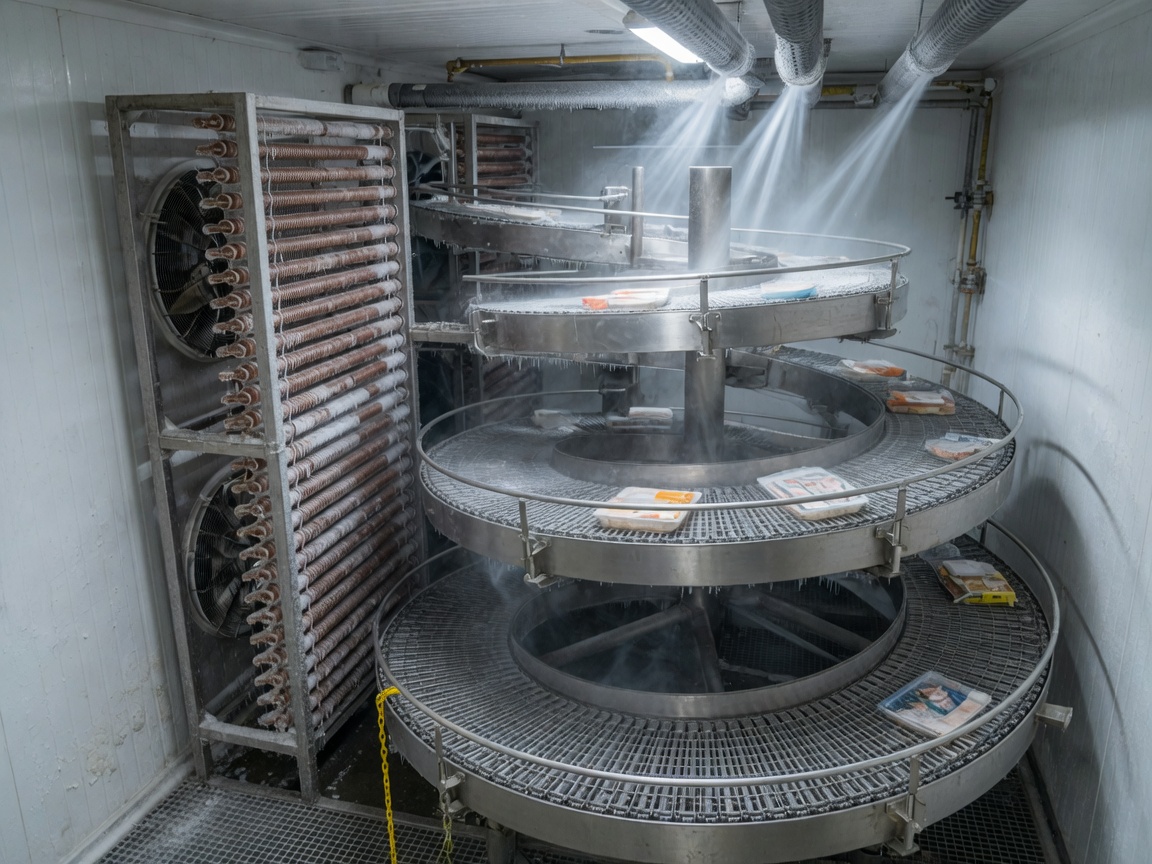
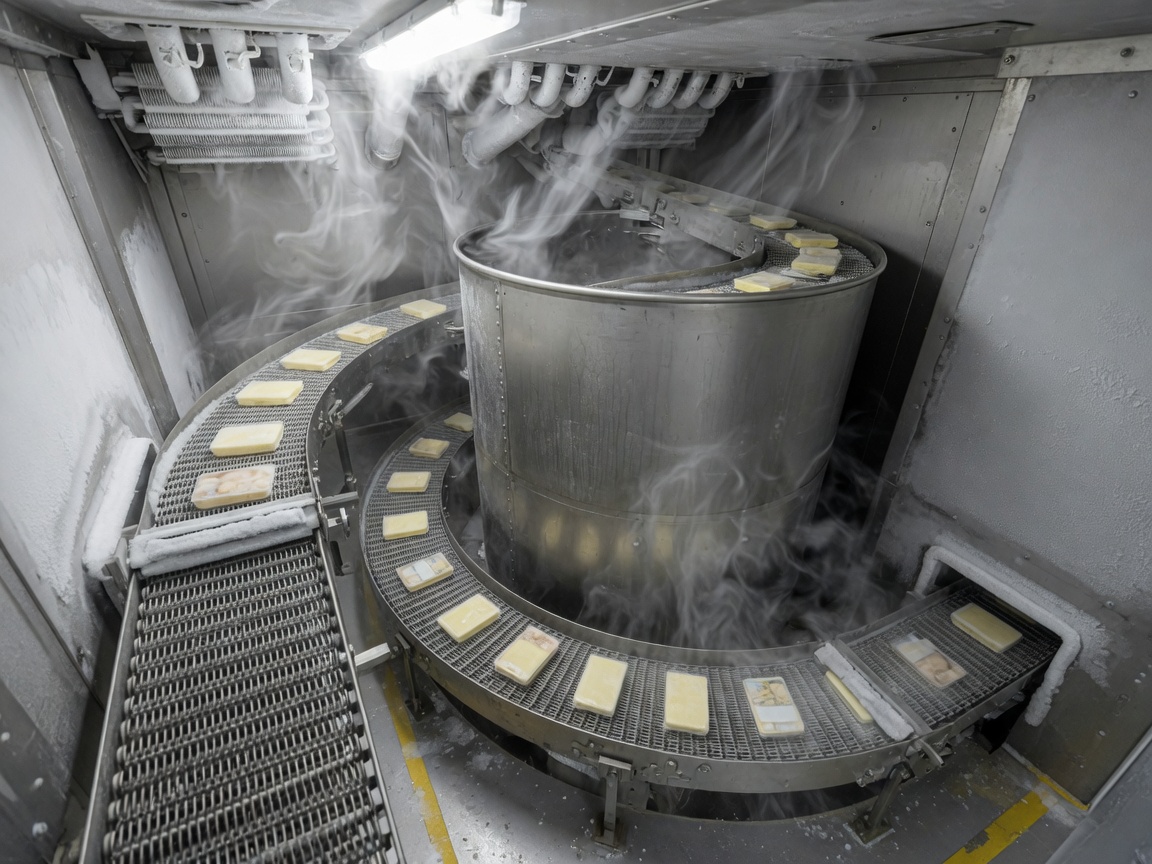
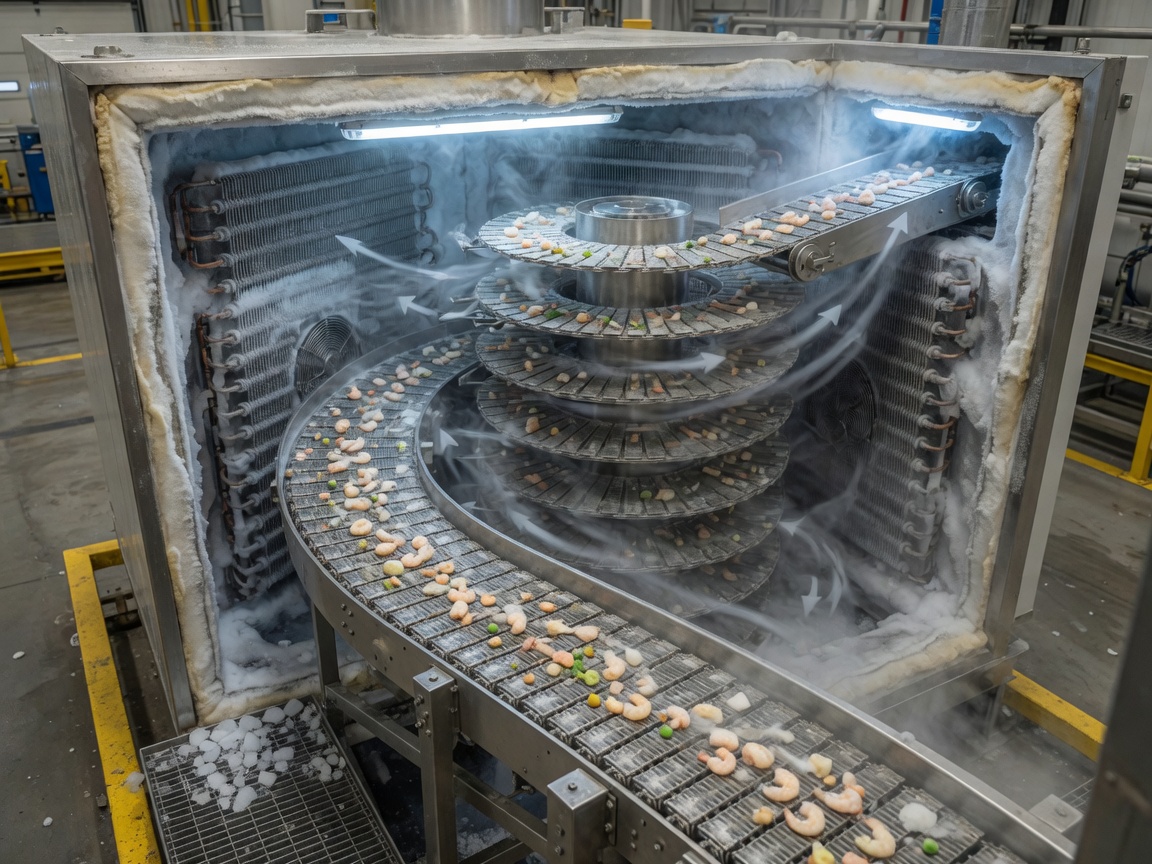
A spiral blast freezer is a continuous industrial freezing system that moves product on a helical conveyor belt through a high-velocity cold airstream, typically between −35 °C and −40 °C, achieving rapid core temperature reduction in a compact footprint. Unlike a static blast chiller or a simple cold storage unit, it is engineered for uninterrupted production throughput — making it the backbone of modern individual quick freezing (IQF) lines worldwide.
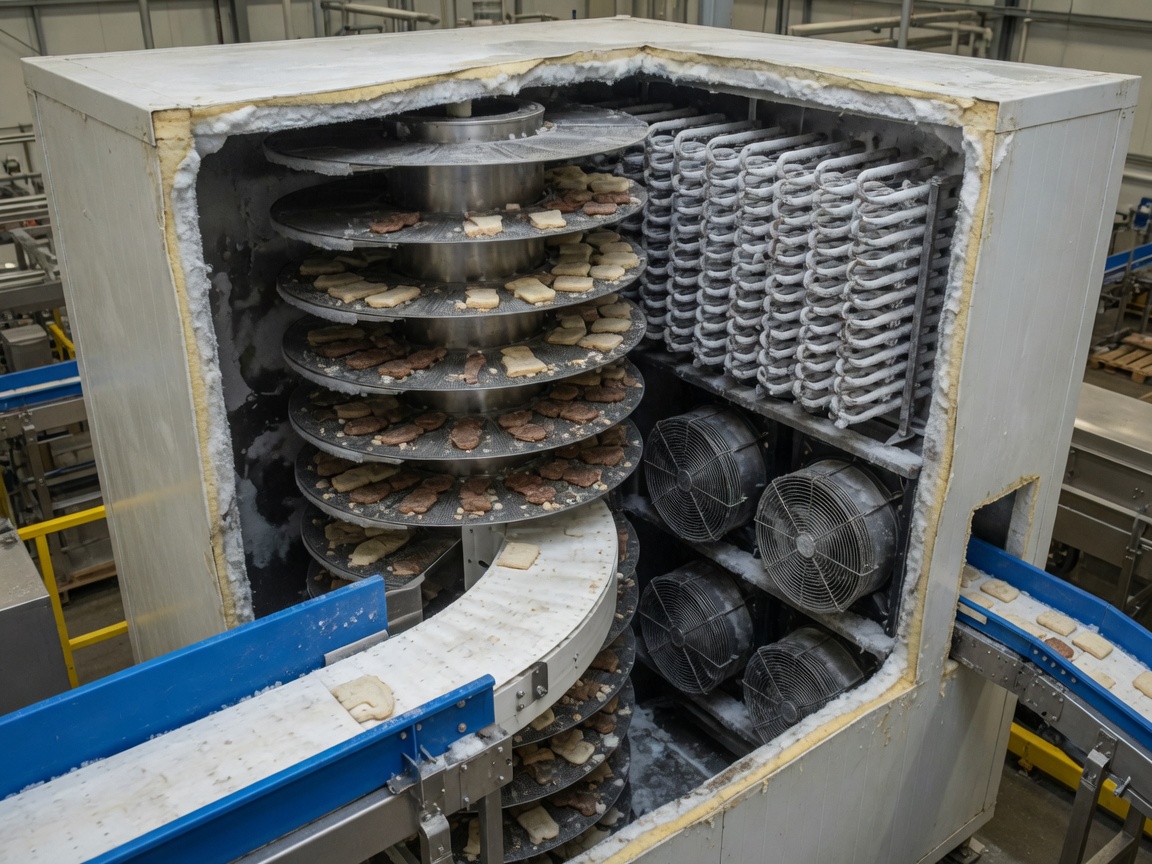
Think of the spiral configuration as folding a very long quick freeze tunnel vertically rather than horizontally. The conveyor belt winds upward in a helix inside a single insulated enclosure, packing what would otherwise be 30–60 metres of linear belt freezer into a floor area as small as 15–20 m². That space efficiency is why high-volume Australian processors — from Queensland seafood plants to Victorian smallgoods manufacturers — have shifted decisively toward spiral freezer systems over the past decade.
According to recent market research, the global spiral freezer segment was valued at approximately AUD 1.8 billion in 2024 and is projected to grow at a 6.2% CAGR through the early 2030s, driven by demand for frozen food processing capacity across Asia-Pacific — a trend that directly benefits Australian export-oriented processors.
How air blast freezing technology works inside a spiral system
Inside the enclosure, high-capacity evaporator coils chill recirculated air, which is then driven across product surfaces by axial fans. Wind speeds typically range from 3 to 7 m/s across the belt. Critically, air blast freezing technology must balance velocity against dehydration: real-world testing consistently shows that pushing airspeed beyond 6 m/s on uncoated protein products increases moisture loss by 0.8–1.4% per hour of residence time, directly eroding yield and revenue. This is one of the most commonly misunderstood trade-offs in the industry.
Main spiral blast freezer types available in 2026
Not all spiral configurations serve the same need. The five primary variants are:
- Single-drum spiral freezer — compact, suited to throughputs of 500–3,000 kg/hr; the most common entry point for mid-scale Australian processors.
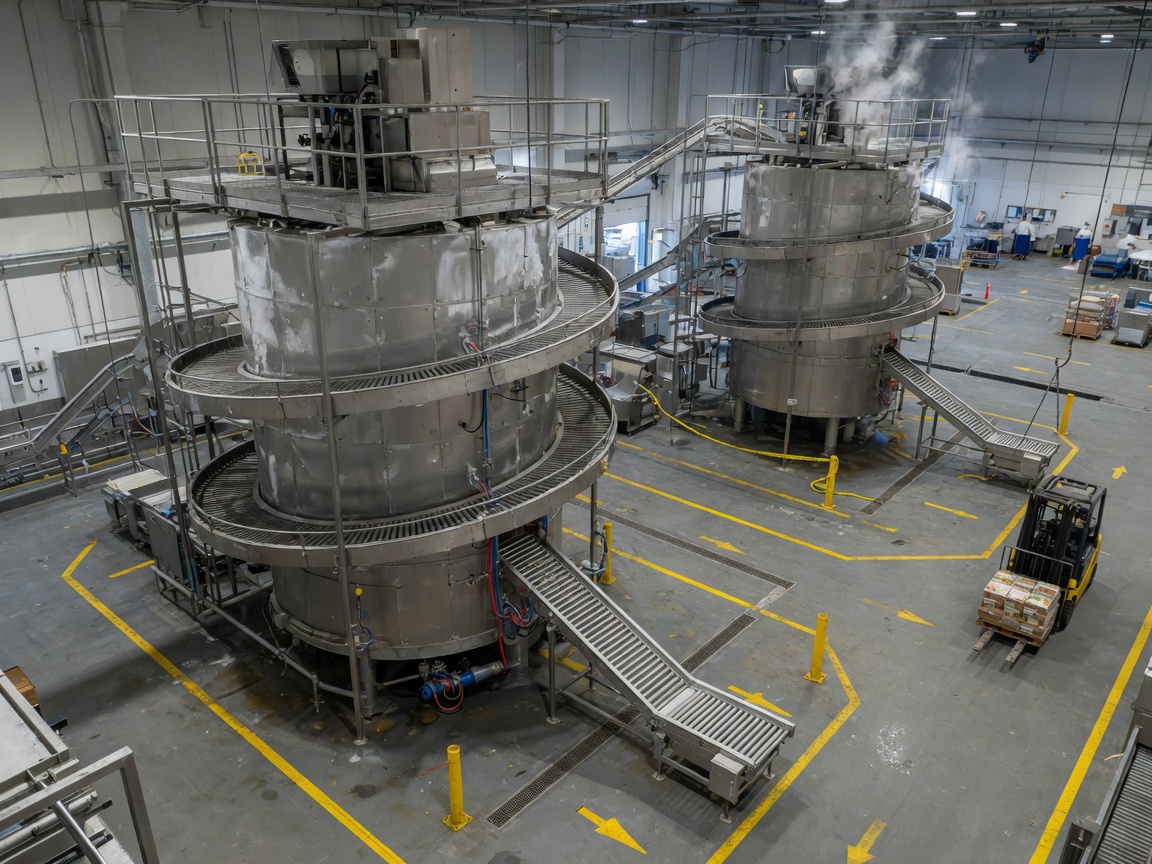
- Double-drum spiral freezer — two independent drum assemblies share one enclosure, roughly doubling capacity without proportional floor area increase; favoured by national co-packers.
- Self-stacking belt spiral — frameless design where the belt supports itself; simplifies sanitation and reduces clean-in-place (CIP) cycle time significantly.
- Cryogenic freezer spiral variant — liquid nitrogen injection combined with mechanical refrigeration; used for high-value or heat-sensitive products where surface quality is non-negotiable.
- Modular spiral freezer — capacity can be scaled by adding drum modules; preferred where production ramp-up timelines are uncertain.
Spiral vs tunnel freezer: a detailed comparison
The spiral blast freezer outperforms a conventional quick freeze tunnel on floor space and labour efficiency, but the picture is not universally one-sided. Understanding the specific trade-offs is essential before committing capital.
| Metric | Spiral blast freezer | Tunnel freezer (linear) | Plate freezer |
|---|---|---|---|
| Typical floor area (1,000 kg/hr) | 15–25 m² | 45–80 m² | 8–14 m² |
| Freeze time (25 mm beef portion) | 12–18 min | 18–30 min | 25–40 min |
| Energy consumption (kWh/tonne) | 55–80 | 70–110 | 40–65 |
| Labour (operators per shift) | 1–2 | 2–3 | 3–5 |
| Product format suitability | Portions, fillets, IQF loose product | Flat/uniform portions | Blocks, flat products only |
| Sanitation complexity | Moderate–high | Moderate | Low–moderate |
| Indicative capital cost (AUD) | $280,000–$950,000 | $120,000–$450,000 | $60,000–$220,000 |
| Annual maintenance cost (AUD) | $18,000–$35,000 | $10,000–$22,000 | $6,000–$14,000 |
When the spiral configuration genuinely wins
For continuous production lines running mixed portion formats at throughputs above 800 kg/hr, the spiral freezer's combination of compact footprint and continuous conveyor operation creates a decisive advantage. Actual case data from seafood blast freezer installations in South Australia shows line integration times drop by 35–45% compared to equivalent tunnel configurations, because a single spiral unit replaces multiple linear belt sections that would otherwise require careful synchronisation.
Where a tunnel or impingement freezer may be preferable
An impingement freezer directs high-velocity air jets perpendicular to flat product surfaces, achieving surface heat transfer coefficients two to three times higher than a standard spiral. For thin, uniform products — crumbed chicken schnitzels, flatbreads, pastry items — an impingement freezer can cut freeze time by 40% relative to a spiral. Of course, if your product mix is diverse or includes irregular shapes, impingement loses its edge rapidly. The freezer conveyor system you choose must match your product geometry, not just your throughput target.
Australian compliance: FSANZ, AQIS and food safety standards
Compliance shapes equipment selection in ways that procurement teams sometimes underestimate — until an audit reveals a gap. In Australia, two regulatory frameworks directly affect spiral blast freezer specification.
FSANZ Standard 3.2.2 and temperature control obligations
Food Standards Australia New Zealand (FSANZ) Standard 3.2.2 mandates that potentially hazardous foods be rapidly moved through the temperature danger zone (5 °C to 60 °C). For most protein products, this means achieving a core temperature of −18 °C within two hours of leaving the cooking or portioning step. A properly specified spiral blast freezer running at −38 °C with adequate airflow meets this requirement comfortably. However, overloading the conveyor — a common operational mistake — extends residence time and can push the product outside the compliant window. Equipment suppliers must provide validated time-temperature profiles as part of their commissioning documentation. Demand this as a contractual deliverable, not an optional extra.
AQIS export requirements and equipment hygiene design
For processors exporting red meat, seafood or dairy to markets including Japan, the EU and the Middle East, the Australian Quarantine and Inspection Service (now administered under the Department of Agriculture, Fisheries and Forestry) mandates that freezing equipment meet hygienic design standards consistent with HACCP principles. This has real consequences for equipment choice: self-stacking belt spiral freezers with open-frame construction and CIP compatibility score significantly better during AQIS establishment audits than older drum designs with enclosed underframes where moisture and microbial contamination can accumulate undetected. Industry consensus is that any new spiral freezer procured for an export-registered establishment should carry third-party hygienic design certification — ideally to EHEDG or equivalent standards.
"Rapid freezing is not merely a quality measure — it is a food safety control. Equipment that cannot deliver validated freeze-down curves under maximum-load production conditions should not be considered compliant, regardless of its nominal temperature specification."
— Australian Institute of Food Science and Technology (AIFST), technical guidance on freezing systems, 2025
Freezing parameters for Australian product categories
Australia's export-oriented food industry centres on a handful of high-value categories. Each has distinct thermal and structural properties that directly inform spiral blast freezer configuration choices.
Beef and lamb (red meat processing)
Portioned beef and lamb cuts (20–40 mm thickness) typically require a product core temperature of −18 °C within 90–120 minutes at −38 °C belt air temperature and 4–5 m/s airspeed. Based on real-world processing data from Australian export abattoirs, a throughput of 1,200 kg/hr of bone-in lamb cuts demands a spiral freezer with at least 280 kW of refrigeration capacity. Belt mesh aperture should be 10–12 mm to prevent bone fragments snagging. The critical risk for red meat on a spiral is colour oxidation from excessive dehydration — another reason to resist the temptation to maximise fan speed beyond the process-validated setpoint.
Seafood (prawns, fish fillets, scallops)
Seafood blast freezer requirements are demanding because marine proteins are particularly sensitive to ice crystal formation. Individual quick freezing of prawns — Australia's highest-value crustacean export — targets a core temperature of −20 °C within 15–25 minutes depending on prawn size (16/20 to 31/40 count). At these parameters, IQF freezer performance requires air temperatures of −40 °C and belt speeds calibrated to deliver a 20-minute residence time. Some Northern Territory and Queensland prawn processors supplement mechanical refrigeration with a cryogenic freezer pre-crust stage, applying a brief liquid nitrogen surface freeze before the spiral stage — this seals the surface against moisture migration during the full freeze cycle.
Dairy (cheese, butter portions, desserts)
Dairy products are among the more forgiving categories for spiral freezing — but not without their own considerations. Portioned cheese and butter slabs (15–25 mm) are typically frozen at −35 °C with moderate airspeed (3–4 m/s) to prevent surface cracking. Milk-based dessert products with high water activity require tighter temperature uniformity across the belt width; any hot-spot zones in the spiral enclosure will produce partially-frozen product that fails texture QC. Specify ±1.5 °C air temperature uniformity across the belt cross-section as a minimum procurement requirement for dairy applications.
Total cost of ownership and ROI analysis
Capital cost is the number that dominates early conversations. It should not dominate the final decision. The real question is: what does this equipment cost per tonne of frozen product over a ten-year horizon?
TCO model: 10-year scenario for a mid-scale Australian processor
Assumptions: single-drum spiral blast freezer, 1,000 kg/hr throughput, two-shift operation (16 hrs/day, 250 days/year), Australian industrial electricity tariff of AUD $0.14/kWh (2026 commercial rate), ammonia (R717) refrigeration system.
| Cost category | Year 1 (AUD) | 10-year total (AUD) |
|---|---|---|
| Capital purchase + installation | $520,000 | $520,000 |
| Energy (electricity) | $62,000 | $680,000 |
| Planned maintenance and consumables | $24,000 | $265,000 |
| Labour (cleaning and operation, incremental) | $38,000 | $420,000 |
| Unplanned downtime cost (est. 1.5% availability loss) | $18,000 | $195,000 |
| Total 10-year TCO | — | $2,080,000 |
| Cost per tonne frozen (10-yr average) | — | AUD $52/tonne |
ROI payback period
For a processor replacing a manual blast chiller operation producing 800 kg/hr, the spiral system's throughput uplift (adding ~200 kg/hr capacity), yield improvement (reducing drip loss by 0.6% through faster freeze-down), and labour savings (eliminating one FTE per shift at AUD $75,000/year) generate combined annual benefits of approximately AUD $195,000. Against an incremental capital outlay of $400,000 over a comparable blast chiller setup, the simple payback period is approximately 25–28 months. Incorporate the energy cost reduction from a modern high-COP ammonia compressor and that figure moves closer to 22 months — well within the 36-month ROI threshold that most Australian food manufacturing CFOs apply to capital equipment approvals.
Choosing the right configuration for your facility
Why do so many facilities end up with a spiral freezer that underperforms? Usually because the selection process prioritised sticker price over process fit. Configuration choice starts with four facility-specific inputs.
Step-by-step selection framework
- Define your design throughput at peak load — not average, but the highest sustainable hourly rate you will ever need. Size to 110% of that figure.
- Characterise your product portfolio — list every SKU by thickness, water activity, coating type and required outlet temperature. Flag any products that may require different belt speeds or air temperatures.
- Measure your available floor envelope — include service access zones (minimum 800 mm on each accessible side) and overhead clearance for coil extraction.
- Confirm refrigerant compatibility — if your site already runs an ammonia (R717) plant, a spiral freezer with a direct R717 coil system is the most energy-efficient option. Greenfield sites in 2026 should default to R717 or CO₂ (R744) to avoid future F-gas compliance costs.
- Specify hygienic design tier — export-registered establishments should require EHEDG-compliant design; domestic-only facilities can accept a lower specification, but should still demand documented CIP procedures.
- Request validated freeze curves under full load — insist on factory acceptance testing (FAT) data demonstrating compliance with your FSANZ time-temperature requirements before shipment.
2026 technology trends worth factoring into your decision
IoT-enabled spiral freezers with real-time energy monitoring, automated defrost scheduling and remote diagnostics are now available from major suppliers including GEA and Starfrost. Based on early deployment data, automated defrost optimisation alone reduces energy consumption by 8–12% annually compared to fixed-interval defrost cycles. For a facility operating at 4,000 tonnes per year, that translates to roughly AUD $25,000 in annual electricity savings — a compelling argument for the incremental cost of a connected control system. The refrigerant transition is equally real: any spiral freezer procured today with HFC refrigerants faces re-gassing or conversion costs within the decade as Australia aligns with the Kigali Amendment phase-down schedule. Understand this risk before signing a supply contract. For context on the underlying physics of rapid chilling, the principles of blast freezing technology are well documented and provide a useful technical foundation for evaluating supplier performance claims.
After-sales service and spare parts in Australia
A spiral blast freezer running 16 hours a day, 250 days a year accumulates roughly 4,000 operating hours annually. Component wear is inevitable. The question is whether your supplier can respond fast enough to prevent a breakdown becoming a catastrophic production loss.
Local service network reality check
The Australian commercial freezer market is served by a mix of European OEMs with local distributor arrangements and a smaller number of domestic manufacturers. The practical implications vary significantly. European brands with Australian distributors typically hold critical spares — belt sections, drive motors, evaporator coil valves — in Sydney or Melbourne warehouses, with transit times of one to three business days to most mainland facilities. For rural or remote processors in Western Australia or the Northern Territory, that lead time extends to five to seven days for non-stocked items, and up to four to six weeks for bespoke components shipped from Europe. That is a significant downtime risk for a facility running perishable product.
What to negotiate before you sign
Procurement teams should treat service terms as non-negotiable elements of the supply contract, not afterthoughts. Key contractual provisions to secure include: a minimum 24-hour on-site response commitment from a factory-trained technician (not just a phone call); a guaranteed strategic spare parts kit held on-site at the supplier's cost for the first two years; maximum four-hour remote diagnostic response via the supplier's IoT platform; and a defined escalation path for parts that must be sourced internationally. Suppliers who resist these terms during negotiation typically struggle to meet them post-commissioning. That resistance is itself informative.
Frequently asked questions
Common questions answered
Q: How does a spiral blast freezer differ from a standard blast chiller?
A: A blast chiller is a batch-loading cold storage unit designed for small volumes and intermittent use. A spiral blast freezer is a continuous conveyor system engineered for sustained industrial throughput, typically 500–15,000 kg/hr, with far greater refrigeration capacity and automation. They are not interchangeable for production-line applications.
Q: What refrigerant should I specify for a new spiral freezer in Australia in 2026?
A: Ammonia (R717) remains the gold standard for large-scale spiral freezer installations due to its superior thermodynamic efficiency and zero global warming potential. CO₂ (R744) cascade systems are a viable alternative for facilities with ammonia safety constraints. Avoid HFC refrigerants for new capital purchases given Australia's Kigali Amendment commitments and rising phase-down costs.
Q: Can one spiral freezer handle multiple product types?
A: Yes, with conditions. Belt speed and fan speed must be adjustable across the required range for each product SKU. Irregular or liquid-coated products may require specific belt mesh sizes. Document validated process parameters for each product and enforce them operationally — running diverse SKUs on a single fixed setpoint is a common cause of quality and compliance failures.
Q: What is a realistic payback period for a spiral blast freezer in Australia?
A: Based on current Australian electricity tariffs and labour costs, a mid-scale spiral freezer replacing batch blast chilling equipment typically delivers a simple payback period of 22–30 months when throughput uplift, yield improvement and labour savings are all modelled. Higher-throughput installations and export-oriented processors typically achieve the shorter end of that range.
Q: Does a spiral blast freezer require FSANZ-specific documentation for compliance?
A: Yes. FSANZ Standard 3.2.2 requires that time-temperature control be validated and documented. Your supplier must provide commissioning data showing that the equipment achieves required core temperatures within mandated timeframes under maximum-load conditions. This documentation forms part of your HACCP records and is subject to regulatory audit.
Final considerations before you procure
Selecting the right spiral blast freezer for an Australian food processing facility is genuinely complex — more so than most capital equipment decisions because the consequences of a poor choice compound across food safety, production efficiency, regulatory compliance and long-term operating costs simultaneously. The fundamentals, however, are consistent: size to validated peak throughput, specify refrigerant and hygienic design to your regulatory tier, model total cost of ownership over ten years rather than sticker price, and treat after-sales service terms as a core commercial negotiation rather than fine print. The processors who get the most from their food freezing equipment investments are invariably those who invest equivalent effort in supplier qualification as in equipment specification. In 2026, with energy costs elevated and Australian export standards under continued scrutiny, that discipline is not optional — it is the difference between a system that performs and one that merely occupies floor space.
Keywords:
Inquiry
If you are interested in our products, please leave your email to receive a free product quote, thank you!
More information



Tel:
Sales E-mail: