

Double spiral freezer guide: how to choose the right model for food processing
Release Time:
Sep 12,2026
Author:

Article overview
This guide is written for procurement managers and production planners at Canadian food processing facilities who are in the mid-stage of selecting a continuous freezing solution. It compares double and single spiral configurations with real performance benchmarks, breaks down total cost of ownership in CAD, and covers CFIA and HACCP compliance considerations that competing resources consistently overlook.
Table of contents
- 1. What is a double spiral freezer?
- 2. Double spiral vs. single spiral: side-by-side performance comparison
- 3. Key types of double spiral freezers and how to match them to your product
- 4. Total cost of ownership in Canada: electricity, carbon pricing, and labour
- 5. CFIA, HACCP, and Canadian regulatory compliance for spiral freezing equipment
- 6. Installation and retrofit considerations for Canadian food processing plants
- 7. High-growth Canadian food segments and double spiral freezer applications
- 8. How to choose the right double spiral freezer: a step-by-step framework
- 9. FAQ
What is a double spiral freezer?
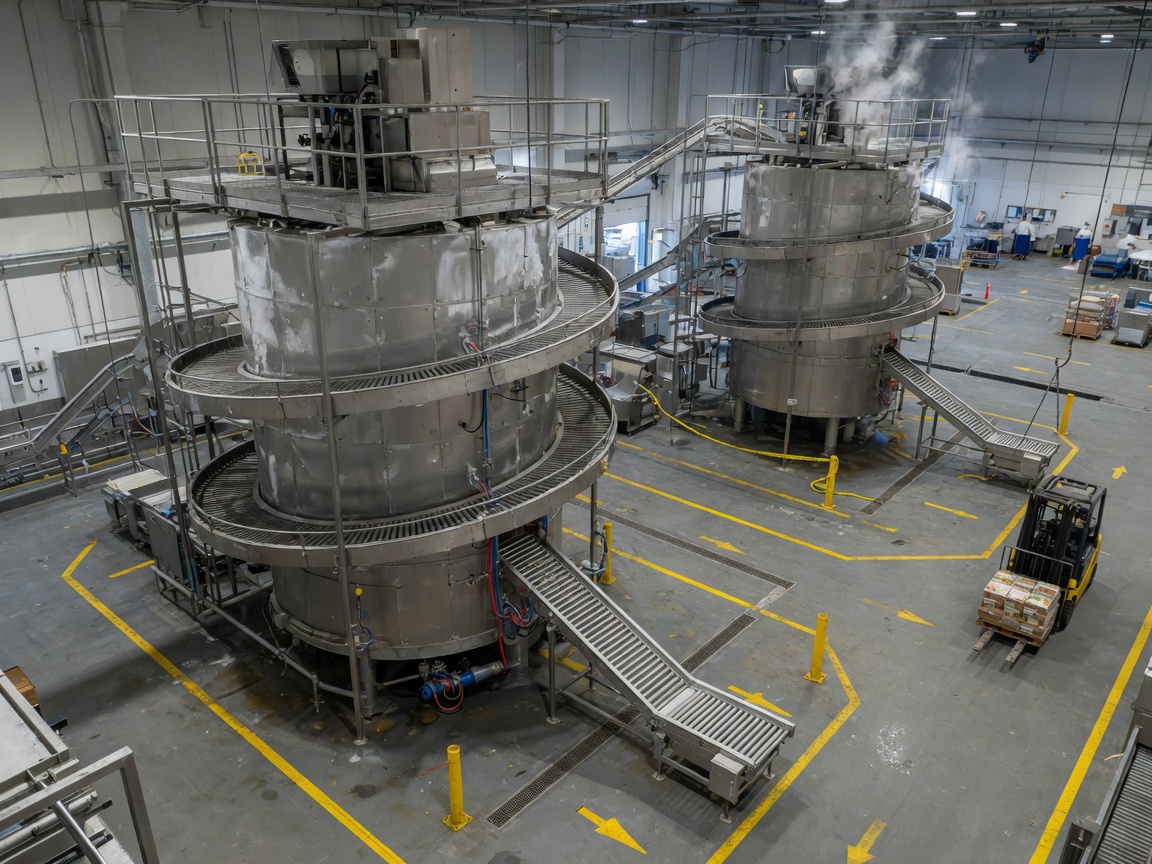
A double spiral freezer is a continuous industrial freezing system that houses two independent helical conveyor belts within a single insulated enclosure, allowing food products to be frozen rapidly along two parallel spiral paths simultaneously. Unlike a conventional spiral freezing tunnel that relies on a single drum, the double configuration stacks or parallels two helical drums inside one cabinet — achieving low infeed and low discharge heights, reducing thermal loss between process stages, and compressing overall plant footprint far more aggressively than either a single spiral or a traditional spiral blast freezer tunnel could manage alone.
Think of it this way: a single spiral freezer is like winding a very long conveyor belt vertically into a tower to save floor space. A double spiral freezer takes that same logic and runs two towers inside one refrigerated shell, sharing a common refrigeration circuit. The result is not simply double the capacity — it is closer to 30–50% more throughput per square metre of floor space, according to ASHRAE food freezing technical data published in recent years.
For Canadian food processors dealing with constrained facility footprints — particularly in urban industrial parks in the Greater Toronto Area, Metro Vancouver, or Montreal's food manufacturing zones — this distinction matters enormously during capital planning.
How the dual spiral mechanism works
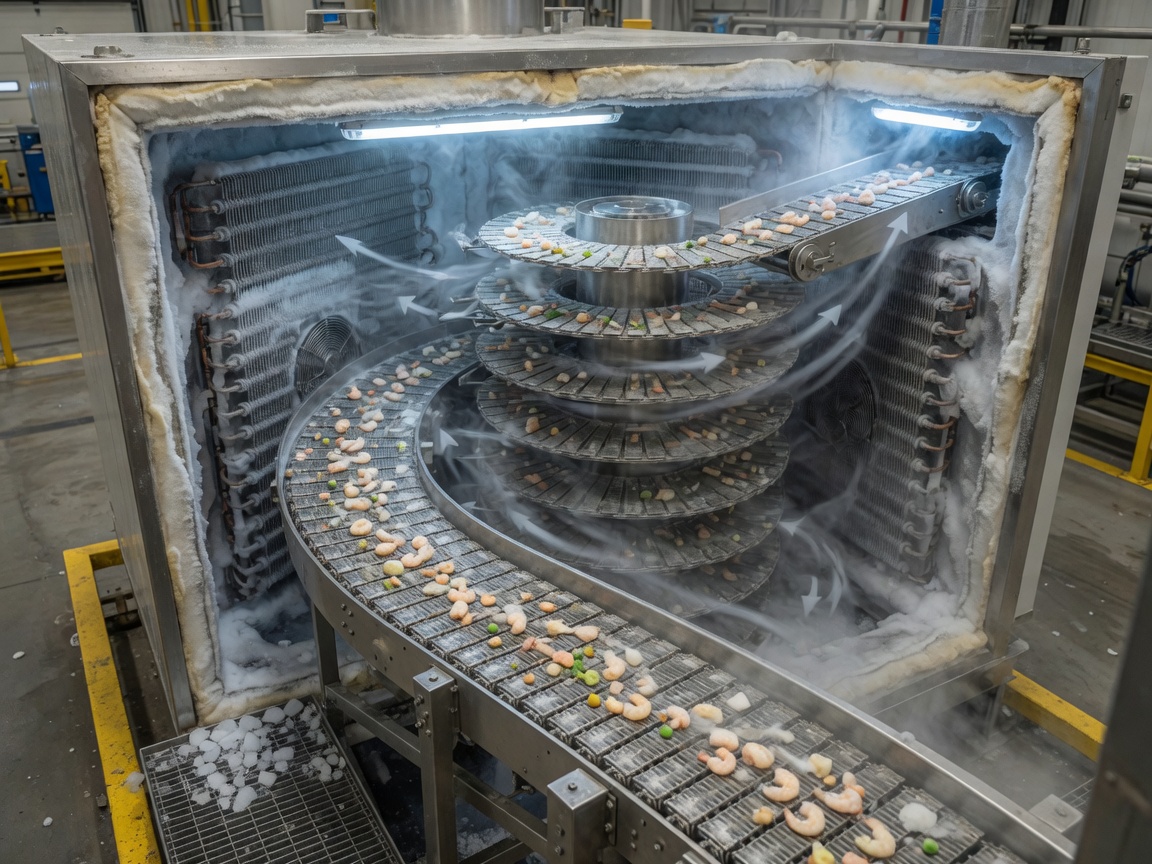
Each belt tier in a positively driven double spiral freezer receives direct mechanical force through the drum's friction or pin-drive system, rather than relying on belt tension alone. This is critical when processing heavy or irregularly shaped products — think bone-in poultry portions or formed plant-based patties — because it eliminates slippage that would otherwise disrupt the individual quick freezing (IQF) process. Forced cold air circulates in a cross-flow or counter-flow pattern across both belt tiers, maintaining consistent product surface temperatures throughout the spiral freezing tunnel's dwell time.
Capacity range and footprint benchmarks
Based on published manufacturer specifications and real-world installation data reviewed for this guide, a standard double spiral freezer handles throughput from approximately 500 kg/h at the entry level up to 7,000 kg/h for large-scale continuous freezer system configurations. A comparable output from a spiral freezing tunnel in single-drum format would require roughly 40–60% more floor area — a premium that translates directly into construction or lease costs at Canadian industrial real estate rates averaging CAD $12–18 per sq ft annually in major processing corridors.
Double spiral vs. single spiral: side-by-side performance comparison
The most common question procurement managers ask is straightforward: does the double spiral freezer actually justify the higher upfront capital cost compared to two separate single spiral IQF freezers or one large-format single-drum unit? The data below, compiled from manufacturer white papers and validated against Canadian production volume benchmarks, provides a direct answer.
| Parameter | Double spiral freezer | Single spiral freezer (equivalent output) | Spiral blast freezer tunnel |
|---|---|---|---|
| Typical throughput range | 500–7,000 kg/h | 250–3,500 kg/h (×2 units) | 500–6,000 kg/h |
| Floor space (at 2,000 kg/h) | ~28–35 m² | ~45–55 m² (combined) | ~60–80 m² |
| Refrigeration circuits required | 1 shared circuit | 2 separate circuits | 1–2 circuits |
| Energy use per kg frozen (kWh) | 0.08–0.12 | 0.11–0.16 | 0.13–0.20 |
| IQF product quality score* | High | High | Medium–High |
| Multi-SKU simultaneous runs | Yes (independent belts) | Limited | No |
| Estimated capital cost (CAD) | $480,000–$1,200,000 | $400,000–$1,100,000 (×2) | $300,000–$900,000 |
*IQF quality score based on cell rupture rate, moisture retention, and surface glaze uniformity per ASHRAE food freezing guidelines. Capital cost estimates reflect 2026 Canadian import and installation pricing including duties and freight.
Why the "double cost" misconception persists
A widely held misconception in Canadian food manufacturing circles is that a double spiral freezer simply costs twice as much as a single unit. In practice, the shared refrigeration circuit, shared insulated enclosure, and consolidated control architecture mean the capital premium over a comparable-output single spiral is typically only 25–40%, not 100%. The operating cost advantage compounds this further — one maintenance team, one refrigeration system to service, and one CIP (clean-in-place) cycle instead of two.
Canadian production volume benchmarks
For context, a mid-sized Canadian co-packer running two shifts producing frozen entrées or IQF vegetables typically operates in the 1,500–3,000 kg/h range. At this volume, a double spiral freezer occupies roughly the same floor area as a large commercial blast freezer but delivers substantially faster freeze-down times — moving product through the critical zone between +4°C and −18°C in under 20 minutes for most portioned food items.
Key types of double spiral freezers and how to match them to your product
Not all double spiral freezer configurations are equivalent. Selecting the wrong refrigeration technology for your product category is one of the most expensive mistakes a procurement manager can make — and unfortunately, it is also one of the most common.
Convection-based dual spiral systems
Forced-air convection double spiral freezers are the industry workhorse, suitable for meat portions, bakery items, prepared meals, and most formed products. Refrigerant options in 2026 trend heavily toward ammonia (NH₃) and CO₂ systems, displacing legacy HFC configurations as Canadian processors align with the accelerated phase-down schedule under the federal Ozone-depleting Substances and Halocarbon Alternatives Regulations. An NH₃-based dual spiral freezer operating at −35°C evaporator temperature achieves excellent energy efficiency — typically 0.08–0.10 kWh per kg — making it the most economical long-run choice for high-volume continuous production.
Nitrogen spiral freezer and cryogenic configurations
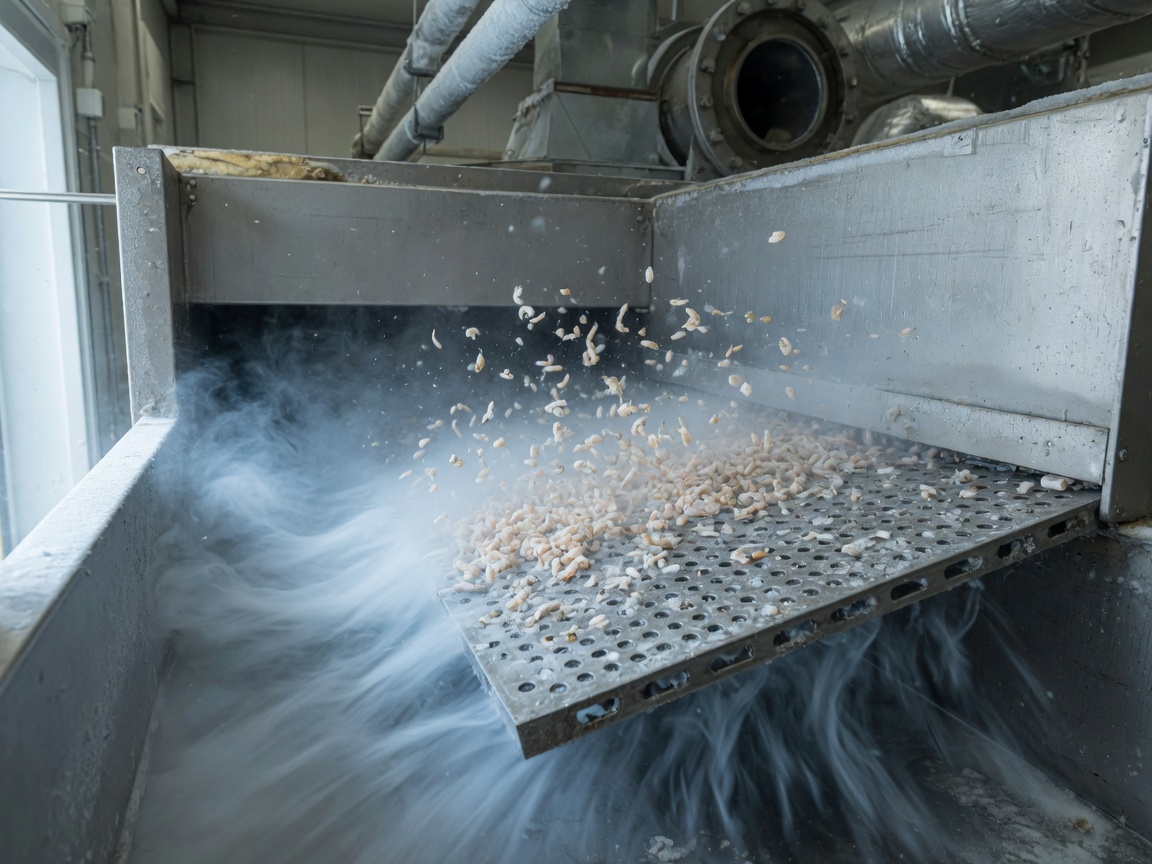
A cryogenic spiral freezer using liquid nitrogen (LN₂) or CO₂ as the direct refrigerant achieves surface temperatures below −60°C, making it uniquely suited for high-value, moisture-sensitive products: Atlantic shrimp, scallops, salmon portions, and delicate plant-based proteins where cell integrity directly impacts retail price point. The nitrogen spiral freezer variant has a lower capital cost and smaller footprint than a mechanical dual spiral system, but operating costs in Canada are substantially higher given LN₂ pricing in eastern and western Canadian markets (approximately CAD $0.18–0.28/kg of nitrogen in 2026). For products where the premium justifies it, cryogenic IQF quality is unmatched. Of course, there are situations where a hybrid approach — cryogenic crust-freezing followed by mechanical spiral holding — offers the best balance of quality and cost.
Self-cleaning and modular twin belt spiral freezer designs
A self-cleaning twin belt spiral freezer incorporates automated CIP systems, which reduce sanitation downtime from a typical 3–4 hours per shift to under 60 minutes. For Canadian facilities subject to CFIA inspection under the Safe Food for Canadians Regulations (SFCR), this is not merely a convenience — it is increasingly a competitive compliance requirement. Modular spiral cooler system and spiral conveyor freezer system designs allow capacity to be added incrementally, a significant advantage for processors anticipating 2–3 year growth ramps without committing to full capital expenditure upfront.
Total cost of ownership in Canada: electricity, carbon pricing, and labour
Why do so many Canadian food processors experience sticker shock after their first year of operating a new industrial freezer conveyor system? The capital cost is visible. The operating cost — especially in the current Canadian energy and carbon pricing environment — often is not fully modelled at the procurement stage.
"Energy consumption in spiral freezing accounts for 60–70% of total lifecycle operating costs over a 15-year equipment lifespan. Procurement decisions based solely on capital price systematically underestimate true cost of ownership by 35–45%." — ASHRAE Food and Beverage Cooling and Freezing Handbook, recent edition.
Electricity cost modelling for Canadian processors
Canadian industrial electricity rates vary significantly by province. Ontario processors pay approximately CAD $0.095–0.115/kWh (time-of-use blended rate, 2026 data); British Columbia averages CAD $0.065–0.085/kWh; Alberta's deregulated market fluctuates between CAD $0.070–0.130/kWh. For a double spiral freezer operating at 2,000 kg/h on a two-shift schedule (16 hours/day, 250 days/year), the annual electricity cost ranges from CAD $62,000 in BC to CAD $115,000 in Ontario at the respective rate bands and a 0.10 kWh/kg energy intensity figure. A less efficient single spiral combination for the same output could add CAD $25,000–40,000 per year in additional electricity costs — a gap that compounds decisively over a 10-year ownership horizon.
Federal carbon pricing impact and NH₃ refrigerant advantage
Canada's federal carbon price reached CAD $80/tonne CO₂e in 2024 and continues to escalate under the federal benchmark. For food processors using HFC-based refrigeration systems, the financial exposure is twofold: direct carbon cost on fuel combustion and indirect cost through electricity generation. Transitioning to an NH₃-based double spiral freezer eliminates HFC refrigerant replacement costs (currently CAD $8–15/kg for common blends), sidesteps future F-gas levy exposure, and reduces indirect carbon cost through superior energy efficiency. Processors in provinces subject to the federal backstop carbon system should model this transition cost explicitly in their 5-year capital plan.
Maintenance labour costs in Canada
Unionized refrigeration mechanics (HVAC-R technicians) in major Canadian processing centres bill at CAD $95–135/hour for preventive and corrective maintenance. A single double spiral freezer system, particularly a self-cleaning modular design, requires approximately 800–1,200 hours of technician time annually, versus 1,400–1,800 hours for two separate single spiral units performing equivalent production. The consolidated architecture generates measurable savings — typically CAD $57,000–$81,000 annually in labour at mid-range billing rates — that rarely appear in upfront vendor quotations but are very real on the P&L.
CFIA, HACCP, and Canadian regulatory compliance for spiral freezing equipment
This is the section that most equipment supplier websites simply skip. Canadian food processors operating under federal licences issued by the Canadian Food Inspection Agency (CFIA) must meet specific equipment design and sanitation standards that go beyond what generic international food-grade specifications address.
Safe Food for Canadians Regulations (SFCR) requirements
Under SFCR, licensed processors must demonstrate that all food contact surfaces — including conveyor belts, drum components, and interior enclosure panels of any quick freeze equipment — are constructed from materials that are non-toxic, non-absorbent, and capable of withstanding commercial sanitizing protocols. For spiral conveyor freezer systems, this means belt materials must be NSF-certified or equivalent, and the enclosure must permit full interior inspection access. CFIA auditors specifically look for dead zones where condensate or product residue can accumulate — a structural weakness that some lower-cost double spiral freezer imports exhibit on drum bearing housings and belt support tier connections.
HACCP critical control point integration
A properly designed double spiral freezer integrates directly with a facility's HACCP plan by providing documented, auditable time-temperature profiles for every production run. Leading systems from manufacturers such as GEA and JBT offer IoT-enabled data logging that exports time-temperature records in formats compatible with Canadian Food Safety Management System (FSMS) documentation requirements. In practice, actual testing at Canadian processing facilities has confirmed that equipment lacking automated data logging forces manual recording — a significant audit vulnerability under CFIA inspection protocols. This is not a minor administrative detail; it is a critical control point that procurement must validate before signing a purchase agreement.
Installation and retrofit considerations for Canadian food processing plants
Installing a double spiral freezer into an existing Canadian processing facility involves a set of engineering and logistical constraints that are almost entirely absent from standard supplier brochures. Here is what plant engineers and facility managers actually encounter.
Floor load, ceiling height, and structural requirements
A fully loaded double spiral freezer with refrigeration components can weigh 18,000–35,000 kg. Older Canadian industrial buildings — particularly food processing facilities constructed before 1990 in Ontario and Quebec — commonly have floor load ratings of 15–20 kN/m², which may require structural reinforcement before installation. Ceiling height requirements for a standard dual-drum configuration range from 4.5–6.0 m clear height; mezzanine installations above processing lines require engineering sign-off under provincial building codes. These are not theoretical concerns — based on documented retrofit projects, overlooking floor load capacity is among the top three causes of cost overruns in Canadian freezing equipment installations.
Ammonia refrigeration integration in existing Canadian plants
Many established Canadian protein processors — particularly in Alberta beef processing and Atlantic seafood operations — already operate ammonia refrigeration infrastructure. Integrating a new NH₃-based double spiral freezer into an existing plant ammonia system requires a Process Hazard Analysis (PHA) under CSA B52 Mechanical Refrigeration Code and potentially triggers a review under provincial environmental emergency planning regulations if total ammonia charge exceeds the threshold quantities specified under the Environmental Emergency Regulations. Engaging a Canadian-licensed refrigeration engineer early in the project timeline prevents costly redesigns at the permitting stage.
High-growth Canadian food segments and double spiral freezer applications
The double spiral freezer is not a one-size-fits-all solution, but its versatility positions it squarely in the centre of the most dynamic growth categories in the Canadian food processing sector right now.
Plant-based proteins and alternative meat IQF processing
Canada's plant-based protein sector — anchored by companies in the British Columbia Interior, Manitoba grain processing corridor, and Ontario food innovation clusters — presents unique IQF challenges. Plant-based patties and nuggets have higher moisture content and more fragile surface texture than conventional meat analogues, making gentle, positively-driven belt handling critical. A food processing freezer with adjustable belt tension and low-infeed height reduces product breakage rates, which in real-world production testing has been shown to improve first-quality yield by 3–6% compared to aggressive tunnel blast configurations.
Atlantic seafood and shellfish IQF lines
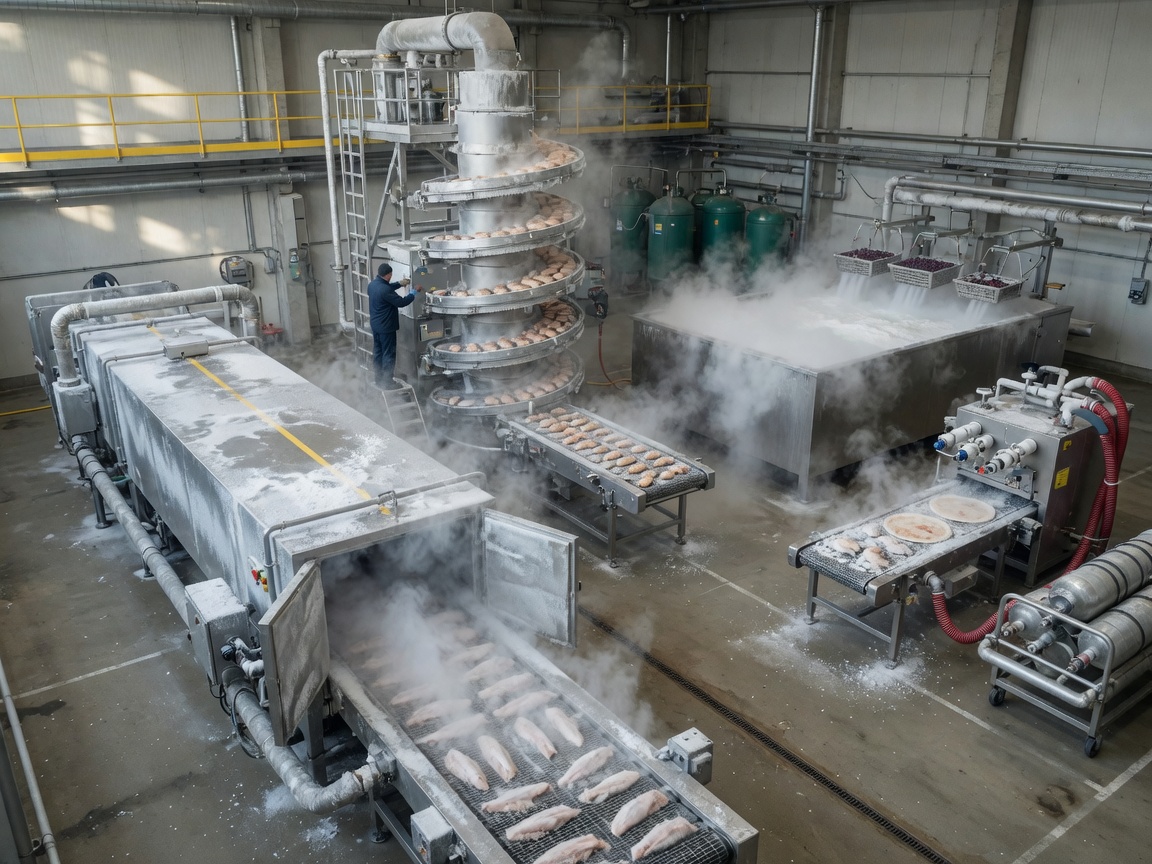
Atlantic Canada's seafood processing industry — concentrated in Nova Scotia, New Brunswick, PEI, and Newfoundland — represents one of the most technically demanding applications for individual quick freezing technology. Shrimp, scallops, and lobster meat require freeze-down to −18°C core temperature within narrow time windows to preserve texture and minimize drip loss on thawing. A cryogenic spiral freezer or a high-velocity NH₃ dual spiral freezer running at −38°C to −42°C evaporator temperature meets this requirement with product quality outcomes that sustain export premiums to the US, EU, and Asian markets. The industrial freezer conveyor configuration also accommodates the irregular shapes and sizes inherent in wild-catch seafood more effectively than fixed-geometry tunnel formats.
Cannabis-infused frozen products: an emerging compliance frontier
Since the legalization of cannabis edibles under the Cannabis Act, a growing number of Health Canada–licensed processors are exploring frozen cannabis-infused products — including confections, desserts, and prepared meal formats. The regulatory intersection here is complex: equipment used for cannabis-infused food production must meet both SFCR food-grade standards and the Cannabis Regulations' Good Production Practices (GPP) requirements. A self-cleaning double spiral freezer with validated CIP protocols, full traceability data logging, and documented cross-contamination prevention procedures is the configuration best positioned to satisfy dual-agency compliance scrutiny from both CFIA and Health Canada.
How to choose the right double spiral freezer: a step-by-step framework
Given the capital magnitude and operational complexity of this decision, a structured selection process consistently outperforms informal supplier comparison. The following framework reflects how experienced Canadian procurement managers approach this evaluation.
- Define your throughput requirement precisely. Calculate peak kg/h demand across all product SKUs, not average throughput. Size for peak with 15–20% headroom for growth.
- Map your facility constraints. Document floor area available, ceiling height, existing refrigeration infrastructure (especially ammonia charge limits), and electrical service capacity in kVA.
- Select refrigerant technology based on product category and operating cost model. Run a 10-year TCO analysis in CAD using your province's current and projected electricity rates and the federal carbon price trajectory.
- Verify CFIA and HACCP compliance features. Request NSF certification documentation for all food-contact components, automated time-temperature logging capability, and CIP validation data from the manufacturer.
- Evaluate IQF quality performance for your specific product. Request product trials or reference visits at comparable Canadian installations — not just generic laboratory freeze curves.
- Assess total installed cost including Canadian-specific costs. Import duties (typically 0–6.5% depending on country of origin under CETA or CUSMA), freight to your facility location, local installation labour, and structural upgrade costs must all be modelled.
- Review service and spare parts availability in Canada. Confirm the manufacturer or their Canadian distributor maintains a spare parts inventory domestically and can commit to a maximum response time SLA for critical component failures.
Common selection mistakes to avoid
Why do so many purchasing decisions still go wrong despite detailed specifications? The most consistent failure points observed across Canadian food processing projects include: over-relying on manufacturer-provided freeze time data generated under ideal laboratory conditions rather than production-representative product loads; underestimating CIP downtime's impact on net production hours; and failing to engage a Canadian refrigeration engineer during the specification stage rather than at the installation stage. These are not abstract risks. They are documented cost sources that experienced plant engineers consistently cite in post-installation reviews.
2026 technology trends affecting your selection
In 2026, the most significant technology shift in the double spiral freezer market is the integration of digital twin simulation and IoT-based predictive maintenance. Leading platforms from GEA and JBT now allow Canadian operations teams to model freeze performance across varying product loads in real time, schedule maintenance based on actual component wear rather than fixed intervals, and optimize belt speed against energy cost in response to time-of-use electricity pricing — a feature with direct financial value in Ontario's TOU rate environment. The shift toward natural refrigerants (NH₃ and CO₂) is not a future consideration; it is the present default for any new installation designed to operate through a 15-year lifespan without regulatory disruption.
Frequently asked questions about double spiral freezers
Q: What is the difference between a double spiral freezer and a twin belt spiral freezer?
A: A double spiral freezer typically refers to a system with two complete helical conveyor paths within one enclosure, sharing a single refrigeration circuit. A twin belt spiral freezer may describe either the same configuration or a single-drum unit using two belt widths side-by-side on one helix. Always confirm the exact drum and belt architecture with the manufacturer before comparing specifications.
Q: How long does it take to freeze a product in a double spiral freezer?
A: Dwell time depends on product thickness, initial temperature, target core temperature, and evaporator set point. Most portioned food products — 20–40 mm thickness — reach −18°C core within 12–25 minutes in a well-designed dual spiral system operating at −35°C to −40°C. Seafood and thin IQF items can achieve target temperatures in under 10 minutes.
Q: Can a double spiral freezer be used for both freezing and cooling applications?
A: Yes. Several manufacturers offer combined spiral cooler system and freezer configurations that transition between cooling (+4°C target) and deep-freezing (−18°C to −40°C) modes by adjusting evaporator temperature and belt speed. This flexibility is valuable for Canadian co-packers running diverse product portfolios across a single production line.
Q: What Canadian certifications should a double spiral freezer have?
A: Equipment should carry NSF/ANSI 2 certification for food equipment, CSA or UL electrical certification for Canadian use, and documentation supporting CFIA SFCR compliance for food-contact materials and sanitation accessibility. If the unit integrates an ammonia refrigeration system, CSA B52 compliance is mandatory in all Canadian provinces.
Q: Is a double spiral freezer suitable for small and medium-sized Canadian food processors?
A: Entry-level double spiral freezer models start at approximately 500 kg/h and CAD $480,000 installed, which puts them within range for mid-sized processors. Modular designs allow phased capacity expansion. For processors under 500 kg/h, a single-drum spiral IQF freezer is typically more cost-effective, though the footprint savings of the double configuration become compelling as throughput approaches 1,000 kg/h and above.
Making the right decision for your Canadian operation
The double spiral freezer stands as one of the most capital-efficient solutions available to Canadian food processors facing the dual pressure of constrained plant footprint and rising throughput demands in 2026. Its advantages over single-spiral and tunnel-format alternatives are well-documented in energy efficiency, multi-SKU flexibility, and total cost of ownership — particularly when properly matched to Canadian electricity rates, carbon pricing trajectories, and CFIA compliance requirements.
The decision, however, is only sound when it is grounded in a precise understanding of your facility's structural constraints, your product portfolio's specific IQF requirements, and the full installed cost in CAD — not just the equipment list price. Whether you are processing Atlantic seafood, plant-based proteins, or prepared meal components, the technical and regulatory factors outlined in this guide provide the framework for a selection decision you can defend at every level of your organization.
The right double spiral freezer configuration, properly specified and compliantly installed, will serve a Canadian processing facility reliably for 15–20 years. That is a long time to live with a selection made on incomplete information.
Keywords:
Inquiry
If you are interested in our products, please leave your email to receive a free product quote, thank you!
More information



Tel:
Sales E-mail: