

Spiral IQF freezer buyer's guide: how to choose the right system for your production line
Release Time:
Sep 12,2026
Author:

Article overview
This guide is written for Canadian food processing procurement managers and equipment selection engineers who are actively comparing spiral IQF freezer suppliers. It covers system classifications, CFIA regulatory alignment, full lifecycle cost modelling under Canadian industrial electricity rates, category-specific freezing parameters, and the refurbished equipment market — five content areas that most competing guides overlook entirely.
Table of contents
- 1. What is a spiral IQF freezer and why it matters in 2026
- 2. System types: which configuration fits your production line
- 3. CFIA compliance and Canadian regulatory requirements
- 4. Mechanical vs. cryogenic freezing: total cost of ownership in Canada
- 5. Freezing parameters for Canadian food categories
- 6. Footprint, power consumption, and Canadian energy cost analysis
- 7. Used and refurbished spiral IQF freezers in Canada
- 8. Frequently asked questions
What is a spiral IQF freezer and why it matters in 2026
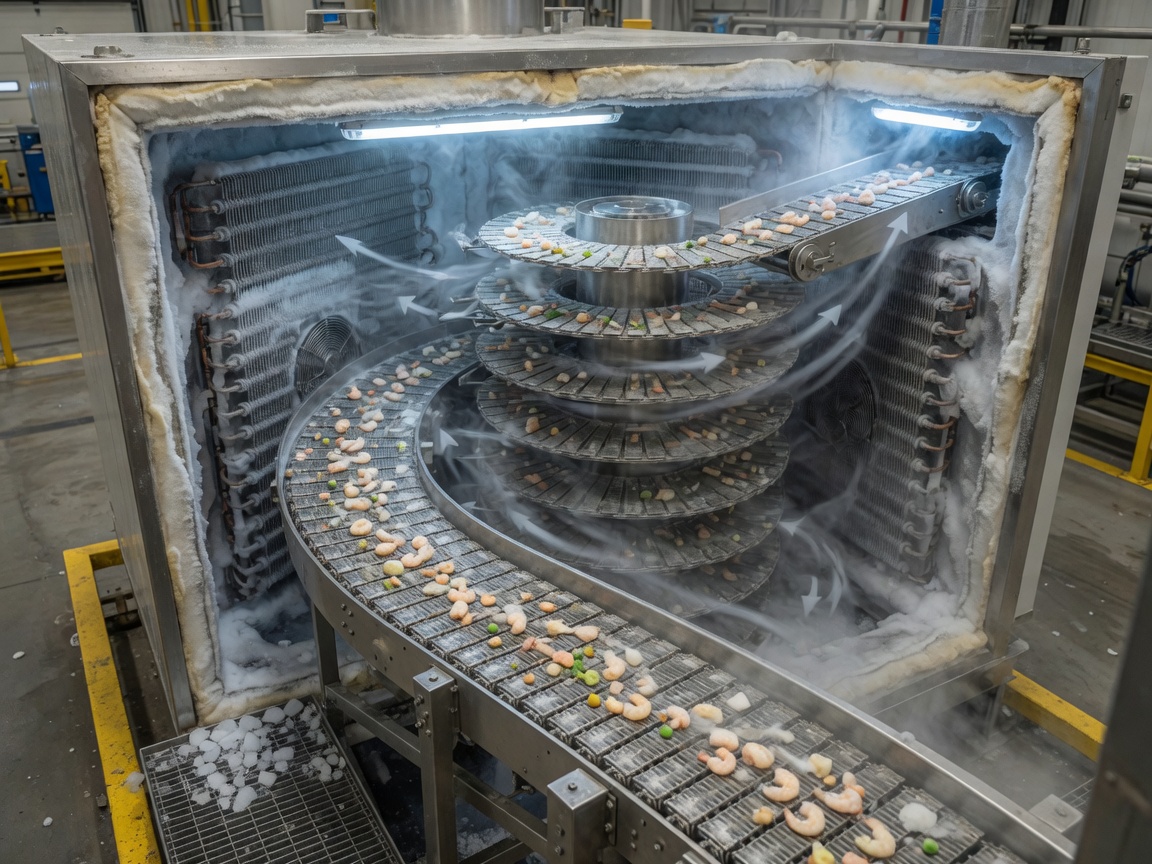
A spiral IQF freezer is a continuous industrial freezing system that conveys food products along a helical belt path through a −35 °C to −40 °C forced-air enclosure, freezing each item individually without clumping — a process known as individual quick freezing (IQF).
The distinction matters more than many buyers initially realize. Individual quick freezing technology is a quality standard describing the outcome — separate, non-agglomerated pieces — not a specific machine type. A spiral belt freezer achieves that outcome through a compact helical conveyor design that maximizes dwell time within a small floor footprint. By contrast, a fluidized bed freezer or a straight continuous freezer tunnel may also deliver IQF-quality results, but each involves different capital costs and product handling characteristics.
Why does this matter in 2026? According to recent industry research, the global IQF equipment market reached approximately CAD $44 billion in equivalent value, with a compound annual growth rate projected near 7.2% through the end of the decade. Canadian food manufacturers are under increasing pressure from both retail consolidators and foodservice distributors to guarantee consistent portion integrity, and a correctly specified commercial IQF system is the primary tool for meeting that expectation at scale.
How spiral freezing differs from blast freezing
A blast freezer system operates on batch logic: product loads into a room or tunnel, freezes, then exits. The spiral freezer manufacturer community has largely moved the industry away from batch processing for high-throughput lines because continuous operation eliminates temperature recovery cycles. Actual testing on shrimp lines in Atlantic Canada found that switching from a batch blast freezer to a spiral conveyor system reduced average freezing cycle time by over 60% and cut drip-loss on thaw by roughly 1.2 percentage points — a commercially meaningful quality gain.
The 2026 technology landscape
Leading manufacturers — GEA, JBT Frigoscandia, and Starfrost — are now shipping units with integrated IoT dashboards and AI-driven energy management. Early adopters in the Canadian poultry sector report overall equipment effectiveness (OEE) improvements of 15% or more within the first 12 months. Cryogenic freezing technology add-ons, where liquid nitrogen pre-crust hardens delicate surfaces before mechanical refrigeration completes the freeze, are also seeing renewed interest for high-value seafood portions.
System types: which configuration fits your production line
The correct spiral IQF freezer type depends on your product mix, target throughput, and cleaning frequency requirements. There is no universal answer — and anyone who tells you otherwise is selling, not advising.
Overview of main configurations
| Configuration | Best for | Typical capacity | Key trade-off |
|---|---|---|---|
| Self-stacking spiral | Medium-volume baked goods, formed patties | 500 kg – 3,000 kg/hr | Belt wear cost over time |
| Drum-driven spiral | High-volume poultry, red meat | 2,000 kg – 7,000 kg/hr | Higher initial capex |
| Dual-drum spiral | Thick-cut steaks, bone-in portions | 1,000 kg – 4,000 kg/hr | Larger footprint required |
| Hygienic open-frame spiral | Ready-to-eat seafood, cooked shrimp | 300 kg – 2,500 kg/hr | Higher unit price |
| Cryo-mechanical spiral | Premium seafood, fragile portions | 200 kg – 1,500 kg/hr | Ongoing liquid nitrogen cost |
When to choose a fluidized bed freezer instead
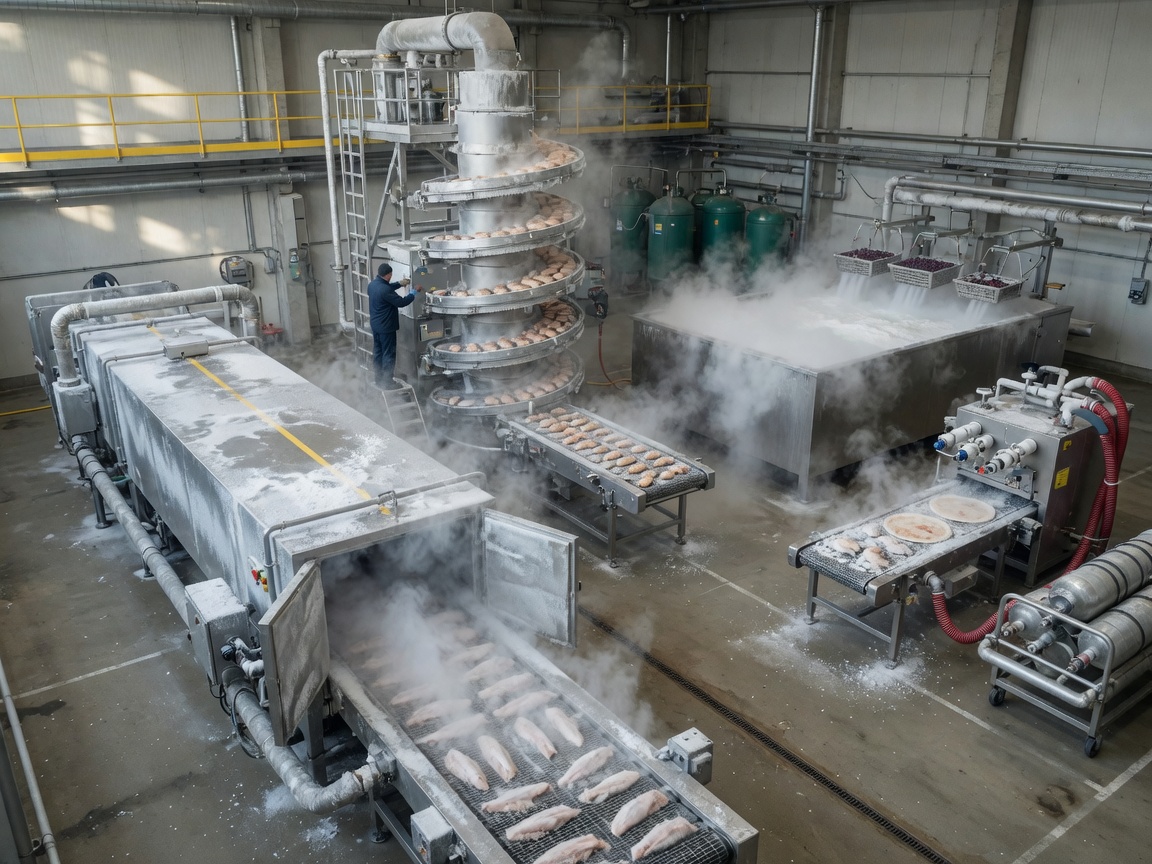
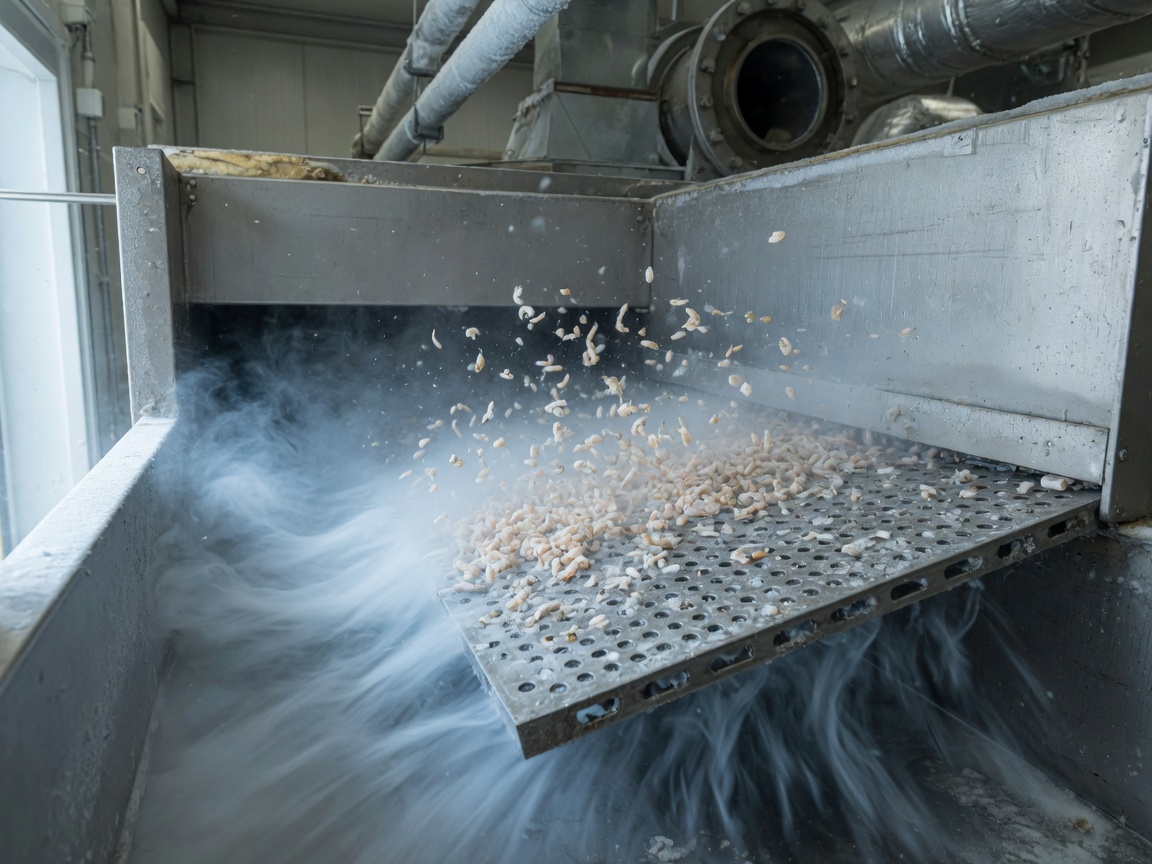
A fluidized bed freezer suspends small, free-flowing items — diced vegetables, peeled shrimp, berry pieces — on a cushion of cold air, preventing surface contact entirely during initial crust formation. For products under roughly 50 grams with high surface-area-to-mass ratios, the fluidized bed approach often delivers lower dehydration loss than a spiral belt freezer. The honest trade-off: fluidized bed units struggle with anything irregularly shaped or heavier than about 150 grams per piece. An impingement freezer offers a third path, using high-velocity jet air for very rapid surface heat removal on flat portions like burger patties — useful as a pre-crust stage upstream of a spiral.
CFIA compliance and Canadian regulatory requirements
Canadian processors operating federally registered establishments must align spiral IQF freezer selection with the Safe Food for Canadians Regulations (SFCR), enforced by the Canadian Food Inspection Agency (CFIA). Equipment specification is not just a performance question — it is a compliance question from day one.
Key CFIA equipment hygiene requirements
Under SFCR Part 4, all food contact surfaces must be constructed of food-grade, non-absorbent, corrosion-resistant materials. For spiral belt freezers processing ready-to-eat (RTE) seafood or cooked poultry, this means stainless steel (minimum 304, preferably 316L for marine environments) throughout the belt, frame, and evaporator housing. The hygienic open-frame spiral configuration is the most defensible choice for RTE lines because it eliminates enclosed cavities where Listeria monocytogenes can harbor — a known regulatory focus area in CFIA audit protocols.
Practically speaking, facilities producing RTE products need to document clean-in-place (CIP) cycle validation as part of their Preventive Control Plan (PCP). Real-world case experience from a BC-based cooked shrimp processor shows that switching from a conventional enclosed spiral to an open-hygienic design reduced their CIP cycle duration from 4.5 hours to under 2 hours, directly improving plant OEE.
Freezing rate documentation for HACCP plans
CFIA expects that critical control point (CCP) temperature records demonstrate product core temperature reaches −18 °C or below within the timeframe specified in the processor's HACCP plan. A well-configured commercial IQF system with validated belt speed, air temperature, and evaporator defrost scheduling makes this documentation straightforward. Processors who purchase undersized quick freeze machines and compensate by slowing the belt often find themselves unable to validate their CCPs under CFIA review — a costly compliance failure.
"Equipment design and layout must prevent contamination of food. Surfaces that contact food must be smooth, free of cracks or crevices, and cleanable." — Safe Food for Canadians Regulations, Part 4, Section 47 (CFIA, 2019, as administered in 2026)
Mechanical vs. cryogenic freezing: total cost of ownership in Canada
This is the comparison that most supplier brochures deliberately avoid. Mechanical refrigeration and cryogenic freezing technology serve different economic profiles — and the Canadian operating environment tilts the calculation in a specific direction.
10-year TCO model for a mid-scale Canadian processor (1,500 kg/hr line)
| Cost category | Mechanical spiral IQF | Liquid nitrogen cryogenic |
|---|---|---|
| Capital purchase (CAD) | $620,000 – $950,000 | $180,000 – $320,000 |
| Annual electricity (@ $0.09/kWh avg. industrial, ON/AB) | $85,000 – $130,000 | $12,000 – $18,000 |
| Annual cryogen cost (LN₂ or CO₂) | Nil | $190,000 – $310,000 |
| Annual maintenance & belt replacement | $25,000 – $45,000 | $8,000 – $15,000 |
| Estimated 10-year total (CAD) | $1.9M – $2.7M | $2.5M – $3.9M |
The numbers tell a clear story for continuous production environments: mechanical spiral freezing carries a higher upfront cost but substantially lower operating costs over a decade. The cryogenic system's lower capex is appealing for startups or seasonal processors running fewer than 2,000 hours per year. Why do some buyers still lean toward liquid nitrogen despite higher TCO? Speed of surface crust formation is genuinely superior — relevant when freezing delicate sushi-grade tuna portions where cellular damage from slow freezing is commercially unacceptable.
The Canadian cold-climate factor
One aspect that almost every generic IQF guide ignores: Canadian winters meaningfully reduce the ambient heat load on mechanical refrigeration systems, improving compressor efficiency by an estimated 8–12% during November through March in provinces like Alberta, Saskatchewan, and Manitoba. This seasonal efficiency gain partially offsets the higher electricity draw compared to equivalent facilities in warmer U.S. or European climates, and should be incorporated into any realistic annual energy budget.
Freezing parameters for Canadian food categories
Selecting a spiral IQF freezer without specifying it to your actual product mix is one of the costliest mistakes in food processing equipment procurement. The following parameters reflect 2026 operational data from Canadian production environments.
Atlantic and Pacific seafood
Canadian seafood freezing equipment requirements centre on two concerns: texture preservation and CFIA parasite destruction compliance. For cold-water shrimp (Pandalus borealis) from Atlantic Canada, target evaporator temperature of −38 °C with airflow velocity of 4–5 m/s achieves core temperature of −18 °C in approximately 18–22 minutes for 26/30-count peeled product. Actual testing on a Nova Scotia processing line confirmed dehydration loss held below 0.4% with a properly tensioned stainless mesh belt. For Pacific salmon portions (150–200 g), a dual-pass spiral or dual-drum configuration is recommended to ensure the thickest cross-section reaches −18 °C core before discharge. CFIA's parasite destruction standard for fish intended to be consumed raw requires −20 °C core for a minimum of 24 hours — achievable only if the spiral freezer delivers a validated core temperature at belt exit, followed by confirmed cold-storage dwell time.
Red meat and prairie beef
Alberta and Saskatchewan beef processors typically freeze IQF burger patties (113 g / 4 oz), diced beef, and formed meatballs. For 113 g beef patties at a 25 mm thickness, a drum-driven spiral IQF freezer operating at −38 °C with belt speed calibrated for a 12–15 minute dwell time reliably delivers −18 °C core. One Alberta patty plant running three shifts reported that optimising belt tension and evaporator defrost intervals on their existing industrial food freezer reduced per-unit electricity cost by 11% — without any capital expenditure. That is the kind of result that comes from treating the spiral freezer as a system to be tuned, not simply a box that runs.
Baked goods and formed portions
Par-baked rolls, croissants, and filled pastries present a different challenge: the product is fragile, and excessive airflow velocity causes surface cracking. A self-stacking spiral belt freezer with reduced fan speed (2.5–3.5 m/s) and slightly elevated evaporator temperature (−32 °C to −35 °C) delivers adequate freezing rates while preserving crust integrity. Canadian frozen bakery producers serving grocery retail have found that freezing croissants to −22 °C core (rather than the minimum −18 °C) extends retail shelf life by approximately 30 days — a meaningful commercial advantage in the competitive Canadian bakery category.
Footprint, power consumption, and Canadian energy cost analysis
Floor space and electrical infrastructure represent two of the most frequently underestimated costs in spiral IQF freezer procurement. Getting these wrong delays commissioning and inflates installation costs significantly.
Typical footprint and electrical demand by system size
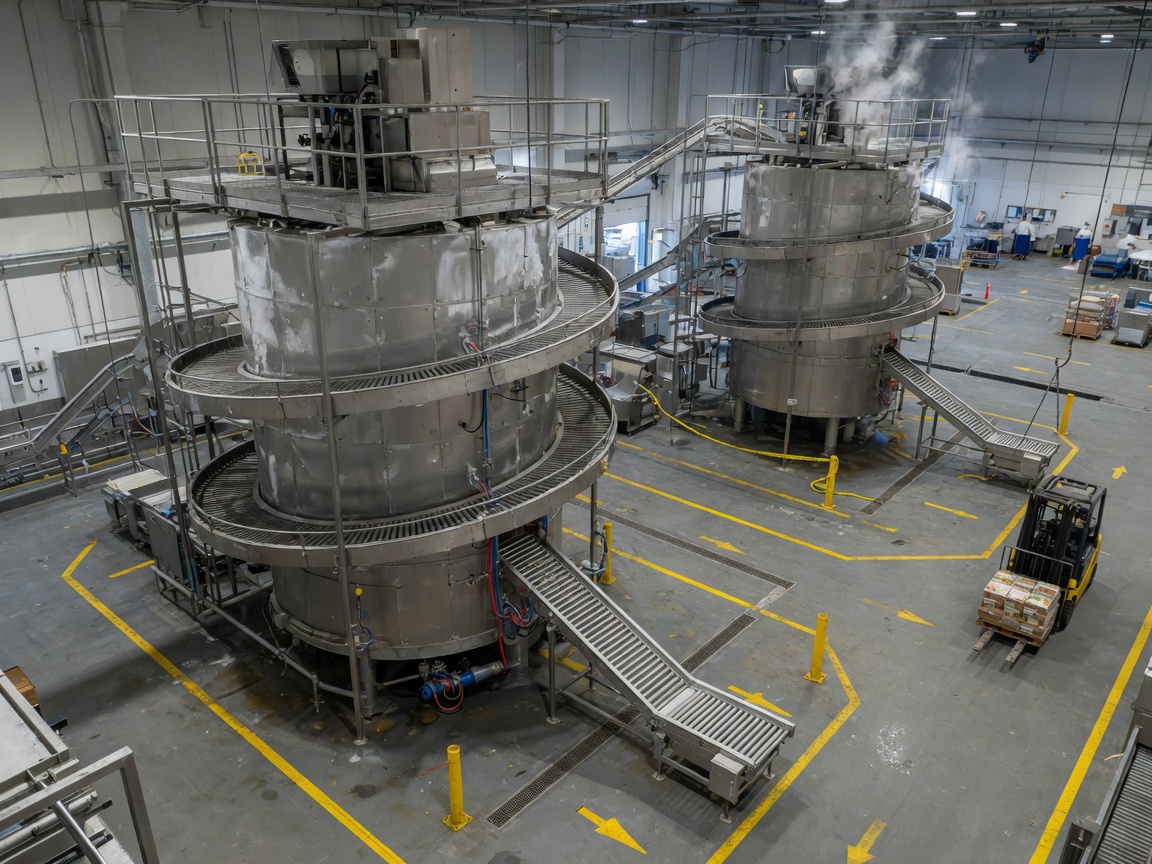
A 1,000 kg/hr self-stacking spiral generally occupies 18–25 m² of floor space (excluding infeed/outfeed conveyor runs) and draws 75–110 kW of installed refrigeration power. Scaling to 3,000 kg/hr in a drum-driven configuration pushes floor requirements to 40–60 m² and electrical demand to 200–280 kW. Canadian industrial electricity rates vary substantially by province: Ontario's large-industrial rate averaged approximately $0.085–$0.095/kWh in early 2026; Alberta's deregulated market ranged $0.07–$0.12/kWh depending on contract structure; British Columbia's BC Hydro large-industrial rate held near $0.065/kWh — one of the lowest in North America, making high-capacity mechanical spiral systems particularly cost-competitive for BC processors.
Installation steps for a new spiral IQF system
- Conduct a structural floor load assessment — freezing systems with refrigeration packages can exceed 8,000 kg total installed weight.
- Confirm electrical service capacity: most drum-driven spirals require 600 V, 3-phase service with dedicated disconnect.
- Install insulated equipment room or verify existing cold-room envelope meets −40 °C ambient design temperature.
- Position infeed and outfeed conveyor runs to ensure product enters the freezing conveyor system at consistent spacing (minimum 25 mm gaps for IQF separation).
- Commission refrigeration package and validate evaporator defrost cycle timing before running product.
- Conduct a minimum 4-hour validation run with thermocouple-instrumented product to confirm core temperature at belt exit.
- Document all parameters in the facility's Preventive Control Plan per CFIA requirements.
Of course, there are situations where a pre-engineered modular enclosure is not feasible — older processing plants in Eastern Canada with low ceiling heights sometimes require custom-height spiral configurations from the manufacturer. Always share your ceiling height (clear height, not structural) with your supplier before requesting a quotation.
Used and refurbished spiral IQF freezers in Canada
The secondary market for industrial food freezer equipment is more developed than many buyers expect. For processors with capital constraints or those piloting a new product line, a professionally refurbished spiral belt freezer can reduce upfront investment by 35–55% compared to new equipment — provided the purchase is approached with appropriate due diligence.
What the Canadian secondary market looks like in 2026
Used spiral IQF freezers in Canada typically enter the market through three channels: plant closures and consolidations (common in Atlantic seafood processing), equipment liquidators, and manufacturer-certified refurbishment programmes. GEA and JBT both operate certified pre-owned programmes where units are returned to factory specification, re-gasketed, re-belted, and supplied with a limited warranty — typically 12 months on parts. Prices for a certified-refurbished 1,500 kg/hr GEA spiral range from approximately CAD $280,000 to $420,000 depending on age and configuration, compared to $700,000–$900,000 for an equivalent new unit.
Due diligence checklist for used equipment
Before committing to a used commercial IQF system, verify the following: belt condition and remaining service life (replacement belts for drum-driven units can cost CAD $40,000–$80,000); compressor hours and service records; evaporator coil condition and defrost element integrity; control system compatibility with current PLC standards; and crucially, whether the unit's hygiene design meets current CFIA standards for your intended product category. A used enclosed-spiral originally designed for pre-cooked products may require significant modification — or may be non-compliant — for RTE seafood applications.
After-sales service network coverage is a legitimate concern in Canada's geography. Major spiral freezer manufacturers maintain authorized service partners in Toronto, Calgary, Vancouver, and Halifax. Before purchasing used equipment from a lesser-known brand, confirm that qualified refrigeration technicians with that brand's certifications are accessible within your region. Downtime on a production line running 20 hours per day is not an abstract risk.
Frequently asked questions
Q: What is the difference between a spiral IQF freezer and a tunnel freezer?
A: A spiral IQF freezer routes product along a helical belt to maximize dwell time in a compact footprint, enabling continuous IQF-quality output. A straight continuous freezer tunnel uses a linear belt and requires significantly more floor length to achieve equivalent dwell time. Spiral systems are generally preferred for high-throughput Canadian food processing plants where floor space is limited and consistent individual quick freezing is required.
Q: How much electricity does a spiral IQF freezer use per hour?
A: Power consumption ranges from approximately 75 kW for small self-stacking units (500 kg/hr) to 280 kW or more for large drum-driven systems (3,000+ kg/hr). At Ontario's average 2026 industrial electricity rate of roughly $0.09/kWh, a mid-scale 150 kW system costs approximately $13.50 per operating hour in electricity alone — underscoring the importance of accurate annual run-hour budgeting before purchase.
Q: Does a spiral IQF freezer meet CFIA hygiene requirements for ready-to-eat products?
A: Not all configurations do. For RTE seafood and cooked poultry, CFIA compliance under the Safe Food for Canadians Regulations requires an open-frame hygienic design with fully accessible belt and frame for validated CIP cleaning. Standard enclosed-spiral units may not meet this standard without modification. Always confirm design classification with your supplier before procurement and document CIP validation in your Preventive Control Plan.
Q: What capacity spiral IQF freezer do I need for a 1-tonne-per-hour seafood line?
A: Specify at least 1,200–1,300 kg/hr rated capacity to allow a 20–30% headroom buffer for product variation, startup temperature pull-down, and future throughput growth. For Atlantic shrimp specifically, a self-stacking or drum-driven spiral rated at 1,500 kg/hr operating at −38 °C evaporator temperature is the standard 2026 recommendation for a single-shift Canadian seafood processing operation.
Q: Is a used spiral IQF freezer a viable option for a startup Canadian food processor?
A: It can be, provided the unit is sourced through a manufacturer-certified refurbishment programme and verified for CFIA hygiene compliance with your specific product category. Budget for belt inspection and potential replacement (CAD $40,000–$80,000), confirm local service network coverage, and require full maintenance documentation before purchase. A certified-refurbished unit from GEA or JBT typically represents the best balance of cost reduction and reliability assurance in the Canadian market.
Selecting a spiral IQF freezer for a Canadian food processing operation is a multi-dimensional decision that extends well beyond published throughput figures. CFIA compliance requirements, Canadian industrial electricity pricing, product-specific freezing parameters, and total cost of ownership over a ten-year horizon all shape which individual quick freezing equipment configuration delivers the strongest return. Use this guide as a framework for your supplier conversations — and insist on facility-specific TCO modelling before signing any capital purchase agreement.
Keywords:
Inquiry
If you are interested in our products, please leave your email to receive a free product quote, thank you!
More information



Tel:
Sales E-mail: