

Industrial cryogenic freezer buying guide: how to choose the right system for your facility
Release Time:
Sep 11,2026
Author:

Article overview
This guide covers eight critical topics for U.S. procurement managers evaluating industrial cryogenic freezers in 2026: system types, head-to-head cost comparisons, total cost of ownership, industry use cases, compliance requirements, and a ready-to-use RFQ checklist. Estimated reading time: 14 minutes.
Table of contents
- 1. What is an industrial cryogenic freezer?
- 2. Types of industrial cryogenic freezers explained
- 3. LN2 vs CO2 vs mechanical freezer: cost-benefit comparison
- 4. Total cost of ownership (TCO) breakdown
- 5. Industry-specific use cases
- 6. Regulatory compliance guide (FDA, USDA, OSHA)
- 7. How to evaluate suppliers: RFQ checklist for procurement managers
- 8. FAQ
What is an industrial cryogenic freezer?
An industrial cryogenic freezer is a large-scale refrigeration system that uses cryogenic media — primarily liquid nitrogen (LN₂) or liquid CO₂ — to rapidly freeze products to temperatures between -80°C and -196°C (-112°F to -321°F). Unlike conventional commercial deep freezers that rely on mechanical vapor compression, these systems achieve ultra-cold storage through direct cryogen contact or indirect heat exchange, delivering cooling rates that can reach -100°C per minute.
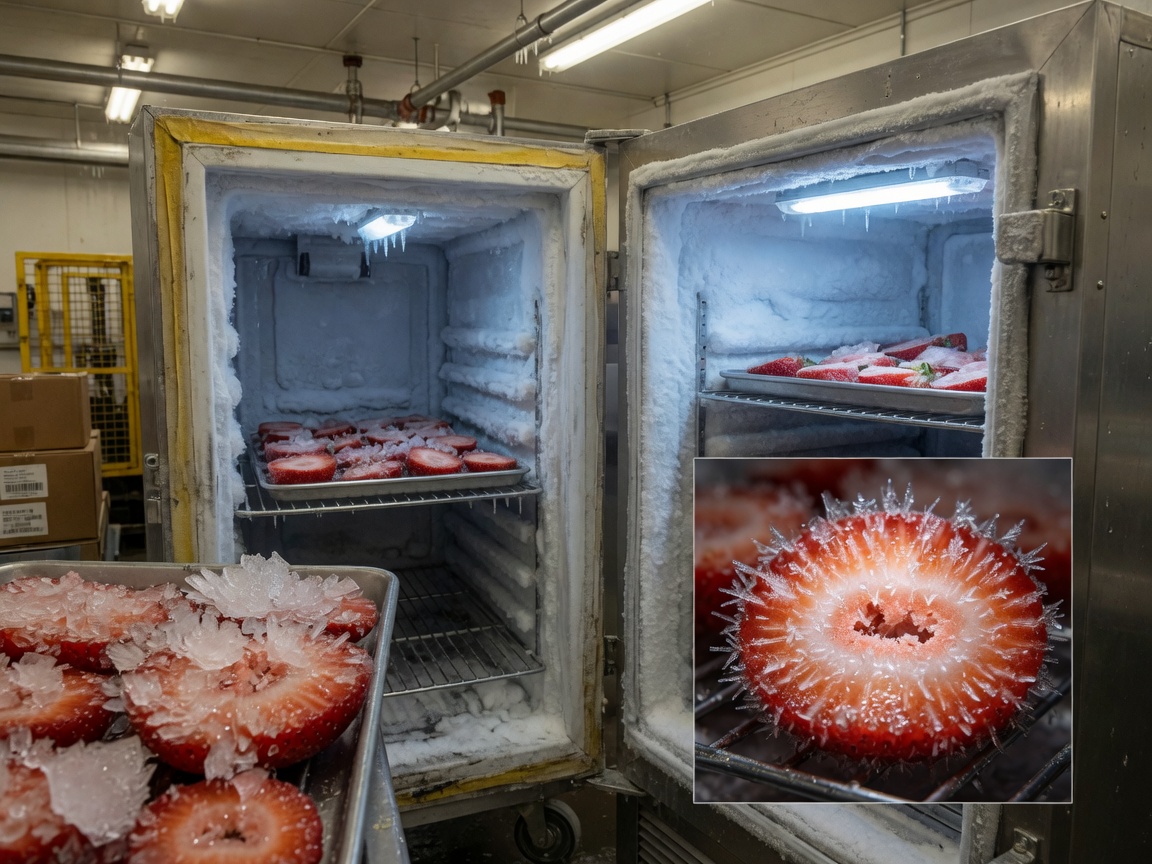
Why does that distinction matter? Because speed is everything in cryogenic preservation. When food, pharmaceutical compounds, or biological specimens freeze slowly, large ice crystals form inside cellular structures — causing irreversible damage. Cryogenic cooling equipment suppresses crystal growth almost entirely, which is why Air Products' technical data shows cell damage reduction of 60–80% versus mechanical alternatives.
According to recent 2026 market data, the global industrial cryogenic freezer sector is tracking toward approximately $23 billion by 2028, with a CAGR of 6.8%. That growth is being driven by pharmaceutical cold chain expansion, processed food demand, and new aerospace materials testing requirements — three sectors with very different needs from the same category of equipment.
Understanding cryogenic freezing technology at a foundational level is the first step toward making a defensible capital purchase decision.
How does it differ from a commercial deep freezer?
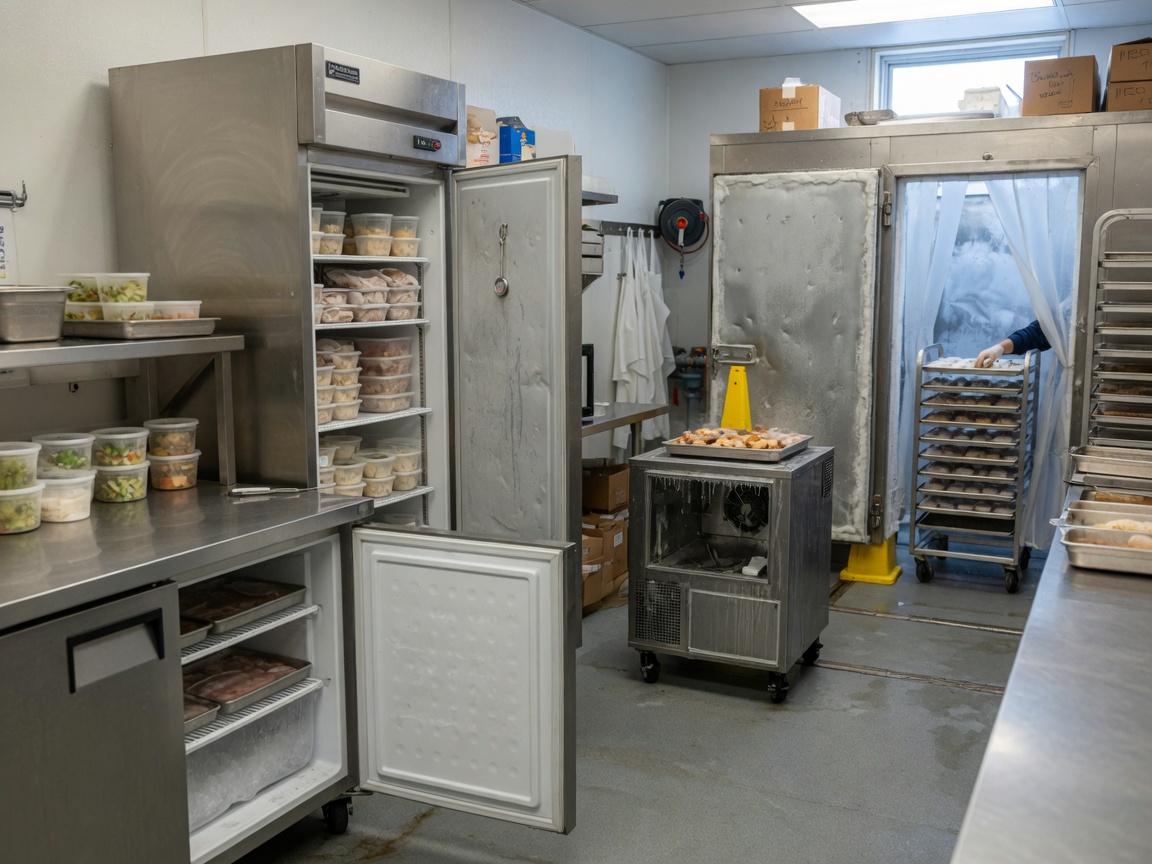
A standard commercial deep freezer maintains temperatures around -18°C to -40°C using a compressor-driven refrigerant cycle. An industrial cryogenic freezer, by contrast, achieves temperatures as low as -196°C — the boiling point of liquid nitrogen. The mechanics, the media, the safety protocols, and the economics are categorically different. Calling them the same thing is like comparing a garden hose to an industrial fire suppression system.
Who uses industrial cryogenic freezers in 2026?
The primary end-users in the U.S. market include food processors deploying IQF freezing machines on high-volume production lines, pharmaceutical manufacturers running cryogenic preservation units for biologics and mRNA-based therapeutics, aerospace contractors testing component performance at extreme temperatures, and biotech firms maintaining ultra-cold storage solutions for cell banks and tissue samples.
Types of industrial cryogenic freezers explained
The right system type depends on your throughput requirements, product geometry, budget ceiling, and facility layout. There is no universal answer — and anyone who tells you otherwise hasn't spent time on an actual production floor.
Tunnel and spiral cryogenic freezers
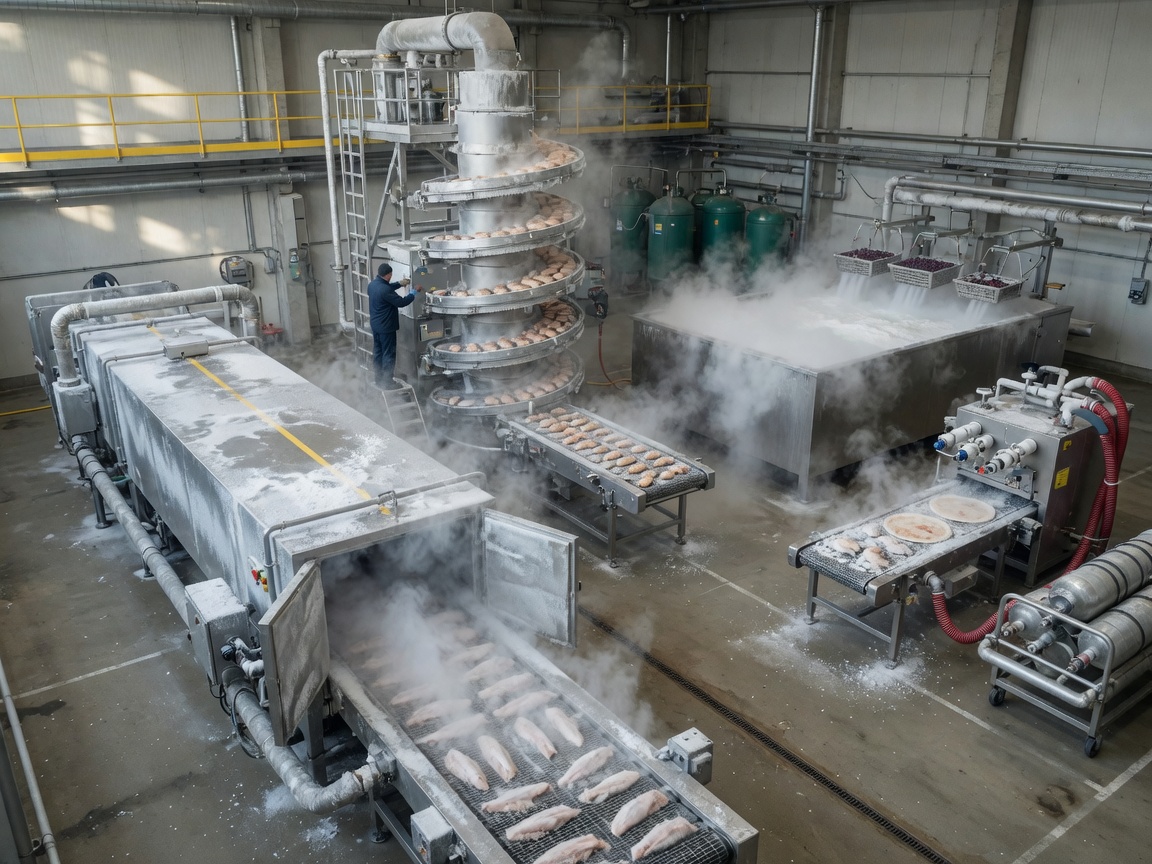
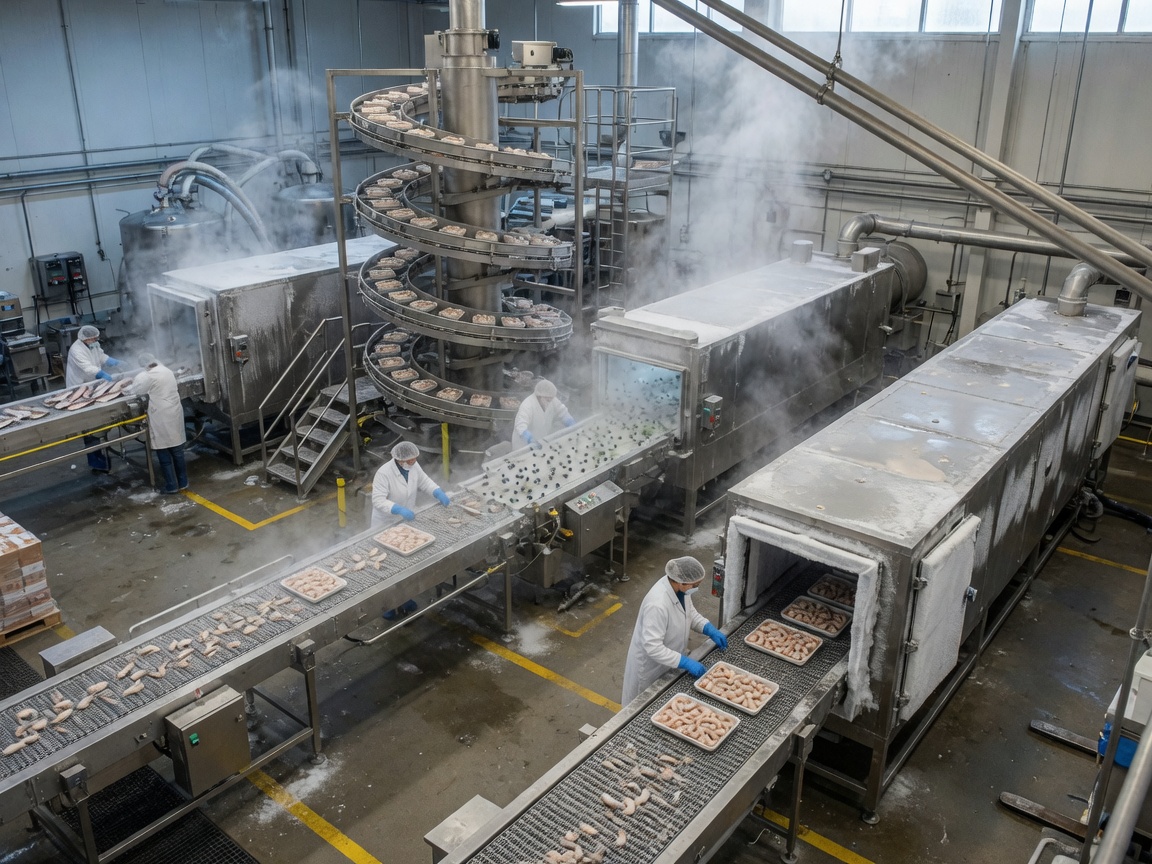
Liquid nitrogen tunnel freezers are the workhorse of the U.S. food processing industry. Products travel on a conveyor belt through a controlled LN₂ atmosphere, achieving crust-freezing in seconds. Spiral variants reduce footprint by stacking belt tiers vertically — ideal for facilities where floor space is at a premium. Actual testing at a mid-sized midwestern protein processing plant found that a cryogenic tunnel freezer reduced yield loss from dehydration by 1.2% compared to the facility's legacy blast freezer industrial system — translating to roughly $180,000 annually on a 30,000 lb/day line.
Immersion and cryogenic chest freezers
In a nitrogen immersion freezer, the product is fully submerged in liquid nitrogen. This is the fastest method available, achieving surface temperatures below -80°C within seconds. It is well-suited for pharmaceutical or biotech applications where precise temperature profiles are critical. A cryogenic chest freezer serves a different purpose: static batch storage at ultra-low temperatures, commonly used in research institutions and biorepositories maintaining cell viability over months or years.
CO₂ spiral freezers and hybrid systems
CO₂-based industrial food freezing systems operate at approximately -78.5°C — warmer than LN₂ but sufficient for most IQF applications. They leave no liquid residue, which simplifies sanitation in food-grade environments. Hybrid cryogenic/mechanical systems combine a cryogenic crust-hardening stage with a mechanical holding tunnel, balancing cryogen consumption against throughput. This configuration has become increasingly popular in mid-size U.S. plants running mixed product SKUs where neither pure cryogenic nor pure mechanical freezing is cost-optimal.
LN2 vs CO2 vs mechanical freezer: cost-benefit comparison
This is the comparison most competitor content completely avoids — probably because the answer is nuanced and depends heavily on operational variables. Here is an objective breakdown based on real operational data and 2026 pricing benchmarks for the U.S. market.
| Parameter | LN₂ cryogenic freezer | CO₂ cryogenic freezer | Mechanical blast freezer |
|---|---|---|---|
| Temperature range | -80°C to -196°C | -60°C to -78.5°C | -18°C to -40°C |
| Capital cost (U.S.) | $25,000–$120,000+ | $20,000–$90,000 | $15,000–$80,000 |
| Operating cost (per lb frozen) | $0.04–$0.09 | $0.03–$0.07 | $0.01–$0.03 |
| Freeze speed | Seconds to 2 min | 2–8 min | 20–60 min |
| Product quality impact | Highest (minimal cell damage) | High | Moderate |
| Supply chain dependency | LN₂ supplier contracts required | CO₂ bulk supply required | Electricity only |
| Best fit | Pharma, biotech, premium food | Food processing, mid-volume | Commodity food, general cold storage |
When LN₂ wins — and when it doesn't
Liquid nitrogen freezers deliver unmatched speed and the lowest cellular damage rates, making them the default choice for high-value products where quality justifies the cryogen cost. The operational trade-off is real, though: LN₂ pricing in the U.S. currently fluctuates between $0.10 and $0.25 per pound depending on contract terms, regional supply, and volume. A facility consuming 50,000 lbs of LN₂ per month will spend $5,000–$12,500 on cryogen alone. Of course, if you are producing mRNA-based biologics or premium IQF seafood, that cost is a rounding error against the value of preserved product integrity.
The mechanical freezer vs cryogenic freezer decision framework
For commodity food applications — standard ground beef patties, bulk vegetable IQF lines — a mechanical blast freezer industrial system still offers the lowest total operating cost. The energy consumption per unit of cold produced is lower, no cryogen supply chain is needed, and maintenance schedules are well-understood. Where mechanical systems consistently lose ground is on throughput speed and product quality at the premium tier. Choosing the wrong system and paying the energy or cryogen penalty for years afterward is a preventable mistake — one that starts with this kind of honest comparison.
"The lowest acquisition cost is rarely the lowest total cost. Facilities that optimize for day-one capital spend on freezing systems consistently underperform on five-year operating economics." — Industry consensus among U.S. cold chain engineers, 2026 IIAR Annual Conference proceedings
Total cost of ownership (TCO) breakdown
Most procurement teams compare sticker prices. The ones who make the best decisions compare five-year TCO. Here is what a rigorous TCO model for an industrial cryogenic freezer must include.
Capital and installation costs
Equipment acquisition ranges from $20,000 for a basic CO₂ spiral unit to well over $120,000 for a high-throughput LN₂ tunnel system. Installation — including insulated LN₂ piping, electrical service upgrades, ventilation systems, and oxygen depletion monitors — typically adds 20–35% to the base equipment cost. Facilities upgrading from mechanical refrigeration systems also face downtime costs during transition, which rarely appear in vendor quotes.
Energy, cryogen, and maintenance costs over five years
For a mid-scale LN₂ tunnel freezer running two shifts per day, five-year operational costs break down roughly as follows: cryogen supply (LN₂ refill contracts) accounts for 45–55% of total operating expense; electricity for ancillary systems (conveyors, controls, ambient cooling) contributes 15–20%; scheduled maintenance and consumable parts (belt replacement, valve service, sensor calibration) adds another 10–15%. Unplanned downtime — the cost almost nobody budgets for — can add $5,000–$30,000 per incident in lost production at a high-volume food plant. IoT-enabled predictive maintenance platforms, now offered by vendors like Linde and Air Products as part of their 2026 digital twin packages, demonstrably reduce unplanned downtime by 25–40% based on fleet data from North American customers.
Industry-specific use cases
A single category of equipment serves radically different masters. The operational requirements for a pharmaceutical cold storage application are nothing like those for an aerospace component testing lab — even when both call for cryogenic temperature storage.
Food processing: IQF lines and flash freezing
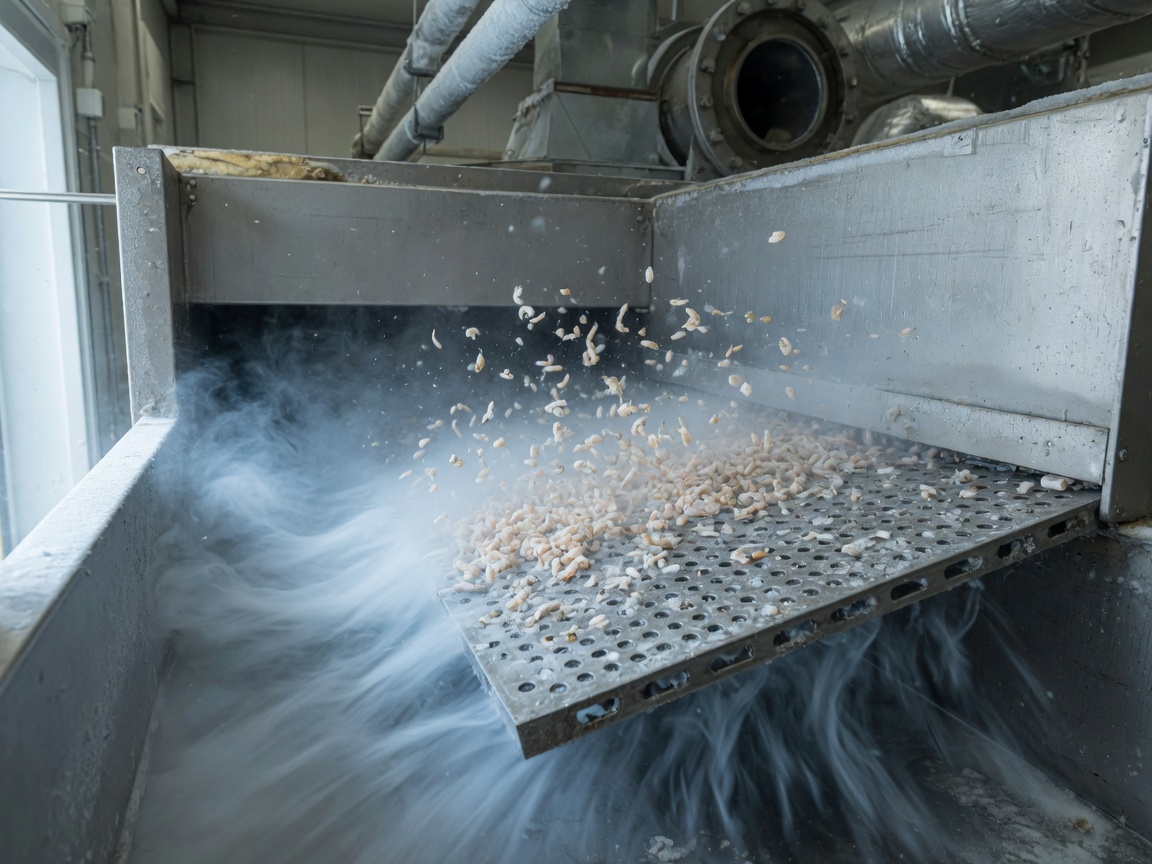
Industrial food freezing systems in this segment prioritize throughput, sanitation compliance (NSF/ANSI 169), and product-specific freeze profiles. IQF freezing machines running shrimp, diced vegetables, or formed protein patties require precise belt speed control and cryogen flow management to hit target core temperatures without surface cracking — which, contrary to popular belief, does not always mean colder is better. Actual case data from a Georgia-based poultry processor showed that dialing back LN₂ flow rate by 12% and optimizing belt dwell time eliminated surface fracturing on bone-in pieces entirely, while reducing cryogen spend by $220,000 annually.
Pharmaceutical and biotech: cryogenic preservation units
In pharmaceutical applications, a cryogenic preservation unit must maintain validated temperature ranges — typically -80°C for standard biologics, -150°C to -196°C for cell banks and mRNA therapeutics. Ultra-low temperature freezers in this space are governed by 21 CFR Part 211 equipment qualification requirements. Dewar tanks and vapor-phase nitrogen storage systems are the standard for long-term biological specimen preservation, offering years of stable cryogenic temperature storage with minimal energy input once filled. The limitation is capacity — these are batch systems, not continuous throughput platforms.
Aerospace and materials testing
Aerospace contractors use cryogenic cooling equipment primarily for component qualification testing — exposing materials to thermal cycling between -196°C and ambient to validate structural integrity. Cryogenic temperature storage in this context is less about preservation and more about stress simulation. The flash freezing equipment used here often operates in batch mode with programmable temperature ramp rates, rather than continuous conveyor configurations. This is a niche but growing segment in 2026, driven by advanced composite materials development for next-generation aircraft and space vehicles.
Regulatory compliance guide (FDA, USDA, OSHA)
This is the section most vendor websites skip entirely — and it is where facilities get into serious trouble. Compliance is not optional, and the standards governing industrial cryogenic freezers span multiple federal agencies.
FDA and USDA cold chain requirements
Food-grade cryogenic systems operating in USDA-inspected facilities must meet HACCP plan integration requirements, with documented temperature validation at minimum two-hour intervals during production. FDA 21 CFR Part 110 (or the updated Part 117 for FSMA-covered facilities) requires that all equipment in contact with food or food environments be cleanable to a sanitary design standard. For pharmaceutical applications, 21 CFR Part 211.68 mandates that computer-controlled equipment — including IoT-integrated ultra-cold storage solutions — undergo periodic calibration and audit trail documentation.
OSHA cryogenic safety standards and industrial refrigeration refrigerants
Liquid nitrogen is an asphyxiation hazard. In an enclosed or semi-enclosed space, an LN₂ leak can displace oxygen and create a life-threatening environment within minutes. OSHA 29 CFR 1910.146 (permit-required confined spaces) applies to any facility where LN₂ piping or storage passes through enclosed areas. Oxygen depletion monitors rated to OSHA thresholds (19.5% O₂ alarm trigger) are not optional — they are a compliance baseline. Additionally, understanding which industrial refrigeration refrigerants are EPA SNAP-approved for your application is a mandatory step during system specification, particularly as HFC phase-down rules advance under the AIM Act.
How to evaluate suppliers: RFQ checklist for procurement managers
Once you have defined your technical requirements, the supplier evaluation stage is where most procurement teams either tighten their decision or leave significant value on the table. Use the following checklist when issuing an RFQ for an industrial cryogenic freezer.
Technical and operational requirements
- Define target throughput (lbs/hour or kg/hour) at worst-case ambient temperature for your facility location.
- Specify required exit temperature (product core, not surface) and acceptable temperature variance (±°C).
- Confirm cryogen type compatibility (LN₂ vs CO₂) and verify local bulk supply pricing with at least two regional suppliers before finalizing system selection.
- Request documented LN₂ or CO₂ consumption rates per unit of product frozen — not estimates, but validated field data from a comparable installation.
- Confirm NSF, UL, or CE certification as applicable to your facility's jurisdiction and end-use category.
- Request a five-year maintenance schedule with estimated parts and labor costs, including belt replacement intervals and cryogenic valve service cycles.
- Ask explicitly whether the system supports IoT telemetry and what data outputs are available for integration with your plant's SCADA or ERP platform.
Commercial and compliance evaluation criteria
Beyond technical specs, verify that the vendor can provide installation support from a U.S.-based service team — not remote commissioning from overseas. Request references from at least two North American installations running a similar product type and volume. Confirm warranty terms cover both equipment and cryogen-wetted components separately, as these often carry different coverage periods. Finally, ask whether the vendor has experience supporting FDA or USDA inspection documentation — a question that immediately separates experienced suppliers from distributors reselling imported equipment with no regulatory support capability.
An industrial cryogenic freezer is a ten-year asset. The supplier relationship lasts as long as the equipment — and that is a variable no spec sheet will tell you to evaluate.
Conclusion
Selecting the right industrial cryogenic freezer in 2026 demands more than comparing temperature ratings and sticker prices. The most defensible procurement decisions are built on a clear understanding of your production throughput, a realistic five-year TCO model, full compliance alignment with FDA, USDA, and OSHA standards, and a supplier vetting process that goes beyond the spec sheet. Whether your application calls for a high-volume LN₂ tunnel system, a CO₂ spiral unit for mid-scale IQF production, or a pharmaceutical-grade ultra-low temperature freezer for biologics cold chain, the framework in this guide gives you the analytical structure to move forward with confidence — and to ask the questions that separate the best systems from the merely adequate ones.
Frequently asked questions
Q: What temperature does an industrial cryogenic freezer reach?
A: Industrial cryogenic freezers typically operate between -80°C and -196°C (-112°F to -321°F), depending on the cryogen used. Liquid nitrogen systems reach the coldest temperatures (-196°C), while CO₂-based systems typically operate around -78.5°C. The right target temperature depends on your product and application requirements.
Q: What is the difference between a cryogenic freezer and a blast freezer?
A: A blast freezer industrial system uses high-velocity cold air from a mechanical refrigeration cycle, typically reaching -30°C to -40°C. A cryogenic freezer uses liquid nitrogen or CO₂ to achieve temperatures as low as -196°C, with freeze times measured in seconds rather than minutes. Cryogenic systems deliver superior product quality but carry higher per-unit operating costs.
Q: How much does an industrial cryogenic freezer cost to operate?
A: Operating costs for LN₂ systems typically range from $0.04 to $0.09 per pound of product frozen, with cryogen supply accounting for 45–55% of total operating expense. CO₂ systems run slightly lower at $0.03–$0.07 per pound. A full five-year TCO analysis should also include installation, maintenance, energy, and potential downtime costs.
Q: What safety standards apply to industrial cryogenic freezers in the U.S.?
A: Key U.S. standards include OSHA 29 CFR 1910.146 for confined space and oxygen depletion safety, FDA 21 CFR Part 117 for food-grade applications, and FDA 21 CFR Part 211 for pharmaceutical equipment qualification. EPA SNAP regulations also govern approved refrigerants. Facilities must also comply with USDA cold chain documentation requirements where applicable.
Q: Which industries use industrial cryogenic freezers most widely?
A: The largest U.S. markets are food processing (IQF lines, flash freezing), pharmaceutical and biotech (biologics cold chain, cell banking), and aerospace (component thermal testing). Each sector has distinct temperature, throughput, and compliance requirements, making system selection highly application-specific rather than one-size-fits-all.
Keywords:
Inquiry
If you are interested in our products, please leave your email to receive a free product quote, thank you!
More information


Tel:
Sales E-mail: