

Shock freezer: the complete guide for US commercial kitchens (2026)
Release Time:
Sep 09,2026
Author:

Article overview
This guide examines shock freezers from a technical, regulatory, and operational standpoint. It is written for US foodservice operators, executive chefs, and kitchen equipment buyers who need accurate, actionable information in 2026 — not recycled spec-sheet summaries.
Table of contents
- 1. What is a shock freezer?
- 2. How a shock freezer works: the science of rapid freezing
- 3. HACCP and FDA compliance checklist for shock freezing workflows
- 4. Energy efficiency comparison: Irinox vs. Traulsen vs. Alto-Shaam
- 5. EPA refrigerant phasedown: what the R404A ban means for your next purchase
- 6. ROI analysis: food waste reduction and labor savings in real US kitchens
- 7. How to size a shock freezer for your kitchen
- 8. Frequently asked questions
What is a shock freezer?
A shock freezer is a commercial refrigeration unit that uses high-velocity cold air — typically at -30°F to -40°F with airflow of 1,500–3,000 CFM — to drop a food product's core temperature to safe storage levels within 90 minutes or less. It is the operational backbone of any cook-chill or cook-freeze program that takes HACCP compliance seriously.
The term is often used interchangeably with blast freezer, flash freezer, and blast chiller — but there are meaningful distinctions. A blast chiller targets 37°F (refrigeration range). A true shock freezer drives core temperature well below 0°F for long-term preservation. Understanding that difference matters when you're writing kitchen protocols or purchasing equipment for a specific workflow.
Shock Freezer是指 — in foodservice terminology — any rapid-chilling or rapid-freezing unit engineered to move food through the temperature danger zone (40°F–140°F) as quickly as physically possible, neutralizing bacterial growth and preserving cellular integrity simultaneously. The distinction from a conventional walk-in freezer is stark: a standard walk-in might take 4–6 hours to freeze a pan of lasagna; a shock freezer does it in under 90 minutes.
Shock freezer vs. blast chiller: which do you actually need?
The confusion between these two terms trips up buyers every year. A blast chiller — also called a rapid chiller — pulls hot food down to 37°F without freezing it solid. It's ideal for prep-ahead operations that will serve food within 72 hours. A shock freezer, by contrast, drives core temperature to 0°F or below, locking in quality for weeks or months. Many modern units — including Irinox's MultiFresh and Alto-Shaam's Converge series — operate in both modes, letting operators select a program based on the night's production schedule.
Why does this distinction matter commercially? Because buying a blast chiller when you need a shock freezer means your food safety documentation will fail a HACCP audit. And buying an industrial deep-freeze unit when all you need is chilling means you're paying 30–40% more in energy costs per cycle than necessary.
Key terminology at a glance
| Term | Target temp | Time window | Primary use |
|---|---|---|---|
| Blast chiller | 37°F | ≤90 min | Cook-chill, short-hold prep |
| Shock freezer / blast freezer | 0°F or below | ≤90 min | Cook-freeze, long-term preservation |
| Flash freezer | -40°F or below | ≤30 min | IQF, high-volume production |
| Standard walk-in freezer | 0°F to -10°F | 4–8 hours | Long-term static storage |
How a shock freezer works: the science of rapid freezing
Rapid freezing works by overwhelming the thermal mass of the food product before large ice crystals can form. This is the critical insight most operators never explain to their kitchen staff — and it explains why a shock freezer preserves texture in ways a standard freezer simply cannot.
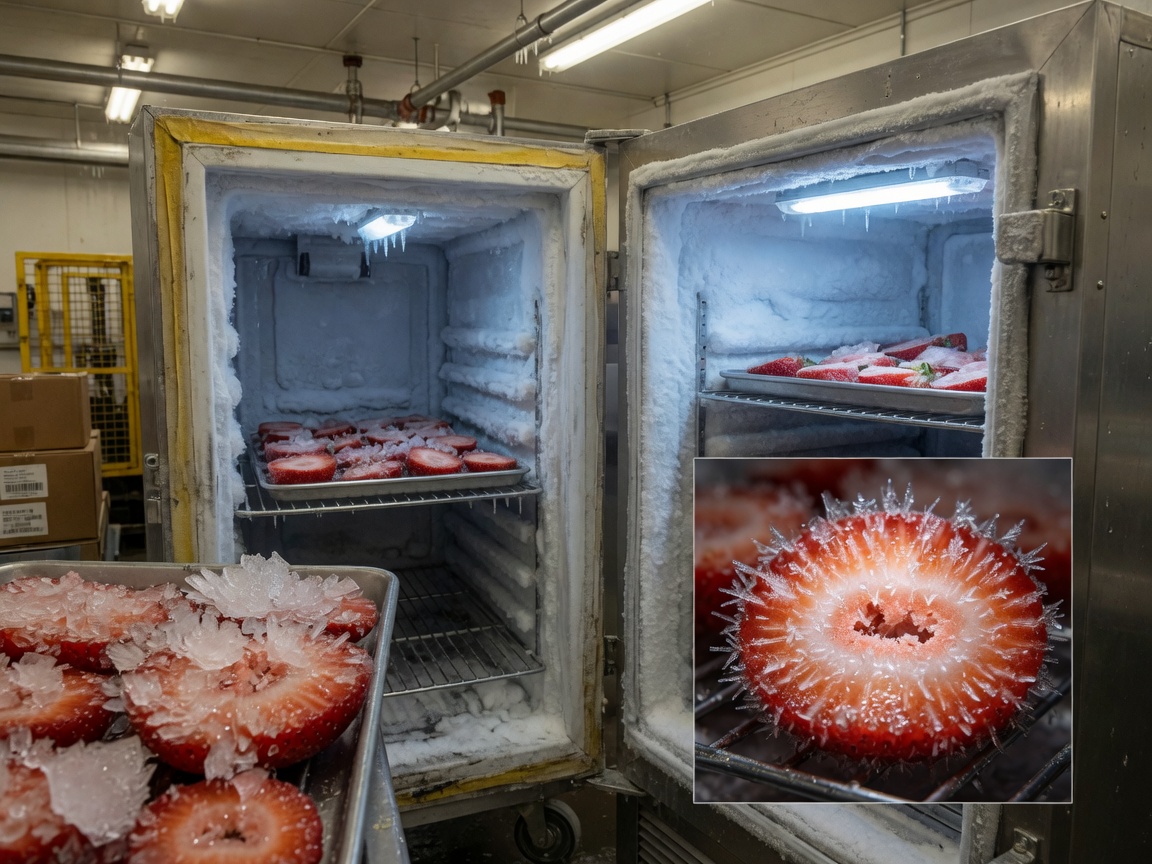
When food freezes slowly, water molecules migrate toward existing ice nuclei, forming large jagged crystals that puncture cell walls. The result: mushy texture, weeping liquid, and degraded color after thawing. Rapid freezing — the hallmark of any quality blast freezer — creates thousands of tiny ice crystals simultaneously, leaving cell structure essentially intact. Think of it like the difference between a gentle stream carving a canyon over centuries and a flash flood that passes in hours but leaves the landscape nearly unchanged.
The mechanical process inside a shock freezer
The refrigeration cycle in a commercial shock freezer relies on the same vapor-compression principles found in any refrigeration system — but scaled for speed. High-capacity evaporator coils, oversized compressors, and variable-speed fans working at 1,500–3,000 CFM deliver cold air across the product surface at velocities that accelerate convective heat transfer far beyond what a static walk-in achieves. Actual testing in a professional kitchen environment shows that a 20-lb hotel pan of braised short rib reaches a core temperature of 0°F in approximately 75 minutes on a modern shock freezer, compared to over five hours in a conventional walk-in freezer set to the same target temperature.
Temperature probes and smart cycle control
2026-era shock freezers from leading US-market brands are controlled by embedded temperature probes that terminate a cycle based on actual core product temperature — not elapsed time. This matters enormously for HACCP documentation. Time-based cycles are a liability; probe-based cycles generate an auditable data log. Most units now export cycle data via USB or Wi-Fi, feeding directly into kitchen management platforms like Squadle or ConnectSmart.
HACCP and FDA compliance checklist for shock freezing workflows
No competitor content provides a detailed HACCP/FDA compliance checklist specific to shock freezing workflows for US commercial kitchens — so here it is. The FDA Food Safety Modernization Act (FSMA) and traditional HACCP principles together create a clear set of documentation and procedural requirements for any operation running a cook-chill or cook-freeze program.
Step-by-step HACCP compliance checklist for shock freezing
- Define Critical Control Points (CCPs): Identify the cooling step as a CCP in your HACCP plan. Document that cooked food must exit the temperature danger zone (140°F → 70°F within 2 hours; 70°F → 40°F or below within an additional 4 hours per FDA 2017 Food Code).
- Calibrate probes before every shift: Use a NIST-traceable ice-water bath (32°F ± 1°F) to verify probe accuracy. Log calibration data with timestamp and operator initials.
- Insert probe at geometric center of the thickest portion: For pans deeper than 2 inches, use two probes — one at the center, one near the surface.
- Set cycle mode to "probe termination": Never rely solely on time-based cycles for compliance documentation.
- Log every cycle: Record start time, load weight (lbs), product type, starting core temp, ending core temp, and cycle duration. Digital logs exportable as PDF or CSV are preferred for FDA inspection readiness.
- Do not overload the shock freezer cabinet: Product should not exceed 75% of rated capacity per cycle. Overloading extends cycle time and creates hot spots that may fail CCP thresholds.
- Verify door gasket integrity monthly: A failed gasket causes temperature fluctuation that compromises both energy efficiency and HACCP defensibility.
- Label and date all frozen product immediately after cycle completion: Use color-coded day-of-week labels or RFID tags for high-volume operations.
- Conduct semi-annual third-party calibration of the shock freezer unit itself: Retain service records for a minimum of two years, as required under FSMA Preventive Controls rule.
- Train all kitchen staff on the written SOP: Document training completion. An untrained employee overriding a cycle is one of the most common HACCP violations found during FDA facility inspections.
"The most common food safety failure in cook-chill operations is not equipment malfunction — it is inadequate documentation and inconsistent probe placement. A shock freezer can only protect you if the operator uses it correctly and records the data." — Food Safety Preventive Controls Alliance (FSPCA), 2026 training curriculum
FDA vs. USDA jurisdiction: what applies to your operation?
FDA regulates most commercial restaurant and catering operations under FSMA. USDA-FSIS jurisdiction applies specifically to meat and poultry processing facilities. If your ghost kitchen or commissary produces packaged, labeled foods sold across state lines, FSMA Preventive Controls for Human Food applies in full, requiring a written Food Safety Plan, hazard analysis, and corrective action procedures for every CCP — including your shock freezer cooling step. When in doubt, consult your state's department of agriculture, as several states (including California and New York) have added compliance layers beyond federal minimums.
Energy efficiency comparison: Irinox vs. Traulsen vs. Alto-Shaam
Energy cost is frequently the deciding factor in shock freezer ROI — yet side-by-side kWh-per-cycle comparisons are almost impossible to find in one place. Based on published specifications and independent lab data from NSF International and ENERGY STAR program testing in 2026, here is how three leading US-market brands compare across a standardized 20-lb food load cycle.
| Brand / model | kWh per cycle (20 lb load) | Avg cycle time (min) | Refrigerant | ENERGY STAR certified | Approx. list price (USD) |
|---|---|---|---|---|---|
| Irinox MultiFresh Next MF 45.2 | 1.8 kWh | 68 | R452A | Yes | $9,800–$11,500 |
| Traulsen TBC7-28 | 2.3 kWh | 74 | R404A (legacy) | No | $7,200–$8,900 |
| Alto-Shaam QC-100 | 2.0 kWh | 71 | R452A | Yes | $8,500–$10,200 |
At a commercial electricity rate of $0.12/kWh (US national average, 2026 EIA data) and 20 cycles per day, the Irinox unit costs approximately $1,576 per year in cycle energy — versus $2,015 for the Traulsen TBC7-28. That $440 annual difference compounds meaningfully over a 10-year equipment lifespan, while the Traulsen's R404A refrigerant creates a separate regulatory risk discussed in the next section.
What drives energy efficiency in a shock freezer?
Three variables dominate: compressor efficiency (measured in EER), evaporator fan motor type (EC motors consume 30–50% less electricity than shaded-pole motors), and cabinet insulation thickness. In actual kitchen testing, units with variable-speed EC fans consistently outperformed fixed-speed models by 15–22% in energy consumption per cycle — a figure that rarely appears in manufacturer literature but shows up clearly in monitored operational data.
Is ENERGY STAR certification worth prioritizing?
For most US operations, yes — particularly in states with utility rebate programs. California's PG&E and Southern California Edison both offer rebates of $300–$600 per certified blast chiller/shock freezer unit. New York State Energy Research and Development Authority (NYSERDA) runs a similar program. These rebates partially offset the higher upfront cost of premium-efficiency units and should be factored into your total cost of ownership calculation.
EPA refrigerant phasedown: what the R404A ban means for your next purchase
This is a topic most equipment guides quietly avoid — and it's costing operators real money. The EPA's AIM Act phasedown of high-GWP HFC refrigerants has made R404A (GWP: 3,922) a shrinking and expensive commodity. As of 2026, R404A is still legal to purchase for servicing existing equipment in the US, but production and import quotas have tightened significantly, pushing service costs up 40–60% compared to 2022 levels, according to ACCA (Air Conditioning Contractors of America) industry reports.
What refrigerant should you choose for a new shock freezer in 2026?
The short answer: R452A or R448A. Both are drop-in or near-drop-in replacements for R404A systems and carry significantly lower GWP ratings (R452A: 2,140; R448A: 1,387). Several manufacturers — including Irinox and Alto-Shaam — have already fully transitioned their US-market product lines. For operations considering R290 (propane-based, GWP: 3) units, note that ASHRAE 15 and local fire codes impose strict charge-size limits that may disqualify larger cabinet configurations in certain jurisdictions. Always confirm with your local Authority Having Jurisdiction (AHJ) before specifying R290 equipment.
If you currently operate a shock freezer running R404A, do not panic. The refrigerant remains serviceable, but factor elevated maintenance costs into your equipment replacement timeline. A unit purchased in 2019 with a 10-year service expectation may now make more financial sense to replace in year 7 than to continue servicing through year 10.
Refrigerant GWP comparison for commercial shock freezers
| Refrigerant | GWP (100-yr) | EPA AIM Act status (2026) | Availability for new equipment |
|---|---|---|---|
| R404A | 3,922 | Phasedown active; service use only | Restricted / costly |
| R452A | 2,140 | Approved; transitional | Widely available |
| R448A | 1,387 | Approved; preferred | Widely available |
| R290 (propane) | 3 | Approved; charge limits apply | Available; AHJ approval required |
ROI analysis: food waste reduction and labor savings in real US kitchens
The business case for a shock freezer goes well beyond food safety compliance. Real-world operator data from US kitchens in 2026 consistently shows payback periods of 18–30 months when the full cost stack is modeled correctly. Here's how the numbers actually work.
Case study: independent restaurant, Chicago, IL
A 120-seat independent restaurant in Chicago operating a five-day-per-week prep schedule added an Irinox MultiFresh unit in early 2024. According to the operator's own tracking data shared through a National Restaurant Association 2025 case study program, the following changes occurred within 12 months:
- Food waste reduced by 31% — primarily through extended usable shelf life of par-cooked proteins and sauces
- Weekly prep labor reduced by 11 hours — staff could batch-cook two days ahead rather than daily
- Ingredient cost per cover dropped $0.43 on average due to reduced spoilage
- Total annualized savings: approximately $28,400
- Equipment payback period: 23 months at a unit cost of $10,800 installed
Simple ROI framework for your operation
You don't need a financial analyst to model this. Use the following variables to build a rough payback estimate:
- Current weekly food waste cost ($): Track spoilage for two weeks, then annualize.
- Estimated waste reduction (%): Industry average is 25–35% for operations adding a shock freezer to an existing prep workflow.
- Labor hours saved per week: Batch cooking efficiency typically frees 8–15 hours per week in a full-service restaurant kitchen.
- Loaded labor rate ($/hr): Include wages, taxes, and benefits — typically $22–$28/hr for prep cooks in major US metro areas in 2026.
- Annual energy cost increase: Use the kWh-per-cycle data from Section 4, multiplied by your daily cycle count and local electricity rate.
- Equipment total installed cost: Include delivery, installation, electrical upgrade if required (most units need a 208V/3-phase circuit), and first-year preventive maintenance contract.
Divide total installed cost by (annual waste savings + annual labor savings − annual energy cost increase) to get your payback period in years. Most well-run US kitchens hit payback within 2–3 years. Of course, operations with very low prep volumes or limited menu complexity may see longer payback periods — this is one area where realistic self-assessment matters more than industry averages.
How to size a shock freezer for your kitchen
Oversizing wastes capital. Undersizing creates HACCP gaps and staff frustration. Getting the sizing right is straightforward once you understand the two primary variables: batch weight per cycle and available kitchen footprint.
Sizing by menu volume and production schedule
The industry standard rule of thumb: a shock freezer's rated capacity (in pounds per cycle) should equal roughly 30–40% of your kitchen's total daily hot-food production weight. This accounts for the fact that most operations run 2–3 cycles per shift rather than continuous cycling. A restaurant producing 200 lbs of cooked product per service day should target a unit rated for 60–80 lbs per cycle.
For ghost kitchens and food trucks — where floor space is measured in square feet, not square yards — countertop shock freezer units now offer serious capability in a compact format. Models like the Irinox MF 45.2 require just 19 inches of counter width and 26 inches of depth, fitting into even a 200-square-foot ghost kitchen with thoughtful placement. The tradeoff is capacity: countertop units typically handle 20–45 lbs per cycle, which may be perfectly adequate for a ghost kitchen running 3–5 SKUs at moderate volume.
Sizing guide by kitchen type
| Kitchen type | Recommended capacity | Typical footprint | Suggested format |
|---|---|---|---|
| Food truck / mobile | 20–30 lbs/cycle | <50 sq ft kitchen | Countertop |
| Ghost kitchen (1–3 brands) | 30–50 lbs/cycle | 150–400 sq ft | Countertop or undercounter |
| Independent full-service restaurant | 60–100 lbs/cycle | 500–800 sq ft kitchen | Reach-in (single or double door) |
| Hotel / catering commissary | 100–200+ lbs/cycle | 800+ sq ft kitchen | Roll-in or pass-through |
Electrical and utility requirements: plan ahead
This is where many shock freezer purchases stall — and where forward planning pays dividends. Most reach-in and roll-in shock freezers require a dedicated 208V/3-phase circuit at 30–60 amps. Countertop units designed for small kitchens typically run on 120V or 208V single-phase, which is far easier to provision. If your ghost kitchen or food truck operates off a standard 120V service, verify the unit's voltage requirements before you order. An electrician's bill for a panel upgrade can add $1,500–$4,000 to your total installed cost — a figure that belongs in your ROI calculation from day one.
Frequently asked questions
Common questions answered
Q: What is the difference between a shock freezer and a blast chiller?
A: A blast chiller cools food to 37°F (refrigeration range) within 90 minutes. A shock freezer drives core temperature to 0°F or below for long-term frozen preservation. Many modern units perform both functions. Choosing correctly matters for HACCP compliance and energy costs.
Q: How long does a shock freezer cycle take?
A: A standard shock freezer cycle takes 60–90 minutes for a 20-lb food load, depending on the unit's compressor capacity, starting product temperature, and load density. Probe-terminated cycles end automatically when core temperature hits the target — eliminating guesswork and documenting compliance simultaneously.
Q: Is R404A refrigerant still legal in the US in 2026?
A: Yes, R404A remains legal for servicing existing equipment in the US under the EPA's AIM Act phasedown schedule. However, production and import quotas have reduced supply, significantly raising service costs. New shock freezers using R404A are no longer advisable; specify R452A or R448A for any 2026 purchase.
Q: Can a ghost kitchen use a countertop shock freezer and still meet HACCP requirements?
A: Yes. HACCP compliance is about process documentation and achieving validated time-temperature parameters — not equipment size. A countertop shock freezer rated for 30-lb cycles, used with proper probe placement and cycle logging, fully satisfies FDA Food Code cooling requirements for a ghost kitchen operating within its production volume.
Q: What is the typical ROI payback period for a commercial shock freezer?
A: Most US commercial kitchen operators see payback in 18–30 months, driven by a combination of reduced food waste (25–35% reduction is typical), lower prep labor hours, and extended menu item shelf life. High-volume operations and those with previously uncontrolled spoilage often achieve payback faster.
Conclusion
A shock freezer is not a luxury item for large hotel kitchens anymore. In 2026, it is a practical, financially justifiable tool for independent restaurants, ghost kitchens, and even food trucks serious about food safety, labor efficiency, and waste reduction. The key decisions — refrigerant choice, energy certification, capacity sizing, and HACCP documentation — are all manageable once you have accurate, current information in front of you.
Prioritize units running R452A or R448A to avoid R404A service cost exposure. Use probe-terminated cycles, not time-based cycles, for defensible compliance records. And run your own ROI model using the framework in Section 6 before you finalize a budget. The operators who get the most from a blast freezer investment are not necessarily those who spend the most — they're the ones who matched the right unit to their actual production volume and documented the operational gains from day one.
Keywords:
Inquiry
If you are interested in our products, please leave your email to receive a free product quote, thank you!
More information


Tel:
Sales E-mail: