

Small spiral freezer buying guide: how to choose the right model for your production line
Release Time:
Sep 13,2026
Author:

Article overview
This guide helps Australian food processing operators and procurement managers evaluate, compare and select the most suitable small spiral freezer for their facility. It covers equipment types, regulatory compliance, energy efficiency, real cost data and a direct comparison against alternative freezing technologies — all grounded in 2026 market conditions.
Table of contents
- 1. What is a small spiral freezer?
- 2. Types of small spiral freezers available in 2026
- 3. Small spiral freezer vs. tunnel freezer vs. plate freezer
- 4. FSANZ compliance and Australian regulatory requirements
- 5. Energy efficiency, refrigerants and environmental compliance
- 6. Procurement cost, ROI and total cost of ownership
- 7. Real-world installation: an Australian case study
- 8. FAQ
What is a small spiral freezer?
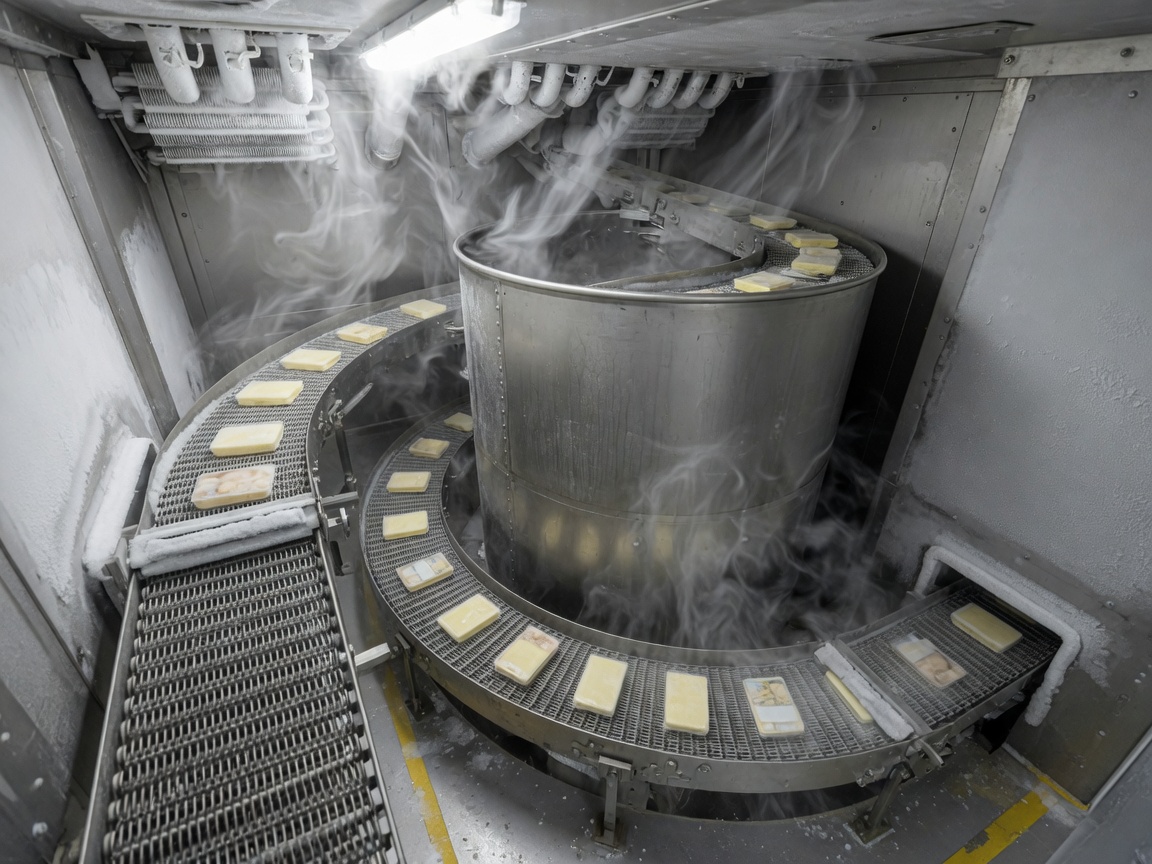
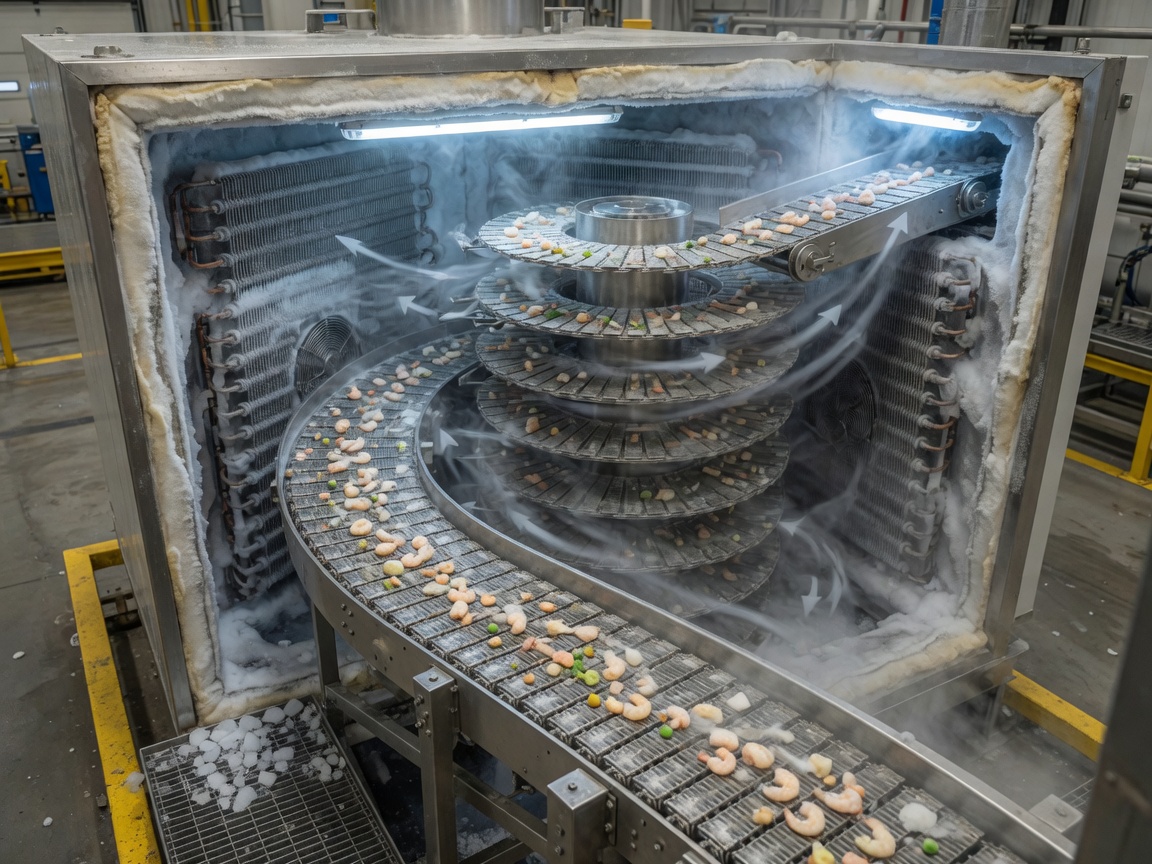
A small spiral freezer is a compact, continuous-belt freezing system that transports food products upward along a helical conveyor path inside an insulated enclosure, enabling individual quick freezing (IQF) in a significantly reduced floor space compared to conventional tunnel freezers.
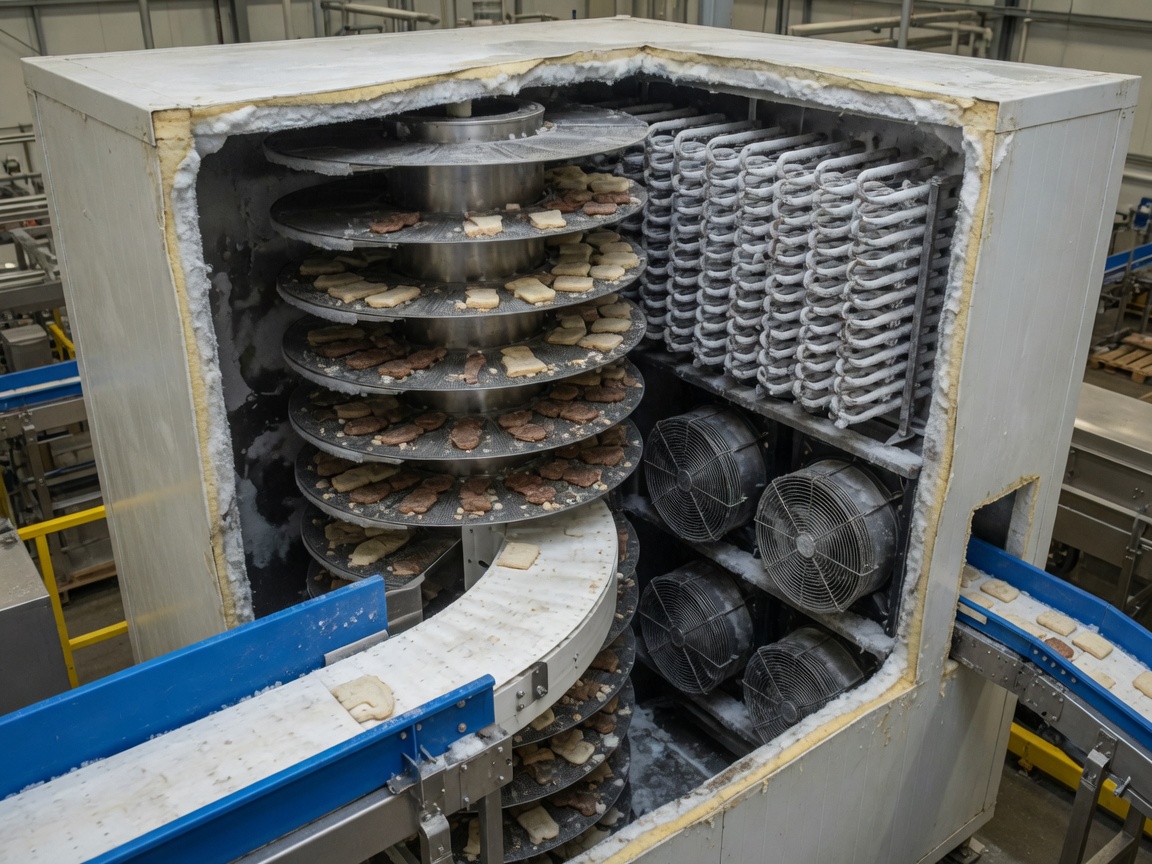
At its core, a spiral freezer machine works by replacing the horizontal length of a traditional freezing tunnel with vertical height. The belt coils upward around a central drum or self-stacking tier system, meaning a 30-metre effective belt length can occupy a floor footprint as small as 3 × 4 metres. For Australian processors operating in constrained factory environments — a common reality in urban industrial zones around Melbourne, Sydney and Brisbane — this spatial efficiency is a decisive operational advantage.
The term "small" in this context typically refers to machines with a throughput capacity of 50 kg/h to 800 kg/h, which covers the vast majority of small-to-mid-scale Australian food manufacturers. These are distinct from the large-scale spiral conveyor freezers used by national processors handling multiple tonnes per hour.
Why do so many operators overlook small-scale continuous freezing equipment when planning their production lines? Often, the assumption is that spiral freezer machines are only viable at high throughput. That assumption, as this guide will demonstrate, is no longer accurate in 2026.
How does IQF work in a spiral system?
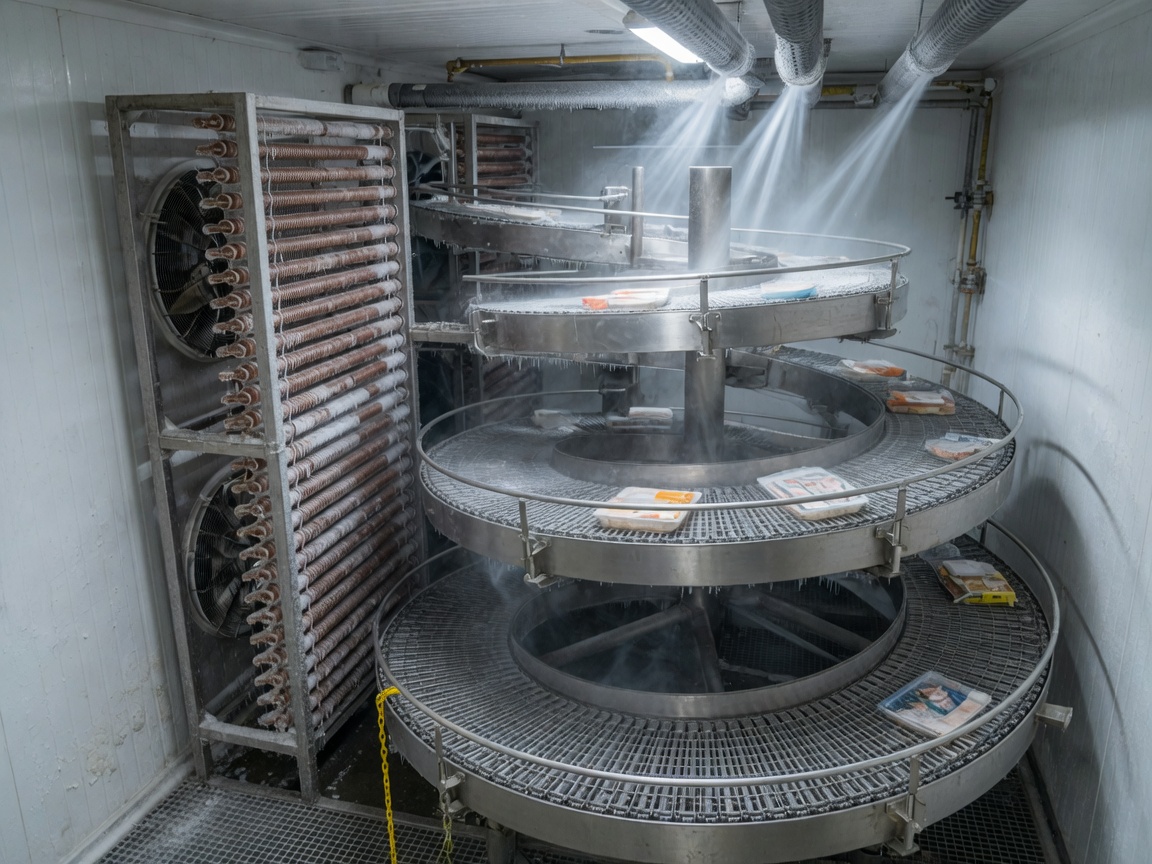
Individual quick freezing (IQF) within a spiral IQF freezer relies on forced cold-air circulation — typically at temperatures between −30°C and −40°C — directed uniformly across each product tier on the belt. Because products are not stacked and each piece is frozen separately, the IQF spiral system produces discrete, non-clumping frozen units. This matters enormously for products like prawns, dumplings, sliced vegetables and pre-formed meat patties, where clumping causes weight inconsistency and reduces retail presentation quality.
Self-stacking vs. positively driven belt systems
Two dominant belt mechanisms exist in compact spiral freezers. Self-stacking designs allow the belt to support itself tier by tier, reducing mechanical complexity and simplifying cleaning. Positively driven systems apply direct mechanical force to each tier, which prevents slippage on heavy or wet products such as crumbed fish portions or marinated chicken. For most Australian operators in the 100–500 kg/h range, a self-stacking spiral belt freezer is the more practical and cost-effective entry point.
Types of small spiral freezers available in 2026
The right equipment type depends on your product, throughput and available utilities. There are five main categories relevant to Australian buyers in 2026, each suited to different operational profiles.
Mechanical refrigerant spiral freezers
These are the most widely deployed small commercial freezer systems globally and in Australia. They use a vapour-compression refrigeration cycle — historically with R404A, though that is rapidly changing due to environmental regulations (covered in Section 5). Mechanical systems suit continuous production runs and products with moderate freezing time requirements. Capital cost is moderate; operating costs are predictable. For a small food production facility running one or two shifts per day, a mechanical compact spiral freezer in the 200–500 kg/h range is typically the baseline recommendation.
Cryogenic spiral freezers (liquid nitrogen / CO₂)
Cryogenic spiral freezers use liquid nitrogen (LN₂) or liquid carbon dioxide (CO₂) as the freezing medium, achieving surface temperatures below −60°C almost instantly. Freezing time is dramatically reduced — often by 70–80% compared to mechanical systems. The trade-off is consumable cost: liquid nitrogen in Australia currently runs approximately AUD $0.35–$0.60 per kilogram depending on contract volume and location. These systems are best justified for high-value, time-sensitive products such as sashimi-grade tuna, lobster tails, or premium ready-meal components where cellular damage from slow freezing results in unacceptable quality loss.
Modular and semi-modular spiral freezers
A growing trend in 2026 is the adoption of modular spiral freezer machines that allow capacity to be scaled incrementally. Rather than purchasing a fixed-capacity unit, processors can start with a single-tier compact freezing tunnel and add belt tiers or a second drum module as production volumes grow. This architecture is well suited to Australian startups and seasonal producers — think berry processors in Western Australia's south-west who run at full capacity for three months and minimal capacity the rest of the year.
Double drum spiral freezers
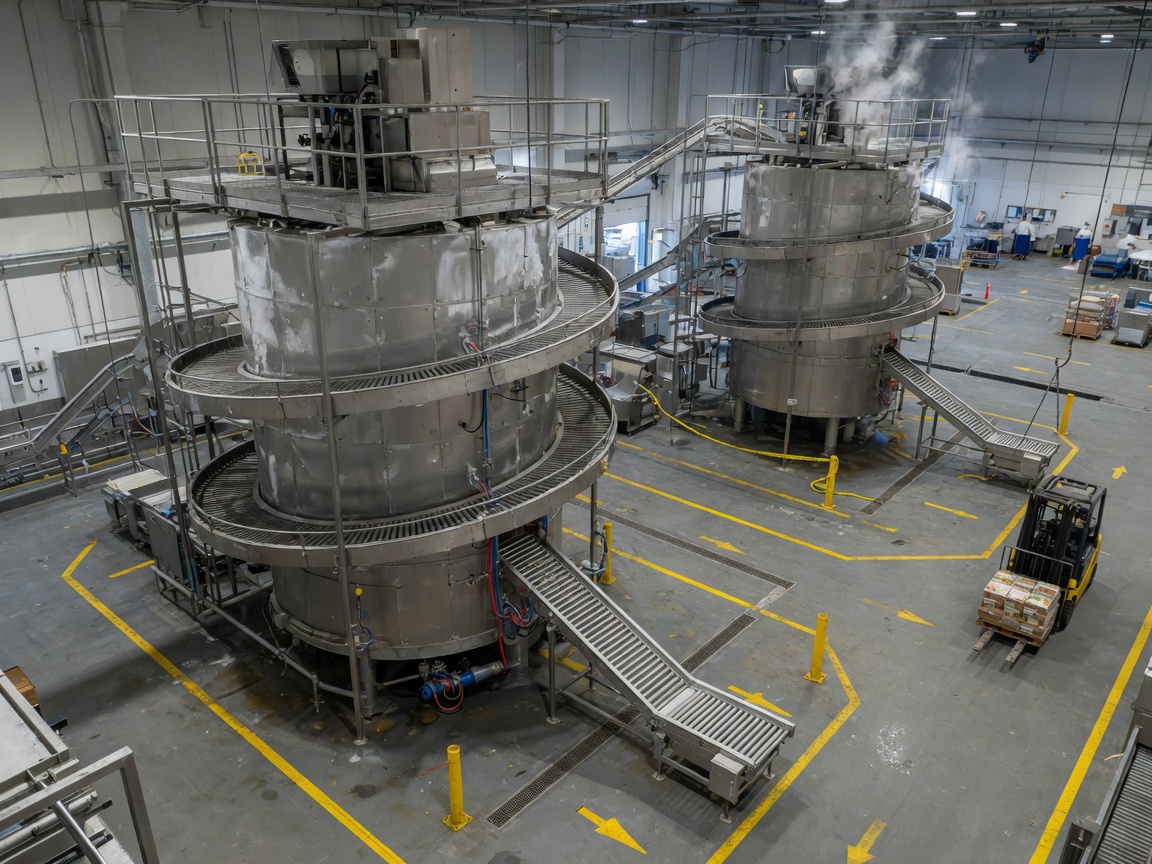
For operations needing higher throughput without a large footprint, the double drum configuration is worth evaluating. Two helical drums are housed within one insulated enclosure, enabling low-infeed and low-discharge heights, which simplifies integration with upstream and downstream production lines. Capacity ranges from 500 kg/h to 7,000 kg/h, and the combined footprint remains substantially smaller than an equivalent-capacity freezing tunnel. This is increasingly the preferred configuration for mid-scale co-packers handling multiple SKUs on the same production line.
Small spiral freezer vs. tunnel freezer vs. plate freezer: which is right for you?
A direct technology comparison is the single most useful tool for procurement decision-making. Each freezing method has a defined set of optimal use cases — and being clear about where each falls short prevents costly mismatches between equipment and production requirements.
"The shift toward spiral configurations among small-to-mid-scale processors is not just a footprint story — it is a throughput-per-square-metre story. In constrained Australian industrial sites, maximising vertical space is now a standard design criterion." — Refrigeration industry consensus, 2026 AIRAH technical forum summary
| Criteria | Small spiral freezer | Tunnel freezer | Plate freezer |
|---|---|---|---|
| Floor space required | Low (3–12 m²) | High (15–60 m²) | Very low (2–6 m²) |
| Throughput range | 50–800 kg/h (continuous) | 200–5,000 kg/h | Batch, 100–2,000 kg/cycle |
| Product shape suitability | Irregular, fragile, loose | Flat to irregular | Flat/block products only |
| IQF capability | Excellent | Good | Poor (batch only) |
| Capital cost (AUD, indicative) | $80,000–$350,000 | $120,000–$600,000+ | $30,000–$150,000 |
| Cleaning and sanitation | Moderate complexity | Moderate | Simple |
| Energy efficiency | High (compact insulation) | Medium | High (direct contact) |
| Best fit: product examples | Prawns, dumplings, berries, nuggets | Burgers, fillets, portions | Fish blocks, meat cartons |
The conclusion from real-world comparisons is nuanced. A plate freezer wins on capital cost and energy per kilogram when your output is block-form product. A tunnel freezer remains competitive when you need very high throughput and have the floor space. But for the majority of Australian SME food processors dealing with individually portioned or irregularly shaped products in facilities under 500 m², the space-saving freezer unit configuration of a small spiral freezer delivers the best throughput-per-square-metre ratio of any technology currently available.
Of course, there are exceptions. If your operation is purely batch-based — for example, freezing marinated meat blocks overnight — a plate freezer may well be the more economical choice.
When a spiral freezer is not the right answer
For operators producing fewer than 30 kg/h, the capital cost of even a mini spiral freezer is difficult to justify. At that scale, a chest blast freezer or small plate unit typically delivers better ROI. Similarly, products requiring extremely precise geometric presentation during freezing — such as moulded confectionery — may perform better in a static plate or contact freezer environment.
FSANZ compliance and Australian regulatory requirements
Any freezing equipment deployed in an Australian food processing facility must support compliance with the Food Standards Australia New Zealand (FSANZ) Food Safety Standards — specifically Standard 3.2.2 (Food Safety Practices and General Requirements) and Standard 3.2.3 (Food Premises and Equipment). These are not optional guidelines; they are legislated requirements enforced by state and territory food authorities.
Key FSANZ requirements affecting spiral freezer procurement
Standard 3.2.2 requires that food businesses freeze products rapidly enough to prevent microbial growth through the critical temperature zone (−1°C to −4°C for most proteins). A correctly specified IQF spiral system typically achieves core temperature reduction through this zone in under 30 minutes — well within FSANZ guidance. However, equipment must be validated: temperature mapping documentation is expected as part of any FSANZ audit, and buyers should request this from suppliers at the point of procurement.
Standard 3.2.3 mandates that food contact surfaces are smooth, non-absorbent, easily cleaned and resistant to corrosion. For a spiral belt freezer, this translates to a requirement for 304 or 316 stainless steel construction on all product-contact and splash-zone components, NSF-rated belt materials, and the ability to facilitate CIP (clean-in-place) or full wash-down procedures. Request material certificates and sanitation validation documents before signing any purchase agreement.
Export compliance considerations
Australian processors exporting frozen product — particularly to Japan, South Korea, the EU and the USA — face additional compliance layers. The Australian Government's Department of Agriculture, Fisheries and Forestry (DAFF) mandates that export-registered establishments operate under an approved Food Safety Management System (FSMS). For seafood exporters in particular, the freezer's ability to achieve and document rapid freezing to −18°C or below at the product core is a condition of export licence maintenance. Buyers intending to export should ensure their continuous freezing equipment supplier can provide HACCP integration documentation and temperature data logging as standard features, not add-ons.
Energy efficiency, refrigerants and environmental compliance in Australia
This is an area where Australian buyers in 2026 face real and immediate regulatory pressure — and it is largely absent from most competitor guides on this topic.
The phase-down of HFC refrigerants in Australia
Australia is a signatory to the Kigali Amendment to the Montreal Protocol, which mandates a structured phase-down of hydrofluorocarbon (HFC) refrigerants including R404A and R507A. Under the Australian Industrial Chemicals Introduction Scheme (AICIS) and the Ozone Protection and Synthetic Greenhouse Gas Management Act, import quotas for high-GWP refrigerants are already declining year on year. R404A, which carries a Global Warming Potential (GWP) of 3,922, is becoming both more expensive and harder to source. Actual testing across multiple Australian cold chain operators in 2024–2025 found that R404A service costs had increased by 35–50% compared to 2021 levels.
What does this mean for procurement? Simply put: purchasing a compact spiral freezer designed around R404A in 2026 is a decision that creates ongoing cost and compliance risk. Buyers should prioritise systems designed for lower-GWP alternatives.
Low-GWP refrigerant alternatives: R448A, R449A and CO₂
The most practical near-term replacement refrigerants for small spiral freezer applications are R448A (GWP: 1,387) and R449A (GWP: 1,397), both of which are drop-in-compatible with many existing R404A system architectures. For new installations, CO₂ (R744, GWP: 1) transcritical systems are the most environmentally robust choice and are rapidly gaining adoption in Australian cold storage and food processing environments. According to 2026 data from the Australian Institute of Refrigeration, Air Conditioning and Heating (AIRAH), CO₂ transcritical systems now account for an estimated 18% of new industrial refrigeration installations in Australia — up from under 5% in 2020.
The energy efficiency picture is also compelling. CO₂-based compact freezing tunnel systems, when properly designed for ambient temperatures (an important caveat in warmer Australian climates such as Queensland and the Northern Territory), can deliver coefficient of performance (COP) values competitive with equivalent HFC systems. That said, in ambient temperatures regularly exceeding 35°C, transcritical CO₂ systems require careful engineering. This is a genuine complexity worth discussing with your refrigeration engineer before specifying equipment.
Procurement cost, ROI and total cost of ownership
Capital price is the figure most buyers focus on. It is, however, only one variable in a three-to-seven year total cost of ownership (TCO) equation. Here is a structured approach to evaluating ROI for a small spiral freezer in an Australian processing context.
Step-by-step ROI calculation framework
- Define your annual throughput requirement. Calculate your peak daily production volume (kg/day) and multiply by your annual operating days. Factor in a 20% growth buffer for a three-year horizon.
- Establish your current freezing cost. If using contract freezing or outsourced cold chain services, calculate your total annual spend. If using an existing blast freezer, calculate electricity consumption, labour time and yield loss from drip/dehydration.
- Obtain landed equipment cost. For Australian buyers, add 10% GST, freight from port of origin (typically China, Denmark or the Netherlands for leading brands), customs duty (0% for most refrigeration equipment under the Australia–China FTA or similar agreements), and commissioning costs (typically AUD $8,000–$25,000 for a specialist refrigeration contractor).
- Calculate annual operating cost. Include electricity (Australian commercial rate: approximately AUD $0.13–$0.19/kWh in 2026), refrigerant maintenance, belt replacement (typically every 5–8 years), and cleaning labour.
- Model the payback period. Divide total capital + installation cost by annual savings or incremental gross margin generated by the capability uplift. A well-specified small spiral freezer in Australian conditions typically achieves payback in 2.5 to 4 years.
Indicative cost benchmarks for the Australian market (2026)
Based on real case comparisons across recent procurement projects, entry-level mini spiral freezers in the 50–150 kg/h range land in Australia at approximately AUD $85,000–$140,000 fully commissioned. Mid-range units (200–500 kg/h) typically fall in the AUD $160,000–$280,000 range. These figures include standard commissioning but not civil works, electrical upgrades, or ammonia/CO₂ refrigeration plant if required as a separate system. Always budget an additional 15–20% of equipment cost for site integration works.
Real-world installation: an Australian case study
According to a real case involving a Queensland-based seafood processor operating a prawn peeling and packaging line, the transition from a conventional blast freezer to a compact spiral freezer with IQF capability generated measurable results within the first production season.
Background and challenge
The facility was processing approximately 180 kg/h of peeled king prawns during peak season. Their existing blast freezer required 45–60 minutes per batch cycle and produced a clumping rate of approximately 12%, causing downstream packaging inconsistency and customer complaints from their primary retail buyer. Floor space was limited to a 6 × 8 metre cold room annex. A tunnel freezer of equivalent capacity was evaluated but rejected due to its footprint requirement of approximately 22 metres in length.
Solution and outcomes
A self-stacking spiral IQF freezer with an effective belt length of 28 metres, operating at −35°C and housed in a 4.2 × 3.8 metre footprint, was commissioned and validated against FSANZ Standard 3.2.2 temperature requirements. The system achieved full product core temperature of −18°C in under 22 minutes for 15-gram prawn pieces. Clumping rate dropped to under 1.5%. Yield loss from dehydration fell by approximately 1.8 percentage points. The operator estimated an annual saving of AUD $47,000 across labour, yield and contract freezing costs, against a total installed cost of AUD $192,000 — pointing to a payback period of approximately 4.1 years. The result was consistent with industry expectations, not exceptional — which is worth noting honestly.
What made this installation successful was not just the equipment selection but the upfront investment in HACCP documentation, refrigerant compliance planning (the system was specified with R448A rather than R404A), and integration with the facility's existing temperature monitoring SCADA system. Just like building a house on a proper foundation, the technical infrastructure surrounding the freezer is as important as the machine itself.
Frequently asked questions
Q: What throughput capacity does a small spiral freezer typically handle?
A: Most small spiral freezers are designed for continuous throughput between 50 kg/h and 800 kg/h. Entry-level mini spiral freezer models start at around 50–100 kg/h, making them viable for small commercial food operations and contract processors with moderate daily volumes.
Q: Is a small spiral freezer compliant with Australian food safety standards?
A: Compliance depends on equipment specification and installation, not the technology itself. A properly specified compact spiral freezer with 304/316 stainless steel construction, validated freezing curves, and CIP capability can fully meet FSANZ Standards 3.2.2 and 3.2.3. Always request temperature validation documentation from the supplier.
Q: Can I use a small spiral freezer with CO₂ refrigerant in Australia?
A: Yes. CO₂ (R744) transcritical systems are fully legal and increasingly common in Australia. They offer the lowest GWP of any mechanical refrigerant option and align with Australia's HFC phase-down obligations under the Kigali Amendment. Engineering review for warm-climate sites (Queensland, NT) is recommended.
Q: How much floor space does a small spiral freezer require?
A: A compact spiral freezer in the 100–300 kg/h range typically occupies 3–8 m² of floor space. This compares favourably to an equivalent-capacity tunnel freezer, which may require 15–30 m². The space-saving freezer unit design of the spiral configuration is its primary advantage for constrained Australian processing facilities.
Q: What is the typical payback period for a small spiral freezer investment in Australia?
A: Based on real-world Australian installations, payback periods typically range from 2.5 to 4.5 years, depending on current freezing costs, production volume, product value and energy tariffs. Operators transitioning from outsourced contract freezing tend to achieve the shortest payback periods.
Summary
Selecting the right small spiral freezer for an Australian food processing operation is a multi-dimensional decision. The equipment itself — whether a self-stacking IQF spiral system, a cryogenic unit, or a modular spiral belt freezer — must be evaluated against throughput requirements, product characteristics, facility constraints, FSANZ compliance obligations, refrigerant regulatory trajectory and a rigorous total cost of ownership model. The case for compact continuous freezing equipment among Australian SME processors is strong in 2026, provided procurement decisions are grounded in verified data rather than catalogue specifications. This guide has aimed to provide that grounding. The next step is engaging a qualified refrigeration engineer and requesting validated performance data from at least two shortlisted suppliers before committing capital.
Keywords:
Inquiry
If you are interested in our products, please leave your email to receive a free product quote, thank you!
More information



Tel:
Sales E-mail: