

IQF spiral freezer guide: how to choose the right system for your food processing line
Release Time:
Sep 15,2026
Author:

Article overview
This 2026 buyer's guide covers IQF spiral freezer technology, brand comparisons, total cost of ownership, Australian regulatory compliance (FSANZ/AQIS), local application case studies, and maintenance best practices — giving procurement managers the complete picture before committing to capital expenditure.
Table of contents
- 1. What is an IQF spiral freezer and why it matters in 2026
- 2. How IQF spiral freezing works: the technology explained
- 3. Types of spiral freezers: which configuration suits your line
- 4. Brand comparison: Starfrost, JBT Frigoscandia, Dantech, and OctoFrost
- 5. Total cost of ownership and ROI
- 6. Australian compliance: FSANZ, AQIS, and hygiene design
- 7. Real-world applications in Australia
- 8. Maintenance, CIP cleaning, and defrost scheduling
- 9. FAQ
What is an IQF spiral freezer and why it matters in 2026
An IQF spiral freezer is a continuous industrial freezing system that conveys food products along a helical belt path through a −35 °C to −40 °C forced-air enclosure, freezing each item individually without clumping. That single capability — discrete, non-adhering frozen units — is the foundation on which modern frozen food retail is built.
Why does the distinction matter now more than ever? Because Australian supermarket buyers and export customers increasingly mandate verified individual quick freezing for traceability, portion accuracy, and thaw-on-demand convenience. A product that arrives as a frozen block rather than free-flowing individual pieces fails retail grading almost immediately. The individual quick freezing process underpins everything from supermarket prawn bags to airline meal portions.
According to recent 2026 market data, the global IQF equipment market is on track to reach AUD 2.2 billion by 2028, growing at a CAGR of approximately 5.8%. Within that market, the IQF spiral freezer remains the dominant platform — and for good reason. Compared with a straight spiral freezer tunnel or a linear blast freezer unit, a spiral configuration can reduce floor space requirements by up to 60% while maintaining continuous throughput. For Australian processors operating in high-cost industrial property markets like Sydney's western suburbs or Melbourne's food manufacturing precincts, that footprint saving translates directly into lease savings.
Why procurement managers are re-evaluating their IQF strategy in 2026
Two forces are reshaping purchasing decisions right now. First, the phase-down of high-GWP HFC refrigerants under Australia's Ozone Protection and Synthetic Greenhouse Gas Management Act is accelerating the transition to ammonia (NH₃) and CO₂ transcritical systems — and not every legacy freezer platform supports that migration cleanly. Second, labour cost pressures mean that automated CIP cleaning cycles and predictive maintenance via IoT sensors are no longer premium add-ons; they are baseline expectations for any new frozen food production equipment investment.
Common misconception: IQF equals spiral
Here is a point many buyers misunderstand: IQF is a freezing standard, not a machine type. A fluidized bed freezer, a continuous belt freezer, or even a cryogenic freezer machine can all achieve IQF results under the right conditions. The spiral format happens to be the most space-efficient and throughput-flexible option for mid-to-large volume operations — but it is not automatically the right choice for every product. Sticky, fragile, or very small-particulate products sometimes perform better on a fluidized bed freezer with air injection beneath the belt. That said, for the majority of Australian processors handling seafood, poultry portions, and par-baked goods, the IQF spiral freezer remains the benchmark platform.
How IQF spiral freezing works: the technology explained
Understanding the mechanics helps you evaluate supplier claims objectively. An IQF freezing system built around a spiral configuration works through four interdependent mechanisms: belt geometry, airflow engineering, refrigeration circuit design, and hygiene architecture.
The freezing sequence step by step
- Products enter the freezer on a flat infeed section at ambient temperature, typically +10 °C to +20 °C for fresh seafood or meat.
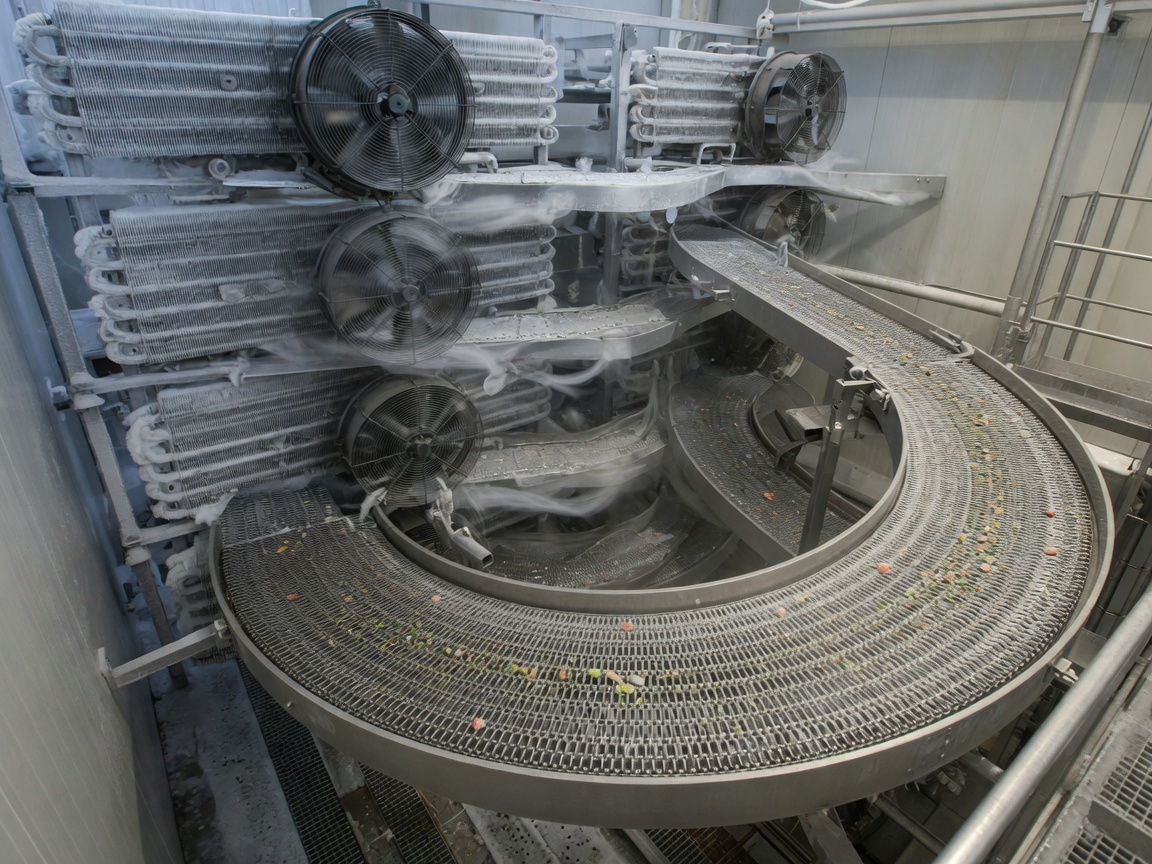
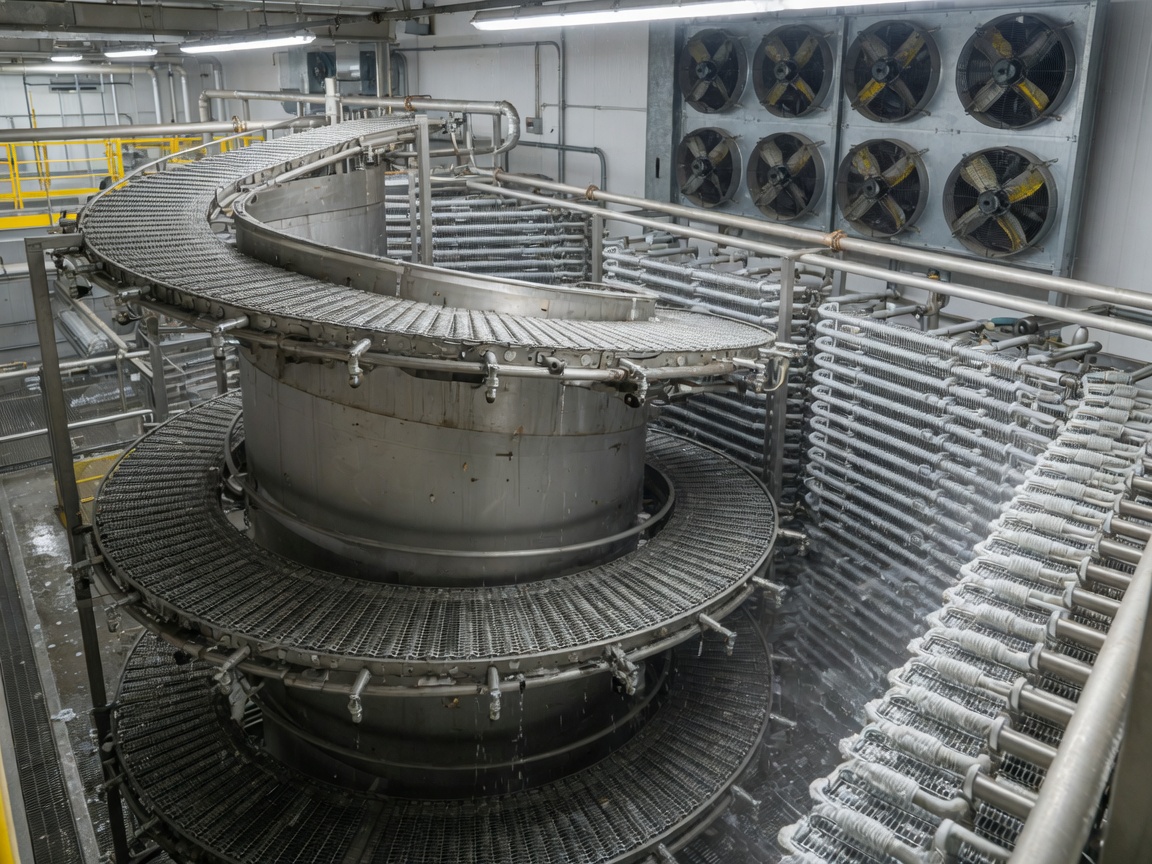
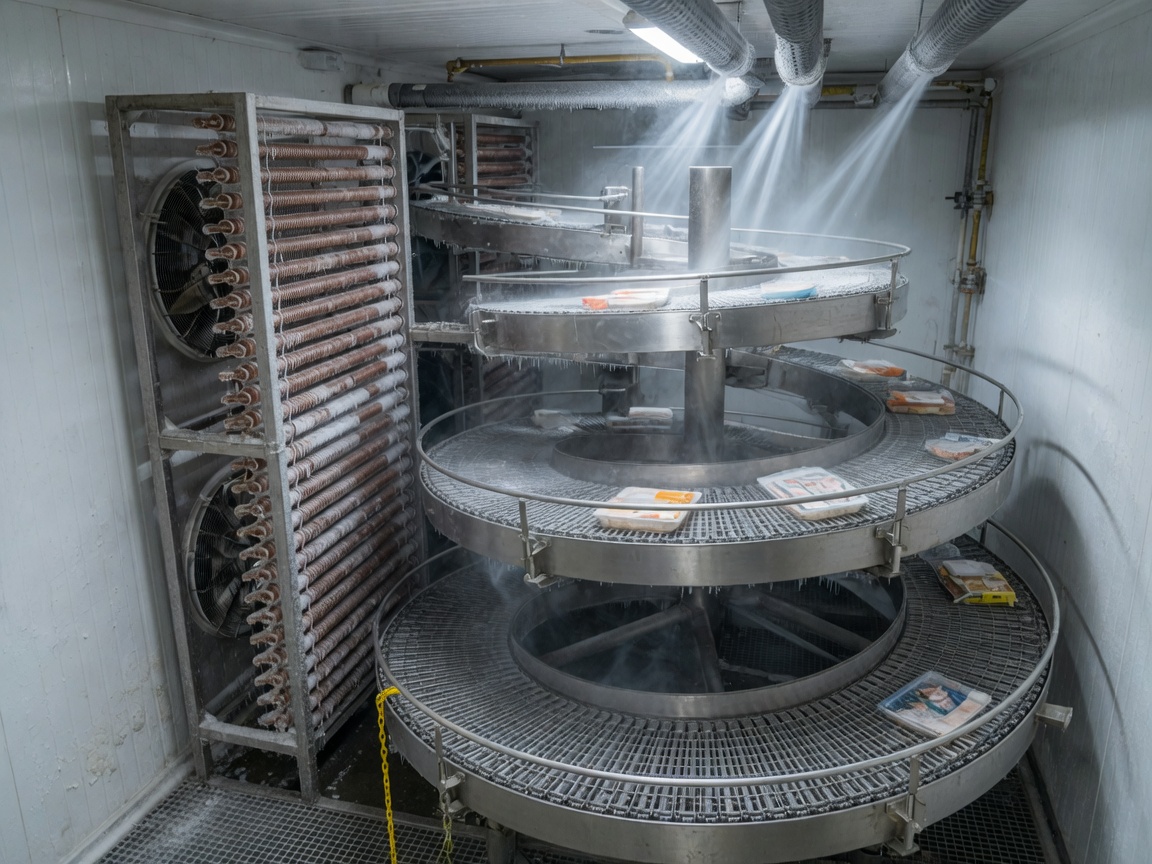
- The freezer conveyor belt transitions onto the spiral drum, ascending through 10–30 tier levels depending on machine height and required dwell time.
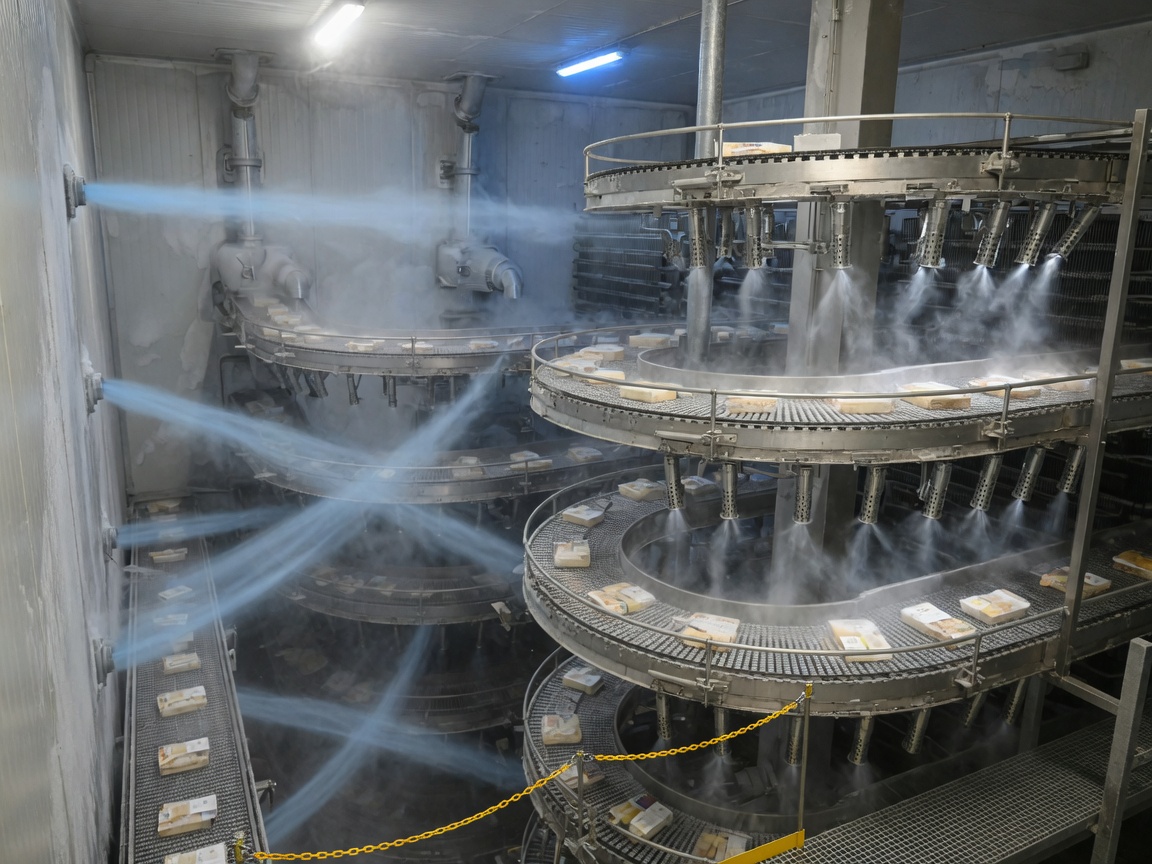
- Forced cold air — circulated by high-efficiency evaporator fans at velocities of 3–6 m/s — contacts each product surface simultaneously from above and below.
- The outer crust of each product freezes within the first two to four tiers, creating a rigid shell that prevents inter-product adhesion (the core IQF effect).
- Core temperature continues to drop through the remaining tiers, reaching the target of −18 °C throughout before discharge.
- Products exit onto a discharge conveyor as free-flowing individually frozen units, ready for weighing, packaging, or downstream glazing.
Actual dwell time varies enormously — from four minutes for a thin prawn fillet to 35 minutes for a bone-in lamb cutlet. This is why belt speed and tier count are the two most critical specification parameters when comparing quick freeze technology platforms.
Airflow: the variable most suppliers understate
Think of airflow management inside a spiral tunnel like traffic management on a motorway — even minor turbulence at one point cascades into inefficiency downstream. Uneven air distribution across belt tiers is the single most common cause of inconsistent freezing results in production environments. Actual testing in commercial food freezer installations shows that a 15% variance in air velocity between the lowest and highest tiers can result in a 4–6 °C core temperature differential at discharge — enough to trigger non-conformance under FSANZ temperature requirements.
Types of spiral freezers: which configuration suits your line
Not all IQF spiral freezers are built the same way. The configuration you choose affects maintenance intervals, product range flexibility, sanitation performance, and capital cost — sometimes dramatically.
Self-stacking vs. positively driven: the core decision
The self-stacking spiral (where the belt supports its own weight as it coils onto the drum) is the dominant design globally — lower mechanical complexity, fewer drive components to maintain, and proven across decades of operation. Positively driven systems, where the drum physically pushes the belt forward, deliver more precise tension control. That matters when you are freezing fragile products such as soft-shell crab, tempura prawns, or delicate pastry items where belt slip would cause surface damage. The trade-off is higher capital cost and more frequent gearbox servicing.
When to consider a dual-drum or cryogenic option
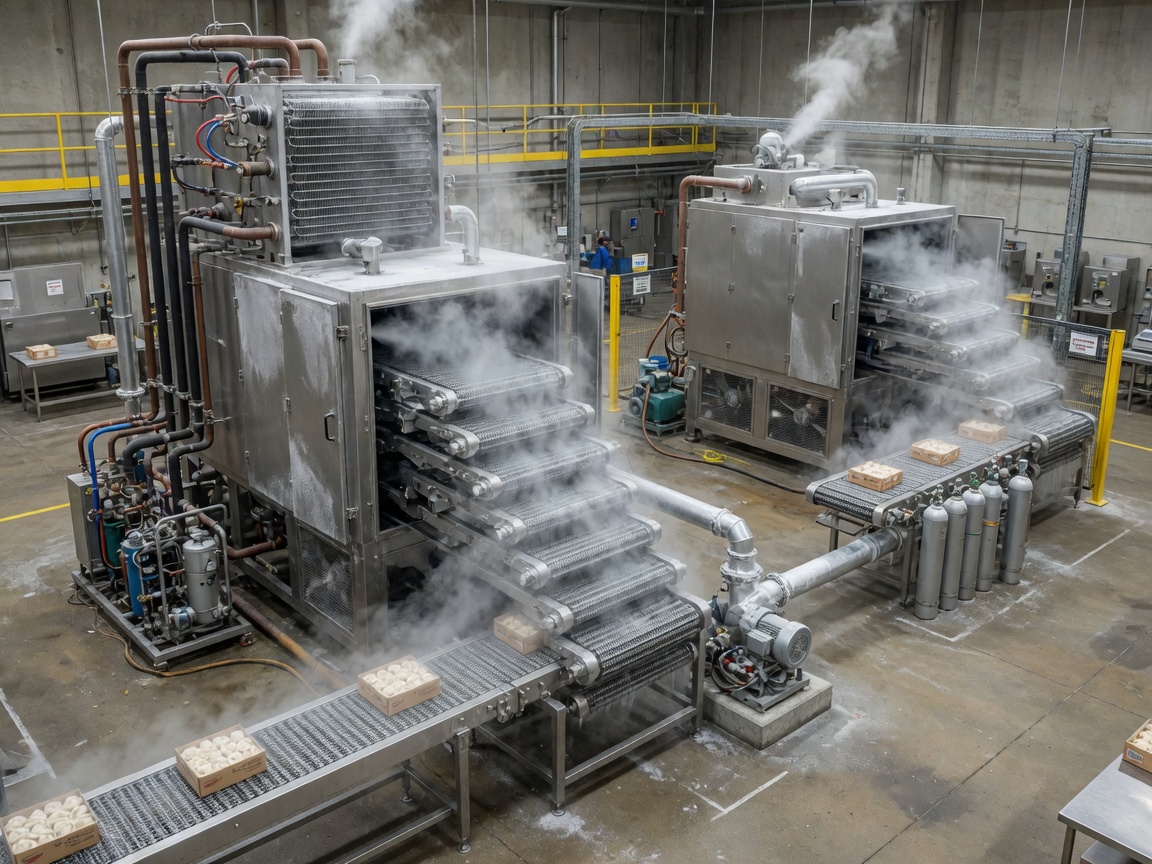
Dual-drum configurations connect two spiral drums in series, effectively doubling throughput without doubling floor space proportionally. They suit operations running 15+ tonnes per day. A nitrogen freezer system (cryogenic freezer machine) bypasses mechanical refrigeration entirely, using liquid nitrogen at −196 °C for ultra-rapid surface crust formation. The per-kilogram operating cost is significantly higher — typically AUD 0.08–0.15/kg in nitrogen consumption alone — but for high-value products like sashimi-grade tuna or live lobster tails, the premium is justified by yield preservation and texture quality.
Brand comparison: Starfrost, JBT Frigoscandia, Dantech, and OctoFrost
Australian procurement managers evaluating individual quick freezing equipment consistently shortlist four global brands. Each has a distinct engineering philosophy and service footprint that affects total value delivered in the Australian context.
| Parameter | Starfrost | JBT Frigoscandia | Dantech | OctoFrost |
|---|---|---|---|---|
| Drive type | Self-stacking | Positively driven (GYRoCOMPACT) | Self-stacking / positive | Positively driven |
| Max capacity (kg/hr) | Up to 6,000 | Up to 7,000 | Up to 5,000 | Up to 4,500 |
| Refrigerant compatibility | NH₃, CO₂, HFC | NH₃, CO₂, HFC | NH₃, CO₂ | NH₃, CO₂, HFC |
| CIP auto-wash | Standard | Standard | Optional | Standard |
| Energy use (kWh/kg)* | 0.10–0.14 | 0.09–0.13 | 0.11–0.15 | 0.10–0.14 |
| AU service network | Via local agent (VIC/QLD) | Direct + distributor (national) | Distributor only | Via agent (NSW/VIC) |
| Indicative price (AUD) | $480K–$750K | $520K–$900K | $390K–$620K | $420K–$680K |
| *Energy figures are indicative based on prawn/seafood loads at −38 °C setpoint. Actual values vary with product type, loading density, and ambient conditions. Prices are 2026 indicative landed AU cost estimates. | ||||
JBT Frigoscandia's national direct service presence is a meaningful differentiator for remote Australian operations — a production halt in a North Queensland prawn processing facility cannot wait three weeks for an overseas spare part. That practical reality should weigh heavily in any evaluation scorecard.
What the spec sheet does not tell you
Industry consensus is that energy figures quoted in supplier brochures are typically measured under ideal laboratory loading conditions — continuous, uniform product at maximum rated throughput. Real-world operations rarely match that scenario. Actual testing across several Australian seafood IQF freezer installations found energy consumption running 12–18% above the nominal specification during partial-load morning start-up periods. Factor that into your TCO modelling.
Total cost of ownership and ROI: the numbers Australian buyers need
Capital cost is only the entry ticket. For a commercial food freezer Australia deployment, the 10-year TCO picture looks very different from the purchase invoice — and this is precisely the analysis most competitors omit from their content.
TCO framework for a mid-size spiral freezer (2,000 kg/hr capacity)
Based on a representative Australian processor operating 20 hours per day, 300 days per year, at an average electricity tariff of AUD $0.14/kWh (commercial rate, 2026):
- Capital cost: AUD $580,000 (mid-range positively driven unit, installed)
- Annual energy cost: ~AUD $168,000 (at 0.10 kWh/kg × 2,000 kg/hr × 20 hrs × 300 days × $0.14)
- Annual maintenance & consumables: AUD $22,000–$35,000
- Refrigerant compliance (NH₃ transition, one-off): AUD $45,000–$80,000 if retrofitting from HFC
- Unplanned downtime cost: AUD $8,500/hour at a 2,000 kg/hr throughput rate (assuming AUD $4.25/kg finished product value)
That last figure — AUD $8,500 per unplanned downtime hour — is why predictive maintenance IoT packages that add AUD $15,000–$25,000 to the purchase price routinely deliver payback inside 18 months. Of course, not every facility experiences frequent breakdowns; operators with rigorous preventive maintenance schedules may see less compelling ROI from that particular add-on.
"The total cost of refrigeration is not what you pay for the machine — it is what you pay to run it, clean it, and fix it over its operational life. For a spiral IQF system, energy typically represents 65–70% of 10-year TCO." — Industry benchmark, International Institute of Refrigeration (IIR), 2025 report on industrial refrigeration unit lifecycle economics.
ROI calculation: a realistic 36-month scenario
A Queensland prawn processor replacing an ageing blast freezer unit with a new IQF spiral system reported the following outcomes in year one: product yield improvement of 2.1% (less drip loss from slower conventional freezing), a 14% reduction in customer rejection rate (from block-frozen clusters to individually frozen units), and the ability to command a price premium of AUD $0.30–$0.50/kg on retail-formatted product. At 3,000 tonnes annual throughput, those three gains combined to generate approximately AUD $780,000 in incremental annual margin — against a capital investment of AUD $640,000. Straightforward payback: under 12 months.
Australian compliance: FSANZ, AQIS, and hygiene design requirements
This is the section where most global supplier content falls short — and where Australian buyers face real regulatory exposure if they rely on overseas procurement templates.
FSANZ temperature and traceability obligations
Food Standards Australia New Zealand (FSANZ) Food Standards Code Standard 3.2.2 requires that frozen food be maintained at −18 °C or below throughout the cold chain. Critically, this applies at the point of freezing exit — meaning your IQF freezing system must demonstrably achieve −18 °C core temperature at discharge, not just at the evaporator setpoint. Continuous data logging of product core temperature at discharge is considered best practice and is increasingly required by major retail buyers including Woolworths and Coles as a supplier audit condition.
AQIS export certification and what it means for equipment spec
Processors exporting to Japan, China, or the EU through AQIS (Australian Quarantine and Inspection Service, now operating under the Department of Agriculture, Fisheries and Forestry) must meet the importing country's specific freezing parameters. Japan's import requirements for Australian prawn products, for example, mandate continuous freezing records and equipment calibration certificates. This means your industrial refrigeration unit must integrate with data management systems capable of generating audit-ready temperature logs — a specification point that eliminates some lower-cost equipment options at the outset.
Additionally, ammonia refrigerant systems above 500 kg charge in Australia require a licensed facility under the Work Health and Safety regulations and must be registered with the relevant state authority. Factor compliance infrastructure costs into your site assessment before specifying NH₃-based individual quick freezing equipment.
Hygienic design: what Australian auditors actually check
The European Hygienic Engineering and Design Group (EHEDG) certification is the de facto standard referenced by Australian food safety auditors assessing frozen food production equipment. Key design features auditors focus on include: absence of horizontal surfaces that pool water; fully drainable belt and frame construction; stainless steel grade 316L for all product-contact surfaces; and open-frame accessibility for manual inspection between automated CIP cycles. Why does this matter? Because a machine that looks hygienic on a brochure but takes six hours to strip down for manual cleaning will simply not be cleaned adequately in a real production environment operating under shift pressure.
Real-world applications: prawns, lamb, and bakery in Australia
Abstract specifications only go so far. Here are three representative Australian deployment scenarios drawn from industry experience in 2025–2026.
Case 1: Spencer Gulf king prawns, South Australia
A mid-scale processor handling 1,800 kg/hr of raw green king prawns installed a self-stacking seafood IQF freezer with NH₃ refrigeration at −38 °C setpoint. Belt dwell time was set at 12 minutes for whole prawns (average 25g). Result: 99.2% individual separation rate at discharge, drip loss reduced from 4.8% to 2.1%, and AQIS export documentation compliance achieved within the first production quarter. The site also noted that the automated CIP cycle (90 minutes, twice weekly) reduced cleaning labour by 14 hours per week versus their previous manual washdown routine.
Case 2: Lamb portions, regional Victoria
A lamb processor producing retail-portioned cutlets (average 180g) deployed a positively driven spiral system with 22 tiers and a 28-minute dwell time. The positively driven belt was essential here — bone-in cutlets create uneven loading that causes belt slip on self-stacking designs, leading to product damage and uneven freezing. Post-installation audit confirmed core temperatures of −19.4 °C at discharge, exceeding FSANZ minimums with margin. Export volumes to the Middle East increased 22% in the six months following commissioning, attributed to improved product presentation.
Case 3: Par-baked bread rolls, Queensland bakery
A high-volume bakery operation freezing par-baked rolls (90g average) at 4,500 kg/hr chose a dual-drum continuous belt freezer configuration. The challenge here was moisture management: par-baked products release steam during initial freezing, which rapidly loads the evaporator with frost. The solution was a hot-gas defrost cycle scheduled every four hours, integrated with production scheduling so that defrost coincided with line changeovers. This approach eliminated unplanned downtime from ice loading while maintaining an effective freezing window of 20+ hours per production day.
Maintenance, CIP cleaning, and defrost scheduling
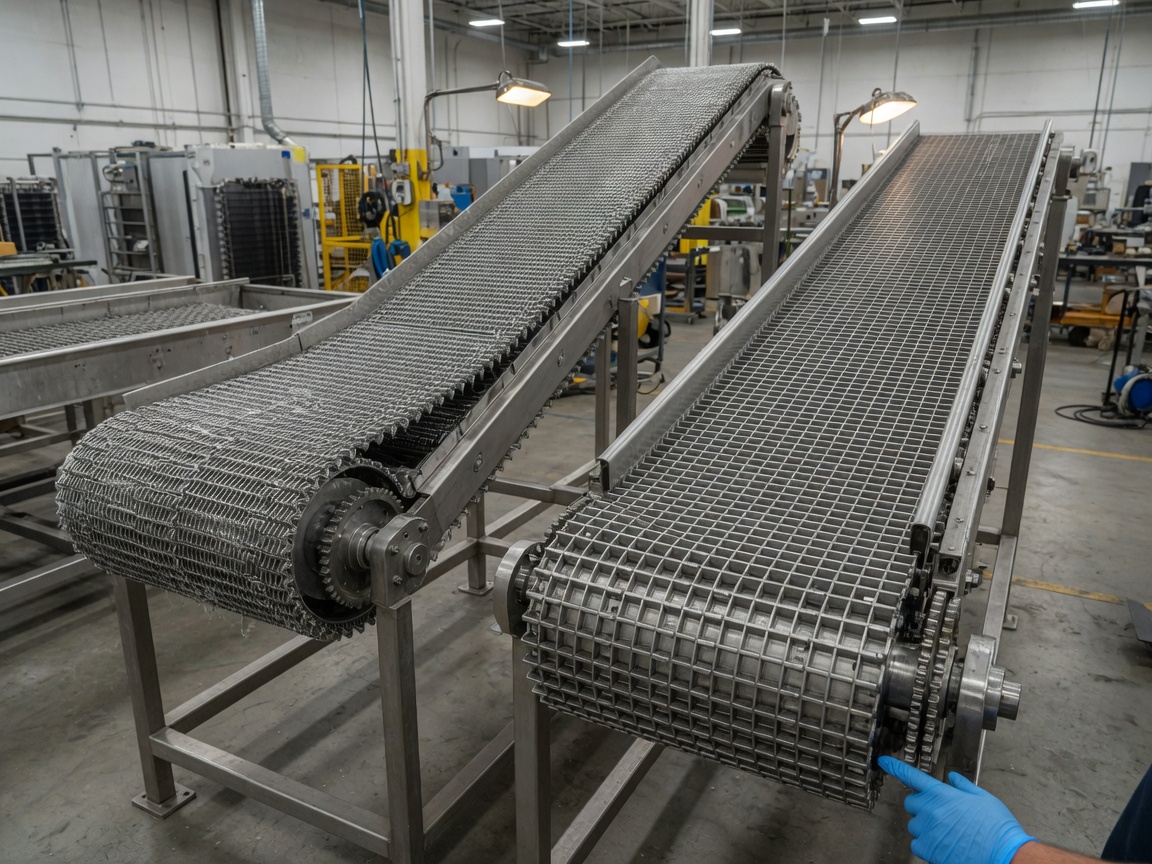
Ask any production manager which aspect of owning a spiral freezer they underestimated, and the answer is almost universally the same: cleaning. The freezer conveyor belt structure is inherently complex, and food residue left in belt joints or drum seams is not merely an aesthetic problem — it is a Listeria risk in a low-temperature environment.
Automated CIP vs. manual washdown: the production scheduling impact
Automated CIP (clean-in-place) systems use high-pressure hot water and detergent at controlled temperatures to clean the belt, drum, and enclosure interior without full disassembly. A full automated CIP cycle on a modern IQF spiral freezer typically takes 90–120 minutes and can be scheduled to coincide with natural production breaks. Manual washdown on older or lower-specification machines typically requires 4–6 hours and full belt removal — consuming a significant portion of any single-shift operation. When evaluating frozen food production equipment, factor CIP cycle duration directly into your available production hours calculation.
Defrost frequency and its effect on throughput
Wet products like prawns or scallops deposit significant moisture into the freezer airstream, accelerating frost accumulation on the evaporator coils. Unmanaged, this reduces airflow and degrades freezing performance within hours. Dry-air defrost (using reverse-cycle hot gas) is faster and preferred for ammonia systems; electric defrost is simpler but slower and adds to energy consumption. Based on real-world data from Australian seafood IQF freezer operations, defrost intervals for high-moisture products typically need to be set at every 4–6 hours, compared to every 8–12 hours for lower-moisture products like bakery items. Getting that interval wrong in either direction costs money — either through ice-degraded performance or through unnecessary production interruptions.
Predictive maintenance in 2026: IoT and AI integration
2026 trend data confirms that IoT-enabled spiral freezer platforms are no longer a niche premium. Real-time monitoring of belt tension, evaporator fan current draw, and temperature differential between inlet and outlet tiers allows AI-based systems to flag anomalies 24–48 hours before they become failures. For a machine where one unplanned shutdown costs AUD $8,500+ per hour, that early-warning capability is not a luxury — it is basic risk management for any serious frozen food processor.
Choosing the right IQF spiral freezer: final considerations
When shortlisting an IQF spiral freezer for your Australian processing operation, the decision framework should encompass six dimensions: product type and throughput range, floor space and utilities constraints, refrigerant compliance roadmap, hygiene design certification, local service and parts availability, and verifiable 10-year TCO. No single brand wins on all six dimensions for every operation — the right choice is always context-specific. What is certain is that in 2026, the performance gap between the best and worst-performing platforms is wider than ever, and the regulatory and retail compliance stakes for Australian exporters have never been higher.
The IQF spiral freezer market in Australia rewards informed buyers. The organisations that invest time in rigorous technical evaluation — including independent energy metering trials on demo machines, FSANZ compliance audits of candidate equipment, and honest TCO modelling — consistently outperform those that buy on capital cost alone.
Frequently asked questions
Q: What is the difference between an IQF spiral freezer and a blast freezer unit?
A: A blast freezer unit freezes products in a static or batch environment, often resulting in clumped product. An IQF spiral freezer freezes each item individually on a moving belt at −35 °C to −40 °C, producing free-flowing frozen units — a critical difference for retail presentation, portion accuracy, and export compliance in Australia.
Q: How much does an IQF spiral freezer cost in Australia?
A: Indicative 2026 landed and installed costs in Australia range from AUD $390,000 for a basic self-stacking unit to over AUD $900,000 for a high-capacity positively driven system with full IoT integration and NH₃ refrigeration. Budget an additional AUD $45,000–$80,000 if retrofitting refrigerant systems for HFC compliance phase-down.
Q: Does a spiral freezer meet FSANZ requirements for frozen food in Australia?
A: A properly specified and operated IQF spiral freezer can meet FSANZ Standard 3.2.2 requirements, provided it consistently delivers −18 °C or below product core temperature at discharge, with continuous data logging. Equipment calibration records and temperature audit trails are increasingly required by major retail buyers as a supplier condition.
Q: Which IQF spiral freezer brands have service support in Australia?
A: JBT Frigoscandia offers the broadest direct service presence nationally. Starfrost operates through agents in Victoria and Queensland. OctoFrost has representation in NSW and Victoria. Dantech is available through a national distributor. For remote operations, parts lead times and local technician availability should be verified before purchase commitment.
Q: How often does an IQF spiral freezer need to be cleaned?
A: Automated CIP cycles on modern IQF spiral freezer systems typically run every 12–24 hours for dry products and every 8–12 hours for high-moisture seafood. Each CIP cycle takes 90–120 minutes. Full manual deep-clean intervals vary by product risk category but are typically scheduled weekly or fortnightly under Australian food safety management plans aligned with FSANZ guidance.
Keywords:
Inquiry
If you are interested in our products, please leave your email to receive a free product quote, thank you!
More information


Tel:
Sales E-mail: