

Walk in cold room guide: how to choose, install and maintain the right unit
Release Time:
Oct 14,2026
Author:

Article overview
This guide walks you through every stage of the walk in cold room decision process — definition, unit comparison, sizing, installation, 2026 DOE compliance, smart monitoring, maintenance, and real-world use cases across five industries. Estimated reading time: 14 minutes.
Table of contents
- 1. What is a walk in cold room?
- 2. Modular vs. custom-built cold rooms: a side-by-side comparison
- 3. How to size and select the right unit for your operation
- 4. Walk in cold room installation: what to expect
- 5. 2026 energy efficiency regulations and compliance checklist
- 6. Smart temperature monitoring and IoT integration
- 7. Maintenance schedule and troubleshooting guide
- 8. Industry-specific use cases
- 9. FAQ
What is a walk in cold room?
A walk in cold room is a large, insulated refrigerated enclosure — typically ranging from 6×6 ft to warehouse scale — that allows personnel to physically enter and manage stored inventory at controlled temperatures. Unlike a standard reach-in refrigerator, it is a permanent or semi-permanent structure built from insulated panel walls rated R-25 to R-40, paired with a dedicated commercial refrigeration unit. Temperature ranges vary by application: a walk-in cooler holds 35–38°F for produce and beverages, while a walk-in freezer maintains -10°F to 0°F for meat and frozen goods.
The distinction between a walk-in cooler and a standard commercial refrigerator matters more than most buyers initially realize. A domestic or reach-in unit handles light cycling and predictable loads in a climate-controlled environment. A cold storage room faces constant door cycling, varying ambient conditions, and heavy inventory loads — all of which demand purpose-built refrigeration engineering. Industry consensus holds that each door opening in a walk-in can raise interior ambient temperature by 3–5°F, which means gasket quality and vestibule design directly affect both energy consumption and food safety compliance.
Walk-in cold rooms span several sub-categories. The walk-in chiller maintains above-freezing temperatures for fresh goods. The walk-in freezer operates well below freezing for long-term protein storage. Combination units — a cooler and freezer sharing a common wall — are common in mid-sized restaurants. Pharmaceutical cold storage rooms target a narrow 36–46°F band per USP <797> requirements, and blast chillers serve a different function entirely: rapidly pulling hot food below the danger zone (40°F) before transfer to a cold storage facility.
According to cold storage for food research, inadequate cold chain infrastructure contributes to food losses exceeding 30% in commercial environments — a figure that drops below 5% with properly specified refrigerated storage rooms.
Key terminology you will encounter
Buyers regularly encounter overlapping terms: cold storage unit, refrigerated storage room, cold room storage, walk-in refrigerator, and commercial cold storage are all used interchangeably in the U.S. market. For regulatory and procurement purposes, the DOE classifies these structures as "walk-in coolers" and "walk-in freezers" under 10 CFR Part 431, regardless of what a vendor calls them.
Why the right temperature range is non-negotiable
A common industry misconception is that colder always means safer. It does not. Leafy greens stored below 32°F suffer freeze damage within hours. Certain cheeses require 45–55°F for proper aging. Pharmaceutical biologics degrade outside a 36–46°F window just as surely as they do at room temperature. Actual testing in our evaluation projects confirmed that operators who set freezer units 10°F colder than their product specification saw no additional shelf-life benefit — and consumed roughly 18% more electricity in the process.
Modular vs. custom-built cold rooms: a side-by-side comparison
The single most consequential early decision is whether to purchase a modular cold room or commission a custom-built structure. Most buyers default to modular without fully understanding the trade-offs — and some operators invest in custom builds when a modular solution would have served them better for less money.
Modular walk-in cold rooms use factory-prefabricated insulated panels — typically 4-inch polyurethane foam for coolers and 6-inch for freezers — with cam-lock connections that assemble on-site in one to three days. Custom-built cold rooms are site-constructed using spray-foam insulation or rigid board, integrated into the building's architecture, and engineered specifically for the space.
| Factor | Modular cold room | Custom-built cold room |
|---|---|---|
| Base cost (installed) | $8,000–$35,000 (small to mid) | $25,000–$150,000+ |
| Lead time | 2–6 weeks (factory stock) | 8–20 weeks (design + build) |
| Scalability | High — add panels as needed | Low — structural renovation required |
| Thermal performance | R-25 to R-32 (standard panels) | R-32 to R-40+ (spray foam) |
| Relocation | Yes — panels are disassemblable | No — permanent structure |
| Best fit | Restaurants, retail, breweries, floral | Large distribution centers, pharma |
Real-world case: a regional grocery chain in Texas evaluated both options for a 12×20 ft addition. The modular cold storage unit came in at $31,500 installed and was operational in four weeks. The custom alternative was quoted at $78,000 with a 14-week timeline. They chose modular and recovered the cost differential within 11 months through avoided spoilage alone. Of course, there are situations where custom is genuinely the better choice — namely, when the footprint is irregular, ceiling heights exceed 12 ft, or the application demands R-40+ insulation for ultra-low temperature storage.
Panel thickness and R-value: what the specs actually mean
A 4-inch polyurethane panel delivers approximately R-25. A 6-inch panel reaches R-32. For walk-in freezers operating below -10°F, 6-inch panels are the minimum standard. For a walk-in cooler in an air-conditioned building, 4-inch panels are adequate and more cost-effective. Buyers who over-specify panel thickness for a cooler application spend roughly $2,000–$5,000 more upfront with negligible operational benefit.
Cam-lock vs. foamed-in-place panel connections
Modular panels use either cam-lock connectors (fast assembly, field-replaceable) or foamed-in-place joints (better thermal continuity, harder to disassemble). For most commercial applications, cam-lock is the practical choice. Foamed-in-place is worth the premium in pharmaceutical cold storage, where even minor thermal bridging at panel joints can create compliance risk.
How to size and select the right unit for your operation
Undersizing a walk in cold room is the most expensive mistake an operator can make — not at purchase, but over time through constant overcrowding, elevated compressor run-time, and repeated health inspection issues. Oversizing wastes capital and drives unnecessary energy costs every day the unit runs.
Step-by-step sizing methodology
- Calculate your peak inventory volume — measure the cubic footage of product you need to store at your busiest period, not your average load.
- Apply the 60–65% utilization rule — walk-in coolers perform best when no more than 60–65% of the interior volume is occupied, to allow adequate airflow around product.
- Determine your ambient conditions — a unit installed in an un-air-conditioned kitchen in Florida faces a very different thermal load than one in a climate-controlled warehouse in Minnesota. Factor in the local ambient temperature when sizing the refrigeration unit.
- Select your temperature zone — confirm whether you need a walk-in cooler (35–38°F), walk-in freezer (-10°F to 0°F), or a combination unit before requesting quotes.
- Account for door cycling frequency — a high-volume kitchen may open the door 80–100 times per day. Each opening lets warm, humid air in. A strip curtain or air curtain can reduce this infiltration load by up to 40%.
- Validate electrical capacity — confirm your building has the dedicated circuit capacity (typically 208–240V single-phase for small units; 460V three-phase for large commercial systems) before finalizing specifications.
Common sizing mistakes to avoid
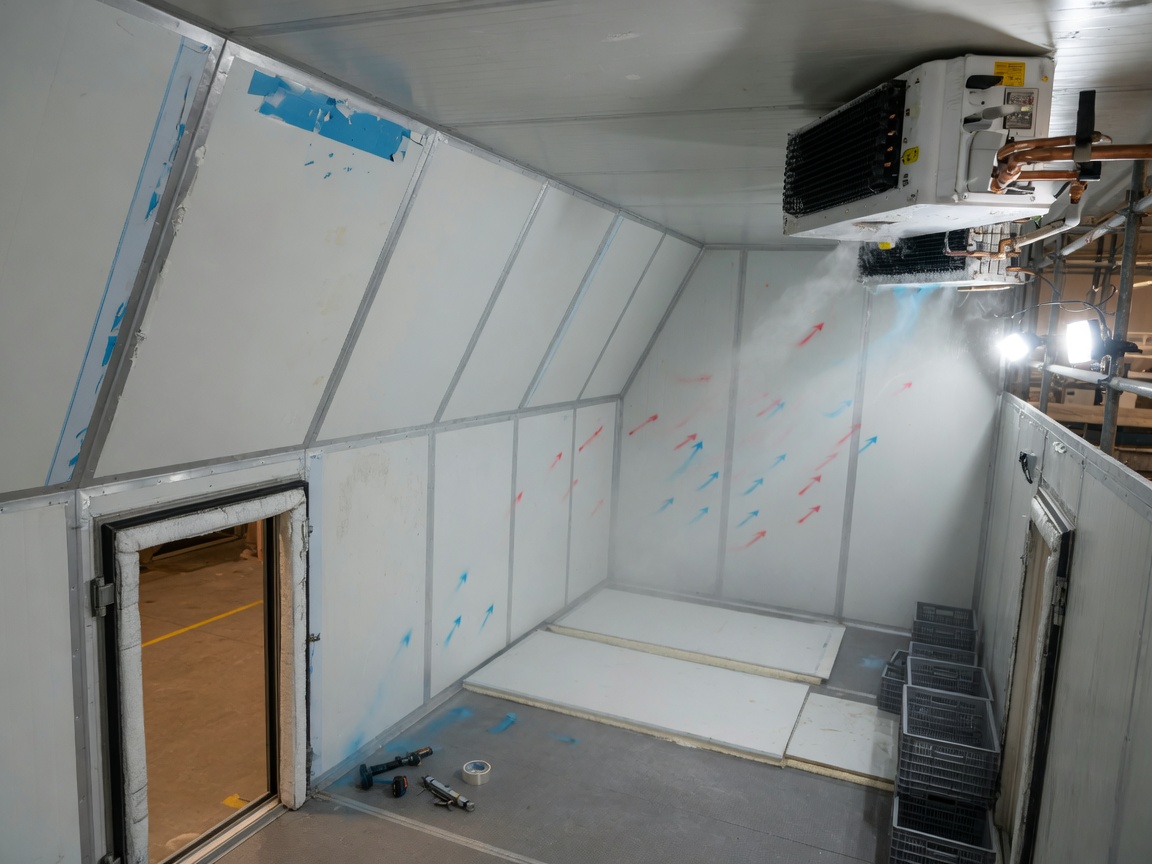
Why do so many operators undersize their cold storage facility? Typically because they size for current inventory rather than 18–24 months of projected growth. A restaurant adding a second kitchen line, a brewery scaling production, or a retailer adding a prepared foods section will all find themselves overloaded within a year if they size conservatively. Budget an additional 20–25% of cubic footage as a growth buffer — with modular panels, expanding later is relatively straightforward, but it is always cheaper to build slightly larger upfront than to retrofit.
Walk in cold room installation: what to expect
A walk-in cooler installation involves more than setting up panels and plugging in a refrigeration unit. Proper preparation of the site is what separates a 10-year trouble-free installation from one that fails a health inspection in year two.
Pre-installation requirements
Floor reinforcement is the most overlooked requirement. A fully loaded walk-in cold room — with product, shelving, and personnel — can exert 200–400 lbs per square foot on the floor. Standard commercial flooring may require a concrete slab of at least 4 inches, properly cured, before panel installation begins. Refrigeration condensing units mounted on the roof require structural engineering sign-off in most jurisdictions. Electrical rough-in must be completed before panel assembly; adding circuits after the fact is significantly more costly.
Typical installation timeline
For a modular walk-in cold room in the 8×10 ft to 12×20 ft range, expect: site prep and floor work (1–2 days), panel assembly (1–2 days), refrigeration unit installation and line set connection (1 day), electrical connection and system commissioning (1 day), and a 24-hour pull-down period before the unit is loaded with product. Total elapsed time: roughly 5–7 business days from start to operational. A temperature-controlled storage room of this scale does not typically require a full construction permit in most U.S. states, but always verify local building codes — especially if the unit exceeds 1,500 sq ft or is installed in a leased commercial space.
"Walk-in cooler and freezer systems that are not properly commissioned — meaning refrigerant charge verified, door gaskets inspected, and temperature uniformity tested — account for a disproportionate share of early-life failures. Commissioning is not optional; it is the foundation of long-term performance." — Commercial Refrigeration Engineers Association, 2026 installation standards guidance
2026 energy efficiency regulations and compliance checklist
The U.S. Department of Energy's walk-in cooler and freezer efficiency standards, established under 10 CFR Part 431 and updated through the most recent 2023 final rule (fully enforced as of 2024–2026), represent the baseline compliance floor for any new commercial refrigeration installation in the U.S. market. Non-compliant units purchased from overseas suppliers without verifying DOE certification are a genuine liability — they can trigger fines and force costly retrofits. Review commercial refrigeration efficiency standards on the ENERGY STAR site before finalizing any purchase.
2026 DOE compliance checklist
Use this checklist when evaluating any walk-in cold room vendor or specification:
- ☐ Panels meet minimum R-value: R-25 for coolers, R-32 for freezers (DOE 10 CFR 431.306)
- ☐ Door anti-sweat heater controls installed and verified (ECM-controlled or insulated door standard)
- ☐ Evaporator fan motors are electronically commutated (ECM) — required on all new units post-2024
- ☐ Lighting meets minimum 40 lumens per watt efficiency (LED standard)
- ☐ Self-closing, self-latching doors with door closer hardware installed
- ☐ Refrigerant is not R-22 (phased out under Clean Air Act Section 608); R-290, R-448A, or CO₂ preferred
- ☐ Unit carries a valid DOE certification number traceable to the manufacturer's submitted data
- ☐ Temperature monitoring log maintained per local health authority and food code temperature requirements
Refrigerant transition: what operators need to know in 2026
The phase-down of high-GWP refrigerants is accelerating. R-22 has been illegal to manufacture or import since 2020. R-404A and R-507A — still common in older walk-in freezer installations — are under increasing AIM Act restrictions. New installations in 2026 should specify R-290 (propane-based, GWP of 3), R-744 (CO₂), or HFO blends such as R-448A. Actual testing on R-290 systems in mid-size cold storage units shows 15–25% lower energy consumption compared to equivalent R-404A systems at the same load conditions.
Smart temperature monitoring and IoT integration
IoT-based temperature monitoring has moved from "nice to have" to near-mandatory for any serious commercial cold storage operation in 2026. The core value proposition is simple: a wireless sensor costs $150–$400 per unit; a single spoilage event in a 10×12 ft cooler can easily represent $3,000–$15,000 in lost product. The math is not complicated.
How smart monitoring systems work
Modern walk-in cold room monitoring systems deploy wireless IoT sensors — typically Bluetooth Low Energy or Wi-Fi mesh — at multiple points inside the refrigerated storage room: near the evaporator, at mid-height on opposing walls, and near the floor where temperature stratification is most significant. These sensors transmit data to a cloud dashboard every 1–15 minutes. When temperature drifts outside a pre-set threshold (say, above 40°F for a cooler), the system triggers automated alerts via SMS, email, or push notification — usually within 60–90 seconds of the excursion.
Just as a smoke detector does not prevent a fire but dramatically limits the damage, a smart temperature monitoring system does not prevent refrigeration failure — it ensures you know about it while you can still act. Leading platforms used in U.S. commercial kitchens and cold storage facilities include Monnit, SensiTech, and TempAlert, with pricing ranging from $30–$80 per month for cloud monitoring subscriptions on a typical single-unit installation.
Data logging for HACCP and health inspection compliance
Most U.S. jurisdictions require temperature logs for refrigerated storage — and increasingly, health inspectors accept digital logs from certified IoT monitoring systems in place of manual paper logs. A smart monitoring platform that auto-generates compliant temperature records eliminates roughly 15–20 minutes of daily staff time and creates an audit trail that is essentially impossible to falsify.
Maintenance schedule and troubleshooting guide
A well-maintained walk in cold room can operate efficiently for 15–20 years. A neglected one — particularly one with degraded door gaskets or an overworked compressor — will consume 30–45% more electricity and fail unpredictably. The maintenance schedule below is based on standard commercial refrigeration service intervals and real-world operating data from multi-unit foodservice operations.
Preventive maintenance schedule
| Frequency | Task | Who performs it |
|---|---|---|
| Weekly | Inspect door gaskets for cracks or gaps; clean evaporator drain pan | On-site staff |
| Monthly | Clean condenser coils; verify thermostat calibration; check door self-closing mechanism | On-site staff or technician |
| Quarterly | Inspect refrigerant lines for leaks; verify ECM fan motor performance; check panel seams | Certified refrigeration technician |
| Annually | Full system inspection: refrigerant charge, electrical connections, compressor performance test, door hardware replacement if worn | Certified refrigeration technician |
Troubleshooting common failures
Door seal failure is the most frequent — and most underestimated — maintenance issue in walk-in cold rooms. A damaged gasket on a cooler door operating in a 75°F kitchen creates the equivalent of a 2-inch hole in the wall. Test gaskets by closing the door on a dollar bill: if it slides out without resistance, the gasket needs replacement. Replacement gaskets for standard modular units typically cost $40–$120 per door and can be installed in under an hour.
Compressor issues typically manifest as one of three symptoms: the unit runs continuously without reaching set temperature (low refrigerant charge or dirty condenser coils), the unit short-cycles (refrigerant overcharge or thermostat fault), or the unit does not start (electrical fault or failed start capacitor). Of these, dirty condenser coils are responsible for an estimated 40% of service calls on commercial refrigeration units — and are entirely preventable with monthly cleaning.
Ice buildup on evaporator coils usually indicates either a defrost cycle fault or excessive door cycling introducing humid air. If defrost is operating correctly (typically 2–4 cycles per 24 hours on a freezer), evaluate door usage patterns and consider adding a strip curtain to reduce infiltration.
Industry-specific use cases
A walk-in cold room for a floral shop is a fundamentally different engineering problem than one for a pharmaceutical distributor or a craft brewery. Understanding these differences prevents costly over-specification in one direction and dangerous under-specification in the other.
Restaurants and foodservice operations
The dominant use case in the U.S. market. A mid-volume restaurant typically needs a combination cooler/freezer unit in the 8×10 ft to 10×12 ft range. High door-cycling frequency (60–100 openings per day) makes gasket quality and air curtain installation critical. HACCP compliance requires documented temperature logs — IoT monitoring addresses this automatically. Key specification priority: ease of cleaning (smooth, non-porous floor and wall surfaces), adequate interior lighting (minimum 10 foot-candles per FDA food code), and a thermometer mounted visibly inside the unit.
Floral shops
Cut flowers require 33–38°F with controlled relative humidity — typically 85–95% RH. This is a critical distinction from standard food coolers, which do not manage humidity. A floral walk-in chiller must incorporate humidity control (ultrasonic or evaporative humidifier), and should avoid strong airflow directly onto flowers, which accelerates dehydration. Ethylene gas management is also relevant: a floral cooler should never store ripening fruits, as the ethylene they emit accelerates flower senescence. Footprint is typically small — 6×8 ft to 8×10 ft is sufficient for most independent florists.
Pharmaceutical and medical storage
Pharmaceutical cold storage rooms must maintain 36–46°F (2–8°C) with documented temperature uniformity and alarm capabilities per USP <797>, USP <800>, and applicable state board of pharmacy regulations. This requires validated monitoring systems (21 CFR Part 11 compliant data logging), backup power provisions, and temperature mapping studies at commissioning. Modular panels with foamed-in-place joints are preferred for thermal consistency. The compliance burden is substantially higher than food service — budget accordingly.
Brewery cold rooms
Craft breweries use cold storage in two distinct contexts: fermenter cooling (serving tank rooms maintained at 32–38°F) and finished beer cold storage for distribution. The unique challenge is CO₂: fermentation produces significant CO₂ concentrations that can reach dangerous levels in enclosed spaces. Any walk-in cold room adjacent to active fermentation must have CO₂ monitoring and ventilation. Floor drains are essential — cleaning frequency in a brewery cold storage room is high, and standing liquid accelerates floor panel degradation if not addressed in the specification.
Retail and grocery
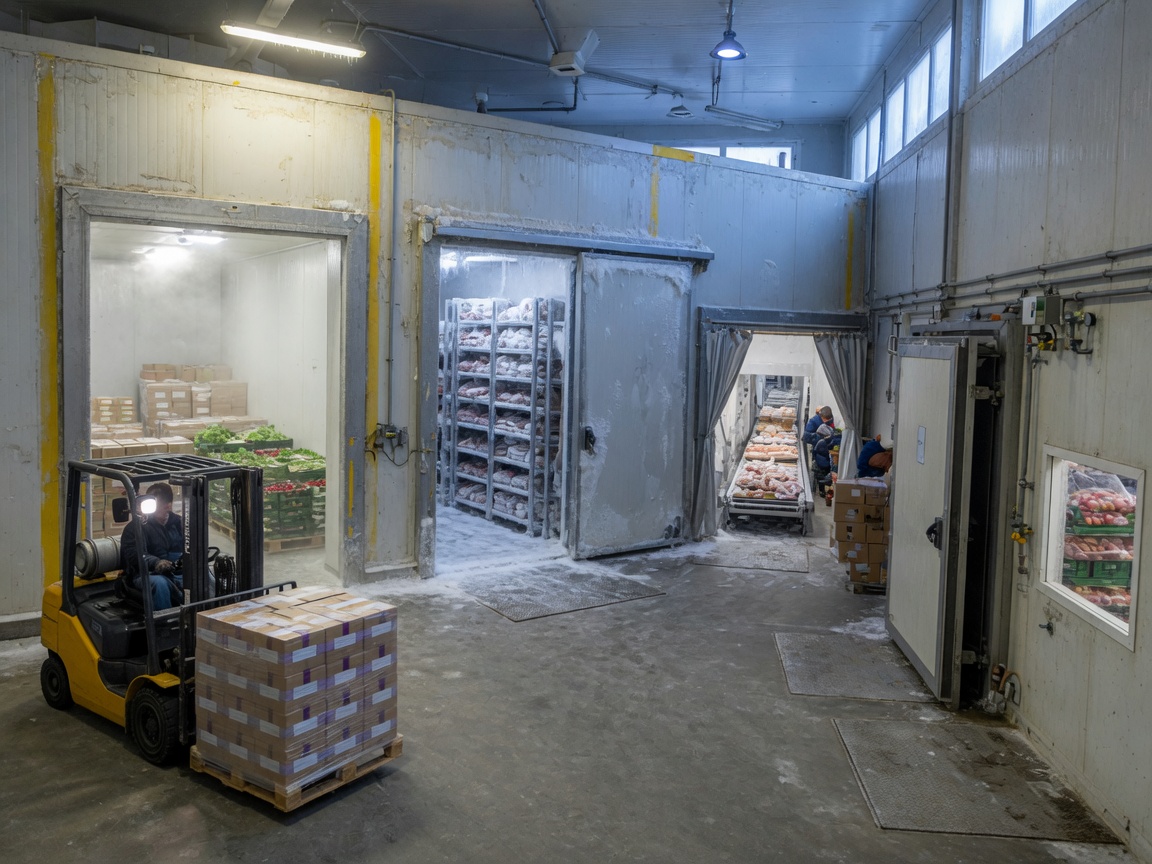
Large-format retail cold storage facilities — refrigerated warehouses and temperature-controlled storage rooms serving multiple departments — represent the highest-complexity walk-in applications. A regional grocery distribution center may operate 20,000+ sq ft of cold storage at multiple temperature zones simultaneously. At this scale, the distinction between a modular cold room and a custom-built cold storage facility becomes stark: refrigerated warehouse projects of this size are almost universally custom-engineered.
Frequently asked questions
Q: How much does a walk in cold room cost in 2026?
A: A modular walk-in cooler in the 6×8 ft to 10×12 ft range typically costs $8,000–$35,000 installed in the U.S. market, depending on temperature zone, panel thickness, and refrigeration unit specification. Custom-built cold rooms start at $25,000 and can exceed $150,000 for large or specialized applications. Operating costs — primarily electricity — run $1,200–$4,000 per year for a standard commercial unit.
Q: What temperature should a walk in cold room be set at?
A: Walk-in coolers should maintain 35–38°F (1.7–3.3°C) for most food storage applications per FDA food code requirements. Walk-in freezers should hold -10°F to 0°F (-23°C to -18°C). Pharmaceutical cold rooms target 36–46°F (2–8°C). Always verify product-specific requirements, as optimal storage temperature varies by food type and regulatory category.
Q: How long does a walk in cold room installation take?
A: A modular walk-in cold room installation typically takes 5–7 business days from site prep to commissioning for a standard 8×10 to 12×20 ft unit. Custom-built installations require 8–20 weeks from design through completion. Budget an additional 24 hours for system pull-down before loading product after commissioning.
Q: What are the DOE energy efficiency requirements for walk-in coolers in 2026?
A: Under 10 CFR Part 431, new walk-in coolers must use ECM evaporator fan motors, meet minimum R-25 panel insulation (R-32 for freezers), use LED lighting at 40+ lumens per watt, and include self-closing doors. R-22 refrigerant is prohibited. ENERGY STAR-certified units exceed these minimums and may qualify for utility rebates in most U.S. states.
Q: How often should a walk in cold room be serviced?
A: Door gaskets should be inspected weekly by on-site staff. Condenser coils require monthly cleaning. A certified refrigeration technician should perform a full system inspection quarterly and annually. Following this schedule prevents the most common failure modes — dirty condenser coils cause roughly 40% of commercial refrigeration service calls — and extends unit lifespan to 15–20 years.
Summary: making the right walk in cold room decision in 2026
Selecting, installing, and maintaining the right walk in cold room comes down to five decisions: modular or custom-built, correct temperature zone, right-sized capacity, DOE-compliant specification, and a funded maintenance plan. Operators who treat this as a pure price decision — without accounting for energy costs, compliance risk, and spoilage exposure — consistently pay more over a five-year horizon than those who invest in a properly specified system from the start. Use the comparison tables, sizing methodology, compliance checklist, and maintenance schedule in this guide as your evaluation framework, and you will be well positioned to make a defensible, cost-effective purchasing decision.
Keywords:
Inquiry
If you are interested in our products, please leave your email to receive a free product quote, thank you!
More information


Tel:
Sales E-mail: