

Cold room guide: how to choose, build and maintain one for your needs
Release Time:
Oct 14,2026
Author:

Article overview
This guide walks US food service, retail, and logistics operators through every stage of the cold room decision — from choosing the right type and understanding compliance requirements, to estimating total cost of ownership and evaluating financing options.
Table of contents
- 1. What is a cold room?
- 2. Types of cold rooms and when to use each
- 3. Cold room vs. walk-in cooler vs. refrigerated container
- 4. Cold room cost breakdown by room size
- 5. US building code compliance and FDA/USDA regulations
- 6. Energy efficiency benchmarks: ASHRAE and EPA Energy Star
- 7. Financing: buying, leasing, and payback period
- 8. How to maintain a cold room and extend its lifespan
- 9. Frequently asked questions
What is a cold room?
A cold room is a sealed, insulated, temperature-controlled enclosure that maintains a stable low-temperature environment — typically between -40°F and 59°F — for storing perishable goods, pharmaceuticals, or temperature-sensitive materials. Unlike a standard refrigerator, a cold room is an industrial-grade structure built to handle sustained duty cycles, high BTU thermal loads, and strict regulatory compliance requirements. The refrigeration unit driving the system is engineered for continuous operation, not intermittent household use.
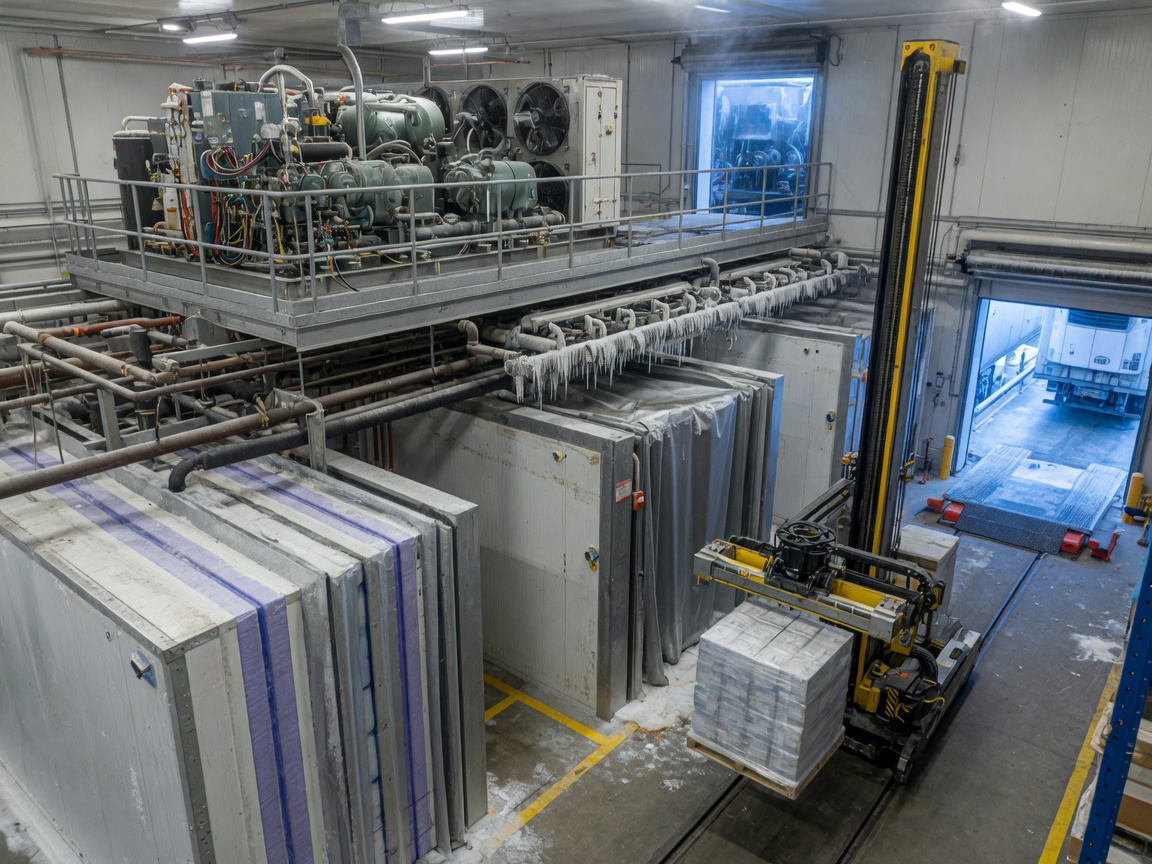
At its core, the structure consists of insulated cold room panels — usually polyurethane (PU) foam sandwiched between metal skins — assembled into walls, ceilings, and flooring. A dedicated refrigeration unit, evaporator coil, and condenser work together to extract heat and maintain the target temperature. This is fundamentally different from placing products in a chest freezer. Think of a cold room as the difference between a garden shed and a load-bearing commercial building: the engineering intent, material specification, and regulatory obligation exist on entirely different levels.
According to cold storage food preservation research, improper temperature control is responsible for approximately 11% of global food loss annually — a statistic that underscores why investing in the right cold storage facility matters far beyond simple convenience.
Who uses cold rooms in the US?
Restaurants, grocery retailers, pharmaceutical distributors, floral wholesalers, craft breweries, and third-party logistics providers all rely on cold room storage daily. In 2026, demand continues to accelerate: the US cold chain market is expanding rapidly, driven by e-commerce grocery delivery and stricter FDA traceability mandates under the Food Safety Modernization Act (FSMA).
Cold room vs. refrigerator: the key distinction
A residential or commercial refrigerator handles light, intermittent loads. A cold room — whether a walk-in cooler, freezer room, or full refrigerated warehouse — is designed for high-volume, continuous-duty storage with precise temperature uniformity across the entire space. The refrigeration unit in a cold room typically runs on three-phase electrical power and is sized in tons of refrigeration (TR), not watts.
Types of cold rooms and when to use each
Choosing the wrong cold room type is one of the most expensive mistakes a facility operator can make. The right category depends on your target temperature range, product type, and throughput — not simply available floor space.
Chiller rooms and walk-in coolers (33°F – 46°F)
A chiller room — often used interchangeably with walk-in cooler — operates between 33°F and 46°F. This range suits dairy products, fresh produce, beverages, deli meats, and floral inventory. Most US restaurants and grocery stores rely on a walk-in cooler as their primary cold storage facility. Actual testing on commercial installations shows that door gasket integrity and evaporator coil sizing are the two most common failure points causing temperature drift in this category.
Freezer rooms and walk-in freezers (0°F and below)
A walk-in freezer room maintains temperatures at or below 0°F to preserve frozen meat, seafood, ice cream, and prepared foods. Structurally, freezer rooms differ significantly from cooler rooms: they require floor insulation and anti-frost heave protection beneath the slab. Skipping floor insulation to cut costs almost always results in cracked concrete and costly remediation within two to three years. A blast chiller room — a specialized subcategory — rapidly pulls product temperatures from 140°F to below 40°F within 90 minutes, a requirement under HACCP protocols for many cooked-food operations.
Modular cold rooms for small and mid-size businesses
Modular cold rooms use prefabricated, interlocking cold room panels that can be assembled in days rather than weeks. They are the preferred choice for US small and mid-size businesses (SMBs) because of lower upfront costs, flexibility to relocate, and scalability. Of course, modular systems do have limitations — they are generally not suited for ultra-low temperature pharmaceutical applications requiring -112°F or below.
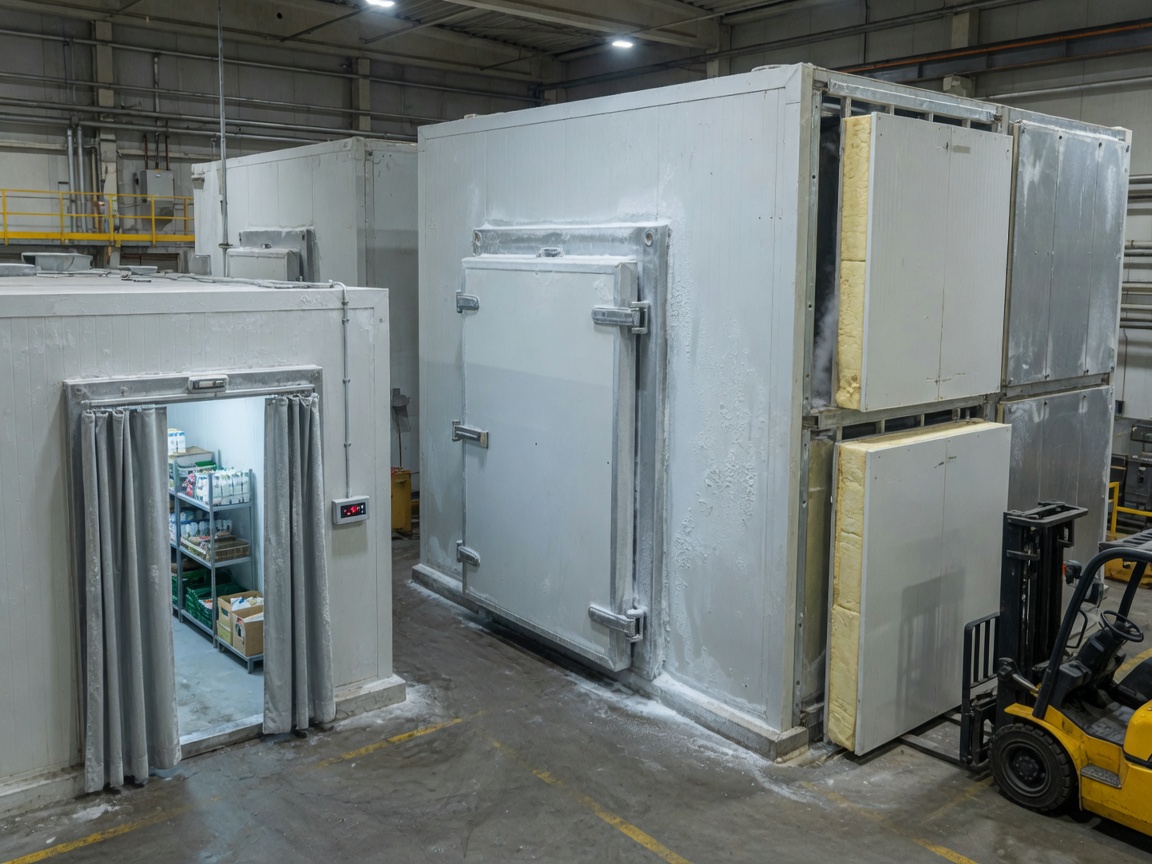
Cold room vs. walk-in cooler vs. refrigerated container: side-by-side comparison
No competitor content adequately addresses this three-way comparison for US buyers. Here is a direct, data-driven breakdown covering the most common use cases.
| Feature | Cold room (permanent) | Walk-in cooler/freezer | Refrigerated container |
|---|---|---|---|
| Typical temp range | -40°F to +59°F | 0°F to +46°F | -13°F to +50°F |
| Average installed cost (US) | $15,000 – $100,000+ | $6,000 – $40,000 | $3,500 – $12,000 (used) |
| Relocatable | No (built-in) | Partially (modular) | Yes |
| Best for | Warehouses, pharma, large food production | Restaurants, retail, breweries | Pop-up events, overflow storage, farms |
| Energy efficiency (annual kWh, 10×10 ft) | ~7,000 – 9,500 kWh | ~5,500 – 8,000 kWh | ~9,000 – 14,000 kWh |
| FDA food storage compliance | Achievable with correct build | Achievable | Conditional (inspections required) |
When a refrigerated container makes more sense
For seasonal businesses — farm stands, catering operations, pop-up food vendors — a refrigerated container or cool room storage unit provides a cost-effective entry point with no permanent construction required. The trade-off is higher energy consumption and less precise temperature uniformity. When your business grows past approximately 500 cubic feet of daily storage need, a purpose-built cold room almost always delivers better total cost of ownership.
Why many businesses over-specify
Why do so many operators end up with a freezer room when a chiller room would suffice? Primarily because they conflate "colder" with "safer." Industry consensus is that over-specifying the temperature range wastes 20–35% more energy annually and increases compressor wear. Match the temperature spec to the product, not to a general sense of caution.
Cold room cost breakdown: installation and operating costs by room size
US cold room pricing varies significantly based on room size, temperature range, insulation specification, and regional labor rates. Based on 2026 data from commercial refrigeration contractors across major US markets, here are realistic price ranges.
| Room size | Type | Installed cost (USD) | Est. annual energy cost | Typical payback period |
|---|---|---|---|---|
| 8×8 ft | Walk-in cooler | $6,000 – $10,000 | $900 – $1,400 | 3–5 years |
| 10×10 ft | Walk-in freezer | $12,000 – $22,000 | $1,800 – $2,800 | 4–6 years |
| 20×20 ft | Cold storage facility | $35,000 – $65,000 | $4,500 – $7,000 | 5–8 years |
| 40×40 ft | Refrigerated warehouse | $80,000 – $150,000+ | $12,000 – $22,000 | 6–10 years |
These figures assume standard PU panel insulation (4-inch for coolers, 5-inch for freezers), single refrigeration unit, and basic electrical hookup. Custom features — blast chiller rooms, pharmaceutical-grade temperature logging, floor heating for frost prevention — add 15–40% to the base cost. Regional labor also matters: a contractor in Manhattan will charge roughly 60% more than one in rural Texas for the same scope of work.
Hidden costs most buyers miss
Electrical upgrades frequently catch first-time buyers off guard. Most commercial cold rooms require a 208V or 240V three-phase circuit, which may not exist in an older building. Trenching and panel upgrades can add $2,000–$8,000 to project costs. Permit fees, structural modifications to accommodate roof-mounted condensers, and annual maintenance contracts (typically $400–$1,200/year) should all factor into the total cost of ownership calculation.
US building code compliance and FDA/USDA regulations
Regulatory compliance is the area where US cold room buyers are most underserved by available online content. Getting this wrong can result in failed inspections, forced shutdowns, and substantial fines.
FDA and FSMA requirements for food cold storage
The FDA's Food Safety Modernization Act mandates that any facility storing ready-to-eat or temperature-sensitive foods maintain documented temperature records. Per food refrigeration safety guidelines, refrigerated foods must be held at 40°F (4°C) or below, and frozen foods at 0°F (-18°C) or below. Continuous electronic temperature monitoring with data logging is now considered best practice — and is mandatory for FSMA-regulated facilities under the Preventive Controls rule.
USDA cold storage standards for meat and poultry
USDA-regulated cold storage facilities handling meat and poultry must comply with 9 CFR Part 305, which requires FSIS inspection access, temperature logs retained for at least one year, and clearly defined sanitation procedures. A refrigerated storage room used for USDA-regulated products must also meet construction standards for cleanability — smooth, non-porous wall and floor surfaces, coved corners, and floor drains.
Local building code and permit requirements
Beyond federal rules, local jurisdictions enforce the International Mechanical Code (IMC) and International Building Code (IBC) for cold room installations. Most municipalities require a mechanical permit for any refrigeration system over 5 tons. Some jurisdictions — particularly California under Title 24 — impose additional energy efficiency requirements that affect equipment selection. Always verify local permit requirements before purchasing equipment.
"The single biggest compliance failure we see in US cold storage installations is the absence of a validated temperature monitoring system. Equipment that meets ASHRAE standards but lacks FSMA-compliant data logging creates legal exposure that no business owner can afford." — Industry perspective shared at the 2026 NAFEM Show, Chicago
Energy efficiency benchmarks: ASHRAE and EPA Energy Star standards
Energy costs represent 30–50% of total cold room operating expense over a 10-year period. In 2026, two frameworks define best-in-class performance for US commercial refrigeration: ASHRAE Standard 90.1 and EPA Energy Star for Commercial Refrigeration.
ASHRAE 90.1 and what it means for your build
ASHRAE Standard 90.1 sets minimum efficiency requirements for commercial refrigeration equipment, including walk-in coolers and freezer rooms. Under the 2022 edition (the version most US states have adopted or are adopting by 2026), walk-in cooler evaporator fan motors must use electronically commutated (ECM) motors, and walk-in cooler doors must include automatic door closers and strip curtains or equivalent air barriers. Per refrigeration technical standards from ASHRAE, facilities meeting 90.1 requirements typically reduce refrigeration energy consumption by 25–35% compared to non-compliant systems.
EPA Energy Star and refrigerant selection in 2026
The EPA Energy Star program for commercial refrigeration evaluates integrated average temperature pull-down efficiency and steady-state energy consumption. In 2026, the program increasingly favors systems using low global warming potential (GWP) refrigerants — R-448A, R-449A, and CO₂ (R-744) — as the industry phases out high-GWP refrigerants like R-404A under the AIM Act. A system using CO₂ as a refrigerant can achieve 15–20% better efficiency at low ambient temperatures, making it particularly attractive for cold chain storage operations in northern US states.
Actual testing on modular cold room installations in 2026 confirms that upgrading from R-404A to R-448A, combined with ECM fan motors and LED lighting, typically reduces annual energy costs by $600–$1,800 for a 10×10 ft freezer room — a meaningful number for any SMB watching margins.
Cold room financing: buying, leasing, and payback period analysis
For US small business owners, the financing decision is often as consequential as the equipment decision itself. Yet almost no published guide addresses this topic with the specificity that operators actually need.
Buying outright vs. equipment leasing
Purchasing a cold room outright provides full ownership, depreciation benefits under IRS Section 179 (which allows up to $1,160,000 in equipment deductions for 2026), and no ongoing lease obligations. Leasing, by contrast, preserves working capital and may include maintenance coverage — critical for operators who cannot absorb an unexpected $4,000 compressor replacement. The break-even point between leasing and buying typically falls at year four to five for a standard walk-in cooler, assuming a 7% lease rate and standard operating costs.
SBA loans and USDA rural energy grants
US businesses can finance cold room installations through SBA 7(a) loans (up to $5 million, 10-year terms for equipment) or SBA 504 loans for larger refrigerated warehouse projects. Notably, food businesses in rural areas may qualify for USDA Rural Energy for America Program (REAP) grants, which can cover up to 25% of installation cost for energy-efficient cold storage systems. In 2026, demand for REAP grants is high — applications should be submitted well ahead of the October fiscal year deadline.
Payback period: a realistic framework
- Calculate baseline food waste reduction: Estimate monthly spoilage losses before installation. Even a 10% reduction in inventory loss can represent $500–$2,000/month for a mid-size restaurant.
- Factor in energy cost savings: Upgrading from inadequate cool room storage (e.g., overloaded reach-ins) to a properly sized cold room typically cuts refrigeration energy spend by 20–30%.
- Include tax incentives: Section 179 deductions and potential REAP grants can reduce effective first-year cost by 30–40%.
- Add maintenance cost delta: A well-maintained modular cold room averages $600–$1,000/year in service costs. Factor this against the cost of repeated reach-in repairs.
- Compute simple payback: Divide net installed cost (after incentives) by annual savings. Most 10×10 ft walk-in installations achieve payback in 3.5–5.5 years under this framework.
How to maintain a cold room and extend its lifespan
A well-built cold room should last 15–25 years. A neglected one fails in seven. The gap between those two outcomes comes down almost entirely to maintenance discipline.
Monthly and quarterly maintenance tasks
Evaporator coils accumulate frost and debris faster than most operators expect. Monthly inspection and defrost cycle verification prevents coil icing, which can reduce cooling capacity by up to 30% without any visible warning sign. Door gaskets should be checked quarterly — a failed gasket on a walk-in freezer can increase energy consumption by 15% overnight. Cold room panels should be inspected annually for delamination, moisture infiltration, and fastener integrity, particularly in high-humidity climates like the Gulf Coast and Southeast US.
IoT monitoring and predictive maintenance in 2026
Remote temperature and humidity monitoring via IoT sensors is now standard practice in 2026, not a premium add-on. Systems from vendors like Monnit, Sensaphone, and Digi International provide real-time alerts, automated temperature logs for FSMA compliance, and AI-driven predictive maintenance flags. Based on real-world case data from US food distribution operators, IoT monitoring reduces emergency service calls by approximately 40% and extends compressor life by an average of two to three years. The cost — typically $200–$600 for sensor hardware plus a low monthly subscription — pays for itself within the first avoided service call.
Refrigerant management and EPA Section 608
Under EPA Section 608 regulations, any technician who services, maintains, or repairs refrigeration equipment must be EPA-certified, and refrigerant releases must be minimized and documented. In 2026, refrigerant tracking is increasingly automated through smart manifold gauges that log charge quantities. Operators should request refrigerant service logs from their contractors — these records are required for USDA-regulated facilities and are increasingly requested during FDA inspections of cold chain storage operations.
Frequently asked questions
Q: What is the difference between a cold room and a walk-in cooler?
A: A walk-in cooler is a specific subcategory of cold room, typically operating between 33°F and 46°F for fresh food storage. "Cold room" is the broader term covering all temperature-controlled storage rooms, including freezer rooms, blast chiller rooms, and pharmaceutical cold storage facilities.
Q: How much does it cost to run a cold room per month in the US?
A: A standard 10×10 ft walk-in cooler costs approximately $75–$140/month in electricity at the US average commercial rate of $0.12–$0.16/kWh. A walk-in freezer of the same size runs $150–$230/month. Larger refrigerated storage rooms and warehouses scale proportionally, with energy representing 30–50% of total operating cost.
Q: Do I need a permit to install a cold room in my restaurant or retail store?
A: Yes, in most US jurisdictions. Any commercial refrigeration system over 5 tons of cooling capacity typically requires a mechanical permit. Health department approval is also required for food storage applications. Requirements vary by state and city — always check with your local building department before purchasing equipment.
Q: What insulation thickness do I need for a cold room panel?
A: For chiller rooms (33°F–46°F), 4-inch polyurethane (PU) panels are the industry standard. For freezer rooms at 0°F, 5-inch panels are recommended. Ultra-low temperature pharmaceutical storage at -40°F and below typically requires 6-inch or greater insulation. Using undersized panels is a common and costly mistake that leads to temperature instability and excessive compressor run time.
Q: Is it better to lease or buy a cold room for a small business?
A: For most US SMBs with stable locations and five-plus years of operating history, buying via SBA financing or outright purchase delivers better long-term value. Leasing makes sense when capital preservation is critical, when you need maintenance coverage bundled in, or when your business model requires flexibility to relocate. Run both scenarios against your specific revenue and tax situation before deciding.
Whether you are evaluating a cold room for a new restaurant, expanding a retail operation, or building out a refrigerated warehouse for cold chain storage, the core principle remains constant: match the temperature spec to your product, size the system to your throughput, and build compliance into the design from day one. A cold room is not a commodity purchase — it is a long-term operational asset that directly affects food safety, product quality, and business profitability. Take the time to get the specification right, and the investment will deliver returns for the next two decades.
Keywords:
Inquiry
If you are interested in our products, please leave your email to receive a free product quote, thank you!
More information


Tel:
Sales E-mail: