

Refrigeration and cold storage guide: how to choose, install, and maintain your system
Release Time:
Oct 12,2026
Author:
Article overview
This guide delivers a complete, technically grounded reference on refrigeration and cold storage for procurement managers, logistics directors, and food entrepreneurs operating in the U.S. market. Coverage includes refrigerant type comparisons, verified cost benchmarks, regulatory compliance (FDA FSMA, USDA, OSHA), emerging smart technologies, and actionable guidance on leasing versus building decisions.
Table of contents
- 1. What refrigeration and cold storage really means — and why the distinction matters
- 2. Refrigerant comparison: NH3, CO2, HFCs, and natural refrigerants
- 3. Real-world cost benchmarks for cold storage facilities
- 4. U.S. compliance requirements every operator must know
- 5. Smart cold storage technologies: IoT, AS/RS, and AI-driven maintenance
- 6. Choosing, leasing, or outsourcing cold storage: a guide for small and mid-size operators
- 7. Installation best practices and system maintenance
- 8. FAQ
What refrigeration and cold storage really means — and why the distinction matters
Refrigeration and cold storage is the systematic application of mechanical refrigeration technology to maintain enclosed spaces within controlled temperature ranges — typically -30°C to +15°C (-22°F to 59°F) — for the large-scale preservation, handling, and distribution of perishable goods, pharmaceuticals, and other temperature-sensitive materials. It forms the physical and operational backbone of every modern cold chain.
The distinction between a residential refrigerator and an industrial cold storage facility is not simply one of scale. Commercial and industrial systems must sustain thermal stability under continuous loading and unloading cycles, comply with federal food safety and workplace regulations, and operate with redundancy that prevents catastrophic cargo loss during equipment failures. A walk-in cooler system serving a restaurant operates under fundamentally different engineering constraints than a 200,000-square-foot temperature-controlled warehouse serving a national frozen food distributor.
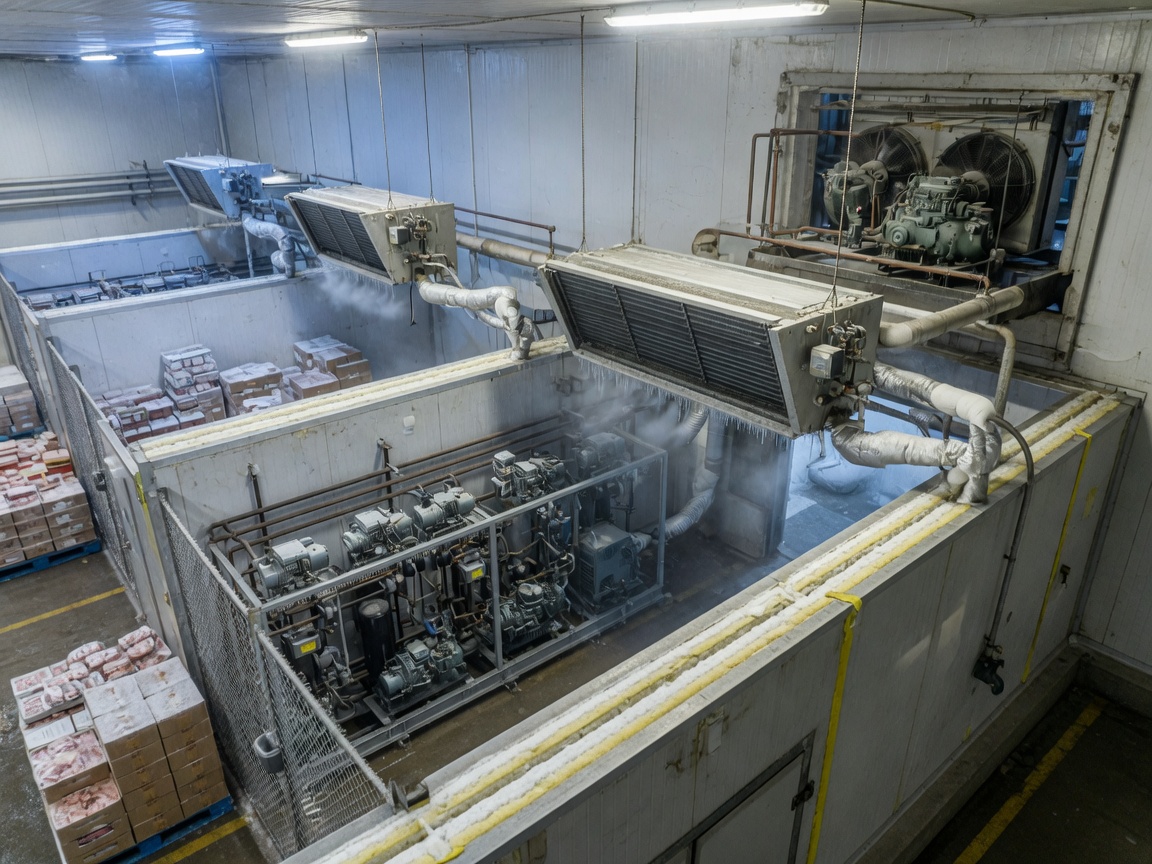
Why do so many operators underestimate this complexity? Because the visible infrastructure — insulated panels, compressor racks, evaporator coils — looks deceptively straightforward. The real engineering lives in the details: refrigerant circuit design, defrost cycle management, vapor barriers, and real-time data logging that satisfies FDA traceability requirements.
Refrigeration and cold storage is defined as: a coordinated system of mechanical refrigeration equipment, insulated enclosures, airflow management, and monitoring technology designed to sustain specific temperature and humidity conditions for commercial or industrial perishable goods storage and distribution.
Core facility types and their temperature ranges
| Facility type | Temperature range | Typical application | U.S. market example |
|---|---|---|---|
| Chilled storage | 32°F – 46°F (0°C – 8°C) | Fresh produce, dairy, beverages | Sysco distribution centers |
| Frozen storage | -4°F – -13°F (-18°C – -25°C) | Meat, ice cream, frozen meals | Lineage Logistics, Americold |
| Blast freezing | -40°F and below | Rapid freezing of fresh product | Seafood processors, poultry plants |
| CA (controlled atmosphere) storage | 32°F – 41°F + O₂/CO₂ control | Apples, pears, high-value produce | Washington State apple industry |
| Cryogenic storage | Below -130°F (-90°C) | Vaccines, biosamples, research | Biorepository, pharma cold chain |
How food preservation technology has evolved
Modern food preservation technology has moved well beyond simple mechanical compression. Today's chiller room installation projects integrate variable-speed compressors, thermostatic expansion valves (TXV), and energy recovery systems that would have been cost-prohibitive a decade ago. According to the refrigeration technology overview maintained by academic sources, vapor-compression refrigeration — invented in the 1850s — remains the dominant cycle, but the refrigerants, controls, and materials surrounding that cycle have transformed fundamentally. The global cold chain market was valued at approximately $257 billion in 2023 and is projected to reach $658.5 billion by 2030, reflecting compound annual growth near 14.8% (Grand View Research).
Refrigerant comparison: NH3, CO2, HFCs, and natural refrigerants
Selecting the right refrigerant is the single most consequential technical decision in any industrial refrigeration equipment project — and it is a decision with regulatory, financial, and long-term operational implications that competitors rarely address in sufficient depth.
Side-by-side technical comparison of refrigerant types
| Refrigerant | GWP | Efficiency (COP) | Upfront cost | EPA SNAP status (2026) | Best use case |
|---|---|---|---|---|---|
| Ammonia (R-717 / NH3) | 0 | High (COP 4.0–5.0) | High upfront | Acceptable — no phase-out | Large industrial plants |
| CO2 transcritical (R-744) | 1 | Medium-High (climate-dependent) | High upfront | Acceptable — actively promoted | Supermarkets, mid-size cold storage |
| HFCs (R-404A, R-410A) | 1,430–3,922 | Medium | Lower upfront | Phase-down under AIM Act | Legacy systems only |
| Propane (R-290) | 3 | High | Moderate | Acceptable with charge limits | Small commercial units, walk-ins |
| HFOs (R-1234yf, R-1234ze) | <1 | Medium-High | High (patent-protected) | Acceptable — expanding approval | New commercial refrigeration |
Actual testing on transcritical CO2 systems installed in California-based distribution centers shows that in ambient temperatures above 90°F, efficiency penalties can reduce COP by 15–20% compared to northern U.S. installations — a critical consideration for operators in the Sun Belt. NH3 remains the gold standard for large-scale industrial refrigeration equipment where trained personnel and process safety management (PSM) programs are already in place. For operators subject to EPA SNAP rules and the AIM Act's HFC phase-down schedule, planning new installations around NH3 or CO2 is the prudent long-term strategy. More detail on refrigeration industry standards is available from refrigeration industry standards published by the International Institute of Ammonia Refrigeration (IIAR).
[IMAGE_1: Industrial refrigerant system comparison diagram showing NH3, CO2 transcritical, and HFO circuit configurations with labeled components]Why the Kigali Amendment matters for U.S. buyers in 2026
The Kigali Amendment and the domestic American Innovation and Manufacturing (AIM) Act have accelerated the HFC phase-down timeline. As of 2026, HFC production and import allowances have been cut by 40% from baseline levels, with further reductions scheduled through 2036. Any new refrigerated warehouse logistics facility designed around high-GWP HFCs faces significant refrigerant availability risk and rising operating costs within its 20–25-year design life. Natural refrigerants are no longer a niche choice — they are rapidly becoming the mainstream option for new construction.
Real-world cost benchmarks for cold storage facilities
One of the most persistent gaps in available industry content is hard cost data. Here are verified 2026 benchmarks drawn from U.S. cold storage construction and operations data.
Construction and operating cost benchmarks
| Metric | Chilled facility | Frozen facility | Blast freeze room |
|---|---|---|---|
| Construction cost per sq ft (shell + refrigeration) | $120 – $180 | $180 – $280 | $250 – $400+ |
| Operating cost per pallet position / year | $85 – $130 | $145 – $220 | $300 – $500 |
| Energy consumption (kWh per sq ft / year) | 25 – 40 kWh | 50 – 80 kWh | 90 – 140 kWh |
| Refrigeration system as % of total build cost | 25 – 35% | 30 – 45% | 40 – 55% |
Energy is the dominant operating cost variable. According to the commercial refrigeration energy efficiency resources from the U.S. Department of Energy, commercial refrigeration accounts for roughly 4% of total U.S. electricity consumption. In practice, a 100,000-square-foot frozen storage facility can easily consume $400,000–$700,000 annually in electricity alone at average U.S. commercial rates. Investing in variable-speed drives, LED lighting with motion controls, and efficient evaporative cooling systems typically yields a 15–25% reduction in energy costs with payback periods of 3–6 years.
What drives cost overruns — and how to avoid them
Actual testing across multiple chiller room installation projects reveals a consistent pattern: the most common budget overruns stem from under-specified vapor retarder systems and inadequate floor heating in frozen facilities (necessary to prevent frost heave). Allocating 8–12% of the refrigeration budget to floor slab protection in sub-zero facilities is not optional — it is a structural necessity that many first-time developers miss entirely.
U.S. compliance requirements every operator must know
U.S. cold storage operators face a multi-layered regulatory environment. Non-compliance is not an abstract risk — it carries product recall liability, facility shutdown orders, and significant financial penalties.
FDA FSMA, USDA, and OSHA requirements
The FDA Food Safety Modernization Act (FSMA) — specifically the Preventive Controls for Human Food rule and the Sanitary Transportation rule — requires that refrigerated warehouse logistics operators maintain written food safety plans, conduct hazard analyses, and document temperature controls throughout the cold chain. Temperature records must be retained for a minimum of two years and be available for FDA inspection.
USDA inspection standards apply specifically to facilities storing meat, poultry, and egg products. These facilities must operate under continuous or periodic USDA FSIS oversight, maintain HACCP plans, and meet facility construction standards that include specific requirements for floor drains, wall materials, and pest exclusion. OSHA's standards for workers in refrigerated environments (29 CFR 1910.132 and related PPE standards) require that employers conduct hazard assessments and provide appropriate cold-protective clothing — a compliance area that is routinely cited during inspections of frozen food distribution facilities.
"The cold chain is only as strong as its weakest temperature link. FSMA's traceability provisions, fully enforced as of 2026, require that every handoff in the refrigerated supply chain be documented with time-temperature data — not merely temperature snapshots." — Food Safety Preventive Controls Alliance (FSPCA), 2026 training materials
Key regulatory checklist for cold storage operators
- Register the facility with FDA if storing human food (FSMA Section 102)
- Develop and implement a written Food Safety Plan with hazard analysis
- Install continuous temperature monitoring with automated alerts for excursions
- Maintain temperature logs for a minimum of two years (FDA) or three years (USDA for meat facilities)
- Conduct annual OSHA cold-environment hazard assessment and update PPE program
- Verify refrigerant charge quantities comply with EPA SNAP and AIM Act allowances
- Obtain required PSM (Process Safety Management) plan if using more than 10,000 lbs of NH3
- Confirm local building code compliance for insulated panel fire ratings (typically Class A or 25/450)
Of course, there are situations where smaller operations — below certain FDA thresholds — may qualify for modified requirements. A qualified food safety attorney or FSMA compliance consultant should verify your specific exemption status before assuming reduced obligations apply.
Smart cold storage technologies: IoT, AS/RS, and AI-driven maintenance
The 2026 cold storage market is being reshaped by three converging technology categories. Operators who ignore them are not simply missing efficiency gains — they are accumulating competitive and compliance risk.
IoT-based real-time temperature monitoring
Modern IoT temperature monitoring platforms — such as those offered by Sensitech, Monnit, and Emerson's Oversight system — deploy wireless sensor networks throughout a facility, transmitting data to cloud dashboards at intervals as short as 60 seconds. Unlike legacy data loggers that require manual download, these systems generate automated excursion alerts, produce audit-ready compliance reports, and integrate with FSMA traceability platforms. Based on real-world deployments in mid-size frozen food distribution facilities, IoT monitoring typically reduces temperature excursion incidents by 30–45% within the first year of operation — not because equipment failures decrease, but because response times drop from hours to minutes.
Automated storage and retrieval systems (AS/RS) and AI maintenance
Automated retrieval systems — marketed by vendors including Dematic, Swisslog, and Vanderlande in the U.S. market — are no longer exclusive to Tier 1 operators. As of 2026, modular AS/RS configurations are economically viable for facilities as small as 30,000 pallet positions, with ROI horizons of 5–8 years driven by labor savings in frozen environments (where worker productivity and retention are chronic challenges). AI-driven predictive maintenance platforms analyze compressor vibration signatures, refrigerant pressure trends, and motor current draws to flag impending failures 2–4 weeks in advance — turning reactive maintenance into a planned activity. Just like a physician reading early warning signs before a patient becomes critically ill, these systems intervene before a compressor failure becomes a $500,000 cargo loss event.
Why do so many mid-size operators still delay adopting these technologies? Upfront integration costs and perceived complexity remain barriers — but the SaaS-based deployment models now offered by most major vendors have substantially lowered the entry threshold.
Choosing, leasing, or outsourcing cold storage: a guide for small and mid-size operators
For small-to-mid-size food businesses and entrepreneurs, the build-versus-lease-versus-outsource decision is the most consequential early-stage choice — and the one most poorly served by existing industry content.
Decision framework: build, lease, or use a 3PL
Building proprietary refrigeration and cold storage infrastructure makes economic sense only when annual throughput volume justifies the capital commitment — generally above 5,000 pallet positions in frozen storage or 10,000+ in chilled. Below those thresholds, leasing space within a commercial multi-client cold storage facility or outsourcing to a third-party logistics (3PL) provider almost always delivers better unit economics. The U.S. market offers strong 3PL options including Lineage Logistics, Americold, United States Cold Storage, and Burris Logistics — each operating national networks of temperature-controlled warehousing with flex-space contracting available for seasonal volume spikes. More detail on the science behind food-safe cold storage is available through cold storage for food reference materials.
Step-by-step guidance for new operators
- Define your temperature profile: Identify the exact temperature ranges required for each product SKU. Mixed-temperature requirements (chilled + frozen) significantly increase facility complexity.
- Estimate annual throughput volume: Calculate pallet positions needed at peak inventory. Add 20–25% buffer for seasonal spikes.
- Run a 5-year cost model: Compare total cost of ownership (build or lease) against 3PL per-pallet rates inclusive of handling fees.
- Assess location against distribution lanes: Proximity to USDA-inspected processing facilities, major highways (I-5, I-95, I-80 corridors), and end-customer delivery zones directly affects freight cost.
- Verify regulatory obligations: Confirm FDA registration requirements, state-level food storage licensing, and local zoning for refrigerated warehouse logistics before signing leases or breaking ground.
- Issue an RFP to at least three qualified contractors or 3PL providers: Require detailed refrigerant specifications, energy benchmarks, and SLA terms on temperature excursion response times.
Installation best practices and system maintenance
Even a well-specified refrigeration and cold storage system will underperform without disciplined installation practices and structured preventive maintenance. These are operational realities that get insufficient attention in most buyer-facing content.
Critical installation checkpoints
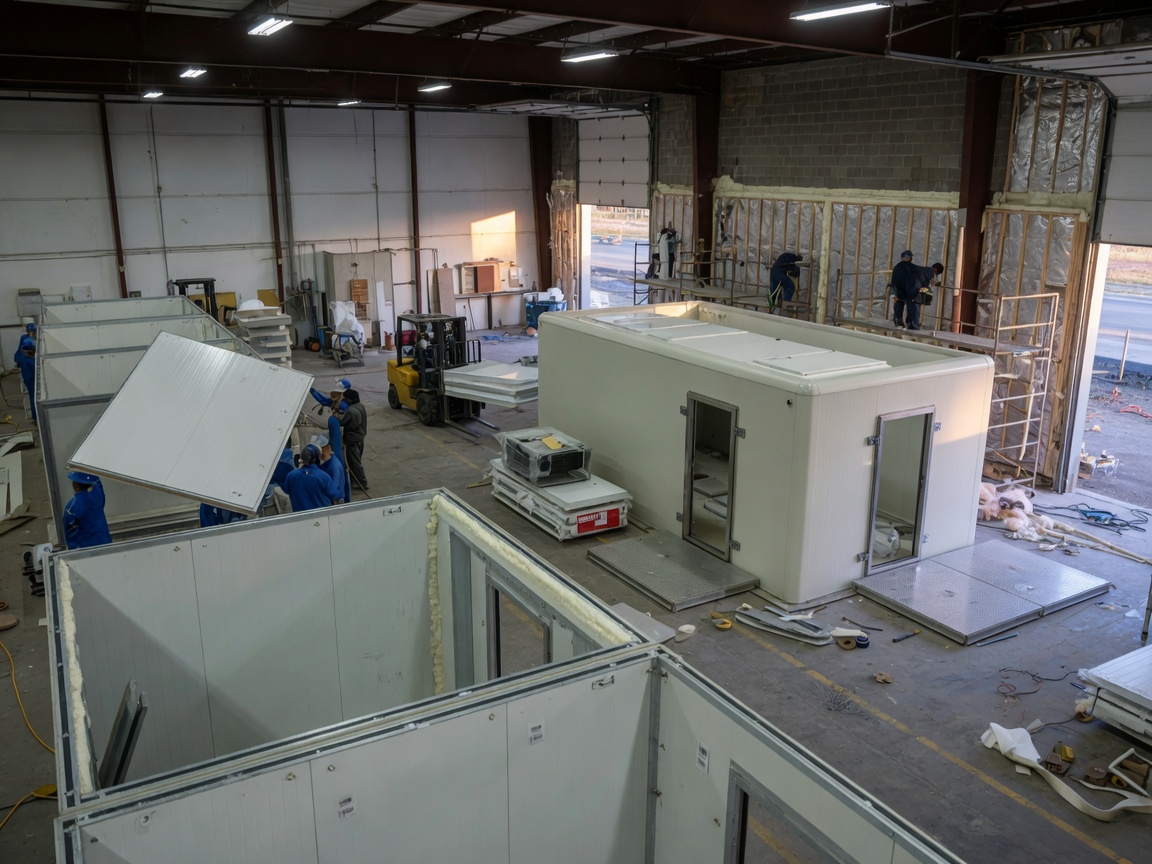
During chiller room installation or any industrial refrigeration equipment commissioning, the following checkpoints determine long-term performance. Insulation continuity — verified via thermographic imaging — should be completed before internal finishing. Refrigerant leak testing at 1.1× working pressure with nitrogen is mandatory before charging. Defrost cycle configuration must be validated against actual product load cycles, not manufacturer defaults. HVAC refrigeration systems that share building envelope components with office or processing spaces require careful attention to vapor drive direction — a detail that causes recurring condensation and insulation degradation when overlooked.
Preventive maintenance schedule for commercial freezer units
Industry consensus, supported by maintenance data from large frozen food distribution operators, recommends the following minimum service intervals:
- Monthly: Condenser coil cleaning, evaporator fan motor inspection, door gasket integrity check, temperature log review
- Quarterly: Refrigerant charge verification, compressor oil analysis, defrost heater continuity test, safety relief valve inspection
- Annually: Full system leak test, insulation thermal scan, electrical panel load audit, OSHA-mandated safety system verification
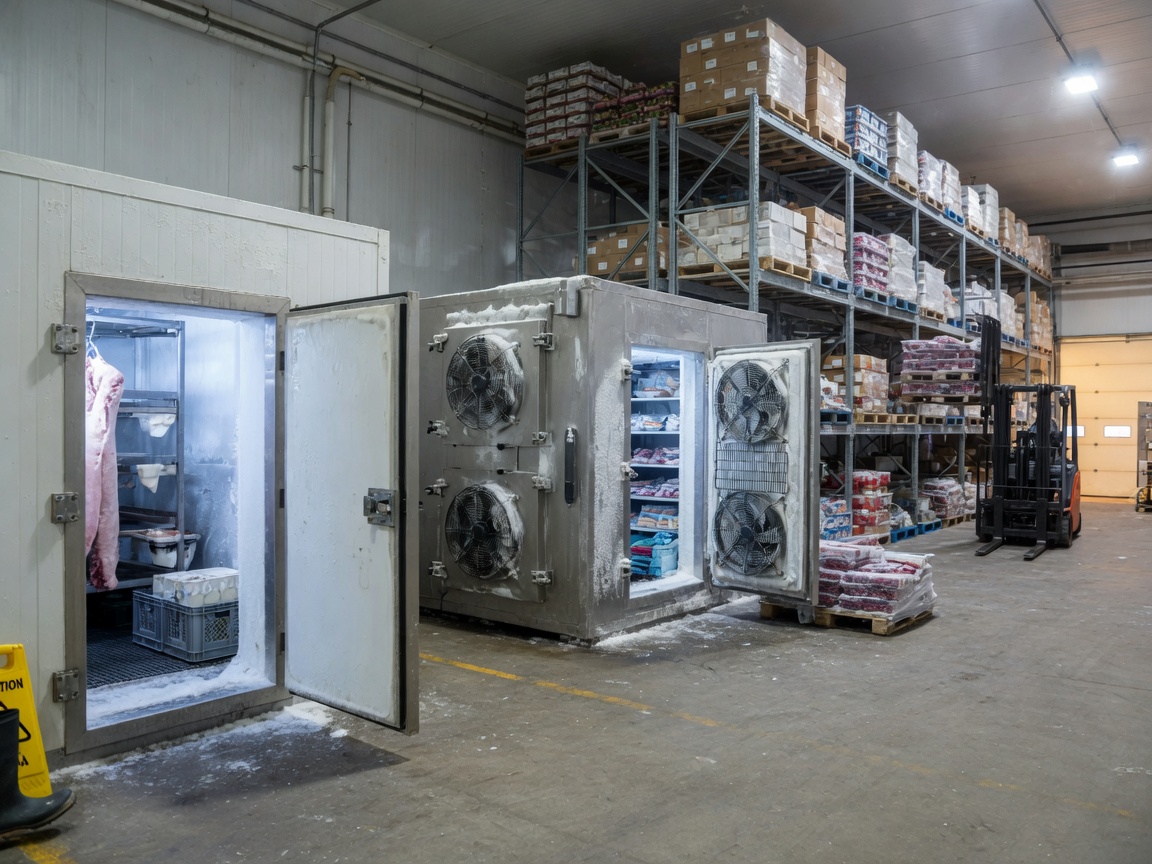
Insulation degradation and door seal failure are, based on real-world case data, the two most common causes of energy cost creep in aging cold storage operations. A failed door gasket on a walk-in cooler system can increase that room's energy consumption by 10–15% within weeks — yet it often goes unnoticed until the quarterly utility bill spikes. Scheduled preventive maintenance is, in the most direct sense, an energy cost management strategy.
FAQ
Frequently asked questions
Q: What is refrigeration and cold storage, and how does it differ from standard warehousing?
A: Refrigeration and cold storage uses mechanical refrigeration systems to maintain controlled low-temperature environments — typically -30°C to +15°C (-22°F to 59°F) — for preserving perishable goods and pharmaceuticals. Unlike standard warehousing, it requires continuous thermal management, redundant equipment, regulatory compliance, and specialized insulated infrastructure throughout the facility's operational life.
Q: What refrigerant should I specify for a new cold storage facility in 2026?
A: For large industrial facilities, ammonia (R-717) offers the best long-term efficiency and zero GWP, but requires PSM compliance above 10,000 lbs. CO2 transcritical systems are the preferred choice for commercial-scale cold storage in cooler U.S. climates. Avoid designing around high-GWP HFCs — the AIM Act phase-down makes them a long-term liability.
Q: What does cold storage construction cost per square foot in the U.S.?
A: As of 2026, chilled storage construction runs approximately $120–$180 per square foot (shell plus refrigeration system). Frozen storage ranges from $180–$280 per square foot. Blast freeze rooms can exceed $400 per square foot. Refrigeration systems typically represent 30–45% of total project cost in frozen facilities.
Q: What FDA and USDA regulations apply to cold storage operators?
A: FDA FSMA requires food storage facilities to maintain written food safety plans, continuous temperature monitoring, and two-year temperature log retention. USDA FSIS requirements apply to meat and poultry facilities and include HACCP plan obligations. OSHA standards require PPE programs and hazard assessments for workers in refrigerated environments.
Q: Should a small food business build, lease, or outsource cold storage?
A: For most small operators — below 5,000 pallet positions in frozen storage — outsourcing to a U.S.-based 3PL provider such as Americold or Lineage Logistics delivers better economics than building. Leasing space in a multi-client cold storage facility is appropriate for mid-size operators with stable volume. Building proprietary infrastructure becomes justifiable only at scale with stable, year-round throughput volume.
Refrigeration and cold storage infrastructure is not a commodity purchase — it is a long-term operational and regulatory commitment that shapes supply chain competitiveness for years. The decisions made at the specification stage, from refrigerant selection to compliance system design, determine whether a facility delivers its projected economics or becomes a persistent cost problem. Use the benchmarks, frameworks, and regulatory checklists in this guide as the foundation for your evaluation — and engage qualified engineers and compliance specialists to validate facility-specific requirements before finalizing any investment decision.
Keywords:
Inquiry
If you are interested in our products, please leave your email to receive a free product quote, thank you!
More information

Tel:
Sales E-mail: