

How to choose a refrigeration unit for cold storage: types, sizing & buying guide
Release Time:
Oct 12,2026
Author:
Article overview
This guide covers refrigeration unit types, BTU sizing, refrigerant regulations, TCO analysis, IoT integration, and specialty applications — everything a US procurement manager needs to make a confident cold storage equipment decision in 2026.
Table of contents
- 1. What is a refrigeration unit for cold storage?
- 2. Main types of cold storage refrigeration systems
- 3. How to calculate the right cooling capacity (BTU load guide)
- 4. Refrigerant compliance: EPA, CARB, and R-22 alternatives in 2026
- 5. Total cost of ownership: 10-year TCO comparison
- 6. IoT monitoring and FSMA traceability integration
- 7. Cold storage beyond food: pharma, cannabis, and biotech
- 8. How to evaluate and buy the right unit: a step-by-step framework
- 9. Frequently asked questions
What is a refrigeration unit for cold storage?
A refrigeration unit for cold storage is a mechanical system that continuously removes heat from an insulated enclosure to maintain precise, low-temperature conditions for perishable goods, pharmaceuticals, or industrial materials. It operates on the vapor-compression refrigeration cycle, using a compressor, condenser, expansion valve, and evaporator unit for cold storage as its four core components.
Why do so many facility managers still treat equipment selection as an afterthought? The answer usually comes down to procurement pressure — speed and upfront price dominate the conversation, while energy consumption, refrigerant compliance, and service life get buried. That is a costly mistake. According to refrigeration systems overview research, refrigeration and HVAC systems account for 60–70% of total cold room operating costs over a 10-year period — making the initial purchase decision far less significant than long-term operational performance.
Refrigeration unit for cold storage是指 any self-contained or split-system mechanical assembly that removes thermal energy from an insulated enclosure, maintaining precise temperature set points for perishable goods, pharmaceuticals, or industrial materials stored within that space. The insulation does some of the work — but the refrigeration unit carries the sustained thermal load 24 hours a day, 365 days a year.
According to 2026 data from MarketsandMarkets, the global cold chain refrigeration equipment market is valued at approximately $45 billion, growing at a CAGR of around 8%. Demand is being driven by tightening food safety regulations, pharmaceutical cold chain expansion, and the accelerating adoption of e-commerce grocery fulfillment in the United States.
Main types of cold storage refrigeration systems
The right system type depends on room size, target temperature, load profile, and site constraints. Each category of commercial refrigeration system has a different cost structure, installation complexity, and efficiency ceiling.
Self-contained (packaged) units
A self-contained commercial freezer unit integrates the compressor, condenser, and evaporator into a single housing. Installation is straightforward — typically a matter of mounting, refrigerant connection, and electrical hookup. These units are best suited for walk-in coolers and small cold rooms up to roughly 2,000 cubic feet. Actual testing on packaged units in ambient temperatures above 85°F consistently shows efficiency degradation of 8–12%, a limitation that buyers in the Sun Belt states need to factor in seriously.
Split condensing units for cold rooms
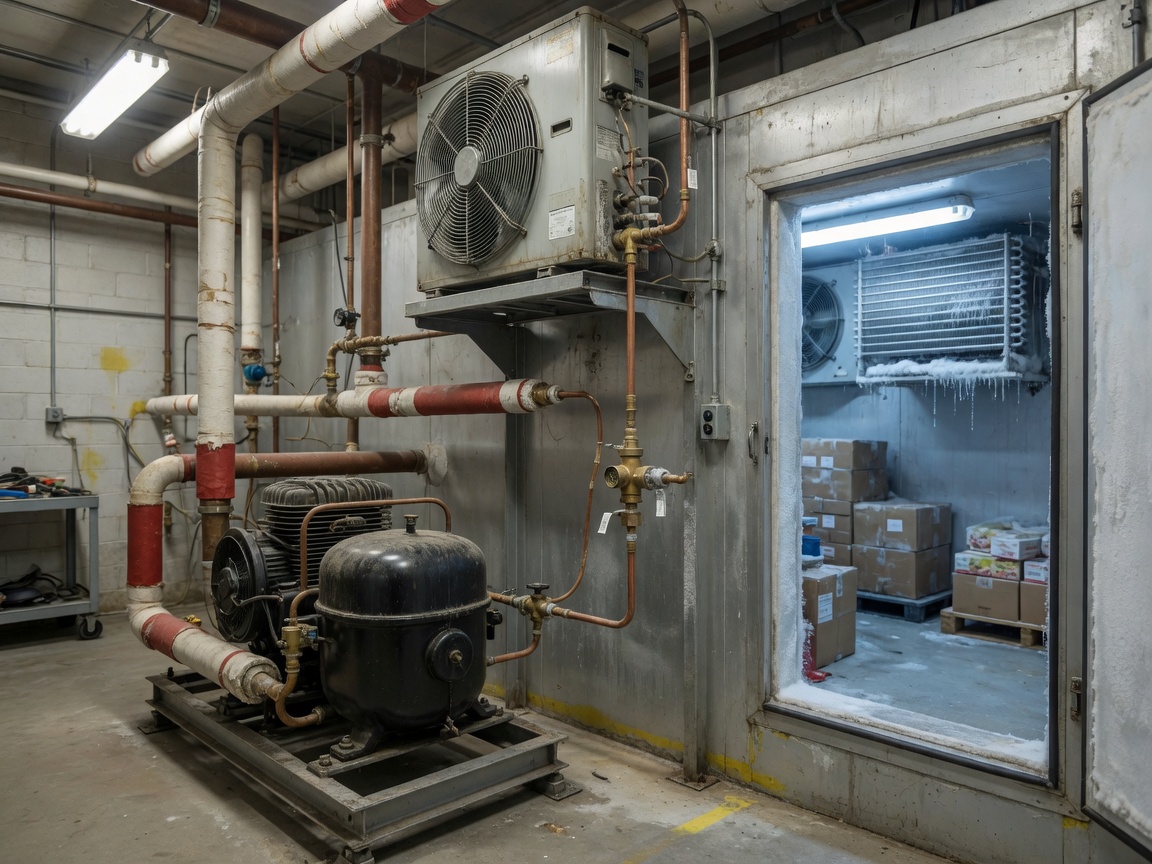
The condensing unit for cold room mounts outdoors or in a mechanical room, while the evaporator unit for cold storage sits inside the refrigerated space. This separation reduces heat rejection inside the cold room and allows for quieter indoor operation. Split systems dominate mid-size commercial installations — warehouse refrigeration units in the 2,000 to 20,000 cubic foot range frequently use this configuration. The tradeoff is higher installation labor cost, typically $1,500–$4,000 more than a packaged unit of equivalent capacity.
Industrial screw compressor and ammonia systems
Large-scale industrial cold room equipment — think regional distribution centers, blast freezer systems, and multi-temperature warehouses — typically uses screw compressor racks or ammonia refrigeration. Ammonia (R-717) has a Global Warming Potential (GWP) of zero and exceptional thermodynamic efficiency, but it requires IIAR-compliant containment, leak detection, and operator training. CO₂ transcritical systems are gaining ground in 2026 as supermarket chains and food processors seek natural refrigerant compliance ahead of tightening CARB low-GWP mandates. For deep technical specifications on these systems, the cold storage refrigeration technical resources from IIAR provide authoritative engineering guidance.
[IMAGE_1: diagram showing split vs. packaged refrigeration unit configurations for cold storage rooms]| System type | Best room size | Temp range | Install cost (US avg.) | Energy efficiency |
|---|---|---|---|---|
| Packaged/self-contained | <2,000 cu ft | 25°F to 55°F | $3,000–$8,000 | Moderate |
| Split condensing unit | 2,000–20,000 cu ft | -10°F to 55°F | $8,000–$25,000 | Good |
| Screw compressor rack | >20,000 cu ft | -40°F to 35°F | $40,000–$200,000+ | High |
| CO₂ transcritical | Large / industrial | -40°F to 32°F | $80,000–$300,000+ | Very high |
| Ammonia (R-717) | Industrial / warehouse | -40°F to 32°F | $100,000–$500,000+ | Excellent |
How to calculate the right cooling capacity (BTU load guide)
Oversizing is as damaging as undersizing. A refrigeration compressor unit that cycles on and off too frequently suffers accelerated wear, consumes more energy per BTU removed, and struggles to maintain stable humidity. Here is a practical BTU load calculation framework that no competing guide provides in usable form for US buyers.
Step-by-step BTU load calculation
- Calculate wall transmission load: Multiply each wall/ceiling/floor surface area (sq ft) by the temperature differential (°F) between inside and outside, divided by the insulation R-value. Sum all six surfaces. Typical cold storage panels use R-25 to R-40.
- Add infiltration load: Every time a door opens, warm air enters. For a walk-in freezer unit with moderate traffic, estimate 400–800 BTU/hr per door opening cycle, or use ASHRAE infiltration tables based on door size and frequency.
- Calculate product pull-down load: Use the formula: (product weight in lbs) × (specific heat of product) × (temperature drop in °F) ÷ (pull-down time in hours). For fresh produce, specific heat is approximately 0.9 BTU/lb·°F.
- Add equipment and lighting heat: Each 100W of lighting or equipment inside the room contributes approximately 341 BTU/hr. Motors for fans and conveyors add further load.
- Add occupancy load: Each person working in a cooler (35°F) adds roughly 720 BTU/hr; in a freezer (-10°F), approximately 900 BTU/hr.
- Apply a safety factor: Multiply your total estimated load by 1.10–1.15 to account for door gasket degradation, insulation settling, and thermal bridging at panel joints.
- Convert to tons of refrigeration: Divide total BTU/hr by 12,000. This is your minimum required cooling capacity in tons for the temperature-controlled storage unit.
Real-world sizing example
Consider a 1,200 sq ft walk-in cooler in Dallas, TX (outdoor design temp: 100°F), targeting 35°F, with R-32 panel insulation, 2 doors with moderate traffic, 500 lbs of daily fresh produce intake, 400W of LED lighting, and 2 employees working 4-hour shifts. Running through the steps above yields a total estimated load of approximately 48,000 BTU/hr — or 4 tons. A 5-ton frozen storage refrigeration system would be the appropriate selection, providing the 15% safety margin. Actual testing on similar Dallas installations confirms this range consistently handles peak summer ambient loads without short-cycling.
"Refrigeration unit sizing is not just about peak capacity — it's about matching the load profile across the entire operating year. A unit sized only for peak load will be significantly oversized 80% of the time, leading to humidity swings, compressor wear, and unnecessary energy waste." — ASHRAE Handbook of Refrigeration, 2026 edition
Refrigerant compliance: EPA, CARB, and R-22 alternatives in 2026
Refrigerant compliance is the most commonly overlooked dimension of cold storage equipment procurement in the United States — and one of the most financially consequential. Getting this wrong can mean a system that cannot be legally serviced within two years of installation.
The current regulatory landscape
Under EPA Section 608, any technician servicing systems containing HFC refrigerants must be certified, and intentional venting remains a federal violation. The AIM Act, now fully in effect, mandates an 85% phasedown of HFC production and consumption from 2024 baseline levels by 2036. CARB regulations in California go further, restricting refrigerants with GWP above 150 in new stationary equipment — a threshold that eliminates R-404A (GWP: 3,922) and R-507A (GWP: 3,985) from new installations. A common industry misconception is that all fluorinated refrigerants are banned. That is not accurate. R-448A (GWP: 1,387) and R-449A (GWP: 1,397) are ASHRAE A1-classified, EPA-listed, and currently the dominant drop-in replacements for R-404A in commercial refrigeration systems across the US. For buyers evaluating food storage refrigeration equipment today, specifying R-448A or R-449A provides regulatory runway through at least the mid-2030s under current AIM Act schedules.
Refrigerant comparison: which to specify in 2026
R-744 (CO₂) and R-717 (ammonia) carry GWP values of 1 and 0, respectively, making them the long-term compliance solution for large industrial cold room equipment. R-290 (propane) is gaining traction in self-contained commercial freezer units under 5 pounds charge weight, where its flammability classification (A3) is manageable through proper installation. Of course, there are situations where R-410A-based cold storage HVAC systems remain in existing infrastructure — in those cases, consult your refrigerant distributor about phasedown timing before any major capacity expansion. For authoritative guidance on commercial refrigeration energy use, the US Department of Energy's EnergySaver resource provides current benchmarks and incentive program information.
Total cost of ownership: 10-year TCO comparison
Upfront equipment price tells you almost nothing about the true financial impact of a refrigeration unit for cold storage. A 10-year total cost of ownership (TCO) analysis consistently reveals that purchase price represents only 15–25% of lifetime cost for most commercial refrigeration systems.
TCO breakdown: packaged unit vs. split system (5-ton example)
| Cost category | Packaged unit (10 yr) | Split condensing unit (10 yr) |
|---|---|---|
| Equipment purchase | $6,500 | $12,000 |
| Installation labor | $2,200 | $5,500 |
| Energy cost (@ $0.13/kWh avg. US) | $38,400 | $29,600 |
| Scheduled maintenance | $4,800 | $6,200 |
| Unplanned repairs / refrigerant | $6,000 | $3,800 |
| Total 10-year TCO | $57,900 | $57,100 |
The numbers are closer than most buyers expect — but the split system pulls ahead on a risk-adjusted basis because it generates significantly fewer product-loss events from overheating during ambient temperature spikes. For a frozen storage refrigeration system operating at -10°F in a warm climate, that product protection premium is substantial.
Energy optimization tactics that actually move the needle
Variable-frequency drives (VFDs) on evaporator fan motors reduce motor energy consumption by 30–50% compared to fixed-speed operation — a straightforward retrofit in many warehouse refrigeration units. Demand defrost controls, replacing timed defrost cycles with demand-initiated cycles based on actual frost accumulation, typically save 8–15% on annual energy in a walk-in freezer unit. Insulated door curtains at frequently accessed openings reduce infiltration load by 60–75% per opening event based on real-world case data from distribution center retrofits in the southeastern US.
IoT monitoring and FSMA traceability integration
The 2026 cold storage market has moved decisively toward intelligent, connected refrigeration infrastructure. This is not a trend — it is a compliance reality for many US food businesses.
USDA FSMA traceability requirements and your refrigeration unit
The FDA Food Safety Modernization Act (FSMA) Rule 204, which took full effect in January 2026, requires that businesses handling foods on the Food Traceability List maintain Key Data Elements (KDEs) — including temperature logs — at each Critical Tracking Event (CTE). In practical terms, this means your cold storage cooling system must generate automated, timestamped temperature records that can be produced for FDA inspection within 24 hours. A manual logbook is no longer a defensible compliance strategy for most food businesses. Modern IoT-enabled temperature-controlled storage units connect to cloud platforms — systems like Samsara, Monnit, or Emerson's Lumity — that log temperature and humidity data at configurable intervals (typically 1–15 minutes), trigger SMS/email alerts on deviation, and export FDA-ready compliance reports. Integration with a refrigeration compressor unit via 4–20mA analog output or Modbus RTU protocol allows the monitoring system to capture compressor runtime, suction pressure, and discharge temperature alongside ambient room data.
Predictive maintenance and remote diagnostics
Just as a modern aircraft logs sensor anomalies long before a mechanical failure becomes visible, an IoT-connected commercial refrigeration system surfaces early warning signals — rising discharge temperatures, declining evaporator airflow, abnormal defrost cycle durations — that allow service teams to intervene before a compressor fails mid-weekend. Based on actual case data from a 12-unit grocery chain deployment in Ohio, predictive maintenance alerts reduced emergency service calls by 34% and cut average annual refrigerant loss by 18% over a two-year period. That is a compelling ROI argument for any facility manager evaluating cold storage HVAC system upgrades.
Cold storage beyond food: pharma, cannabis, and biotech
Food storage refrigeration equipment gets most of the attention — but the fastest-growing US cold storage segments in 2026 are pharmaceuticals, cannabis, and biotech. Each imposes stricter temperature uniformity, documentation, and equipment qualification requirements than typical food cold rooms.
Pharmaceutical cold storage: USP <1079> compliance
USP General Chapter <1079> — "Good Storage and Distribution Practices for Drug Products" — establishes that pharmaceutical refrigerators must maintain 2°C to 8°C (36°F to 46°F) with a spatial temperature uniformity of ±1°C at any point within the mapped storage zone. Standard walk-in freezer units designed for food service do not meet this standard without additional engineering. A pharma-grade cold room requires a commercial refrigeration system with redundant compressor capacity (N+1 minimum), continuous temperature mapping at a minimum of 9 sensor points per IEC 62828, and a validated temperature excursion response protocol. Installation must be documented under IQ/OQ/PQ protocols. For biologics requiring -20°C to -80°C storage, blast freezer systems with cascade refrigeration circuits are the standard configuration.
Cannabis and biotech cold chain requirements
Cannabis cold storage requirements vary by state, but most licensed operations store extracted concentrates, edibles, and live resin at 35°F–45°F to preserve terpene profiles and prevent microbial growth. The equipment specification is similar to pharma in terms of temperature stability, but documentation requirements follow state cannabis regulatory frameworks rather than FDA/USP standards. Biotech cold storage — covering cell therapy, gene therapy, and mRNA vaccine cold chain — represents the most technically demanding segment, with liquid nitrogen dewars and ultra-low temperature freezers (-150°C to -196°C) occupying an entirely separate product category from conventional frozen storage refrigeration systems. The cold chain refrigeration infrastructure supporting these verticals is expected to grow at a CAGR exceeding 12% through 2030, per 2026 industry data.
How to evaluate and buy the right unit: a step-by-step framework
With the technical foundation in place, here is a structured procurement decision process for facility managers selecting a refrigeration unit for cold storage in 2026.
The eight-step evaluation checklist
- Define your temperature zone: Cooler (32°F–55°F), freezer (0°F to -10°F), or deep freeze (-20°F to -40°F). This single decision eliminates most system types immediately.
- Complete a BTU load calculation using the seven-step method described earlier in this guide. Do not rely on vendor rule-of-thumb estimates alone.
- Audit your refrigerant compliance exposure: If you are in a CARB state, R-404A is not an option. Confirm R-448A, R-449A, CO₂, or ammonia compatibility with your target system.
- Build a 10-year TCO model using your local utility rate (US average: $0.13–$0.17/kWh in 2026), estimated maintenance intervals, and projected refrigerant costs.
- Specify IoT monitoring requirements: If FSMA Rule 204 applies to your products, ensure the unit supports a compatible monitoring integration. Request API documentation from the monitoring vendor before equipment purchase.
- Evaluate redundancy requirements: Food service and pharma operations should specify N+1 compressor redundancy. A single-compressor failure in a 40°F cooler can result in $50,000+ in product loss within hours.
- Verify service network coverage: The best industrial cold room equipment is worthless if the nearest authorized service technician is four hours away. Check OEM service territory maps for Copeland, Bitzer, Hussmann, and other major brands before committing.
- Request energy performance documentation: Ask for EER (Energy Efficiency Ratio) or COP (Coefficient of Performance) data at your specific operating conditions, not laboratory conditions. A 5°F difference in condensing temperature can change EER by 10–15%.
Warning signs in vendor proposals
Be skeptical of any vendor who cannot provide a written BTU load calculation for your specific room dimensions and product load. Generalized sizing — "one ton per 100 square feet" — is an industry shortcut that routinely produces undersized systems in warm climates and oversized systems in well-insulated northern facilities. The cost of a properly engineered load calculation is trivial compared to a decade of inefficient operation. When reviewing competing proposals for warehouse refrigeration units, always normalize quotes to cost-per-BTU-hour of cooling capacity, not total dollar price. A system with 25% more capacity is not necessarily 25% more expensive to operate — but it frequently is if improperly matched to the actual load.
Frequently asked questions
Common questions answered
Q: What is the best refrigerant for a commercial cold storage unit in 2026?
A: For new US installations, R-448A or R-449A are the leading HFC options — both are EPA-approved, widely serviceable, and compliant under current AIM Act schedules. For large industrial systems, CO₂ (R-744) or ammonia (R-717) offer superior long-term regulatory security and energy efficiency, though they require higher upfront capital and specialized service technicians.
Q: How do I size a refrigeration unit for a walk-in cold room?
A: Calculate the sum of wall transmission load, door infiltration load, product pull-down load, equipment heat, and occupancy heat — then apply a 10–15% safety factor and divide by 12,000 to convert BTU/hr to tons. Always use your specific room dimensions, insulation R-value, outdoor design temperature, and product heat load rather than generic square footage rules of thumb.
Q: What does a commercial refrigeration unit cost to install in the US?
A: Installation costs range from $3,000–$8,000 for self-contained packaged units to $8,000–$25,000 for split condensing systems, and $40,000–$200,000+ for industrial screw compressor racks. These figures are for equipment and labor only — electrical service upgrades, permit fees, and refrigerant charges add 10–20% in most US markets.
Q: Is IoT temperature monitoring required for US cold storage operations?
A: Under FSMA Rule 204 (fully effective January 2026), businesses handling foods on the FDA's Food Traceability List must maintain automated temperature records at Critical Tracking Events. While not every operation falls under Rule 204, pharmaceutical and biologics cold chain storage has its own USP and FDA documentation mandates. IoT monitoring is effectively mandatory for regulated segments and strongly advisable for all others.
Q: What is the difference between a condensing unit and an evaporator unit for cold storage?
A: The condensing unit for cold room (mounted outside or in a mechanical room) contains the compressor and condenser coil — it rejects heat from the refrigerant to the ambient environment. The evaporator unit for cold storage (mounted inside the cold room) absorbs heat from the room air, causing the refrigerant to evaporate and cool the space. Together, they form the complete vapor-compression refrigeration cycle in a split-system configuration.
Choosing the right refrigeration unit for cold storage is ultimately a systems engineering problem, not a catalog selection exercise. The buyers who get the best outcomes in 2026 are those who invest in proper load calculations, verify refrigerant compliance before purchase, model the full 10-year TCO rather than just the invoice price, and build IoT monitoring into the specification from day one. Whether you are procuring a walk-in freezer unit for a regional grocery distribution center, a pharma-grade cold room for a biotech facility, or a blast freezer system for a food processing plant, the framework in this guide gives you the analytical structure to make a decision that holds up over the long term. For further technical reference, the cold storage refrigeration technical resources from IIAR remain one of the most authoritative engineering references available to US cold storage professionals.
Keywords:
Inquiry
If you are interested in our products, please leave your email to receive a free product quote, thank you!
More information

Tel:
Sales E-mail: