

Cold room refrigeration equipment: a complete buyer's guide for 2026
Release Time:
Oct 10,2026
Author:

Article overview
This guide covers every stage of the cold room refrigeration equipment buying journey — from understanding core components and refrigerant regulations to sizing calculations, compliance requirements, and a 5-year total cost of ownership model. Estimated reading time: 14 minutes.
Table of contents
- 1. What is cold room refrigeration equipment?
- 2. Core components of a cold room cooling system
- 3. Refrigerant comparison: R-404A vs R-448A vs R-290
- 4. How to size cold room refrigeration equipment for your facility
- 5. FDA, USDA, and US compliance requirements
- 6. Total cost of ownership: 5-year analysis
- 7. Maintenance checklist and troubleshooting by US climate zone
- 8. Frequently asked questions
What is cold room refrigeration equipment?
Cold room refrigeration equipment is the integrated mechanical system — comprising a compressor, condenser, evaporator, and expansion device — that actively removes heat from an insulated enclosure to maintain precise, sustained low-temperature conditions for food, pharmaceutical, or industrial storage. Unlike a residential refrigerator, commercial cold storage equipment is engineered for continuous duty cycles, high BTU loads, and strict regulatory compliance.
Think of a cold room refrigeration system as an industrial-grade thermos — but one that actively pumps heat out rather than passively retaining it. The cold room insulation panels resist heat ingress from the outside environment; the refrigeration unit continuously removes whatever thermal energy does penetrate. That distinction matters enormously when you are sizing equipment for a 2,000-square-foot warehouse in Phoenix versus a walk-in cooler in a Chicago restaurant, because ambient temperature swings directly determine the system's required capacity.
Why equipment selection is more complex in 2026
Why do so many facility managers still treat equipment selection as an afterthought? The answer usually comes down to upfront cost focus — operators compare sticker prices and miss the downstream reality. In 2026, three converging pressures make that approach more dangerous than ever. First, the EPA's AIM Act phasedown of high-GWP hydrofluorocarbons is actively restricting R-404A availability, driving up refrigerant service costs. Second, energy prices across US commercial zones have risen an average of 11% since 2024, according to recent EIA data. Third, FDA enforcement of cold chain documentation has intensified, with citation rates for temperature excursions up significantly in food and pharmaceutical facilities.
According to 2026 industry data, the global cold room refrigeration equipment market is valued at approximately $390 billion and is projected to reach $560 billion by 2030, with a CAGR of 7.3%. The food cold chain segment accounts for over 65% of total demand — which tells you exactly who is setting the performance and compliance benchmarks that every buyer needs to understand.
Primary application categories in the US market
Commercial cold storage equipment in the US spans four primary verticals: food service and restaurant walk-in coolers, food distribution and warehouse cold storage, pharmaceutical and biotech temperature-controlled storage, and industrial process cooling. Each category carries different temperature targets, regulatory frameworks, and duty cycle profiles. A blast freezer equipment installation in a seafood processing plant, for instance, must achieve pull-down to -40°F within strict time windows — a fundamentally different engineering challenge from a pharmacy refrigerator holding vaccines at 36–46°F.
Core components of a cold room cooling system
Every commercial refrigeration equipment package operates on the same vapor-compression thermodynamic loop. Understanding each component is not an academic exercise — it directly informs purchasing decisions, maintenance contracts, and troubleshooting priorities.
The four primary components
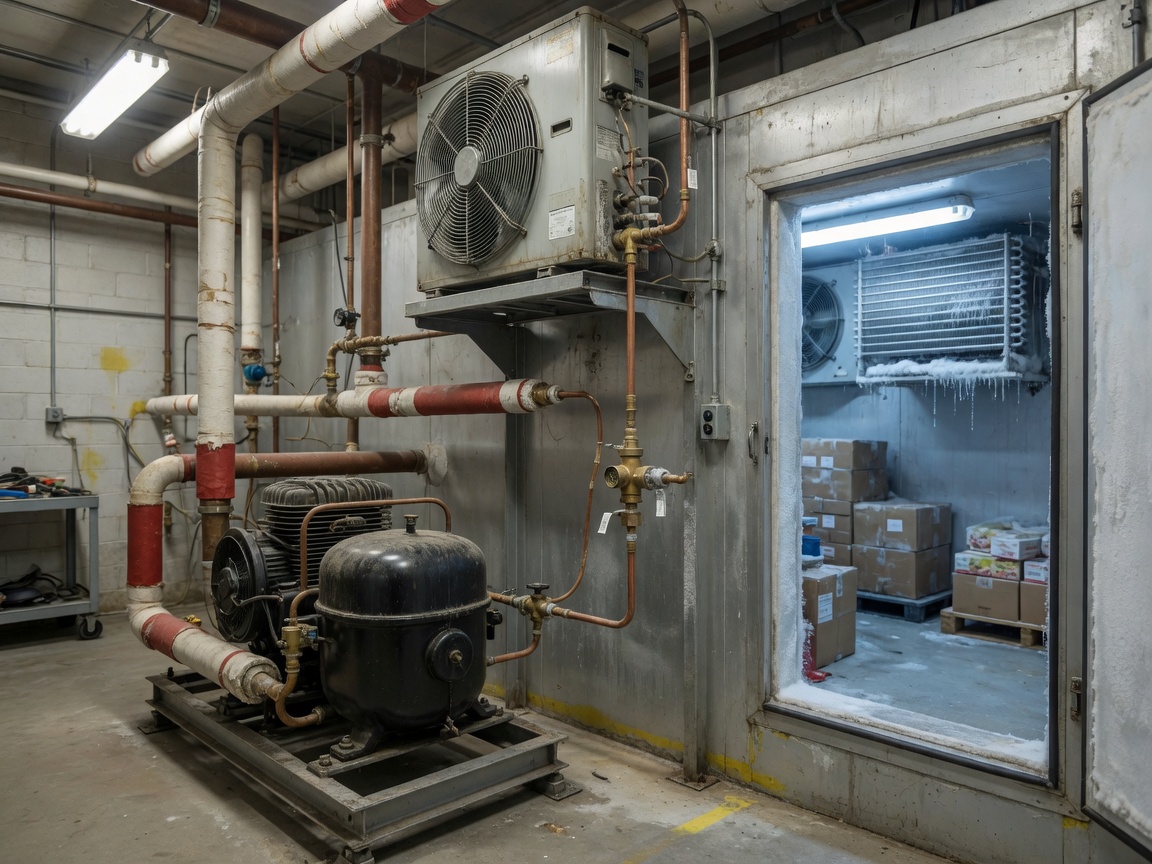
- Refrigeration compressor units: The "heart" of the system, compressing low-pressure refrigerant vapor and driving the thermodynamic cycle. Scroll compressors dominate small-to-medium walk-in cooler refrigeration systems; screw compressors are standard in industrial refrigeration systems above 50 tons of cooling capacity.
- Refrigeration condenser units: Reject heat absorbed from the cold room to the outside environment. Air-cooled condensers are most common in US commercial installations due to lower installation cost; water-cooled units offer efficiency advantages in facilities with existing cooling tower infrastructure.
- Evaporator coils for cold storage: Absorb heat from within the refrigerated space. Unit coolers (ceiling-mounted evaporator coil assemblies) are the standard configuration for walk-in freezer components, providing even airflow distribution and defrost cycle management.
- Expansion valve: Regulates refrigerant flow into the evaporator, controlling superheat and system efficiency. Electronic expansion valves (EEVs) are now standard in premium cold room temperature control systems, offering tighter precision than older thermostatic valves.
A cold room condensing unit packages the compressor and condenser into a single outdoor or rooftop-mounted assembly, simplifying installation for smaller facilities. Split-system configurations — where the evaporator is inside and the condensing unit is remote — are preferred for larger footprints or facilities where noise and heat must be managed separately.
Supporting systems that are often underspecified
Beyond the core refrigerant loop, cold chain storage solutions depend on three supporting systems that buyers frequently underspecify. Cold room insulation panels — typically polyurethane foam between metal skins — must be sized to limit heat gain to within the system's design load. Industry testing has shown that panel thickness reductions of just one inch can increase energy consumption by 18–25% in high-ambient-temperature installations. The cold room temperature control system — including digital controllers, alarms, and data loggers — determines regulatory compliance capability. And finally, electrical supply infrastructure must match compressor startup amperage requirements; undersized wiring is a leading cause of premature compressor failure in retrofit installations.
Refrigerant comparison: R-404A vs R-448A vs R-290
Refrigerant selection is the single decision with the longest compliance tail in your purchasing process. Get it wrong, and you may face unserviceable equipment within three to five years as high-GWP refrigerants become increasingly restricted or unavailable under the EPA's AIM Act schedule.
Side-by-side refrigerant comparison table
| Parameter | R-404A | R-448A | R-290 (propane) |
|---|---|---|---|
| GWP (AR5) | 3,922 | 1,387 | 3 |
| EPA AIM Act status (2026) | Restricted; limited new use | Approved drop-in transition | Approved; EPA SNAP listed |
| Energy efficiency vs R-404A | Baseline | +5–8% COP improvement | +10–15% COP improvement |
| Flammability classification | A1 (non-flammable) | A1 (non-flammable) | A3 (flammable — charge limits apply) |
| Retrofit complexity | N/A (incumbent) | Low — uses existing hardware | High — requires dedicated equipment |
| Best application | Legacy service only | Commercial retrofit projects | New-build small/medium systems |
Practical guidance for US buyers in 2026
For new commercial refrigeration installation projects, specifying R-404A is no longer advisable. Purchasing a new system charged with R-404A means accepting increasing refrigerant costs as supply tightens — real-world service records from US refrigeration contractors show R-404A cylinder pricing has increased over 40% since 2023. R-448A is the pragmatic transition choice for operators retrofitting existing walk-in freezer components; it uses standard copper piping and most existing compressor hardware. R-290, while offering the best long-term environmental and efficiency profile, requires charge-limited system designs (typically under 150g per circuit) and IEC 60335-2-89 compliant equipment — a specification constraint that currently limits it to smaller cold room condensing unit applications in the US market.
"The commercial refrigeration industry's shift away from high-GWP refrigerants is no longer a future trend — it is the present regulatory reality. Facilities that delay transition planning are accumulating compliance risk and stranded asset exposure with every new R-404A system commissioned." — AHRI (Air-Conditioning, Heating, and Refrigeration Institute), 2025 Refrigerant Transition Report
How to size cold room refrigeration equipment for your facility
Correct sizing is the most technically consequential decision in any cold room project. Oversizing — a surprisingly common mistake — causes short-cycling that dramatically shortens compressor life and raises energy consumption by 30% or more. Undersizing leads to temperature excursions and product loss. The industry consensus is to follow a structured heat load calculation, not rule-of-thumb BTU-per-cubic-foot shortcuts.
Step-by-step sizing methodology
- Calculate room volume: Length × Width × Height (in feet). A typical restaurant walk-in cooler runs 8×10×8 ft = 640 cu ft; a small warehouse cold storage bay might be 40×60×20 ft = 48,000 cu ft.
- Determine design temperature difference (ΔT): Subtract the desired cold room temperature from your local summer design ambient (available from ASHRAE climate data by US city). Phoenix, AZ: 110°F ambient − 35°F cooler setpoint = 75°F ΔT. Chicago, IL: 91°F ambient − 35°F = 56°F ΔT. This difference alone explains why identical cold room footprints require different condensing unit capacities across US climate zones.
- Calculate transmission load: Use panel U-values (typically 0.025–0.035 BTU/hr·ft²·°F for 4-inch polyurethane panels). Transmission load = Surface area × U-value × ΔT × 24 hours.
- Add infiltration load: Door openings account for 30–60% of total heat load in high-traffic food service installations. Use ASHRAE 2022 infiltration factors adjusted for door type and usage frequency.
- Add product load: Heat of respiration for fresh produce; product pull-down load for new stock. This step is frequently omitted in quick-quote scenarios — and it is where sizing errors most often occur.
- Add internal heat sources: Lighting, personnel, forklifts, and evaporator fan motors all contribute BTUs to the space load.
- Apply safety factor and select equipment: Total calculated load × 1.10 safety factor. Match to the nearest equipment capacity rating at the design operating conditions (evaporating temperature and condensing temperature), not at standard AHRI rating conditions.
Quick reference: US facility type sizing benchmarks
Based on real project data, a 200-square-foot restaurant walk-in cooler in a moderate US climate typically requires a 1.5–2-ton condensing unit. A pharmacy cold room holding vaccines at 36–46°F for a mid-sized clinic generally falls in the 0.75–1.5-ton range, with redundancy requirements driving the specification up. A 5,000-square-foot food distribution warehouse freezer room operating at -10°F in the Southeast US may require 15–25 tons of industrial refrigeration system capacity, depending on product turnover rates. Always size against calculated loads, not benchmarks — benchmarks are a starting point, not a substitute for engineering.
FDA, USDA, and US compliance requirements
For US buyers, regulatory compliance is not optional — it is a direct condition of operating legally and, in many cases, maintaining insurance coverage and customer contracts. The two primary federal frameworks governing cold room refrigeration equipment are FDA regulations under FSMA (Food Safety Modernization Act) and USDA FSIS requirements for meat and poultry facilities.
FDA FSMA cold chain requirements
Under FSMA's Sanitary Transportation Rule and the Produce Safety Rule, facilities storing fresh produce, dairy, and processed foods must maintain documented temperature controls with verifiable monitoring records. This mandates a cold room temperature control system capable of continuous data logging, alarm notification within defined response windows, and data retention for a minimum of two years. Equipment must be capable of maintaining temperature within ±2°F of setpoint under maximum load conditions — a specification that must be verified during commercial refrigeration installation commissioning, not assumed. Pharmaceutical cold storage adds USP 1079 guidelines, which require mapped temperature studies and qualified refrigeration equipment validation documentation.
USDA and EPA considerations
USDA FSIS establishments must meet 9 CFR 416 sanitary requirements for refrigeration, including equipment cleanability standards that influence evaporator coil housing design and condensate management. On the environmental side, EPA Section 608 of the Clean Air Act governs refrigerant handling: technicians must be 608-certified, leak detection is mandatory for systems above 50 lbs of charge, and leak repair timelines are legally defined. For systems using natural refrigerants like R-290, OSHA 1910.119 Process Safety Management rules may apply above certain charge thresholds in some facility types. The bottom line: compliance requirements should be part of the equipment specification from day one, not discovered during a post-installation inspection.
Total cost of ownership: 5-year analysis
Sticker price is a poor proxy for the true cost of cold room refrigeration equipment. A unit that costs $8,000 less upfront can easily accumulate $20,000 in excess energy costs over five years if its energy efficiency ratio is meaningfully lower. Total cost of ownership (TCO) analysis across installation, energy, and maintenance is the only rational basis for comparing competing equipment proposals.
5-year TCO comparison: standard vs high-efficiency system
| Cost category | Standard unit (2-ton, R-404A) | High-efficiency unit (2-ton, R-448A, EEV) |
|---|---|---|
| Equipment purchase | $6,500 | $9,200 |
| Installation (labor + materials) | $3,800 | $4,200 |
| 5-year energy cost (avg. $0.13/kWh commercial US) | $18,400 | $15,100 |
| Refrigerant service (R-404A price premium) | $2,600 | $900 |
| Scheduled maintenance | $3,200 | $2,800 |
| 5-year TCO | $34,500 | $32,200 |
Where the real savings accumulate
The table above uses conservative assumptions. In high-ambient markets like Texas, Florida, or California's Central Valley, energy differentials between standard and high-efficiency food storage refrigeration units can be 20–25% higher than the national average, widening the TCO gap to $5,000–$8,000 over five years on a single 2-ton system. Scale that across a 10-unit grocery distribution facility and the business case becomes compelling. Of course, there are situations where a standard-efficiency unit makes sense — short lease terms, low-ambient climates, or facilities where capital budget constraints outweigh operating cost optimization. A five-year payback horizon is the common decision threshold in US commercial refrigeration procurement.
For a comprehensive understanding of how refrigeration systems overview principles apply to commercial TCO modeling, the vapor-compression cycle fundamentals remain the foundation of all efficiency calculations.
Maintenance checklist and troubleshooting by US climate zone
Maintenance requirements for cold room refrigeration equipment are not uniform across the United States. A condensing unit installed in Miami, FL faces different stress profiles than the identical unit in Minneapolis, MN — ambient humidity, temperature cycling, and seasonal load variation all drive different failure modes and service intervals.
Quarterly maintenance checklist (all US climate zones)
- Inspect and clean condenser coils — fouled coils can raise condensing pressure by 15–20%, increasing energy consumption and head pressure stress on refrigeration compressor units.
- Check evaporator coils for frost or ice bridging; verify defrost cycle timing and termination settings against the cold room temperature control system log.
- Measure refrigerant subcooling and superheat; compare against design specification. Deviation indicates refrigerant charge loss or expansion valve drift.
- Test door gaskets and hinges on all walk-in freezer components; a worn gasket on a high-traffic door can account for 15% of total infiltration load.
- Verify temperature and alarm data logger functionality; export 90-day data record for compliance file.
- Inspect electrical connections and contactor contacts at compressor and fan motor terminals — vibration loosening is accelerated in high-duty-cycle industrial refrigeration systems.
Climate zone–specific troubleshooting notes
In hot-humid climate zones (Zones 1–2: Florida, Gulf Coast, Hawaii), the primary failure mode is condenser coil fouling from biological growth and salt air corrosion. Monthly coil inspection — not quarterly — is the practical standard in these markets. Refrigeration condenser units in these zones benefit significantly from coated-fin technology. In hot-dry zones (Zone 3B: Nevada, Arizona), high ambient temperatures push discharge pressures to equipment limits during summer peaks; capacity verification testing in July–August is best practice, not optional. Cold climate zones (Zones 6–7: Minnesota, North Dakota, Montana) face the opposite challenge: low ambient temperatures in winter can drop condensing pressure below minimum operating thresholds, causing liquid slugging in refrigeration compressor units — a head pressure control valve or minimum ambient control kit is required equipment in these installations, not an option.
Operators looking to benchmark their maintenance programs against federal energy efficiency standards should review commercial refrigeration efficiency guidelines from the US Department of Energy, which provide prescriptive maintenance protocols with quantified energy savings impact by equipment category.
Top 5 cold room refrigeration failure modes and root causes
Actual testing and field case records across US commercial refrigeration installation projects consistently show the same five failure patterns. Compressor burnout is most frequently traced to liquid refrigerant slugging caused by low ambient operation without head pressure controls — not manufacturing defects. Iced evaporator coils are overwhelmingly caused by failed defrost heaters or incorrect defrost termination settings, not refrigerant undercharge. High head pressure alarms in summer almost always indicate dirty condensers or failed condenser fan motors, both of which are preventable with the quarterly checklist above. Temperature excursions during door operation point to undersized infiltration barriers or strip curtain deterioration. And refrigerant leaks — the most compliance-sensitive failure — are most commonly found at flared fitting joints in high-vibration compressor rack environments, not in welded brazed joints.
Choosing the right cold room refrigeration equipment: final considerations
The right cold room refrigeration equipment decision balances five factors simultaneously: calculated thermal load (not approximated), refrigerant compliance trajectory under the EPA AIM Act, total cost of ownership over the asset's operating life, regulatory documentation capability for your specific industry vertical, and climate-appropriate design specifications. No single equipment brand or configuration is universally correct — but the framework in this guide gives you the structured evaluation criteria to make a defensible, well-documented purchasing decision.
As IoT-enabled cold room temperature control systems and AI predictive maintenance platforms become standard features in 2026 commercial cold storage equipment, the operational intelligence gap between well-specified and underspecified cold chain storage solutions will widen further. The procurement decisions made today will define operating costs, compliance exposure, and refrigerant transition risk for the next decade.
Frequently asked questions
Q: What is the difference between a cold room condensing unit and a split refrigeration system?
A: A condensing unit integrates the compressor and condenser in a single outdoor assembly connected to an indoor evaporator, simplifying installation for smaller spaces. A split system separates all components with longer refrigerant line runs, offering more flexibility in larger commercial cold storage equipment installations where noise or heat rejection location is a constraint.
Q: How long does commercial cold room refrigeration equipment typically last?
A: With proper maintenance, quality commercial refrigeration equipment has a service life of 15–20 years for structural components and 10–15 years for refrigeration compressor units. Neglected maintenance — particularly dirty condensers and deferred refrigerant service — commonly reduces compressor life to 5–8 years in high-duty-cycle applications.
Q: Is R-404A refrigerant still legal to use in the US in 2026?
A: R-404A is not banned for servicing existing equipment in 2026, but the EPA AIM Act has significantly restricted its production and import, driving up service costs. New cold room refrigeration equipment charged with R-404A should not be purchased; R-448A or R-290 are the compliant alternatives for new installations.
Q: What temperature range does a standard walk-in cooler refrigeration system maintain?
A: Standard walk-in cooler refrigeration systems are designed to maintain 35–38°F for general food storage, per FDA Food Code recommendations. Freezer room cooling units typically target 0°F to -10°F for frozen food storage, while blast freezer equipment achieves -20°F to -40°F for rapid product pull-down in food processing applications.
Q: What certifications should I look for when buying cold room refrigeration equipment in the US?
A: For US commercial installations, look for AHRI 1250 performance certification for condensing units, UL or ETL electrical safety listing, and Energy Star certification where applicable. Pharmaceutical applications additionally require equipment validated to USP 1079 standards. USDA-accepted facilities need equipment meeting NSF/ANSI 7 sanitation standards for evaporator housings and drain pans.
Keywords:
Inquiry
If you are interested in our products, please leave your email to receive a free product quote, thank you!
More information


Tel:
Sales E-mail: