

Cold room condenser buying guide: how to choose the right unit for your cold storage
Release Time:
Oct 09,2026
Author:
Article overview
This guide delivers a complete, engineer-grade evaluation framework for selecting a cold room condenser in 2026. You will find type comparisons, a step-by-step sizing methodology, refrigerant transition guidance under the EPA AIM Act, a 10-year cost model, US compliance requirements, and maintenance benchmarks — all structured for procurement professionals at the solution-evaluation stage.
Table of contents
- 1. What is a cold room condenser?
- 2. Types of cold room condensers: which one fits your application?
- 3. How to size a cold room condenser: BTU/ton guide with US climate zone examples
- 4. EPA AIM Act and refrigerant transition: what it means for condenser selection in 2026
- 5. Lifecycle cost analysis: 10-year CapEx vs. OpEx comparison
- 6. US code compliance for cold room condenser installation
- 7. Maintenance intervals and troubleshooting benchmarks
- 8. Frequently asked questions
What is a cold room condenser?
A cold room condenser is the heat-rejection component of a refrigeration system that cools and liquefies high-pressure refrigerant vapor discharged by the compressor, transferring that heat to ambient air or water so the refrigeration cycle can continue.
More precisely, the cold room condenser sits between the compressor and the expansion valve. The compressor delivers superheated, high-pressure vapor; the condenser strips away that heat load; and the resulting high-pressure liquid feeds the expansion valve before entering the evaporator coil inside the cold room. Understanding condenser heat transfer principles is foundational before any equipment selection decision.
Think of it as a radiator on a car engine — except instead of managing combustion heat, it is continuously evacuating the thermal load from a commercial walk-in cooler or freezer room. Without effective heat rejection, every other component in the cold room refrigeration system is fighting an uphill battle.
In practice, the condenser is often the first component to underperform as a facility ages, because it is exposed to outdoor ambient conditions, dust, and seasonal temperature swings. Actual field data from multiple US distribution center retrofits confirm: a condenser operating at only 85% of rated heat rejection efficiency forces the compressor to work roughly 10–12% harder to maintain target evaporating temperature — consistent with ASHRAE engineering handbook benchmarks.
How does a cold room refrigeration system work?
A cold room refrigeration system is a closed-loop mechanical assembly comprising four primary components: compressor, condenser, expansion valve, and evaporator. The compressor pressurizes refrigerant vapor; the cold room condenser unit rejects that heat to ambient air or water; the evaporator unit absorbs heat from inside the insulated enclosure as refrigerant expands; and the expansion valve governs refrigerant flow rate. Electrical controls, defrost timers, and temperature sensors tie the cold room HVAC equipment together into a regulated system capable of maintaining precise temperature bands 24/7 under heavy duty cycles.
Why condenser selection matters more than most buyers realize
Why do so many cold storage projects underperform despite using reputable compressors? The answer, consistently, traces back to undersized or poorly positioned condensers. An undersized refrigeration heat rejection unit elevates condensing pressure, increases compression ratio, and reduces system capacity — sometimes by 20–30% in high ambient temperature environments like the American Southwest. Oversizing is not cost-free either: an excessively large cold storage condensing unit can cause short-cycling, liquid slugging, and accelerated compressor wear. Balance matters.
Types of cold room condensers: which one fits your application?
The right condenser type depends on your facility's size, water availability, local climate, energy costs, and budget horizon. Four main categories dominate the US commercial refrigeration market in 2026.
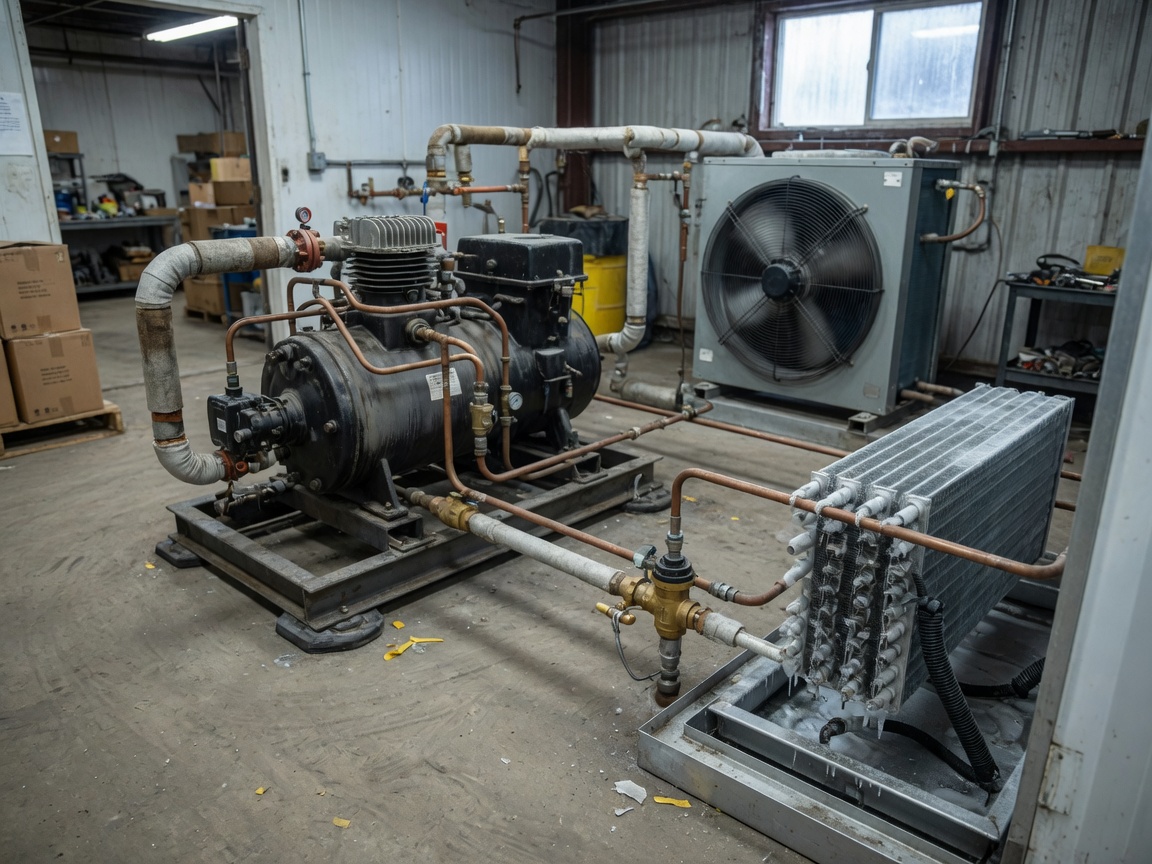
[IMAGE_1: diagram comparing air-cooled, water-cooled, evaporative, and remote condenser configurations for cold storage systems图]Air-cooled condenser units
The air-cooled condenser unit is the most widely deployed type in the US market, accounting for the majority of walk-in cooler condenser installations in grocery, foodservice, and pharmaceutical cold storage. Installation is straightforward — no cooling tower, no water treatment system, no makeup water supply. The unit mounts outdoors or in a ventilated machine room, and ambient air flows across finned coils to reject heat. Performance, however, degrades as ambient temperature climbs. A unit rated at 3 tons of heat rejection at 95°F ambient (a common AHRI rating condition) may only deliver 2.5 effective tons at 115°F — a reality that matters enormously in Phoenix, AZ, where summer design temperatures routinely exceed 110°F.
Water-cooled and evaporative condensers
Water-cooled condensers circulate chilled water or city water across refrigerant-side heat exchanger tubes, achieving much lower condensing temperatures than air-cooled designs — typically 10–15°F lower condensing temperature at equivalent ambient conditions. This translates directly into improved compressor efficiency and system capacity. The trade-off is infrastructure: a cooling tower, water treatment program, and local water use permits add both CapEx and ongoing OpEx. They remain the preferred choice for large industrial refrigeration condenser applications above 50 tons.
The evaporative condenser cold storage solution splits the difference. It uses a combination of air flow and water spray over the coil surface, leveraging evaporative cooling to dramatically reduce the leaving-air temperature. In arid climates — paradoxically — evaporative condensers deliver even greater efficiency gains than in humid climates, because the wet-bulb temperature depression is larger. Evaporative designs typically reduce annual energy consumption by 15–25% compared with equivalent air-cooled configurations, per industry data from 2026 AHRI studies.
Remote condenser refrigeration and microchannel designs
Remote condenser refrigeration separates the condensing unit from the compressor rack, placing the heat rejection coil on the rooftop while the compressor and controls remain inside a machine room. This architecture reduces noise inside the facility, improves maintenance access, and allows heat reclaim integration. Microchannel condensers — aluminum, flat-tube, parallel-flow — are gaining adoption in 2026 due to their 30–40% lower refrigerant charge requirement, making them well-suited to A2L low-GWP refrigerant transitions discussed later in this guide.
| Condenser type | Best application | Typical efficiency (EER improvement vs baseline) | CapEx range (per ton, installed, USD) | Water use |
|---|---|---|---|---|
| Air-cooled | Small–medium walk-in (<25 tons) | Baseline | $800–$1,400 | None |
| Water-cooled | Large industrial (>50 tons) | +18–25% EER | $1,500–$2,800 | High |
| Evaporative | Medium–large, arid/hot climates | +15–25% EER | $1,200–$2,200 | Moderate |
| Remote air-cooled | Multi-compressor rack systems | Baseline to +10% | $1,000–$1,800 | None |
| Microchannel | Low-charge A2L refrigerant systems | +5–12% EER (reduced charge) | $1,100–$1,900 | None |
How to size a cold room condenser: BTU/ton guide with US climate zone examples
Correct sizing of a commercial refrigeration condenser is non-negotiable. Neither oversizing nor undersizing is safe or economical. The following step-by-step methodology is the approach used in real US cold storage commissioning projects.
Step-by-step sizing procedure
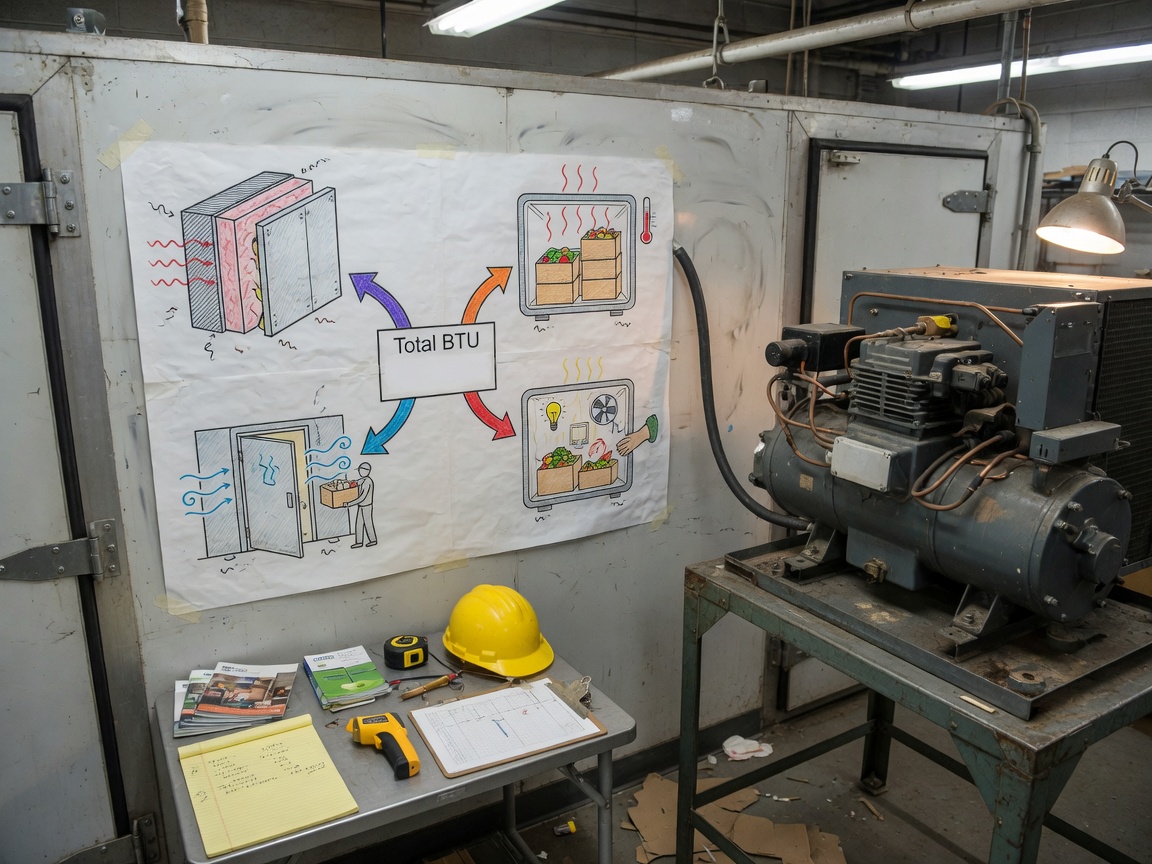
- Calculate total heat load (BTU/hr): Sum wall/floor/ceiling transmission load, product load (pull-down + respiration for produce), infiltration load (door openings), equipment heat (lighting, fans, motors), and people load if applicable. Use ASHRAE Handbook of Refrigeration load calculation procedures.
- Convert to tons of refrigeration: Divide total BTU/hr by 12,000. One ton = 12,000 BTU/hr of heat removal.
- Determine the heat of rejection (HOR): The condenser must reject both the refrigeration load AND the heat of compression. HOR = Refrigeration capacity × (1 + 1/COP). For a typical R-448A system at medium-temp, use a heat rejection multiplier of approximately 1.25–1.30.
- Select ambient design temperature: Use the ASHRAE 1% summer design dry-bulb temperature for your location — not average summer temperature. This is the temperature that will only be exceeded 1% of summer hours.
- Apply ambient derating factor: Most manufacturer catalog ratings are at 95°F ambient. If your design temp is higher, apply the derating curve from the manufacturer's engineering data.
- Add a 10–15% safety margin for fouling, future load growth, and refrigerant performance variations.
Phoenix, AZ vs. Chicago, IL: why climate zone determines condenser size
Here is where most generic guides fail buyers. Consider two identical 2,000 sq ft walk-in cooler projects, both targeting 35°F box temperature.
Phoenix, AZ: ASHRAE 1% summer design dry-bulb = 111°F. A system sized for 10 tons of refrigeration requires approximately 13 tons of heat rejection capacity. At 111°F ambient, a standard air-cooled condenser derated to roughly 78% of its 95°F catalog rating must be sized at 13 ÷ 0.78 = approximately 16.7 catalog tons to actually deliver 13 tons in the field.
Chicago, IL: ASHRAE 1% summer design dry-bulb = 91°F. The same 13-ton heat rejection requirement at 91°F ambient — where the condenser operates above its 95°F rating point — requires only about 13.5 catalog tons. That is nearly a 24% difference in condenser hardware between two identical refrigeration loads simply due to geography.
Of course, there are situations where even this adjusted sizing proves insufficient — for example, rooftop installations with poor air circulation, where effective ambient temperature can rise 10–15°F above actual outdoor conditions due to heat recirculation.
EPA AIM Act and refrigerant transition: what it means for condenser selection in 2026
The EPA AIM Act (American Innovation and Manufacturing Act) is reshaping every condenser procurement decision in the US market. If you are specifying or purchasing a cold room condenser in 2026, refrigerant compatibility is not optional fine print — it is a primary selection criterion.
The phase-down timeline and condenser compatibility
The AIM Act mandates an 85% reduction in HFC production and consumption by 2036 relative to baseline. By 2026, the industry has already largely moved away from R-22 (phased out under the Montreal Protocol) and is actively transitioning from R-404A and R-507A toward lower-GWP alternatives. The primary replacements relevant to cold storage include:
- R-448A and R-449A: Drop-in replacements for R-404A in medium- and low-temperature applications. Both operate at higher discharge pressures than R-404A — typically 15–25 psi higher. Any condenser being specified today must be pressure-rated accordingly, with a minimum design pressure of 400 psig on the high side.
- R-454B (Opteon XL41): An A2L mildly flammable refrigerant with GWP of 466, increasingly common in new equipment. Requires condenser coil materials and gaskets verified compatible with A2L refrigerants; microchannel aluminum designs with appropriate seal materials are preferred.
- R-32: Used in some split-system cold storage applications; higher operating pressures require verified pressure rating on condensing units.
"Contractors who specify condensing units without verifying refrigerant compatibility with post-2025 low-GWP alternatives are creating liability exposure for their clients. Pressure ratings, lubricant compatibility, and seal materials must all be re-evaluated — not assumed from legacy R-404A specifications." — Paraphrased from ACCA technical guidance, 2026 edition
Practical checklist for refrigerant-ready condenser procurement
When evaluating any commercial refrigeration condenser for 2026 procurement, confirm: (1) high-side pressure rating ≥400 psig, (2) coil and header material compatibility with the target refrigerant, (3) lubricant compatibility statement from the manufacturer for POE oils used with the new refrigerant, and (4) UL or ETL listing updated to cover A2L refrigerants if applicable. Manufacturers who cannot provide these certifications in writing should be removed from the short list.
Lifecycle cost analysis: 10-year CapEx vs. OpEx comparison
Purchase price is the wrong metric for condenser evaluation. The total cost of ownership over a 10-year horizon tells a fundamentally different story — and business cases built on CapEx alone routinely select the wrong equipment type.
10-year model assumptions (US commercial, 20-ton system)
The following model uses a 20-ton commercial cold storage application in the US Sun Belt, operating 8,000 hours per year, at a blended electricity rate of $0.13/kWh (US commercial average per EIA 2026 data). Maintenance costs reflect industry-standard service intervals.
| Cost category | Air-cooled | Water-cooled | Evaporative |
|---|---|---|---|
| Initial installed cost | $24,000 | $44,000 | $36,000 |
| Annual energy cost (10-yr avg) | $18,200/yr | $14,100/yr | $14,800/yr |
| Annual maintenance cost | $1,200/yr | $2,800/yr | $2,100/yr |
| Water/treatment cost (10-yr) | $0 | $18,000 | $9,500 |
| 10-year total cost of ownership | $218,000 | $229,000 | $193,500 |
The evaporative condenser emerges as the lowest 10-year cost option in hot US climates despite a higher CapEx than air-cooled — a finding that contradicts the instinct to minimize upfront spend. In mild climates like the Pacific Northwest, the energy gap between air-cooled and evaporative narrows considerably, and the simpler air-cooled configuration may represent better value. Understanding refrigeration systems overview principles helps contextualize why condensing efficiency has such a multiplied impact on system-wide energy costs.
What these numbers mean for procurement strategy
A $20,000 difference in CapEx between air-cooled and evaporative is recovered in energy savings within approximately 3.5 years in Sun Belt locations at $0.13/kWh. As US commercial electricity rates trend upward — the EIA projects continued rate increases through 2028 — that payback period will shorten further. Procurement decisions made on purchase price alone are, bluntly, costing facility owners money.
US code compliance for cold room condenser installation
Non-compliant condenser installations create permit delays, insurance exposure, and in severe cases, forced decommissioning. The US regulatory landscape for commercial refrigeration condenser installations involves multiple overlapping authorities.
Key standards and listing requirements
- UL listing: Condensing units for cold storage applications must carry a UL 207 or UL 303 listing (for refrigerant-containing components) verified by a Nationally Recognized Testing Laboratory (NRTL). Some jurisdictions accept ETL or CSA equivalents.
- ASHRAE Standard 15: Safety standard for refrigeration systems. Governs machinery room ventilation, refrigerant detection requirements, pressure relief device sizing, and occupancy classifications. Any cold room refrigeration system installation in a commercial building must demonstrate ASHRAE 15 compliance.
- International Building Code (IBC) mechanical permits: Most US jurisdictions require a mechanical permit for any cold room HVAC equipment installation exceeding a threshold capacity (commonly 5 tons or above). Permit drawings must show condenser location, setback from property lines and air intakes, electrical service, and refrigerant type and charge quantity.
- EPA Section 608: All refrigerant handling during installation and commissioning requires certified technicians under EPA Section 608. This is non-negotiable and increasingly enforced.
Siting and setback considerations
Local zoning and mechanical codes often specify minimum setback distances for outdoor condensing units — commonly 5–10 feet from property lines, 10 feet from operable windows, and 15 feet from building air intakes. Failure to respect setbacks during design is one of the most common causes of costly project redesigns during the permit review phase. In California, additional Title 24 energy efficiency requirements apply to commercial refrigeration equipment, including minimum efficiency ratings that may exceed federal minimums.
Maintenance intervals and troubleshooting benchmarks
Even a correctly sized, fully compliant cold room condenser will underperform and fail prematurely without a structured maintenance program. The industry data is unambiguous: according to ASHRAE studies, fouled condenser coils are the single most common cause of elevated head pressure and reduced system capacity in commercial refrigeration applications.
Recommended maintenance schedule
- Monthly: Visual inspection of coil fins for debris, damage, and frost accumulation; verify fan blade rotation and motor amperage within nameplate limits; check for refrigerant leaks at header connections.
- Quarterly: Coil cleaning with low-pressure water rinse and approved coil cleaner for air-cooled units in dusty environments; verify condensing pressure at rated ambient vs. manufacturer curve; check vibration isolators and mounting hardware torque.
- Semi-annually: Inspect and clean evaporative condenser distribution system, drift eliminators, and sump; test water treatment chemistry for evaporative units; verify refrigerant charge against manufacturer superheat/subcooling targets.
- Annually: Comprehensive coil inspection for corrosion, especially in coastal environments; motor bearing inspection and lubrication; full electrical termination inspection; verify capacity against original commissioning data.
Pressure differential benchmarks and common fault codes
The single most useful diagnostic metric for a walk-in freezer condenser coil or any commercial refrigeration condenser is the condensing pressure-to-ambient temperature relationship. Establish a baseline at commissioning: log condensing pressure (or condensing temperature) against ambient dry-bulb temperature. In subsequent service visits, any deviation exceeding 10 psig above the baseline curve at equivalent ambient conditions indicates fouling, refrigerant overcharge, or non-condensable gas contamination.
Common fault conditions and their probable causes:
- High head pressure with normal ambient temperature: Fouled coil fins, failed condenser fan motor, non-condensables in system, refrigerant overcharge.
- Low head pressure with high ambient temperature: Refrigerant undercharge, restricted liquid line, compressor inefficiency.
- Cycling on high-pressure cutout during peak afternoon hours only: Marginal condenser sizing for the climate zone, or heat recirculation from poor unit placement — revisit siting.
- Excessive condenser fan motor amperage: Coil restriction causing fan to work against elevated static pressure; debris accumulation on fan blade.
The real-world benchmark from field experience: a well-maintained air-cooled condenser coil in a commercial food distribution facility should not require chemical cleaning more than twice per year in a typical US inland environment. Coastal or high-pollution environments may require quarterly cleaning with corrosion-inhibiting coil cleaner to preserve fin integrity.
Conclusion
Selecting the right cold room condenser in 2026 demands more than matching a BTU number to a catalog page. It requires factoring in your local climate zone's ambient design temperature, your refrigerant roadmap under the EPA AIM Act, a realistic 10-year total cost of ownership model, US code compliance requirements from UL through ASHRAE 15, and a maintenance program that preserves rated performance over the equipment's full service life. The decisions made at the specification stage — condenser type, sizing methodology, refrigerant compatibility — compound over a decade of operating costs. Invest the engineering hours upfront. The lifecycle cost data shown in this guide makes the financial case conclusively.
Frequently asked questions
Q: What size cold room condenser do I need for a 1,000 sq ft walk-in cooler?
A: A 1,000 sq ft walk-in cooler in a temperate US climate typically requires 3–5 tons of refrigeration capacity. Applying a heat rejection multiplier of 1.25 and a 15% safety margin, target a condenser rated at approximately 4.5–7 catalog tons at your local ASHRAE 1% design ambient temperature. Always perform a full heat load calculation rather than relying on rules of thumb.
Q: How often should I clean my cold room condenser coil?
A: In typical US inland commercial environments, clean air-cooled condenser coils at minimum twice per year — spring and fall. High-dust, coastal, or high-grease environments (e.g., near cooking operations) may require quarterly cleaning. Use manufacturer-approved coil cleaner and low-pressure rinse; high-pressure washing can damage aluminum fins permanently.
Q: Is R-404A still acceptable for new cold room condenser installations in 2026?
A: R-404A is effectively a legacy refrigerant for new US installations in 2026. Its high GWP (3,922) places it squarely in the EPA AIM Act phase-down trajectory. Most leading equipment manufacturers have already discontinued new R-404A product lines. Specify R-448A, R-449A, or A2L alternatives such as R-454B for any new cold storage condensing unit procurement.
Q: What is the difference between a condensing unit and a condenser in cold storage?
A: A condenser is solely the heat exchanger coil and fan assembly that rejects heat to ambient air or water. A condensing unit for cold storage is an integrated package that includes the compressor, condenser, fan motor, controls, and often a receiver — essentially the complete high-side refrigeration assembly. In split systems, the condenser may be remote from the compressor.
Q: Do I need a permit to install a commercial refrigeration condenser in the US?
A: Yes, in nearly all US jurisdictions. Systems above approximately 5 tons require a mechanical permit under the International Building Code, and ASHRAE Standard 15 compliance documentation is typically required. Refrigerant handling must be performed by EPA Section 608 certified technicians. Consult your local Authority Having Jurisdiction (AHJ) for specific requirements before beginning installation.
Keywords:
Inquiry
If you are interested in our products, please leave your email to receive a free product quote, thank you!
More information

Tel:
Sales E-mail: