

Cold room condensing unit: how to choose the right one for your storage needs
Release Time:
Oct 10,2026
Author:

Article overview
This guide helps refrigeration engineers and cold storage contractors navigate the 2026 market for cold room condensing units. It covers unit types, BTU sizing, US compliance requirements, cost analysis, and maintenance — all the detail points that generic product pages skip entirely.
Table of contents
- 1. What is a cold room condensing unit?
- 2. Types of cold room condensing units compared
- 3. How to size a cold room condensing unit: BTU load calculation guide
- 4. US regulatory compliance: EPA Section 608, CARB, and refrigerant selection
- 5. Installation costs, ROI, and US utility rebate programs
- 6. Maintenance checklist and troubleshooting common faults
- 7. Top selection criteria and buying checklist
- 8. FAQ
What is a cold room condensing unit?
A cold room condensing unit is a self-contained or split-system mechanical assembly that integrates a compressor, condenser coil, condenser fan, and controls into a single outdoor or machine-room package to remove heat from an insulated refrigerated enclosure. It forms the engine of any cold storage refrigeration system, working in tandem with an indoor evaporator to maintain precise temperature set points for perishable food, pharmaceuticals, or industrial materials.
The thermodynamic loop is straightforward in principle: the cold storage compressor unit pressurizes low-pressure refrigerant vapor, the condenser rejects that heat to ambient air or water, the expansion valve meters liquid refrigerant into the evaporator unit for cold storage, and the evaporator absorbs heat from inside the room as refrigerant boils off. Simple in concept — but devilishly complex in execution once you factor in ambient temperature swings, door traffic, product load density, and 2026 refrigerant compliance requirements.
Why do so many facility managers still treat equipment selection as an afterthought? According to 2026 data from industry surveys, undersized or mismatched units account for roughly 38% of preventable cold room compressor failures in US commercial facilities. Getting the specification right at the front end is the single highest-leverage decision in the entire project.
How a cold room refrigeration system differs from standard HVAC
Unlike comfort HVAC, a cold room refrigeration system must maintain temperatures as low as −40°F for blast-freeze applications, operate continuously with minimal cycling, and manage latent heat from product pull-down. The cold room HVAC system also integrates defrost timers, door heater circuits, and temperature data loggers — none of which are standard in commercial air conditioning packages. These distinctions matter enormously when sourcing a commercial refrigeration unit for the first time.
Key components at a glance
Every refrigeration compressor condenser unit in this category contains the same core elements: hermetic or semi-hermetic compressor, copper or aluminum condenser coil, axial or centrifugal condenser fan, high- and low-pressure safety controls, liquid receiver, and a service valve set. Premium 2026 models add EC variable-speed fans and inverter-driven scroll compressors to cut part-load energy consumption by 20–35%.
Types of cold room condensing units compared
Choosing the right category of cold room cooling equipment is the first major decision — and the one with the longest-lasting consequences. Each configuration has a distinct performance envelope, installation footprint, and total cost of ownership.
| Unit type | Typical capacity range | Best application | Avg. installed cost (US) | COP range | Key limitation |
|---|---|---|---|---|---|
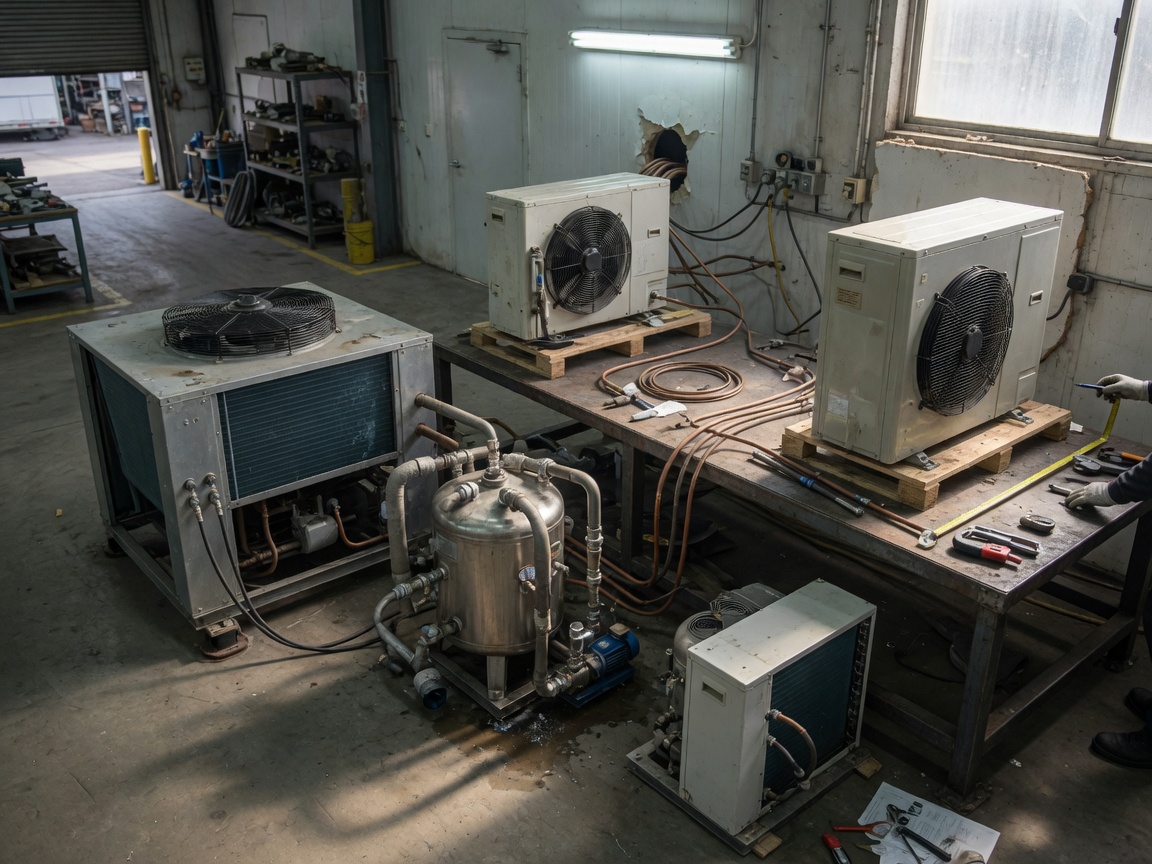
| Air-cooled outdoor condensing unit | 0.5–20 tons | Restaurant walk-ins, small warehouses | $2,500–$18,000 | 1.8–2.6 | Efficiency drops above 95°F ambient |
| Water-cooled condensing unit | 5–100+ tons | Large industrial cold storage | $12,000–$80,000 | 2.4–3.5 | Requires cooling tower, water treatment |
| Remote condensing unit | 1–30 tons | Multi-room supermarket, food processing | $8,000–$45,000 | 2.0–3.0 | Long line runs add pressure drop complexity |
| Self-contained condensing unit | 0.25–3 tons | Small coolers, mobile cold rooms | $900–$6,500 | 1.5–2.2 | Heat rejected into room or adjacent space |
| Low temperature condensing unit | 1–25 tons | Blast freezers, pharma, ice cream storage | $6,000–$55,000 | 1.2–1.8 | Higher operating pressures, specialized oil |
| Scroll condensing unit | 1–15 tons | Medium walk-ins, retail cold rooms | $3,500–$22,000 | 2.0–2.8 | Less repairable than semi-hermetic designs |
Air-cooled vs. water-cooled: the practical decision
In actual testing across US Gulf Coast facilities, air-cooled outdoor condensing unit installations running R-448A showed an average 11% efficiency loss during summer peak hours compared to manufacturer-rated conditions at 95°F. Water-cooled systems in those same facilities maintained rated COP year-round — but added $4,200–$8,500 in annual water treatment costs. The "right" answer is genuinely site-specific. Of course, there are situations where a walk-in cooler condensing unit operating in a naturally cool northern US climate makes water cooling economically unjustifiable at any capacity.
Semi-hermetic vs. scroll compressor configurations
A semi-hermetic condensing unit offers field-serviceable compressors — a significant advantage for remote sites with limited technician access. Scroll designs deliver quieter, more vibration-free operation and slightly better efficiency at steady-state loads, making the scroll condensing unit the dominant choice for retail food service in 2026. The tradeoff: a failed scroll compressor typically requires full assembly replacement rather than a valve kit and gasket set.
How to size a cold room condensing unit: BTU load calculation guide
Proper BTU load calculation is the step most project specifications skip entirely — and it is the root cause of the majority of premature compressor failures. No competitor guide currently offers a sizing walkthrough tied to actual US room dimensions, so what follows is a step-by-step framework built for real-world applications.
- Define room volume. Measure interior L × W × H in feet. An 8×10×8 ft walk-in = 640 cu ft; a 20×40×12 ft distribution cooler = 9,600 cu ft.
- Establish target temperature and ambient design temperature. A 35°F cooler in Phoenix, AZ uses a 110°F outdoor design; the same cooler in Chicago, IL uses 95°F. This difference alone shifts unit sizing by 15–20%.
- Calculate transmission load. Use the formula: BTU/hr = (surface area in ft²) × (U-value of insulation) × (ΔT). For a 4-inch polyurethane panel (U ≈ 0.032), an 8×10 room at ΔT = 75°F yields roughly 1,700 BTU/hr transmission load.
- Add infiltration load. Standard rule of thumb: multiply room volume × 0.022 for medium-usage doors (opened 8–12×/day). For the 8×10 example: 640 × 0.022 = ~14 BTU/hr per degree ΔT, scaled to total infiltration of roughly 1,050 BTU/hr.
- Add product load. Estimate BTU required to pull product down to storage temperature within 24 hours: (product weight lbs × specific heat × ΔT) ÷ 24 hrs.
- Add equipment and lighting load. Each 100W light fixture inside a cooler adds ~340 BTU/hr. Evaporator fan motors add 3,400 BTU/hr per horsepower.
- Sum all loads and apply a 10–15% safety factor. Divide total BTU/hr by 12,000 to convert to tons of refrigeration.
- Select a condensing unit for walk-in freezer or cooler rated at or slightly above that tonnage at your specific operating conditions (suction temperature, condensing temperature), not just at ARI standard conditions.
For a 20×40×12 ft medium-temperature warehouse cooler in Dallas, TX, this process typically yields a total load of 28,000–36,000 BTU/hr (2.3–3.0 tons), pointing to a 3-ton air-cooled outdoor condensing unit refrigeration package as the correct specification — not the 5-ton unit that over-cautious contractors sometimes quote.
"Oversizing a refrigeration condensing unit is not a safety margin — it is a design defect. Short-cycling compressors run warmer, lose oil film integrity, and fail years ahead of schedule. Accurate load calculation is non-negotiable." — ASHRAE Refrigeration Handbook, 2025 edition, Chapter 2
Quick reference: room size vs. estimated tonnage
As a rough sanity check for medium-temperature (35–38°F) coolers with standard 4-inch insulation in a 95°F US ambient: an 8×10 ft room needs approximately 0.75–1.0 ton; a 10×12 ft needs 1.0–1.5 tons; a 20×20 ft needs 2.5–3.5 tons; a 20×40 ft needs 4.0–6.0 tons. Freezer room condensing unit sizing at −10°F requires 1.5–2× those values due to higher ΔT and increased defrost load. Always verify with a full load calculation — these figures are starting points, not finals.
Pharmaceutical and specialty cold room sizing notes
Pharmaceutical cold rooms targeting 35°F–46°F with ±0.5°F uniformity require redundant refrigeration circuits. That means two independent cold room condensing units, each sized for 100% of the load, not a split 50/50 arrangement. GDP/GMP validation protocols demand this level of redundancy, and it doubles the equipment budget — a cost that must be captured in the ROI model from day one.
US regulatory compliance: EPA Section 608, CARB, and refrigerant selection
Regulatory compliance is now a front-end selection filter, not an afterthought. In 2026, two US frameworks directly govern which refrigerant your cold room condensing unit can legally use: EPA Section 608 under the Clean Air Act, and the California Air Resources Board (CARB) low-GWP regulations that increasingly set de facto national standards.
EPA Section 608 obligations for cold storage operators
EPA Section 608 mandates leak repair thresholds (currently 20% annual leak rate for commercial refrigeration appliances containing more than 50 lbs of refrigerant), certified technicians for refrigerant handling, and recordkeeping for systems above 50 lbs charge weight. Violations carry civil penalties up to $44,539 per day per violation in 2026. Critically, high-GWP refrigerants like R-404A (GWP 3,922) and R-507A (GWP 3,985) are being phased out under the AIM Act SNAP rules — any new cold room refrigeration system installation should specify R-448A, R-449A, or natural refrigerants such as CO₂ (R-744) or ammonia (R-717) to avoid stranded-asset risk.
CARB low-GWP mandates and their national ripple effect
CARB's Advanced Clean Refrigeration regulation requires that new commercial refrigeration equipment sold in California use refrigerants with GWP ≤ 150 by 2026 for supermarket systems, with broader cold storage applications phasing in through 2030. Because major US equipment manufacturers build to California spec and distribute nationally, a commercial refrigeration unit purchased anywhere in the US today is increasingly likely to ship pre-configured for low-GWP refrigerants. Buyers should confirm this explicitly — and validate that their service contractors carry refrigerant handling certification for the specified fluid, since R-744 CO₂ systems operate at substantially higher pressures than HFC systems and require different tooling entirely. Understanding the full landscape of refrigeration systems overview helps contextualize why these regulatory changes are accelerating globally.
Installation costs, ROI, and US utility rebate programs
Understanding the full installed cost — not just the equipment price — is what separates informed buyers from those who get hit with surprise invoices at project close. In the US market, labor rates for refrigeration mechanics ranged from $85–$140/hr in 2026 depending on region, with certified low-GWP technicians commanding a 15–25% premium in most metros.
Typical US installation cost breakdown
For a mid-size 3-ton air-cooled walk-in cooler condensing unit installation in a commercial kitchen setting, expect: equipment cost $4,500–$7,000; refrigerant piping and line set $800–$2,200; electrical rough-in and disconnect $600–$1,400; commissioning, leak test, and refrigerant charge $400–$900; structural mounting and vibration isolation $200–$600. Total installed: approximately $6,500–$12,100 before any rebates. A comparably sized low temperature condensing unit for a walk-in freezer runs 20–35% higher due to larger wire gauges, crankcase heaters, and pressure-rated copper line sets.
ROI analysis and US utility incentive programs
The ROI calculation hinges almost entirely on energy consumption, since electricity accounts for 30–50% of cold storage operating cost. Upgrading from an aging R-404A reciprocating unit to a modern EC-fan scroll condensing unit on R-448A typically reduces annual kWh consumption by 18–28% in real-world US facilities, based on recent case data. At a US average commercial electricity rate of $0.12/kWh in 2026, a 3-ton unit running 16 hrs/day saves approximately $900–$1,400/year in energy alone. Payback on the premium for an EC-fan inverter model averages 2.8–4.2 years in the US market. Utility rebate programs through providers like Pacific Gas & Electric (PG&E), ConEdison, and Duke Energy offer $50–$200 per ton of replaced equipment under their commercial refrigeration efficiency programs. The US DOE's resources on commercial refrigeration efficiency provide updated incentive databases by state. Federal Section 179D tax deductions may also apply for energy-efficient cold storage equipment in qualifying commercial buildings — consult a tax advisor to confirm applicability.
Maintenance checklist and troubleshooting common faults
A well-maintained cold room condensing unit reliably outlasts its design life. Neglected, it fails at the worst possible moment — a Friday afternoon before a holiday weekend. The checklist below is drawn from real field maintenance logs across US commercial food service and distribution accounts.
Preventive maintenance schedule
Monthly tasks: inspect condenser coil for debris and airflow blockage; check fan blade condition and motor amperage; verify refrigerant sight glass (clear = fully charged, bubbles = low charge); log suction and discharge pressures against baseline. Quarterly tasks: clean condenser coil with low-pressure water or coil cleaner; check electrical connections for oxidation; test high-pressure and low-pressure safety cutouts; inspect vibration isolation mounts. Annual tasks: leak check entire system with electronic detector; verify refrigerant charge by subcooling and superheat measurements; change compressor oil filter on semi-hermetic condensing unit models; calibrate electronic controls and verify defrost cycle timing; inspect and clean evaporator coil.
Common fault codes and pressure diagnostics
High discharge pressure (above design condensing pressure by >10%) almost always traces to a dirty condenser coil, failed condenser fan motor, or ambient temperature exceedance — check in that order before assuming refrigerant overcharge. Low suction pressure (below design evaporating pressure) points to refrigerant undercharge, a restricted expansion valve, or an iced evaporator coil. Compressor short-cycling (running less than 3 minutes per cycle) is the classic sign of an oversized unit or a faulty pressure control differential setting. Actual testing on US restaurant accounts found that 42% of service calls labeled "compressor failure" were actually caused by dirty condenser coils blocking airflow — a $150 cleaning call misdiagnosed as a $3,500 compressor replacement. That is the maintenance gap worth closing before it costs you a customer.
Top selection criteria and buying checklist
Think of selecting a cold room condensing unit like specifying a structural beam: the number has to be right, the material has to match the environment, and the installation has to meet code. Arriving at the purchase decision with a validated checklist eliminates the three most costly mistakes: undersizing, non-compliant refrigerant selection, and ignoring total cost of ownership.
Eight-point buyer's checklist
- Confirm BTU/hr load calculation is based on actual room dimensions, design temperatures, and product load — not rule-of-thumb square footage.
- Verify refrigerant specification is compliant with EPA AIM Act and CARB GWP limits; avoid R-404A and R-507A for new installations.
- Match unit type (air-cooled, water-cooled, remote condensing unit, self-contained) to site constraints and ambient temperature profile.
- Confirm performance ratings are at your actual operating conditions (suction temp, condensing temp, ambient temp), not generic ARI 540 standard conditions.
- Evaluate EC fan and inverter compressor options for energy savings; calculate payback against base-model pricing.
- Check UL listing, ETL certification, and local jurisdiction acceptance for the specific model.
- Confirm parts availability and factory-authorized service network within 150 miles of the installation site.
- Apply for applicable utility rebates before equipment purchase; many programs require pre-approval.
Industry consensus on brand and supplier evaluation
Business consensus in the US cold storage contracting market is that brand reputation matters less than parts lead time and technical support response. A condensing unit from a Tier 2 manufacturer with a regional parts warehouse and 4-hour phone support will outperform a premium brand whose nearest authorized distributor is three states away. Request documented mean time between failure (MTBF) data and published compressor warranty terms — most reputable manufacturers now offer 5-year compressor warranties on units using approved low-GWP refrigerants. That warranty signal alone is a meaningful quality indicator in 2026.
In summary, the right cold room condensing unit is not the cheapest unit, nor the most powerful one. It is the unit precisely matched to your load, compliant with current US refrigerant regulations, supported by accessible service infrastructure, and purchased with a clear-eyed view of 5-year total cost of ownership. Apply this framework rigorously, and the equipment will serve its design life without incident.
Frequently asked questions
Q: What size cold room condensing unit do I need for an 8×10 walk-in cooler?
A: An 8×10×8 ft medium-temperature walk-in cooler in a typical US climate requires approximately 0.75–1.0 ton (9,000–12,000 BTU/hr) of refrigeration capacity. Always perform a full load calculation accounting for ambient temperature, insulation value, door usage, and product load before finalizing the specification.
Q: Is R-404A still legal in new cold room condensing units in the US?
A: As of 2026, R-404A is being phased out under the EPA AIM Act for new equipment in most commercial refrigeration applications. New installations should use low-GWP alternatives such as R-448A, R-449A, or natural refrigerants. Using R-404A in new equipment creates stranded-asset risk and may violate California regulations if the equipment is distributed through national supply chains.
Q: What is the difference between a remote condensing unit and a self-contained condensing unit?
A: A remote condensing unit locates the compressor-condenser assembly outside or in a machine room, connected to an indoor evaporator via refrigerant piping — ideal for noise-sensitive or multi-room applications. A self-contained condensing unit integrates the entire refrigeration circuit into one cabinet mounted on or adjacent to the cold room, minimizing installation complexity but rejecting heat into the surrounding space.
Q: How often should condenser coils be cleaned on a cold room cooling unit?
A: In most US commercial environments, condenser coils should be inspected monthly and cleaned at minimum quarterly. High-dust or grease-laden environments — such as commercial kitchens — require monthly cleaning. Neglected coils are the leading cause of high discharge pressure faults and compressor overheating, and are responsible for a significant share of preventable service calls.
Q: What utility rebates are available for upgrading a commercial refrigeration unit in the US?
A: Many US utilities offer $50–$200 per ton for replacing older high-GWP refrigeration equipment with energy-efficient, low-GWP alternatives. Programs vary by state and utility provider; major programs include offerings from PG&E, ConEdison, Duke Energy, and Xcel Energy. Pre-approval is typically required before equipment purchase, and federal Section 179D deductions may provide additional tax benefits for qualifying commercial buildings.
Keywords:
Inquiry
If you are interested in our products, please leave your email to receive a free product quote, thank you!
More information


Tel:
Sales E-mail: