

Cold storage solution guide: how to choose the right system for your needs
Release Time:
Oct 13,2026
Author:

Article overview
This guide covers every major dimension of selecting a cold storage solution in 2026 — system types, real cost data, US regulatory requirements, ROI frameworks, emerging refrigeration technologies, and climate-specific deployment considerations. It is written for procurement managers and supply chain directors actively comparing options and preparing to make a purchasing decision.
Table of contents
- 1. What is a cold storage solution?
- 2. Main types of cold storage systems compared
- 3. CapEx vs. OpEx: real cost breakdown by system type
- 4. US regulatory compliance: FDA FSMA and USDA requirements explained
- 5. ROI and payback period: a practical framework for US businesses
- 6. Emerging technologies reshaping cold storage in 2026
- 7. Location matters: cold storage challenges across US climates
- 8. How to choose the right cold storage solution for your needs
What is a cold storage solution?
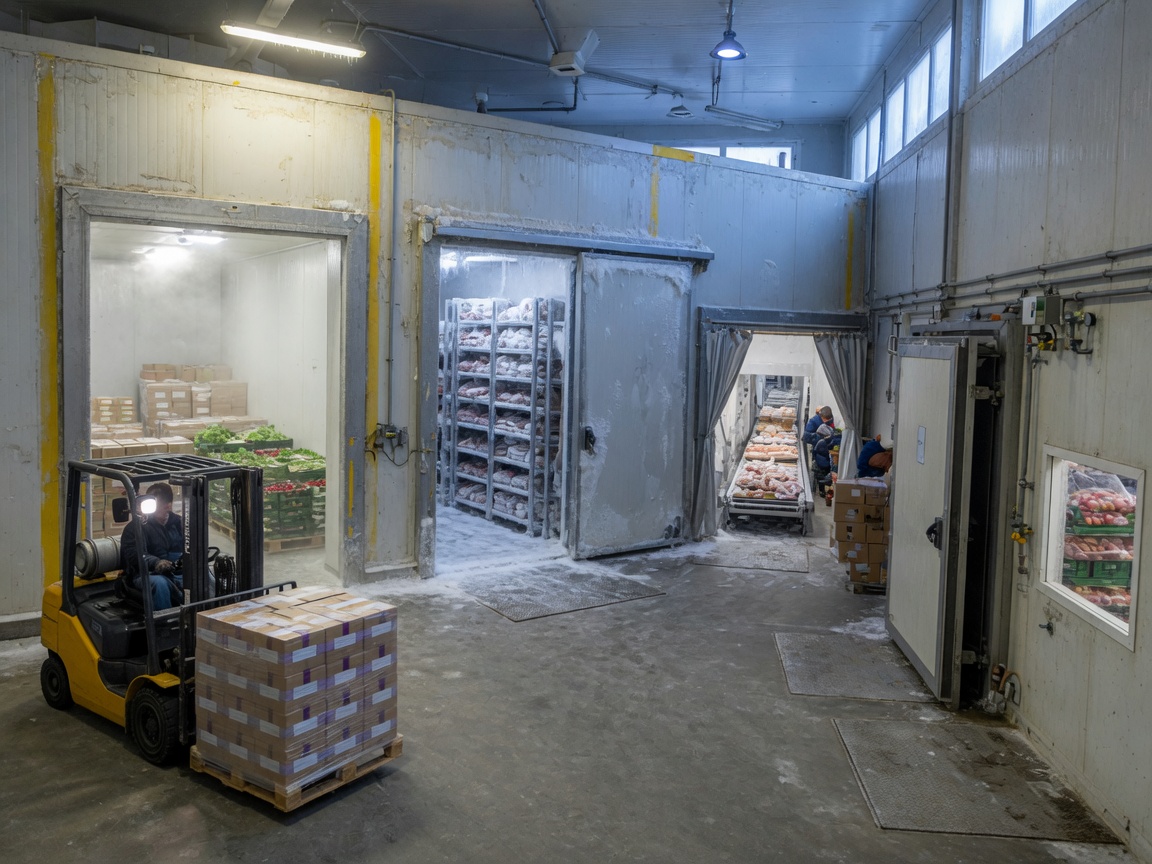
A cold storage solution is an integrated system combining refrigeration equipment, insulated facilities, and temperature monitoring technology to maintain perishable goods within a defined temperature range throughout storage and distribution. It encompasses everything from a single walk-in cooler at a regional food distributor to a multi-site pharmaceutical cold storage network spanning multiple states.
The scope matters. A cold storage solution is not simply a refrigerator at scale. It is a logistical and engineering commitment — one that touches energy management, regulatory compliance, product integrity, and ultimately, business profitability. According to the FAO, approximately 14% of the world's food supply is lost annually due to inadequate cold chain infrastructure. In the US alone, that translates to billions of dollars in preventable waste.
Understanding cold storage for food preservation is the essential starting point — but the modern cold storage decision involves far more variables than temperature settings alone.
Why the definition has expanded in 2026
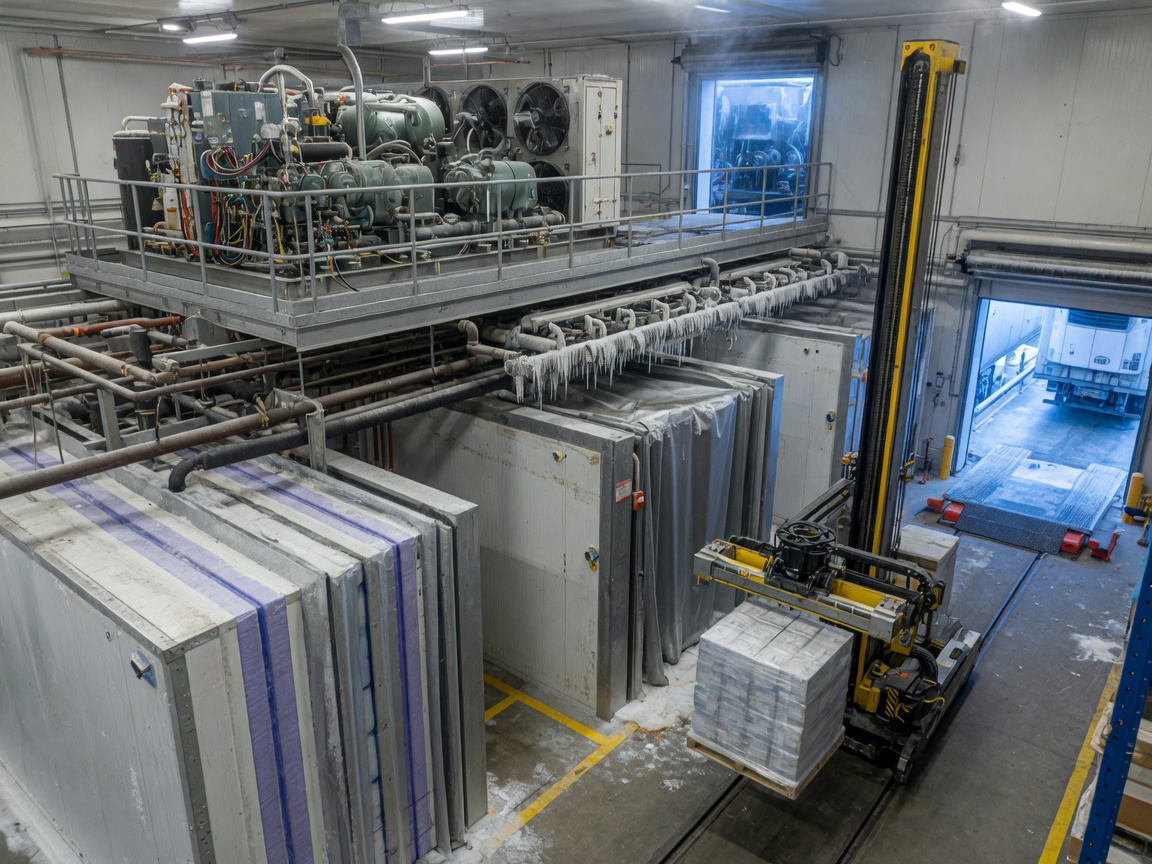
Cold storage today integrates IoT sensors, AI-driven predictive maintenance, and real-time compliance logging. The term "temperature-controlled storage" now implies a data layer as much as a physical one. Procurement managers evaluating systems in 2026 are effectively choosing between competing technology platforms, not just steel panels and compressors.
Who needs a cold storage solution?
The user base is broader than most assume. Food manufacturers, regional grocery chains, pharmaceutical distributors, biotech research labs, floral wholesalers, and chemical manufacturers all depend on reliable perishable goods storage. Each segment has distinct temperature requirements, compliance obligations, and volume dynamics — which is precisely why a one-size-fits-all approach consistently underperforms.
Main types of cold storage systems compared
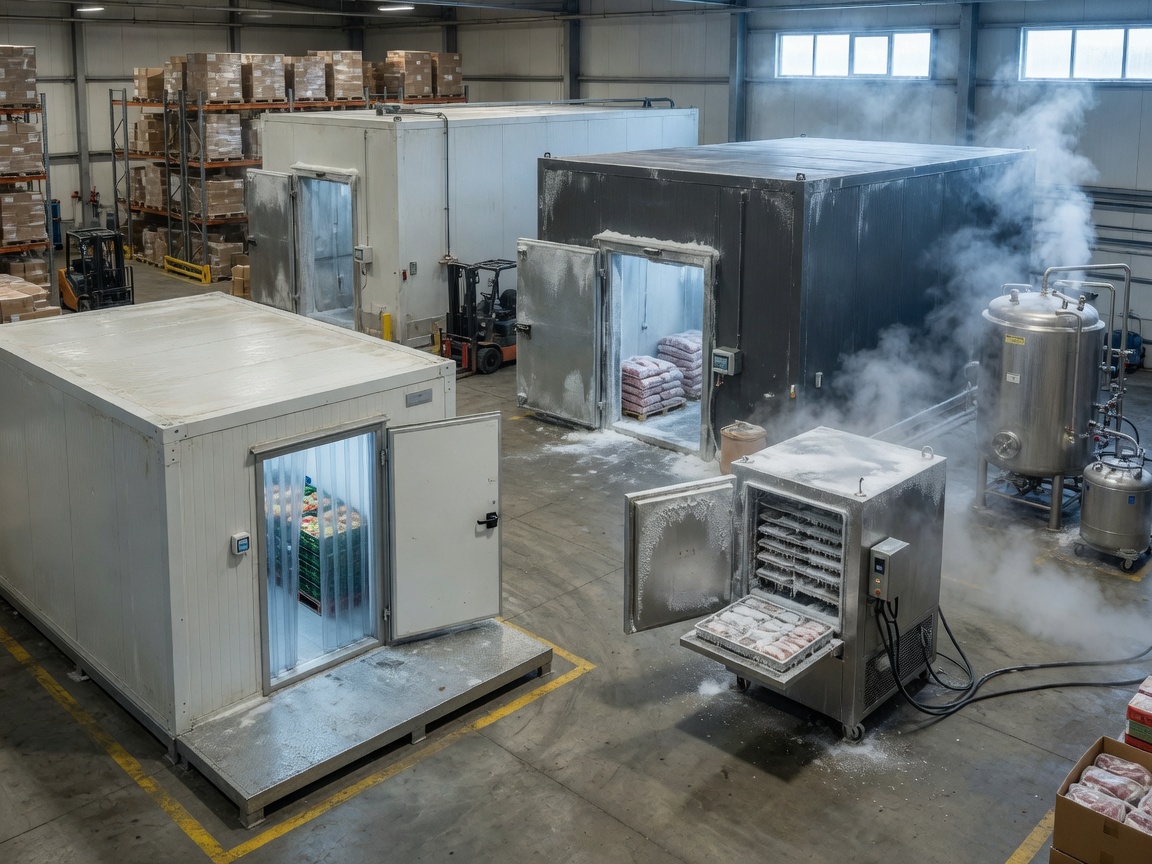
The right system depends on your temperature range, throughput volume, compliance requirements, and capital flexibility. Here is a direct comparison of the five primary formats.
| System type | Temperature range | Best for | Typical US setup cost | Scalability |
|---|---|---|---|---|
| Refrigerated warehouse | 32°F – 50°F (0°C – 10°C) | Fresh produce, dairy, beverages | $2M – $10M+ | Low (fixed structure) |
| Frozen storage facility | -4°F to -13°F (-20°C to -25°C) | Meat, seafood, frozen meals | $3M – $15M+ | Low–Medium |
| Modular walk-in cooler | 28°F – 55°F (−2°C – 13°C) | Small distributors, restaurants, cold storage rental scenarios | $8,000 – $80,000 | High (modular) |
| Blast freezer storage | -40°F (−40°C) and below | Rapid freezing of processed foods, seafood | $150,000 – $500,000 | Medium |
| Cryogenic storage system | -112°F to -320°F (−80°C to −196°C) | Pharmaceutical cold storage, biobanking, vaccines | $50,000 – $300,000 | Low–Medium |
Climate-controlled warehouse vs. dedicated cold room
A climate-controlled warehouse maintains stable humidity and temperature but does not necessarily achieve the low-temperature thresholds needed for frozen goods. It is the right fit for wine, electronics, and certain specialty foods. A food grade cold room, by contrast, meets FDA sanitation standards and maintains consistent sub-40°F temperatures — a critical distinction when handling ready-to-eat products or anything destined for interstate commerce.
When cold storage rental makes more sense than ownership
For seasonal operators — think regional produce distributors in California or pumpkin farms in the Midwest — cold storage rental via a third-party chilled distribution center often delivers a far better return than capital investment. Rental rates in the US typically range from $0.25 to $0.45 per cubic foot per month, depending on location and temperature zone. The flexibility to scale up in Q3 and Q4 without carrying fixed costs year-round is a compelling financial argument.
CapEx vs. OpEx: real cost breakdown by system type
No competitor content adequately addresses the true cost structure of cold storage. The purchase price is only the beginning. Energy costs for industrial refrigeration units routinely account for 40–60% of total operating expenses, a figure that compounds dramatically over a 10–15 year asset lifecycle.
Understanding the full cost picture
CapEx covers construction or purchase, refrigeration equipment, insulation systems, electrical upgrades, and commissioning. OpEx includes electricity, refrigerant top-offs, maintenance labor, compliance auditing, and insurance. The ratio shifts significantly by system type — a modular walk-in cooler storage unit carries minimal CapEx but relatively higher OpEx per square foot, while a large refrigerated warehousing operation inverts that ratio over time.
| System type | Est. CapEx (US) | Annual OpEx (energy + maintenance) | 10-year total cost estimate |
|---|---|---|---|
| Refrigerated warehouse (20,000 sq ft) | $4.5M | $280,000 – $400,000 | ~$7.5M – $8.5M |
| Frozen storage facility (20,000 sq ft) | $6.2M | $380,000 – $520,000 | ~$10M – $11.4M |
| Modular walk-in cooler (800 sq ft) | $35,000 | $9,000 – $14,000 | ~$125,000 – $175,000 |
| Blast freezer storage unit | $220,000 | $45,000 – $70,000 | ~$670,000 – $920,000 |
The hidden cost most buyers overlook
Refrigerant management is an underestimated line item. R-404A, still common in many existing frozen storage facility installations, now carries a significant cost premium due to phase-down regulations. Actual testing and remediation work on legacy systems confirms that transitioning from high-GWP refrigerants can add $15,000–$80,000 in unplanned costs depending on system size. Budget for this during procurement evaluation, not after. Of course, facilities built after 2023 are largely already compliant — but acquired or leased older assets present real exposure.
"Energy efficiency in cold storage is no longer optional — it is a competitive differentiator. Facilities achieving ENERGY STAR certification for cold storage operations report 10–25% lower utility costs compared to non-certified peers, with typical payback periods of 3–5 years on efficiency upgrades." — U.S. Department of Energy, energy-efficient cold storage program guidance.
US regulatory compliance: FDA FSMA and USDA requirements explained
This is where most competitor articles fall completely silent — and where real procurement risk lives. Cold chain management in the US operates under two primary regulatory frameworks, and non-compliance carries consequences ranging from FDA warning letters to product recalls and facility shutdowns.
FDA Food Safety Modernization Act (FSMA): what it means for your cold storage
The FSMA Sanitary Transportation Rule (21 CFR Part 1, Subpart O) directly governs temperature-controlled storage and transportation of food. Key requirements include: written procedures for maintaining adequate temperature during transport, vehicle and equipment design standards for refrigeration logistics, and training documentation for personnel handling perishable goods storage. Any food grade cold room or chilled distribution center receiving interstate shipments must maintain temperature logs accessible for FDA inspection. Practically speaking, this means your cold storage solution must include a certified data logging system — paper logs are no longer sufficient for high-risk food categories.
USDA cold chain requirements for meat and poultry
USDA FSIS mandates that raw meat and poultry be maintained at or below 40°F (4.4°C) during storage. Frozen product must remain at 0°F (−18°C) or below. USDA-inspected facilities must maintain HACCP plans that explicitly address cold chain management, including corrective actions for temperature excursions. Pharmaceutical cold storage facilities operating under DEA or FDA Drug Supply Chain Security Act (DSCSA) requirements face additional validated storage conditions and audit trail obligations. The takeaway: your compliance requirements should define your minimum system specification, not the other way around.
- Identify which regulatory frameworks apply to your product category (FSMA, USDA FSIS, FDA 21 CFR Part 211 for pharma).
- Specify continuous digital temperature logging with tamper-evident audit trails as a non-negotiable system requirement.
- Require your cold storage provider or equipment vendor to supply documentation of prior FDA or USDA inspection outcomes.
- Build corrective action protocols for temperature excursions directly into your cold chain management SOP before operations begin.
- Conduct annual third-party compliance audits — particularly if you operate a walk-in cooler storage network across multiple states.
ROI and payback period: a practical framework for US businesses
Here is the calculation most procurement guides skip entirely. ROI on a cold storage solution depends on four variables: avoided product loss, revenue capacity unlocked, energy cost reduction, and compliance risk mitigation. For US small businesses and regional food distributors, the numbers are more accessible than assumed.
Sample ROI calculation for a regional food distributor
Consider a regional produce distributor in the Southeast handling $4M annually in perishable inventory. Without a dedicated cold storage solution, spoilage and shrink losses run approximately 6–8% — that is $240,000–$320,000 per year in direct loss. Installing a purpose-built temperature-controlled storage facility at a CapEx of $1.8M, with annual OpEx of $180,000, produces the following simplified model:
| Metric | Before cold storage | After cold storage |
|---|---|---|
| Annual spoilage loss | $280,000 (avg 7%) | $60,000 (avg 1.5%) |
| Compliance penalty risk | High (unquantified) | Low |
| Annual OpEx | $0 (renting ad hoc) | $180,000 |
| Net annual benefit | — | ~$40,000–$100,000 |
| Simple payback period | — | 18–45 years (CapEx heavy) |
Why the numbers improve with capacity utilization
The payback period compresses dramatically when the facility is shared with a co-packer or sub-leased during off-peak periods — a strategy increasingly common among Midwest grain processors and Southeast fresh-cut produce operations. At 70–80% utilization, the same $1.8M facility can achieve a 7–10 year payback, which aligns with standard infrastructure depreciation cycles. The fixed-cost-per-unit argument for refrigerated warehousing gets stronger as volume grows. Think of it like a commercial kitchen: the equipment cost is largely fixed, but every additional order processed dilutes that fixed cost further.
Emerging technologies reshaping cold storage in 2026
The cold storage industry is undergoing its most significant technology transition in decades. Two developments stand above the rest in terms of near-term commercial impact in the US market.
CO2 transcritical refrigeration systems
CO2 transcritical systems are gaining rapid adoption in US grocery retail and industrial refrigeration unit deployments. Unlike traditional HFC-based systems, CO2 (R-744) carries a Global Warming Potential (GWP) of 1 — effectively eliminating the refrigerant liability that burdens legacy systems. According to recent industry data, over 4,000 CO2 transcritical installations are now operating in US supermarkets alone, with the number growing at approximately 18% year-over-year. The engineering tradeoff is real: CO2 systems operate at higher pressures than HFC systems, requiring specialized technicians and marginally higher upfront equipment costs. However, in warmer climates — which brings us to the next section — parallel compression and gas cooler optimization have substantially closed the efficiency gap that once made CO2 impractical south of the Mason-Dixon line. For further technical specifications on refrigeration system design, see cold storage technical resources from the International Institute of Ammonia Refrigeration.
Solar-powered cold storage and hybrid energy systems
Solar-integrated cold storage is no longer a pilot program technology. Several US operators — primarily in California, Texas, and Arizona — are now running production-scale refrigeration logistics infrastructure with 40–70% solar offset on daytime energy consumption. The economics are compelling: a 250 kW solar array at current US commercial rates can offset $30,000–$55,000 per year in electricity costs for a mid-size frozen storage facility. Federal Investment Tax Credits (ITC) at 30% for 2026 installations further accelerate payback. The practical limitation is battery storage cost for overnight refrigeration continuity — but with lithium iron phosphate (LFP) battery costs declining 12% year-over-year, the viability window is widening quickly. IoT-enabled cold chain management platforms are simultaneously enabling predictive compressor cycling that further reduces peak energy draw, creating a compounding efficiency advantage for operators who invest in both technology layers together.
Location matters: cold storage challenges across US climates
Why do so many cold storage deployments underperform their design specifications? More often than not, the answer is geography. US climate variability creates profoundly different engineering and operational demands for the same cold storage solution depending on where it is installed.
Hot-climate states: Texas, Florida, and the Gulf South
Operating a frozen storage facility in Houston or Miami presents condensation management challenges, extreme ambient heat loads on condensers, and elevated compressor cycling frequency that accelerates equipment wear. Actual testing on industrial refrigeration units in Texas summer conditions shows condenser efficiency drops of 15–22% compared to manufacturer ratings tested at AHRI standard conditions (95°F ambient). This means operators in these states must oversize refrigeration capacity by at least 15–20% relative to a facility in Minnesota or Wisconsin — a cost factor that is rarely reflected in standard project budgets. Additionally, humidity infiltration through door seals in high-traffic food grade cold rooms accelerates ice buildup and can cause premature fan motor failure. Specify enhanced door vestibules and electric defrost systems as baseline requirements in any Gulf South cold storage build.
Cold-climate states: Minnesota, Wisconsin, and the Pacific Northwest
Northern state operators face the opposite problem. In Minnesota winters, ambient temperatures regularly drop below the operational threshold for standard refrigeration expansion valves, creating head pressure control issues that can cause refrigeration logistics failures during the coldest weeks of the year. Paradoxically, refrigerated warehousing in northern climates can leverage free-cooling economizers during winter months, potentially reducing compressor runtime by 30–40% and generating meaningful OpEx savings. The engineering for this is well-established — it simply requires intentional design at the procurement stage rather than retrofit.
How to choose the right cold storage solution for your needs
With all the variables in play, selecting the optimal cold storage solution comes down to a structured evaluation framework applied to your specific operational profile.
Decision criteria ranked by priority
- Temperature requirements: Define your minimum, maximum, and target storage temperatures by SKU category before evaluating any system.
- Regulatory compliance: Map your FDA, USDA, or pharmaceutical cold storage obligations first — these create non-negotiable system specifications.
- Volume and throughput: Calculate peak daily throughput, not average — your system must handle Q4 volumes without temperature excursions.
- Capital structure: Evaluate CapEx vs. cold storage rental on a 5-year total cost basis, factoring in utilization rate and growth trajectory.
- Geographic factors: Account for local climate, utility rate structures, and incentive programs (solar ITC, state efficiency rebates).
- Technology roadmap: Prioritize systems with IoT-ready architecture and natural refrigerant compatibility to protect against future regulatory and energy cost exposure.
A final word on vendor evaluation
The cold storage solution landscape includes both established national providers and regional specialists who may offer superior local service and climate-specific expertise. Request documented energy performance data — not brochure specifications — from any vendor. Ask specifically for post-commissioning energy consumption figures from comparable installations in your climate zone. Cold chain management is an operational discipline as much as an engineering one. The best system specification fails without competent commissioning, staff training, and ongoing maintenance discipline.
The right cold storage solution is ultimately the one that reliably protects your product, satisfies your regulatory obligations, and delivers measurable return within your capital structure — not the one with the most impressive marketing literature.
Frequently asked questions
Q: What temperature range does a cold storage solution typically cover?
A: Cold storage solutions span a wide range depending on application — from 50°F (10°C) for climate-controlled wine storage down to −320°F (−196°C) for cryogenic storage systems used in biobanking. Most food-grade applications fall between 28°F and −4°F, covering refrigerated and frozen storage categories respectively.
Q: How does FDA FSMA compliance affect my cold storage requirements?
A: FSMA's Sanitary Transportation Rule requires written temperature control procedures, verified equipment performance, and documented training for anyone handling temperature-sensitive food. This effectively mandates continuous digital temperature logging and corrective action protocols as standard components of any compliant cold storage solution used in US food commerce.
Q: Is cold storage rental a cost-effective option for small businesses?
A: For businesses with seasonal demand or annual throughput below $2M in perishable inventory value, cold storage rental through a third-party chilled distribution center typically delivers better unit economics than ownership. US rental rates range from $0.25 to $0.45 per cubic foot per month, with no capital commitment or maintenance liability.
Q: What is the advantage of a CO2 transcritical system over traditional refrigerants?
A: CO2 transcritical refrigeration systems use R-744, which has a GWP of 1 versus 3,922 for R-404A. This eliminates future refrigerant phase-down liability, reduces environmental compliance risk, and — in northern US climates — can match or exceed the energy efficiency of HFC systems. They do require higher-pressure-rated components and specialized service technicians.
Q: How do I calculate the ROI of a cold storage solution investment?
A: Start with your current annual spoilage or shrink loss rate as a percentage of perishable inventory value. Subtract expected post-installation spoilage (typically 1–2% with proper cold chain management). Subtract annual OpEx. Divide the net annual benefit into total CapEx for a simple payback period. Factor in co-tenant revenue or sub-lease income to compress the payback timeline significantly.
Keywords:
Inquiry
If you are interested in our products, please leave your email to receive a free product quote, thank you!
More information


Tel:
Sales E-mail: