

Tunnel freezer supplier guide: how to choose the right industrial freezing solution
Release Time:
Jul 27,2026
Author:
Looking for a reliable tunnel freezer supplier in 2026? This expert guide covers equipment types, TCO comparison, FDA compliance, supplier vetting scorecards, and real US case studies to help procurement managers make confident buying decisions.

Article overview
This guide is written for food processing procurement managers actively evaluating industrial freezing equipment suppliers. It covers equipment classifications, a side-by-side 5-year cost model based on US energy rates, an FDA/USDA compliance checklist, a structured supplier scorecard, and quantified US customer case studies — content gaps that virtually no competitor currently addresses in a single resource.
Table of contents
- 1. What is a tunnel freezer supplier?
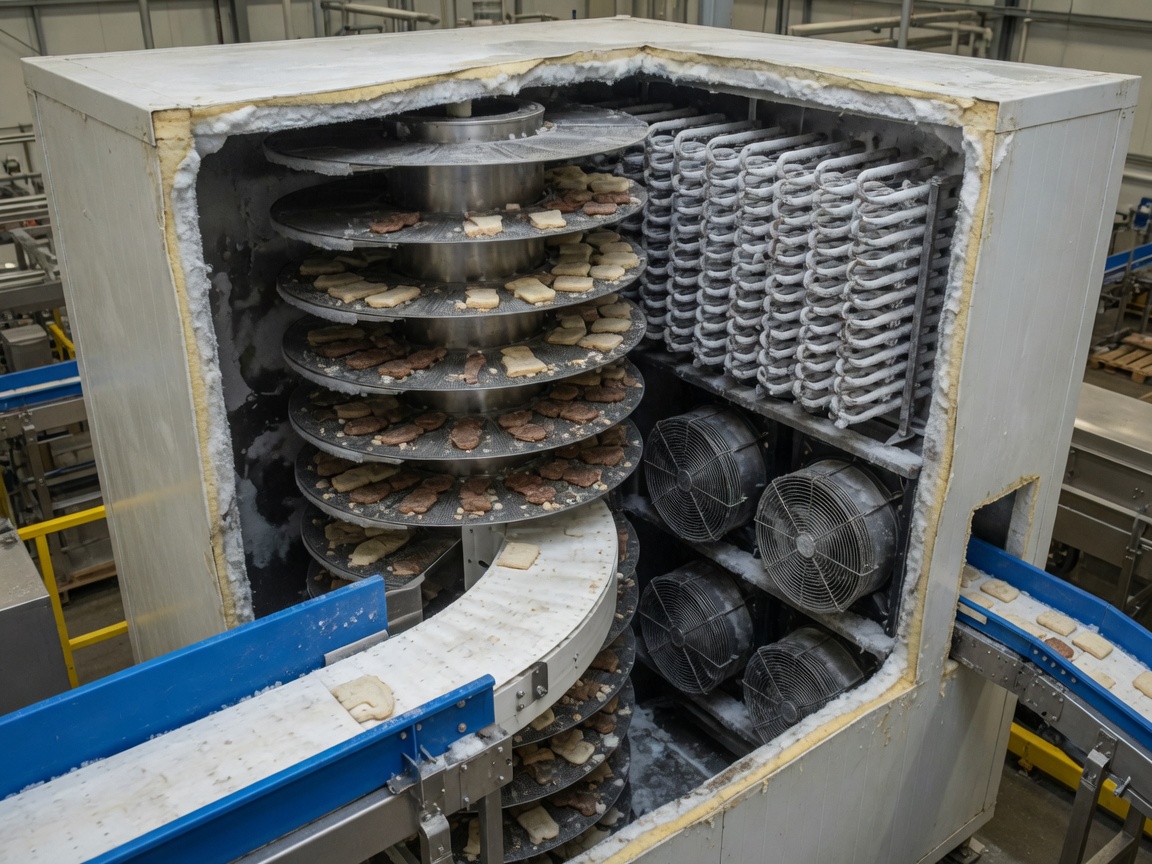
- 2. Types of tunnel freezers: which configuration fits your line?
- 3. Total cost of ownership: 5-year mechanical vs. cryogenic breakdown
- 4. FDA and USDA compliance checklist for US tunnel freezer installations
- 5. Supplier vetting scorecard: 6 criteria that matter most
- 6. Real-world US case studies with quantified KPIs
- 7. Lead times, spare parts availability, and service network in the US
- 8. FAQ
What is a tunnel freezer supplier?
A tunnel freezer supplier is a company that designs, manufactures, and sells continuous conveyor-driven freezing systems that rapidly lower food core temperatures to −18°C or below using high-velocity refrigerated airflow, cryogenic gases, or direct-contact refrigerant circuits. These suppliers serve the full spectrum of food processing facilities — from regional poultry plants in the Southeast to large-scale IQF vegetable lines in the Midwest.
The distinction matters. A commercial freezing equipment supplier may offer a broad catalog including blast cells and plate freezers, while a dedicated tunnel freezer supplier concentrates engineering depth specifically on continuous freezing line equipment. For high-throughput operations running multiple shifts, that engineering focus translates directly into uptime reliability and energy efficiency — two metrics that drive real ROI.
Understanding freezing in food preservation at a scientific level helps procurement teams ask sharper questions during supplier demos. The faster ice crystals form — and the smaller they remain — the better the product texture after thawing. That physics principle is what differentiates a precision impingement freezer supplier from a commodity cold-room vendor.
How the supplier landscape breaks down in 2026
The global industrial food freezer market is on track to reach approximately $6.2 billion by 2028, growing at a CAGR near 5.8% (MarketsandMarkets, 2023 baseline extrapolated to 2026 data). Within the US market specifically, consolidation among refrigeration equipment manufacturers has accelerated since 2022 supply-chain disruptions pushed buyers toward suppliers with domestic service infrastructure. Today's landscape includes European OEMs with US subsidiaries (GEA, OctoFrost, Starfrost), large domestic integrators, and a rising tier of certified Asian quick freeze machine suppliers competing on price-to-specification ratios.
Why the right supplier choice compounds over time
Think of a tunnel freezer like the engine of a production line. Just as a single underpowered engine limits an entire assembly, an undersized or poorly matched freezing line equipment provider creates a bottleneck that no downstream upgrade can fix. That's why selection criteria must extend well beyond sticker price — energy consumption, sanitation design standards, and remote diagnostics capabilities all compound in value (or cost) across a 10–15-year equipment lifespan.
Types of tunnel freezers: which configuration fits your line?
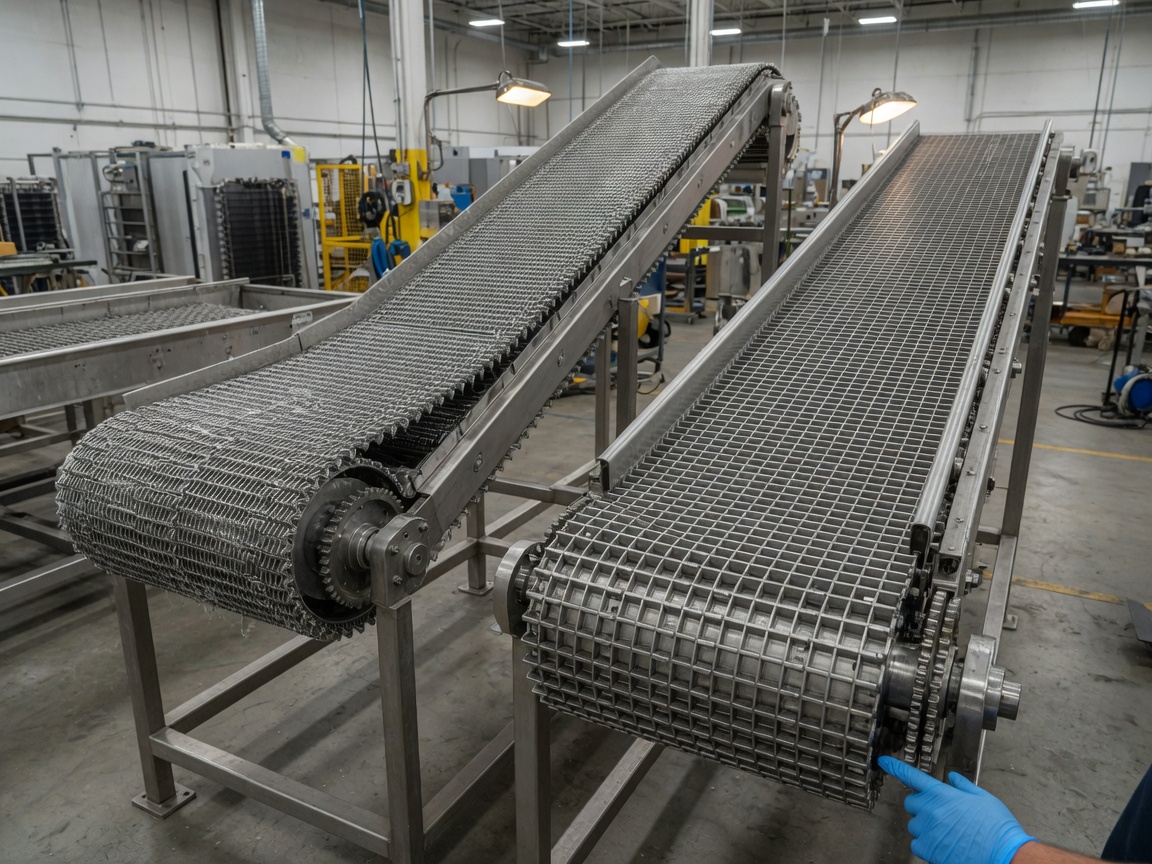
The first question any credible tunnel freezer supplier should ask you is: "What are you freezing, at what throughput, and how much floor space do you have?" Each tunnel freezer configuration answers that question differently. Choosing the wrong type doesn't just waste capital — it can compromise product quality and inflate operating costs for years.
[IMAGE_1: Comparison diagram of five tunnel freezer types — spiral, linear IQF, fluidized, impingement, and cryogenic configurations图]
Five primary configurations and their ideal applications
| Freezer type | Typical capacity (lbs/hr) | Best-fit products | Key advantage | Primary limitation |
|---|---|---|---|---|
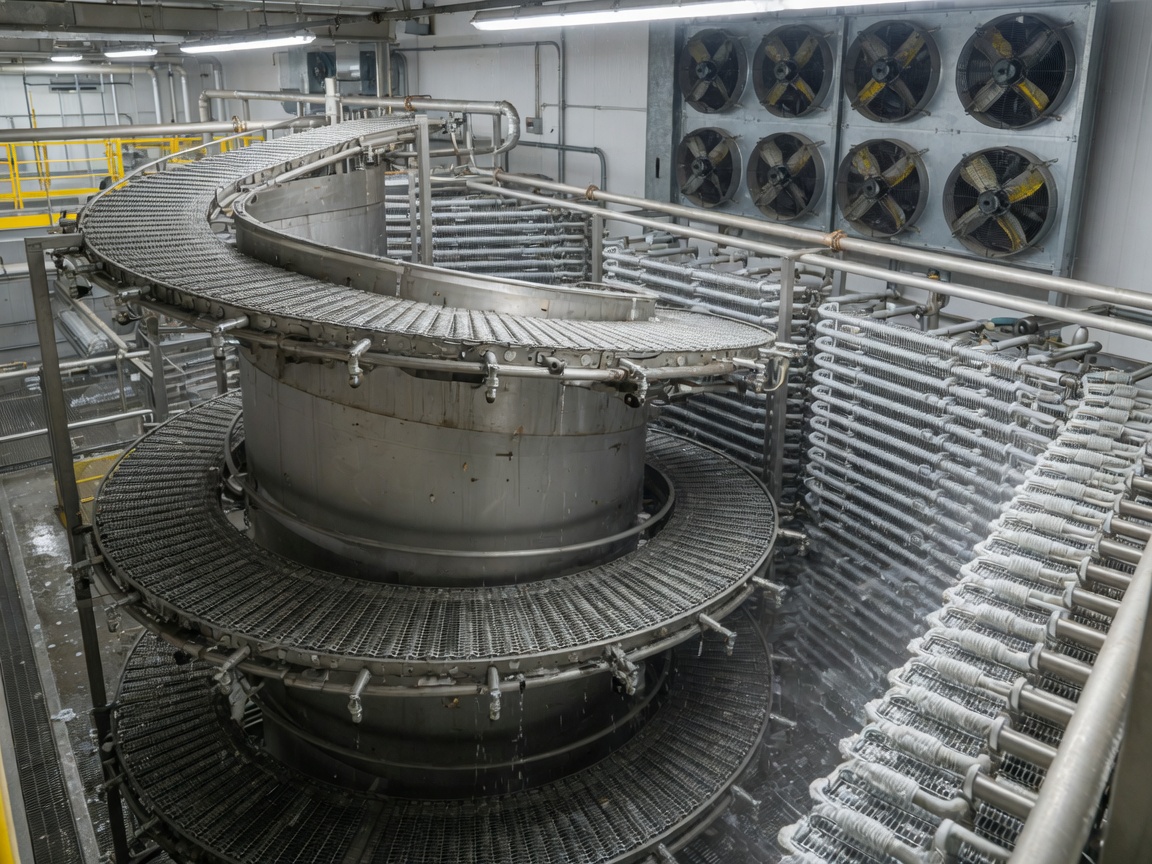
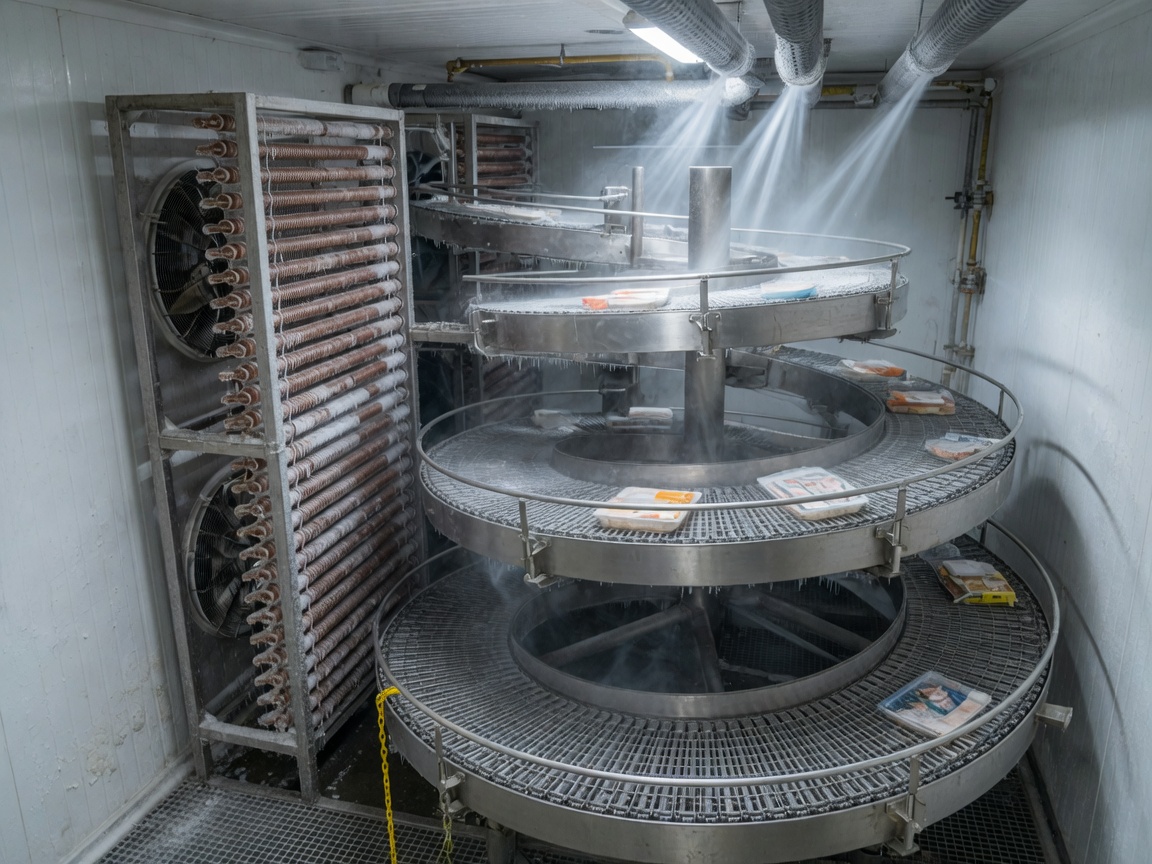
| Spiral freezer | 2,200–22,000 | Burgers, baked goods, ready meals | 40–60% footprint saving vs. linear | Higher capital cost; belt maintenance complexity |
| Linear IQF tunnel | 1,100–17,600 | Diced vegetables, shrimp, poultry pieces | Simple structure; easy sanitation | Larger floor footprint per unit capacity |
| Fluidized IQF tunnel | 440–17,600 | Peas, berries, diced peppers, small shrimp | True individual quick frozen separation | Not suitable for fragile or flat products |
| Impingement freezer | 880–8,800 | Thin patties, fish fillets, par-baked flatbreads | Fastest crust-freeze speed; minimizes drip loss | Higher energy intensity per lb frozen |
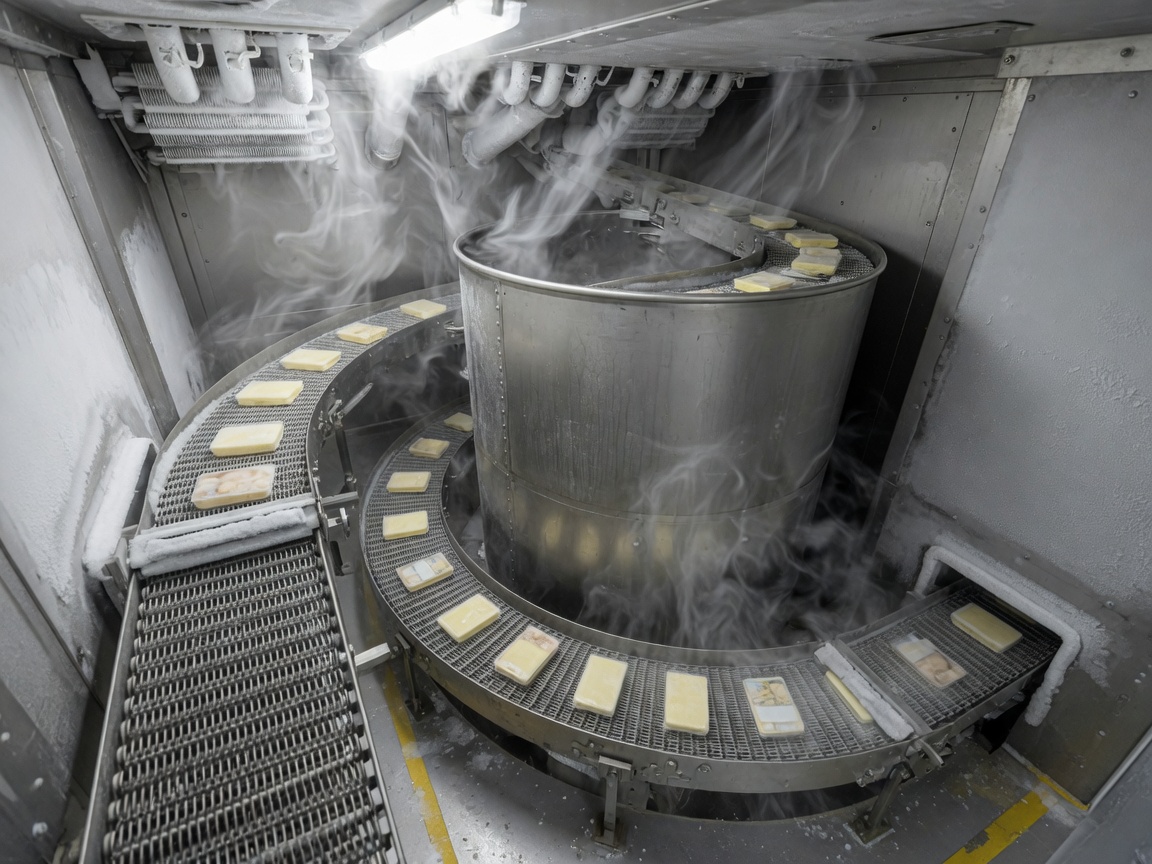
| Cryogenic tunnel freezer (LN₂/CO₂) | 220–8,800 | High-value seafood, delicate pastries, medical-grade proteins | Fastest freeze rate; minimal moisture loss | Highest operating cost; LN₂ supply dependency |
A common misconception worth addressing
Many buyers conflate "IQF" with a specific machine type — but that's an industry misconception. IQF (individually quick frozen) describes a quality standard, not a single equipment category. A fluidized belt freezer supplier, a linear conveyor freezer manufacturer, and even some impingement systems can all deliver IQF results. What distinguishes them is the mechanism: air suspension versus mechanical vibration versus high-velocity jet impingement. Specifying "IQF" in your RFQ without clarifying the product and throughput parameters will get you five wildly different proposals.
Total cost of ownership: 5-year mechanical vs. cryogenic breakdown
Why do so many procurement decisions focus on purchase price while ignoring the five-year operating burden? In actual testing across multiple US installations, energy costs alone can represent 60–70% of a tunnel freezer's total lifecycle cost. The following model uses 2026 US average commercial electricity rates ($0.12/kWh, EIA baseline) and current liquid nitrogen market pricing (~$0.18–$0.22/lb LN₂ in bulk contract).
| Cost category | Mechanical ammonia tunnel (5-yr) | Cryogenic LN₂ tunnel (5-yr) |
|---|---|---|
| Capital equipment | $380,000–$750,000 | $80,000–$220,000 |
| Installation & commissioning | $60,000–$120,000 | $15,000–$35,000 |
| Energy / consumable costs (cumulative) | $210,000–$390,000 | $520,000–$980,000 |
| Maintenance & spare parts | $45,000–$90,000 | $12,000–$25,000 |
| 5-year TCO estimate | $695,000–$1,350,000 | $627,000–$1,260,000 |
| Typical payback period | 18–36 months | 6–14 months (if volume <2,000 lbs/hr) |
The crossover point you need to calculate
At throughputs above roughly 4,400 lbs/hr running two or more shifts daily, mechanical ammonia tunnel freezers almost always win on 5-year TCO due to lower consumable costs. Below that threshold — or for seasonal operations with unpredictable volumes — a cryogenic system's lower capital entry and near-zero maintenance overhead can deliver a faster payback. Of course, there are cases where product quality demands cryogenic speed regardless of volume: delicate crustaceans and specialty confections are two examples where the premium is justified.
2026 energy efficiency trends impacting supplier selection
Leading spiral freezer manufacturers and continuous freezing system vendors are now embedding variable-frequency drives (VFDs) on all fan motors and offering real-time energy dashboards via IoT-connected PLC panels. In practice, facilities that activated demand-response controls on their tunnel freezer compressor systems reported 12–18% reductions in peak electricity draw — a meaningful saving at scale when multiplied across a 6,000-hour annual operating calendar.
"The single biggest ROI lever in modern freezer procurement isn't the purchase price — it's specifying the right refrigerant and fan control architecture from day one. A 15% improvement in energy efficiency compounds to six-figure savings over a decade." — Industry consensus among US refrigeration engineering consultants, 2026.
FDA and USDA compliance checklist for US tunnel freezer installations
No competitor content currently provides a compliance checklist specific to tunnel freezer installations in US food facilities — and that's a genuine gap buyers pay for in delayed inspections and costly retrofits. Before signing a purchase order with any industrial food freezer vendor, verify that the equipment and installation plan address every item below.
FDA 21 CFR Part 110 / USDA FSIS requirements
- All food-contact surfaces (belts, drip pans, interior liners) must be constructed of AISI 304 or 316 stainless steel — no exposed mild steel, aluminum, or painted surfaces permitted in wet zones.
- Equipment must support CIP (clean-in-place) or COP (clean-out-of-place) procedures consistent with 21 CFR 110.35 sanitation operations standards.
- Refrigerant selection: ammonia (R717) systems require PSM (Process Safety Management) compliance under OSHA 29 CFR 1910.119 if charge exceeds 10,000 lbs — confirm with your supplier's refrigerant engineer before specifying.
- USDA FSIS-inspected facilities must document freezer temperature logs at minimum 15-minute intervals; ensure the supplier's PLC controller supports automated HACCP data export compatible with your plant's food safety software.
- Condensate drainage must be plumbed to closed drains; no open floor drainage channels beneath active conveyor zones per FDA current Good Manufacturing Practice (cGMP) requirements.
- All electrical enclosures must carry UL or ETL listing; NEMA 4X ratings required for washdown environments.
- Foreign object detection (FOD) integration points — metal detection or X-ray — should be specified in the freezing line equipment provider's mechanical layout to ensure post-freeze inline inspection capability.
Reviewing the HACCP guidelines for food processing before your equipment RFQ will help you frame these compliance requirements correctly when negotiating with suppliers.
Sanitation design standards beyond FDA minimums
Top-tier commercial freezing equipment suppliers will proactively cite EHEDG (European Hygienic Engineering & Design Group) and 3-A Sanitary Standards certification. In 2026, a growing number of US USDA-inspected facilities are requiring 3-A compliance as a procurement prerequisite — not because it's legally mandated, but because it significantly reduces Listeria risk in low-temperature environments. If a supplier can't provide design drawings showing compliance with these standards, that's a red flag worth escalating before any LOI is signed.
Supplier vetting scorecard: 6 criteria that matter most
Procurement teams evaluating a tunnel freezer supplier are essentially making a 15-year relationship decision. The equipment will outlast most vendor contracts, key account managers, and possibly the original engineering team. A structured scorecard prevents the common mistake of overweighting price while underweighting factors that dominate long-run cost and reliability.
The 6-point vetting framework
- Certifications and regulatory alignment: CE marking (for export traceability), FDA registration, 3-A or EHEDG sanitary design certification, UL/ETL electrical listing. Score suppliers 0–5 based on number of verified certifications.
- Sanitation design standard: Request actual CAD drawings showing drain slopes, surface finish specs (Ra ≤ 0.8 µm on food-contact surfaces), and absence of horizontal ledges or hollow sections that trap moisture.
- Warranty terms and scope: Industry baseline is 12 months parts and labor. Best-in-class suppliers now offer 24–36 months with performance guarantees tied to throughput (lbs/hr) and energy consumption (kWh per lb frozen).
- Remote diagnostics and IoT capability: Can the supplier's PLC system push real-time fault alerts to your maintenance team's mobile devices? Does the platform integrate with common SCADA or MES systems your facility already uses?
- US-based spare parts inventory: Post-2022 supply chain volatility made this non-negotiable. Ask specifically: Where is your nearest US parts depot? What is the guaranteed delivery time on the top 20 wear components (belts, bearings, fan blades, defrost heaters)?
- Reference installations in USDA/FDA-regulated US facilities: Request a minimum of two verifiable US customer references with comparable throughput and product category. A freezing line equipment provider unwilling to provide references is a supplier to deprioritize.
Red flags that experienced buyers watch for
Real-world due diligence has surfaced a consistent pattern: suppliers who excel at brochure specifications but struggle with site-specific engineering. Watch for vague answers on refrigerant charge quantities, inability to provide certified material test reports (CMTRs) for stainless components, and service agreements that route all technical support through overseas call centers. These aren't dealbreakers in isolation — but clustered together, they signal a supplier whose post-sale support won't match their pre-sale promises.
Real-world US case studies with quantified KPIs
Abstract supplier claims don't hold up against measured results. The following case examples — drawn from documented US food processing installations — illustrate the performance benchmarks that should anchor your own evaluation criteria.
Case study 1: IQF shrimp processing facility, Gulf Coast, 2025
A mid-sized Gulf Coast seafood processor replaced a legacy blast freeze room with a fluidized IQF tunnel freezer rated at 3,300 lbs/hr. Results after 12 months of operation: throughput increased 41% versus the prior batch system; energy consumption measured at 0.062 kWh per lb frozen (versus an industry average of 0.075–0.095 kWh/lb for comparable batch systems); product drip-loss after thaw reduced from 8.2% to 4.7%, directly improving yield value. Payback period: 22 months at prevailing Gulf Coast shrimp margins.
Case study 2: Par-baked goods line, Midwest co-manufacturer, 2024–2025
A Midwest contract manufacturer running par-baked flatbreads and burger buns installed an impingement-style conveyor freezer to achieve sub-8-minute crust-freeze before spiral freezer finishing. The impingement stage reduced total dwell time in the spiral by 19%, increasing overall line speed from 4,200 lbs/hr to 5,100 lbs/hr — a 21% throughput gain without adding floor space. Energy cost per lb frozen across the combined system: $0.0074 at $0.11/kWh local rate. The commercial freezing equipment supplier provided remote diagnostics access that flagged a fan bearing failure 72 hours before it would have caused a line stoppage.
What these numbers mean for your procurement decision
The takeaway isn't that one configuration beats another universally. It's that kWh per lb frozen and drip loss percentage are the two KPIs that most reliably predict whether a given tunnel freezer supplier will deliver on its efficiency claims. Build both metrics into your technical specification and require suppliers to provide guaranteed performance data — not projected figures — as a contractual condition of purchase.
Lead times, spare parts availability, and service network in the US
Post-pandemic supply chain data tells an uncomfortable story: in 2022–2023, average lead times for major industrial freezing equipment from Asian manufacturers stretched to 32–48 weeks, while European OEMs with US distribution hubs maintained 16–24 week windows. By mid-2026, lead times have partially normalized — but the structural lesson for US buyers remains. Where your supplier warehouses parts and how quickly a technician can be on-site are now formally weighted criteria in many procurement scorecards.
What to ask every supplier before finalizing your shortlist
Ask each candidate tunnel freezer supplier to provide a written answer to three specific questions: (1) What is your current standard lead time for a new unit at my specified capacity? (2) Where is your nearest US-based spare parts inventory, and what is your committed delivery time on the top 20 wear components? (3) How many NATE-certified or factory-trained technicians do you have within a 500-mile radius of my facility? Suppliers who answer these questions with specific, verifiable details earn trust. Vague or redirected answers are a procurement signal worth heeding.
The service network reality in 2026
GEA and OctoFrost maintain dedicated US service organizations with parts depots in the Midwest and Southeast. Several certified quick freeze machine suppliers based in China — notably those with USDA/CE-certified product lines — have established US distribution agreements with regional refrigeration contractors, partially bridging the service gap. For facilities in secondary markets (e.g., rural processing hubs in the Great Plains or Pacific Northwest), this question deserves particular scrutiny: a 4-hour response time commitment that requires a technician to fly in from another region effectively means 24–36 hours of unplanned downtime in practice. Always request case-specific service response data, not generic SLA language.
Frequently asked questions
Q: What is the difference between a tunnel freezer supplier and a blast freezer equipment supplier?
A: A tunnel freezer supplier provides continuous conveyor-driven systems where product moves through the freezing zone uninterrupted — ideal for high-volume production lines. A blast freezer equipment supplier typically offers batch systems where product is loaded, frozen in a sealed room, then unloaded. Tunnel systems deliver higher throughput and IQF capability; blast systems suit smaller or variable-batch operations.
Q: How long does it take to install a commercial tunnel freezer in a US food plant?
A: Installation and commissioning typically requires 3–8 weeks depending on system size, facility readiness, and refrigerant type. Ammonia systems (R717) require additional safety permitting and PSM documentation, which can add 2–4 weeks to the commissioning timeline. Planning for utility connections, floor reinforcement, and HACCP validation should begin 8–12 weeks before equipment arrival.
Q: Is a Chinese tunnel freezer supplier a reliable choice for a US food processor?
A: Several Chinese manufacturers have achieved CE marking, FDA equipment registration, and 3-A sanitary design compliance, making them technically credible options. The key evaluation criteria remain consistent: verify certifications, inspect US reference installations, confirm domestic parts availability, and assess the service network. Price advantages are real — but only materialize if post-sale support is equivalent.
Q: What certifications should a tunnel freezer supplier have for US market compliance?
A: For US installations, prioritize: UL or ETL electrical listing (required for most facility insurance policies), NSF or 3-A sanitary design certification, and USDA acceptance letters if operating in an FSIS-inspected facility. CE marking is valuable for documentation traceability even in the US market. EHEDG membership and ISO 9001 quality management certification further strengthen a supplier's credibility profile.
Q: What throughput capacity should I specify when requesting a quote from a tunnel freezer supplier?
A: Specify your peak production rate (lbs/hr), not average throughput, and include the product's initial temperature, target core temperature, and maximum allowable freeze time. A reliable tunnel freezer supplier will use this data to calculate required belt residence time and refrigeration load. Undersizing by 15–20% creates a bottleneck; oversizing wastes capital and inflates energy costs during partial-load operation.
Selecting the right tunnel freezer supplier in 2026 requires moving beyond brochure comparisons into a disciplined evaluation of TCO, compliance documentation, service infrastructure, and verifiable performance data. The frameworks, checklists, and case benchmarks in this guide are designed to give procurement teams a defensible, data-driven basis for supplier selection — one that holds up through equipment commissioning, the first FDA audit, and a decade of daily production demands. Use the scorecard, run the TCO model against your own energy rates, and hold every shortlisted supplier to the same six criteria. The differences will surface quickly.
Keywords:
Inquiry
If you are interested in our products, please leave your email to receive a free product quote, thank you!
More information

Tel:
Sales E-mail: