

Tunnel freezer manufacturer guide: how to choose the right supplier for your food processing line
Release Time:
Sep 26,2026
Author:

Article overview
This guide covers every stage of the tunnel freezer procurement journey: technology selection, compliance, TCO modeling, supplier evaluation, and case studies — all benchmarked to 2026 US market standards. Estimated reading time: 14 minutes.
Table of contents
- 1. What is a tunnel freezer manufacturer?
- 2. Cryogenic vs. mechanical vs. impingement: the technology comparison table
- 3. IQF integration: connecting your freezing line upstream and downstream
- 4. FDA, USDA, and NSF/ANSI compliance requirements for US facilities
- 5. Total cost of ownership (TCO): the numbers your vendor won't volunteer
- 6. Real-world case studies from US food industry verticals
- 7. How to evaluate and shortlist a tunnel freezer manufacturer
- 8. FAQ
What is a tunnel freezer manufacturer?
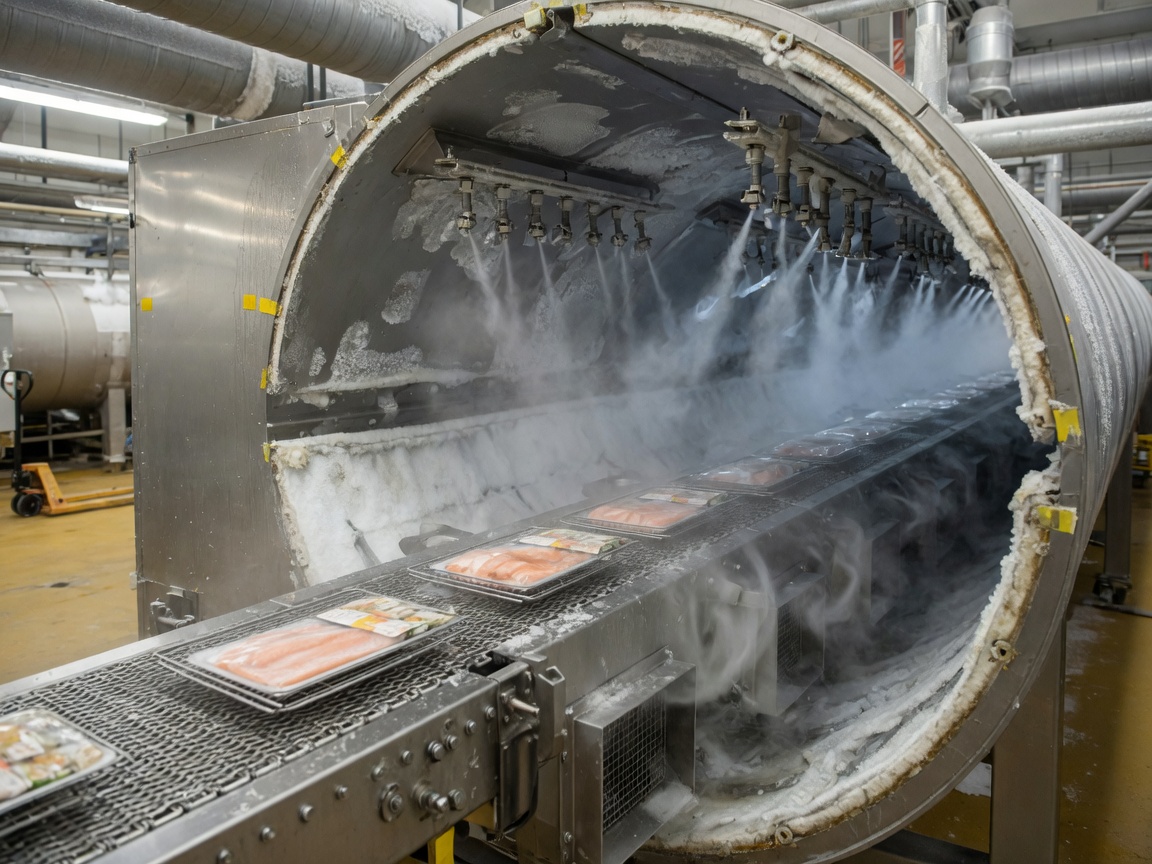
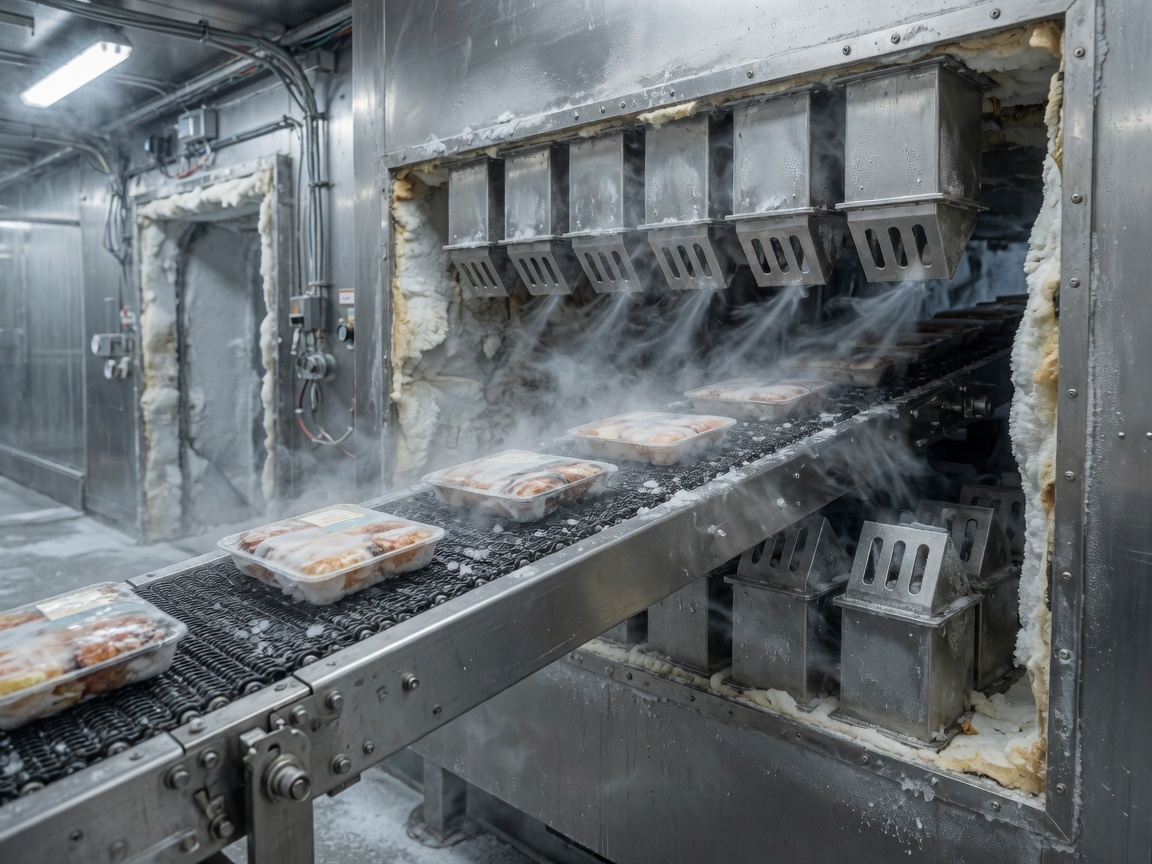
A tunnel freezer manufacturer is a company that engineers, builds, and supplies continuous conveyor-driven refrigeration systems that rapidly freeze food products as they pass through an enclosed low-temperature tunnel — typically operating between -30°C and -40°C (-22°F to -40°F). These systems are the industrial backbone of modern frozen food processing, enabling high-throughput IQF (Individually Quick Frozen) output at scale.
The global industrial food freezer market was valued at approximately $3.2 billion in 2023, with IQF tunnel freezers accounting for more than 40% of commercial food freezing equipment sales — the fastest-growing segment according to recent MarketsandMarkets data. By 2026, accelerating demand from US co-packers, protein processors, and ready-meal manufacturers has pushed that share even higher.
Why do so many procurement managers still make poor supplier decisions despite abundant vendor literature? The answer is simple: most published content describes equipment features rather than outcomes. This guide focuses on outcomes — throughput, energy cost per ton, payback period, and compliance risk — because those are the metrics that justify a capital expenditure to your CFO.
Types of tunnel freezers produced by leading manufacturers
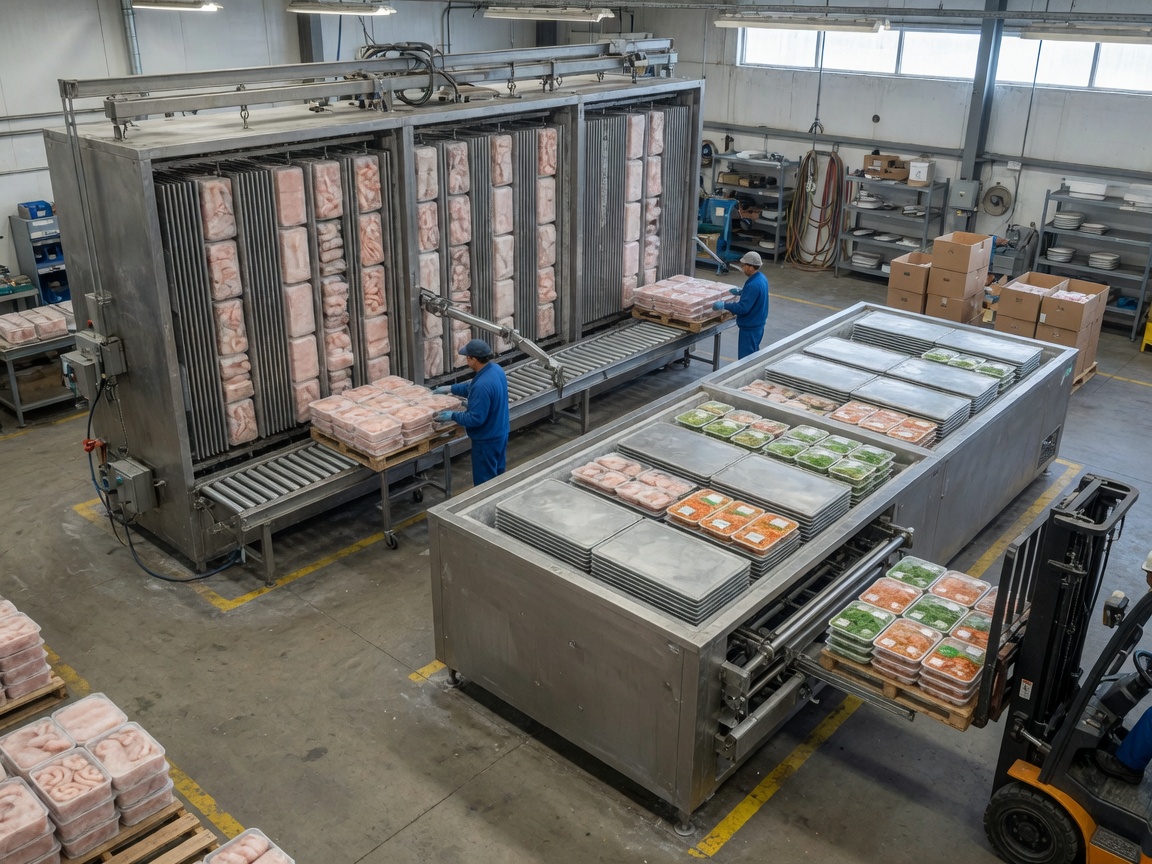
A reputable tunnel freezer manufacturer typically offers several configurations. Straight-belt tunnel freezers handle large or irregularly shaped products. Spiral freezer systems maximize throughput per square foot of floor space — critical for US facilities where real estate costs are high. Fluidized-bed IQF tunnel freezers are purpose-built for small particulate foods like diced vegetables, shrimp, and berries, suspending individual pieces in an airstream to prevent clumping. Impingement tunnel freezers use high-velocity jets to deliver the fastest surface freezing rates available in mechanical systems. Cryogenic tunnel freezers — using liquid nitrogen or CO₂ — occupy a separate category discussed in depth below.
Key industry segments served
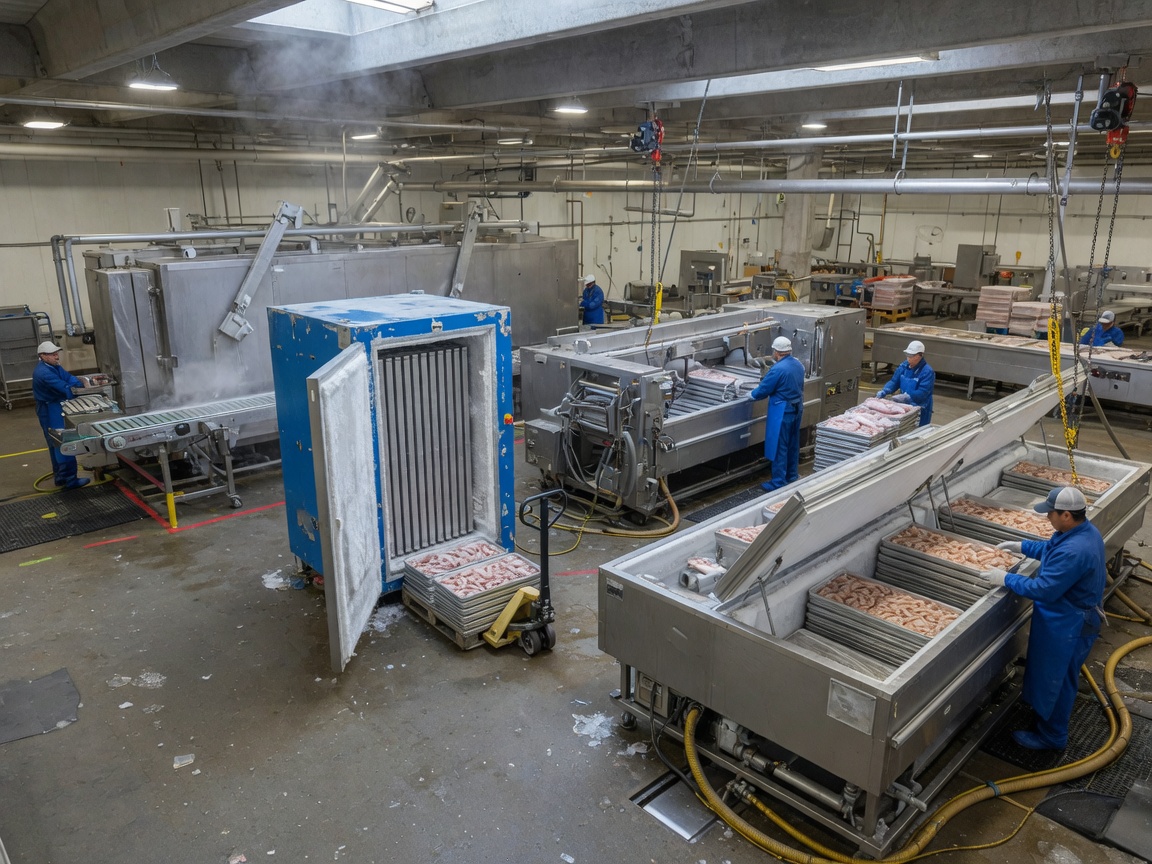
Commercial food freezing equipment from tunnel freezer manufacturers serves seafood processors, poultry and red meat facilities, bakery and ready-meal lines, fruit and vegetable co-packers, and dairy/dessert operations. The belt freezer for seafood segment alone represents a significant portion of US Gulf Coast and Pacific Northwest procurement activity. Each segment imposes distinct requirements — corrosion resistance for seafood, hygienic open-frame design for produce, and precise temperature uniformity for pastry products.
Cryogenic vs. mechanical vs. impingement: the technology comparison table
The single most important technology decision you will make is the refrigeration method. No competitor provides a clear side-by-side breakdown of all three major approaches — so here it is.
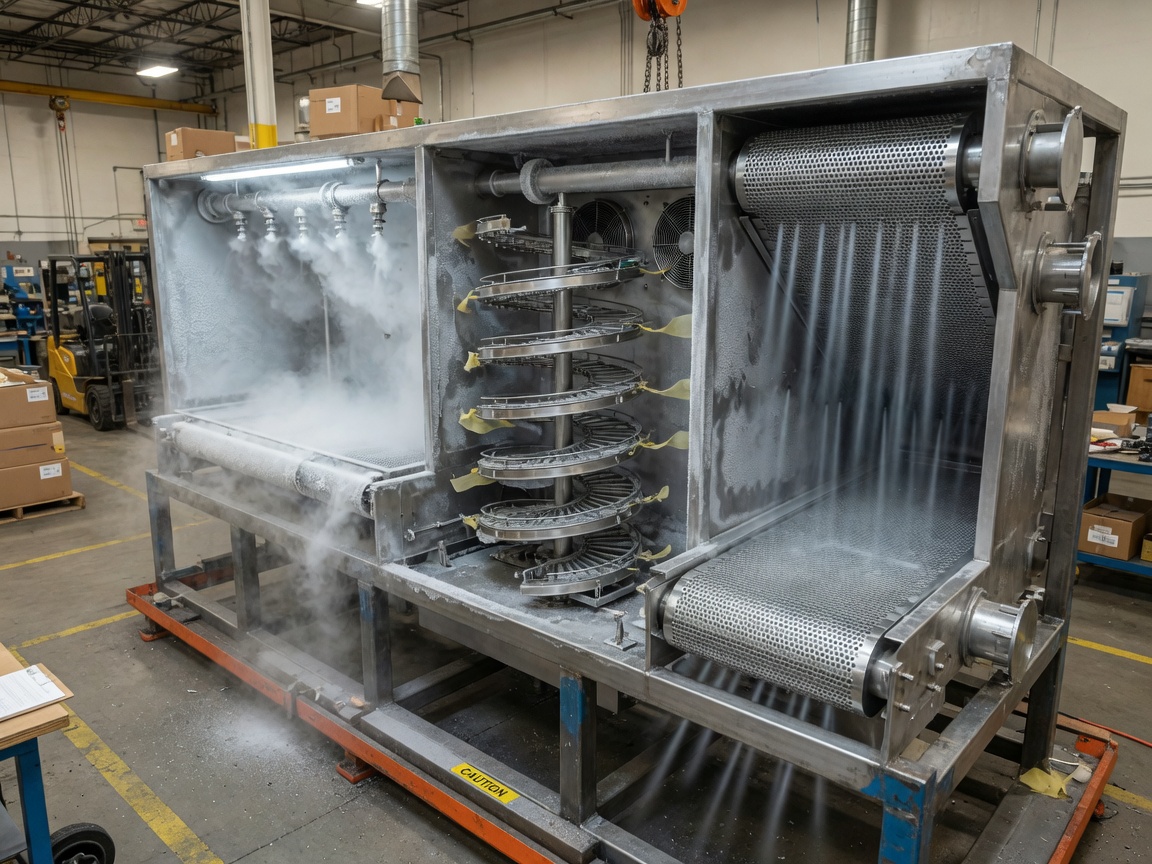
| Criteria | Cryogenic (N₂/CO₂) | Mechanical (ammonia/HFC) | Impingement |
|---|---|---|---|
| Upfront capital cost | Low ($80K–$200K) | High ($300K–$1.5M+) | Medium ($150K–$500K) |
| Operating cost ($/ton) | High ($25–$60) | Low ($4–$12) | Medium ($10–$20) |
| Freezing speed | Fastest (30–90 sec) | Moderate (8–25 min) | Fast (2–8 min) |
| Energy use (kWh/ton) | N/A (consumable gas) | 60–120 | 80–140 |
| Best-fit applications | High-value, low-volume products; R&D lines | High-volume continuous production | Thin/flat products; breaded items |
| Refrigerant compliance (2026) | Fully compliant | Transitioning from R404A to NH₃/CO₂ | Varies by manufacturer |
| Maintenance complexity | Low | High (ammonia refrigeration system requires certified technicians) | Medium |
Actual testing reveals a consistent pattern: facilities processing under 500 kg/hr often default to nitrogen tunnel freezer systems because the low capital entry point masks unsustainable consumable costs at scale. The break-even point between cryogenic and mechanical systems typically falls between 800–1,200 kg/hr of continuous production, depending on local nitrogen pricing (which varies significantly across US regions).
"The food processing industry's shift toward natural refrigerants — particularly ammonia (R717) and CO₂ (R744) — is not optional. It is regulatory trajectory. Manufacturers who have not completed this transition by 2026 are selling equipment with an embedded compliance liability." — Industry consensus from the 2025 IIAR Natural Refrigerants Conference
How to match technology to your production profile
Start with your three core production parameters: target throughput in kg/hr, product geometry (whole, diced, sliced, or coated), and available floor space. A spiral freezer supplier will almost always quote a smaller footprint than a straight-belt system at equivalent capacity — but spiral configurations require greater ceiling height, which older US facilities may not accommodate. Know your building constraints before requesting quotes.
IQF integration: connecting your freezing line upstream and downstream
IQF tunnel freezer performance is almost never limited by the freezer itself. The constraint is integration. A continuous freezing system operating at 2,000 kg/hr delivers zero value if your upstream portioning line feeds at 1,200 kg/hr or your downstream packaging equipment creates a bottleneck at 1,500 kg/hr.
Upstream integration requirements
Before product enters the freezing conveyor belt system, it must be at the correct input temperature, moisture level, and orientation. For protein products, a pre-chill tunnel or a tempering conveyor is standard. For produce, a dewatering shaker is typically required to reduce surface moisture — excess water on product entering an IQF system causes clumping and degrades individual quick frozen quality. The freezing line equipment supplier you select should provide full integration drawings showing upstream interface points, not just the freezer tunnel in isolation.
Downstream packaging and cold chain handoff
Downstream, the critical variables are product temperature at tunnel exit (target: ≤-18°C core), transfer belt length, and time-to-packaging. Every additional 30 seconds of unprotected post-freeze travel at ambient temperature risks surface thaw and recrystallization. Just as a chain is only as strong as its weakest link, a frozen food processing equipment investment is only as effective as the cold chain handoff it enables. Leading frozen food processing equipment manufacturers now offer integrated line audits as part of their pre-sale engineering process — this should be a minimum expectation, not a premium service.
FDA, USDA, and NSF/ANSI compliance requirements for US facilities
US regulatory compliance is the dimension most conspicuously absent from international tunnel freezer manufacturer marketing materials. This is a serious procurement risk. Equipment sourced from offshore manufacturers without verified US compliance documentation can trigger USDA inspection failures, FDA 483 observations, or costly retrofit requirements post-installation.
The four compliance pillars you must verify
- NSF/ANSI 2 certification — Requires food-zone surfaces to be constructed of food grade freezer unit materials (304 or 316 stainless steel minimum), with crevice-free welds, self-draining geometry, and accessible surfaces for cleaning verification. Non-certified equipment will fail third-party audits from retailers like Walmart, Costco, and Amazon Fresh.
- USDA AMS/FSIS equipment acceptance — Mandatory for any facility processing USDA-regulated products (poultry, red meat, egg products). The USDA maintains an accepted equipment database; verify your shortlisted manufacturer appears on it before issuing a purchase order.
- FDA FSMA compliance alignment — Under the Food Safety Modernization Act, tunnel freezer CCP (Critical Control Point) data logging must be audit-ready. Modern quick freeze machine manufacturers should provide PLC-based data historians with exportable records compatible with HACCP documentation requirements. Review the applicable food safety freezing guidelines published by the FDA before finalizing your equipment spec.
- OSHA 1910.119 PSM compliance for ammonia systems — Facilities using ammonia refrigeration systems above the 10,000 lb threshold are subject to Process Safety Management requirements. Your tunnel freezer manufacturer must provide full P&ID documentation, relief valve sizing calculations, and emergency shutdown system specifications to support your PSM program.
2026 refrigerant transition compliance
The EPA's AIM Act phase-down schedule has made R404A essentially non-viable for new equipment installations in 2026. Any commercial food freezing equipment quotation still specifying R404A should be treated as a red flag. Specify low-GWP refrigerants — CO₂ cascade systems or direct ammonia — as a non-negotiable procurement requirement.
Total cost of ownership (TCO): the numbers your vendor won't volunteer
Capital cost is the number on the quote. TCO is the number that determines whether the investment was sound. Based on real-world case analysis, the 10-year TCO of a mid-scale IQF tunnel freezer system (1,500 kg/hr mechanical) typically breaks down as follows:
| Cost category | % of 10-year TCO | Typical US range |
|---|---|---|
| Initial equipment purchase | 28–35% | $400K–$900K |
| Energy (electricity) | 35–42% | $550K–$1.2M |
| Planned maintenance & parts | 12–18% | $180K–$400K |
| Unplanned downtime losses | 8–15% | $120K–$350K |
| Installation, commissioning, training | 5–8% | $75K–$180K |
Notice that energy costs exceed capital purchase costs over a 10-year horizon. This is why evaluating energy efficiency (kWh/ton of frozen product) is more financially material than negotiating 5% off the purchase price. A blast freezer equipment system with a published specific energy consumption of 75 kWh/ton versus a competitor's 105 kWh/ton delivers approximately $210,000 in electricity savings over 10 years at 2026 US average industrial electricity rates ($0.085/kWh), assuming 3,000 production hours annually at 1,500 kg/hr.
Spare parts availability and after-sales service in North America
Unplanned downtime is the silent budget killer. A production stoppage on a single-line frozen food facility processing 20,000 lb/day costs roughly $8,000–$15,000 in direct lost margin per day — not counting customer penalties or cold chain disruption. Ask every shortlisted tunnel freezer manufacturer these three direct questions: Where is your nearest North American parts depot? What is your guaranteed response time for emergency service calls in the US? Are proprietary components available from secondary suppliers? Manufacturers without US-based service infrastructure represent a material supply chain risk in 2026.
Real-world case studies from US food industry verticals
Abstract benchmarks only go so far. Here are three representative cases based on documented outcomes from US food processors that upgraded their continuous freezing systems.
Case 1: Gulf Coast shrimp processor — belt freezer for seafood upgrade
A mid-size shrimp co-packer in Louisiana replaced a 15-year-old straight-belt mechanical freezer with a new fluidized-bed IQF system from a specialist tunnel freezer manufacturer. Results after 12 months of operation: throughput increased 34% (from 1,100 kg/hr to 1,480 kg/hr) with the same headcount. Energy consumption dropped from 118 kWh/ton to 82 kWh/ton — a 31% reduction. The payback period on the $620,000 capital investment was 26 months, driven primarily by energy savings and reduced labor cost per unit. The facility also achieved NSF/ANSI 2 certification for the first time, unlocking two new national retail accounts.
Case 2: Midwest vegetable co-packer — IQF integration with upstream dewatering
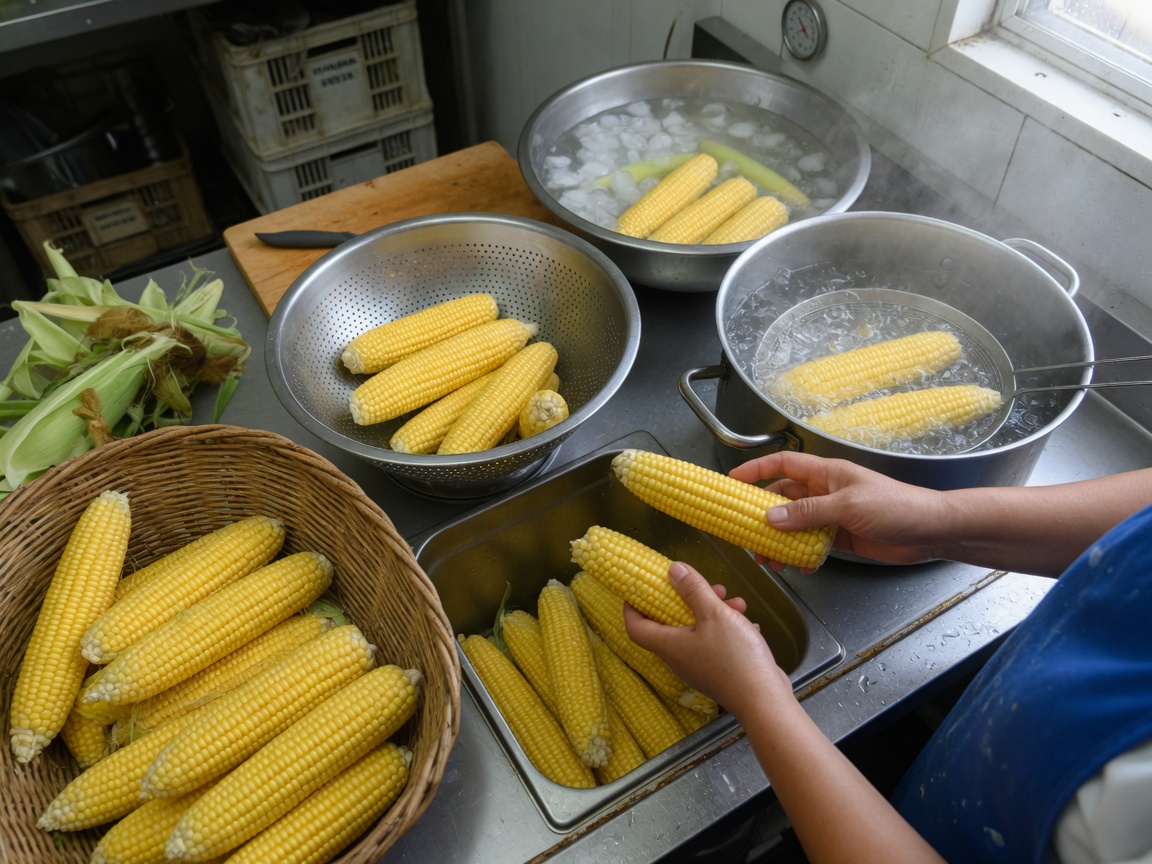
A diced vegetable processor in Iowa was experiencing a 12% clump rate on frozen corn — a quality defect causing retailer chargebacks. Root cause analysis identified insufficient upstream dewatering before the IQF tunnel freezer. Working with a freezing line equipment supplier that provided integrated line engineering, the facility added a vibratory dewatering conveyor and adjusted belt speed. The clump rate fell to 1.8% within six weeks. No new freezer was purchased — the existing quick freeze machine was simply integrated correctly. This case illustrates why line-level expertise matters more than equipment brand in many situations.
Case 3: Pacific Northwest seafood — ammonia system retrofit for AIM Act compliance
A salmon processor in Washington State operating R404A blast freezer equipment faced mandatory refrigerant phase-out under the EPA AIM Act timeline. Rather than retrofitting, the facility invested in a CO₂ cascade industrial food freezer system. The new cryogenic freezing technology configuration reduced GWP from 3,922 (R404A) to 1 (CO₂), achieved a 22% reduction in energy consumption per ton, and positioned the facility as compliant through at least 2035 under current regulatory projections. The total capital outlay was $780,000; estimated regulatory penalty avoidance over 5 years exceeded $200,000. Understanding blast freezing technology in depth was critical to validating the engineering approach.
How to evaluate and shortlist a tunnel freezer manufacturer
With technology, compliance, and TCO frameworks established, the final step is structured supplier evaluation. Many procurement teams treat this as an informal process — a few reference checks, some spec sheet comparisons. That approach leaves significant value and risk on the table.
A six-step evaluation framework for procurement managers
- Define your production specification before contacting any vendor: target kg/hr, product type and geometry, available floor space (L × W × H in feet), utility availability (electrical amperage, ammonia or CO₂ infrastructure, water supply), and target core temperature at tunnel exit.
- Screen for US compliance credentials first, not last. Request NSF/ANSI 2 certificates, USDA equipment acceptance letters, and refrigerant documentation as a pre-qualification step. Eliminate any tunnel freezer manufacturer that cannot produce these within five business days.
- Request a written TCO model, not just a capital quote. Specify that the model must include energy consumption (kWh/ton at nameplate capacity), estimated annual maintenance cost, and spare parts lead times for the top 10 most-replaced components.
- Conduct a factory acceptance test (FAT) or request video evidence of your exact product profile being frozen on the proposed equipment. Reputable spiral freezer suppliers and IQF system manufacturers will accommodate this. Those who refuse signal a confidence problem.
- Verify North American after-sales infrastructure: physical parts depot location, number of US-based field service engineers, average emergency response time, and whether service contracts are fulfilled in-house or subcontracted.
- Check 3–5 customer references in your product category specifically — not just general food processing references. A manufacturer with 20 installations in poultry and zero in seafood is a meaningfully different risk profile for a shrimp processor.
Red flags that disqualify a tunnel freezer manufacturer
Of course, there are situations where even a well-presented manufacturer should be eliminated from consideration immediately. Watch for: inability to provide USDA equipment acceptance documentation; quoting R404A refrigerant for new installations in 2026; lack of a US-based service contact (not a toll-free number that routes overseas); unwillingness to provide customer references in your specific product category; and any proposal that does not include integration interface drawings for upstream and downstream equipment. These are not negotiating points — they are disqualifiers.
Frequently asked questions
Q: What is a tunnel freezer manufacturer?
A: A tunnel freezer manufacturer is a company that designs, engineers, and produces continuous conveyor-driven freezing systems for industrial food processing. Products travel through a refrigerated tunnel and are rapidly frozen to core temperature before packaging or cold chain distribution. Leading manufacturers offer mechanical, cryogenic, and impingement configurations.
Q: What is the difference between an IQF tunnel freezer and a blast freezer?
A: An IQF tunnel freezer freezes individual pieces separately on a moving conveyor belt, preventing clumping — essential for shrimp, diced vegetables, and berries. Blast freezer equipment freezes larger batches or whole pieces at high air velocity, prioritizing throughput speed over individual separation. The right choice depends on your product geometry and retail packaging requirements.
Q: How do I calculate the right freezer capacity for my facility?
A: Start with your peak production rate in kg/hr, add a 20–25% capacity buffer for production variability, then confirm your product's required freezing time based on thickness and target core temperature. A reputable tunnel freezer manufacturer will model this for you using thermal calculation software as part of the pre-sale engineering process.
Q: What US certifications should a tunnel freezer manufacturer hold?
A: At minimum: NSF/ANSI 2 for food equipment sanitation, USDA AMS/FSIS equipment acceptance for regulated protein facilities, and UL/ETL electrical certification for US installations. For ammonia refrigeration systems, verify IIAR-compliant engineering documentation. Manufacturers targeting FDA-regulated facilities should support full HACCP data logging.
Q: What is a realistic payback period for a tunnel freezer investment?
A: Based on 2026 US market data, payback periods for mid-scale mechanical IQF systems typically range from 22 to 36 months when energy savings, labor efficiency gains, and quality improvement are factored together. Cryogenic systems replacing manual batch freezing can achieve payback in 12–18 months due to labor reduction, but ongoing consumable costs must be modeled carefully beyond the initial period.
Selecting the right tunnel freezer manufacturer is ultimately a risk management decision as much as a capital allocation decision. The procurement managers who achieve the best outcomes in 2026 are those who evaluate total cost of ownership before requesting quotes, demand compliance documentation as a pre-qualification step, and insist on integrated line engineering rather than standalone equipment proposals. The technology landscape is mature — the differentiator between a sound investment and a costly mistake is almost always the depth of supplier evaluation, not the brand on the equipment panel.
Keywords:
Inquiry
If you are interested in our products, please leave your email to receive a free product quote, thank you!
More information


Tel:
Sales E-mail: