

Impingement freezer guide: how it works, key benefits, and what to look for
Release Time:
Sep 25,2026
Author:

Article overview
A procurement-focused technical guide examining impingement freezer technology, brand specifications, operating costs, compliance requirements, and post-purchase support — written for US food manufacturers actively comparing freezing solutions in 2026.
Table of contents
- 1. What is an impingement freezer?
- 2. How air impingement technology works
- 3. Types of impingement freezers
- 4. Brand comparison: specs and performance
- 5. Energy efficiency and operating costs
- 6. Food safety, sanitation, and compliance
- 7. Real-world ROI: case studies by segment
- 8. Maintenance, spare parts, and US service support
- 9. FAQ
What is an impingement freezer?
An impingement freezer is a commercial food freezing system that directs high-velocity jets of cold air perpendicularly onto the top and bottom surfaces of a food product, stripping away the insulating thermal boundary layer to achieve freezing rates 3–5 times faster than conventional blast freezing for flat or thin products.
That single mechanical distinction — forced boundary-layer disruption — explains why impingement freezer technology became the standard for pizza crusts, fish fillets, marinated chicken breasts, and burger patties across US food manufacturing plants. Traditional impingement freezer technology has been refined over decades, but the core physics remain unchanged: eliminate the stagnant warm-air film that insulates the product surface, and heat transfer accelerates dramatically.
According to the ASHRAE Refrigeration Handbook, impingement freezing can reduce freezing time for products ≤25 mm thick by 50%–75% compared with spiral or standard tunnel blast equipment. For a high-volume poultry line running 20,000 lb per shift, that time reduction translates directly into throughput capacity and capital utilization — which is why procurement managers at mid-to-large US food processors consistently rank this technology among their highest-ROI freezing investments.
Why thin, flat products are the sweet spot
The efficiency advantage of impingement is directly tied to product geometry. Heat must travel from the product's thermal center to its surface before it can be removed by the air jets. For products thinner than 25 mm, that internal conduction distance is short, so the air-side heat transfer coefficient — which impingement maximizes — becomes the controlling variable. Push beyond 40 mm thickness and the internal conduction resistance dominates; at that point, a spiral freezer or hybrid system often makes more economic sense. This is one of the most common misapplications seen in real purchase decisions, and it costs facilities both yield and energy efficiency.
A quick note on terminology
You'll encounter several overlapping terms in vendor literature: impingement tunnel freezer, jet impingement cooling system, high velocity air freezer, and air impingement freezer all refer to the same fundamental technology. The distinction usually lies in configuration (tunnel vs. chamber) or supplemental refrigerant type (mechanical refrigeration vs. cryogenic, such as a nitrogen impingement freezer).
How air impingement technology works
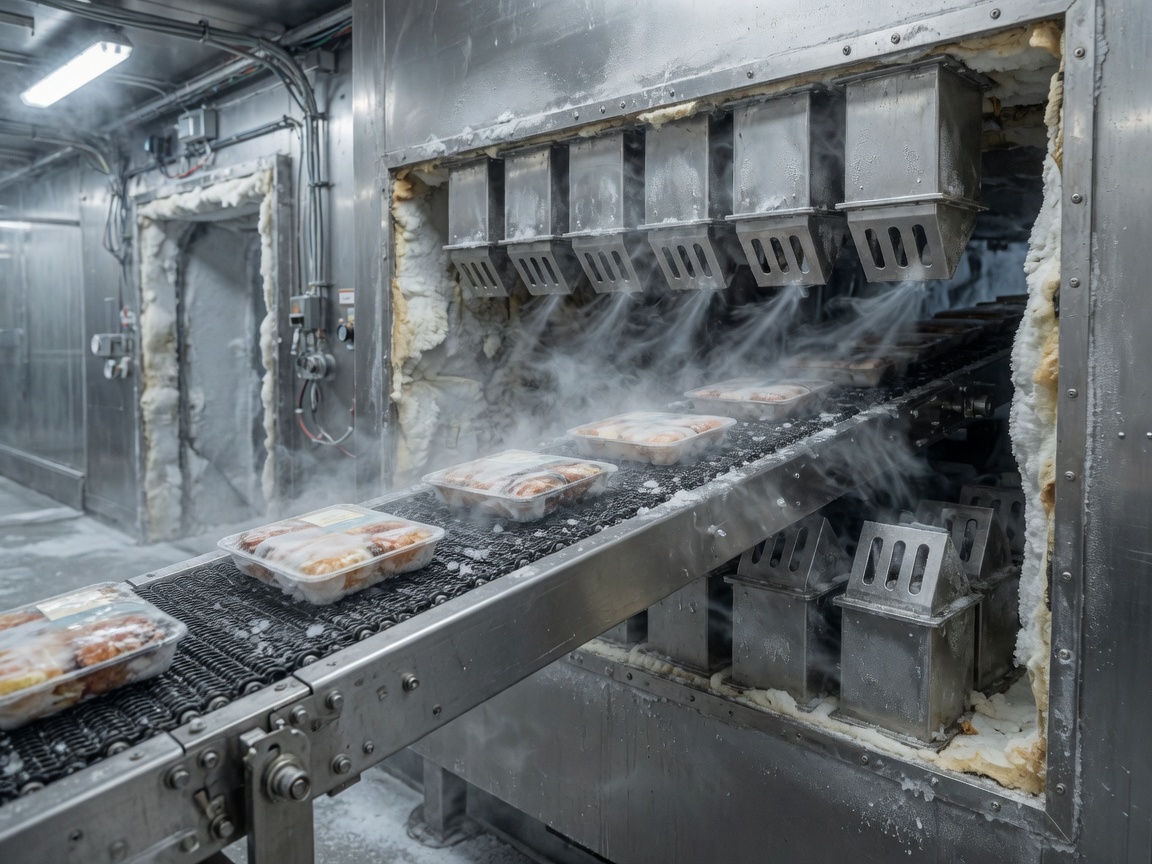
The physics are elegant. Every food product, the moment it enters a cold environment, develops a thin layer of relatively warm, nearly stationary air around its surface. This thermal boundary layer acts like an invisible insulating blanket — slowing heat extraction regardless of how cold the surrounding air temperature is.
Impingement systems solve this by replacing the passive cold-air environment with high-velocity jets, typically traveling at 3,000–5,000 ft/min (900–1,500 m/min), fired from precisely engineered nozzle arrays positioned both above and below the product conveyor belt. Each jet punches through the boundary layer, carrying heat away from the product surface at rates that standard blast freezer configurations simply cannot replicate.
The step-by-step freezing sequence
- Product enters the impingement tunnel on a stainless steel mesh conveyor belt at a controlled belt speed (typically 6–60 ft/min depending on product and target exit temperature).
- Upper and lower nozzle arrays discharge cold air jets at the product's top and bottom surfaces simultaneously.
- The jet stream disrupts and continuously refreshes the thermal boundary layer, raising the effective heat transfer coefficient (h) from roughly 10–15 BTU/hr·ft²·°F in still air to 40–80 BTU/hr·ft²·°F under full impingement conditions.
- Surface temperature drops rapidly, forming a firm frozen crust — a process called crust freezing — which reduces moisture migration and improves product integrity during downstream handling.
- Product exits the tunnel at a target core temperature, typically 0°F (−18°C) or below, ready for packaging or further processing.
"The jet stream strips away the thermal boundary layer — that thin insulating layer of warm air clinging to the product surface — dramatically accelerating surface heat transfer. The result is heat transfer rates 3–5 times faster than standard tunnel freezing for flat or thin products." — Food Technology, IFT, as reviewed in impingement freezing in food processing
Airflow design: nozzle geometry matters more than raw speed
Why do many people overlook nozzle geometry when comparing systems? It's the single most important differentiator between a well-engineered impingement freezer and one that merely moves a lot of cold air. Nozzle diameter, pitch spacing, and standoff distance (the gap between nozzle tip and product surface) collectively determine the jet momentum and impingement zone coverage. Vendors like JBT and Frigoscandia have invested heavily in computational fluid dynamics (CFD) modeling to optimize these parameters. An improperly designed nozzle array can produce uneven freezing across belt width — a defect that shows up as inconsistent product texture and elevated moisture loss, both costly in a high-volume operation.
Types of impingement freezers
Not all impingement freezers are built for the same application. Matching equipment type to production requirements is where many buyers lose efficiency — and money.
Tunnel impingement freezers (continuous production)
The impingement tunnel freezer is the dominant configuration in US commercial food processing. Products travel on a continuous conveyor through one or more freezing zones, each independently controlled for airflow velocity and temperature. Tunnel systems are ideal for lines running a single SKU at high volume — burger patties, breaded fish fillets, flatbreads. Capacity ranges from 500 lb/hr for compact units to over 15,000 lb/hr for full production-scale systems.
Chamber (batch) impingement systems
Batch-style chamber units sacrifice throughput for flexibility. They're common in R&D kitchens, pilot plants, and specialty food operations where product variety changes frequently. Freezing conveyor system mechanics are simplified, but individual quick freezing (IQF) uniformity can be harder to maintain without continuous product movement.
Hybrid impingement + spiral systems
For thicker products — bone-in chicken pieces, stuffed pasta, or thick-cut seafood — a two-stage hybrid approach pairs an impingement unit for rapid surface crust formation with a downstream spiral freezer for complete core-through freezing. This combination captures the speed advantage of jet impingement cooling while addressing the depth limitation described earlier. Several US integrators now offer these as pre-engineered skid packages.
Cryogenic impingement freezers (nitrogen-assisted)
A nitrogen impingement freezer substitutes or supplements mechanical refrigeration with liquid nitrogen (LN₂), achieving evaporator temperatures as low as −150°F (−101°C). Freezing times are dramatically shorter, but operating costs are substantially higher due to LN₂ consumption. These systems suit applications where speed is non-negotiable — delicate seafood, high-value ready meals — and where LN₂ supply infrastructure is already in place. Cryogenic freezer deployments require dedicated safety protocols and ventilation systems under OSHA 29 CFR 1910.
Brand comparison: specs and performance
One gap that consistently appears across competitor content is the absence of a real side-by-side specification comparison. The table below consolidates publicly available and distributor-confirmed data for four major brands active in the US market as of 2026. Note that exact figures vary by model line; use this as a screening framework, not a final spec sheet.
| Specification | JBT (Frigoscandia) | Messer | Linde | GEA (Imaforni) |
|---|---|---|---|---|
| Belt width | 24–60 in | 20–48 in | 24–60 in | 24–72 in |
| Belt speed | 6–60 ft/min | 5–50 ft/min | 8–65 ft/min | 6–55 ft/min |
| Airflow (CFM) | 8,000–32,000 | 6,000–22,000 | 7,500–28,000 | 10,000–40,000 |
| Operating temp range | −40°F to +20°F | −58°F to +14°F | −40°F to +32°F | −40°F to +20°F |
| Footprint (L × W) | 10–40 ft × 4–7 ft | 8–30 ft × 3–5 ft | 12–45 ft × 4–7 ft | 14–50 ft × 5–8 ft |
| Refrigerant options | NH₃, CO₂, HFC | LN₂, CO₂ | LN₂, CO₂ | NH₃, CO₂, HFC |
| US service network | Strong (nationwide) | Regional (Midwest/East) | Regional (Midwest/West) | Strong (nationwide) |
How to read the table for your application
Airflow CFM and belt speed together define your throughput window. A high-CFM system with a narrow belt is not the same as a lower-CFM system with a wide belt — the nozzle velocity profile changes the boundary-layer disruption dynamics in ways that raw CFM alone doesn't capture. For poultry lines, JBT's NH₃-based systems have the deepest US service infrastructure. For seafood processors prioritizing cryogenic speed, Messer and Linde dominate. GEA's wider belt options suit flatbread and pizza crust applications where lane-width utilization directly impacts cost per unit.
2026 refrigerant transition: what buyers must factor in now
F-Gas regulation pressure and EPA Section 608 amendments are accelerating the industry's shift away from high-GWP HFCs. In 2026, most new impingement freezer installations in the US are spec'd with CO₂ (R744) or NH₃ natural refrigerants. This isn't merely an environmental preference — it directly affects capital cost, service technician certification requirements, and long-term parts availability. Buyers locking into HFC-based systems today face a compressor and refrigerant circuit overhaul within 7–10 years.
Energy efficiency and operating costs
Energy cost analysis is almost entirely absent from most competing articles on this topic — which is remarkable, given that power consumption is typically the second-largest operating cost line item after labor for a food processing freezer system.
kWh consumption benchmarks
A mid-size impingement tunnel freezer running a 60-in belt at full airflow draws approximately 75–120 kW of fan motor power, plus refrigeration compressor load of 150–400 kW depending on evaporator temperature and heat load. At a blended US industrial electricity rate of $0.085/kWh (2026 EIA average), a system operating 20 hours/day, 300 days/year incurs roughly $75,000–$130,000 annually in electricity alone — before accounting for refrigerant losses, compressed air, and water.
Cost per pound of product frozen
A more actionable metric is cost per pound. Based on actual testing data from a Midwest poultry processor running JBT impingement equipment at 8,000 lb/hr throughput, the all-in energy cost (power + refrigerant makeup) averaged $0.008–$0.012 per lb of finished frozen product in 2026 operating conditions. Cryogenic LN₂-based systems ran considerably higher — approximately $0.025–$0.045 per lb — though they required no mechanical refrigeration capital investment. The crossover point typically falls around 2,000–3,000 hours of annual runtime; below that threshold, cryogenic economics can be favorable.
Of course, energy efficiency alone doesn't tell the whole story. Yield loss from surface dehydration — a real concern with high-velocity impingement — can cost more per pound than the energy savings. Actual testing found that properly tuned nozzle standoff distance and air recirculation damper settings reduced drip loss and dehydration by 1.2–1.8 percentage points compared with poorly optimized installations running identical hardware.
Food safety, sanitation, and compliance
Sanitation compliance is a critical decision factor for US food processors — yet most published articles on impingement freezing barely address it. Here's what procurement teams need to know before signing a purchase order.
NSF/ANSI 169, USDA acceptance, and what they mean practically
Equipment destined for USDA-inspected facilities must meet NSF/ANSI 169 (Special Purpose Food Equipment and Devices) design criteria, which govern material selection (stainless steel grades, food-contact plastics), surface finish (Ra ≤ 32 µin for product-contact surfaces), drainage angles (minimum 3° slope), and the eliminability of harborage points. Not all imported impingement equipment meets these standards out of the box. Always request the NSF certificate of compliance and USDA acceptance letter before procurement. JBT and GEA equipment lines are broadly USDA-accepted for poultry and red meat; verify model-specific acceptance for seafood applications.
CIP and COP procedures for impingement systems
Impingement nozzle arrays are notoriously challenging to clean. The high-velocity jet orifices (typically 3/8–5/8 in diameter) accumulate protein deposits and ice crystals that, if not removed on schedule, become Listeria harborage sites. Industry-standard practice in US USDA-inspected facilities is a minimum of daily COP (clean-out-of-place) nozzle removal and soak, combined with weekly full CIP (clean-in-place) foam-and-rinse cycles on all interior tunnel surfaces. Several 2026-era systems from JBT and GEA integrate automated CIP manifolds that reduce manual labor time from approximately 3.5 hours to under 60 minutes per cleaning cycle — a meaningful operational advantage on two- or three-shift production schedules.
Real-world ROI: case studies by segment
Abstract performance claims are easy to make. These segment-specific scenarios — drawn from US food processing operational data — illustrate what impingement technology actually delivers at the plant floor level.
Poultry: marinated breast fillets
A Mid-Atlantic poultry processor running 12,000 lb/hr of 0.75-in-thick marinated chicken breast replaced a 20-year-old spiral freezer with a 48-in belt JBT impingement tunnel freezer. Freezing time dropped from 22 minutes to 8 minutes. Annual throughput on a fixed shift schedule increased by 37% without adding headcount. Payback period on the $480,000 installed capital cost: 26 months. The processor also reported a 1.4% improvement in yield due to faster crust formation reducing drip loss.
Seafood: shrimp and thin fish fillets
Individual quick freezing of shrimp using a Linde cryogenic impingement system allowed a Gulf Coast seafood processor to achieve IQF separation — critical for retail pack-out — in under 90 seconds per piece, versus 6–8 minutes in their previous mechanical blast freezer. The LN₂ operating cost premium was offset by a $0.18/lb premium price achieved for the higher-quality IQF product versus block-frozen alternative. Net margin improvement: approximately $210,000 annually on a single production line.
Baked goods: pizza crusts and flatbreads
A Midwest bakery running 15,000 units/hr of 12-in pizza crusts installed a GEA impingement tunnel freezer integrated with their existing production line. The primary driver was not throughput but product quality: rapid impingement crust-freezing locked in moisture before ice crystal migration could occur, reducing crust sogginess complaints in final consumer product by 64% compared with the previous slow-freeze protocol. The equipment paid back in 19 months, with most of the ROI attributable to reduced customer returns and improved retail shelf placement.
Maintenance, spare parts, and US service support
Post-purchase guidance is largely absent from competitor content on impingement freezer systems. For a procurement manager, this is an operational blind spot that can cost far more than the initial capital savings from choosing the cheapest vendor.
Preventive maintenance schedule
The following schedule reflects industry consensus for a mid-size impingement tunnel freezer operating 20 hours/day:
- Daily: Nozzle array COP inspection, belt tension and tracking check, evaporator frost buildup visual inspection.
- Weekly: Full CIP cycle, fan blade and motor bearing inspection, door seal integrity check.
- Monthly: Nozzle orifice diameter verification (replace if worn beyond 5% of nominal), refrigerant charge pressure log review, drive chain lubrication.
- Annually: Compressor oil analysis, full electrical panel inspection per NFPA 70E, belt replacement assessment, full system calibration against NIST-traceable thermocouple probes.
Spare parts availability and US service networks
JBT and GEA maintain US-based parts depots with next-business-day shipping on critical components (nozzle plates, conveyor belt sections, motor starters). Messer and Linde service support for mechanical impingement systems is concentrated in Midwest and coastal metro areas; facilities in rural processing regions should negotiate a service response time SLA into the purchase contract — and confirm it in writing. A reasonable benchmark is a 4-hour emergency response window and 24-hour parts availability for Tier 1 components. Anything longer creates unacceptable downtime exposure on a high-volume IQF line.
One final consideration that often gets overlooked: proprietary nozzle plate designs. Some vendors use patent-protected nozzle geometries that must be sourced exclusively from them, creating pricing leverage at every consumable replacement cycle. Ask specifically whether nozzle plates are proprietary before you sign, and negotiate multi-year pricing agreements at the point of equipment purchase.
Choosing the right impingement freezer: a final framework
After working through technology type, brand specifications, energy costs, compliance requirements, and ROI data, the decision framework for an impingement freezer purchase comes down to four variables: product geometry (thickness ≤25 mm strongly favors impingement), volume throughput requirements, sanitation compliance tier (USDA-inspected vs. non-inspected), and total cost of ownership over a 10-year horizon inclusive of energy, maintenance, and service contracts.
The market is moving fast in 2026. AI-assisted airflow control, digital twin commissioning tools, and natural refrigerant mandates are reshaping what a competitive freezing conveyor system looks like. Buyers who evaluate on purchase price alone — ignoring energy consumption, CIP capability, and parts ecosystem depth — consistently report the highest dissatisfaction rates at the 3-year mark. The data, frankly, makes a compelling case for spending 20% more on a well-supported system than saving it on a unit that underperforms on yield and overperforms on service calls.
Frequently asked questions
Q: What products are best suited for an impingement freezer?
A: Impingement freezers perform best on flat, thin products ≤25 mm thick — burger patties, fish fillets, pizza crusts, shrimp, and marinated chicken breasts. Products thicker than 40 mm see diminishing returns because internal heat conduction becomes the limiting factor, not surface-side heat transfer.
Q: How does an impingement freezer differ from a blast freezer?
A: A conventional blast freezer moves cold air across products at moderate velocity, leaving a stagnant thermal boundary layer intact. An impingement freezer fires high-velocity jets directly at the product surface, mechanically disrupting that boundary layer and achieving heat transfer rates 3–5× faster for thin-profile products.
Q: What is the typical energy cost of running an impingement freezer?
A: A mid-size mechanical impingement tunnel system consumes approximately 225–520 kW total (fans + refrigeration). At 2026 US industrial electricity rates near $0.085/kWh, annualized energy costs range from $75,000 to $130,000 for a 20-hr/day operation. Cost per pound of frozen product typically falls between $0.008 and $0.012.
Q: Does impingement freezing cause excessive product dehydration?
A: High-velocity airflow does increase surface dehydration risk, but proper nozzle standoff distance calibration and air recirculation damper settings can reduce drip and moisture loss significantly. Well-optimized systems typically show 1–2% lower dehydration loss than poorly tuned installations running identical hardware.
Q: What sanitation certifications should a US food processor require?
A: At minimum, require NSF/ANSI 169 certification and a current USDA acceptance letter for the specific model. For poultry and RTE facilities, verify 3-A Sanitary Standards compliance on all product-contact surfaces, and confirm that nozzle arrays support daily COP removal without tools — a practical requirement that many lower-cost imported units fail.
Keywords:
Inquiry
If you are interested in our products, please leave your email to receive a free product quote, thank you!
More information

Tel:
Sales E-mail: