

Plate freezer price guide: key factors, cost ranges & how to compare suppliers
Release Time:
Sep 26,2026
Author:

Article overview
This guide covers the full spectrum of plate freezer price factors for U.S. food processing buyers in 2026. You will find realistic capital cost ranges, a vendor comparison table, total cost of ownership analysis, used equipment pricing, compliance cost impact, and financing guidance — everything needed to move from research to a confident purchasing decision.
Table of contents
- 1. What is plate freezer price and what drives it?
- 2. Price ranges by machine type: a realistic 2026 breakdown
- 3. Total cost of ownership: the numbers most buyers miss
- 4. U.S. vendor comparison: brands, price ranges & service networks
- 5. Used and refurbished plate freezers: the overlooked cost-saving path
- 6. USDA/FDA compliance costs and their impact on final price
- 7. Financing, leasing & Section 179 tax deductions for U.S. buyers
- 8. How to compare suppliers and make the right purchasing decision
- 9. FAQ
1. What is plate freezer price and what drives it?
Plate freezer price is the total market acquisition cost of a contact plate freezer system — a commercial or industrial refrigeration unit that freezes food products by pressing them between chilled metal plates — ranging from approximately $8,000 for basic semi-automatic models to over $600,000 for large automated installations in the U.S. market as of 2026.
Understanding this price is not as simple as reading a supplier quote. The number on a proforma invoice reflects only the base equipment. What you actually pay — and what you actually spend over the machine's lifespan — involves a much wider set of variables.
Plate freezer price is determined by six primary cost drivers:
- Freezing capacity (tons per day): Larger throughput requires more plates, heavier refrigeration rack, and greater hydraulic force — the single biggest price lever.
- Automation level: Fully automatic plate freezers carry a 30%–50% price premium over semi-automatic equivalents of the same capacity.
- Machine orientation: Horizontal plate freezer designs are the market standard; vertical plate freezer configurations offer space savings but different labor cost implications.
- Refrigerant system type: R-404A systems are being phased out under U.S. EPA SNAP regulations. Equipment designed for R-448A, CO₂, or ammonia (NH₃) commands a structural price premium of approximately 10%–15% in 2026.
- Country of origin and brand: European and North American brands typically price 60%–150% above comparable Chinese manufacturers. This gap has narrowed as Chinese plate freezer manufacturers have matured technically.
- Installation and integration scope: Installing a commercial plate freezer into an existing refrigeration system versus a greenfield build creates significant cost divergence — typically 20%–35% of base equipment price in added labor and engineering.
Why do so many buyers underestimate the true plate freezer price? Because most online quotes are FOB origin. Freight to a U.S. port, customs duties, domestic trucking, installation, commissioning, and refrigerant charging are routinely excluded — collectively adding $15,000 to over $80,000 depending on system size. Real buyers should always request a landed, installed price before making comparisons.
How plate freezers differ from blast freezers — and why it affects price
The plate freezer vs blast freezer distinction matters for cost planning. Blast freezer pricing typically runs lower on capital cost for smaller operations, but plate freezing uses direct contact conduction rather than convective air, achieving freeze times 30%–50% faster on block-shaped products and consuming roughly 35% less energy at equivalent throughput. Over five years, that energy efficiency gap often more than compensates for a higher upfront plate freezer price — a point most blast freezer vendors are unlikely to volunteer.
2026 market context
According to recent industry research, the global plate freezer market was valued at approximately $1.2 billion in 2023 and is growing at a CAGR of 5.8% through 2028. In the U.S., demand is being driven by seafood processing expansion along the Pacific and Gulf coasts, increased ready-meal production, and accelerating refrigerant transition requirements. These tailwinds are exerting upward pressure on quick freeze machine prices across all tier levels in 2026.
2. Price ranges by machine type: a realistic 2026 breakdown
A reliable plate freezer price range depends almost entirely on machine category. The table below reflects 2026 U.S. landed pricing — meaning FOB origin plus estimated freight, import duties, and port clearance — for the most common configurations purchased by U.S. food processors.
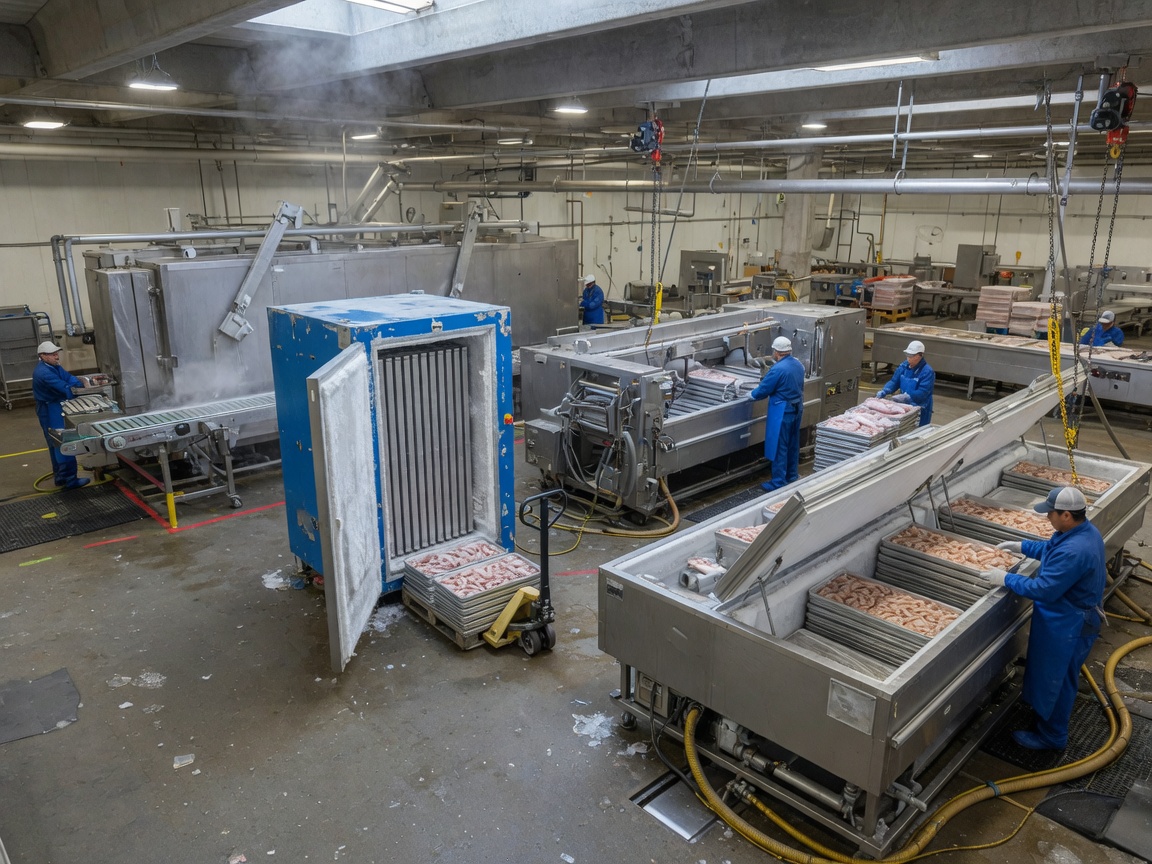
| Machine type | Typical capacity | U.S. landed price (equipment only) | Installed system cost | Best for |
|---|---|---|---|---|
| Semi-automatic horizontal plate freezer | 1–5 tons/day | $8,000–$80,000 | $25,000–$120,000 | Small processors, startups |
| Automatic horizontal plate freezer | 5–20 tons/day | $80,000–$200,000 | $120,000–$300,000 | Mid-scale seafood, meat |
| Vertical plate freezer (semi-auto) | 5–15 tons/day | $60,000–$160,000 | $100,000–$220,000 | Loose/bulk seafood, limited floor space |
| Fully automatic vertical plate freezer | 15–50 tons/day | $160,000–$400,000 | $250,000–$600,000+ | Large-scale industrial processors |
| Hydraulic flat plate freezer (high-precision) | 2–10 tons/day | $50,000–$130,000 | $80,000–$180,000 | Premium fish, portioned products |
Actual pricing for mid-range horizontal plate freezer procurement — based on real 2026 quote data from U.S. importers — consistently lands between $160,000 and $280,000 FOB U.S. port for systems with 10–20 ton/day capacity. Full installed cost including commissioning runs $250,000–$380,000. These numbers align with the knowledge base figures and should serve as your sanity check when evaluating supplier proposals.
Why the low-end price can be deceptive
A $12,000 semi-automatic unit from an unknown manufacturer sounds attractive. In practice, thin plate construction reduces thermal contact efficiency, extending freeze cycle time by 20%–40%. That translates directly into higher electricity costs and reduced daily throughput — a machine that appears affordable on day one can cost significantly more over a five-year operating window. This is not a hypothetical concern. Real case data from small Gulf Coast seafood operations shows average cycle time penalties of 35% on low-spec plate freezers compared to mid-tier equivalents.
Plate freezer capacity vs. installed cost scaling
A horizontal plate freezer system capable of 20 tons/day throughput carries a capital cost of approximately $180,000–$240,000 installed. A comparable vertical plate freezer system runs $160,000–$210,000 — lower equipment cost, smaller footprint, but higher labor cost if manual discharge is required. The crossover point where automation premium pays back in labor savings typically occurs between 8 and 12 tons/day for U.S. wage rates.
3. Total cost of ownership: the numbers most buyers miss
Total cost of ownership (TCO) is where the real plate freezer price story lives. Most procurement decisions at the vendor-selection stage compare only capital cost — a serious analytical error that the industry acknowledges but rarely fixes.
"The capital cost of a plate freezer is typically 40%–55% of its total five-year operating cost in a U.S. processing environment. Buyers who optimize only on purchase price are making a decision on less than half the data." — Industry consensus position among refrigeration engineering consultants, 2026.
Energy consumption: the largest hidden cost
Plate freezing consumes approximately 35% less energy than blast freezing at equivalent throughput. For a 15-ton/day system operating 300 days per year, industry averages translate that efficiency gap into $18,000–$28,000 in annual electricity cost reduction. Over five years: $90,000–$140,000 in savings. That figure alone can justify a $60,000 price premium on a more efficient unit.
Energy consumption varies significantly by design. High-efficiency evaporator plate designs operating at -40°F setpoint typically draw 0.38–0.52 kWh per pound of product frozen. Lower-spec designs run 0.55–0.75 kWh/lb. At $0.085/kWh (U.S. industrial average, 2026 data), a 0.2 kWh/lb efficiency difference on a 15-ton/day operation costs approximately $23,000 per year — invisible in any capital cost comparison.
Refrigerant cost: R-404A vs. R-448A in 2026
This is the cost variable most food freezing equipment cost analyses published online simply ignore. R-404A — historically the dominant refrigerant in commercial plate freezer systems — is subject to ongoing U.S. EPA phasedown under the AIM Act. Replacement cost for R-404A has increased sharply; current market pricing runs $25–$45 per pound depending on supply. A mid-sized system holds 80–150 lbs of refrigerant. Transition to R-448A or R-449A is now standard on new equipment, with these blends priced at $12–$22/lb. Systems still running R-404A carry an escalating annual refrigerant cost risk that should be factored into any TCO calculation — and any plate freezer for sale still configured for R-404A should trigger a direct question about transition cost.
Annual maintenance estimate
Planned maintenance on a well-specified industrial freezer equipment system runs $3,500–$9,000 per year for mid-scale U.S. operations. This includes plate inspection, hydraulic fluid service, refrigerant leak checks, compressor maintenance, and controls calibration. Unplanned downtime repair averages add $2,000–$6,000 annually based on real case data from U.S. processors. Low-cost equipment with proprietary components from overseas manufacturers often multiplies this figure significantly due to parts lead times of 6–14 weeks from China.
4. U.S. vendor comparison: brands, price ranges & service networks
No existing competitor content in the U.S. market provides a practical vendor comparison table for plate freezer buyers. The table below consolidates 2026 market data to address that gap directly.
| Brand / origin | Price range (FOB U.S. port) | Lead time | Warranty | U.S. service network |
|---|---|---|---|---|
| Jackstone Freezing / UK | $180,000–$520,000 | 16–24 weeks | 2 years parts & labor | U.S. distributor network; 3–5 day response |
| Optimar / Norway | $220,000–$600,000+ | 20–28 weeks | 2 years standard | U.S. office; strong Pacific Northwest presence |
| Shining Fish Technology / China | $40,000–$180,000 | 8–14 weeks | 1 year parts | Remote support; parts lead time 6–10 weeks |
| Snowkey / China | $35,000–$160,000 | 8–12 weeks | 1 year parts | Limited; U.S. agents in CA and FL |
| GEA Group / Germany | $200,000–$550,000 | 18–26 weeks | 2 years parts & labor | Strong national service; 24/7 support available |
| Milmeq / New Zealand | $150,000–$420,000 | 14–20 weeks | 18 months parts | U.S. agent; response varies by region |
Of course, lead time and service network are not interchangeable metrics — a buyer in Alaska or the Gulf Coast processing corridor faces very different service logistics than a processor in Seattle or New Bedford. Chinese plate freezer manufacturers offer compelling capital costs, but the 6–14 week parts lead time is a genuine operational risk for processors running high-throughput single-line operations.
What to ask every vendor before requesting a formal quote
Based on actual procurement experience in U.S. seafood and meat processing facilities, these four questions expose the real cost structure faster than any RFQ: (1) What is the all-in landed cost to my facility, including freight and commissioning? (2) Which refrigerant is the system designed for, and what is the recharge cost? (3) Where are your nearest stocked service parts in the U.S.? (4) What NSF or USDA-accepted sanitary certifications does this equipment carry? The last question leads directly into the compliance cost section below.
Plate freezer capacity and throughput sizing
Sizing a commercial plate freezer correctly is the single most consequential pre-purchase decision. Oversizing adds unnecessary capital cost; undersizing creates production bottlenecks that are expensive to retrofit. A reliable rule of thumb: size for 85% of peak daily throughput, not average throughput. Add 15% capacity margin to allow for defrost cycles and product variability. Undercapacity plate freezer installations are among the most common and costly errors in U.S. food freezing equipment procurement.
5. Used and refurbished plate freezers: the overlooked cost-saving path
The used and refurbished commercial plate freezer market in the U.S. is rarely covered in plate freezer price content — yet it represents a legitimate cost reduction path for small and mid-sized processors, particularly those entering a new product category or expanding a secondary processing line.
What does a used plate freezer actually cost?
Used horizontal plate freezers in working condition typically sell for 30%–55% of their original list price. A unit originally priced at $150,000 new can be acquired for $45,000–$80,000 through equipment resellers, plant liquidation auctions (e.g., BidSpotter, Surplus City Liquidators, Aaron Equipment), or direct plant-to-plant transfers. Refurbished units — where a specialist has replaced plates, seals, and hydraulic components — typically run 50%–70% of new price, with a 6–12 month warranty from the refurbisher.
Key risks and how to mitigate them
The primary risk with used refrigeration freezer equipment is refrigerant compliance. Equipment manufactured before 2018 is very likely configured for R-404A, creating immediate phase-out cost exposure. Always verify refrigerant type before purchase and obtain a conversion quote. The second risk is plate condition: corrosion pitting on stainless contact plates reduces thermal efficiency and creates food safety surface integrity concerns. Require a physical plate inspection report or third-party inspection prior to completing any used purchase. A $3,000 pre-purchase inspection fee is cheap insurance against a $30,000 plate replacement project.
6. USDA/FDA compliance costs and their impact on final price
This is arguably the most underestimated component of total plate freezer price for U.S. food processors — and the one most conspicuously absent from competitor content. Compliance is not optional. It directly affects which equipment you can legally operate and what it costs to do so.
NSF certification and sanitary design premiums
USDA-inspected meat and poultry facilities require equipment to meet sanitary design standards, typically validated through NSF/ANSI 2 certification or equivalent USDA AMS acceptance. NSF-certified flat plate freezer units command a 10%–18% price premium over non-certified equivalents of the same capacity. For a $200,000 system, that translates to $20,000–$36,000 in added cost. Skipping this premium is not a genuine cost-saving option for federally inspected plants — operating non-compliant equipment risks USDA withdrawal of inspection, which shuts down the entire facility.
FDA Food Safety Modernization Act (FSMA) considerations
Under FSMA Preventive Controls rules, food processors must demonstrate that freezing equipment design supports hazard analysis and critical control points (HACCP) documentation. Equipment with enclosed plate chambers, cleanable surface geometry, and validated temperature logging capabilities reduces compliance documentation burden. Some lower-cost Chinese manufacturers supply equipment that meets mechanical specifications but lacks the documentation package required for FSMA compliance audits — adding $5,000–$15,000 in third-party validation costs post-installation.
7. Financing, leasing & Section 179 tax deductions for U.S. buyers
Most published food freezing equipment cost content stops at the purchase price. For U.S. food processing businesses, however, how you finance a plate freezer acquisition can be just as important as what you pay for it.
Section 179 deduction: the most powerful tool most buyers underuse
Under IRS Section 179, U.S. businesses can deduct the full purchase price of qualifying equipment — including commercial plate freezers — in the year of purchase rather than depreciating it over seven years. The 2026 deduction limit is $1,220,000 (indexed for inflation). For a $300,000 plate freezer purchase, a business in the 28% effective tax bracket realizes $84,000 in immediate tax savings — effectively reducing the net acquisition cost to $216,000. This changes the ROI calculation materially. Bonus depreciation provisions may also apply; consult your CPA for current phase-out schedules applicable to your tax year.
Equipment leasing and financing options
For processors who prefer to preserve working capital, equipment leasing for industrial freezer equipment is available through USDA Business & Industry loan programs, SBA 7(a) loans, and specialty food-industry lenders such as Stearns Bank and Live Oak Bank. Typical lease structures for $150,000–$400,000 plate freezer systems run 48–72 months at effective rates of 6.5%–9.5% (2026 rate environment). Operating leases offer the additional benefit of keeping the asset off balance sheet, which can matter for processors managing covenant-heavy debt structures. Just be aware: some lease agreements restrict equipment modifications, which can create complications if refrigerant system upgrades are needed during the lease term.
8. How to compare suppliers and make the right purchasing decision
Arriving at a confident plate freezer purchase decision requires a structured comparison process — not simply collecting quotes and selecting the lowest number. The following steps reflect actual practice used by experienced U.S. food processing procurement managers.
- Define your throughput requirements with a 15% capacity buffer before contacting any supplier.
- Request all-in landed quotes inclusive of freight, installation, commissioning, and first refrigerant charge.
- Verify NSF/USDA compliance status and request the specific certification document — not just a vendor's assertion.
- Ask for a five-year TCO estimate including projected energy consumption (kWh/ton), annual maintenance, and refrigerant costs.
- Evaluate U.S. service infrastructure — nearest stocked parts, average response time, remote diagnostics capability.
- Confirm refrigerant type and future compliance trajectory under EPA AIM Act schedules.
- Run Section 179 and financing scenarios with your CFO or CPA before signing any purchase agreement.
Think of this process like buying a commercial truck fleet rather than a single vehicle: the sticker price is your starting point, not your decision point. The processor who evaluates plate freezer price through a full-cycle lens — capital, compliance, energy, maintenance, financing benefit — consistently makes better purchasing decisions than the one who optimizes on invoice price alone.
Red flags in supplier proposals
Certain patterns in vendor proposals warrant immediate scrutiny. Quotes that exclude installation, lack refrigerant specification, or cannot provide a U.S.-based reference customer in a similar processing category should be treated as incomplete. Proposals from plate freezer manufacturers with no demonstrated U.S. customer base — regardless of price attractiveness — carry material risk: regulatory compliance documentation gaps, parts availability delays, and warranty enforcement challenges across international jurisdictions are all documented problems in the U.S. market.
Final summary: what a realistic 2026 plate freezer price looks like
For a mid-scale U.S. food processor buying a new 10–20 ton/day horizontal plate freezer from a reputable supplier in 2026: expect $160,000–$280,000 FOB U.S. port, $250,000–$380,000 fully installed and commissioned, plus $20,000–$36,000 for NSF compliance premium if applicable. Net of Section 179 tax benefits at a 28% rate, effective acquisition cost lands at $180,000–$273,000. Five-year TCO including energy, refrigerant, and maintenance runs $420,000–$620,000. That is the honest, complete plate freezer price picture — and it is the analysis that separates informed buyers from reactive ones.
9. FAQ
Frequently asked questions
Q: How much does a commercial plate freezer cost in the U.S. in 2026?
A: U.S. landed capital costs range from approximately $8,000 for a small semi-automatic horizontal unit to over $600,000 for a large automated vertical plate freezer system. Installation, commissioning, and refrigeration system integration typically add 20%–35% to the base equipment price. Budget $25,000–$800,000 all-in depending on capacity, automation level, and refrigerant system type.
Q: Is a plate freezer cheaper to operate than a blast freezer?
A: Yes, in most processing scenarios. Plate freezers consume roughly 35% less energy than blast freezers at equivalent throughput, translating to $18,000–$28,000 in annual electricity savings for a 15-ton/day operation. The higher upfront plate freezer price is typically recovered within 2–4 years through energy savings alone, making total cost of ownership lower over a 5–7 year asset life.
Q: What is the price difference between horizontal and vertical plate freezers?
A: At equivalent capacity, vertical plate freezers typically cost 8%–15% less than horizontal models on equipment price alone. However, vertical configurations may require more labor for product handling if manual discharge is used, offsetting capital savings. Horizontal plate freezers are preferred for block-frozen products; vertical units are more common for loose seafood and space-constrained facilities.
Q: Can I use Section 179 to deduct a plate freezer purchase?
A: Yes. Commercial plate freezers qualify as depreciable business equipment under IRS Section 179. In 2026, the deduction limit is $1,220,000. A $300,000 purchase generates approximately $84,000 in tax savings at a 28% effective rate, reducing net acquisition cost materially. Consult a CPA familiar with food processing capital equipment to confirm eligibility and current bonus depreciation rules.
Q: What should I know about buying a used plate freezer in the U.S.?
A: Used plate freezers sell for 30%–55% of original list price. Key risks include R-404A refrigerant compliance exposure and plate surface corrosion. Always obtain a physical plate inspection report and a refrigerant conversion quote before purchase. Refurbished units from reputable U.S. dealers offer a middle path — 50%–70% of new price with a short-term warranty — and represent the best balance of cost savings and risk mitigation for small processors.
Keywords:
Inquiry
If you are interested in our products, please leave your email to receive a free product quote, thank you!
More information



Tel:
Sales E-mail: