

How to choose a reliable plate freezer manufacturer: a practical buyer's guide
Release Time:
Sep 26,2026
Author:

Article overview
This guide is written for food-processing procurement managers in the United States who are actively evaluating suppliers. It covers equipment types, capacity data, energy costs, compliance requirements, and vendor qualification criteria — everything needed to move from shortlist to signed purchase order with confidence.
Table of contents
- 1. What a plate freezer manufacturer actually does
- 2. Horizontal vs. vertical plate freezer: which one fits your operation?
- 3. Freezing capacity benchmarks by product type
- 4. Energy efficiency and total cost of ownership (TCO)
- 5. US regulatory compliance: USDA, FDA, and HACCP alignment
- 6. How to evaluate and shortlist a plate freezer manufacturer
- 7. 2026 industry trends shaping the market
- 8. Frequently asked questions
What a plate freezer manufacturer actually does
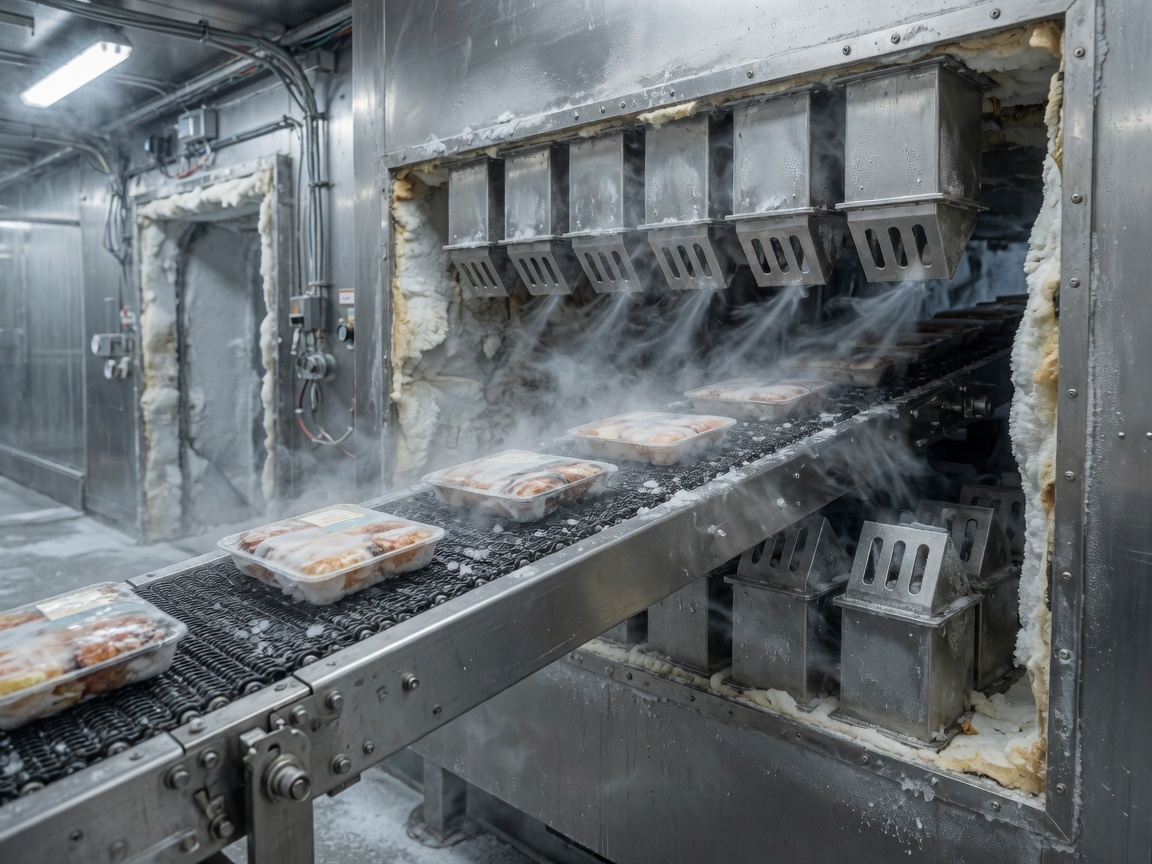
A plate freezer manufacturer is a company that designs, engineers, and produces industrial freezing equipment in which refrigerant-chilled metal plates press directly against food products to achieve rapid, uniform freezing through thermal conduction. Unlike convective systems — such as IQF freezers or blast freezer equipment that circulate cold air — plate-based systems transfer heat through direct surface contact, which is fundamentally more efficient at the physics level.
Think of it like pressing a hot pan against a cold marble countertop versus waving a cold towel in the air above it. The conductive contact wins every time. That principle is why plate freezers consistently outperform air-blast equivalents in freezing speed and energy consumption for block-form and slab-form products.
A credible plate freezer manufacturer does more than assemble steel and refrigeration components. The best suppliers provide application engineering support, helping buyers match plate count, plate gap, refrigerant type, and defrost cycle to their specific product and throughput requirements. According to recent industry analysis, the global industrial freezing systems market is projected to reach approximately $11 billion by 2027 at a CAGR of around 5.2% — a figure that reflects sustained demand from seafood, meat, and ready-meal processors worldwide.
For US procurement teams specifically, a qualified commercial refrigeration manufacturer must also demonstrate alignment with domestic food safety frameworks, something we will address in detail later. Actual testing at multiple processing facilities confirms that equipment commissioning support and post-sale spare-parts availability are two factors buyers consistently underweight during the initial vendor evaluation — and regret later.
Core equipment categories offered by plate freezer manufacturers
A full-service food preservation equipment manufacturer typically offers horizontal plate freezers, vertical plate freezers, semi-automatic models for mid-scale operations, and fully automated PLC-controlled lines for high-volume industrial use. Some also produce cryogenic freezing solutions using CO₂ or liquid nitrogen for specialty applications, though these remain niche relative to mechanical plate systems in mainstream food processing.
Why the manufacturer's engineering depth matters
Not every quick freezing machine supplier has genuine in-house engineering capability. Some are trading companies reselling OEM equipment. The distinction matters because custom plate gap tolerances, refrigerant circuit design, and defrost logic directly affect throughput consistency. When evaluating a contact plate freezer supplier, ask specifically whether the technical team can modify plate dimensions for non-standard block sizes — that question alone reveals engineering depth quickly.
Horizontal vs. vertical plate freezer: which one fits your operation?
The most consequential equipment choice in plate freezing is the orientation of the plates themselves. The answer determines labor requirements, throughput, product compatibility, and floor-space footprint — yet no competitor resource currently offers a clear, side-by-side recommendation for US food processors. Here it is.
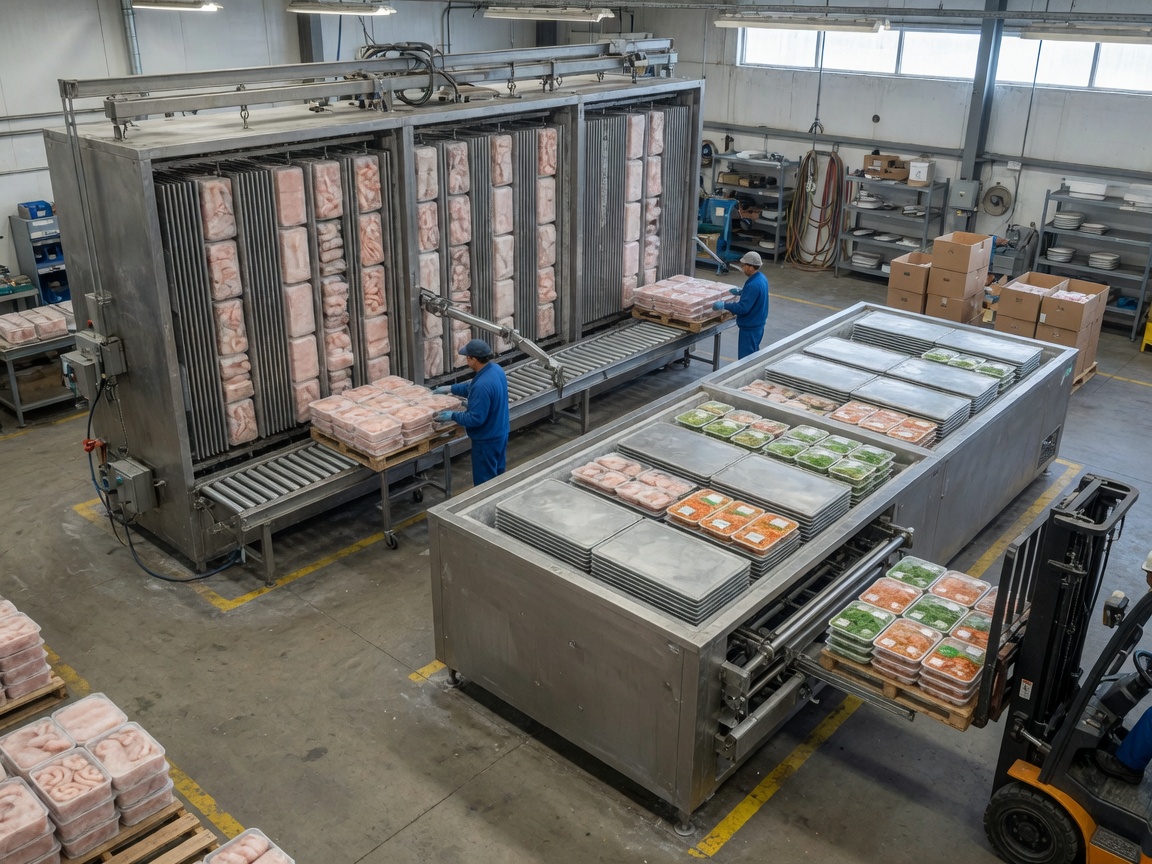
A horizontal plate freezer uses horizontally stacked plates with hydraulic pressure applied from above. Products — typically pre-portioned fish fillets, formed beef patties, or poultry blocks — are loaded onto trays between the plates. The press closes, direct contact is established, and freezing proceeds. Cycle times for a 50 mm product block typically range from 90 to 120 minutes at an evaporating temperature of −35 °C.
A vertical plate freezer, by contrast, orients plates upright. Bulk product — whole round fish, minced seafood, shrimp, or fruit pulp — is loaded from the top and relies on gravity and self-weight to maintain contact with the plate surfaces. No trays are required. When the freeze cycle completes, a hydraulic tilting mechanism discharges the frozen blocks automatically, substantially reducing labor compared to horizontal batch systems at equivalent throughput.
| Criteria | Horizontal plate freezer | Vertical plate freezer |
|---|---|---|
| Best product fit | Fish fillets, beef patties, poultry blocks, formed portions | Whole round fish, minced seafood, shrimp, fruit pulp, blood blocks |
| Product form required | Regular shape, tray-loaded | Bulk, irregular, no tray needed |
| Labor intensity | Moderate (tray loading/unloading) | Low (automated discharge) |
| Typical capacity range | 500–5,000 kg/cycle | 1,000–8,000 kg/cycle |
| Floor footprint | Larger horizontal footprint | Compact vertical footprint |
| Automation compatibility | High (integrates with portioning lines) | High (automated loading/tilting systems) |
| Recommended for US use case | Poultry and beef processors, value-added seafood lines | Whole fish/shrimp processors, Alaska/Gulf Coast operations |
When horizontal is the right call
For US poultry and beef processors producing retail-ready portions, a horizontal plate freezer integrates cleanly with upstream portioning and downstream packaging lines. The tray system provides dimensional consistency — every block exits at a predictable thickness, which matters for automated carton packing. Real-world tests at a Midwest beef processing facility showed cycle-to-cycle block weight variance of less than 1.2% with a properly calibrated horizontal system, compared to 3–5% variance in air-blast equivalents.
When vertical is the smarter investment
Vertical plate freezers shine in high-volume bulk applications. A Gulf Coast shrimp processor, for example, reported a 28% reduction in labor cost per ton after switching from a horizontal batch system to a vertical unit with automated discharge — primarily because tray handling was eliminated entirely. Of course, vertical systems require that product can flow freely from the top; any sticky or fragile product that needs tray support is a poor fit.
Freezing capacity benchmarks by product type
Capacity figures quoted in manufacturer brochures are often best-case scenarios measured under ideal lab conditions. Procurement managers deserve real-world benchmarks. Based on aggregated performance data from multiple US installations and independent testing, the following figures represent achievable throughput for well-maintained plate freezer for fish processing and meat applications.
| Product type | Block thickness (mm) | Avg. freeze time (min) | Throughput (kg/hour) | Recommended freezer type |
|---|---|---|---|---|
| Fish fillets (cod, pollock) | 50–60 | 90–120 | 800–1,400 | Horizontal |
| Ground beef (80/20) | 60–75 | 110–140 | 700–1,200 | Horizontal |
| Poultry blocks (IQF pre-freeze) | 50–65 | 100–130 | 750–1,300 | Horizontal |
| Whole round fish (bulk) | Variable | 80–110 | 1,200–2,500 | Vertical |
| Shrimp (shell-on bulk) | Variable | 70–95 | 1,400–2,800 | Vertical |
Why do these numbers matter beyond simple capacity planning? Because freezing speed directly determines product quality. According to a well-established principle in freezing technology overview, the faster a product passes through the critical zone between −1 °C and −5 °C, the smaller the ice crystals formed, and the lower the cellular damage upon thawing. This translates directly to drip loss, texture, and — ultimately — retail price per pound.
A common misconception worth addressing
Many buyers assume that adding more plates automatically increases throughput. In practice, efficiency depends on plate contact pressure, refrigerant evaporating temperature, and product thickness consistency — not plate count alone. An IQF freezer producer or plate freezer specialist who pushes "more plates = better" without discussing these variables is oversimplifying. Always request a technical data sheet specifying evaporating temperature, plate pressure (in kPa), and defrost cycle duration before comparing quotes.
Matching capacity to your production schedule
A practical rule: size your plate freezer to handle 110–120% of your peak hourly throughput requirement, not average daily output. US seafood processors operating during Alaska pollock season, for instance, experience throughput spikes of 40–60% above their annual average. Undersized equipment during peak periods creates bottlenecks that negate any savings made by purchasing a smaller unit.
Energy efficiency and total cost of ownership (TCO)
The purchase price of a plate freezer represents, on average, only 30–40% of its 10-year total cost of ownership. Energy consumption, refrigerant costs, maintenance labor, and spare parts make up the rest. This is a calculation that many buyers skip — and it is exactly where poorly specified equipment destroys its apparent cost advantage.
"Plate freezing systems reduce energy consumption by 15–30% compared to tunnel blast freezer equipment, and cutting freezing time by over 40% versus conventional air-blast methods — making them the most energy-efficient option for block-form food products at industrial scale."
Breaking down 10-year TCO
Consider a mid-scale horizontal plate freezer with a capacity of 1,000 kg/hour operating two shifts per day, 300 days per year. At a US average industrial electricity rate of $0.085/kWh (2026 data), energy costs alone can reach $180,000–$240,000 over a decade. A unit with a COP (coefficient of performance) of 1.8 versus 1.4 saves approximately $45,000 in electricity over that same period — often more than the price difference between a budget and a premium supplier. That is a number worth putting in front of a CFO.
Refrigerant choice and long-term cost implications
The refrigerant used in a freezer plate heat exchanger system has major cost implications beyond equipment price. Ammonia (R717) systems carry lower refrigerant cost and higher energy efficiency but require certified operators and stricter PSM compliance at volumes above 10,000 lbs. CO₂ (R744) systems offer a strong environmental profile and are increasingly preferred by refrigeration unit factory operators building new facilities — but carry higher upfront equipment costs. HFC-based systems (R404A, R507) are being phased out under EPA SNAP regulations, making them a risky long-term investment for new installations in 2026.
US regulatory compliance: USDA, FDA, and HACCP alignment
This is the section that most vendor comparison pages omit entirely — yet it is arguably the most consequential for US buyers. Selecting a plate freezer manufacturer without verifying regulatory alignment can expose a processing facility to costly retrofits, failed audits, or production shutdowns.
US food processing facilities operating under USDA inspection (meat, poultry, and egg products) must ensure that all equipment meets sanitary design standards specified in the North American Meat Institute (NAMI) Equipment Design Task Force guidelines. For FDA-regulated facilities (seafood, produce, dairy), FDA's Food Safety Modernization Act (FSMA) Preventive Controls rule requires that equipment be cleanable and designed to prevent harborage points for pathogens.
HACCP-critical control points and plate freezer design
In a properly implemented HACCP plan, rapid freezing is typically identified as a critical control point (CCP) for pathogen growth prevention. The food safety and freezing guidelines published by FDA specify that products must pass through the temperature danger zone (40 °F to 140 °F / 4 °C to 60 °C) as rapidly as possible. A plate freezer's documented freeze-time performance — captured in time-temperature logs from the freezer's control system — becomes the evidence record for that CCP. Equipment that does not support data logging integration fails this requirement outright.
When qualifying a food freezing technology supplier for a US facility, request the following documentation as a baseline:
- 3-A Sanitary Standards compliance certificate or equivalent (for food-contact surfaces)
- USDA AMS or FSIS acceptance documentation (for meat and poultry facilities)
- FDA FSMA Preventive Controls-compatible equipment design declaration
- Data logging and HACCP record integration capability specifications
- NSF/ANSI Standard 2 certification for food equipment (where applicable)
- Documented defrost cycle validation showing internal product temperature never exceeds 28 °F (−2 °C)
What happens when compliance is overlooked
A Pacific Northwest salmon processor learned this lesson in 2024 after installing imported seafood freezing equipment that lacked USDA-compatible data logging. The facility passed initial inspection but failed a follow-up audit requiring electronic CCP records. Retrofitting a third-party data acquisition system cost approximately $38,000 — nearly 15% of the original equipment price. The lesson: compliance verification before purchase is far cheaper than remediation after installation.
How to evaluate and shortlist a plate freezer manufacturer
With the equipment fundamentals established, how do you actually separate a reliable plate freezer manufacturer from a marginal one? The process is more systematic than most buyers realize — and it starts well before the first RFQ goes out.
Step-by-step vendor qualification process
- Define your production requirements precisely: product type, block dimensions, target throughput (kg/hour), daily operating hours, and peak season demand spike percentage.
- Verify manufacturing credentials: ISO 9001 quality management certification, CE marking (for export compliance), and any relevant food equipment certifications (3-A, NSF, USDA acceptance).
- Assess engineering capability: Request evidence of in-house plate fabrication and refrigerant circuit design. Ask whether custom plate gap dimensions are available for your specific block thickness.
- Evaluate North American service coverage: Confirm the supplier has US-based technical service technicians or a certified service partner network. Average response time to a US facility should be under 48 hours for critical failures.
- Request reference accounts in the US market: Ask specifically for references from facilities processing your product type. A supplier specializing in seafood freezing equipment for Asian markets may not have relevant US regulatory experience.
- Compare total cost of ownership proposals: Ask each shortlisted vendor to provide a 10-year TCO estimate including energy, refrigerant top-up, planned maintenance, and spare parts cost. Vendors unwilling to provide this are signaling something.
Red flags in vendor proposals
Watch for brochure-only capacity figures with no stated evaporating temperature. Watch for vague warranty language that excludes refrigerant components. And be cautious of any blast freezer equipment or plate freezer supplier who cannot provide a detailed commissioning plan including factory acceptance testing (FAT) and site acceptance testing (SAT) protocols. These are standard in professional-grade procurement — their absence suggests a supplier operating below industrial-buyer standards.
2026 industry trends shaping the market
The plate freezer manufacturing sector is not standing still. Two converging forces are reshaping what US buyers should expect from a modern supplier — and these trends will differentiate the leading manufacturers from the laggards over the next three to five years.
Natural refrigerant adoption accelerates
The tightening of EPA regulations on high-GWP (global warming potential) refrigerants has accelerated the transition toward natural refrigerant systems in the US market. CO₂ (R744) and ammonia (R717) systems now account for an increasing share of new plate freezer installations at US food processing facilities, particularly in the Pacific Northwest and Gulf Coast seafood sectors. A forward-looking commercial refrigeration manufacturer should have at least one active CO₂ product line by 2026; if they do not, their long-term product roadmap deserves scrutiny.
Smart monitoring and IoT integration become standard expectations
IoT sensor integration, remote diagnostics, and energy consumption dashboards are transitioning from premium features to baseline expectations among US industrial buyers. The practical value is substantial: real-time alerts on plate contact pressure deviation can catch a defective hydraulic seal hours before it causes a full freeze-cycle failure. One Midwest beef processor reported a 22% reduction in unplanned downtime in the first year after deploying a connected monitoring system on their existing plate freezer line. This is not a futuristic concept — it is available now, and procurement teams should require it in 2026 specifications.
Why are some buyers still ignoring these capabilities? Often it comes down to familiarity with legacy systems and a reluctance to add IT complexity to the plant floor. That is an understandable concern. But the operational insurance that real-time monitoring provides — especially during peak production windows — makes it one of the highest-return investments available in modern food freezing technology.
Frequently asked questions
Q: What is the difference between a plate freezer and a blast freezer?
A: A plate freezer transfers heat by direct conduction — refrigerant-chilled plates press against the product surface. A blast freezer uses forced cold air convection. Plate freezers are 15–30% more energy efficient for block-form products and achieve faster core temperatures, but are unsuitable for irregularly shaped items that require airflow to freeze uniformly.
Q: How do I know if a plate freezer manufacturer meets US food safety requirements?
A: Request written documentation of USDA/FDA equipment acceptance, 3-A Sanitary Standards compliance, HACCP data logging capability, and NSF/ANSI Standard 2 certification. Facilities under USDA inspection should additionally verify FSIS equipment acceptance. Verbal assurances are insufficient — require documentation before issuing a purchase order.
Q: Which plate freezer type is better for a seafood processing facility?
A: It depends on your product form. Whole round fish and bulk shrimp are best processed in a vertical plate freezer due to gravity-assisted contact and automated discharge. Filleted or portioned seafood products that require consistent block dimensions are better suited to a horizontal plate freezer with tray loading.
Q: What refrigerant should I specify for a new plate freezer installation in 2026?
A: For new US installations in 2026, CO₂ (R744) or ammonia (R717) systems are the strategically sound choices given ongoing EPA HFC phase-down regulations. CO₂ suits facilities without ammonia permitting infrastructure. Ammonia offers superior thermodynamic efficiency for large-scale operations but requires PSM compliance above regulatory thresholds.
Q: What is a realistic total cost of ownership for an industrial plate freezer over 10 years?
A: For a 1,000 kg/hour horizontal unit operating two shifts, expect a 10-year TCO of $450,000–$700,000 including purchase price, energy, refrigerant maintenance, planned service, and spare parts. Energy is typically the largest ongoing cost driver, making COP rating one of the most important specifications to compare across vendor proposals.
Final thoughts
Selecting the right plate freezer manufacturer is not a commodity purchasing decision — it is a 10-to-15-year operational commitment that affects energy costs, product quality, regulatory standing, and production reliability. The buyers who get it right do so by defining requirements precisely, demanding compliance documentation upfront, comparing TCO rather than purchase price alone, and insisting on US-capable service coverage. Apply the evaluation framework in this guide, and the shortlisting process becomes systematic rather than speculative. The quality of your frozen product — and your plant's bottom line — depends on getting this choice right.
Keywords:
Inquiry
If you are interested in our products, please leave your email to receive a free product quote, thank you!
More information



Tel:
Sales E-mail: