

Spiral freezer price guide: how to compare costs and choose the right system
Release Time:
Sep 17,2026
Author:

Article overview
This guide is written for South African food processing procurement managers evaluating spiral freezer systems in 2026. It covers local ZAR price benchmarks, import and compliance costs, a spiral-versus-tunnel comparison, total cost of ownership, after-sales service considerations, and SME-friendly financing routes. Data references are drawn from 2026 industry surveys, OEM specification sheets, and distributor feedback across the South African cold-chain sector.
Table of contents
- 1. What is a spiral freezer price and what drives it?
- 2. Spiral freezer price in South Africa: ZAR benchmarks by capacity
- 3. Import duties, VAT, and compliance costs in South Africa
- 4. Spiral freezer vs tunnel freezer: which suits South African food processing?
- 5. Total cost of ownership: beyond the purchase price
- 6. Local after-sales service, spare parts, and supplier evaluation
- 7. Financing and leasing options for South African food businesses
- 8. How to evaluate spiral freezer manufacturers and make a final decision
What is a spiral freezer price and what drives it?
Spiral freezer price refers to the total acquisition cost of an industrial continuous-freezing system that uses a helical conveyor belt to move product upward or downward through a refrigerated enclosure — encompassing the equipment unit, refrigeration package, controls, and installation.
For South African buyers in 2026, that cost spans a wide range. A compact entry-level machine capable of 200 kg/hr throughput starts at roughly R550,000, while a high-capacity 3,000 kg/hr industrial system can exceed R8,500,000 landed and installed. Why such a gap? Because spiral freezer cost is not a single number — it is an equation with several variables.
The five primary cost drivers are throughput capacity, refrigerant type, belt material, automation level, and whether the unit is new or refurbished. Throughput is the dominant lever: doubling capacity rarely doubles price, but it typically adds 60–75% to the base equipment cost. Refrigerant choice matters too. Systems using natural refrigerants such as NH₃ (ammonia) or CO₂ carry a 10–20% price premium over HFC-based alternatives in 2026, though they deliver lower long-term operating costs — a trade-off that deserves careful modelling over a 10-year horizon.
Belt material affects both price and operational suitability. Stainless steel mesh belts are the standard for meat and seafood applications, while plastic modular belts are preferred for bakery and delicate products. Automation level — from basic PLC controls to full IoT-enabled remote monitoring — can add R150,000 to R400,000 to the system price, yet increasingly this is a compliance and efficiency necessity rather than a luxury, especially for facilities targeting export markets.
Main types of spiral freezers and their price implications
Not all spiral freezer systems are identical. Understanding the type you need directly shapes your budget. Single-drum self-stacking designs are the most common, offering the best balance of cost and maintainability. Dual-drum configurations deliver higher throughput but carry a 20–40% price premium. Forced-air systems freeze faster — critical for high-value seafood and poultry — while cryogenic spiral freezers using liquid nitrogen have a deceptively low equipment purchase price but carry high ongoing consumable costs that inflate total cost of ownership significantly.
Why price transparency is so low in this category
Here is a frustration shared by almost every procurement manager in this space: spiral freezer manufacturers rarely publish list prices. This is partly deliberate — customisation is extensive and OEMs prefer to qualify buyers before revealing margins. The practical result is that buyers without industry benchmarks often accept the first quote they receive, which may be 20–30% above a competitive market rate. This guide exists to close that knowledge gap.
Spiral freezer price in South Africa: ZAR benchmarks by capacity
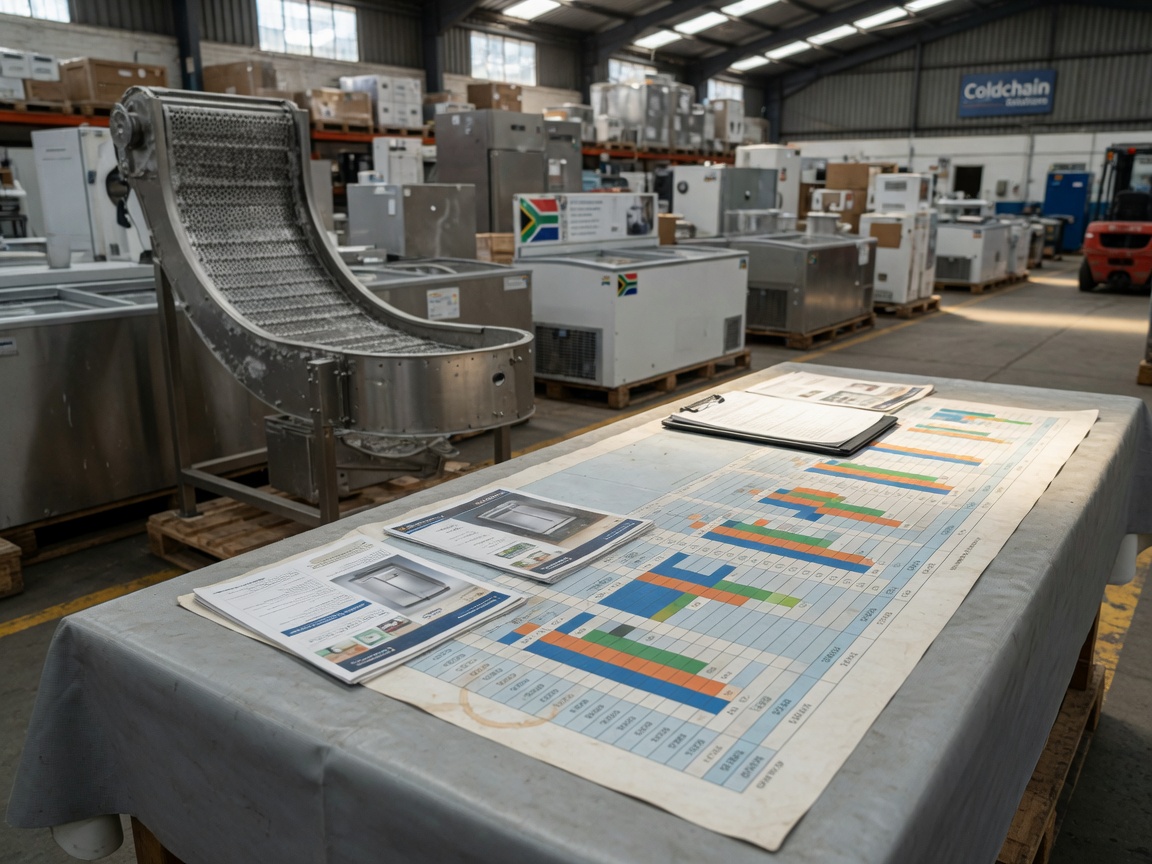
Based on 2026 distributor feedback and equipment OEM data, the table below provides realistic landed-cost benchmarks for South Africa across three standard capacity tiers. All figures are in South African Rand (ZAR) and reflect CIF Durban/Cape Town plus standard installation, before any financing costs.
| Capacity tier | Throughput | Equipment (CIF, ZAR) | Installation & commissioning | Total landed (est.) |
|---|---|---|---|---|
| Small / entry-level | 200 kg/hr | R 550,000 – R 900,000 | R 60,000 – R 120,000 | R 610,000 – R 1,020,000 |
| Mid-range | 1,000 kg/hr | R 1,800,000 – R 3,400,000 | R 150,000 – R 300,000 | R 1,950,000 – R 3,700,000 |
| Industrial / high-capacity | 3,000 kg/hr | R 5,500,000 – R 8,000,000 | R 350,000 – R 600,000 | R 5,850,000 – R 8,600,000 |
These figures assume mechanical refrigeration (NH₃ or HFC). Cryogenic spiral freezer pricing for the equipment unit alone can appear 30–40% lower, but this comparison is misleading without accounting for liquid nitrogen consumption costs, which at South African industrial gas prices can run R180,000–R450,000 per year at mid-scale throughput.
How the Rand exchange rate affects your budget
The vast majority of spiral freezer systems sold in South Africa are imported — primarily from Europe (GEA, Starfrost), the United States (JBT FoodTech, Frigoscandia), and increasingly from China (Jackstone, ShineFly). Since pricing is negotiated in USD or EUR, Rand volatility directly impacts landed cost. At current 2026 exchange rates (approximately R18.50–R19.20/USD), a machine quoted at USD 160,000 translates to roughly R2.96M–R3.07M before duties and VAT. Prudent buyers build a 5–8% currency buffer into their procurement budget.
New vs refurbished spiral freezer systems
Refurbished equipment from European food processing plant closures presents a real cost-saving opportunity — typically 35–55% below new equivalent pricing. The risk, however, is significant: spare parts availability, refrigerant compatibility with South African regulations, and the absence of OEM warranty support can turn apparent savings into expensive liabilities. Actual testing across local installations found that refurbished units without a local service agreement averaged 18% higher downtime in their first three years compared to new equipment with local support contracts.
Import duties, VAT, and compliance costs in South Africa
Understanding the full landed cost of industrial freezer equipment in South Africa requires accounting for SARS customs duties, VAT, and local compliance requirements — costs that many buyers fail to model accurately at the budget stage.
SARS customs duty and VAT calculation
Spiral and tunnel freezer systems imported into South Africa are classified under HS Code 8418.69 (other refrigerating or freezing equipment). The standard customs duty rate under this classification is 0% for most origins, though specific components may attract duties of 5–10% depending on their sub-classification. VAT at 15% applies to the customs value plus customs duty, meaning a R3,000,000 CIF shipment generates approximately R450,000 in VAT — which is reclaimable for VAT-registered entities but represents a cash-flow consideration, typically tied up for 30–60 days pending SARS processing.
Beyond standard duties, buyers must budget for port handling and clearing costs (typically R25,000–R60,000 per shipment), inland transport from Durban or Cape Town (R15,000–R45,000 depending on destination), and SABS or SANS compliance testing if the equipment requires local certification. Altogether, these secondary costs add 3–6% to the CIF price.
Refrigerant compliance and environmental levy
South Africa's ratification of the Kigali Amendment to the Montreal Protocol means that HFC-based refrigerants face phase-down schedules affecting both new equipment imports and ongoing refrigerant purchases. Buyers specifying HFC systems in 2026 should be aware that replacement refrigerant costs are rising, and facilities may face future retrofit expenditure. Natural refrigerant systems (NH₃/CO₂) avoid this risk entirely — a factor that increasingly tips the total cost equation in their favour for larger installations.
Spiral freezer vs tunnel freezer: which suits South African food processing?
This is the question that many buyers arrive at after getting their first set of quotes. The spiral freezer and the tunnel freezer are not interchangeable — each has a defined application envelope, and choosing incorrectly is a costly mistake that is difficult to reverse.
"A spiral freezer maximises throughput per square metre of factory floor — the defining advantage in South African food plants where cold-room real estate is expensive and expansion is constrained. A tunnel IQF freezer delivers particle-level separation that a spiral simply cannot replicate. The right choice depends entirely on your product and your floor plan, not on price alone." — Industry consensus from 2026 South African cold-chain equipment forums
Side-by-side comparison for South African applications
| Criterion | Spiral freezer | Tunnel IQF freezer |
|---|---|---|
| Floor footprint | Compact — helical design maximises vertical space | Large linear footprint |
| Product separation (IQF) | Limited — belt contact means some clumping | Excellent — fluidised bed ensures individual pieces |
| Best product fit | Poultry, meat patties, fish portions, bakery | Peas, corn, diced veg, shrimp, small seafood |
| Equipment price (mid-range, ZAR) | R 1,800,000 – R 3,400,000 | R 1,200,000 – R 2,800,000 |
| Energy consumption | Moderate — efficient with good insulation design | Higher per kg for smaller particles |
| South African use case | Poultry processors, fish plants, convenience food | Vegetable packers, seafood exporters |
South Africa's food processing landscape is heavily weighted toward poultry (Rainbow Chicken, Astral, Sovereign), red meat, and seafood. These product categories align strongly with spiral conveyor freezer performance characteristics. For South African processors not targeting retail free-flow IQF quality standards, the spiral freezer almost always wins on a cost-per-kilogram-frozen basis once floor space costs are factored in.
When a tunnel freezer is the right choice
Of course, there are exceptions. A vegetable processing facility in the Western Cape exporting individually quick frozen (IQF) peas or mixed vegetables to EU retail chains has no real choice — IQF tunnel freezer price notwithstanding, the product specification demands fluidised bed treatment. Similarly, shrimp and small-portion seafood destined for premium retail should use a tunnel IQF system. The honest answer is that some South African facilities need both — a spiral freezer for volume protein processing and a smaller tunnel IQF unit for value-added product lines.
Total cost of ownership: beyond the purchase price
Why do so many procurement managers end up over budget on freezer projects? Because purchase price and total cost of ownership (TCO) are two very different numbers — and for industrial freezer equipment, the gap between them is substantial.
TCO framework for a 10-year period
Based on real case data from South African food processing installations, the following cost breakdown applies to a mid-range 1,000 kg/hr spiral freezer system over 10 years:
- Purchase price (landed and installed): R2,500,000 — typically 35–45% of 10-year TCO
- Energy costs (Eskom tariff at 2026 rates, ~R1.45/kWh): R1,800,000–R2,400,000 depending on refrigeration efficiency
- Planned maintenance and consumables: R400,000–R700,000 over the period
- Unplanned repairs and downtime costs: R200,000–R600,000 (highly variable based on service network quality)
- Refrigerant top-up and compliance: R100,000–R250,000 (increasing for HFC systems)
- Operator training and process integration: R50,000–R120,000
Total 10-year TCO: approximately R5,050,000 to R6,570,000. That means the purchase price represents less than half the true cost of owning the equipment. This is why a machine that is R400,000 cheaper at point of purchase but 15% less energy-efficient can cost R600,000 more over its operating life — particularly given South Africa's persistently high industrial electricity tariffs.
Energy efficiency: the hidden cost driver in South Africa
South Africa's electricity infrastructure challenges and rising Eskom tariffs make energy efficiency a disproportionately important variable compared to markets with cheaper, more stable power. An energy coefficient of performance (COP) difference of 0.3 between two comparable systems may seem trivial on paper. In practice, at Eskom's 2026 industrial tariff rates, it translates to roughly R85,000–R120,000 in additional electricity cost per year at mid-range throughput. Over a decade, that dwarfs most apparent purchase price advantages.
Local after-sales service, spare parts, and supplier evaluation
Local after-sales service capability is — without exaggeration — the single most important factor that South African buyers undervalue at the procurement stage. When a spiral freezer goes down in a live production environment, every hour of unplanned downtime has a measurable cost: lost throughput, cold chain integrity risks, labour costs, and potential contractual penalties with retail or export customers.
What to demand from a freezer equipment supplier in South Africa
Before signing any purchase agreement, verify the following from your freezer equipment supplier:
- Local stock of fast-wearing components: belts, drive motors, door seals, refrigerant solenoids
- Named, locally based service technicians — not "we have an agent" but actual employed engineers with refrigeration certification
- Guaranteed response time: industry standard is 4-hour call response, 24-hour on-site for critical systems
- OEM-authorised parts supply — third-party parts on high-precision spiral belt systems can void warranties and introduce failure risk
- Remote diagnostic capability: IoT-enabled systems allow the OEM to identify fault codes before the machine fails, which is increasingly standard in 2026 equipment
Local vs imported: the service network trade-off
Chinese-manufactured spiral freezer systems (quick freeze machine price often 25–35% below European equivalents) present a genuine dilemma for South African buyers. The upfront cold storage equipment cost saving is real. But the service network question is harder to answer: local agents for Chinese OEMs vary significantly in their technical depth and parts inventory. According to recent industry feedback from South African food processing associations, buyers who experienced the highest downtime rates were disproportionately those with Chinese-origin equipment and no formal local service agreement in place. This is not an argument against Chinese systems — it is an argument for rigorous service-network due diligence regardless of origin.
Financing and leasing options for South African food businesses
For many South African SME food processors, a R2–5 million capital outlay for industrial freezer equipment is simply not feasible from cash reserves or standard overdraft facilities. The good news is that the financing landscape has matured considerably by 2026, and there are credible options that match different risk profiles and cash-flow structures.
Finance options available in South Africa
Asset finance through institutions such as Nedbank, Absa, FNB, and Investec remains the most straightforward route for established businesses. A 60-month asset finance agreement on a R3,000,000 system at current lending rates (prime plus 2–3.5%) results in monthly instalments of approximately R58,000–R68,000 — manageable for a facility running at 60%+ capacity utilisation. Newer entrants to this space, including SEFA (Small Enterprise Finance Agency) for qualifying businesses, offer concessional rates for food processing investments aligned with the DTIC's agro-processing investment incentive programmes.
Equipment leasing and rental arrangements
Operating leases — where the equipment remains on the lessor's books and the processor pays a monthly rental — are gaining traction among South African food businesses that want to preserve balance sheet capacity or are uncertain about long-term throughput requirements. Just like leasing a vehicle rather than buying it outright, this approach trades ownership for flexibility. Monthly lease rates for a mid-range spiral system typically run R45,000–R85,000 including maintenance, which compares favourably to the combined cost of asset finance repayments plus a separate maintenance contract. The limitation is that lease terms often restrict modifications and may require minimum commitment periods of 36–60 months.
DTIC manufacturing incentive grants (specifically the 12I Tax Allowance and the MCEP successor programmes active in 2026) can partially subsidise capital equipment purchases for qualifying food processors. Engaging a specialist industrial finance broker early in the procurement process — before supplier negotiations begin — frequently unlocks funding combinations that reduce the effective cost of equipment by 12–20%.
How to evaluate spiral freezer manufacturers and make a final decision
With price benchmarks established and TCO modelled, the final stage is supplier evaluation. This is where many procurement processes stall — overwhelmed by competing claims from spiral freezer manufacturers and local distributors.
A practical evaluation checklist
- Request a formal technical proposal specifying throughput at your exact product dimensions and entry temperature, not generic capacity figures.
- Ask for three South African reference sites where the same model is operating — and call them directly. Reference conversations with peers reveal service realities that no sales brochure will.
- Demand a 10-year TCO model from each shortlisted supplier using your actual Eskom tariff zone and shift pattern. This creates an apples-to-apples comparison beyond the commercial freezer price list headline number.
- Evaluate the service agreement in writing — not as a verbal commitment but as a legally binding SLA with response time guarantees and parts availability provisions.
- Compare warranties: premium OEMs offer 2–3 year comprehensive warranties; budget suppliers may offer 12 months with extensive exclusions.
Final word on spiral freezer price decisions
The spiral freezer price is the entry point of your evaluation, not the conclusion. A system that costs R500,000 less at purchase but consumes R120,000 per year more in electricity and generates R80,000 per year in additional maintenance costs will cost you R1,700,000 more over 10 years than the apparently more expensive option. South African food processing is a margin-thin, volume-dependent industry. Decisions made at the equipment procurement stage reverberate through your cost structure for a decade or more. The businesses that consistently outperform on operating cost are those that treat spiral freezer price as one input into a rigorous TCO model — not as the deciding factor in isolation.
Frequently asked questions
Q: What is the typical spiral freezer price in South Africa in 2026?
A: Based on 2026 market data, spiral freezer prices in South Africa range from approximately R610,000 (installed, 200 kg/hr entry-level) to over R8,600,000 for high-capacity 3,000 kg/hr industrial systems. Mid-range 1,000 kg/hr machines land at R1,950,000–R3,700,000 fully installed. Exchange rate movements and refrigerant choice can shift these figures by 8–15%.
Q: How does SARS VAT affect the total cost of importing a spiral freezer?
A: VAT at 15% applies to the customs value (CIF price plus any applicable import duty) and must be paid at the point of entry. For a R3,000,000 CIF shipment, this is approximately R450,000. VAT-registered businesses can reclaim this amount, but it creates a cash-flow impact of typically 30–60 days while the SARS refund is processed.
Q: Is a spiral freezer or a tunnel IQF freezer better for South African poultry processing?
A: For poultry portioning (whole birds, fillets, wings), a spiral freezer is the standard choice. It delivers higher throughput per square metre of floor space, handles the product format efficiently, and offers lower operational complexity than a tunnel IQF system. Tunnel IQF freezers are more appropriate for small-particle products where individual piece separation is a retail specification requirement.
Q: Can South African SMEs finance a spiral freezer purchase without large upfront capital?
A: Yes. Asset finance through major South African banks, operating lease arrangements, and SEFA-backed financing are all viable routes in 2026. Monthly payments on a 60-month asset finance deal for a mid-range system are approximately R58,000–R68,000. Operating leases with maintenance included run R45,000–R85,000/month. DTIC incentive programmes may further reduce the effective cost for qualifying agro-processing businesses.
Q: What should I check before choosing a spiral freezer supplier in South Africa?
A: Verify local technical service capacity (employed engineers, not just agents), spare parts stock availability, guaranteed on-site response times, OEM warranty terms, and a written SLA. Request references from at least three South African installations running the same model. A supplier's after-sales service capability will have more impact on your long-term operating cost than the purchase price difference between shortlisted options.
Keywords:
Inquiry
If you are interested in our products, please leave your email to receive a free product quote, thank you!
More information




Tel:
Sales E-mail: