

Spiral freezer buyer's guide: how to choose the right system for your production line
Release Time:
Sep 17,2026
Author:

Article overview
This buyer's guide examines spiral freezer technology in depth — from equipment classification and technical specs to energy costs and South African supplier selection. Procurement managers at food processing facilities will find actionable comparison data, a step-by-step evaluation framework, and answers to the most common questions asked during the equipment sourcing process.
Table of contents
- 1. What is a spiral freezer?
- 2. Types of spiral freezers explained
- 3. Technical specification comparison
- 4. Energy efficiency and operating costs
- 5. Hygienic design and food safety compliance
- 6. How to evaluate and select a supplier in South Africa
- 7. 2026 trends shaping spiral freezer procurement
- 8. Frequently asked questions
What is a spiral freezer?
A spiral freezer is an industrial continuous freezing system in which a helical conveyor belt winds upward inside a vertical insulated enclosure, using forced cold air circulation to rapidly and uniformly freeze food products at temperatures typically between −30 °C and −40 °C. It belongs to the broader family of food processing equipment and is considered the most space-efficient solution for high-volume, uninterrupted production lines.
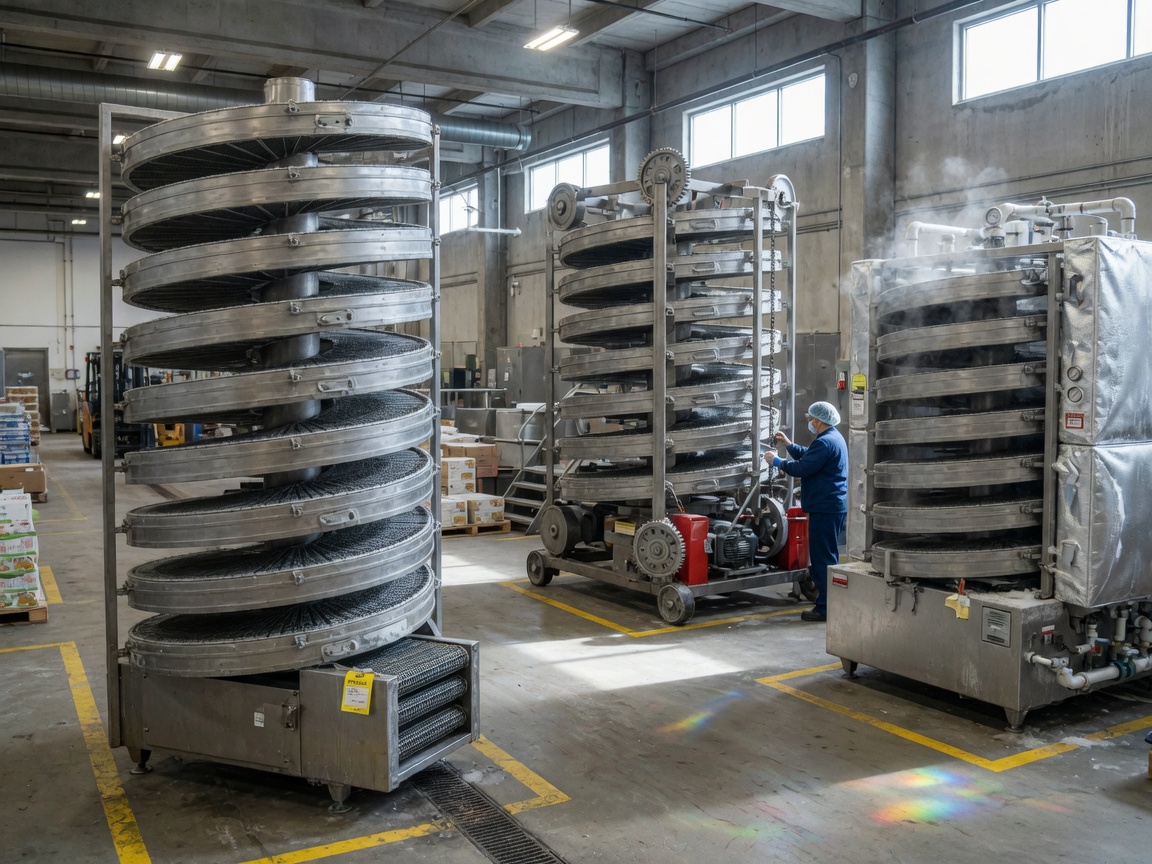
Think of a spiral freezer like a multi-storey parking garage for food — a remarkably long conveyor belt is folded into a compact vertical envelope, allowing hundreds of kilograms of product to be frozen simultaneously without occupying the large floor area that a conventional tunnel freezer would require. According to ASHRAE food refrigeration technical guidelines, a spiral conveyor freezer can reduce floor space requirements by up to 50% compared to an equivalent-capacity linear blast freezer. For South African processing facilities, where floor space in abattoirs and co-packing plants often comes at a premium, that difference is commercially significant.
Spiral freezer is defined as an industrial food preservation equipment category within the broader commercial refrigeration unit family, characterised by a helical conveyor belt, a driven drum or self-stacking belt structure, and a dedicated refrigeration circuit designed to achieve individual quick freezing (IQF) or crust-freezing of portioned food products moving continuously along the production line.
The equipment integrates directly into cold chain infrastructure and is a critical node between processing and distribution in any serious food manufacturing operation.How does a spiral freezer work?
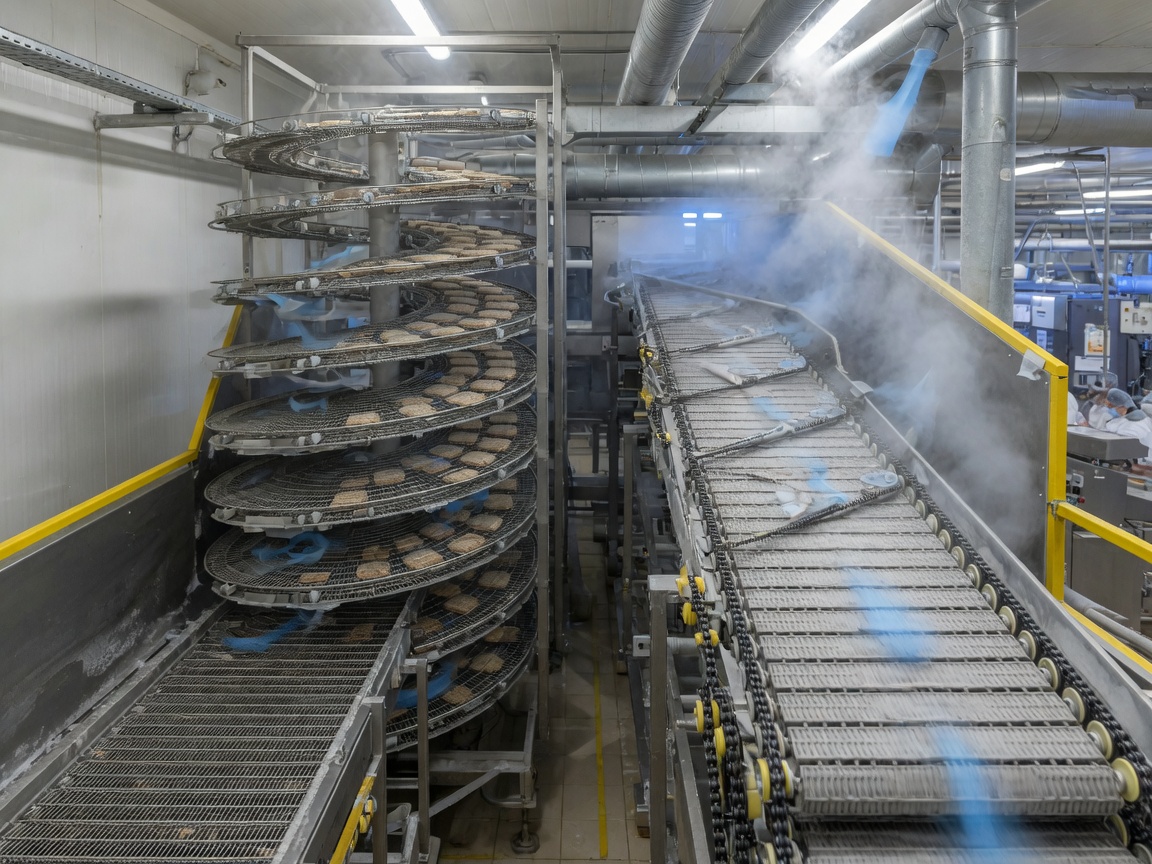
Product enters the freezer at the bottom tier of the helix on a stainless steel or plastic modular belt. As the belt revolves around a central drum — or self-stacks tier by tier — refrigerated air is forced across the product surface, extracting heat at a controlled rate. By the time product exits at the top or bottom of the spiral (depending on configuration), it has reached the target core temperature. Residence time is adjusted by varying belt speed, making the system adaptable to different product densities and freezing profiles. Actual testing in meat freezing equipment installations shows that core temperature can drop from +4 °C to −18 °C in as little as 18 to 35 minutes for a 100 g chicken portion, depending on airflow velocity and evaporator design.
Where is a spiral freezer used?
Spiral freezers are standard equipment across red meat processing, poultry freezing, seafood freezing systems, ready meals, bakery products, and dairy. In South Africa, the poultry sector — which accounts for the largest share of processed protein consumption nationally — is the dominant application. Facilities processing bone-in chicken pieces, burger patties, or crumbed products rely on the continuous throughput of a spiral freezer to match the speed of upstream slaughter and portioning lines. The same equipment is increasingly used in seafood processing operations in the Western Cape and KwaZulu-Natal coastal regions.
Types of spiral freezers explained
Not all spiral freezers are built the same way. The drive mechanism, refrigerant system, and structural configuration each determine which application a unit is best suited to. Choosing the wrong type is a costly mistake — and one that is far more common than procurement teams expect.
Self-stacking spiral freezer
In a self-stacking design, the conveyor belt supports itself as it spirals upward, with each tier resting on the one below. This eliminates the need for an external support cage, making cleaning significantly easier and reducing the overall mechanical complexity. Brands such as JBT have built their spiral product ranges around this architecture. For South African buyers, the simplified maintenance profile is a meaningful advantage — local service technicians are more readily available for mechanically straightforward equipment, reducing downtime risk when OEM support is not on the ground.
Positively driven (rack-driven) spiral freezer
A positively driven freezer uses an external drive frame or rack to propel the belt. This design handles heavier product loads and is better suited to dense, irregular-shaped items such as bone-in joints or large fish portions. The trade-off is greater mechanical complexity and a more involved CIP (clean-in-place) process. These units are widely used in South African red meat export facilities where high product mass per belt metre is non-negotiable.
Dual drum spiral freezer
A dual drum configuration houses two independent spiral belts within a single insulated enclosure, effectively doubling throughput capacity without doubling the facility footprint. This is the preferred choice for national-scale poultry processors who need output volumes exceeding 5 000 kg per hour. The capital cost is substantially higher, but when evaluated on a cost-per-kilogram-frozen basis, dual drum systems often deliver the most competitive economics at scale.
Cryogenic spiral freezer (liquid nitrogen / CO₂)
Cryogenic variants replace the mechanical refrigeration circuit with liquid nitrogen (LN₂) or CO₂ injection, achieving ultra-low temperatures rapidly. They are well-suited to high-value products — shellfish, sashimi-grade tuna, or premium confectionery — where speed of freezing directly impacts texture and cell integrity. However, the operating economics are markedly different: liquid nitrogen running costs are typically three to five times higher than mechanical refrigeration on a per-kilogram basis. Cryogenic freezers make sense for small-batch premium products, not for the high-volume commodity proteins that dominate South African food processing.
Technical specification comparison
When evaluating a spiral freezer against competing systems — or comparing one supplier's offering against another — the specification table is where buying decisions are won or lost. Below is a structured comparison of the main freezer types relevant to South African food processors in 2026.
| Specification | Self-stacking spiral | Rack-driven spiral | Cryogenic spiral | Linear tunnel freezer |
|---|---|---|---|---|
| Typical throughput | 500–4 000 kg/h | 800–6 000 kg/h | 100–1 500 kg/h | 1 000–8 000 kg/h |
| Operating temperature | −30 °C to −40 °C | −30 °C to −40 °C | −60 °C to −90 °C | −28 °C to −38 °C |
| Floor space requirement | Low | Low–medium | Very low | High |
| Energy consumption | Medium | Medium–high | Very high (consumable) | High |
| IQF capability | Yes | Yes | Yes (superior) | Yes |
| CIP hygiene rating | High | Medium | Medium–high | High |
| Typical capex (USD equivalent) | $180 000–$450 000 | $250 000–$600 000 | $80 000–$200 000 | $120 000–$380 000 |
| Best application | Poultry, ready meals | Red meat, fish portions | Shellfish, premium protein | Bulk commodity freezing |
Note: Capex figures are indicative USD equivalents based on 2026 import pricing into South Africa and will vary with ZAR/USD exchange rate at time of order. Always request a ZAR-denominated quotation inclusive of shipping, installation, and commissioning.
Key specification parameters to define before issuing an RFQ
Before approaching any supplier, procurement managers should be able to state the following clearly: required throughput in kg/h, target product core temperature on exit, product dimensions and weight range, belt width required, available floor height (critical for spiral stacking configuration), refrigerant preference or restriction, and required sanitation standard (e.g., FSSC 22000, HACCP, or DAFF compliance for export facilities). Suppliers who receive an incomplete brief will size equipment conservatively — which typically means oversizing and overspending.
Common sizing misconception
A widely held misconception in the industry is that a larger spiral freezer automatically delivers higher throughput. In practice, throughput is governed by the interaction of belt tier count, residence time, and airflow velocity across the product surface. Increasing drum diameter without recalibrating the refrigeration unit and fan array can produce temperature gradients across belt tiers — meaning products on outer tiers freeze at a different rate than those near the drum. This results in inconsistent exit temperatures and potential food safety non-compliance, particularly under DAFF export inspection protocols.
Energy efficiency and operating costs
Energy consumption is arguably the most consequential ongoing cost factor for any spiral freezer installation in South Africa. Given Eskom's current tariff environment and persistent load-shedding risk, energy efficiency is not simply a green credential — it is a direct determinant of operational profitability.
Understanding the real cost of running a spiral freezer
A mid-sized spiral freezer with a throughput of 2 000 kg/h will typically draw between 80 kW and 140 kW of installed refrigeration capacity. At Eskom's 2026 large-power-user industrial tariff (approximately R2.85/kWh on a time-of-use structure), a 20-hour production day translates to a daily energy cost of between R4 560 and R7 980 for refrigeration alone — excluding ancillary drives, fans, and lighting. Over a 250-day production year, that equates to R1.14 million to R1.99 million in energy expenditure per freezer. Why do so many procurement managers underweight this figure when evaluating capex? The answer usually lies in siloed budget structures, where capital equipment and utilities are managed by different departments.
Features that reduce energy consumption
Variable frequency drives (VFDs) on evaporator fans allow airflow to be modulated based on real-time belt loading rather than running at fixed maximum speed regardless of product volume. According to recent research by GEA, VFD-equipped spiral freezers can reduce fan energy consumption by 20–35% in partial-load conditions. Additionally, high-efficiency evaporator coil design reduces defrost cycle frequency, further cutting energy demand. When comparing supplier quotations, request the Coefficient of Performance (COP) data for the refrigeration unit at −35 °C evaporating temperature — this single figure allows direct, like-for-like energy efficiency comparison between competing systems.
"Selecting refrigeration equipment on capex alone, without a full lifecycle cost analysis, routinely results in the most energy-inefficient system winning the tender — at significant long-term cost to the operator." — GEA Group white paper on industrial freezer total cost of ownership, 2025
Of course, there are situations where a higher-capex, energy-efficient model may not be justified — for example, in a contract processing facility with short-term tenure or highly seasonal production volumes. The lifecycle cost analysis must always reflect actual production hours, not theoretical maximums.
Hygienic design and food safety compliance
Hygienic design is a non-negotiable dimension of any industrial freezer specification. South African export processors operating under DAFF (Department of Agriculture, Forestry and Fisheries) oversight, or supplying to retailers audited under the GFSI framework (FSSC 22000, BRC), face strict requirements for equipment cleanability and microbiological control.
CIP system requirements for spiral freezers
The layered belt structure of a spiral freezer creates inherent cleaning challenges. Residue, fat, and protein deposits can accumulate on belt joints, drum surfaces, and interior enclosure walls if the CIP system is inadequate. Best practice, as defined by the European Hygienic Engineering and Design Group (EHEDG), requires full drainage capability from all internal surfaces, no horizontal ledges where water can pool, and spray nozzle coverage that reaches all belt surfaces across every tier.
From real-world audits of South African poultry processing facilities, one of the most common non-conformances during third-party hygiene inspections relates to incomplete CIP coverage on the inner belt surface of the lower spiral tiers — precisely where product contact intensity is highest. Specifying a minimum CIP water temperature, pressure, and detergent concentration in the equipment contract — rather than leaving it to supplier discretion — is a practice that experienced procurement managers enforce consistently.
Material and surface finish standards
All product-contact surfaces should be 304 or 316 stainless steel with a minimum surface finish of Ra 0.8 µm. Plastic modular belts must be fabricated from food-grade materials compliant with EU Regulation 10/2011 or FDA 21 CFR equivalent. Belt joints and drive components should be accessible without tools for routine inspection. These are not aspirational standards — they are baseline requirements for any facility aiming to supply South African retail chains such as Woolworths Food, Pick n Pay, or SPAR, all of whom conduct supplier audits that include freezer equipment inspections.
How to evaluate and select a supplier in South Africa
Selecting a spiral freezer supplier in South Africa involves a different risk profile than procurement in Europe or North America. Import lead times, limited OEM technician presence, and ZAR currency volatility all factor into the real total cost of ownership. A structured evaluation process reduces exposure significantly.
Step-by-step supplier evaluation process
- Define your technical brief: Specify throughput, product type, exit temperature, floor dimensions, refrigerant restrictions, and sanitation standard before issuing any RFQ.
- Shortlist suppliers with proven local references: Request a list of installed units operating in South Africa. A reference site visit to a local poultry or red meat processor is far more informative than a factory demonstration in Germany or the USA.
- Evaluate lifecycle cost, not just capex: Request a 10-year total cost of ownership model from each supplier, including projected energy consumption, spare parts cost, and recommended preventive maintenance intervals.
- Assess local service capability: Confirm whether the supplier has certified technicians based in South Africa or a formally appointed local service agent. Understand the average response time commitment for breakdown callouts.
- Review spare parts availability: Critical wear components — belt segments, drive sprockets, bearing assemblies — should be stocked locally. A six-week import lead time on a failed bearing that stops your production line is an unacceptable risk.
- Negotiate commissioning and training terms: Factory acceptance testing (FAT) and site acceptance testing (SAT) protocols, operator training hours, and a performance warranty period (minimum 12 months at rated throughput) should be contractually defined.
Red flags to watch for during supplier engagement
Suppliers who cannot provide independent reference contacts, who quote throughput based on ideal conditions without stating the product and temperature basis, or who are unable to supply a dimensioned general arrangement drawing within five business days of receiving your brief, are exhibiting behaviours that are consistently associated with post-installation disputes. The South African food processing sector is small enough that reputations — good and bad — travel quickly. Peer referrals from industry networks such as the Red Meat Industry Forum (RMIF) or South African Poultry Association (SAPA) remain one of the most reliable qualification signals available.
For a comprehensive background reference on spiral freezer technology and design principles, the spiral freezer overview on Wikipedia provides a useful starting point before engaging technical suppliers.
2026 trends shaping spiral freezer procurement
The spiral freezer market is not static. Two structural shifts are redefining procurement priorities in 2026, and South African buyers who understand them will make better long-term investment decisions.
IoT integration and predictive maintenance
Leading equipment manufacturers — including GEA and Linde — have embedded IoT sensor arrays and AI-driven predictive maintenance modules into their 2025–2026 product lines. These systems monitor motor current draw, belt tension, evaporator pressure, and airflow velocity in real time, flagging anomalies before they become failures. For South African operators managing multiple production shifts with limited engineering staff on site, the value of receiving an automated alert that a bearing is showing early fatigue signs — rather than discovering it as an unplanned breakdown during a Friday night shift — is substantial. Digital twin functionality, which creates a virtual model of the physical freezer for remote diagnostics, is now a standard offering from premium suppliers and should be evaluated as part of the total system specification.
Natural refrigerant transition
The global phase-down of high-GWP refrigerants under the Kigali Amendment to the Montreal Protocol is accelerating the industrial refrigeration sector's transition to natural refrigerants — primarily CO₂ (R744) and ammonia (R717). While South Africa's formal regulatory timeline for HFC phase-down is less aggressive than the EU's F-Gas regulation, multinational food companies operating local production facilities are increasingly mandating natural refrigerant systems to comply with their own corporate sustainability commitments. Procurement managers evaluating a spiral freezer with a 15-year service life should seriously consider whether a system built around R404A or R449A will remain operationally and commercially viable for the full asset life. Recent market data indicates that R404A refrigerant prices in South Africa have increased by over 40% since 2022, a trajectory that is expected to continue as global supply tightens.
Frequently asked questions
Q: What is the difference between a spiral freezer and a tunnel freezer?
A: A spiral freezer winds its conveyor belt in a helix to maximise belt length per square metre of floor space, making it more compact. A conventional tunnel freezer runs the belt in a straight horizontal line, requiring significantly more floor length. For equivalent throughput, a spiral freezer typically uses 40–50% less floor area than a linear tunnel freezer.
Q: How much does a spiral freezer cost in South Africa?
A: Based on 2026 import pricing, a mid-range self-stacking spiral freezer with 1 500–2 500 kg/h throughput typically costs between R3.2 million and R7.5 million landed, installed, and commissioned. Final cost depends on belt width, tier count, refrigerant system, and local service contract terms. Always request a ZAR-denominated all-inclusive quotation.
Q: Can a spiral freezer be used for IQF (individual quick freezing)?
A: Yes. Spiral freezers are among the most common platforms for IQF processing of poultry pieces, seafood, vegetables, and portioned meat products. The key requirement for true IQF output is that product pieces do not contact each other during freezing — belt width, product spacing at infeed, and airflow uniformity across all tiers must be engineered together to achieve this.
Q: How often does a spiral freezer need to be defrosted and cleaned?
A: Most spiral freezers in high-throughput meat or poultry applications run a full CIP and defrost cycle every 12 to 24 hours of production time. The exact interval depends on product fat content, infeed temperature, and the capacity of the evaporator coil. Automated defrost timing controlled by a PLC reduces human error and ensures consistent hygiene compliance.
Q: Which refrigerant should I specify for a new spiral freezer installation?
A: For new installations with a 10–15 year asset life in South Africa, CO₂ (R744) or ammonia (R717) systems are strongly recommended where facility safety protocols allow. These natural refrigerants are future-proof against regulatory phase-downs and have lower long-term operating costs than HFC-based systems. For smaller installations below 500 kg/h, modern low-GWP HFO blends may be a practical alternative.
Summary
A spiral freezer is a foundational piece of cold chain equipment for any serious food processing operation in South Africa. Choosing the right system requires a clear technical brief, a rigorous total cost of ownership analysis, verified local service capability, and an understanding of where the market is heading on refrigerants and digital integration. Procurement managers who apply the structured evaluation process outlined in this guide will be positioned to select a continuous freezing system that delivers reliable performance, regulatory compliance, and commercial efficiency across its full operational life — whether the application is poultry, red meat, seafood, or value-added ready meals.
Keywords:
Inquiry
If you are interested in our products, please leave your email to receive a free product quote, thank you!
More information




Tel:
Sales E-mail: