

Spiral freezer for sale: how to choose the right model for your food processing line
Release Time:
Sep 17,2026
Author:

Article overview
A practical 2026 procurement guide for South African food processors evaluating spiral freezer for sale options — covering equipment types, ZAR pricing, load-shedding risks, HACCP compliance, and local after-sales support.
Table of contents
- 1. What is a spiral freezer and why it matters for your production line
- 2. Types of spiral freezers available for sale in 2026
- 3. How to size a spiral freezer for your facility: a practical capacity guide
- 4. Spiral freezer price in South Africa: ZAR cost breakdown and financing options
- 5. South African compliance: DAFF, HACCP, and food safety standards
- 6. Load-shedding and power continuity: the South African buyer's blind spot
- 7. Local after-sales support, spare parts, and maintenance contracts
- 8. FAQ
What is a spiral freezer and why it matters for your production line
A spiral freezer for sale is a continuous-belt industrial freezing system where a helical conveyor winds vertically inside an insulated enclosure, freezing food products rapidly and uniformly as they travel upward through the cold air zone. Unlike a conventional tunnel freezer for sale — which runs in a straight horizontal line — the spiral configuration stacks the belt height rather than length, reducing floor footprint by more than 60% for equivalent throughput capacity, according to GEA Group's technical white paper.
For South African food processors operating in facilities where every square metre carries a premium, that space efficiency is not a minor benefit — it is often the deciding factor. Real-world installations at poultry processing plants in Gauteng and seafood operations in the Western Cape confirm this: a continuous freezer system rated at 1,000 kg/h can be housed in a footprint smaller than a standard shipping container.
But floor space is only part of the story. The spiral belt freezer also delivers consistent product core temperatures, which is critical for both food safety and retail shelf-life claims. Compared to a blast freezer unit — which processes batches with uneven temperature distribution — a spiral IQF freezer achieves individual quick freezing across an uninterrupted product flow. This matters enormously when you are supplying major retailers such as Pick n Pay or Woolworths, whose cold chain specifications are non-negotiable.
Why do so many procurement managers overlook the operational cost difference between a spiral and a tunnel freezer? Primarily because the upfront capital cost of a spiral freezer appears higher. Yet when energy consumption per kilogram of frozen product is calculated over a five-year period, the spiral system consistently outperforms — delivering a lower total cost of ownership, particularly when paired with modern NH₃ or CO₂ refrigeration systems.
How a spiral freezer works: the core mechanism
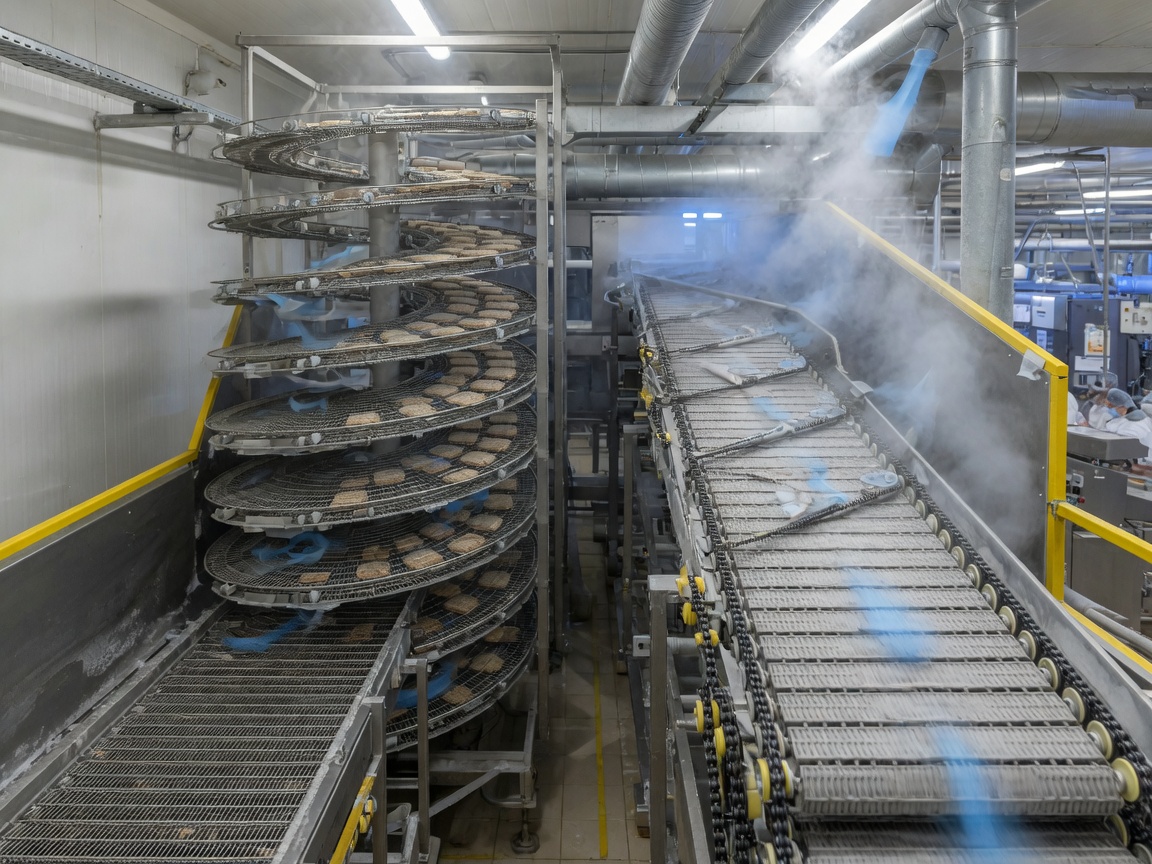
Products enter the freezer conveyor system at the bottom tier, riding a stainless-steel mesh or plastic modular belt that spirals upward through a controlled airflow. Forced-air refrigeration — typically at temperatures between −30°C and −40°C — surrounds the product on all sides. By the time the product exits at the discharge point, the core temperature has reached the target −18°C or below required by South African food safety regulations.
Industries using spiral freezers in South Africa
The food processing freezer category covers a broad range of applications in the South African context. Meat freezer equipment in abattoirs and deboning rooms, seafood freezing systems at Cape Town harbour-side processors, bakery line freezers for par-baked rolls, and ready-meal production at co-packers in Johannesburg — all rely on spiral technology. As South Africa's frozen food retail sector grew by an estimated 8.3% in 2025 (according to recent industry data), demand for industrial freezer equipment capable of high-volume, consistent output has accelerated into 2026.
Types of spiral freezers available for sale in 2026
Choosing the right type of commercial spiral freezer is the foundational decision — and it is where most buyers make avoidable errors. The market in 2026 offers five principal configurations, each suited to distinct production environments.
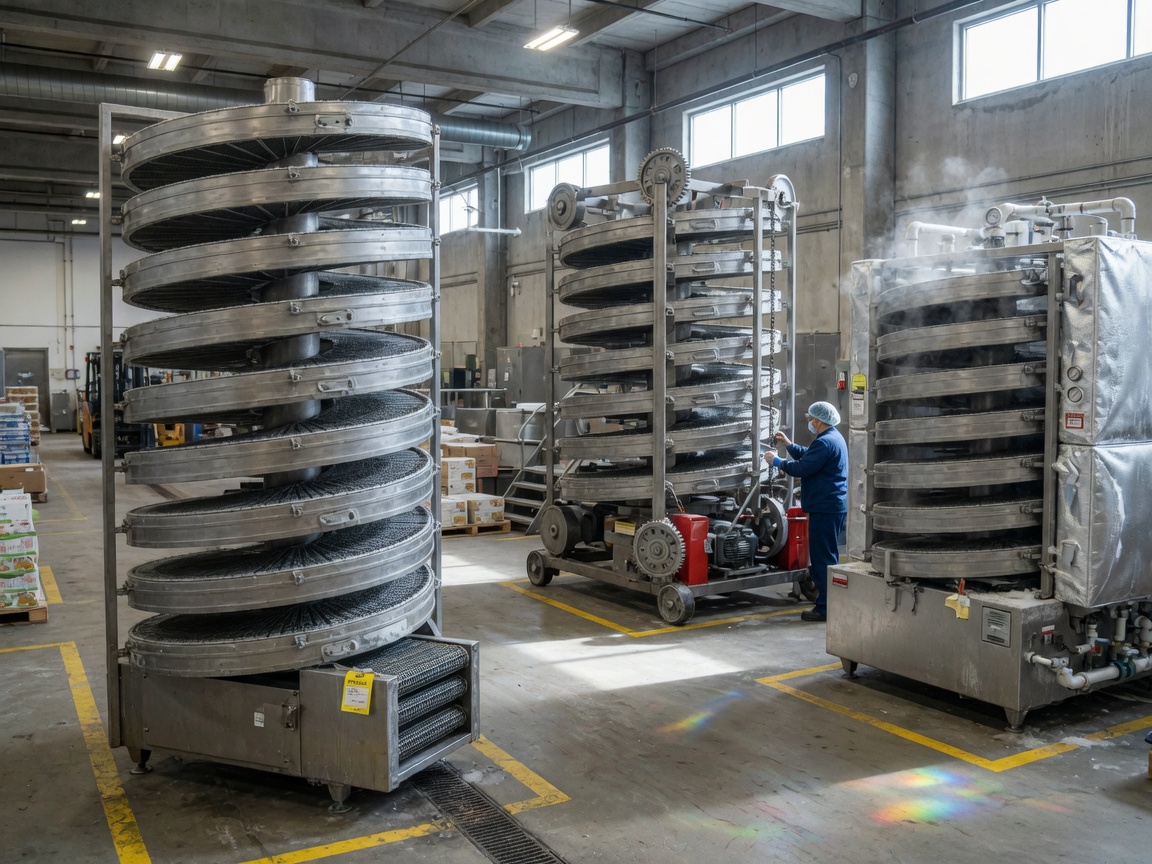
| Type | Best suited for | Throughput range | Key advantage | Limitation |
|---|---|---|---|---|
| Self-stacking | Poultry, seafood, bakery | 300–2,000 kg/h | Minimal maintenance; belt self-supports | Not ideal for very heavy/sticky loads |
| Positive drive | Heavy meat cuts, battered products | 500–3,000 kg/h | Handles sticky/heavy loads reliably | Higher belt wear cost |
| Cryogenic (LN₂/CO₂) | High-value seafood, ready meals | 100–800 kg/h | Fastest freeze time; minimal drip loss | High ongoing cryogen cost in ZAR |
| Hygienic design | RTE (ready-to-eat) foods | 200–1,500 kg/h | Meets FDA/EHEDG/HACCP standards | Premium price point |
| Compact/small-scale | SME processors, pilot lines | 50–300 kg/h | Lower capex; suitable for tight spaces | Limited scalability |
Self-stacking vs positive drive: which suits South African conditions?
Based on actual installations across sub-Saharan Africa, the self-stacking spiral freezer remains the dominant choice for processors with diverse product mixes — primarily because belt maintenance is simpler and local technicians can manage it without manufacturer intervention. Positive drive systems deliver undeniable performance advantages for sticky or heavy products, but the belt replacement cost in ZAR (imported components) can add R180,000–R350,000 per service cycle, a factor many buyers underestimate at the procurement stage.
New vs refurbished spiral freezers: a frank assessment
The refurbished market can reduce upfront investment by 35–55% — a meaningful saving when the rand is under pressure. However, a professionally refurbished quick freeze machine requires independent inspection of belt wear, refrigerant integrity, insulation condition, and control system firmware. Without certified inspection reports, that saving can quickly be consumed by repair costs. The industry consensus is: refurbished is viable, but only with documented condition assessments from a qualified refrigeration equipment supplier.
How to size a spiral freezer for your facility: a practical capacity guide
Correct sizing is the single most critical technical decision in the procurement process — and the one most often skipped. Oversized equipment runs at low utilisation, inflating energy costs per kilogram and accelerating mechanical wear. Undersized equipment creates bottlenecks that choke your entire production line.
The primary sizing variables are: required throughput in kg/h, target product exit temperature (typically −18°C core), product dimensions and density, dwell time needed to achieve the freeze target, and available floor space dimensions in your facility.
- Define your peak production rate — not your average rate. Size for the busiest shift, not the median week.
- Calculate required dwell time using the product's thermal load: thicker products (e.g., 25mm chicken breast) need significantly longer freeze curves than thin items (e.g., 8mm fish fillets).
- Determine belt width and tier count — a wider belt accommodates flat products side by side; more tiers increase dwell time without extending footprint.
- Account for a 15–20% capacity buffer to handle production surges, seasonal peaks (especially pre-December in South Africa's retail calendar), and partial load efficiency losses.
- Confirm floor load bearing — a fully loaded industrial freezer equipment unit can exceed 8,000 kg total weight; older factory floors in Johannesburg's industrial zones frequently fail this check.
Sizing reference: capacity vs footprint for SME processors
For small to mid-size processors — the segment most underserved by competing content — the practical entry point is a compact spiral freezer rated between 100 and 400 kg/h. At this capacity range, a unit typically occupies 3m × 4m floor space, consumes 30–75 kW of refrigeration power, and can be integrated into an existing cold room environment. This makes it accessible for township-based food manufacturers and export-oriented abattoirs in the Eastern Cape that are scaling up for the first time.
Common sizing mistakes to avoid
Just like choosing an engine too large for a vehicle, over-specifying a freezer conveyor system wastes fuel on every trip. The most common mistake encountered in real procurement audits: basing the specification on theoretical maximum production rather than verified operational averages. The result is a machine running at 40% capacity, consuming near-full-load power. Of course, there are exceptions — processors planning aggressive expansion within 24 months should build in higher headroom deliberately, but document that rationale explicitly in the capital expenditure approval.
Spiral freezer price in South Africa: ZAR cost breakdown and financing options
Price transparency is one of the most significant gaps in the South African market for spiral freezer for sale listings. Most international suppliers quote in USD or EUR, leaving buyers to absorb exchange rate volatility on top of an already complex procurement decision. Here is a realistic 2026 ZAR-denominated reference framework.
| Category | Capacity range | Estimated price (ZAR, 2026) | Notes |
|---|---|---|---|
| Compact/entry-level | 100–300 kg/h | R900,000 – R2,200,000 | Incl. basic refrigeration package |
| Mid-range commercial | 400–1,000 kg/h | R2,500,000 – R6,500,000 | Self-stacking, NH₃ system |
| High-capacity industrial | 1,500–3,000+ kg/h | R8,000,000 – R18,000,000+ | Full line integration, automation |
| Refurbished/used | Varies | R500,000 – R3,500,000 | Condition-dependent; inspect before purchase |
Import duty (SARS tariff heading 8418.69) currently applies at 0% for most industrial refrigeration equipment, though VAT at 15% applies on landing value. Freight, commissioning, and installation typically add 12–18% to the CIF price — a cost frequently omitted from initial supplier quotations, and one that catches buyers off guard.
Financing and leasing options available in South Africa
Several South African financial institutions offer asset-backed financing for food processing equipment. The Industrial Development Corporation (IDC) provides agro-processing loan facilities with preferential rates for qualifying food manufacturers. Nedbank and Standard Bank both operate equipment finance desks with terms of 36–60 months for capital machinery. Leasing structures — where the asset remains on the supplier's balance sheet — are increasingly used by SME processors to preserve working capital, with monthly rentals for a mid-range commercial spiral freezer typically ranging from R55,000 to R130,000 per month depending on term and deposit.
Total cost of ownership: beyond the purchase price
Energy consumption is typically the largest ongoing cost — a 1,000 kg/h spiral IQF freezer running 16 hours per day at Eskom's 2026 industrial tariffs (approximately R1.85–R2.20 per kWh for large commercial users) can generate electricity costs of R280,000–R420,000 annually. Add preventative maintenance contracts (R80,000–R160,000 per year), belt replacement cycles, and refrigerant top-ups, and the five-year TCO picture looks very different from the sticker price.
South African compliance: DAFF, HACCP, and food safety standards
This is an area almost entirely absent from competing content — and it represents genuine procurement risk. In South Africa, food processing facilities are regulated under the Foodstuffs, Cosmetics and Disinfectants Act (Act 54 of 1972) and are subject to inspection by the Department of Agriculture, Land Reform and Rural Development (DALRRD, formerly DAFF). Export-oriented processors must additionally comply with requirements set by the PPECB (Perishable Products Export Control Board).
HACCP requirements and what they mean for your freezer specification
HACCP (Hazard Analysis and Critical Control Points) is not optional for any serious food processing operation in South Africa — major retailers demand FSSC 22000 or SANS 10330 certification as a condition of supply. Your freezer conveyor system is a Critical Control Point (CCP) for temperature reduction. This means the unit must have calibrated temperature monitoring with data logging capability, alarm systems triggered by temperature deviation, and smooth-surface hygienic design that supports CIP (clean-in-place) or manual wash-down without harbouring bacteria.
When evaluating a commercial spiral freezer or blast freezer unit, request the following compliance documentation from the supplier: CE marking (for European-manufactured units), EHEDG (European Hygienic Engineering and Design Group) certification for food contact surfaces, calibration certificates for temperature sensors, and manufacturer documentation confirming belt materials are food-grade under EU Regulation 10/2011 or equivalent.
Export certification: PPECB and cold chain integrity
Processors exporting frozen meat or seafood from South Africa must satisfy PPECB inspection criteria, which include verified rapid freezing rates that demonstrate product reaches −18°C core within specified timeframes. A well-specified spiral IQF freezer with validated temperature data logs provides the evidence trail required. Importers in the EU, UK, and Middle East increasingly request third-party verification of freeze curve compliance — a requirement your cold storage freezer South Africa infrastructure must support from day one.
"Hygienic design is no longer a premium add-on — it is the baseline expectation for any new food processing freezer entering the South African market. Buyers who compromise on surface cleanability to reduce purchase price invariably spend more on failed audits and product recalls." — Industry consensus from South African cold chain engineering consultants, 2026.
Load-shedding and power continuity: the South African buyer's blind spot
Not a single competing page for spiral freezer for sale addresses this — yet it is the most operationally critical risk for any South African food processor. Even with Eskom's improved grid stability in 2026, scheduled and unscheduled outages remain a real threat to continuous freezer system operation. A power interruption during active freezing can devastate an entire product batch, trigger HACCP non-conformance, and — in worst cases — render frozen inventory unsafe for retail.
Power protection strategies for spiral freezer operations
The practical mitigation framework used by established South African processors includes three tiers. First, an online UPS (Uninterruptible Power Supply) rated to carry control systems, data loggers, and safety alarms for a minimum of 30 minutes — this prevents data loss and allows a controlled shutdown rather than an emergency stop. Second, a diesel generator sized to sustain the refrigeration compressor load (typically 30–150 kW for mid-range units) with automatic transfer switching. Third, thermal mass design: specifying a spiral freezer with enhanced insulation panels (minimum 150mm PIR) that retain internal temperature for longer during unplanned outages, buying time for generator transfer.
What to ask your supplier about load-shedding preparedness
Ask prospective refrigeration equipment suppliers these specific questions: Does the control system support automatic restart after power restoration without manual intervention? What is the maximum allowable power interruption before product integrity is compromised? Can the unit interface with a building management system (BMS) for automated generator handover? Suppliers who cannot answer these questions clearly have insufficient experience with South African operating conditions. This is a non-trivial differentiator when shortlisting vendors.
Local after-sales support, spare parts, and maintenance contracts
Equipment downtime in a food processing environment is not an inconvenience — it is a financial emergency. A spiral freezer for sale from an overseas supplier with no local service presence can mean 6–12 weeks waiting for a critical spare part, at a cost of tens of thousands of rand per day in lost production. This risk is systematically underestimated at the procurement stage.
What genuine local support looks like
Credible after-sales support in the South African context means: a local or regional technical engineer (based in Gauteng, Western Cape, or KwaZulu-Natal) who can be on-site within 24–48 hours; a local spare parts inventory covering high-wear components (belt sections, drive sprockets, temperature sensors, door gaskets); and a documented preventative maintenance schedule delivered under a formal SLA (Service Level Agreement). Before signing any purchase order, request the name and contact details of the local service representative — if the supplier hesitates, that tells you everything.
Evaluating maintenance contracts: what to include
A well-structured maintenance contract for industrial freezer equipment in South Africa should cover quarterly preventative inspections, annual belt tension calibration, refrigerant leak checks every six months, control system firmware updates, and a guaranteed response time with financial penalties for non-compliance. Contracts priced at R8,000–R25,000 per month for mid-range units are reasonable; anything significantly below this threshold warrants scrutiny about what is actually included. Just as you would not buy a production vehicle without roadside assistance, you should not commission a commercial spiral freezer without a verified service network backing it.
2026 technology trends affecting after-sales: predictive maintenance
Leading manufacturers including JBT and Starfrost now offer IoT-enabled spiral freezers with embedded sensors monitoring belt tension, motor load, airflow velocity, and refrigerant pressure in real time. Cloud-based analytics flag anomalies before failures occur, reducing unplanned downtime by an estimated 15–20% according to recent manufacturer data. For South African buyers, the practical question is whether local service engineers have access to the same diagnostic platform — confirm this explicitly before purchasing any IoT-equipped quick freeze machine.
Frequently asked questions
Q: What is the difference between a spiral freezer and a tunnel freezer for sale?
A: A tunnel freezer runs in a straight horizontal line and requires significant floor length; a spiral freezer winds the belt vertically, reducing floor space by over 60% for the same throughput. Spiral systems are preferred where facility space is limited, while tunnel freezers suit high-volume single-product lines with abundant floor space.
Q: How much does a spiral freezer cost in South Africa in 2026?
A: Entry-level compact units start at approximately R900,000; mid-range commercial systems range from R2.5 million to R6.5 million; high-capacity industrial units can exceed R18 million. Prices vary with capacity, refrigerant type, automation level, and whether the unit is new or professionally refurbished. Always request ZAR-denominated quotes inclusive of VAT, freight, and commissioning.
Q: Does a spiral freezer meet HACCP and South African food safety requirements?
A: It can — but only if specified correctly. The unit must feature calibrated temperature data logging, hygienic surface design, and cleanability standards aligned with EHEDG or equivalent. Confirm FSSC 22000 and SANS 10330 compatibility with the supplier and request documentation before purchase. This is essential for supplying major SA retailers or exporting under PPECB certification.
Q: What happens to a spiral freezer during Eskom load-shedding?
A: Without mitigation, a power cut during active freezing risks product spoilage and HACCP non-conformance. Best practice is to install an online UPS for control systems, a diesel generator for compressor load, and specify enhanced insulation panels (150mm+ PIR) to extend thermal retention. Ask suppliers specifically whether the unit supports automatic restart after power restoration.
Q: Is a refurbished spiral freezer a good option for South African buyers?
A: Potentially — a professionally refurbished unit can reduce capital cost by 35–55%. However, it must come with independent inspection reports covering belt condition, refrigerant integrity, insulation, and control systems. Without this documentation, repair costs frequently exceed the initial saving. Use only suppliers who can provide verifiable condition assessments and local warranty support.
Making the right call on your spiral freezer investment
The decision to invest in a spiral freezer for sale is rarely straightforward — but it becomes significantly clearer when you approach it with the right framework. Start with verified throughput requirements, not aspirational ones. Demand ZAR-denominated pricing that includes all landed costs. Insist on HACCP-compatible design documentation before any contract is signed. And — critically for the South African environment — evaluate every supplier on the strength of their local service network, not just the specification sheet of their equipment.
The 2026 market for food processing freezer equipment in South Africa is maturing rapidly. Buyers who invest time in thorough pre-purchase due diligence — covering technical sizing, regulatory compliance, load-shedding resilience, and after-sales infrastructure — consistently achieve better outcomes than those who optimise exclusively on purchase price. The data is clear: total cost of ownership over five years is a far more meaningful metric than the figure on the first quotation you receive.
Use this guide as your evaluation checklist. Request formal proposals from at least three refrigeration equipment suppliers. Compare them against the criteria outlined in each section above. And if a supplier cannot answer your questions about load-shedding contingency, DAFF compliance, or local spare parts availability — that is your answer about whether they are the right partner for your operation.
Keywords:
Inquiry
If you are interested in our products, please leave your email to receive a free product quote, thank you!
More information




Tel:
Sales E-mail: