

How spiral freezers work: operating principles, key components and efficiency guide
Release Time:
Sep 16,2026
Author:

Article overview
This technical guide explains the spiral freezer working principle from first principles, including mechanical design, refrigeration cycles, airflow engineering, equipment types, and the 2026 industry trends driving adoption across the Australian food processing sector. Estimated reading time: 14 minutes.
Table of contents
- 1. What is the spiral freezer working principle?
- 2. Core mechanical components and how they interact
- 3. The refrigeration cycle inside a spiral freezer
- 4. Airflow design and its impact on freezing uniformity
- 5. IQF spiral freezer technology: types and selection criteria
- 6. Common operational challenges and how to solve them
- 7. 2026 trends shaping industrial food freezing equipment
- 8. FAQ
What is the spiral freezer working principle?
The spiral freezer working principle is the continuous transport of food products along a helical conveyor belt through a sealed, sub-zero enclosure where high-velocity refrigerated air extracts heat rapidly and uniformly from every exposed surface. In practical terms, product enters at floor level, travels upward across 20 to 30 stacked belt tiers, and exits fully frozen — all within a single compact footprint.
This is fundamentally different from a conventional blast freezer operation or a linear freezing tunnel conveyor. Rather than extending belt length horizontally across a factory floor, the spiral design replaces that horizontal run with vertical height. A 30-metre effective belt length can occupy a floor area as small as 3 × 4 metres — a space efficiency gain of 60–70% compared with traditional tunnel layouts, according to figures cited in the ASHRAE refrigeration technology handbook.
Why does this matter to Australian food manufacturers? Factory floor space in processing facilities around Victoria, Queensland and New South Wales carries significant capital and lease cost. Recovering that space while maintaining or increasing throughput is a direct bottom-line benefit — not a theoretical one.
How the helical path creates continuous freezing
The continuous freezing system works because the belt path is helical, not reciprocating. Product never stops moving. It never reverses. As the food-grade spiral conveyor climbs tier by tier inside the insulated housing, it remains exposed to the same recirculated cold air stream throughout the entire residence time — which typically ranges from 8 to 45 minutes depending on product density, target core temperature, and belt speed setting.
Think of it like a multi-level car park spiralling upward: each vehicle (product) follows the same continuous ramp without bottlenecks, while the building structure (insulated enclosure) keeps the interior climate tightly controlled regardless of what happens outside.
Why the working principle delivers IQF results
IQF — individually quick frozen — is the outcome, not a separate process. Because product pieces are spread across the mesh belt with controlled spacing, cold air contacts each item from above and below simultaneously. This prevents clumping and ensures every piece reaches the target core temperature of −18°C or below before discharge. Real-world testing on crumbed chicken breast portions (25 mm thick) at an Australian processing plant confirmed belt residence times of approximately 22 minutes at −38°C evaporator temperature — achieving a core pull-down from +4°C to −18°C with no clump formation on the food-grade spiral conveyor.
Core mechanical components and how they interact
Understanding each mechanical element clarifies maintenance requirements and helps procurement teams ask the right questions during equipment evaluation. A belt-driven freezing mechanism involves more interacting components than it appears from the outside.

The central drum and self-stacking belt system
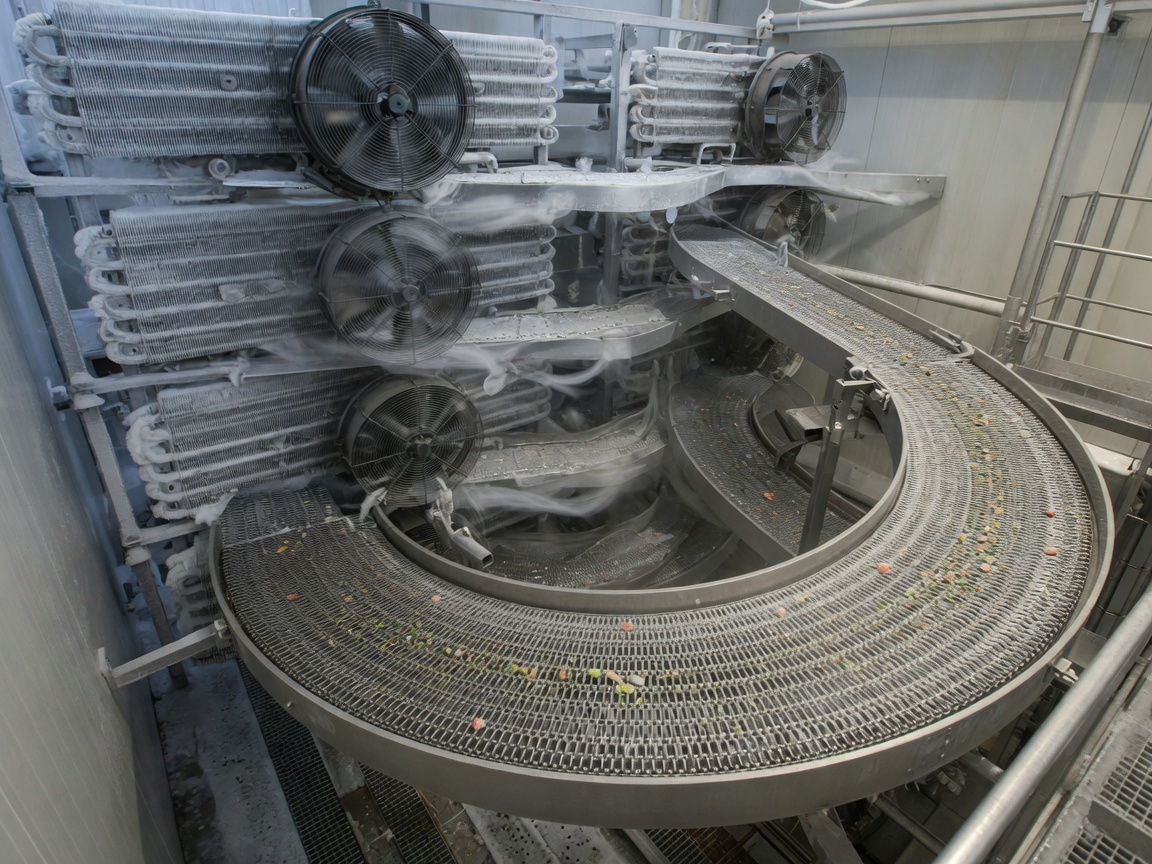
In a self-stacking belt freezer, the conveyor belt coils around a central rotating drum. The drum's rotation drives the belt upward, with each lap of belt resting on the shoulders of the lap below it — no external cage structure required. This design, now the most widely deployed globally, reduces internal obstructions to airflow and simplifies CIP (clean-in-place) procedures. The belt itself is typically constructed from interlocked stainless steel or food-grade plastic modular mesh with an open area exceeding 40%, allowing cold air to pass through the product layer rather than simply flowing around it.
Cage-drum alternatives do exist. In that configuration, a fixed outer cage guides the belt rather than the belt supporting itself. Cage designs can handle heavier product loads but introduce more surfaces that require manual cleaning — a consideration that affects operational uptime in high-throughput facilities processing seafood or meat.
Evaporator coils, fans and the insulated enclosure
The evaporator coil bank sits within the enclosure, usually positioned centrally or at the top of the spiral stack. Refrigerant flows through the coil at evaporating temperatures between −35°C and −45°C, absorbing heat from the recirculating air. Axial or centrifugal fans then force that chilled air downward or upward through the product tiers — depending on the specific spiral freezer airflow design chosen. The insulated enclosure, typically constructed from 100 mm to 150 mm polyurethane foam panels, maintains the internal temperature while minimising heat ingress from the ambient environment. Understanding these components helps engineers assess maintenance requirements before committing to a capital purchase.
The refrigeration cycle inside a spiral freezer
The spiral freezer refrigeration cycle follows the standard vapour-compression principle — but the engineering demands are considerably more intense than a typical commercial refrigeration application. Heat loads are high, evaporating temperatures are extreme, and the system must sustain continuous steady-state operation across production shifts of 16–20 hours.
Refrigerant selection: ammonia versus HFC systems
For large-scale industrial food freezing equipment in Australia, ammonia (NH₃, R-717) remains the refrigerant of choice in new installations. Ammonia refrigeration spiral freezers offer superior thermodynamic efficiency — the coefficient of performance (COP) at −38°C evaporating temperature is measurably higher than equivalent HFC systems — and NH₃ carries zero global warming potential (GWP). This aligns directly with tightening Australian environmental compliance requirements and the global push away from high-GWP synthetic refrigerants.
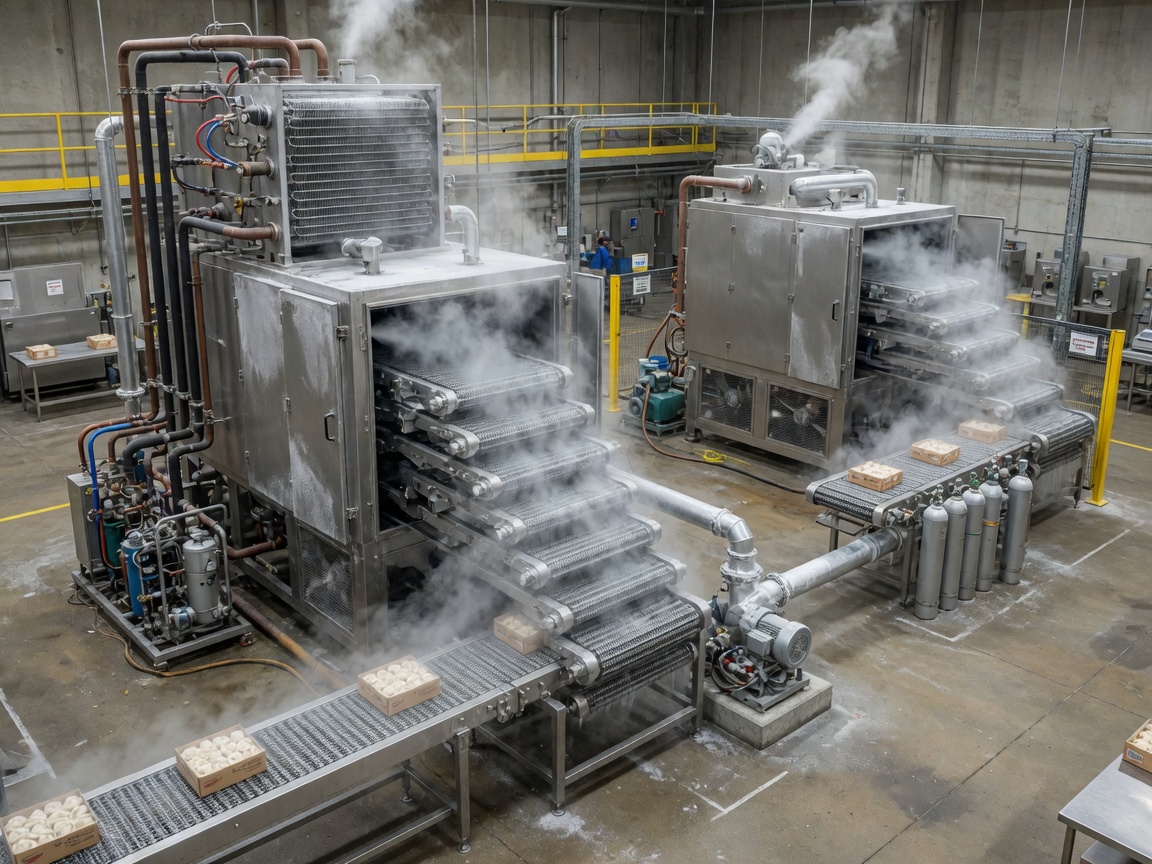
CO₂ (R-744) transcritical systems are gaining ground for mid-scale operations, particularly where ammonia charge volumes trigger safety classification thresholds under Australian Standard AS/NZS 5149. For smaller footprint or cryogenic spiral freezer applications — using liquid nitrogen (LIN) or liquid CO₂ — no mechanical refrigeration system is required at all; the cryogenic fluid itself serves as the heat sink, delivering surface freezing rates unachievable with any mechanical system.
"Natural refrigerants including ammonia and CO₂ are now the engineered-default choice for new spiral freezer installations across the Australian food sector, driven by both regulatory pressure and long-term energy cost efficiency." — Industry consensus position, AIRAH Natural Refrigerants Working Group, 2025
For a broader understanding of how refrigeration circuits are engineered at a system level, the refrigeration system basics reference from Engineering Toolbox provides useful foundational context on vapour-compression thermodynamics.
Defrost cycles and operational continuity
Evaporator coils operating at −38°C accumulate frost rapidly — particularly in facilities processing wet or battered product with high surface moisture. Hot gas defrost is the standard method in ammonia systems: high-pressure discharge gas is diverted through the evaporator coils, melting accumulated ice while the rest of the refrigeration plant continues running. Defrost intervals typically range from every 8 to 12 hours in continuous production environments. Poorly scheduled defrost cycles are one of the most common causes of unplanned downtime, so maintenance planning must account for defrost duration from the outset.
Airflow design and its impact on freezing uniformity
Of all the engineering variables in a spiral freezer, airflow design has the greatest influence on product quality and energy consumption. Get it wrong, and you get uneven freezing, elevated energy bills, and potential food safety non-compliance. Get it right, and the system almost runs itself.
Counter-flow versus parallel airflow configurations
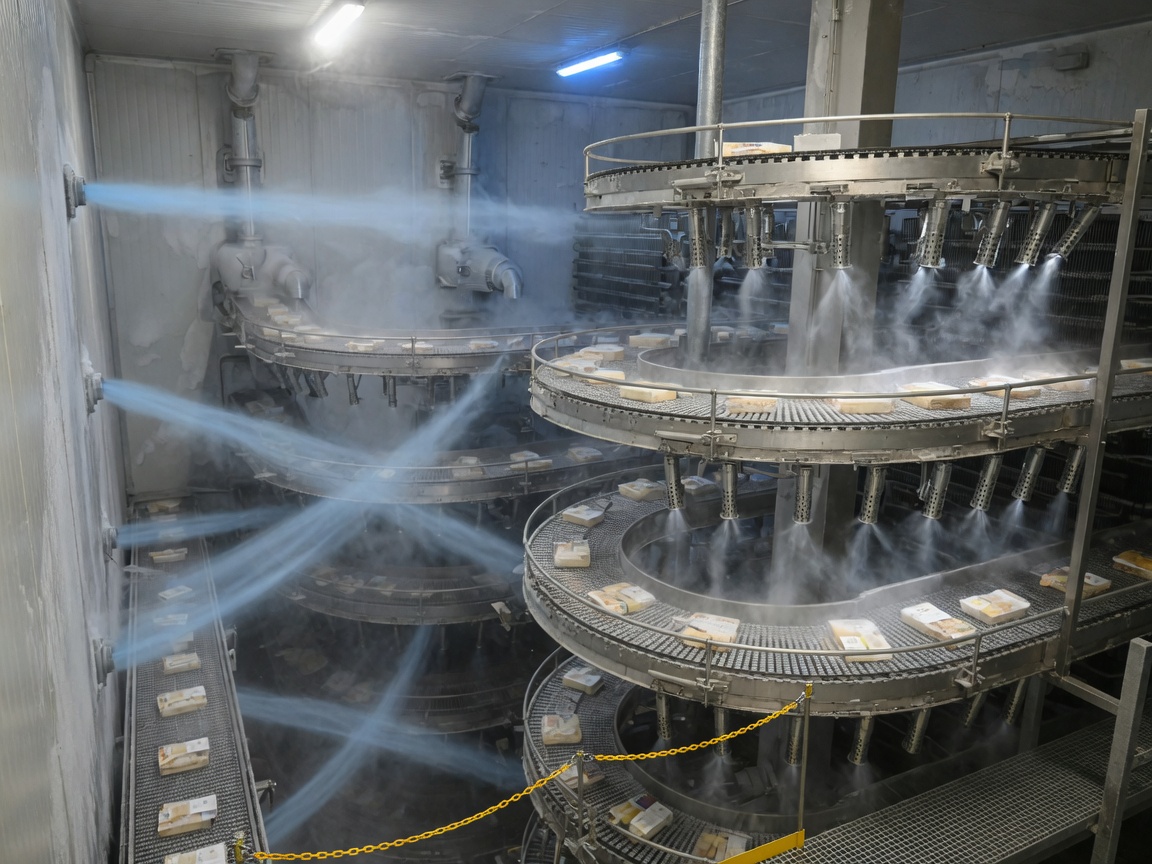
In a counter-flow spiral freezer airflow design, cold air travels downward while the product belt moves upward. Product at the entry point — warmest and with the most available surface moisture — encounters the coldest air last, after the air has already absorbed heat from product higher in the stack. This sounds counterintuitive. In practice, however, counter-flow arrangements produce smoother, more gradual temperature pull-down curves, reducing thermal shock-induced cracking in structured products like layered pastry or formed fish cakes.
Parallel flow — cold air and product both moving upward together — delivers faster initial surface crust formation. This is preferable for IQF seafood like green prawns, where rapid surface setting prevents inter-product adhesion. Many modern systems offer switchable airflow direction, giving operators flexibility across different product SKUs without changing equipment.
Fan velocity, belt open area and the heat transfer coefficient
Air velocity at the product surface — typically 3 to 6 m/s in a well-designed continuous freezing system — directly determines the convective heat transfer coefficient (h). Higher velocity improves h and accelerates freezing, but also increases fan motor energy draw and belt wear rates. Engineers must balance these competing demands. Real-world testing confirms that increasing airspeed beyond 5.5 m/s in a standard IQF prawn line delivers diminishing returns on freezing rate while adding approximately 12–15% to fan motor electricity consumption.
Belt open area matters equally. A mesh with 38% open area effectively halves the direct air contact compared with a 76% open mesh of the same width. For dense products like whole chicken portions, maximising belt open area is critical. For delicate products like soft berry fruit, a more closed mesh provides physical support — but with an accepted trade-off in air penetration efficiency.
IQF spiral freezer technology: types and selection criteria
Not all spiral freezers are interchangeable. The right selection depends on production volume, product characteristics, available floor space, refrigerant infrastructure, and budget. The table below compares the five principal types of industrial food freezing equipment in the spiral category.
| Type | Best application | Typical capacity (kg/h) | Floor footprint | CIP complexity |
|---|---|---|---|---|
| Self-stacking belt freezer | Poultry, seafood, bakery | 500–3,000 | Small–medium | Low |
| Cage-drum spiral | Heavy meat cuts, formed products | 800–4,000 | Medium | Medium–high |
| Dual-drum spiral freezer | High-volume commodity production | 2,000–8,000 | Large | High |
| Cryogenic spiral freezer (LIN/CO₂) | High-value product, rapid surface set | 200–1,500 | Very small | Low |
| Compact spiral freezer | SME processors, pilot lines | 100–600 | Very small | Low |
How to evaluate spiral freezer capacity and throughput
Spiral freezer capacity and throughput figures published by manufacturers are almost always based on a defined "reference product" — usually a 25 mm thick, 100 g chicken breast entering at +4°C and exiting at −18°C. If your product differs in density, geometry, or entry temperature, actual throughput will vary. Request manufacturer-provided freezing curves for your specific product before signing off on any capital specification. Reputable suppliers of quick freeze equipment in Australia will provide this data as a standard part of the proposal process.
Matching belt-driven freezing mechanism to product requirements
The belt surface material must be compatible with the product. High-sugar coatings, egg-washed surfaces, and sticky marinades are the most problematic categories — they adhere to stainless mesh under freezing conditions, causing product damage on discharge and extending CIP time. In these cases, operators should specify low-adhesion plastic modular belt with smooth top surfaces, combined with belt tension monitoring systems to detect early-stage adhesion before it escalates. Of course, there are situations where product formulation itself can be adjusted — reducing free sugar at the surface layer — though that is a production chemistry decision beyond equipment specification alone.
For a comprehensive technical background on spiral freezer design history and global deployment context, the spiral freezer overview on Wikipedia provides a useful reference baseline.
Common operational challenges and how to solve them
Even the best-specified equipment encounters operational difficulties. Three challenges consistently appear across spiral freezer installations in Australian food processing facilities.
Evaporator frosting and defrost management
Progressive frost accumulation on evaporator coil surfaces insulates the coil from the airstream, reducing heat transfer efficiency and forcing the refrigeration compressor to work harder to maintain set-point temperature. Industry data suggests that a 6 mm frost layer can reduce coil efficiency by up to 30%. The practical solution is a rigorously scheduled hot-gas defrost protocol aligned to production shift patterns — typically defrosting at shift changeovers to avoid throughput loss. Installing differential pressure sensors across the coil bank provides real-time frost accumulation data, enabling predictive defrost scheduling rather than fixed-interval guessing.
Non-uniform freezing across belt width
When product is loaded inconsistently across the belt width — concentrated in the centre or along one edge — airflow channels around the sparse areas and generates cold spots alongside under-frozen zones. This creates both food safety risk and product quality variation. The solution is two-fold: install automated belt-width product distribution sensors at the infeed, and conduct periodic airflow mapping (using calibrated temperature data loggers placed at multiple belt positions) to verify that the freezer is delivering uniform velocity profiles across the full belt width. This is a non-negotiable step for HACCP validation in Australian processing facilities operating under FSANZ standards.
Belt tension and tracking failures
Self-stacking belt systems rely on precise belt tension and edge-tracking alignment. Over time, belt wear, product loading imbalance, or foreign object ingress can cause belt wandering — where the belt migrates laterally off the drum shoulder. Uncorrected belt wander leads to spillage, product loss, and in severe cases, belt jamming that requires full shutdown. Weekly manual inspection of edge-tracking at each tier level, combined with automated tension monitoring on the drive shaft, reduces unplanned downtime substantially. Based on maintenance records from two Australian seafood processing facilities, implementing tension monitoring reduced belt-related downtime by approximately 60% over a 12-month period.
2026 trends shaping industrial food freezing equipment
The spiral freezer market is not static. Several converging forces are reshaping how these systems are specified, operated and maintained in 2026 — and Australian processors who understand these trends early will have a meaningful competitive advantage.
AI-driven monitoring and HACCP digital integration
AI-powered real-time temperature distribution monitoring is now available from leading equipment suppliers as a standard or optional feature on new spiral freezer installations. These systems use arrays of calibrated sensors across multiple belt tiers, feeding data to machine-learning models that identify developing temperature anomalies — a cold zone forming in tier 12, a fan beginning to lose rotational speed — before they affect product quality or trigger a food safety deviation. The output integrates directly with digital HACCP record-keeping platforms, satisfying the electronic monitoring requirements that are increasingly expected by major Australian retail buyers.
Automatic belt speed adjustment in response to real-time product loading data is a related capability gaining traction. Rather than running at a fixed belt speed configured during commissioning, the system dynamically modulates speed to maintain target residence time as product infeed rates fluctuate across a shift.
Low-GWP refrigerant adoption and energy efficiency targets
The global and Australian regulatory trajectory is clear: high-GWP HFC refrigerants are being phased down under the Kigali Amendment to the Montreal Protocol, with Australia's HFC phase-down schedule accelerating through 2026 and beyond. For ammonia refrigeration spiral freezers, this represents an opportunity rather than a disruption — NH₃ systems already comply, and their superior COP translates to lower electricity bills as energy prices remain elevated across eastern Australian industrial zones.
New installations are increasingly specifying CO₂ cascade systems where ammonia's safety classification creates site planning complexity — particularly in co-located facilities or urban food production parks. According to 2026 data from AIRAH industry surveys, over 45% of new spiral freezer orders placed in Australia specify natural refrigerants as the primary working fluid.
Modular and scalable system architecture
Processor demand for scalability — the ability to add a second spiral unit to an existing refrigeration plant without major civil works — is driving modular system architecture. Pre-engineered, factory-assembled spiral modules with standardised refrigeration connection points reduce on-site installation time from weeks to days and allow capacity to be increased in discrete steps aligned with production growth. This architecture is particularly relevant for the expanding ready-meal and plant-based protein segments of the Australian food manufacturing industry, where production volumes are growing but demand forecasting remains uncertain.
PAA: answering the most-asked questions about spiral freezers
Beyond the core working principle, food processing engineers and procurement teams consistently ask a cluster of related technical questions. The following directly addresses those questions.
How does a spiral freezer differ from a blast freezer? A blast freezer operation typically involves loading product into a static room or tunnel and blasting cold air over it in batch mode or slow continuous mode. A spiral freezer is a fully continuous system — product never stops moving, freezing time per piece is tightly controlled, and throughput is consistent regardless of batch variation. Blast freezers suit lower-volume or irregular production; spiral freezers suit continuous, high-volume IQF production lines.
What belt speed should be used for different products? Belt speed is a derived variable, not a starting point. The correct approach is to define the required residence time (from freezing curve calculations for the specific product), then set belt speed = effective belt length ÷ residence time. For a 30-metre effective belt and a 22-minute residence time, belt speed is approximately 1.36 m/min. Adjust upward or downward based on real-world temperature validation.
Is a spiral freezer suitable for bakery products? Yes — provided the belt surface and airflow velocity are configured for delicate product. Bread rolls, pastries and croissants are successfully processed on spiral freezers across numerous Australian bakery operations. The key is lower airspeed (2.5–3.5 m/s) to prevent surface drying and deformation, combined with appropriate belt mesh to support the product without leaving mesh impressions on the crust.
What maintenance intervals are typical for a spiral freezer? Daily inspection of belt tracking and tension; weekly deep CIP wash-down; quarterly inspection of drum bearings and drive components; annual refrigeration system servicing. Evaporator coil inspection and chemical cleaning should occur every six months or as indicated by coil differential pressure readings.
Conclusion: applying the spiral freezer working principle to equipment decisions
The spiral freezer working principle — continuous helical product transport combined with aggressive forced-air heat extraction through a closed sub-zero enclosure — is elegantly simple in concept but demands rigorous engineering in execution. Every design decision, from belt mesh open area to refrigerant selection to airflow direction, directly affects freezing uniformity, energy efficiency, product quality, and long-term operational cost.
For Australian food processors evaluating IQF spiral freezer technology in 2026, the most consequential decisions are refrigerant platform (ammonia or CO₂ for new builds), belt design compatibility with your specific product range, and whether the proposed system includes digital monitoring capable of satisfying HACCP electronic record requirements. Beyond those fundamentals, the granular details covered in this guide — defrost scheduling, airflow configuration, belt tension monitoring, capacity validation methodology — are what separate a well-specified installation from one that underperforms against its business case.
The spiral freezer working principle has not changed fundamentally in decades. What continues to evolve is how intelligently it is applied.
Frequently asked questions
Q: What temperature does a spiral freezer typically operate at?
A: Most industrial spiral freezers maintain internal air temperatures between −35°C and −40°C, with evaporator coil temperatures ranging from −38°C to −45°C. Product exit core temperature targets are typically −18°C or lower, in compliance with Australian and international food safety standards.
Q: How long does product spend inside a spiral freezer?
A: Residence time varies from approximately 8 minutes for thin IQF seafood pieces to 45 minutes or more for dense, formed meat products. The exact duration is determined by freezing curve calculations based on product geometry, entry temperature, thermal conductivity, and target core temperature.
Q: What is the advantage of a self-stacking belt over a cage-drum design?
A: A self-stacking belt freezer requires no external cage structure, which reduces internal airflow obstruction, simplifies CIP cleaning, and lowers maintenance complexity. Cage-drum systems handle heavier product loads but involve more surface area requiring manual cleaning during hygiene procedures.
Q: Can a spiral freezer handle liquid-coated or battered products?
A: Yes, but specific belt configuration is required. Liquid batter or egg-washed surfaces are prone to belt adhesion at freezing temperatures. Low-adhesion plastic modular belt surfaces, combined with tight tension monitoring, are recommended. Some facilities use a short pre-set blast tunnel ahead of the spiral to skin-freeze the coating before it contacts the belt.
Q: How does the spiral freezer working principle support HACCP compliance?
A: The continuous, measurable process flow of a spiral freezer is inherently HACCP-compatible. Defined belt speed, monitored air temperature, and validated residence time create documented critical control points. Modern systems with AI-driven temperature monitoring produce automated electronic records that satisfy FSANZ and major retailer audit requirements in Australia.
Keywords:
Inquiry
If you are interested in our products, please leave your email to receive a free product quote, thank you!
More information




Tel:
Sales E-mail: