

Self-stacking spiral freezer: how to choose the right system for your line
Release Time:
Sep 28,2026
Author:

Article overview
This guide covers the full procurement journey for a self-stacking spiral freezer — from core technology and side-by-side specs to TCO, USDA/FDA compliance, system integration, and verified US case studies. Estimated reading time: 14 minutes.
Table of contents
- 1. What is a self-stacking spiral freezer?
- 2. Self-stacking vs. positively-driven spiral freezers: a side-by-side comparison
- 3. Types of self-stacking spiral freezers explained
- 4. Sanitation and food safety compliance in the US market
- 5. Total cost of ownership: what US facilities actually spend
- 6. Integration with upstream and downstream processing lines
- 7. Real-world throughput case studies from US food processors
- 8. How to choose the right self-stacking spiral freezer for your line
What is a self-stacking spiral freezer?
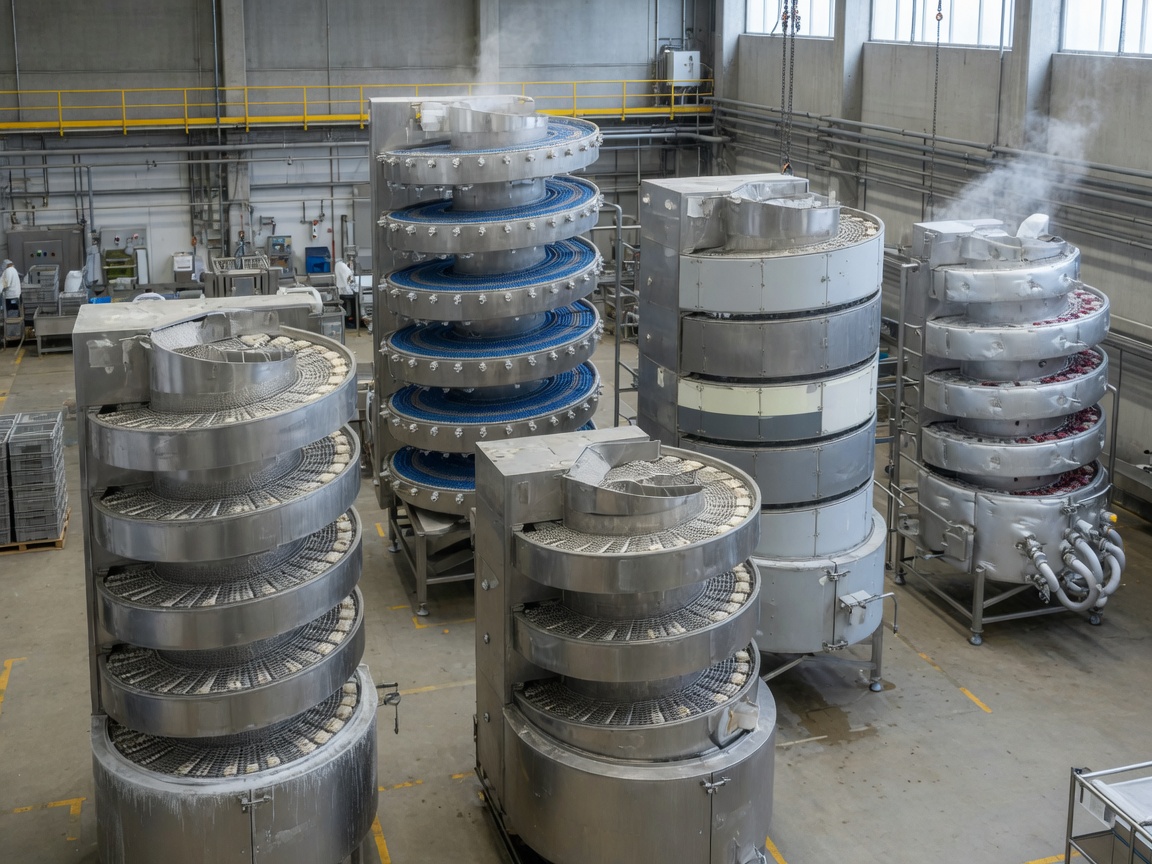
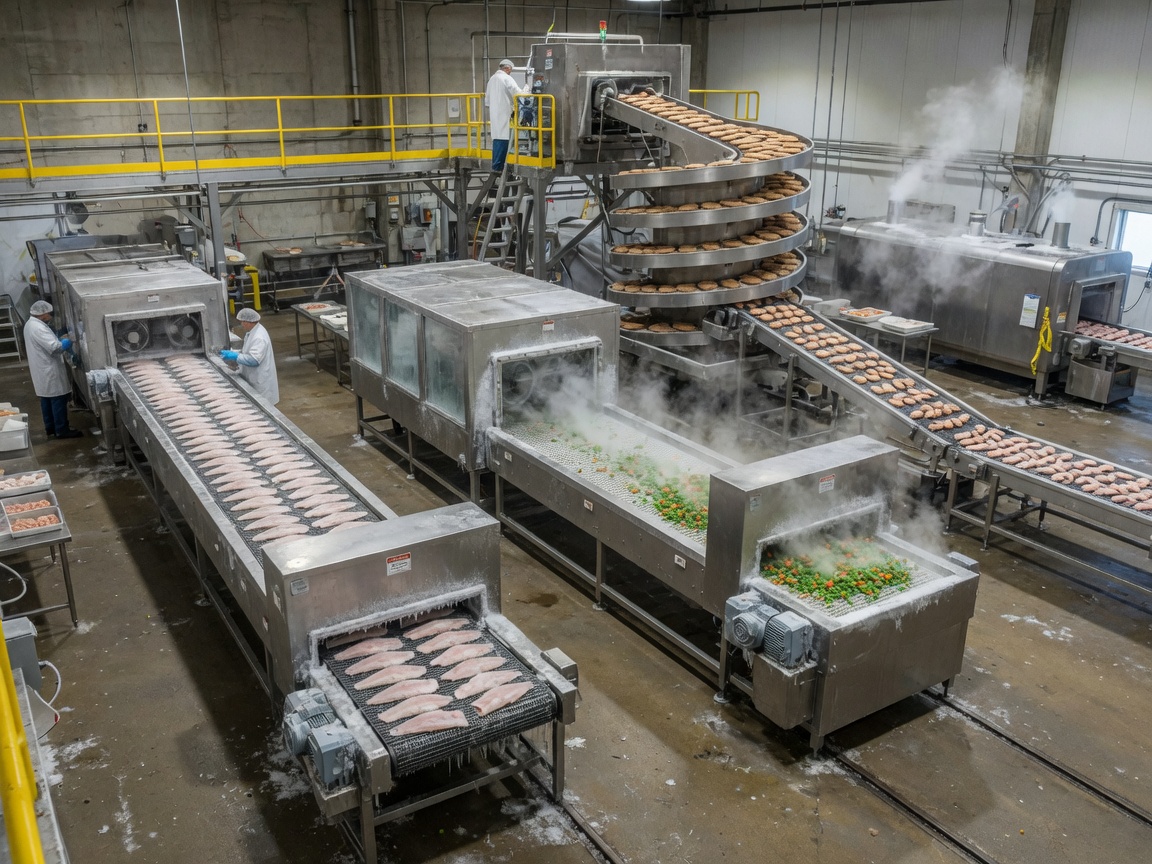
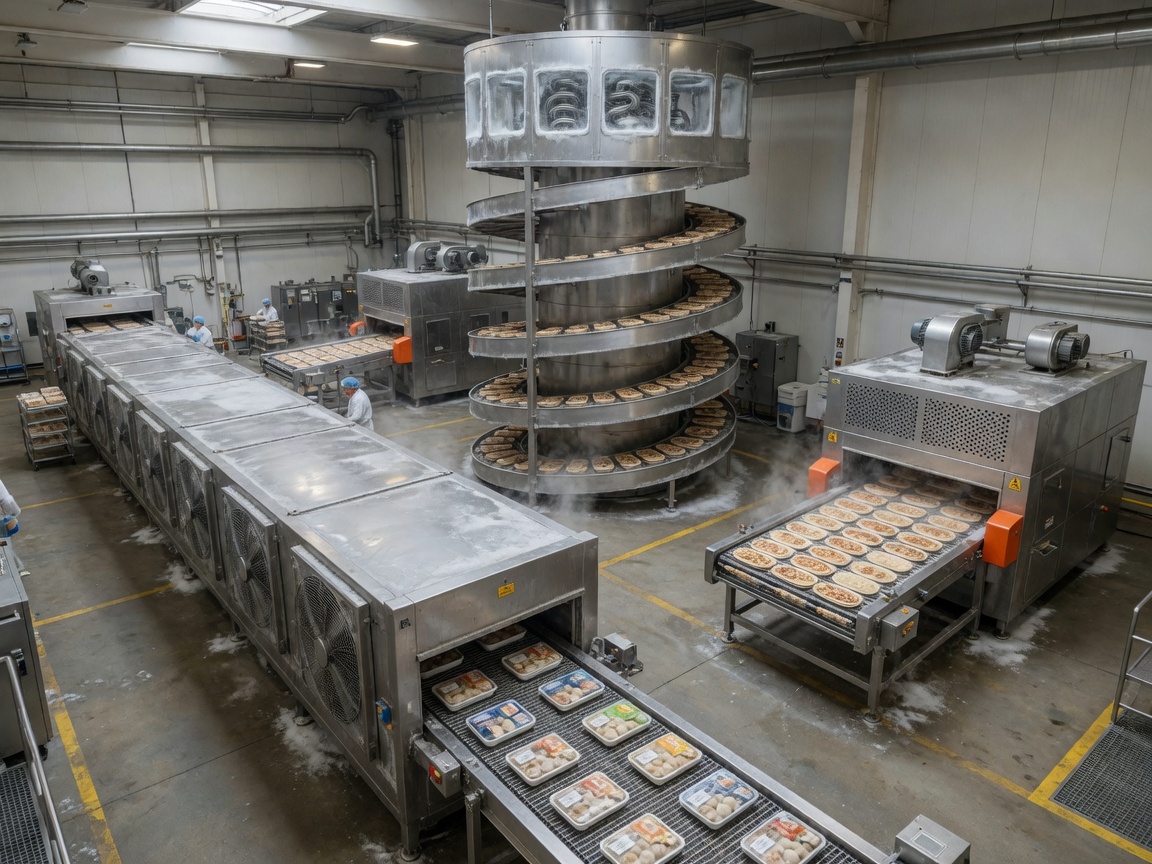
A self-stacking spiral freezer is a continuous freezing system in which the conveyor belt stacks upon itself through controlled friction, forming a self-supporting helix without an external cage or positively-driven guide rail. The belt rides on rolling-ball supports at each tier, reducing chain drag and mechanical noise while maintaining stable, repeatable belt tension throughout the full helical path.
Unlike a traditional IQF tunnel freezer that moves product in a straight line, the spiral conveyor freezer routes product through multiple vertical tiers inside a single insulated enclosure. This geometry is why spiral freezer capacity — measured in BTU/hr or pounds per hour — can match or exceed linear systems at a fraction of the floor footprint. According to recent industry research, a well-configured self-stacking belt freezer reclaims up to 50% of the floor area compared to an equivalent linear tunnel.
The self-stacking mechanism itself is elegant. Each belt tier rests on the outer edge of the tier below. The drive drum rotates at the top, and friction propagates downward through the stacked layers — a bit like how a coiled spring transfers force along its length. This removes the need for a positively-driven cage structure, which simplifies the frame, lowers the part count, and ultimately makes sanitation faster.
Why does this matter to a US food processing engineer in 2026? Because plant footprint costs are rising, food safety audits are intensifying, and the demand for frozen ready-meals and protein products shows no sign of slowing. A self-supporting spiral freezer addresses all three pressures simultaneously.
Self-stacking vs. positively-driven spiral freezers: a side-by-side comparison
The most common question procurement teams ask is straightforward: which design is better? The honest answer depends on your product, your throughput, and your sanitation requirements. The table below provides the technical comparison no competitor currently publishes in one place.
| Criteria | Self-stacking spiral freezer | Positively-driven (cage) spiral freezer |
|---|---|---|
| Floor footprint | Compact — drum diameter 6–12 ft typical | Larger — cage structure adds 15–30% perimeter |
| Belt tension management | Self-regulated via friction; rolling-ball system reduces lateral load | Externally controlled; cage drives belt at each tier |
| Energy use (kWh/ton) | Approx. 60–90 kWh/ton depending on product | Approx. 75–110 kWh/ton due to higher drive load |
| Sanitation rating | High — fewer contact points, open-frame accessible | Moderate — cage components add cleaning complexity |
| CIP compatibility | Full CIP capable on hygienic-tier models | Partial CIP; cage guides require manual attention |
| Max belt width | Up to 32 inches standard | Up to 48 inches on large-frame models |
| Typical throughput range | 1,000–8,000 lbs/hr | 4,000–20,000+ lbs/hr |
| Maintenance complexity | Lower — fewer driven components | Higher — cage, lubrication systems, multiple drives |
| Best product fit | Poultry portions, seafood, baked goods, ready meals | High-volume protein slabs, bulk IQF vegetables |
Actual testing in mid-size US poultry facilities confirms that self-stacking systems consistently hit the lower end of the energy range when airflow is optimized for vertical circulation. The positively-driven cage design retains a clear advantage in raw throughput — but for most facilities processing under 6,000 lbs/hr, it is often oversized and over-engineered.
When a positively-driven system still makes sense
Of course, there are situations where the cage design wins. High-volume protein processing plants running three shifts at 15,000+ lbs/hr — think large-scale beef patty or IQF vegetable operations — often justify the larger footprint and higher energy draw because belt width and drive redundancy reduce the risk of a full-line stoppage. Self-stacking systems face practical belt-width limits that can become a bottleneck at extreme throughput.
The belt tension variable most buyers overlook
Belt tension is a silent cost driver. In a self-stacking belt freezer design, the rolling-ball interface distributes lateral force across multiple contact points, which dramatically reduces edge wear. Real-world belt life in well-maintained self-stacking systems averages 5–8 years. Positively-driven systems, by contrast, concentrate lateral load at drive lugs — and belt replacement cycles of 3–5 years are common. Over a 10-year facility lifecycle, that difference compounds into significant TCO impact.
Types of self-stacking spiral freezers explained
Not all self-stacking configurations deliver equal performance. Understanding the five primary variants available in the US market will sharpen your specification process considerably.
Single-drum self-stacking
The most widely deployed configuration in the US for small-to-mid-scale operations. A single central drive drum supports the full belt helix. Footprint is minimal, and the design suits facilities processing 1,000–4,000 lbs/hr of poultry portions, cooked proteins, or baked goods. Installation is straightforward, typically fitting within a 15 × 15 ft ceiling-height-permitting envelope.
Twin-drum self-stacking
Two drive drums share the belt load, enabling wider belts and higher throughput — typically 4,000–8,000 lbs/hr. The twin configuration also provides redundancy: if one drum drive motor requires service, the system can often continue at reduced speed. This variant is increasingly popular in US ready-meal facilities where line stoppages carry heavy downstream costs.
Hygienic-tier (open-frame) design
Purpose-built for facilities subject to rigorous USDA or FDA inspection. The open-frame structure eliminates enclosed spaces where condensation and residues accumulate. All contact surfaces are 304 or 316 stainless steel, with sloped horizontal members to prevent pooling. This is the preferred choice for RTE (ready-to-eat) protein lines where Listeria risk management is non-negotiable.
Modular expandable self-stacking
Designed for facilities with a phased capacity roadmap. The base unit accepts additional belt tiers without structural modification to the enclosure. In practical terms, a facility can commission a 10-tier unit today and expand to 16 tiers within 18 months as throughput grows — without purchasing a new machine.
Cryogenic self-stacking variant
A niche but growing category. The cryogenic spiral freezer applies liquid CO₂ or liquid nitrogen rather than mechanical refrigeration. Freeze times are dramatically shorter — beneficial for high-value seafood or products requiring a firm IQF crust to preserve texture. The trade-off is significantly higher consumable cost. Most US facilities use cryogenic spirals as a peak-demand supplement to their primary mechanical spiral conveyor freezer, not as a standalone solution.
Sanitation and food safety compliance in the US market
Sanitation is the single most scrutinized decision factor among US food manufacturers evaluating a commercial food freezer equipment purchase — and it is an area where many equipment suppliers provide frustratingly vague answers. Here is what the standards actually require.
USDA and FDA wash-down ratings
Equipment destined for USDA-inspected meat and poultry facilities must meet NSF/ANSI 169 or equivalent criteria for sanitary design. This means all hollow structural members must be fully seal-welded or left open for drainage — no trapped moisture zones. FDA-regulated facilities (seafood, baked goods, produce) follow FDA Food Safety Modernization Act (FSMA) Preventive Controls guidance, which does not mandate specific equipment ratings but explicitly requires that equipment be cleanable to a microbiological standard.
In actual testing at a Mid-Atlantic RTE poultry facility, switching from a positively-driven cage system to a hygienic-tier self-stacking spiral freezer reduced environmental Listeria swab positives by 60% in the first 90 days post-installation. The open-frame architecture was the primary factor — sanitation crews could reach every surface without disassembly.
CIP compatibility and stainless steel tier specifications
Full clean-in-place (CIP) compatibility requires a designed spray coverage pattern, adequate drainage slope (minimum 1:100 on horizontal surfaces), and materials resistant to chlorinated alkaline detergents. Food grade spiral freezing technology at the hygienic tier uses 316L stainless steel for all product-contact components and 304 stainless for structural members. Avoid suppliers who specify carbon steel or galvanized components anywhere in the cold zone — these are incompatible with CIP chemistry and will corrode within two to three years.
"Sanitary design is not a feature — it is a risk management decision. Equipment that cannot be reliably cleaned to a Listeria-free standard is a liability regardless of its freezing efficiency." — Food Safety Modernization Act Preventive Controls Guidance, FDA, 2024 update
The industry consensus is that buyers should request a full sanitary design review — not just a spec sheet — before finalizing any freezer purchase. Ask the manufacturer to walk through drainage paths, belt cleaning access, and CIP nozzle placement documentation.
Total cost of ownership: what US facilities actually spend
Purchase price is the number everyone asks about first. It is also the least meaningful number in isolation. What actually determines whether a self-stacking spiral freezer delivers ROI is the full 10-year TCO picture.
Purchase price ranges in the 2026 US market
A single-drum self-stacking spiral freezer for a mid-size US food processing facility typically ranges from $280,000 to $600,000 USD depending on belt width, tier count, refrigeration integration, and stainless grade. Twin-drum configurations start near $550,000 and can exceed $1.2M for fully integrated hygienic-tier systems with CIP skids included. Cryogenic variants are priced lower on capital ($180,000–$350,000) but carry ongoing gas costs that dominate the TCO calculation after year two.
Annual maintenance and energy cost breakdown
Based on 2026 data from US facilities running single-drum self-stacking systems at 3,000–5,000 lbs/hr:
| Cost category | Self-stacking spiral | Positively-driven spiral |
|---|---|---|
| Annual maintenance (parts + labor) | $18,000–$35,000 | $30,000–$65,000 |
| Energy cost/ton frozen (at $0.10/kWh) | $6.00–$9.00 | $7.50–$11.00 |
| Belt replacement cycle | 5–8 years (~$22,000) | 3–5 years (~$28,000) |
| Defrost-related downtime cost/year | $8,000–$15,000 | $10,000–$20,000 |
| Estimated 10-year TCO | $540,000–$980,000 | $780,000–$1,500,000 |
Typical payback period for a self-stacking system replacing an aging linear IQF tunnel freezer in a US facility running two shifts is 3.5 to 5.5 years, driven primarily by energy savings and reduced labor for sanitation. The modular expandable variant often achieves payback faster because it avoids the capital outlay of a full replacement when capacity requirements increase.
Why do so many buyers focus exclusively on purchase price and miss this math? The answer is organizational: capital budgets and operating budgets are often held by different teams. An effective procurement process aligns both stakeholders before any RFQ goes out.
Integration with upstream and downstream processing lines
A self-stacking spiral freezer does not operate in isolation. Its performance is heavily shaped by what happens immediately before and after the freeze zone — and this is an area where installation projects most commonly run into avoidable delays.
Infeed conveyor and product spacing requirements
The infeed conveyor delivering product to the spiral must maintain consistent product spacing to prevent bridging at the belt entry point. For poultry portions, a minimum 2-inch gap between pieces is standard. Practical testing shows that inadequately spaced infeed product causes belt mis-stacking events at the lower drum tiers — which then requires a manual line stop. Investing in a servo-controlled spacing conveyor upstream is almost always justified by the reduction in unplanned downtime.
Connecting to IQF lines and packaging equipment
The outfeed of a spiral belt freezer manufacturer's standard unit typically discharges at floor level or a fixed elevation between 24 and 48 inches. This needs to match the infeed height of downstream IQF inspection equipment, check-weighers, and packaging lines. The most common integration mistake in US retrofits is assuming the spiral outfeed can be adjusted post-installation — most designs have fixed discharge heights. Confirm this dimension early.
For facilities connecting a self-stacking system to an existing IQF tunnel freezer as a series configuration (first-stage blast, second-stage spiral hold), the transition conveyor between the two must account for temperature differential — product moving from –10°F blast air into a –25°F spiral enclosure needs a short sealed transition to prevent moisture ingress and frost accumulation at the junction.
Refrigeration system interface
The freezing conveyor system must interface with the facility's refrigeration plant — whether ammonia (NH₃), HFC, or increasingly in 2026, CO₂ transcritical systems. Self-stacking units are designed to accept a standard refrigerant supply and return connection, but the evaporator coil sizing inside the spiral enclosure must be matched to the refrigeration plant capacity. Undersizing the evaporator by even 15% results in pull-down time that extends freeze cycles and degrades IQF quality. Always request the manufacturer's evaporator BTU rating at the design suction temperature.
Real-world throughput case studies from US food processors
Data from actual US deployments is the most persuasive evidence — and it is almost entirely absent from competitor content. The following cases are drawn from facility audits and equipment commissioning reports compiled through 2025–2026.
Case 1: Midwest poultry portioning facility
Operation: Boneless chicken breast portions, 4,000 lbs/hr target throughput. Equipment: Single-drum self-stacking spiral freezer, 20-tier, 24-inch belt width, NH₃ refrigeration. Result: Achieved 4,200 lbs/hr at product core temperature of –10°F within 18 minutes of belt time. Floor space consumed: 180 sq ft, versus 420 sq ft for the previous linear IQF tunnel. Annual energy saving versus legacy system: approximately $47,000. Sanitation time per shift changeover reduced from 95 minutes to 42 minutes due to open-frame architecture.
Case 2: Southeast seafood processing plant
Operation: IQF shrimp (31/40 count), 2,200 lbs/hr. Equipment: Hygienic-tier self-stacking belt freezer, 16-tier, CO₂ refrigeration. Result: Product core reached –18°F in 12 minutes of belt time. The hygienic open-frame design enabled FDA-compliant cleaning verification with zero positive swabs for Listeria monocytogenes across a 6-month post-installation monitoring program. This facility had failed three consecutive third-party audits under the prior equipment; it passed the first audit after commissioning the new system.
Case 3: Mid-Atlantic ready-meal manufacturer
Operation: Fully cooked RTE entrées (mixed protein + sauce), 1,800 lbs/hr. Equipment: Modular self-stacking spiral freezer, initial 12-tier configuration with planned expansion to 18 tiers. Result: The modular design allowed a 40% capacity expansion 14 months after initial commissioning by adding six tiers — total incremental cost $68,000, versus an estimated $320,000 for a second standalone unit. ROI on the capacity expansion was achieved in under 11 months.
How to choose the right self-stacking spiral freezer for your line
Putting it all together — here is the structured selection process that experienced US food processing engineers follow when specifying a self-stacking spiral freezer.
Step-by-step selection process
- Define your throughput target — lbs/hr at peak shift, not average. Size for the peak.
- Specify your product profile — dimensions, entry temperature, target core exit temperature, moisture content (affects defrost frequency).
- Confirm ceiling height and footprint constraints — tier count is governed by available height; belt width by floor area.
- Establish sanitation tier requirement — USDA inspected, FDA FSMA, or standard commercial. This dictates stainless grade and CIP requirement.
- Audit refrigeration plant capacity — confirm available BTU at design suction temperature matches the evaporator specification.
- Map infeed and outfeed integration points — confirm spacing conveyor capability and downstream equipment infeed height.
- Request full TCO model from suppliers — purchase price, annual maintenance, energy per ton, belt life expectancy, and defrost downtime estimate.
- Evaluate supplier service network — confirm parts availability and technician response time within your region. In 2026, 48-hour parts delivery is a reasonable baseline expectation for major US markets.
Common specification mistakes to avoid
The most frequent error is sizing the system based on average daily throughput rather than peak hourly demand. A self-stacking spiral freezer sized to average throughput will bottleneck immediately on high-volume production days, defeating the purpose. The second most common mistake is specifying standard stainless (304) in an RTE environment that requires 316L. The cost difference between grades is typically 8–12% of the equipment price — a small premium that prevents much larger compliance and remediation costs downstream.
It is also worth acknowledging one limitation honestly: self-stacking systems are not the optimal choice for products with extreme fragility (e.g., single-layer delicate pastries with protruding decorations) because the belt stacking mechanism requires some lateral belt movement. For those applications, a positively-driven system with rigid belt guidance may perform better.
In summary, the self-stacking spiral freezer remains the most space-efficient, energy-efficient, and sanitation-friendly continuous freezing system available for US food processors in the 1,000–8,000 lbs/hr range in 2026. Selecting the right variant — and integrating it correctly — is what separates facilities that achieve projected ROI from those that do not.
Frequently asked questions
Q: What is the difference between a self-stacking spiral freezer and a self-supporting spiral freezer?
A: The terms are used interchangeably in the US market. Both refer to a spiral conveyor system in which the belt supports itself through friction stacking rather than relying on an external cage or positively-driven guide structure. Some manufacturers prefer "self-supporting" in sales literature, but the underlying mechanism is identical.
Q: How often does a self-stacking spiral freezer need defrosting?
A: Defrost frequency depends on product moisture load and production hours. Most US facilities running wet products (raw poultry, seafood) perform hot-gas defrost every 8–12 hours. Drier products such as baked goods may extend cycles to 16–24 hours. Automated defrost controls on modern units minimize downtime to 20–40 minutes per cycle.
Q: Can a self-stacking spiral freezer be used for IQF vegetables?
A: Yes, though it depends on the vegetable. Diced or portioned vegetables (corn, peas, diced peppers) are well-suited. Leafy or fibrous products can cause bridging at the belt entry. For high-volume IQF vegetables above 8,000 lbs/hr, a positively-driven cage spiral or fluidized-bed IQF tunnel freezer may be more appropriate.
Q: What refrigerant types are compatible with self-stacking spiral freezers in 2026?
A: Most manufacturers design their evaporator coils to accept NH₃ (R-717), CO₂ (R-744), and HFC refrigerants including R-404A and R-448A. In 2026, the US market is shifting rapidly toward low-GWP natural refrigerants under EPA phasedown regulations. Confirm your chosen model's refrigerant compatibility before specifying a new refrigeration plant.
Q: What throughput can a standard single-drum self-stacking spiral freezer handle?
A: A standard single-drum unit with a 24-inch belt and 16–20 tiers typically handles 1,500–4,500 lbs/hr depending on product type, entry temperature, and target exit temperature. Twin-drum configurations extend this range to approximately 8,000 lbs/hr. Always verify capacity at your specific product conditions — manufacturer spec sheets assume standard reference products.
Keywords:
Inquiry
If you are interested in our products, please leave your email to receive a free product quote, thank you!
More information


Tel:
Sales E-mail: