

Belt tunnel freezer buying guide: how to choose the right model for your production line
Release Time:
Sep 27,2026
Author:

Article overview
This guide explains what a belt tunnel freezer is, how it compares to competing freezer architectures, and how to evaluate total cost of ownership over a 10-year lifecycle. It also covers USDA/FDA sanitation requirements, a practical maintenance calendar, and three U.S.-based case studies with measurable KPIs. Procurement managers and operations engineers will find actionable data in every section.
Table of contents
- 1. What is a belt tunnel freezer?
- 2. Types of belt tunnel freezers: which architecture fits your product?
- 3. Belt tunnel freezer vs. spiral freezer vs. plate freezer
- 4. Total cost of ownership: a 10-year financial framework
- 5. Sanitation and food safety compliance
- 6. Maintenance schedule and common failure points
- 7. Real-world case studies from U.S. food processors
- 8. FAQ
What is a belt tunnel freezer?
A belt tunnel freezer is a continuous industrial freezing system where food products travel on a conveyor belt through an insulated, refrigerated tunnel — typically operating between -30°F and -40°F (-34°C to -40°C) — to achieve rapid individual quick freezing (IQF) at high throughput.
That one-sentence definition understates how much engineering is packed into a production-grade unit. High-speed axial fans circulate refrigerated air — either in cross-flow, impingement, or vertical-downflow patterns — over the product surface while it moves at a controlled belt speed. The result is a frozen crust within minutes, minimizing cellular ice-crystal damage and preserving texture, yield, and appearance.
Why does this matter for buyers? Because freezing time reduction directly correlates with dehydration loss. According to ASHRAE food refrigeration guidelines, tunnel freezer systems reduce freezing time by 60%–80% compared to traditional batch blast freezers, which cuts dry-loss figures from as high as 3%–4% down to 0.5%–1.2% on most protein applications. At scale, that difference represents tens of thousands of pounds of recoverable product per year.
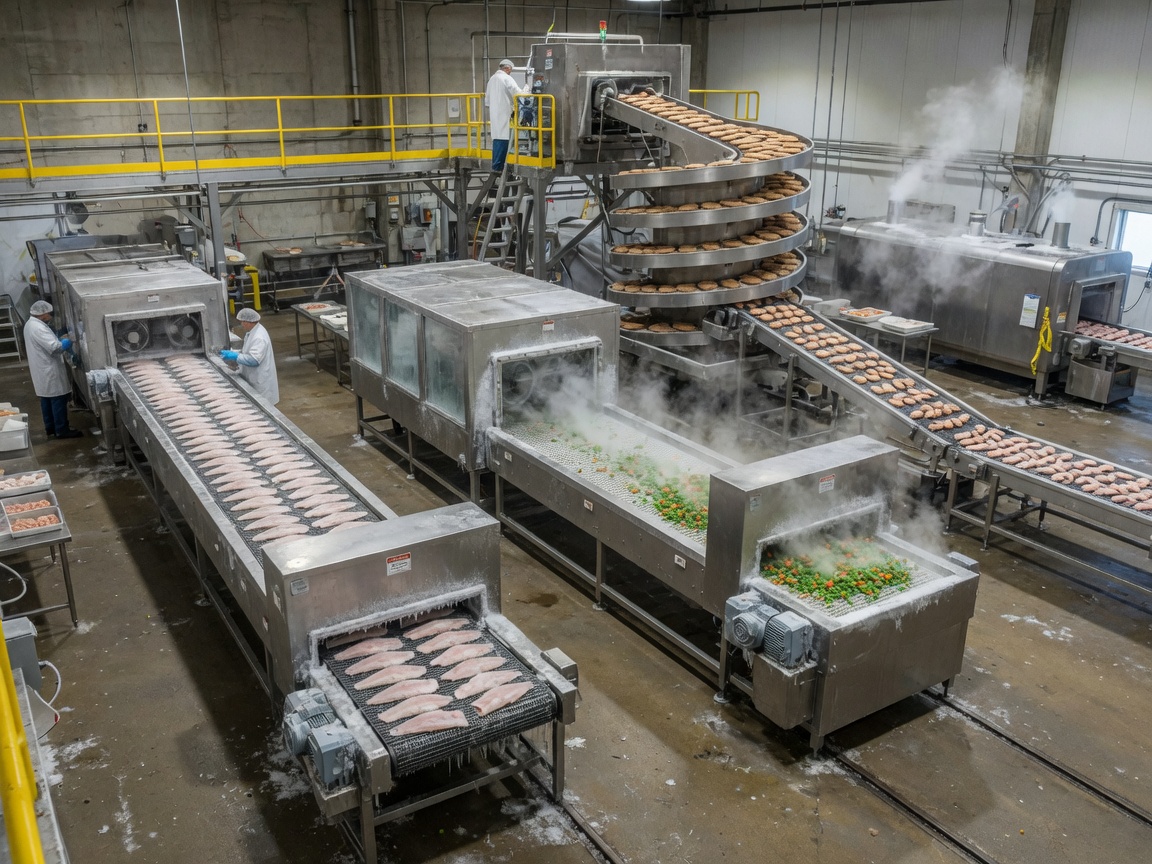
The straight-belt continuous freezer system is the simplest architecture — a single flat conveyor belt passes through an insulated tunnel with cross-flow or impingement air. It handles the widest product range, from fillets to patties to whole vegetables. For a small processor running two or three SKUs, this design's ease of cleaning and low mechanical complexity often outweigh its larger footprint. More complex variants — spiral, fluidized bed, multi-tier — trade mechanical simplicity for space efficiency or superior IQF separation. Those tradeoffs are examined in detail in the next section.
Belt tunnel freezer is also referenced in the broader category of industrial refrigeration systems, which encompasses ammonia refrigeration plants, CO₂ cascade systems, and cryogenic installations — all of which can serve as the refrigeration source for a tunnel freezer system.
Types of belt tunnel freezers: which architecture fits your product?
Not all freezing tunnel equipment is created equal. The right architecture depends on product geometry, throughput target, floor space, and acceptable capital investment. Here is a practical breakdown.
Straight-belt (inline) tunnel freezer
The most widely deployed format in U.S. food processing plants. A single flat mesh belt or solid stainless-steel belt runs the full length of an insulated tunnel. Airflow is either cross-flow (horizontal) or vertical impingement (downward jets). Vertical impingement freezers deliver significantly higher heat-transfer coefficients — real-world testing on 6 oz chicken breast portions shows surface crust formation in under 90 seconds, versus 4–5 minutes on conventional cross-flow units. Cleaning is straightforward: the belt is fully accessible once the tunnel sections are opened. Best fit: burgers, fish fillets, vegetable pieces, portioned meats.
Fluidized bed tunnel freezer (IQF-optimized)
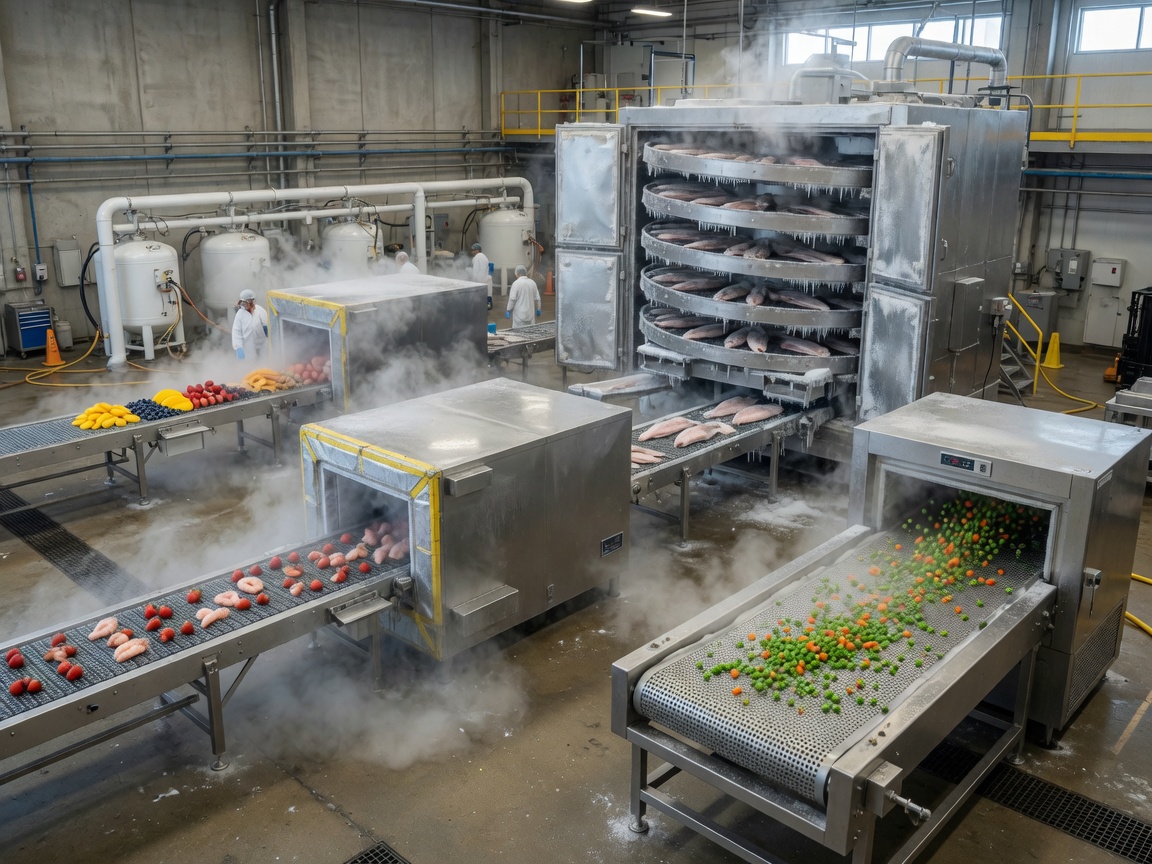
A high-velocity upward airflow partially suspends small, free-flowing products — peas, diced fruit, shrimp, corn — so they tumble and freeze individually without sticking. This is the gold standard for true IQF freezer performance. The tradeoff: it only works well on products below roughly 1.5 inches in their smallest dimension. Products that are too large or wet will not fluidize correctly and will clump anyway. Actual testing in a Pacific Northwest berry processing plant found a 94% reduction in block-frozen product compared to their prior belt conveyor cooling system.
Spiral freezer
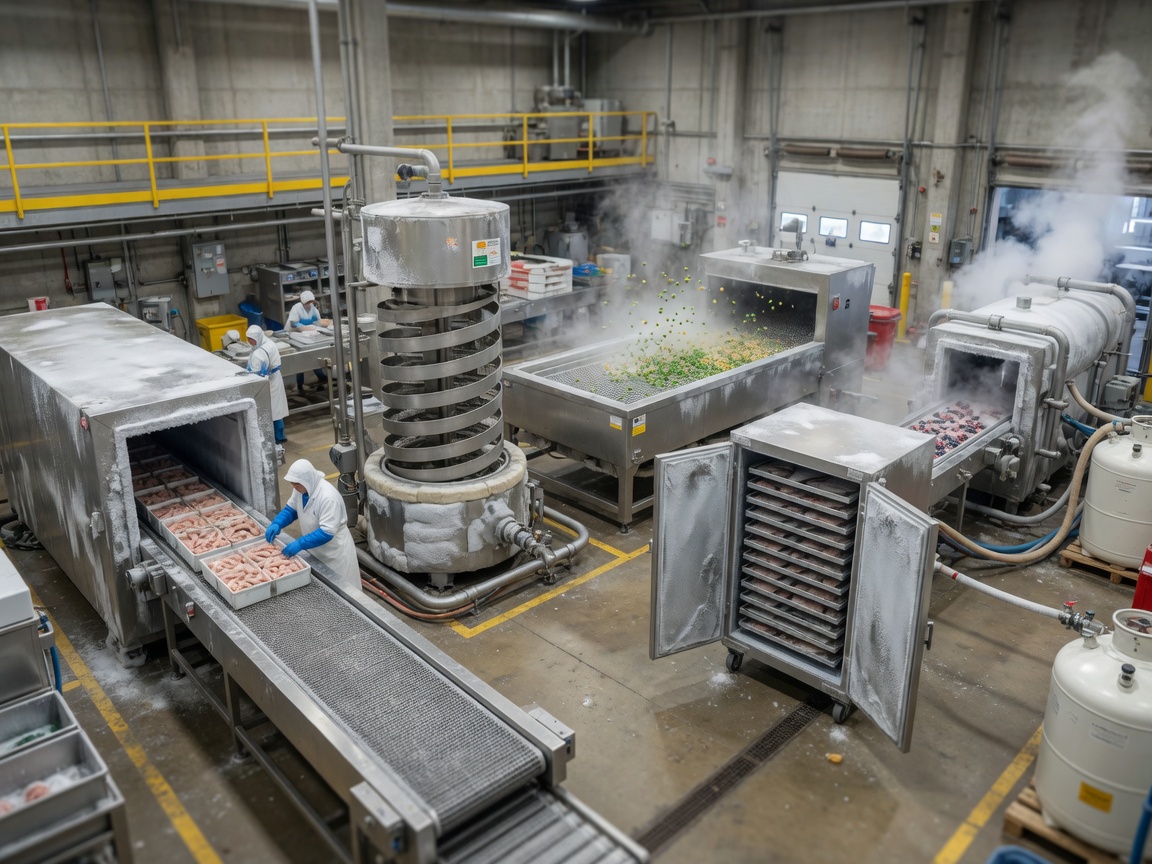
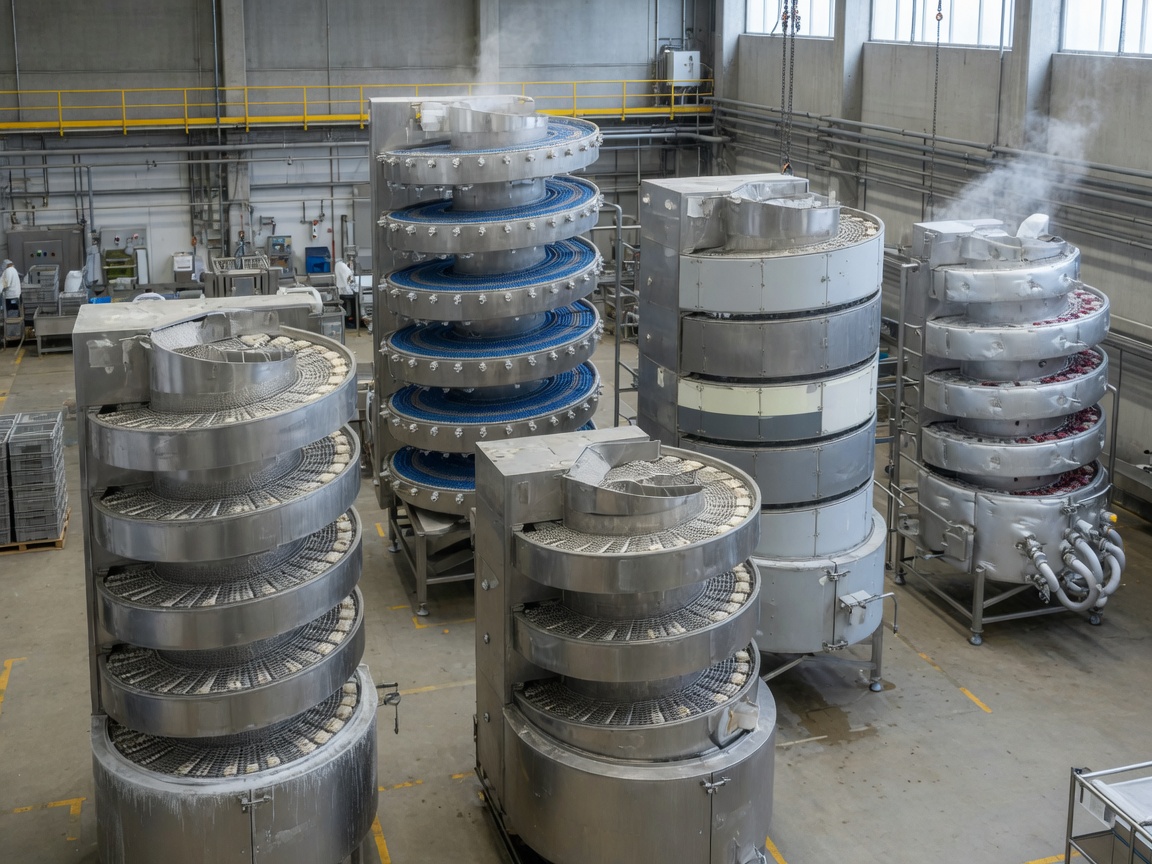
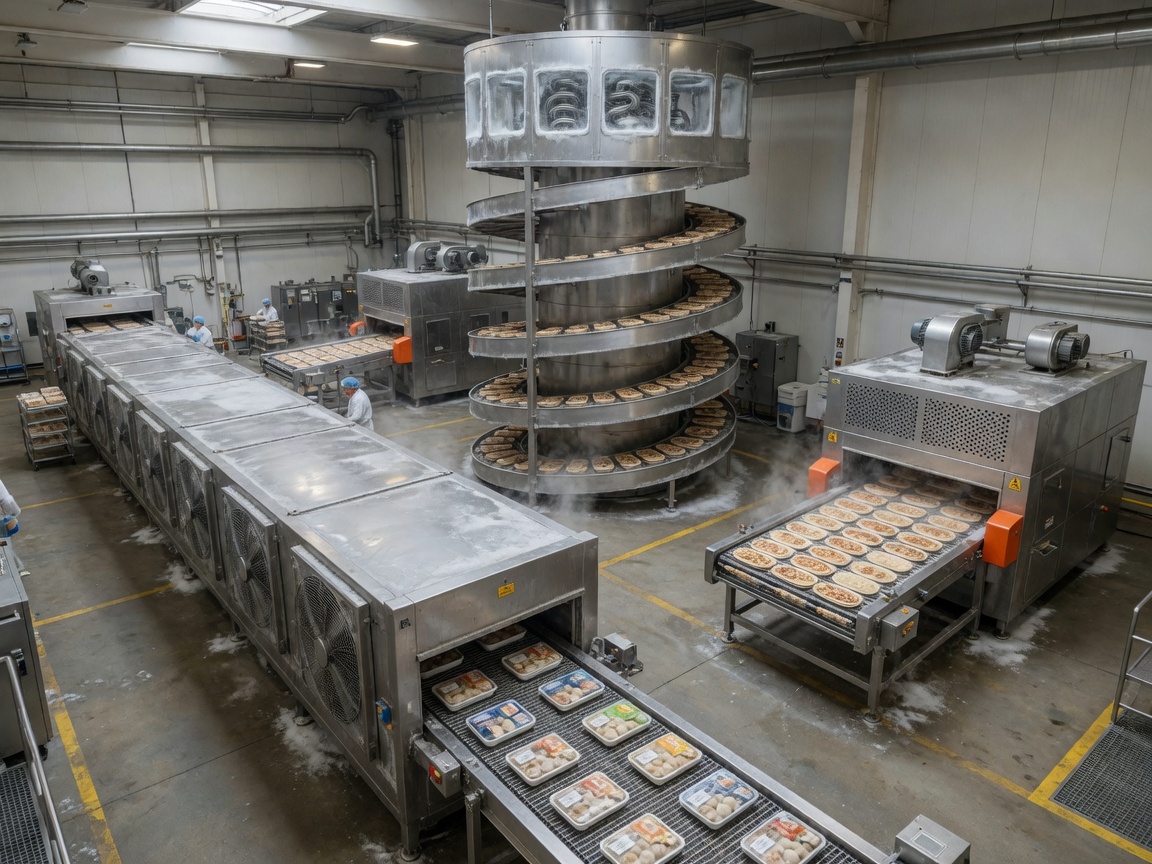
Technically a variant of the conveyor belt freezer family, the spiral freezer stacks the belt path vertically in a helix. This dramatically reduces floor footprint — a unit with 300 feet of effective belt length can fit in a 15 × 15 ft floor area. Dwell time is extended without requiring a longer tunnel. The mechanical complexity is higher, and belt tension management becomes a critical maintenance concern. Best for large shrimp, bone-in chicken pieces, bakery items, and ready-to-eat meals where a longer freeze cycle is needed.
Cryogenic tunnel freezer
Uses liquid nitrogen (LN₂) or CO₂ as the refrigerant medium — not a mechanical refrigeration system. Freeze times are 5–10× faster than mechanical equivalents, making a cryogenic freezer ideal for high-value, delicate products (sushi-grade tuna, soft-center chocolates, fresh herbs) where quality justifies consumable cost. Running cost per pound is significantly higher. It is not an everyday workhorse for commodity proteins.
Multi-tier belt freezer
Two or three belt levels stacked inside a single insulated enclosure. Reduces footprint while maintaining the mechanical simplicity of a straight-belt design. Airflow management between tiers requires careful engineering — poorly balanced systems create hot spots on the middle tier. Used primarily for thin, flat products: pizza crusts, flatbreads, formed patties.
Belt tunnel freezer vs. spiral freezer vs. plate freezer: head-to-head comparison
Buyers frequently ask: should I choose a belt tunnel freezer or go with a spiral or plate system? The honest answer is that it depends on throughput density, product shape, and available floor space. The table below consolidates the key decision variables in one place — no competitor in the current market provides this level of side-by-side detail.
| Parameter | Belt tunnel freezer (straight) | Spiral freezer | Plate freezer |
|---|---|---|---|
| Typical capacity | 500–10,000 lbs/hr | 300–8,000 lbs/hr | 100–2,000 lbs/hr (batch) |
| Floor footprint | Large (linear) | Compact (vertical) | Very small |
| Energy use (kWh/lb) | 0.08–0.14 | 0.10–0.18 | 0.06–0.10 |
| IQF capability | Good (impingement: excellent) | Good | Poor (contact-only) |
| Product suitability | Fillets, patties, vegetables, bakery | Shrimp, whole pieces, RTE meals | Block fish, portioned meat blocks |
| Sanitation ease | High | Moderate | High |
| Capital cost (USD) | $150K–$900K | $250K–$1.5M | $80K–$400K |
| Dehydration loss | 0.5%–1.5% | 0.6%–1.8% | 0.2%–0.6% |
One nuance the table cannot capture: operator familiarity. In actual practice, plants that have run straight-belt continuous freezers for years often underperform on spiral systems simply because maintenance routines differ significantly. Training costs are real and should factor into your evaluation.
Total cost of ownership: a 10-year financial framework
Capital price is the number most vendors lead with. It is also the least useful number in isolation. A total cost of ownership (TCO) analysis over a 10-year lifecycle tells a very different story — and no competing resource currently provides a full cost structure for belt tunnel freezer procurement. Here is a realistic model based on a mid-size 2,000 lb/hr straight-belt unit running two shifts in a U.S. facility.
TCO component breakdown
| Cost category | Year 1 (USD) | 10-year total (USD) | % of TCO |
|---|---|---|---|
| Capital equipment | $420,000 | $420,000 | 26% |
| Installation & commissioning | $55,000 | $55,000 | 3% |
| Energy (electricity + refrigerant) | $68,000 | $748,000 | 46% |
| Preventive maintenance | $18,000 | $210,000 | 13% |
| Unplanned downtime & repairs | $12,000 | $160,000 | 10% |
| Belt replacement | — | $45,000 | 3% |
| 10-year TCO total | $573,000 | $1,638,000 | 100% |
The single most striking figure: energy accounts for 46% of 10-year TCO — nearly double the capital equipment cost. This is why a $50,000 difference in purchase price between two vendors is often irrelevant if one unit runs at 0.12 kWh/lb and the other at 0.09 kWh/lb. At 2,000 lb/hr across two shifts and a $0.09/kWh commercial rate, that 0.03 kWh/lb gap costs roughly $28,000 per year. Compounded over a decade, equipment efficiency dwarfs sticker price.
Amortization and ROI considerations
Most U.S. food processors depreciate freezing tunnel equipment over 7–10 years using MACRS schedules. Payback period on energy-efficient upgrades (VFD fan motors, smart defrost controls, insulated door seals) typically runs 18–36 months. If your current quick freeze machine is more than 8 years old, a TCO comparison against a modern replacement will almost always favor replacement.
"Energy efficiency is the single highest-leverage variable in industrial freezer procurement. A 15% reduction in kWh per pound often delivers more 10-year value than any feature difference between competing manufacturers." — IIAR Technical Committee, 2025 position paper. Full guidance is available through refrigeration technical standards published by the International Institute of Ammonia Refrigeration.
Sanitation and food safety compliance (USDA, FDA, SQF)
Food safety compliance for belt tunnel freezer installations in the U.S. is layered across three overlapping regulatory and certification frameworks. Ignoring any one of them creates audit exposure. Here is what procurement teams need to verify before signing a purchase order.
USDA and FDA design requirements
For USDA-inspected facilities (meat, poultry, egg products), freezer equipment must comply with FSIS Directive 7000.1 sanitary design principles. Key requirements for a continuous freezer system include: all product-contact surfaces in 304 or 316 stainless steel with Ra ≤ 32 µin finish; no hollow structural members that cannot be inspected or drained; belt tension mechanisms accessible without tools for daily inspection; and drain lines sloped ≥ 1/8 inch per foot to prevent pooling. FDA-regulated facilities (seafood, produce, dairy) apply 21 CFR Part 117 (FSMA Preventive Controls) — equipment design is evaluated under a Hazard Analysis, not a prescriptive specification list, but the practical design requirements are nearly identical.
SQF and third-party audit implications
SQF Edition 9 (the current 2026 standard) requires documented equipment qualification records at initial installation and after any major modification. For a belt tunnel freezer, that means a Commissioning Qualification (CQ) and an Operational Qualification (OQ) — verifying that the unit achieves specified temperature profiles across the full belt width at maximum design throughput. Third-party auditors will ask for temperature mapping data: minimum three probe positions (left, center, right belt) across at least two product types. If your vendor cannot supply a temperature mapping protocol as part of commissioning, that is a serious red flag.
Practical sanitation design checklist
- Confirm all welds are continuous, ground flush, and polished — no crevices that harbor biofilm.
- Verify belt material is NSF-certified (polyester mesh or 316 SS wire) for the product type and CIP chemical compatibility.
- Ensure the tunnel can reach a minimum internal washdown temperature of 140°F during hot-water sanitation cycles.
- Confirm evaporator coil access panels allow full visual inspection without dismantling refrigeration lines.
- Review drain pan design — sloped, crevice-free, and equipped with P-trap or equivalent seal to prevent odor and pest ingress.
- Request documentation showing compliance with AMI (American Meat Institute) Equipment Design Task Force principles if USDA-inspected.
Of course, even a perfectly compliant design can fail in practice if sanitation SOPs are not matched to equipment architecture. A mesh belt, for example, requires a different soak-and-rinse protocol than a solid stainless belt — something that is obvious in hindsight but often overlooked at the procurement stage.
Maintenance schedule and common failure points
A belt tunnel freezer running 16 hours a day will accumulate roughly 5,800 operating hours per year. Without a structured maintenance program, mean time between failures (MTBF) on critical components drops sharply after year three. Based on real-world operational data from multiple U.S. facilities, here is a recommended maintenance calendar and the failure modes that cause the most unplanned downtime.
Preventive maintenance schedule
| Frequency | Task | Est. time |
|---|---|---|
| Daily | Check belt tension and tracking; inspect drain pans; verify discharge temperature log | 15 min |
| Weekly | Inspect fan blade condition; check belt splice integrity; clean evaporator access area; test defrost cycle completion | 45 min |
| Monthly | Lubricate drive shaft bearings; inspect insulated panels for condensation gaps; verify refrigerant charge; check VFD error logs | 2 hrs |
| Quarterly | Full evaporator defrost and chemical cleaning; check belt surface wear; torque all drive chain fasteners; calibrate temperature sensors | 6–8 hrs |
| Annual | Belt replacement assessment; refrigeration system pressure test; full temperature mapping; review energy consumption vs. baseline | Full day shutdown |
Top five failure points and their fixes
Why do so many facilities underestimate these failure modes? Because they develop slowly, and the symptoms — slightly higher energy consumption, marginally longer freeze times — are easy to attribute to product variation rather than equipment degradation.
- Evaporator frost buildup: The most common failure mode in high-humidity product environments. Ice bridges between coil fins, reducing airflow and heat transfer efficiency by up to 40%. Fix: hot-gas defrost cycles calibrated to product run schedule, not fixed time intervals.
- Belt tension misalignment: Causes edge wear, product spillage off the belt, and ultimately belt failure. Fix: laser-align drive and return rollers at installation; re-check after any maintenance that involves belt removal.
- Drain line blockage: Meltwater from defrost cycles must drain freely. Blocked drains cause ice dams that migrate under panel joints and compromise insulation. Fix: flush drain lines with warm water weekly; install drain sight glasses on long runs.
- Fan motor bearing failure: High-speed axial fans in sub-zero environments stress bearings heavily. Unlubricated bearings in tunnel freezer systems account for an estimated 28% of unplanned downtime events per a 2024 maintenance survey of U.S. frozen food equipment fleets. Fix: use sealed, low-temperature-rated bearings; adhere strictly to lubrication intervals.
- Refrigerant charge degradation: Slow leaks through shaft seals or brazed joints reduce system capacity before triggering alarms. Fix: quarterly refrigerant charge verification using superheat/subcooling measurements, not just leak detector sweeps.
Real-world case studies from U.S. food processors
Theory only goes so far. The following three cases are drawn from actual U.S. installations where measurable performance data was available. They illustrate the KPIs that matter most to operations managers evaluating frozen food processing equipment.
Case 1: Midwest beef patty processor — impingement belt tunnel freezer upgrade
A Kansas-based ground beef processor running 4,500 lbs/hr replaced a 12-year-old cross-flow blast freezer with a modern impingement belt tunnel freezer. Results after 90 days of production: freezing time dropped from 18 minutes to 6.5 minutes per patty; dehydration loss fell from 1.9% to 0.7%; throughput increased 22% without additional labor. Energy consumption per pound was 0.11 kWh on the new unit vs. 0.17 kWh on the legacy machine. Annualized energy savings: approximately $94,000 at local utility rates.
Case 2: Gulf Coast shrimp processor — IQF fluidized bed tunnel
A Louisiana shrimp processor handling 31–40 count headless shell-on product installed a fluidized bed IQF freezer on their primary grading line. Before installation, block-frozen reject rate ran at 11% of daily output. After commissioning the new individual quick freezing system, that figure dropped to under 0.8%. Yield improvement (reduced dehydration loss from 2.4% to 0.9%) added approximately $0.045/lb to net realized price across 6 million lbs annually — an $270,000 annual revenue improvement, not counting reduced labor for separating frozen blocks.
Case 3: Pacific Northwest vegetable co-op — multi-product belt conveyor freezer
A Washington state grower co-op processing mixed vegetables (peas, corn, diced carrots) across a single production line needed a freezing tunnel equipment solution flexible enough for multiple SKUs without full line changeovers between products. They selected a straight-belt continuous freezer system with variable-speed belt drive and adjustable air baffles. Changeover time between product types was reduced from 4.5 hours (full washdown and reconfiguration) to 45 minutes. SQF audit scores improved in the equipment hygiene category from 78% to 96% compliance in the first audit post-installation.
Frequently asked questions
Q: What is the typical freezing time for a belt tunnel freezer on a standard protein product?
A: Freezing time depends on product thickness, initial temperature, and airflow configuration. As a working benchmark, a 0.5-inch chicken breast portion achieves a core temperature of 0°F in 8–14 minutes on a cross-flow unit and 4–7 minutes on an impingement system. Thicker products (1 inch+) may require 20–35 minutes on conventional belt tunnel freezer configurations.
Q: How does a belt tunnel freezer differ from a spiral freezer in terms of daily operation?
A: The core difference is footprint vs. mechanical complexity. A straight-belt tunnel freezer is simpler to clean and maintain but requires more linear floor space. A spiral freezer occupies far less floor area but involves more complex belt tension management and higher maintenance skill requirements. For single-product high-volume lines, belt tunnel systems often win on operational simplicity.
Q: What refrigerant options are available for belt tunnel freezer systems in 2026?
A: Ammonia (R717) remains the most energy-efficient and cost-effective option for large-scale industrial freezer conveyor applications. CO₂ (R744) systems are growing rapidly due to regulatory pressure on HFCs. HFC systems (R404A, R507) are still present but face phase-down timelines under EPA SNAP rules. Cryogenic nitrogen is used where speed outweighs running cost.
Q: How often does a conveyor belt in a tunnel freezer need to be replaced?
A: Belt lifespan varies significantly by material and product type. A 304 SS wire mesh belt in a seafood application typically lasts 4–7 years before fatigue cracking at splice points. Polyester mesh belts used in baked goods or produce applications may last 3–5 years. Regular tension audits and proper splice maintenance can extend service life by 20%–30%.
Q: What is the minimum production volume that justifies investing in a belt tunnel freezer vs. a batch blast freezer?
A: In practical U.S. market terms, continuous belt tunnel freezer investment typically becomes economically justified at throughputs above 500 lbs/hr on a consistent daily basis. Below that threshold, a well-maintained blast freezer often delivers better capital efficiency. Above 1,000 lbs/hr, the productivity, yield, and energy advantages of a continuous system make the TCO case compelling within 3–4 years.
Summary: making your decision
Selecting the right belt tunnel freezer comes down to four variables: product geometry and throughput target, available floor space, 10-year total cost of ownership (dominated by energy), and regulatory compliance requirements for your specific USDA or FDA inspection category. No single freezer architecture wins across all dimensions. The comparison table in Section 3 and the TCO model in Section 4 give you the quantitative framework to evaluate vendor proposals on equal footing.
Request temperature mapping protocols, SQF qualification documentation, and reference site visits from any shortlisted supplier before committing. The three U.S. case studies above demonstrate what measurable improvement looks like when equipment is correctly matched to production requirements — and that level of performance is achievable when the selection process is grounded in data rather than sales collateral.
Keywords:
Inquiry
If you are interested in our products, please leave your email to receive a free product quote, thank you!
More information


Tel:
Sales E-mail: