

Custom spiral freezer buyer's guide: how to choose the right system for your production line
Release Time:
Sep 27,2026
Author:

Article overview
This guide is written for food manufacturing engineers and procurement managers at U.S. facilities evaluating custom spiral freezer solutions. It covers system types, cryogenic versus mechanical trade-offs, ROI data, compliance requirements, the step-by-step customization process, and category-specific performance benchmarks — all the information needed to complete a rigorous vendor evaluation.
Table of contents
- 1. What is a custom spiral freezer?
- 2. Cryogenic vs. mechanical spiral freezing: a side-by-side comparison
- 3. ROI analysis and payback period benchmarks for US food plants
- 4. Sanitation, compliance, and regulatory standards
- 5. The customization process: what "custom" actually means step by step
- 6. Product-specific freezing performance data
- 7. 2026 technology trends
- 8. FAQ
What is a custom spiral freezer?
A custom spiral freezer is a continuously operating conveyor-based freezing system in which the belt travels in a vertical helix inside an insulated enclosure, engineered to match a specific facility's throughput, footprint, product type, and temperature requirements. Unlike off-the-shelf equipment, a custom unit is designed from the ground up — belt width, drum diameter, tier count, airflow pattern, and refrigeration integration are all specified to your production reality rather than a catalog default.
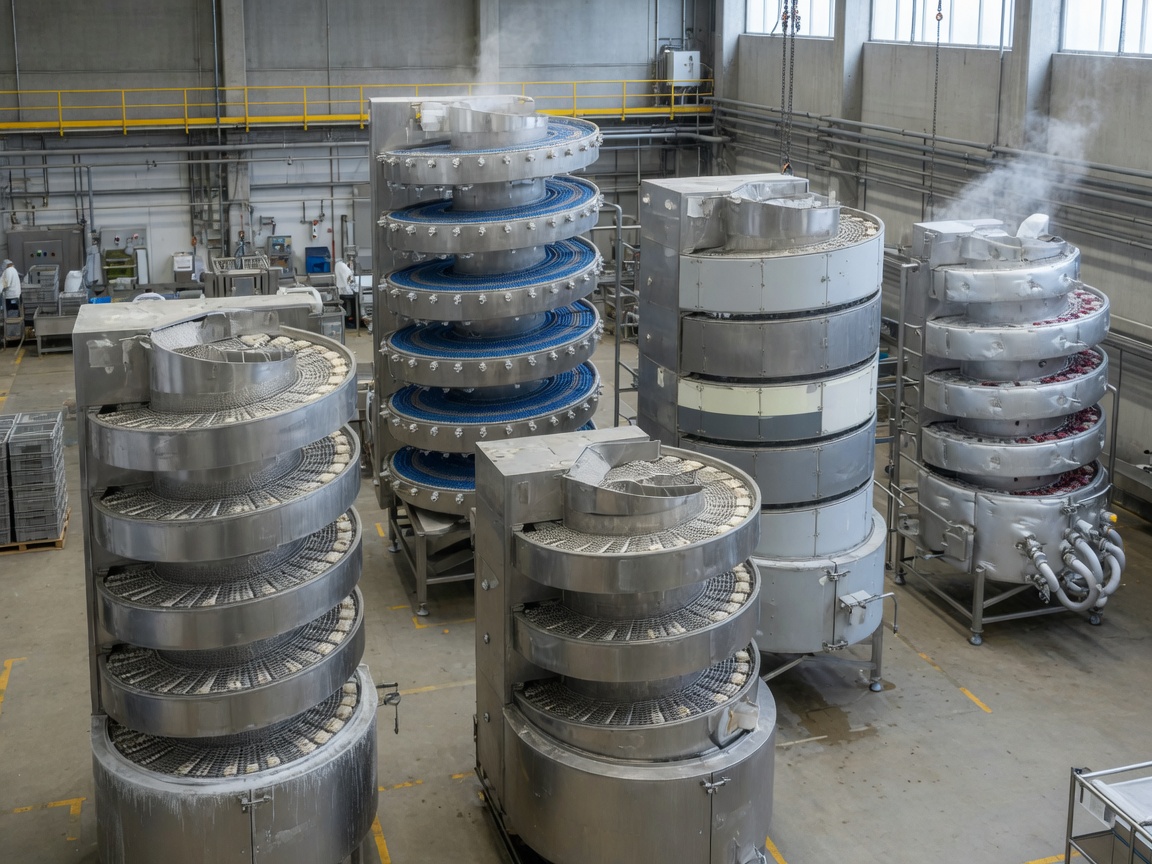
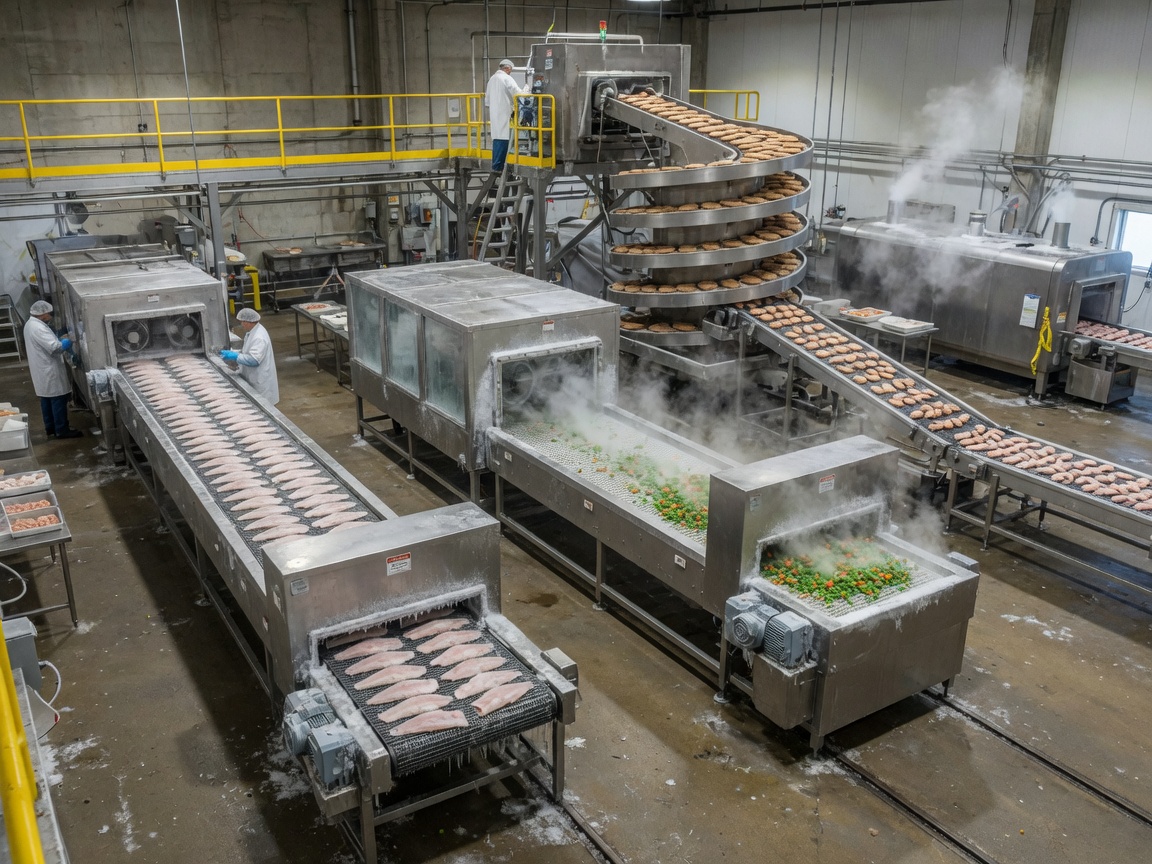
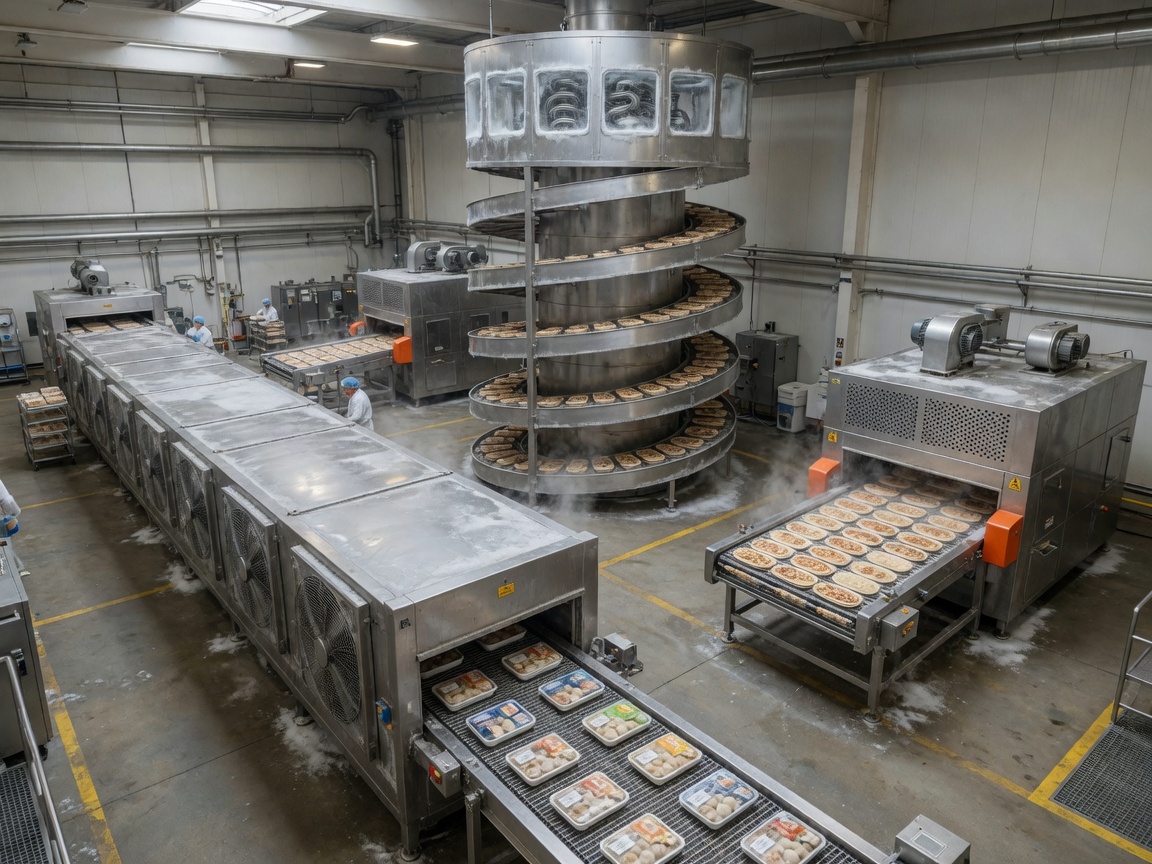
Think of a spiral freezer technology like a vertical parking garage for your product: instead of extending a freezing tunnel horizontally across hundreds of feet of valuable floor space, the conveyor belt winds upward in a helix, packing the same dwell time into a fraction of the footprint. That spatial efficiency is precisely why co-packers, poultry processors, seafood facilities, and bakeries across the United States favor the spiral configuration over a conventional belt freezer or blast freezer tunnel.
The core components — drum, self-stacking or positive-drive belt, evaporator coils, fans, and the insulated enclosure — remain consistent across platforms. What changes in a custom build is how those components are sized, arranged, and integrated with your existing food processing freezer line. According to recent industry data, properly sized custom spiral freezer systems reduce floor space consumption by 20–35% compared to standard models, a figure that directly translates to lower facility overhead costs.
Key system types available in 2026
The continuous freezing equipment market offers several structural variants, each suited to different production environments:
- Self-stacking spiral: The belt supports its own weight on adjacent tiers. Lower mechanical complexity, widely used for IQF vegetables and portions.
- Positive-drive spiral: A driven drum engages the belt edge, providing precise speed control under heavy loads — preferred for dense proteins like bone-in chicken.
- Dual-drum spiral: Two parallel drums within one enclosure, delivering very high throughput for national-scale food manufacturers.
- Hygienic-design spiral: Open-frame stainless steel construction with no horizontal ledges, engineered specifically for ready-to-eat facilities operating under strict FDA inspection regimes.
- Compact modular spiral freezer: Reduced-diameter footprint for retrofit projects; ships in sections and assembles inside existing buildings with limited door clearance.
How a helix freezer differs from adjacent equipment
A helix freezer occupies a distinct position between a flat-belt conveyor freezer and a freezing tunnel. Flat-belt systems offer simpler cleaning but require enormous floor length; blast freezers deliver fast pull-down but are inherently batch-oriented and labor-intensive. The spiral configuration combines continuous operation with compact geometry — which is why it dominates high-volume, automated food manufacturing freezer applications. A custom cryogenic freezer variant adds a liquid nitrogen or CO₂ injection stage, enabling surface crust-freezing in seconds before the mechanical refrigeration stage maintains core temperature.
Cryogenic vs. mechanical spiral freezing: a side-by-side comparison
No competitor in the top Google results provides a clear, honest comparison of these two freezing technologies — yet this is the first technical fork in the road for any U.S. food plant engineer specifying a new system. Here is the data-driven breakdown.
Mechanical spiral freezing uses recirculated refrigerated air (typically NH₃ or HFC-based systems, increasingly CO₂ in 2026 builds) to extract heat gradually over a longer belt path. Cryogenic spiral freezing injects liquid nitrogen (LN₂) or CO₂ directly into the enclosure, achieving surface temperatures as low as −196 °F (LN₂) almost instantly. Both approaches can be configured as a custom spiral freezer — the choice depends on production economics, product quality targets, and throughput volume.
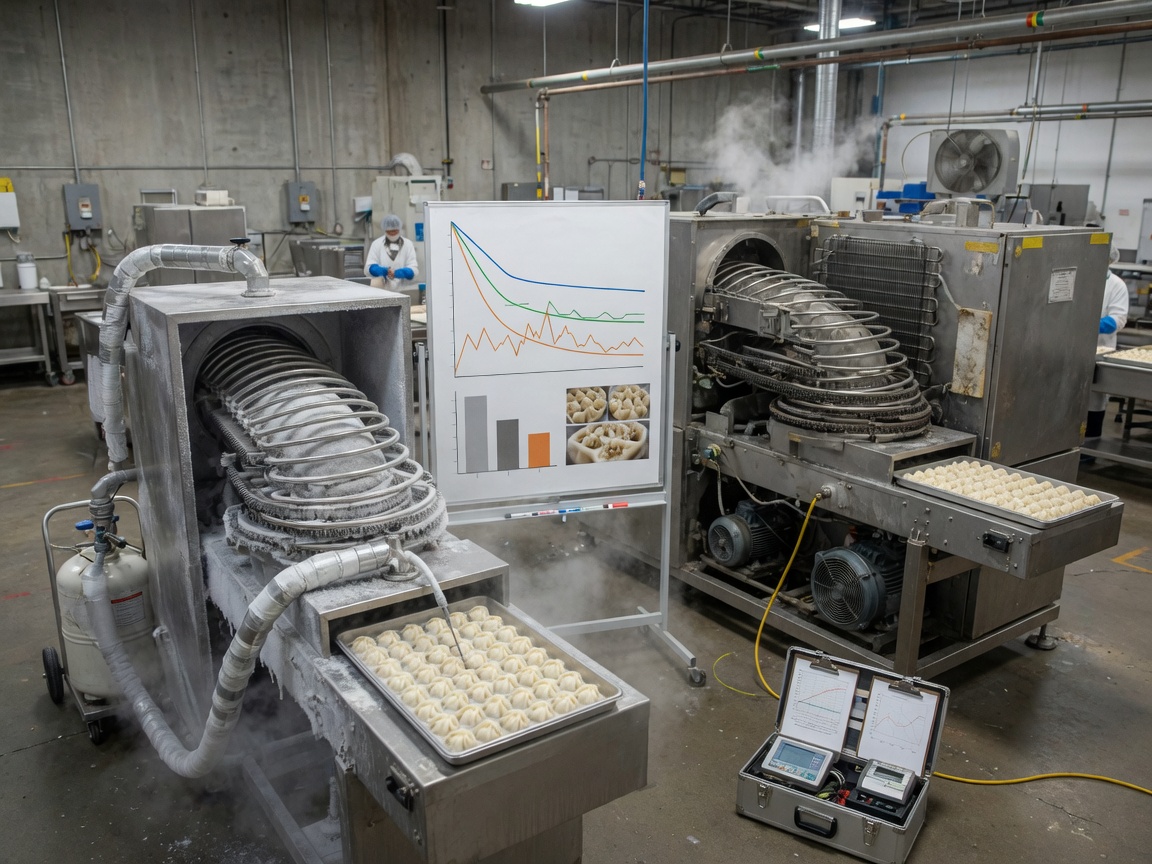
| Criteria | Mechanical spiral freezer | Cryogenic spiral freezer |
|---|---|---|
| Capital cost (typical US install) | $400K – $2M+ | $150K – $600K (equipment only) |
| Operating cost | Low (electricity + refrigerant); $0.01–$0.03/lb | High (LN₂ consumption); $0.06–$0.18/lb |
| Freezing speed | Moderate (8–30 min dwell time) | Very fast (1–5 min surface crust) |
| Product quality impact | Good; slight moisture loss (~1–2%) | Excellent; minimal drip loss; preserves texture |
| Energy efficiency | High (COP 2–4 for NH₃ systems) | Low (LN₂ production is energy-intensive) |
| Footprint | Moderate to large | Compact (shorter belt path needed) |
| Best applications | High-volume IQF, poultry, vegetables | Premium seafood, delicate baked goods, high-value proteins |
| Payback period | 3–6 years | 1–3 years (lower capex offset by higher opex) |
Why do so many procurement teams get this decision wrong? Because they compare sticker prices without modeling operational costs over a 10-year asset life. A mechanical commercial freezing system with a $900K upfront investment can deliver a total cost of ownership (TCO) 40–60% lower than cryogenic over a decade at volumes above 5,000 lbs/hour. Below that threshold, the math often flips.
Hybrid cryogenic-mechanical configurations
A growing number of 2026 custom spiral freezer installations combine a cryogenic crust-freeze stage at belt entry with a mechanical refrigeration zone for core temperature pull-down. This hybrid approach captures the quality benefits of rapid surface freezing while limiting LN₂ consumption to the critical first minutes of dwell time — reducing cryogen costs by 30–50% versus full-cryogenic operation. For high-value proteins at mid-volume plants (2,000–8,000 lbs/hour), this is increasingly the recommended configuration.
ROI analysis and payback period benchmarks for US food plants
Capital equipment decisions in the $200K–$2M range require financial justification, yet virtually no competitor publishes benchmark ROI data. The figures below are drawn from recent industry project data and equipment supplier disclosures to provide credible reference points for U.S. procurement teams.
ROI drivers to quantify before you buy
The financial case for a custom spiral freezer rests on five measurable levers:
- Throughput increase: Replacing a batch blast freezer with a continuous freezing equipment system typically increases effective throughput by 25–40% at the same headcount.
- Yield improvement: Reducing moisture loss from 2.5% (air-blast) to 0.8% (mechanical spiral) on a 10,000 lb/day shrimp line equals roughly $180,000/year in recovered product value at $3.00/lb.
- Labor reduction: Automated loading and continuous operation eliminates 2–4 FTE positions per shift, saving $120K–$240K annually at U.S. labor rates.
- Energy savings: Modern NH₃-based stainless steel spiral freezer systems operate at 15–25% lower energy consumption per pound frozen versus older HFC equipment.
- Floor space recapture: Industrial real estate in U.S. food corridors runs $8–$22/sq ft annually; a compact modular spiral freezer freeing 2,000 sq ft generates $16K–$44K in implicit annual savings.
"When you model total cost of ownership rather than purchase price, the right-sized custom spiral freezer almost always delivers a 3–5 year payback in high-volume continuous operations — and that window is compressing as labor costs rise." — Food Engineering Magazine, 2025 Capital Equipment Survey
Payback period reference table by production scale
| Production volume (lbs/hr) | Typical system capex | Est. annual savings | Payback period |
|---|---|---|---|
| 1,000 – 3,000 | $300K – $600K | $80K – $150K | 3 – 5 years |
| 3,000 – 8,000 | $600K – $1.2M | $220K – $400K | 2.5 – 4 years |
| 8,000 – 20,000+ | $1.2M – $2M+ | $450K – $900K | 1.5 – 3 years |
Of course, these are benchmark ranges — actual results vary based on product mix, shift patterns, and local energy rates. The key discipline is building a site-specific model before vendor selection, not after.
Sanitation, compliance, and regulatory standards
In U.S. food manufacturing, regulatory compliance is not a post-purchase consideration — it is a design input. Any custom spiral freezer specification for a facility producing RTE (ready-to-eat) foods, USDA-inspected meat, or FDA-regulated seafood must address four primary standards from the outset.
The four compliance frameworks every US buyer must address
- FDA Food Safety Modernization Act (FSMA): Requires equipment to support Preventive Controls programs. Spiral freezers must be cleanable to a validated microbial standard; open-frame designs with no horizontal ledges are preferred during FDA inspection.
- USDA FSIS requirements: For federally inspected poultry and meat plants, the continuous freezing equipment must achieve and maintain product core temperatures per USDA time/temperature tables (e.g., poultry to 0 °F or below within prescribed windows).
- 3-A Sanitary Standards: 3-A SSI certification confirms that equipment surfaces, welds, and clearances meet hygienically accepted construction criteria. Specify 3-A compliance explicitly in your RFQ for any food-contact belt freezer component.
- EHEDG (European Hygienic Engineering & Design Group): While a European standard, many U.S. export facilities and multinational CPG brands require EHEDG-certified designs as a global procurement baseline. A stainless steel spiral freezer built to EHEDG guidelines typically exceeds domestic requirements.
Sanitation-by-design features to specify
Actual testing on installed systems reveals that sanitation failures most often originate at belt-to-drum contact points and inside the evaporator enclosure — not on visible belt surfaces. Specify the following features in your equipment purchase agreement:
- CIP (clean-in-place) or WIP (wash-in-place) capability with validated cycle documentation
- 316L stainless steel on all food-zone surfaces, with electropolished welds
- Minimum 1.5-inch clearance from floor to lowest horizontal surface for floor cleaning access
- Removable evaporator coil access panels without specialized tooling
- Belt material certified food-safe (e.g., FDA 21 CFR-compliant polypropylene or stainless wire mesh)
The customization process: what "custom" actually means step by step
Procurement teams frequently ask: if I request a custom spiral freezer, what am I actually getting, and how long will it take? The honest answer is that "custom" spans a spectrum from minor configuration changes to full ground-up engineering — and the timeline differs accordingly.
The five-stage customization process
- Application intake (1–2 weeks): The manufacturer collects product data (dimensions, weight, initial temperature, target exit temperature), production rate, available floor area, ceiling height, and refrigeration infrastructure. This stage is more rigorous than a standard quote — expect to share production line drawings and product samples.
- Thermal engineering and simulation (2–4 weeks): Engineers run heat-load calculations and airflow simulations (CFD modeling) to size the evaporator, fan arrays, and belt path. This is where drum diameter, tier count, and belt speed are determined. Output is a formal Thermal Design Report.
- Mechanical design and approval drawings (3–5 weeks): CAD models of the commercial freezing system are generated. The client reviews and approves footprint layout, infeed/outfeed heights, and utility connection points. Change orders at this stage are low-cost; changes after fabrication begin are expensive.
- Fabrication and factory acceptance testing (10–20 weeks depending on complexity): The food manufacturing freezer is built, assembled, and run at the manufacturer's facility. FAT (Factory Acceptance Test) confirms that throughput, temperature pull-down, and belt performance meet specification before shipment.
- Installation, commissioning, and SAT (4–8 weeks on-site): Site Acceptance Testing validates performance under real production conditions. Operator training is delivered. Warranty and PM (preventive maintenance) agreements are finalized.
Total lead time from signed order to production-ready equipment: typically 20–36 weeks for a full custom build. Modular spiral freezer configurations using pre-engineered sub-assemblies can compress this to 14–18 weeks. Plan your capital project timeline accordingly — this is not equipment you can order on a six-week lead time.
What questions to ask during vendor evaluation
Beyond price, the evaluation criteria that most reliably predict post-installation satisfaction include: Does the vendor conduct CFD thermal modeling in-house or outsource it? Can they provide reference sites with the same product category? What is their documented FAT protocol? How is the service network structured for U.S. facilities — are field engineers domestic or flown in from overseas? These questions separate engineering-led manufacturers from catalog resellers.
Product-specific freezing performance data
One of the most persistent frustrations for U.S. buyers is that vendors publish throughput numbers without tying them to specific product categories. A 10,000 lb/hr rating means nothing if it was measured on flat hamburger patties and your product is breaded shrimp with irregular geometry. Below are category-specific benchmarks based on real installed IQF freezer and industrial food freezer performance data.
IQF shrimp (31/40 count, tail-on)
Initial product temperature: 38 °F. Target core: 0 °F. Recommended system: mechanical spiral with high-velocity top-air impingement. Typical belt dwell: 12–16 minutes at −35 °F supply air. Moisture loss: 0.8–1.2%. IQF separation quality: excellent when belt speed is tuned to prevent overlap at entry. A cryogenic spiral freezer variant achieves the same core temperature in 4–6 minutes but at 4–6× higher per-pound operating cost — justified only when yield premium exceeds the cryogen cost differential.
Breaded chicken products (4 oz portions)
Initial temperature: 165 °F post-cook (continuous line). Target core: 0 °F. This is the most thermally demanding scenario — a 165° inlet temperature requires either a pre-cooling conveyor before the freezing tunnel or a longer belt path (additional tiers). Typical configuration: 20–24 tier spiral with forced-air recirculation at −30 °F. Dwell time: 22–28 minutes. Crust integrity (breading adhesion) is maximized when surface temperature drops below 28 °F within the first 3 minutes — another case where a hybrid cryogenic entry stage provides measurable quality benefit.
Artisan bread and baked goods
Initial temperature: 85–95 °F post-bake. Target core: −10 °F (extended shelf life). The challenge here is crust integrity — rapid surface freezing with very gentle airflow to prevent crust cracking. Recommended: low-velocity spiral system with airflow baffles directing air horizontally rather than downward onto product. Belt material: flat modular polypropylene to prevent base damage. Dwell time: 30–40 minutes. This application rarely benefits from cryogenic freezing; the capital and operating cost premium is not recovered at typical bakery volumes.
2026 technology trends shaping the next generation of spiral freezers
The custom spiral freezer market in 2026 is being reshaped by two converging forces: the demand for IoT-enabled operational intelligence and the regulatory pressure to eliminate high-GWP refrigerants from new installations.
IoT integration and predictive maintenance
Industry consensus is that remote monitoring is no longer a premium option — it is a baseline expectation in 2026 procurement specifications. Leading manufacturers now embed sensor arrays that stream belt tension, coil pressure drop, fan amperage, and zone temperatures to cloud dashboards accessible via any browser. Predictive maintenance algorithms flag bearing wear before catastrophic failure, reducing unplanned downtime by an estimated 35–55% according to recent machine data studies. When evaluating vendors, ask specifically whether their IoT platform integrates with SCADA systems already deployed in your facility, and whether data ownership remains with your company.
Low-GWP refrigerant compatibility
Driven by the AIM Act's HFC phasedown schedule and parallel pressure from major U.S. food retailer sustainability programs, new custom spiral freezer installations in 2026 are increasingly specified with NH₃ (ammonia) or CO₂ transcritical refrigerant systems. Ammonia offers COP advantages of 15–25% over HFC equivalents and zero direct GWP, though it requires additional safety engineering (ventilation, leak detection, personnel training) that adds $30K–$80K to project cost. CO₂ systems are gaining ground in smaller footprint applications where ammonia's toxicity hazard is difficult to manage. Any custom cryogenic freezer or mechanical spiral procured today should confirm compatibility with low-GWP refrigerants to protect the asset's operational life through 2035 and beyond.
Modular and scalable architectures
Just as important — and underappreciated — is the shift toward modular spiral freezer designs that allow capacity expansion without full replacement. Manufacturers now offer bolt-on tier extension kits that add 4–6 tiers to an existing drum assembly, increasing throughput by 20–30% at roughly 15–25% of new-unit cost. For growing food manufacturers, specifying a "future-proof" drum diameter at initial purchase — even if current production doesn't fill it — is a capital efficiency strategy worth modeling.
Frequently asked questions
Making the right custom spiral freezer decision requires more than browsing vendor brochures. It demands a disciplined process: thermal engineering inputs, compliance requirements embedded in the specification, a TCO model that stretches beyond purchase price, and a vendor evaluation process that tests engineering depth — not just catalog breadth. The frameworks, data tables, and benchmarks in this guide are designed to give U.S. procurement teams the analytical foundation to do exactly that, and to walk into supplier conversations with the right questions already answered.
Keywords:
Inquiry
If you are interested in our products, please leave your email to receive a free product quote, thank you!
More information


Tel:
Sales E-mail: