

Blast tunnel freezer guide: how to choose the right system for your production line
Release Time:
Sep 27,2026
Author:

Article overview
This guide covers blast tunnel freezer system types, mechanical vs. cryogenic cost comparisons, ROI calculations, FDA/HACCP compliance, application sizing, and automation integration — everything a food processing procurement manager needs at the supplier evaluation stage in 2026.
Table of contents
- 1. What is a blast tunnel freezer?
- 2. System types: which configuration fits your line?
- 3. Mechanical refrigeration vs. cryogenic: a side-by-side comparison
- 4. ROI and total cost of ownership analysis
- 5. USDA, FDA, and HACCP compliance for US facilities
- 6. Application-specific sizing guide
- 7. Automation integration and facility layout planning
- 8. Frequently asked questions
What is a blast tunnel freezer?
A blast tunnel freezer is a continuous industrial freezing system that drives high-velocity chilled air — typically at 2–6 m/s — through an enclosed insulated tunnel, rapidly reducing product core temperature to −18°F (−28°C) or below within minutes rather than hours.
Unlike a static cold storage freezer, which relies on passive or low-circulation air and produces large ice crystals that damage cell walls, a blast tunnel freezer forces turbulent airflow across every surface of the product simultaneously. The result is dramatically faster pull-down freezing rates, smaller intracellular ice crystals, and significantly lower drip loss after thawing — a difference that translates directly into product yield and customer satisfaction.
According to the International Institute of Refrigeration, tunnel freezing reduces freeze time by 60–80% compared to static cold storage. That is not a marginal improvement. It fundamentally changes what a food processing line can achieve in a shift. The global market for industrial freezing equipment was valued near $2.3 billion in 2025 and continues to grow at approximately 6.8% annually, reflecting sustained capital investment across poultry, seafood, ready-meal, and bakery sectors in the US and beyond.
So why do so many buyers still approach procurement with outdated assumptions? The most common mistake is treating all tunnel freezers as equivalent and selecting on price alone — a decision that can take years to unwind.
How a blast freezer tunnel works
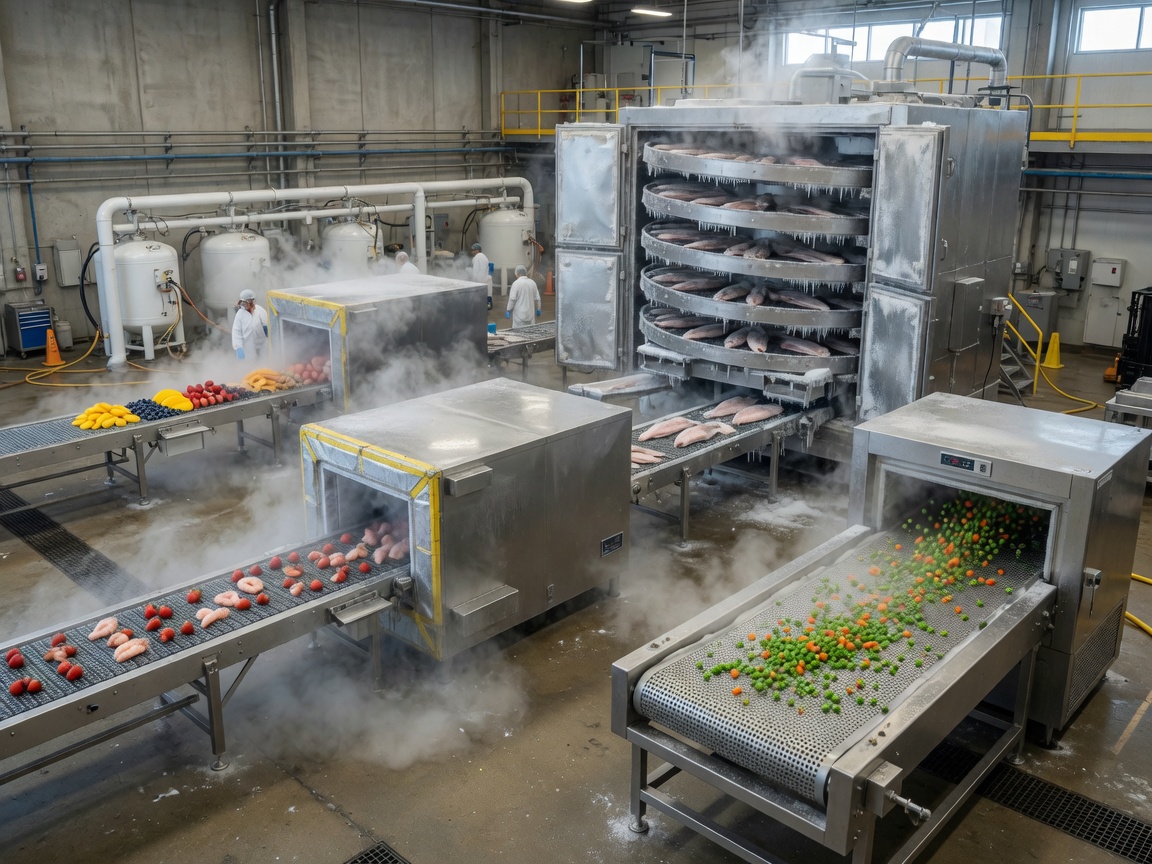
Product enters the freezing conveyor belt at ambient or chilled temperature. Inside the tunnel chamber, axial or centrifugal fans circulate refrigerated air at controlled velocity. Evaporator coils — fed by a mechanical refrigeration circuit or a cryogenic supply line — maintain air temperature between −35°C and −40°C. As the belt moves product from inlet to outlet, the surface freezes first, forming a protective crust that seals in moisture. The core temperature follows as dwell time accumulates. By the time product exits, it meets IQF (individually quick frozen) specifications ready for packaging or downstream automation.
Key performance metrics to understand before buying
Three numbers define freezer performance: freezing rate (°C/min of core pull-down), specific energy consumption (kWh per pound or kg frozen), and product weight loss (%). Real-world benchmarks from US poultry and seafood plants show that a well-tuned IQF tunnel freezer running shrimp at 1,000 lb/hr consumes between 0.08 and 0.14 kWh/lb depending on product thickness, belt loading, and inlet temperature. Understand these figures before you request a quote — vendors who cannot provide them during pre-sales are a red flag.
System types: which configuration fits your line?
The right blast tunnel freezer configuration depends on your product geometry, throughput target, available floor space, and sanitation requirements. There is no universal best choice — and confusing tunnel types at the specification stage is a costly error.
Linear blast tunnel freezers
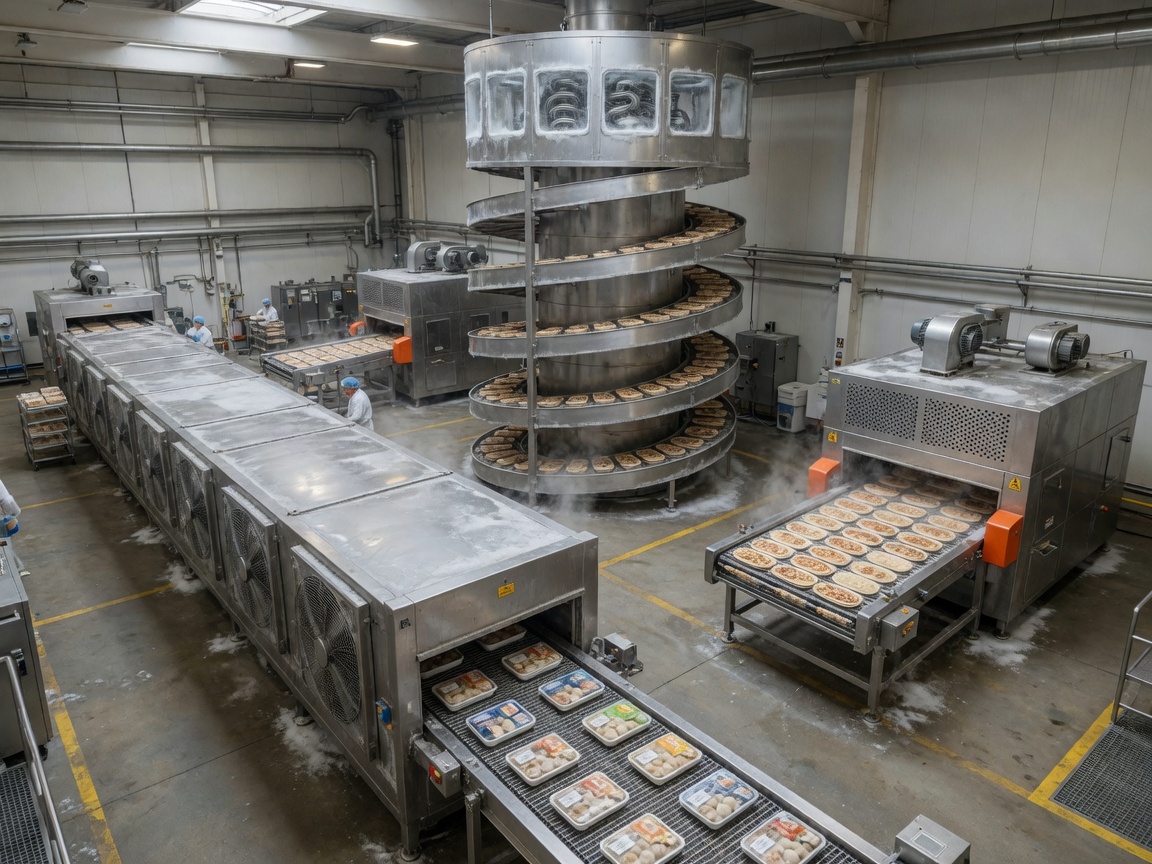
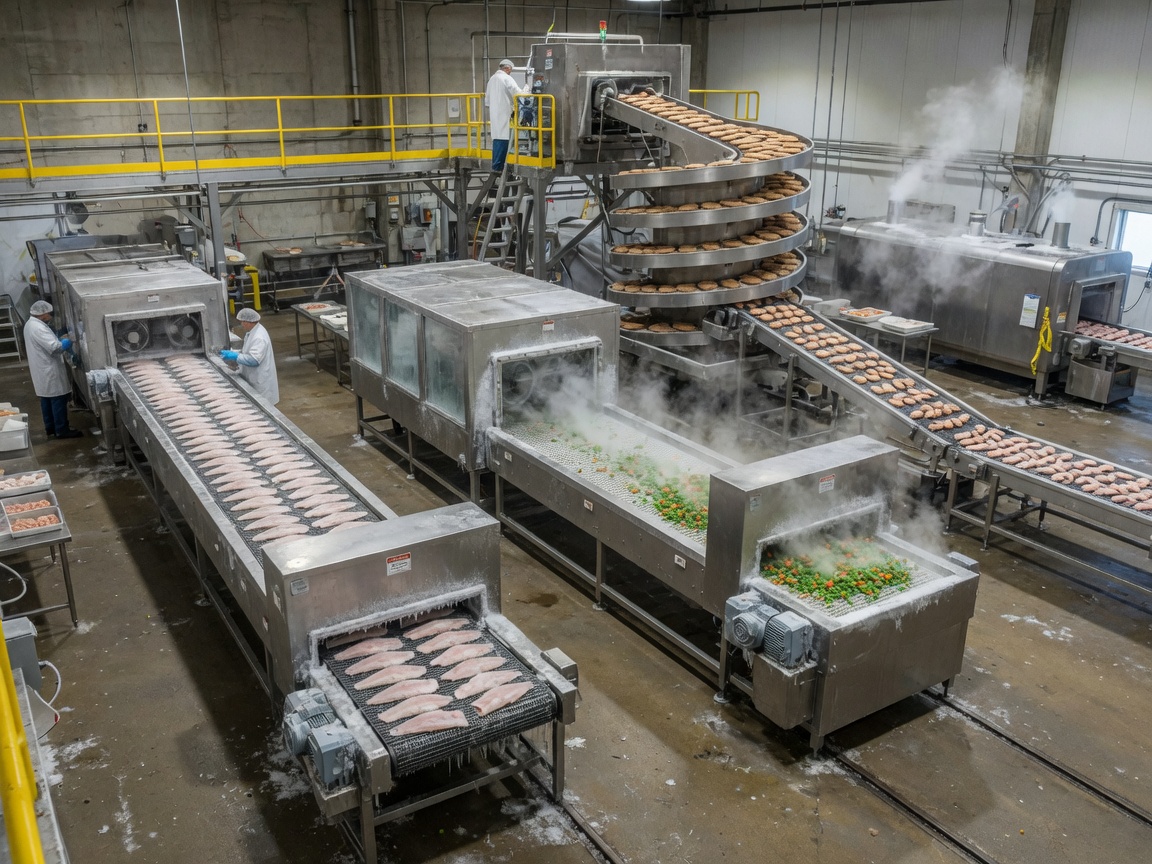
The straight-line blast freezer tunnel is the backbone of large-volume IQF processing. A single insulated chamber, one continuous freezing conveyor belt, fans and evaporators mounted overhead or to the side — simple, serviceable, and scalable. Throughput ranges from roughly 500 kg/hr to over 8,000 kg/hr. Linear systems are ideal when floor space is not a constraint and product flow is unidirectional. Maintenance access is straightforward, which matters during HACCP audits. For high-volume seafood or vegetable lines, this remains the industry standard.
Spiral freezers, impingement freezers, and multi-tier systems
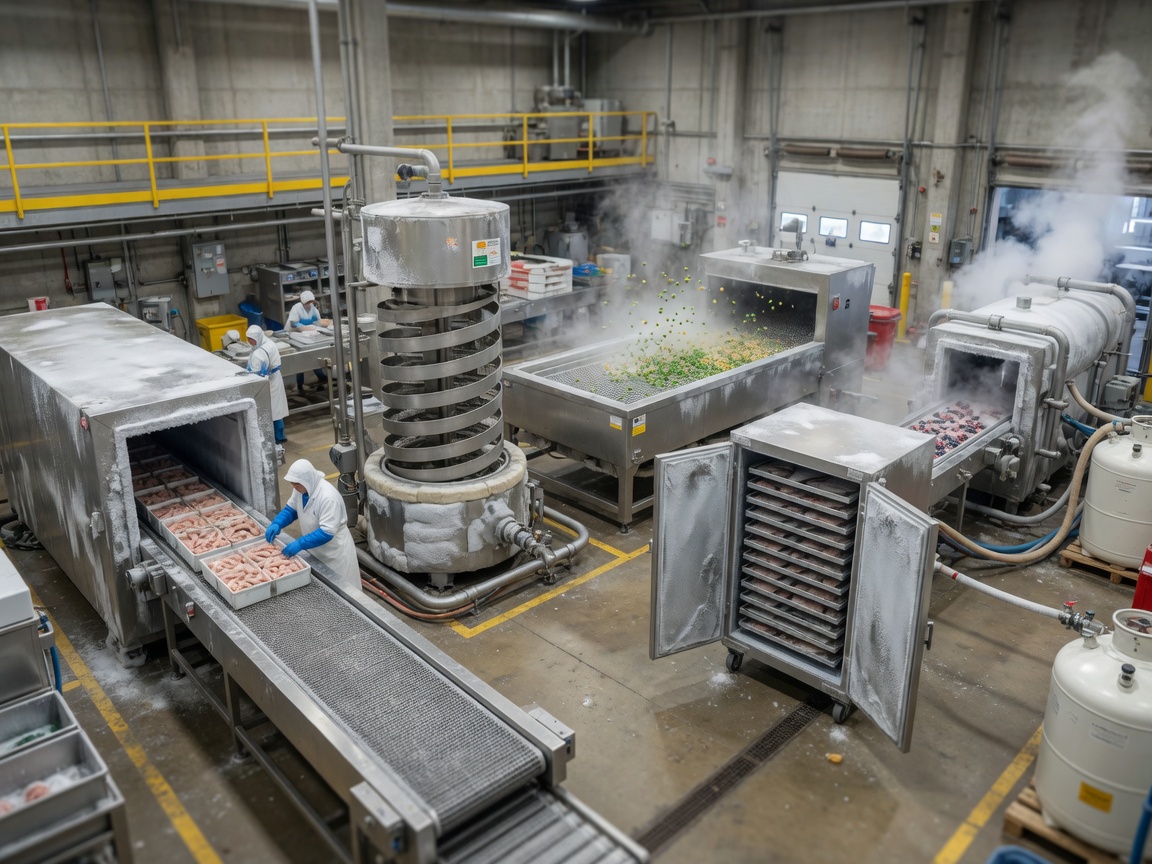
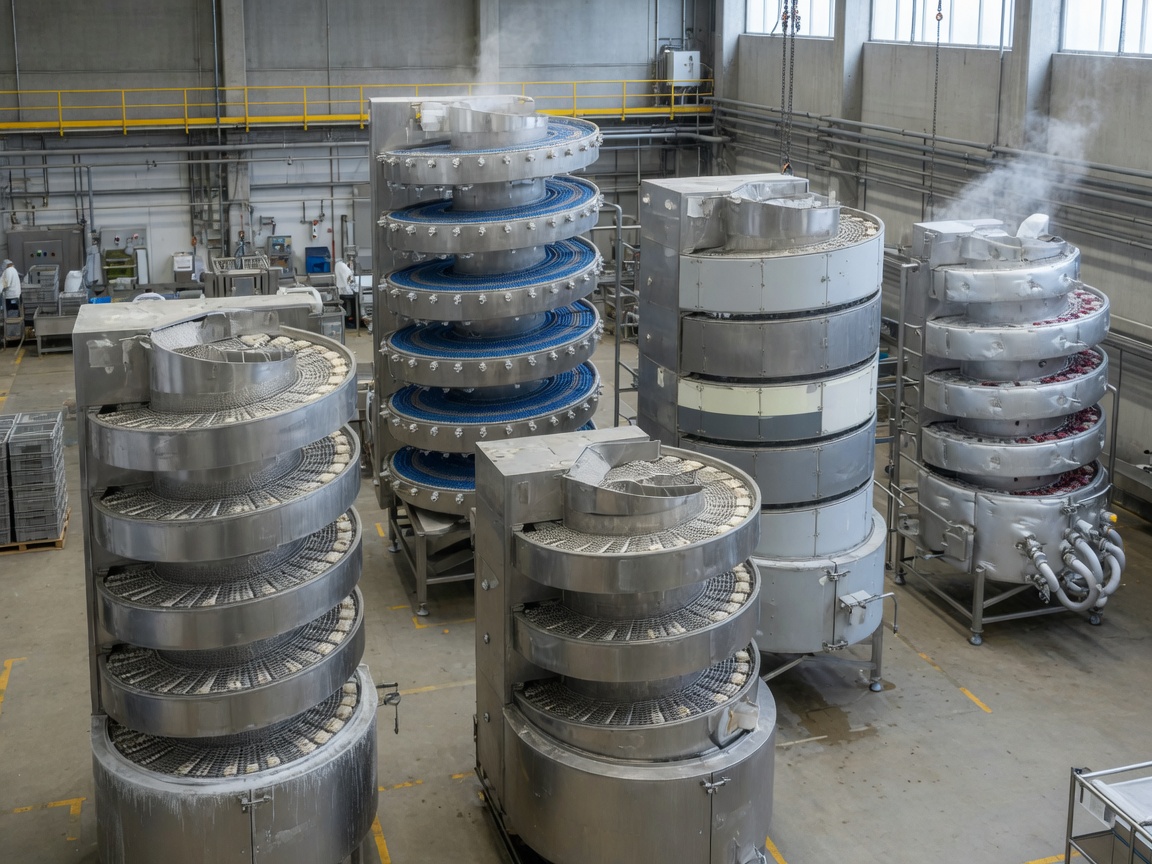
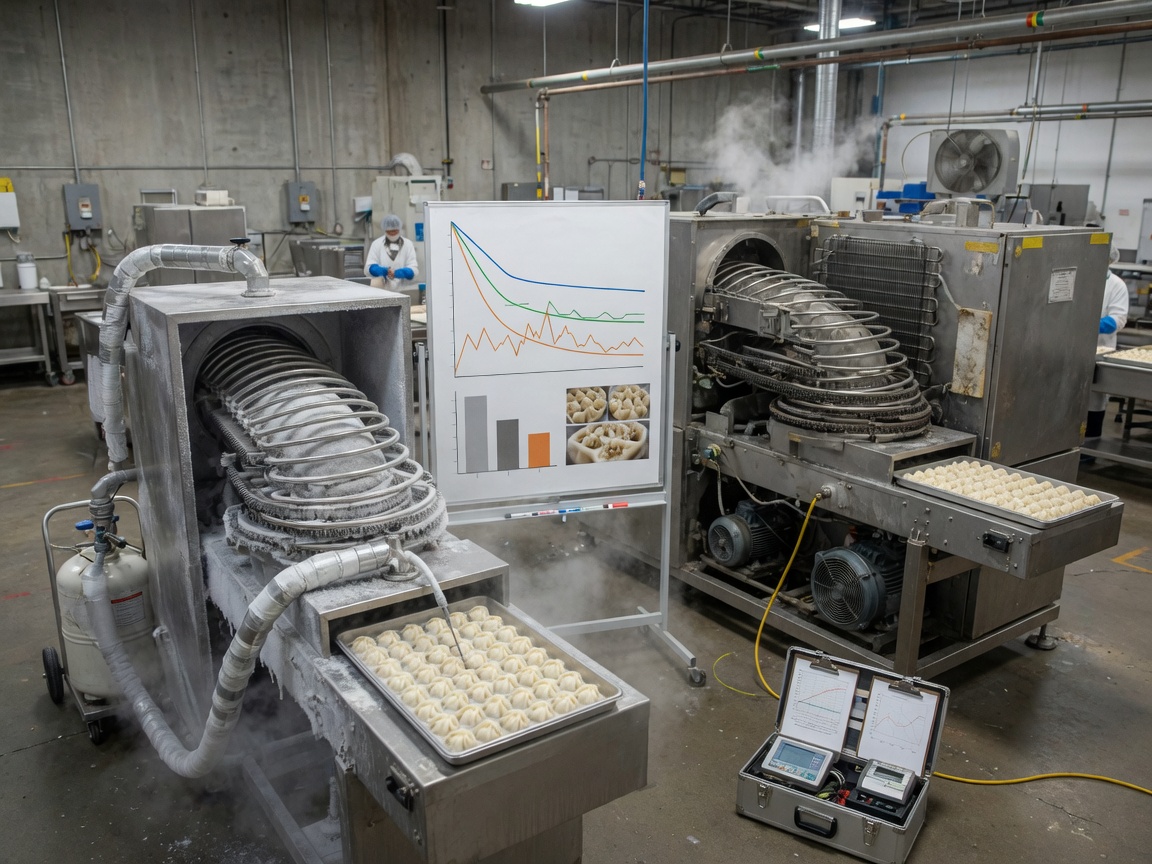
A spiral freezer uses a helical conveyor stacked vertically inside a single enclosure, delivering equivalent dwell time in a fraction of the floor footprint. It is an excellent choice for poultry portions, burgers, or battered products where the plant layout limits tunnel length. The tradeoff is higher mechanical complexity and more demanding sanitation protocols. Impingement freezers — a specialized subtype of the rapid freezing unit family — direct high-velocity air jets perpendicular to the product surface, achieving exceptional crust-freeze speed on flat items like pizza, fish fillets, and tortillas. Multi-tier tray systems serve ready meals and bakery items where product is packaged in containers before freezing. Each type addresses a specific niche; none is interchangeable without consequence.
Mechanical refrigeration vs. cryogenic: a side-by-side comparison
This is the decision most buyers research longest — and where competitive content consistently falls short. Both mechanical refrigeration and cryogenic freezing tunnels can achieve IQF-quality results, but they serve fundamentally different operational profiles.
Mechanical systems use a closed-loop refrigeration circuit — typically ammonia (R717) or CO₂ (R744) in modern US plants — to maintain tunnel air temperature. Cryogenic freezing tunnels inject liquid nitrogen (LN₂) or liquid CO₂ directly into the tunnel chamber, achieving air temperatures as low as −196°C for nitrogen systems. Understanding blast chilling freezing technology at a system level clarifies why each approach dominates different use cases.
| Factor | Mechanical refrigeration | Cryogenic (LN₂/CO₂) |
|---|---|---|
| Capital cost | $150,000–$600,000+ | $40,000–$180,000 |
| Operating cost (per lb frozen) | $0.01–$0.03 (energy-based) | $0.06–$0.18 (cryogen cost) |
| Freeze speed | Moderate (2–8 min surface freeze) | Very fast (<60 sec surface freeze) |
| Product weight loss | 0.5–1.5% | 0.1–0.4% |
| Refrigerant compliance (2026) | NH₃/CO₂ preferred; HFCs phasing out | LN₂ and CO₂ fully compliant |
| Best application | High-volume, continuous production | Startups, pilot lines, premium SKUs |
| Maintenance complexity | High (compressors, refrigerant circuits) | Low (no compressors) |
| Payback period | 3–7 years at high throughput | 1–2 years at low volume |
"For facilities freezing above 2,000 lbs per hour continuously, mechanical refrigeration almost always delivers lower total operating cost over a five-year horizon. Cryogenic nitrogen tunnel freezers remain the preferred entry point for lower-volume or highly seasonal operations." — Industry consensus among US food processing engineers, 2026.
Of course, there are situations where a hybrid approach makes sense — a mechanical system as the primary continuous freezer system with a cryogenic backup for peak demand or product trials. This configuration is gaining traction in large US ready-meal facilities where SKU variety demands flexibility.
Refrigerant selection in 2026
HFC-based systems are under increasing regulatory pressure from the EPA's AIM Act phasedown schedule. In 2026, new mechanical installations in the US are overwhelmingly specifying ammonia or CO₂ cascade systems. Both are natural refrigerants with zero global warming potential — and both require specific safety protocols and OSHA PSM compliance for ammonia systems above threshold quantities. Factor this into your total installation budget, not just the equipment line item.
ROI and total cost of ownership analysis
Most vendor quotes focus on purchase price. Smart procurement managers know that sticker price is often the smallest number in a five-year TCO model. Here is how to build the calculation correctly.
The five cost drivers that vendors rarely volunteer
Energy consumption is typically the largest ongoing cost. A mechanical blast tunnel freezer running at 2,000 lb/hr for 16 hours per day, 250 days per year, consuming 0.12 kWh/lb, draws approximately 960,000 kWh annually. At $0.08/kWh (US industrial average, 2026 data), that is $76,800 per year in electricity alone — before refrigeration plant overhead. Product yield loss is the second silent cost: a 1% weight loss difference between systems, at $3.00/lb product value and 8 million lbs/year throughput, equals $240,000 annually. Maintenance contracts, defrost cycle downtime, consumables such as belts and gaskets, and regulatory compliance costs round out the picture. When all five are modeled together, the cheapest equipment frequently becomes the most expensive system.
Payback period benchmarks for US food processors
Real cases from US poultry and seafood plants show mechanical IQF tunnel freezers achieving full payback in 3.5–5 years at 2,000+ lb/hr utilization, assuming energy costs remain stable and throughput targets are met. Cryogenic freezing tunnels achieve payback faster at lower volumes but become uneconomical above roughly 1,500 lb/hr sustained throughput due to cryogen cost. For a 500 lb/hr shrimp line running 10 hours/day, LN₂ operating costs often exceed the mechanical alternative within 18 months. These numbers are not theoretical — they come from actual plant audits conducted in 2025. Understanding quick freezing food quality implications also affects revenue-side ROI modeling, since better product quality commands price premiums in retail and foodservice channels.
USDA, FDA, and HACCP compliance for US facilities
Compliance is not optional — and it is not something to retrofit after installation. Every blast tunnel freezer installed in a US food processing facility must be designed and documented to satisfy a layered regulatory framework from day one.
Regulatory requirements by agency
The USDA FSIS governs meat and poultry processing plants and requires that freezing equipment maintain validated time-temperature profiles that prevent pathogen survival or regrowth. The FDA, under the Food Safety Modernization Act (FSMA), requires written Preventive Controls plans that include freezing as a process control, with documented monitoring procedures, corrective actions, and records retention. Inspectors specifically look at whether temperature sensors are calibrated, whether defrost cycles are logged, and whether product dwell time is verified against the kill-step validation. The food safety freezing guidelines published by the FDA provide the baseline framework that HACCP plans must reference. Missing any of these documentation elements can trigger a Form 483 observation or, in USDA facilities, a suspension of inspection — which means the line stops.
HACCP-aligned maintenance and defrost protocols
A HACCP-compliant blast tunnel freezer installation requires: calibrated temperature data loggers at inlet, midpoint, and outlet; automatic defrost cycle records with timestamps; belt speed verification logs; and sanitation records documenting clean-in-place or manual wash-down procedures. Many 2026-era systems include built-in IoT data logging that exports directly to FSMA-compatible record-keeping platforms, simplifying audit preparation substantially. When evaluating vendors, ask specifically whether their control systems can generate 21 CFR Part 11-compliant electronic records. This question alone separates serious suppliers from commodity vendors.
Application-specific sizing guide
There is no single "standard" blast tunnel freezer. Every application — seafood, poultry, baked goods, ready meals — has distinct thermal load characteristics that drive belt speed, tunnel length, air temperature, and airflow configuration. Getting sizing right is where procurement managers most often need outside expertise.
Sizing by product category
The table below reflects real-world specifications from US food processing installations in 2026. These ranges are starting points for vendor conversations, not final specifications — actual sizing always requires a formal heat load calculation based on your specific product, inlet temperature, and target exit temperature.
| Product type | Recommended tunnel temp | Belt speed range | Typical dwell time | Notes |
|---|---|---|---|---|
| IQF shrimp / seafood | −35°C to −38°C | 0.05–0.15 m/s | 8–15 min | High moisture; glazing often applied post-freeze |
| Poultry portions | −35°C to −40°C | 0.03–0.10 m/s | 15–25 min | USDA FSIS process validation required |
| Baked goods / par-baked | −28°C to −32°C | 0.08–0.20 m/s | 5–10 min | Impingement freezer preferred for flat items |
| Ready meals (tray-packed) | −35°C to −38°C | 0.04–0.09 m/s | 20–35 min | Multi-tier tray tunnel often preferred |
| Vegetables / fruit IQF | −32°C to −35°C | 0.10–0.25 m/s | 3–8 min | Mesh belt to prevent product sticking |
Common sizing mistakes to avoid
Undersizing the evaporator coil surface area is the most frequent engineering error — it creates a thermal deficit that no amount of fan speed increase can fully compensate. Equally problematic is over-specifying belt width for low-density products: an underloaded conveyor wastes energy and reduces airflow efficiency. Think of the freezing conveyor belt like a highway — design it for peak-hour traffic, not empty-road cruising, but building a 12-lane expressway for a country road is just as wasteful as the reverse.
Automation integration and facility layout planning
A blast tunnel freezer does not operate in isolation. Its performance is only as good as the systems feeding it upstream and receiving product downstream. In 2026, leading US food processors are specifying fully integrated continuous freezer systems from raw input to palletization — and the blast freezer sits at the thermal heart of that line.
Upstream and downstream integration points
Upstream, the freezer must be matched to forming, coating, or portioning equipment output rates — a mismatch here creates either a starved belt (energy wasted, product spacing inefficient) or a backed-up buffer that compromises food safety. Most modern IQF tunnel freezer installations include an infeed accumulation conveyor with variable-speed control to smooth upstream irregularities. Downstream, the freezer feeds directly into packaging lines, checkweighers, metal detectors, and case erectors. The critical interface is temperature: product exiting a blast tunnel freezer at −18°C must not warm above −10°C surface temperature before entering the primary packaging station. This requires the packaging zone to be climate-controlled — a facility design requirement that is frequently overlooked until construction begins.
IoT, predictive maintenance, and smart freezer features in 2026
The 2026 generation of commercial blast chiller and tunnel freezer systems from major OEMs includes embedded sensor arrays that monitor belt tension, evaporator frost buildup, fan motor current draw, and product zone temperatures in real time. These data feeds integrate with FSMA-compliant data logging platforms and, increasingly, with predictive maintenance AI models that flag anomalies 48–72 hours before a failure event. Actual testing in a Midwest US seafood facility found that predictive maintenance alerts reduced unplanned downtime by 34% in the first year of deployment — a figure that translates directly to recovered throughput and avoided emergency service costs. Critically, these systems also auto-generate the temperature and process records required for HACCP verification, eliminating manual log sheets and the errors they introduce.
Frequently asked questions
Q: What is the difference between a blast tunnel freezer and a standard cold storage freezer?
A: A blast tunnel freezer uses high-velocity forced air at 2–6 m/s to rapidly freeze products on a moving conveyor, reducing core temperature to −18°C in minutes. A standard cold storage freezer relies on static or low-circulation air, freezing product over many hours — producing larger ice crystals, higher drip loss, and inferior texture upon thawing.
Q: When should I choose a cryogenic freezing tunnel over a mechanical system?
A: Choose cryogenic (LN₂ or CO₂) when your throughput is below approximately 1,000–1,500 lb/hr, when you need fast startup with minimal capital, or when you are processing premium products where the lowest possible weight loss justifies higher cryogen operating costs. Above that volume threshold, mechanical refrigeration almost always wins on TCO.
Q: What FDA and USDA documentation is required for a blast tunnel freezer installation?
A: At minimum, you need a validated HACCP plan with freezing as a documented process control, calibrated temperature sensor records, defrost cycle logs, belt speed verification records, and sanitation logs. FDA FSMA Preventive Controls rules also require written monitoring procedures and corrective action protocols tied to the freezer's critical limits.
Q: Can a blast tunnel freezer be integrated with existing packaging and conveyor lines?
A: Yes, but integration requires careful matching of belt speed, product temperature at handoff, and throughput rate. A variable-speed infeed accumulation conveyor is strongly recommended to buffer upstream irregularities. The downstream packaging zone must also be climate-controlled to prevent product surface warming above −10°C before primary packaging.
Q: What is a realistic payback period for a mechanical IQF tunnel freezer in the US?
A: For continuous production at 2,000+ lb/hr, most US food processors achieve full payback in 3.5–5 years when energy savings, yield improvement, and reduced product giveaway are factored in. At lower throughputs, payback extends to 6–8 years, at which point a cryogenic or hybrid approach may offer better financial performance over a five-year horizon.
Ready to evaluate your blast tunnel freezer options?
Use the specifications, TCO framework, and compliance checklist in this guide as your baseline evaluation criteria before requesting vendor quotes. The right blast tunnel freezer for your production line is the one that meets your throughput targets, satisfies your regulatory obligations, and delivers the lowest verifiable cost per pound frozen over a five-year horizon — not simply the lowest invoice price.
Keywords:
Inquiry
If you are interested in our products, please leave your email to receive a free product quote, thank you!
More information


Tel:
Sales E-mail: