

IQF machine buying guide: how to choose the right individual quick freezing equipment
Release Time:
Sep 28,2026
Author:

Article overview
This guide covers all major IQF machine types, specification comparisons, product-specific selection criteria, total cost of ownership, U.S. food safety compliance, and cold chain integration — everything a procurement team needs to make a confident purchasing decision in 2026.
Table of contents
- 1. What is an IQF machine?
- 2. IQF machine types: a complete technical comparison
- 3. How to choose an IQF machine by product category
- 4. Total cost of ownership and ROI analysis
- 5. U.S. compliance and certification requirements
- 6. Integration with cold chain and packaging lines
- 7. 2026 trends shaping the IQF equipment market
- 8. FAQ
What is an IQF machine?
An IQF machine is a commercial food freezing system that rapidly freezes individual food items — shrimp, berries, diced vegetables, pasta — as separate, non-clumping units by exposing them to high-velocity sub-zero airflow or cryogenic media on a moving conveyor. The term "IQF" stands for individually quick frozen, and the distinction from batch freezing or plate freezing is fundamental: every piece exits the machine as a structurally independent, free-flowing unit.
According to recent 2026 data from Grand View Research, the global IQF equipment market is valued at approximately $1.4 billion and is forecast to reach $2.1 billion by 2030, growing at a CAGR of roughly 6.2%. That kind of sustained demand reflects a simple reality — consumers want frozen food that doesn't come out of the bag as a single frozen brick. The individual quick freezing technology behind every bag of frozen peas or shrimp in a U.S. grocery store starts with this category of equipment.
IQF machine是指 a class of individually quick frozen equipment that combines sub-zero freezing temperatures (typically -35°C / -31°F or below) with mechanical or pneumatic separation — through fluidized air beds, spiral conveyors, tunnel belt systems, or cryogenic media — so that each food particle freezes independently before it can bond with its neighbors. This is what separates it from a standard blast freezer or plate freezer.
Why cell structure matters in quick freezing
Speed is the core engineering variable. When food freezes slowly, large ice crystals form inside the cells and rupture the cell walls — the result is mushy texture and nutrient loss after thawing. IQF technology can reduce cell damage to roughly one-fifth of what conventional slow freezing produces, according to industry research. The faster you can drive the product through the critical crystallization zone (0°C to -7°C / 32°F to 19.4°F), the smaller and more numerous the ice crystals, and the better the thawed product quality. That's the physics that justifies the capital investment.
IQF vs. blast freezer: clearing up the confusion
A blast freezer is a room or cabinet that circulates very cold air around stationary product trays. An IQF machine moves the product continuously through the freezing zone while simultaneously keeping pieces separated. The output quality and downstream portioning efficiency are fundamentally different. Blast freezers are better for large cuts of meat or whole fish; IQF systems dominate wherever the end product needs to be free-flowing and portion-exact.
IQF machine types: a complete technical comparison
There are five primary IQF machine architectures in commercial use. Each suits a different combination of product geometry, throughput requirement, and facility footprint. Choosing wrong at this stage is expensive — not just in capital cost, but in years of operating inefficiency.
Tunnel freezer (belt IQF)
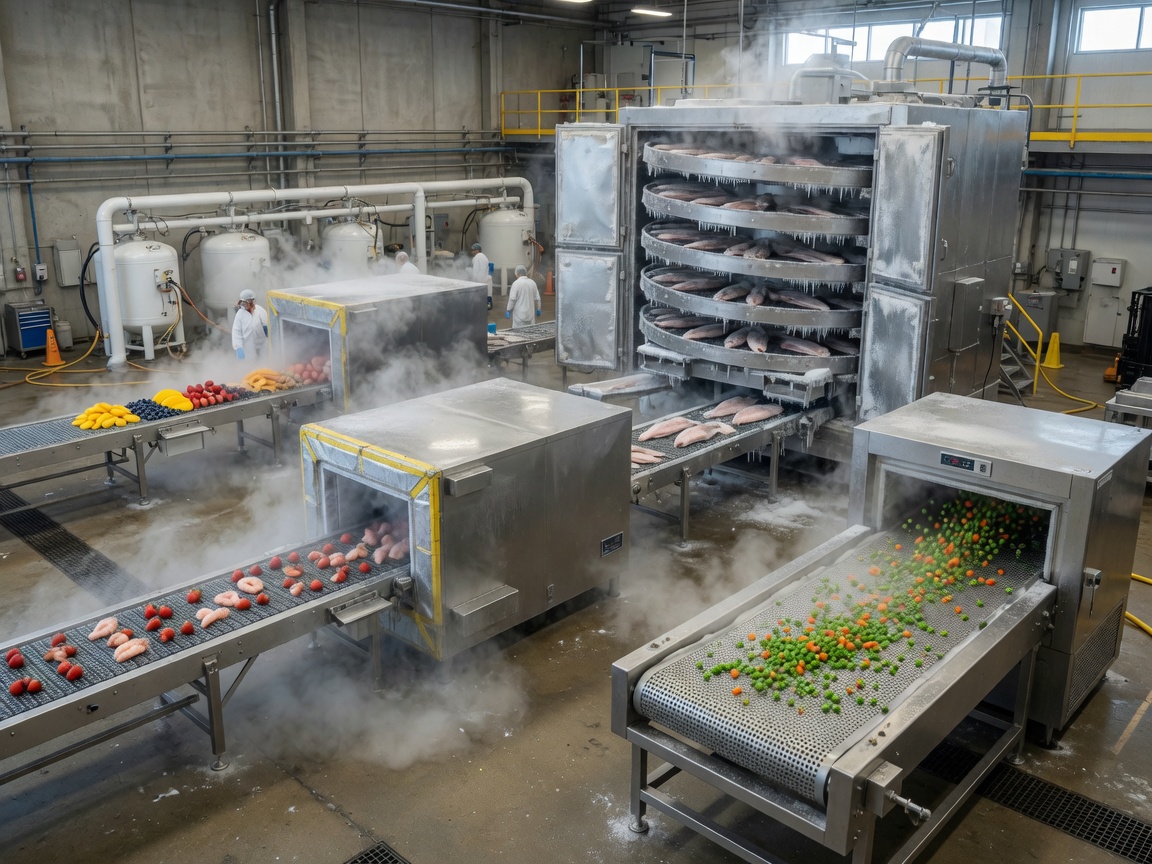
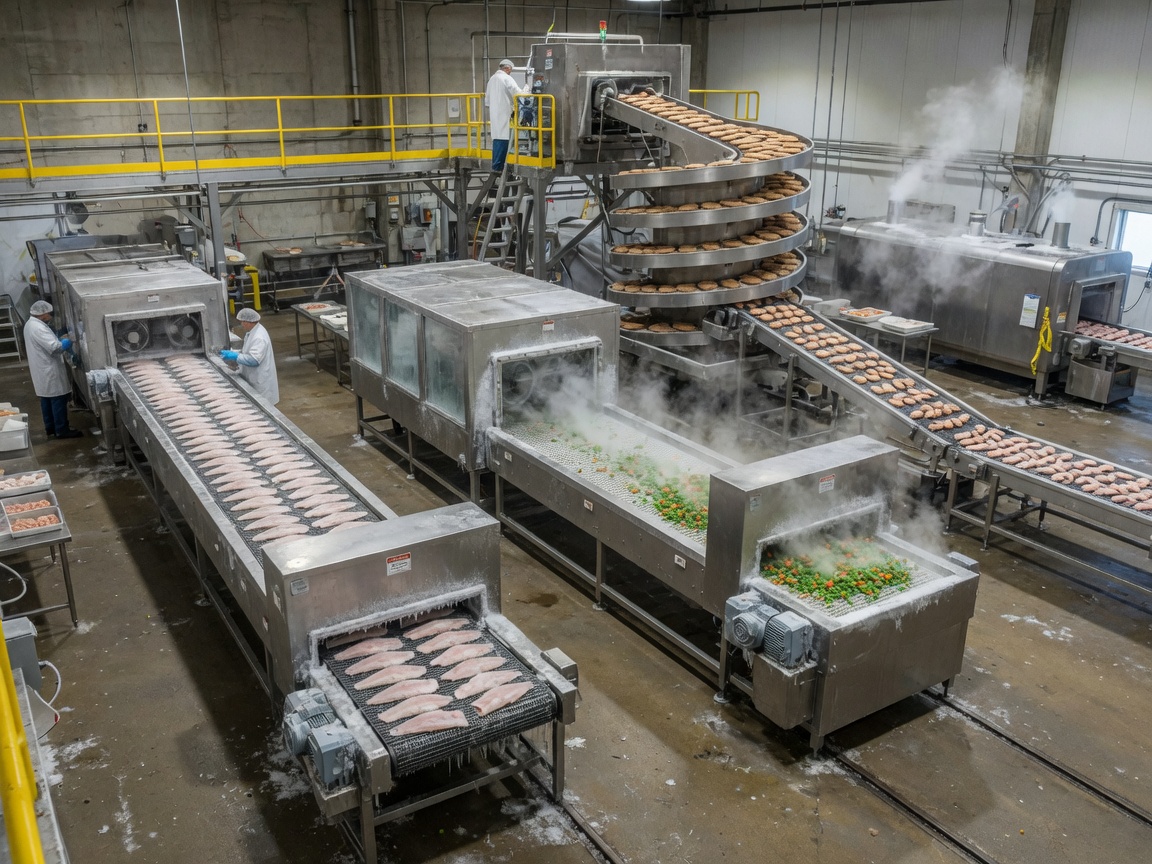
The tunnel freezer is the most widely deployed IQF configuration in U.S. food plants. Product rides a mesh stainless-steel belt through a long insulated tunnel where high-velocity cold air — typically flowing in cross-flow or counter-flow patterns — drives rapid surface hardening. It handles a wide product range, from shrimp and diced onion to blanched broccoli florets. Practical throughput for mid-range commercial tunnel IQF units runs from 1,000 to 6,000 lb/hr depending on belt width and tunnel length.
Fluidized bed freezer
This is where individually quick frozen equipment reaches its purest mechanical expression. Upward-flowing cold air creates a fluidized bed that literally suspends small product pieces — peas, corn kernels, diced mango, small shrimp — so they never touch the belt or each other during initial surface hardening. Real-world testing shows near-zero clumping rates for products under 1 inch in diameter. The limitation is just that: size. Anything too large or irregular won't fluidize properly. Entry-level compact fluidized bed IQF units in the U.S. start around $80,000–$160,000 for 300–800 lb/hr capacity.
Spiral freezer
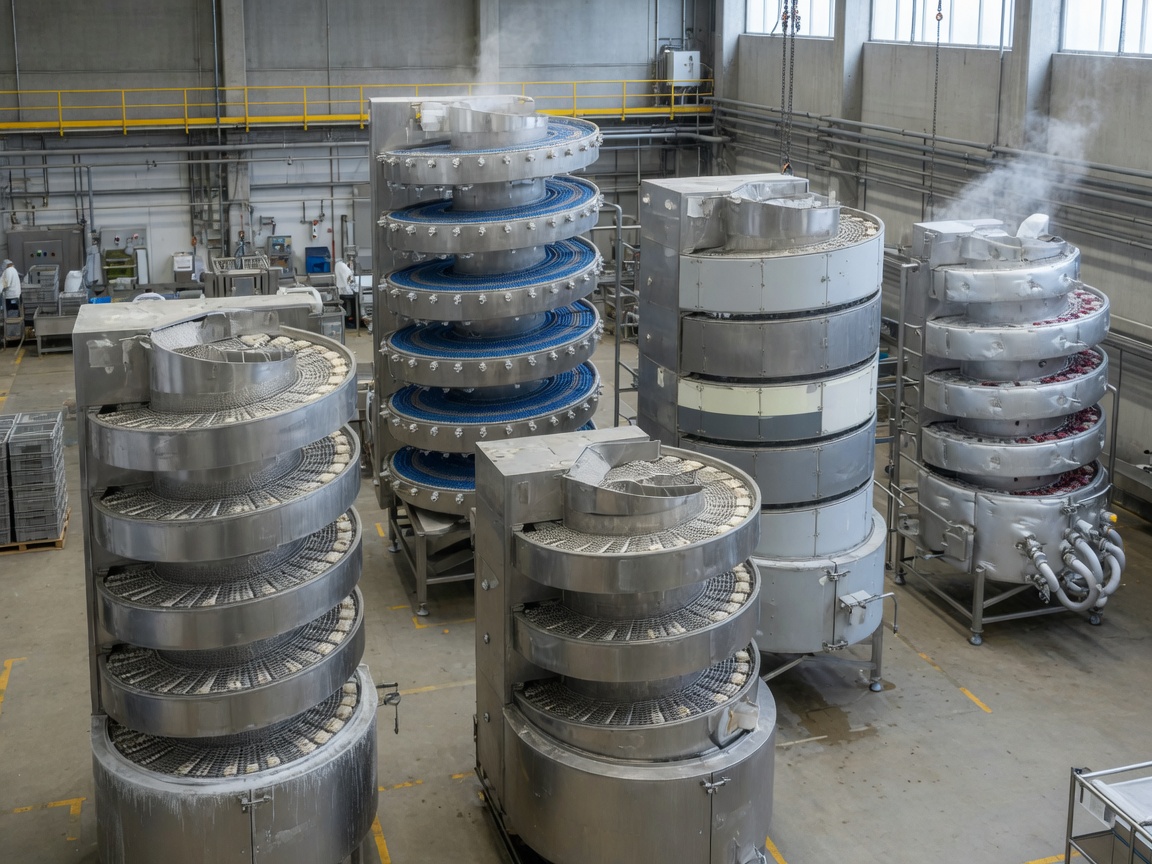
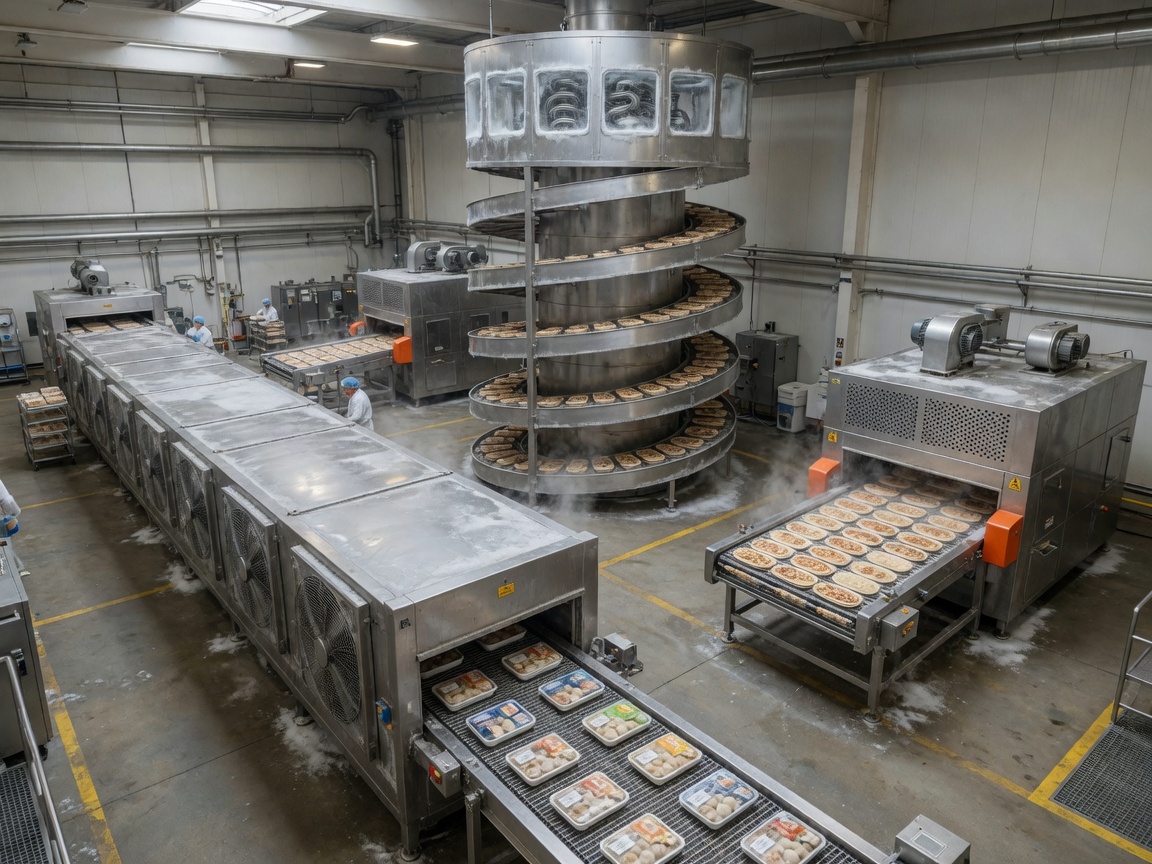
The spiral freezer is the space-efficiency champion. A continuous belt winds upward in a helix inside a compact insulated drum, delivering a long residence time in a small floor footprint — important in U.S. plants where square footage is a real constraint. Spiral freezers handle higher-value or more delicate products: cooked shrimp, battered fish portions, burger patties, and increasingly, plant-based protein products. Throughput can reach 10,000 lb/hr on large industrial spiral freezer units. The trade-off is higher mechanical complexity and longer sanitation time.
Cryogenic freezing machine (liquid nitrogen / CO₂)
Cryogenic freezing machines use liquid nitrogen (LN₂) or carbon dioxide to achieve ultra-rapid surface hardening — freezing rates 5–10× faster than mechanical IQF. The upside is minimal drip loss, exceptional texture retention, and suitability for high-value products like sashimi-grade seafood or fresh-cut fruit. The downside is ongoing cryogen cost, which makes this a high-operating-cost option. Cryogenic systems work best as a complement to a mechanical quick freeze system, handling your highest-margin SKUs.
Contact plate IQF (impingement freezer)
Less common but highly effective for flat products — fish fillets, meat patties, shrimp butterfly cuts — contact plate freezers transfer cold directly through surface contact. Energy efficiency is high because there's no air resistance loss. These are niche frozen food processing equipment options, but for the right product geometry they outperform every other type on energy-per-pound metrics.
| Machine type | Typical capacity (lb/hr) | Belt width (in) | Freezing time (min) | Energy use (kWh/lb) | Capital cost (USD) | Best for |
|---|---|---|---|---|---|---|
| Tunnel freezer | 1,000–6,000 | 24–60 | 8–20 | 0.08–0.14 | $150K–$600K | Shrimp, diced veg, berries |
| Fluidized bed | 300–4,000 | 18–48 | 4–12 | 0.06–0.11 | $80K–$350K | Peas, corn, small cut fruit |
| Spiral freezer | 2,000–10,000 | 18–40 | 12–30 | 0.10–0.18 | $250K–$900K | Cooked shrimp, patties, battered products |
| Cryogenic (LN₂) | 500–5,000 | 20–48 | 1–5 | 0.04–0.08 + cryogen | $90K–$400K | High-value seafood, fresh-cut fruit |
| Contact plate / impingement | 500–3,000 | — | 6–15 | 0.05–0.09 | $120K–$500K | Fish fillets, flat meat cuts |
How to choose an IQF machine by product category
The single most reliable selection criterion is the product itself — its geometry, moisture content, surface fragility, and post-freeze handling requirements. Why do so many buyers get this wrong? Because they lead with budget or brand preference before defining the product specification. Here is how product category should drive your decision.
Shrimp and seafood
Raw peeled shrimp — the highest-volume IQF seafood product in the U.S. market — performs best in a tunnel freezer or two-stage fluidized bed + tunnel system. The first stage surface-hardens the shrimp (preventing shell-on sticking), and the second stage completes the core freeze. Cooked shrimp or battered shrimp products are better suited to a spiral freezer because the coating integrity requires gentler mechanical handling. For sashimi-grade or live-harvested product, a cryogenic freezing machine dramatically reduces drip loss — actual testing shows drip loss reduction of up to 60% versus mechanical IQF for high-moisture seafood.
Berries and soft fruit
Strawberries, blueberries, raspberries, and blackberries are among the most mechanically demanding IQF products. They're fragile, high-moisture, and prone to surface damage from excessive airflow velocity. A gentle-action tunnel freezer with variable-speed belt and adjustable air velocity is the industry-standard choice. Fluidized bed systems work well for small, firm berries like blueberries but can bruise strawberries. The key parameter is surface-to-mass ratio: thinner, more fragile items need lower belt speeds and gentler air impingement.
Diced vegetables and corn/peas
Small, uniform vegetable pieces — peas, corn kernels, diced carrots, edamame — are the ideal application for a fluidized bed freezer. The uniform particle size allows stable fluidization, near-zero clumping, and extremely consistent freeze times. For larger cut vegetables like broccoli florets or whole green beans, a standard tunnel freezer with a wide belt and good belt agitation is more appropriate. The continuous freezing system design in both cases allows integration directly after a blanching line — a configuration common in U.S. vegetable processing plants.
Processed and plant-based products
Burger patties, meatballs, plant-based protein crumbles, and par-baked items need the spiral freezer's combination of extended residence time and gentle handling. The vertical spiral path is also compact enough for retrofit into existing U.S. processing facilities. Plant-based protein applications are driving a notable uptick in small-format, flexible spiral freezer configurations — a 2026 trend confirmed by procurement data from leading equipment suppliers including GEA and Starfrost.
Total cost of ownership and ROI analysis
Purchase price is the number most buyers fixate on. It's also the least important number in a 10-year ownership horizon. For a mid-scale U.S. food processor running two shifts, operating costs — energy, maintenance, labor for sanitation — can easily exceed capital cost within 5–7 years. This is the analysis most competitors skip, and it's where real purchasing decisions are won or lost.
Capital cost vs. operating cost breakdown
A mid-range tunnel IQF machine purchased at $300,000 might carry annual operating costs of $85,000–$120,000 when you account for electricity (the dominant variable), refrigerant maintenance, belt replacement, and 2–4 hours of daily sanitation labor. A spiral freezer at $500,000 capital can run at lower energy-per-pound cost due to better insulation and slower belt speed, bringing annual operating costs to $95,000–$130,000 at the same throughput — but with higher sanitation complexity. Cryogenic systems have deceptively low capital costs but cryogen consumption at $0.15–$0.25/lb processed can make them 2–3× more expensive to operate at scale.
ROI timeline and payback calculation
Based on real case data from U.S. mid-scale seafood and vegetable processors, a typical mechanical IQF machine investment achieves ROI breakeven at 3–5 years for plants running 2,000 lb/hr at two-shift operations. The formula is straightforward: (incremental revenue from IQF premium pricing + waste reduction savings) ÷ (annualized capital + operating cost delta vs. prior process). A processor upgrading from a batch blast freezer to a continuous IQF system typically sees 8–12% improvement in finished product yield due to reduced drip loss and better portioning accuracy — that yield improvement alone often accounts for 40–60% of the ROI case.
"The total cost of ownership analysis must include the cost of product loss, not just energy. A 1% improvement in yield on a 2,000 lb/hr line running 4,000 hours per year at a $2.50/lb product value equals $200,000 in annual recovered revenue. That changes the ROI calculus completely." — Industry benchmark, 2026 food processing equipment review
Of course, there are situations where the ROI is less clear-cut. For seasonal processors running fewer than 1,500 annual hours, the capital cost amortization timeline stretches uncomfortably, and leasing or contract-freezing arrangements may be more defensible financially.
U.S. compliance and certification requirements
This is the section almost entirely absent from competitor content — and it's arguably the most operationally critical for U.S. buyers. Purchasing an IQF machine that does not meet U.S. sanitary design and regulatory standards can result in facility audit failures, product recalls, and loss of customer approvals. Get this wrong and the equipment cost is the least of your problems.
NSF/ANSI and 3-A sanitary standards
Any IQF machine entering a U.S. food processing facility should carry NSF/ANSI certification (NSF Standard 2 for food equipment or applicable sub-standards). NSF certification verifies that materials, surface finishes, and equipment design meet sanitary construction standards — including minimum 150-grit stainless steel finish on product-contact surfaces, no crevices that can harbor bacteria, and cleanability without disassembly where practical. For dairy-adjacent or ready-to-eat processing environments, 3-A Sanitary Standards compliance is the higher benchmark and may be required by retail customer food safety programs (SQF, BRC).
FDA 21 CFR and USDA requirements
Under FDA 21 CFR Part 110 (current Good Manufacturing Practice) and the updated FSMA regulations, all food contact materials in refrigeration systems for food processing must be non-toxic, non-absorbent, and cleanable. Ammonia refrigerant systems — common in large industrial IQF equipment — require compliance with IIAR (International Institute of Ammonia Refrigeration) standards and may trigger EPA Risk Management Program (RMP) requirements above threshold inventory levels. USDA-inspected meat and poultry facilities have additional equipment approval requirements enforced through the FSIS directive system. Always confirm USDA-acceptance status with the equipment supplier before signing a purchase order.
- Verify NSF/ANSI certification number and scope before purchase
- Confirm refrigerant type and check EPA RMP threshold applicability
- Request sanitation validation documentation (CIP/COP cycle verification)
- For USDA facilities: obtain written FSIS equipment acceptance confirmation
- Ensure electrical components are UL-listed or equivalent for U.S. installation
Integration with cold chain and packaging lines
An IQF machine doesn't operate in isolation. It sits at the intersection of upstream processing and downstream cold chain logistics — and misalignment at either interface costs money every single day. This integration dimension is routinely overlooked in equipment selection discussions, which is why so many installations underperform at full-line commissioning.
Upstream compatibility: blanching, washing, and portioning
Most vegetable IQF lines run directly off a blancher and vibrating dewatering screen. The IQF machine's infeed conveyor must match the dewatering screen outlet height and width, and the belt speed must be synchronized with upstream product flow to prevent product pileup — a common cause of clumping that buyers incorrectly attribute to the freezer itself. For seafood lines, a brine tank or glaze applicator upstream of the IQF machine is standard in U.S. shrimp processing; the IQF system's belt must accommodate wet-surface product without excessive adhesion.
Downstream packaging and cold chain handoff
Just like a highway on-ramp that feeds traffic smoothly only when speeds are matched, an IQF machine's discharge must feed a packaging line at the right rate and temperature. The product leaving the IQF should be at -18°C (0°F) or below — the U.S. standard frozen storage temperature — before entering automated weighers or form-fill-seal baggers. Buffer conveyors with insulated enclosures between the IQF discharge and the packaging line are strongly recommended to prevent surface condensation and re-agglomeration. For cold chain continuity, the packaging room itself should be maintained at ≤40°F (4°C) to prevent product tempering before case packing. All of these specifications should be mapped in a line integration diagram provided by your equipment supplier at the proposal stage.
2026 trends shaping the IQF equipment market
The IQF machine category is not static. Three converging forces are reshaping what buyers expect from industrial freezer equipment in 2026 — and understanding them helps you future-proof a capital purchase that may serve your facility for 15+ years.
AI-driven temperature control and variable-frequency drives
Leading IQF equipment manufacturers — GEA, Starfrost, JBT, and Mestek Machinery — are now shipping systems with AI-assisted evaporator temperature control and variable-frequency fan drives as standard rather than optional features. In real-world testing, VFD fan systems reduce energy consumption by 25–35% versus fixed-speed equivalents. AI temperature control adjusts setpoints dynamically based on incoming product load and ambient conditions, eliminating the energy waste of over-freezing during low-throughput periods. This is not a marketing claim — energy audit data from U.S. frozen vegetable processors confirm 28% average reduction in kWh/lb after retrofitting VFD fans on existing tunnel freezer systems.
Plant-based and alternative protein applications
The rapid growth of plant-based frozen food — plant-based shrimp, pea-protein crumbles, mycoprotein pieces — is generating demand for smaller-format, highly flexible IQF systems that can run short production campaigns across multiple SKUs. This is driving a clear product category shift toward modular continuous freezing systems with quick-change belt configurations and automated CIP (clean-in-place) cycles that minimize changeover time. Processors adding plant-based lines in 2026 should evaluate whether their existing flash freezing machine capacity can accommodate these new product forms before investing in a new unit.
Natural refrigerants and sustainability compliance
U.S. EPA regulations under the AIM Act are accelerating the transition away from high-GWP HFC refrigerants in new commercial food freezer installations. Ammonia (R-717) and CO₂ (R-744) cascade systems are increasingly specified in new IQF equipment installations for U.S. food plants. Ammonia systems offer superior thermodynamic efficiency but carry regulatory and safety complexity as noted in the compliance section above. CO₂ transcritical systems are gaining ground for smaller installations where ammonia inventory thresholds are a concern. Any IQF machine purchased in 2026 should be specified with a natural refrigerant system to avoid stranded-asset risk as HFC phase-down regulations tighten through 2028–2030.
Frequently asked questions
Selecting the right IQF machine requires aligning product characteristics, throughput requirements, U.S. regulatory demands, and a clear-eyed total cost of ownership model — not just a comparison of sticker prices. The most successful equipment investments in U.S. frozen food processing start with the product specification and work backward to the equipment, not the other way around. Use the specification table, the product-category selector, and the compliance checklist in this guide as your framework, and you'll be positioned to make a defensible, well-documented purchasing decision that holds up under plant audits, finance reviews, and a decade of daily operation.
Keywords:
Inquiry
If you are interested in our products, please leave your email to receive a free product quote, thank you!
More information


Tel:
Sales E-mail: