

IQF equipment guide: how to choose the right individual quick freezing system
Release Time:
Sep 28,2026
Author:

Article overview
This guide is written for food processing plant procurement managers who are in the equipment evaluation stage. It covers system types, cost structures, compliance requirements, ROI estimation, and sustainability benchmarks — everything needed to make a confident purchasing decision in 2026.
Table of contents
- 1. What is IQF equipment?
- 2. Types of IQF equipment: a side-by-side comparison
- 3. Mechanical vs. cryogenic IQF: the real cost breakdown
- 4. FDA/USDA sanitation compliance for IQF equipment design
- 5. Product-specific IQF selection: shrimp, vegetables, and more
- 6. IQF equipment ROI: payback period framework for U.S. processors
- 7. Sustainability and energy efficiency in 2026
- 8. FAQ
What is IQF equipment?
IQF equipment is a category of industrial freezing machinery that freezes food items individually and separately — preventing clumping, preserving texture, and locking in nutritional value — rather than freezing them in a solid mass. The abbreviation stands for Individual Quick Freezing, a process where each piece, whether a shrimp, a pea, or a diced mango cube, exits the system as a discrete, free-flowing unit.
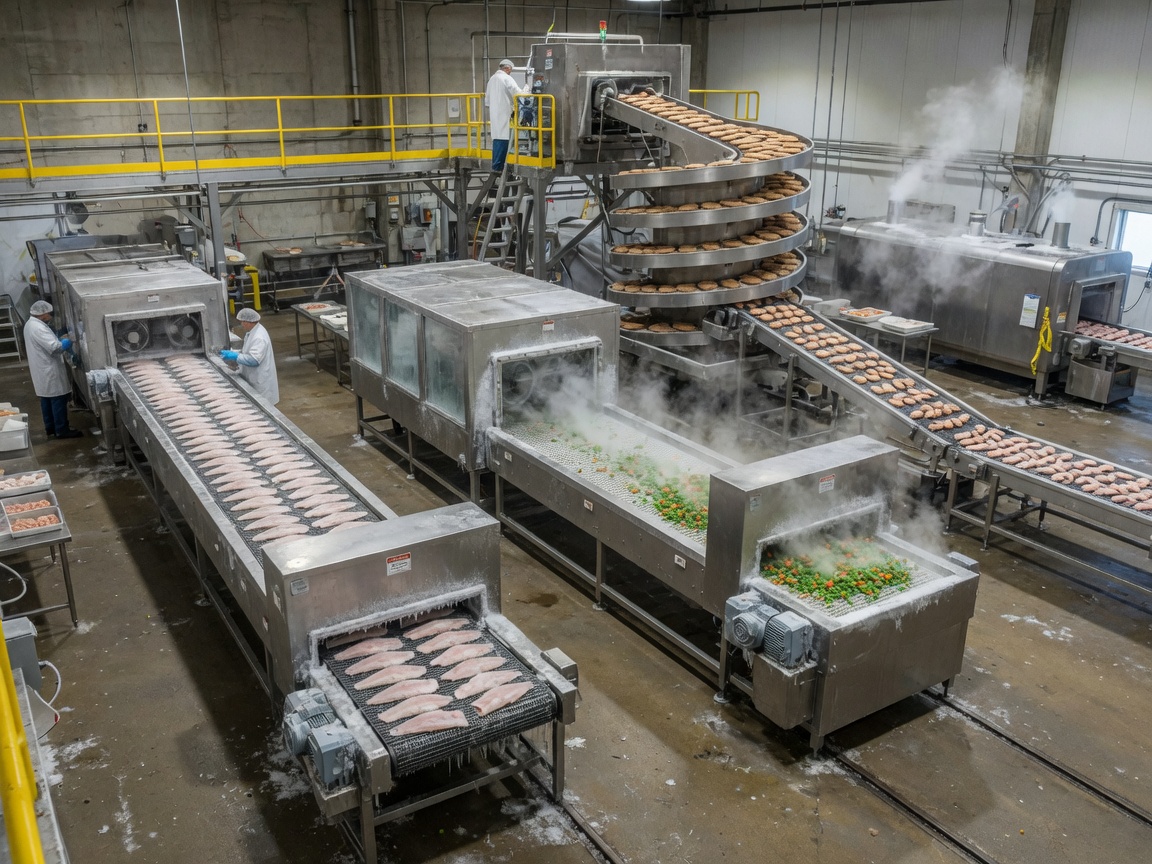
IQF equipment refers to any continuous or batch-mode freezing system — including tunnel freezers, fluidized bed freezers, spiral freezers, and cryogenic freezing equipment — designed to achieve rapid surface hardening of individual food pieces at temperatures typically between −30°F and −40°F (−34°C to −40°C), with residence times calibrated to product mass and thermal conductivity.
Why does this distinction matter? Because cell damage is the enemy of frozen food quality. According to recent industry research, IQF technology holds cellular rupture rates below 5%, compared to 30% or higher in conventional batch freezing. That gap translates directly into yield, texture after thawing, and ultimately retail price point. The global IQF equipment market was valued at approximately $1.8 billion in 2023 and is projected to reach $2.8 billion by 2030, growing at a CAGR of roughly 6.5% — driven largely by U.S., European, and Southeast Asian frozen food production expansion.
Think of IQF equipment as the difference between dumping ice cubes from a tray in one frozen block versus releasing individual cubes cleanly — except the stakes involve tons of shrimp per hour and millions of dollars in processing infrastructure.
How individual quick freezing works mechanically
At its core, an individual quick freezing machine achieves separation through one of two physical principles: high-velocity cold air that creates a fluidized bed suspending product particles, or mechanical conveying with precisely controlled airflow that prevents contact between pieces. In both cases, the goal is identical — freeze the surface fast enough that moisture cannot migrate between particles before they are fully hardened. This is quick freeze technology in its most effective industrial form.
Who uses IQF equipment in the U.S.?
The buyer spectrum is broad. Large frozen food production lines at companies processing millions of pounds of product annually run multi-lane spiral freezers or high-capacity tunnel freezers rated at 5–20 tons per hour. On the other end, regional processors and co-manufacturers handling specialty items — heirloom vegetables, premium Gulf shrimp, or artisan fruit purées — often operate smaller continuous freezing systems at 500 lbs to 2 tons per hour. The equipment choice, as we'll explore, varies dramatically between these scales.
Types of IQF equipment: a side-by-side comparison
There is no single "best" IQF freezer — the right system depends on product geometry, throughput target, facility footprint, and refrigerant infrastructure. Here is a direct breakdown of the five primary categories.
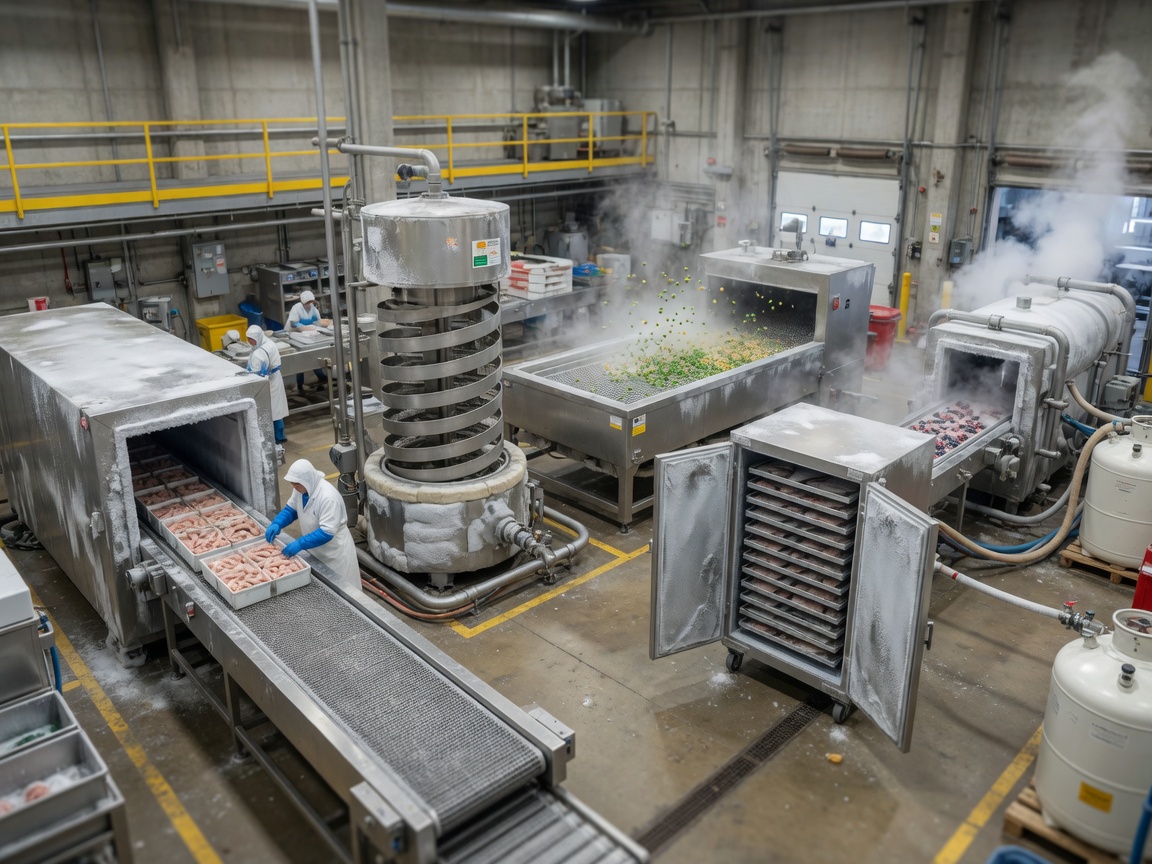
| Equipment type | Best for | Typical capacity | CapEx range (USD) | Energy use (kWh/ton) |
|---|---|---|---|---|
| Tunnel freezer | Sliced vegetables, patties, fish fillets | 1–10 tons/hr | $80,000–$400,000 | 90–130 |
| Fluidized bed freezer | Peas, corn, diced fruit, small shrimp | 0.5–5 tons/hr | $100,000–$350,000 | 80–110 |
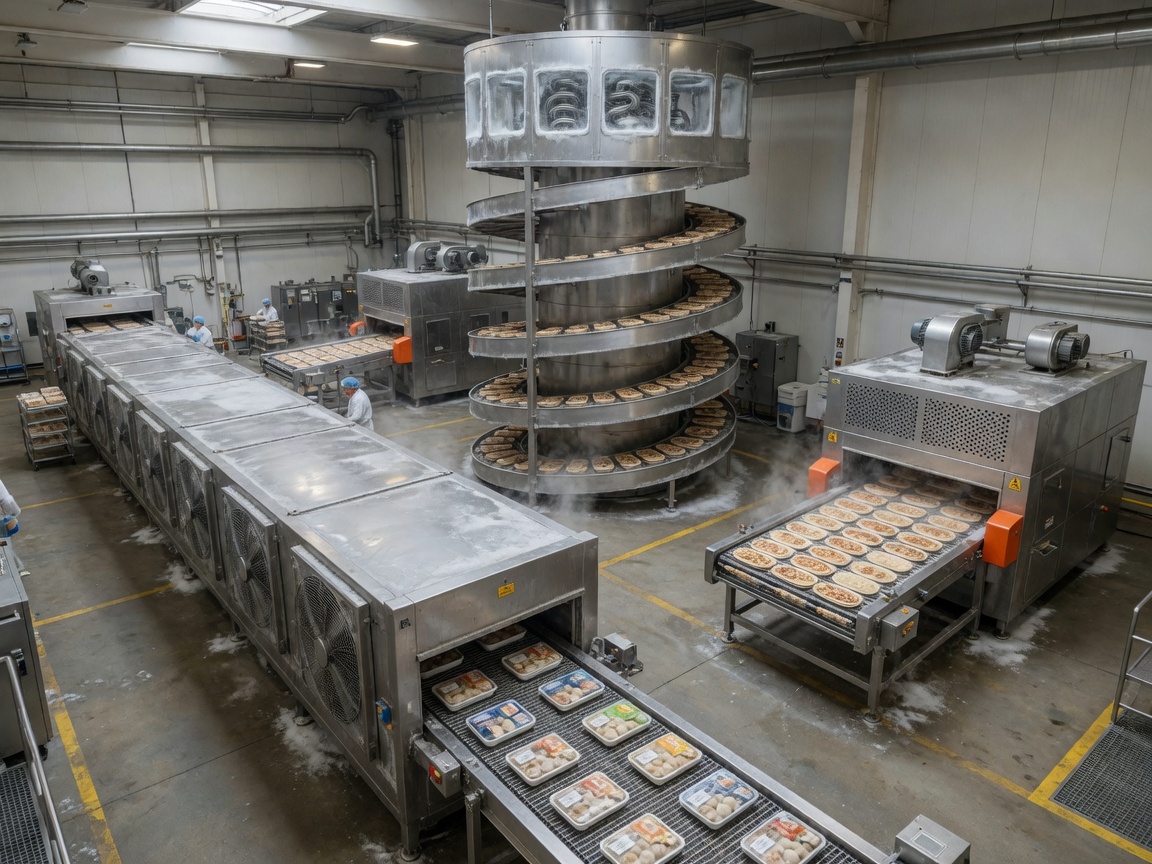
| Spiral freezer | Whole shrimp, chicken portions, baked goods | 2–20 tons/hr | $250,000–$1,200,000 | 95–140 |
| Plate freezer | Block fish, portioned meat, regular shapes | 0.5–4 tons/hr | $60,000–$300,000 | 60–85 |
| Cryogenic freezer (LN₂/CO₂) | High-value seafood, ready meals, delicate items | 0.2–3 tons/hr | $30,000–$180,000 | N/A (cryogen cost $0.15–$0.40/lb) |
Fluidized bed freezers: the purest IQF expression
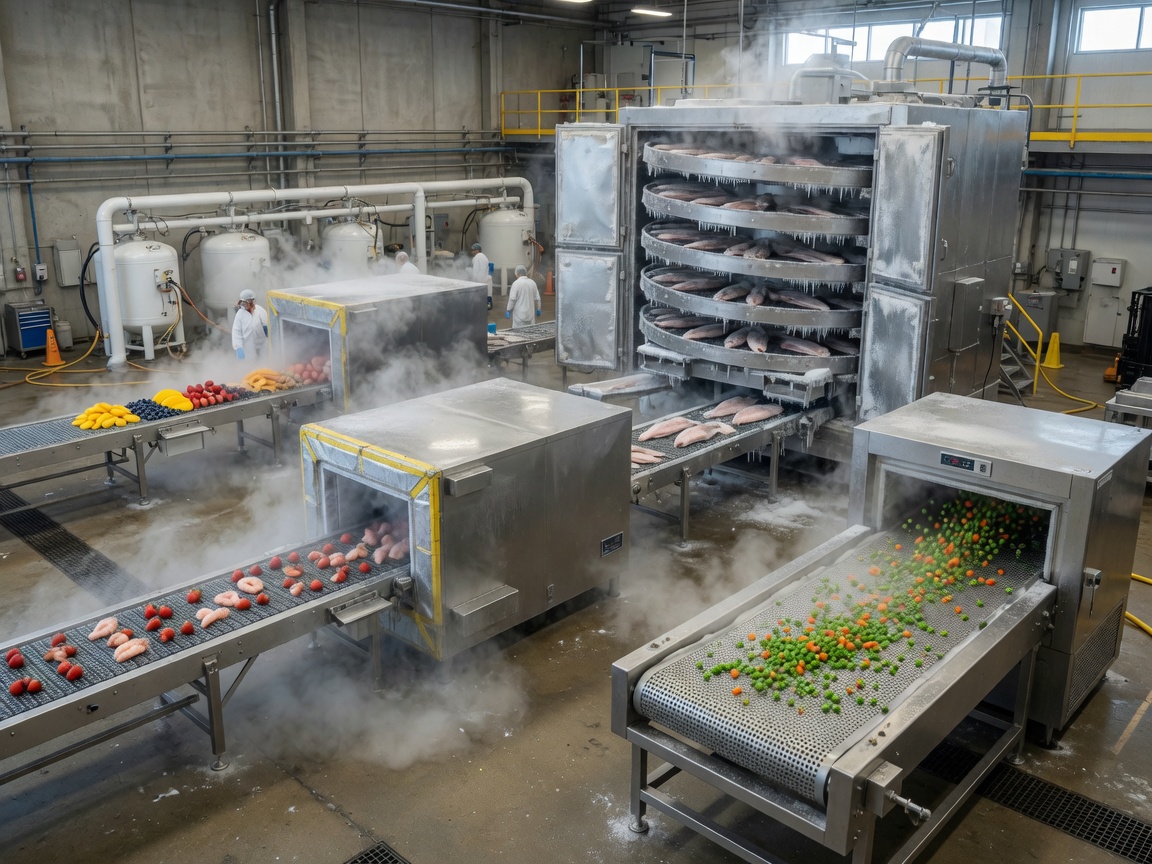
A fluidized bed freezer is where individual quick freezing reaches its mechanical ideal. Upward-flowing cold air literally suspends small product pieces — peas, corn kernels, diced mango, small shrimp — so they never contact the belt or each other during initial surface hardening. Actual testing in commercial production environments shows clumping rates drop to under 1% with properly pre-dried inputs. The tradeoff? Products heavier than roughly 2–3 oz per piece cannot be adequately suspended, making this system unsuitable for whole fish or bone-in poultry.
Spiral freezers: the workhorse of high-volume lines
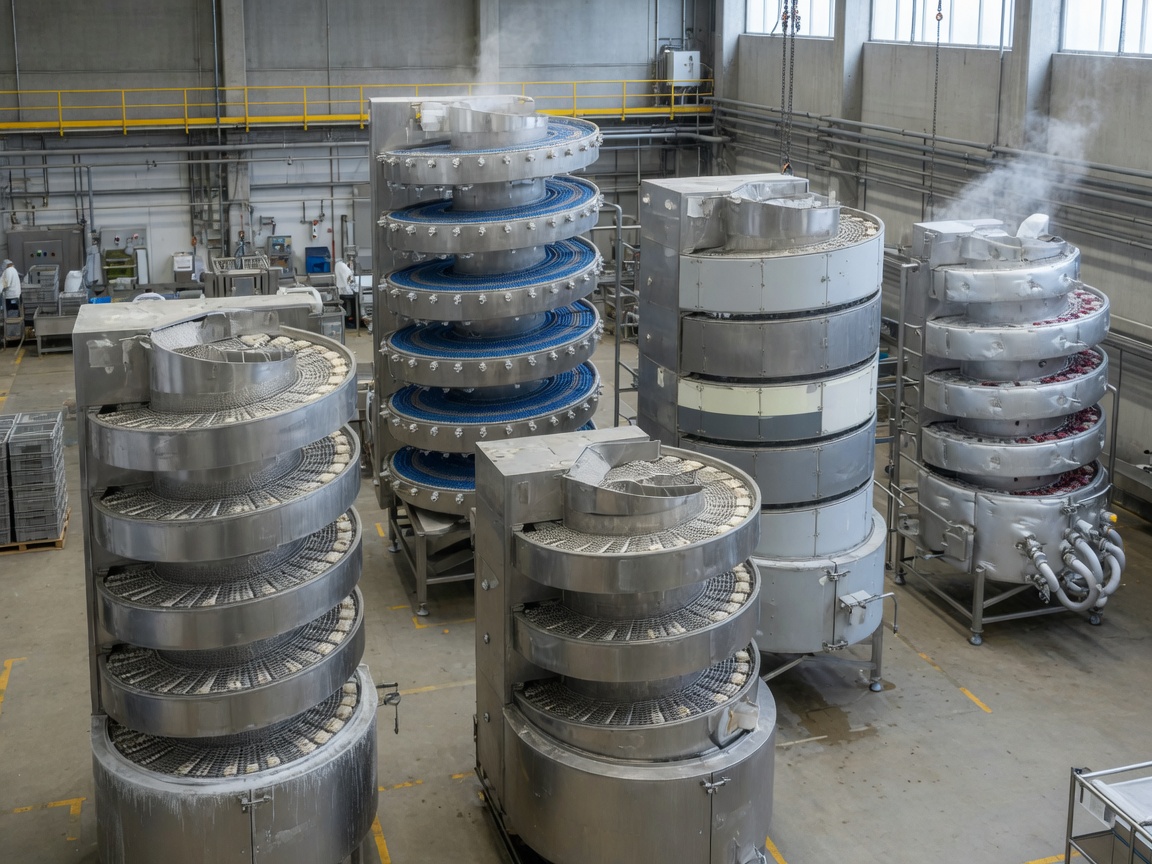
For operations running continuous freezing systems at scale, the spiral freezer dominates. Its helical belt design maximizes freezing dwell time within a compact footprint — a critical advantage when plant floor space in U.S. facilities runs $150–$300/sq ft. Industry consensus holds that spiral systems offer the best balance of throughput, sanitation access, and capital cost per ton for facilities processing above 3 tons per hour. The main limitation is capital expenditure, which can exceed $1 million for large industrial food freezer configurations.
Mechanical vs. cryogenic IQF: the real cost breakdown
This is the comparison almost no competitor addresses honestly. Cryogenic freezing equipment has a deceptively low sticker price — but the total cost of ownership diverges sharply from mechanical blast freezer equipment within 12 to 18 months of operation. Here's the analysis U.S. procurement teams actually need.
Capital expenditure (CapEx)
A liquid nitrogen cryogenic tunnel for a 1-ton/hr operation can be purchased for $40,000–$80,000. A mechanical tunnel freezer at the same capacity runs $120,000–$200,000. On CapEx alone, cryogenic wins decisively. This is why smaller startups and co-manufacturers often enter the market with LN₂ systems — lower upfront barrier, faster installation, no refrigeration compressor infrastructure required.
Operating expenditure (OpEx) and energy cost per ton
Here the equation flips. Liquid nitrogen in the U.S. currently costs $0.15–$0.40 per pound depending on contract volume and geography. Processing 1 ton of product in a cryogenic system consumes approximately 1.5–2.5 lbs of LN₂ per pound of product frozen — translating to $450–$2,000 in cryogen cost per ton. A mechanical commercial freezing system running on ammonia or CO₂ refrigerant might consume 90–130 kWh per ton; at the U.S. industrial electricity average of $0.075/kWh (2026 data), that's $6.75–$9.75 per ton in energy cost. The gap is not subtle. For a facility freezing 2 tons per hour across two shifts, cryogenic operating costs can exceed mechanical by $800,000–$1,500,000 annually.
"For high-throughput operations above 1 ton per hour, the operational cost advantage of mechanical IQF systems over cryogenic alternatives typically reaches break-even within 14 months, making mechanical the clear long-term investment for established processors." — Industry analysis, 2026 Frozen Food Processing Technology Review
Of course, there are situations where cryogenic makes sense even at scale. Products sensitive to dehydration loss — lobster tails, sashimi-grade tuna, premium berry varieties — benefit from the ultra-rapid surface crust formation that liquid nitrogen delivers. Dehydration loss in mechanical IQF typically runs 1–3% by weight; cryogenic systems cut that to 0.2–0.5%. For high-value products priced above $8/lb, that weight retention difference alone can justify cryogenic OpEx.
FDA/USDA sanitation compliance for IQF equipment design
Most IQF equipment buyers focus on throughput and cost. Fewer think rigorously about sanitation design until their first FDA inspection or USDA audit — at which point a poorly specified machine becomes a compliance liability. This section covers what the regulations actually require and how equipment design must respond.
Hygienic zoning and material specifications
Under 21 CFR Part 117 (FSMA Preventive Controls) and USDA FSIS facility standards, food-contact surfaces in IQF equipment must be constructed of non-porous, corrosion-resistant materials — typically 304 or 316L stainless steel. All welds must be continuous, ground smooth, and free of crevices where biofilm can accumulate. Horizontal ledges that cannot drain freely are a red flag in any FDA inspection. When evaluating any industrial food freezer for a USDA-inspected facility, request the manufacturer's 3-A Sanitary Standards certification or NSF/ANSI 169 compliance documentation as a baseline requirement.
CIP/SIP compatibility and defrost design
Clean-in-Place (CIP) and Sterilize-in-Place (SIP) compatibility is no longer optional in U.S. food processing. A frozen food production line running seafood or poultry must be capable of full internal sanitization without disassembly. Look for IQF systems with sloped drain pans (minimum 3° pitch), removable belt sections with tool-free access, and evaporator coils positioned for direct foam cleaning access. Defrost design matters too: hot-gas defrost cycles that leave standing water in inaccessible zones create Listeria risk — particularly problematic in ready-to-eat product environments.
Product-specific IQF selection: shrimp, vegetables, and more
The biggest selection mistake processors make is choosing equipment based on generic specs rather than product-specific throughput benchmarks. What works for diced bell peppers will underperform badly on whole shrimp. Here's a category-by-category breakdown.
Best IQF equipment for shrimp processing
Seafood freezing equipment for shrimp must handle a product that varies significantly in size (count 16/20 vs. 51/60), surface moisture, and value. For peeled and deveined (P&D) shrimp under 10g each, a fluidized bed IQF freezer delivers the cleanest individual separation and lowest clump rate. Actual production data from Gulf Coast processing facilities shows fluidized bed systems achieving freezing capacity of 1–3 tons per hour for P&D shrimp with less than 0.8% clumping loss at product core temperatures of −18°C within 8–12 minutes. For larger whole shell-on shrimp or prawns above 15g, a tunnel freezer or spiral freezer is more appropriate, as body weight exceeds fluidization thresholds.
IQF for diced vegetables and fruit
Diced vegetables — bell peppers, onions, carrots, broccoli florets — are among the most forgiving products for IQF. The fluidized bed freezer again excels here, provided incoming moisture is controlled. A pre-drying or centrifuge step that reduces surface moisture below 2% before the product enters the freezing tunnel can improve individual separation by 40–60% compared to wet-fed product. For whole berries such as blueberries and strawberry halves, a two-stage approach — brief fluidized bed crust freeze followed by a spiral freezer for final hardening — is the configuration used by most leading U.S. frozen fruit processors.
IQF equipment ROI: payback period framework for U.S. processors
No ROI calculator exists in most competitor content. That's a serious gap, because the payback analysis for a commercial freezing system is genuinely complex — and getting it wrong can sink a mid-size operation. Here is a simplified but realistic payback period framework.
Step-by-step ROI estimation for a mid-size U.S. processor
- Define baseline product value: Calculate current per-pound revenue for your frozen product category. Premium IQF product typically commands a 15–25% price premium over block-frozen equivalent at retail and foodservice.
- Estimate yield improvement: IQF processing typically reduces drip loss at thaw by 4–8 percentage points vs. block freezing. On 1 million lbs/year processed, a 5% yield gain at $3/lb = $150,000 in recovered revenue annually.
- Calculate energy and cryogen OpEx delta: Use the mechanical vs. cryogenic OpEx figures from Section 3, adjusted for your actual throughput hours and local utility rate (check your state's commercial electricity tariff).
- Factor in waste reduction: Clump-free IQF product reduces customer return claims and rework cost. Based on industry benchmarks, this typically reduces product loss by 1.5–3% of total production volume.
- Compute simple payback period: Divide total CapEx (equipment + installation + utility upgrades) by annual net benefit (yield gain + waste reduction + price premium capture − incremental OpEx). A $300,000 mechanical IQF system delivering $120,000/year in net benefit has a 2.5-year payback — well within the 3–5 year threshold most U.S. food manufacturers target for capital equipment.
What small processors often miss
Installation and utility infrastructure costs are routinely underestimated. A mechanical blast freezer equipment installation typically requires electrical service upgrades ($15,000–$50,000), ammonia or CO₂ refrigeration system integration, insulated room construction, and drainage. Budget 25–40% of equipment CapEx for site preparation. Ignoring this converts an apparently affordable $150,000 tunnel freezer into a $220,000 project — and shifts the payback period by 6–12 months.
Sustainability and energy efficiency in 2026
U.S. food manufacturers and their retail partners are under growing pressure to document carbon footprint and energy consumption across processing operations. IQF equipment purchasing decisions in 2026 increasingly involve sustainability criteria that simply did not appear on RFQs five years ago.
Refrigerant transition: the shift to natural refrigerants
The HFC phase-down under the AIM Act — the U.S. implementation of the Kigali Amendment — is directly affecting IQF equipment specification. R404A and R22, the dominant refrigerants in legacy commercial freezing systems, are being phased out in favor of low-GWP alternatives. The three leading natural refrigerants for industrial food freezer applications are ammonia (NH₃, R717), CO₂ (R744), and propane (R290). Ammonia remains the most thermodynamically efficient option for large-scale frozen food production lines, delivering 20–30% lower energy consumption per ton compared to HFC systems. CO₂ cascade systems are gaining ground in smaller applications where ammonia's toxicity poses facility safety challenges. When evaluating new IQF equipment in 2026, insist on refrigerant compatibility documentation and confirm the system is designed for future refrigerant transition without full compressor replacement.
ENERGY STAR and certification benchmarks
While ENERGY STAR does not currently offer a specific certification tier for industrial IQF freezers, major U.S. retailers including Walmart and Costco are requiring their frozen food suppliers to document processing energy intensity as part of supplier sustainability scorecards. The industry benchmark for a well-optimized mechanical IQF system is 90–110 kWh per ton of frozen product. Systems exceeding 140 kWh/ton should trigger a retrofit evaluation. Variable frequency drives (VFDs) on evaporator fan motors — a relatively low-cost upgrade at $3,000–$8,000 per unit — can reduce fan energy consumption by 30–50%, often delivering payback within 18 months at current electricity rates. For deeper analysis of the underlying technology, see the Wikipedia overview of individual quick freezing technology, which covers the thermodynamic principles driving these efficiency benchmarks.
Smart IQF equipment with integrated PLC/SCADA controls and AI-driven temperature optimization — a 2026 trend now appearing in mid-tier equipment from multiple manufacturers — offers another pathway to energy reduction. Real-world case data from North American seafood processing operations shows AI temperature control reducing average refrigeration runtime by 8–14% without compromising product core temperature targets. It's a compelling value proposition, particularly for operations with high utility costs in states like California or New York.
Choosing the right IQF equipment: final guidance
Selecting the right IQF equipment comes down to matching system design to three variables: product characteristics, required freezing capacity in tons per hour, and total cost of ownership over a 10-year horizon. A fluidized bed freezer wins for small, uniform particles. A spiral freezer wins for high-volume continuous operation. Cryogenic freezing equipment wins for ultra-premium, moisture-sensitive products where dehydration loss is more costly than cryogen spend. Mechanical systems win everywhere else at scale. Factor in FDA/USDA compliance requirements from the design specification stage — not after the machine arrives on the floor. Run the ROI payback model before issuing any RFQ, and insist on natural refrigerant compatibility as a standard procurement requirement in 2026.
Frequently asked questions
Q: What is the difference between IQF equipment and a standard blast freezer?
A: A blast freezer equipment unit freezes products in bulk at high air velocity, often resulting in clumped or block-frozen output. IQF equipment is specifically engineered to freeze each food item individually using controlled airflow or fluidization, producing free-flowing, non-clumped product with significantly lower cellular damage and better post-thaw texture.
Q: How much does IQF equipment cost in the U.S.?
A: Entry-level cryogenic IQF systems start around $30,000–$80,000. Mid-range mechanical tunnel freezers or fluidized bed systems run $100,000–$400,000. Large spiral freezers for high-volume frozen food production lines can exceed $1 million. Always add 25–40% for installation, utility upgrades, and site preparation.
Q: Which IQF equipment is best for shrimp processing?
A: For peeled, deveined shrimp under 10g each, a fluidized bed freezer delivers the best individual separation and lowest clumping rate, typically under 1% with properly pre-dried input. For larger whole shrimp or prawns above 15g, a tunnel freezer or spiral freezer is the better choice based on product weight and geometry requirements.
Q: What sanitation certifications should I require for IQF equipment?
A: At minimum, require 3-A Sanitary Standards certification or NSF/ANSI 169 compliance. For USDA-inspected facilities, confirm food-contact surfaces are 304 or 316L stainless steel, all welds are ground smooth, and the system supports CIP/SIP cleaning protocols without full disassembly. Verify sloped drain pans and accessible evaporator coil design.
Q: How long is the typical payback period for a mechanical IQF system?
A: For U.S. small-to-mid-size processors, the payback period for a mechanical commercial freezing system typically ranges from 2 to 4 years, factoring in yield improvement, product price premium, and waste reduction. Operations processing premium seafood or fruit at higher per-pound values tend to achieve payback closer to 18–24 months.
Keywords:
Inquiry
If you are interested in our products, please leave your email to receive a free product quote, thank you!
More information


Tel:
Sales E-mail: