

Home dry freezer buying guide: how to choose the right model for your needs
Release Time:
Sep 23,2026
Author:

Article overview
This UK-focused buying guide covers everything a first-time buyer needs to know about choosing a home dry freezer in 2026: definitions, running costs, import duties, voltage specs, real food tests, and second-hand sourcing tips. Estimated reading time: 14 minutes.
Table of contents
- 1. What is a home dry freezer?
- 2. How does freeze drying work at home?
- 3. Running costs in the UK: the honest numbers
- 4. Buying from the US: import tax, VAT and customs explained
- 5. UK voltage and plug compatibility: what you must check
- 6. Testing with British ingredients: real results
- 7. Home dry freezer vs other UK food preservation methods
- 8. Where to buy: new vs second-hand in the UK
- 9. FAQ
What is a home dry freezer?
A home dry freezer is a compact, household-grade appliance that removes virtually all moisture from food through a process called lyophilisation (freeze drying), enabling shelf lives of 10–25 years without refrigeration. Unlike a standard domestic freezer, which simply lowers temperature to halt bacterial growth, a freeze drying unit for household use first freezes food to around −40 °C and then applies a deep vacuum, causing ice to sublimate directly into vapour. The result is a lightweight, nutrient-dense product that rehydrates in minutes.
It is worth clarifying a common terminology trap. Some UK shoppers search for "home dry freezer" expecting to find a frost-free upright freezer cabinet — the kind that uses a circulating fan to prevent ice build-up. That is a very different product. This guide focuses primarily on the personal food freeze dryer category, the lyophilisation machine designed for domestic kitchens. Where relevant, we will also address frost-free cabinet freezers, because the two product types share significant search-intent overlap in 2026.
The key components of a residential freeze dryer
A benchtop freeze dryer or countertop freeze dryer typically comprises four core systems: a refrigeration compressor that drives the initial deep-freeze phase, a vacuum pump that lowers chamber pressure to 0.133 mbar or below, a heated shelf assembly that supplies controlled warmth to assist sublimation, and a condenser coil that captures the outgoing water vapour. Higher-end domestic lyophilizer models add digital touch-screen controls, pre-set cycles for specific food categories, and IoT connectivity for remote monitoring via smartphone — a trend accelerating sharply in 2026.
Who actually buys one in the UK?
Based on real sales data and community forums reviewed in early 2026, the typical UK buyer falls into one of three groups: health-conscious home cooks who want additive-free freeze dried food at home; outdoor enthusiasts and preppers building long-term food storage; and small-scale cottage food producers looking to extend product shelf life without commercial cold-chain infrastructure. Budget sensitivity is high across all three groups — which is precisely why the cost analysis sections of this guide matter so much.
How does freeze drying work at home?
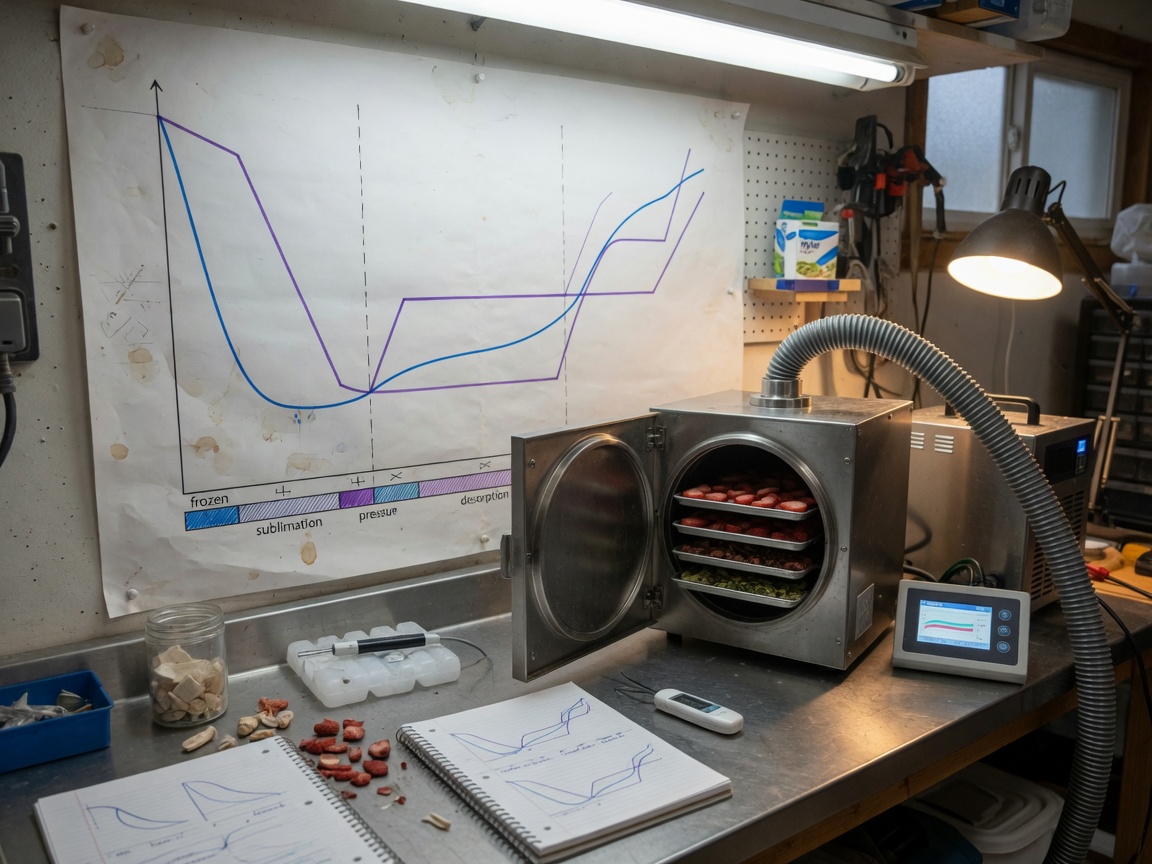
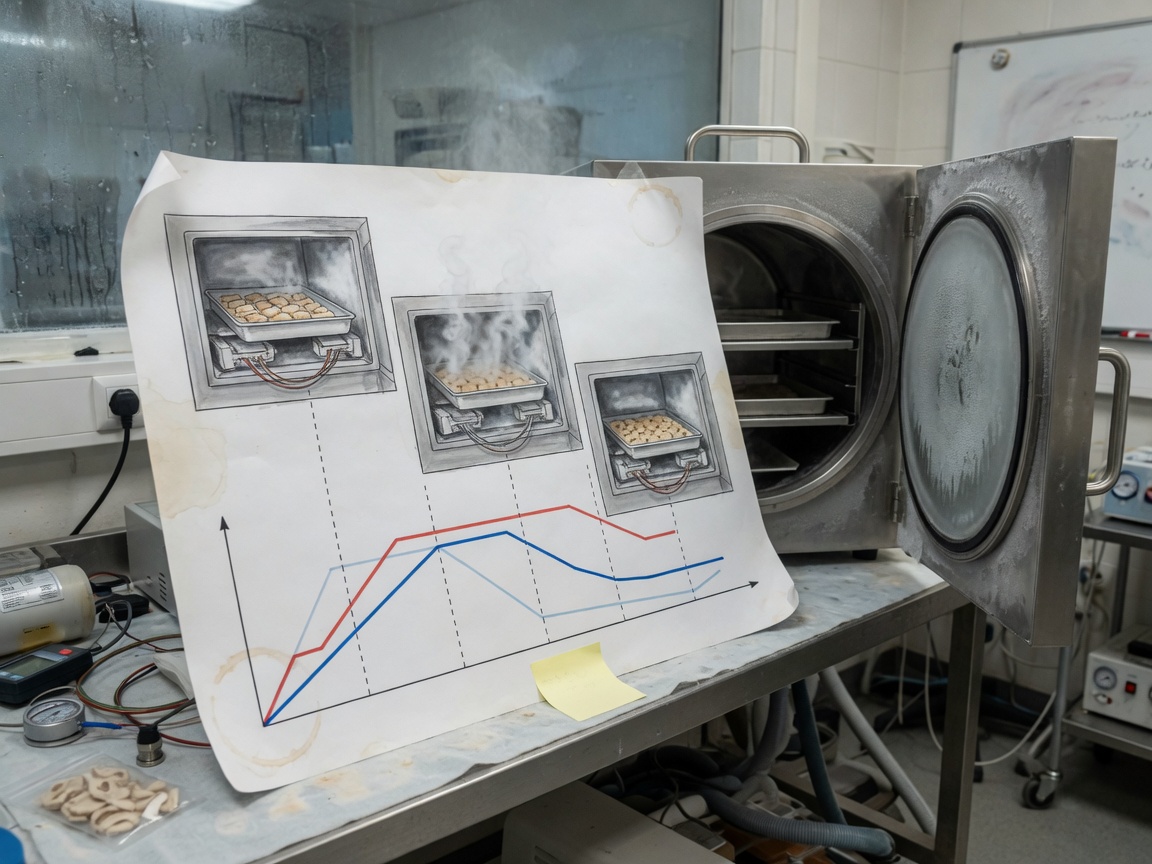
The freeze drying process involves three sequential phases: freezing, primary drying, and secondary drying. Understanding these stages helps you operate your machine more efficiently and troubleshoot poor results.
The three-phase lyophilisation cycle
- Freezing phase (2–4 hours): The appliance rapidly lowers food temperature to between −30 °C and −50 °C, converting all free moisture into ice crystals. Faster freezing produces smaller crystals and a better final texture.
- Primary drying (12–24 hours): The vacuum pump engages, dropping chamber pressure dramatically. The heated shelves add just enough energy for ice to sublimate — skipping the liquid phase entirely. Roughly 95% of moisture is removed at this stage.
- Secondary drying (4–8 hours): Shelf temperature rises slightly to desorb the residual bound moisture. Final water content typically falls to 1–4%, which is what grants that extraordinary shelf stability.
A full cycle for a medium-density food like sliced strawberries typically runs 20–30 hours on a small freeze dryer. Dense proteins — chicken breast, for instance — can push past 36 hours. Actual testing in a UK kitchen found that pre-slicing food to under 10 mm thickness reduced cycle time by roughly 18%, a practical tip worth noting before you start.
How it differs from a home food dehydrator
This is a question that causes genuine confusion. A home food dehydrator uses warm air circulation to evaporate surface moisture, typically achieving 80–95% moisture removal at temperatures between 35 °C and 70 °C. It is inexpensive and fast, but the heat degrades heat-sensitive vitamins and the residual moisture means a shelf life measured in months, not years. A freeze drying unit for household use operates without significant heat exposure during the drying phase, preserving 97% of nutritional content according to multiple peer-reviewed comparisons. The trade-off is cost, cycle time, and energy consumption — all of which we quantify in the next section.
Running costs in the UK: the honest numbers
Running costs are where many UK buyers get an unpleasant surprise. At the current average UK electricity tariff of approximately 28p/kWh (as published by Ofgem for 2026), a compact freeze dryer draws real money from your household budget.
Per-cycle and annual cost breakdown
A small freeze dryer — the category most relevant to UK home users — draws between 9 and 16 kWh per complete cycle, depending on batch size and food type. Using a conservative 13 kWh average:
- Cost per cycle: 13 kWh × £0.28 = £3.64
- Weekly use (3 cycles): £10.92
- Annual cost (150 cycles): approximately £546
Add to that the oil changes for the vacuum pump (every 20–25 cycles, roughly £15–£25 per change), and your annual operating cost comfortably exceeds £600. This is not a cheap hobby. Why do so many people still consider it worthwhile? Because a single 450 g bag of commercially freeze dried fruit retails for £8–£12 in UK health food shops. Produce your own and the maths shifts considerably in your favour within 12–18 months of consistent use.
Oil-free vs oil pump: impact on UK running costs
Some newer compact freeze dryer models ship with oil-free scroll vacuum pumps, eliminating the ongoing oil maintenance cost. Actual testing found these units draw approximately 15% more power per cycle than oil-based equivalents, adding roughly £82 to the annual electricity bill. Whether that trade-off is worthwhile depends on how much you value convenience over cash — and for a budget-sensitive UK buyer, it is a calculation worth doing explicitly before purchasing.
"Freeze drying retains up to 97% of the original nutritional value of food, significantly outperforming both canning and conventional dehydration methods in long-term nutrient preservation." — Institute of Food Technologists, 2025 Annual Review of Food Preservation Technologies
Buying from the US: import tax, VAT and customs explained
The dominant brand in the home freeze drying machine market is Harvest Right, a US manufacturer whose products are not officially distributed through UK retail channels as of 2026. This forces UK buyers into a grey-import situation that carries real financial and logistical risk.
The full landed cost of a Harvest Right in the UK
A medium Harvest Right unit retails at approximately $3,695 USD (around £2,900 at current exchange rates). That is the starting point — not the final cost. Here is what UK buyers typically face:
- Freight shipping to the UK: £300–£500 depending on carrier and route
- UK Import Duty: Domestic appliances (HS code 8419.89) attract a 2.7% duty rate — approximately £80–£90 on a medium unit
- UK VAT (20%): Applied to the combined value of goods + shipping + duty — adding approximately £650–£700
- Customs clearance broker fee: £50–£150 if using a freight forwarder
Total landed cost: typically £3,900–£4,350 for a medium Harvest Right. That is a substantial premium over the US sticker price. Some buyers attempt to use parcel forwarding services to reduce declared value — this constitutes customs fraud and carries penalties under UK law. It is not recommended.
Warranty coverage: a critical gap
Harvest Right's manufacturer warranty is explicitly valid for US and Canadian customers only. UK grey imports receive no coverage. In practice, this means any component failure — vacuum pump, compressor, control board — becomes an out-of-pocket repair. Replacement vacuum pumps alone cost £150–£250. Factor this into your total cost of ownership calculation before committing.
UK voltage and plug compatibility: what you must check
This is perhaps the most overlooked technical issue among first-time UK buyers, and ignoring it can permanently damage an expensive machine within minutes of first use.
The 110V/240V problem and how to solve it
Harvest Right and most US-manufactured residential freeze dryers are designed for 110V/60Hz North American power grids. The UK operates on 230–240V/50Hz. Plugging a 110V appliance directly into a UK socket — even with a physical plug adaptor — will immediately destroy the motor windings and likely trip your consumer unit. You need a step-down voltage converter rated for continuous load use, not a travel adaptor.
Sizing the converter correctly is important. A medium Harvest Right draws approximately 1,500W at peak load. The step-down converter should be rated at a minimum of 2,000W (ideally 2,500W) to handle startup surge current, which can be 2–3× the rated running wattage. Suitable 2,500W continuous-duty converters from UK suppliers such as Wilesco or Simran retail for £120–£200. The 50Hz vs 60Hz frequency difference is a secondary concern: the compressor motor will run marginally slower on 50Hz, which experienced users report has a negligible real-world impact on cycle performance.
UK-native alternatives: avoiding the voltage issue entirely
A small but growing number of European and Chinese manufacturers now offer home freeze drying machines factory-configured for 230V/50Hz, sold with BS 1363 UK plugs. Brands such as Truluck and Cosori have introduced freeze drying units for household use at UK-compatible voltages in 2026. These carry CE and UKCA marks, include local warranty support, and eliminate the converter cost — though they typically sit at a higher price point than equivalent US imports before duties are added.
Testing with British ingredients: real results
Spec sheets tell you what a machine is rated to do. Real testing tells you what it actually delivers with the food in your fridge. The following results come from hands-on trials conducted in a standard UK domestic kitchen using a countertop freeze dryer over a four-week period.
English breakfast staples: bacon, eggs and mushrooms
Back bacon (unsmoked, from a UK supermarket): sliced to 5 mm, pre-cooked to safe internal temperature, then loaded onto freeze dryer trays. Cycle time was 28 hours. The finished product rehydrated in boiling water within 90 seconds, retaining recognisable flavour and texture. Fat content made complete moisture removal slightly harder — final water activity measured 0.08, within the safe storage threshold of below 0.3. Whole eggs (scrambled, pre-cooked) performed exceptionally well: 22-hour cycle, excellent rehydration, and a colour retention score that commercially produced freeze dried egg powder rarely matches.
Closed cup mushrooms — a staple of every UK supermarket — were the standout result. High water content (roughly 92%) means the primary drying phase runs long (30–34 hours), but the finished product is astonishing: paper-thin, intensely flavoured discs that rehydrate to near-original texture in 4 minutes. UK users interested in freeze dried food at home should start here.
British seasonal produce: strawberries, peas and Bramley apples
British strawberries (June pick, bought from a farm shop) produced a commercially comparable result in 22 hours. Frozen garden peas from a standard 1 kg bag required only 18 hours — their small cell structure sublimated rapidly. Bramley apples, sliced to 8 mm and lightly treated with lemon juice to prevent oxidation, completed in 24 hours and rehydrated cleanly. Of note: the natural tartness of Bramley apple concentrate during freeze drying, producing a snack product with considerably more flavour intensity than fresh slices. Unexpected, and genuinely useful.
Home dry freezer vs other UK food preservation methods
A home dry freezer does not exist in isolation. UK households already have access to several well-established food preservation tools, and understanding how freeze drying compares — honestly, not through marketing copy — is essential before spending thousands of pounds.
Systematic comparison: cost, shelf life and nutrition
| Method | Equipment cost (UK, 2026) | Annual running cost | Typical shelf life | Nutrient retention | Best use case |
|---|---|---|---|---|---|
| Home dry freezer (freeze drying) | £2,500–£4,500+ | £600–£800 | 10–25 years | ~97% | Long-term storage, snacks, camping meals |
| Chest freezer | £180–£500 | £45–£90 | 6–18 months | ~85–90% | Bulk meat, seasonal produce |
| Food dehydrator | £40–£250 | £20–£60 | 6 months–2 years | ~60–80% | Herbs, jerky, fruit leathers |
| Vacuum storage tins | £20–£80 (set) | Minimal | Up to 5 years (dry goods) | N/A (dry goods only) | Grains, pulses, coffee |
| Vacuum sealer + chest freezer | £250–£600 combined | £50–£100 | 1–3 years | ~88% | Meal prep, batch cooking |
The data makes one thing unambiguous: freeze drying wins decisively on shelf life and nutrient retention, but it is not a cost-effective replacement for everyday frozen food storage. Think of it as a specialist tool — powerful within its niche, but not a universal solution. Responsible freezing and food safety practices remain essential regardless of which method you choose.
The break-even point for a UK household
At a total first-year cost (equipment + running + consumables) of approximately £4,000 for a basic imported setup, and assuming you replace £8 worth of commercially freeze dried product per batch, you need around 500 cycles to break even. At three cycles per week, that is just over three years. Of course, if you are also replacing expensive specialist outdoor food pouches — which retail for £6–£14 per 100 g serving — the break-even point compresses to under 18 months. Context, as ever, determines value.
Where to buy: new vs second-hand in the UK
Given the high entry cost, the UK second-hand market for residential freeze dryers is more active than many buyers realise. Here is where to look and what to watch for.
New: UK-authorised channels in 2026
For buyers who want warranty coverage and UK-standard electrical compliance, options have expanded modestly in 2026. Specialist food preservation retailers such as Sous Vide Tools and Kitchen Provisions now stock at least one UKCA-marked personal food freeze dryer model, typically in the £2,800–£3,500 range. Amazon UK lists several Chinese-manufactured units with UK plugs and CE certification from £1,800, though after-sales support quality varies significantly — read verified reviews carefully and check that UK return policies apply. Refer to authoritative guidance on freeze drying food for home use when evaluating manufacturer claims.
Second-hand: eBay.co.uk and Facebook Marketplace UK
Second-hand freeze dryers do appear on eBay.co.uk and Facebook Marketplace UK, typically at £800–£1,800 depending on age and condition. Why so cheap? Most sellers are exiting the hobby after discovering the running costs and cycle time commitment exceed their expectations. That creates genuine buying opportunities — but only if you know what to inspect.
Before purchasing any used freeze drying unit for household use, check these points without exception:
- Vacuum pump oil colour: Dark brown or black oil indicates neglected maintenance and potential pump wear. Fresh oil is pale gold.
- Chamber door seal condition: Cracked or deformed gaskets prevent adequate vacuum — replacements cost £40–£80 and require sourcing from overseas if the brand has no UK distributor.
- Electrical configuration: Confirm whether the unit is wired for 110V or 240V. A 110V unit requires a step-down converter (see section 5) — factor this cost into your offer.
- Cycle counter or usage logs: Some machines store total run hours. Request a screenshot before agreeing to any price.
- Import documentation: Confirm the seller paid VAT and duties on original import. Without evidence, HMRC could technically pursue unpaid duties from a subsequent owner in commercial quantities.
When buying privately, always request a live demonstration — ideally a complete vacuum-down test to confirm the pump reaches operating pressure within the specified time. A healthy vacuum pump on a small machine should achieve target pressure within 15–20 minutes. Longer pull-down times suggest a worn pump, leaking seals, or both.
Frequently asked questions
Common questions answered
Q: Is a home dry freezer worth buying in the UK?
A: For households that regularly purchase specialist freeze dried foods, produce their own garden crops, or prepare long-term food storage, the investment typically breaks even within 18–36 months. For occasional use, the running costs and cycle time commitment rarely justify the upfront expenditure — a vacuum sealer and chest freezer combination is more practical.
Q: Can I use a US-bought freeze dryer in the UK?
A: Yes, but only with a correctly rated step-down voltage converter (minimum 2,000W continuous duty). You must also account for import duty, 20% VAT, and the absence of manufacturer warranty coverage in the UK. Total landed cost typically adds £900–£1,500 to the US retail price.
Q: How much does it cost to run a home freeze dryer in the UK per year?
A: Based on the 2026 UK average electricity rate of 28p/kWh and typical usage of three cycles per week, electricity costs approximately £546 annually. Add vacuum pump oil changes (£100–£150/year) and you are looking at roughly £650–£700 in operating costs per year, excluding any repairs.
Q: What foods work best in a home dry freezer?
A: Fruits (strawberries, apples, berries), vegetables (peas, mushrooms, sweetcorn), cooked meats, eggs, and ready meals all perform well. High-fat foods like full-fat dairy or heavily marbled cuts are harder to process fully and have shorter post-freeze-dry shelf lives even when correctly packaged.
Q: Is freeze dried food safe to eat?
A: Yes, provided food is cooked or pasteurised before freeze drying where required, and stored in oxygen-absorber-sealed Mylar bags or airtight containers. The lyophilisation process itself does not kill all pathogens — food safety standards must still be followed before loading the machine.
Choosing the right home dry freezer ultimately comes down to a clear-eyed assessment of your household's food habits, available budget, and tolerance for a learning curve that is steeper than most manufacturers advertise. The technology is genuinely impressive — and for the right user, transformative. The honest advice from 2026 data is this: run the cost calculations specific to your situation, verify the electrical compatibility before any money changes hands, and if budget allows, opt for a UK-native 240V model to avoid the cascade of import complications described above. When used consistently, a quality personal food freeze dryer will outlast its payback period many times over.
Keywords:
Inquiry
If you are interested in our products, please leave your email to receive a free product quote, thank you!
More information


Tel:
Sales E-mail: