

Mesh belt tunnel freezer buying guide: how to choose the right model for your production line
Release Time:
Sep 22,2026
Author:

Article overview
This buying guide covers everything a U.S. food processing procurement manager needs: equipment definitions, comparison tables, compliance checklists, sizing methodology, TCO analysis, and verified case studies — all updated for 2026.
Table of contents
- 1. What is a mesh belt tunnel freezer?
- 2. Mesh belt vs. spiral vs. fluidized bed IQF: which one fits your line?
- 3. USDA, FDA, and FSMA compliance requirements for mesh belt freezer design
- 4. How to size your mesh belt tunnel freezer correctly
- 5. Total cost of ownership: energy, maintenance, and ROI analysis
- 6. Real U.S. plant case studies with measurable KPIs
- 7. 2026 technology trends shaping the industry
- 8. FAQ
What is a mesh belt tunnel freezer?
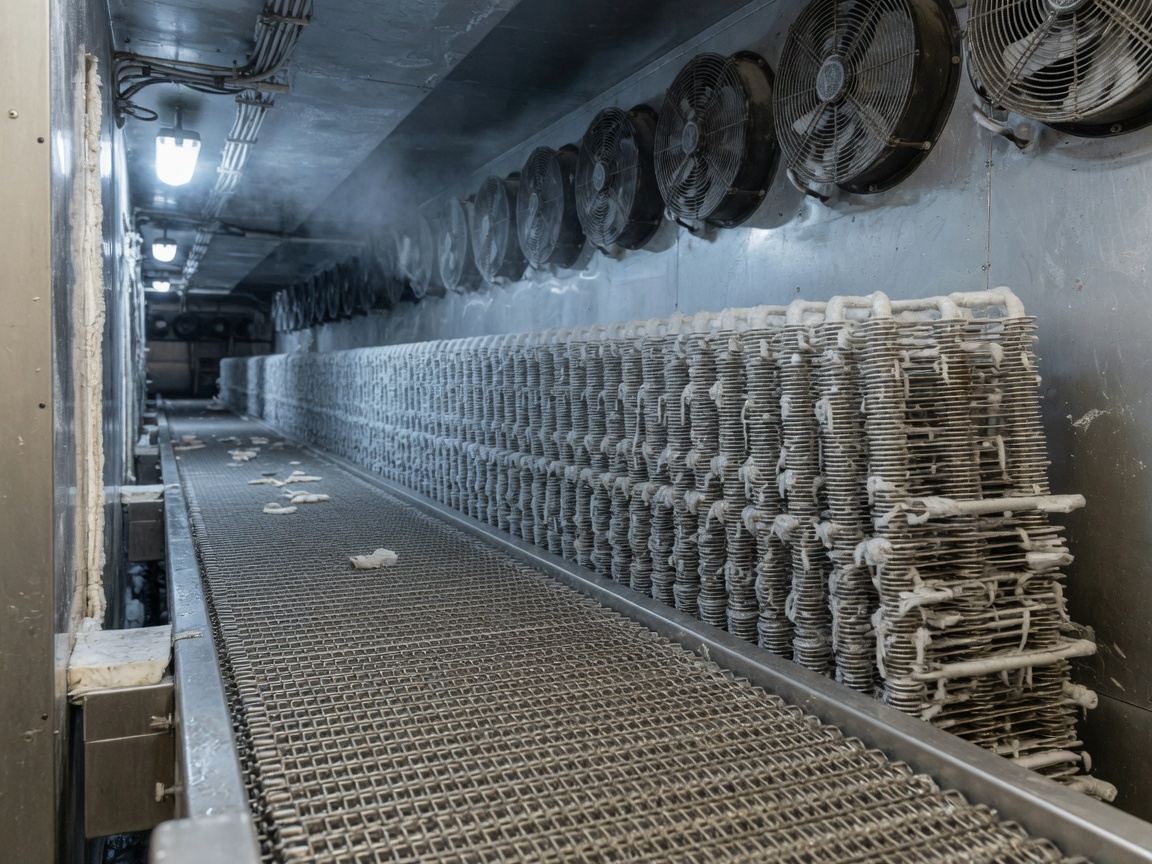
A Mesh Belt Tunnel Freezer is a continuous industrial freezing system in which food products travel on a stainless steel mesh conveyor belt through an insulated tunnel, where high-speed fans force refrigerated air at −35°C to −40°C over the product surface to achieve individual quick freezing (IQF). Unlike batch freezers, this machine never stops moving — product enters one end, exits the other fully frozen, and the line keeps running.
The design sounds straightforward. In practice, the engineering decisions behind belt width, airflow direction, fan configuration, and insulation thickness determine whether a facility hits its throughput targets or bleeds energy costs for years. That's a distinction most buyers only discover after commissioning.
Mesh Belt Tunnel Freezer是指:一种连续式IQF工业速冻设备,食品置于不锈钢网带上持续传送,通过强制冷风循环实现快速单体冻结,广泛应用于肉类、海鲜、蔬菜及预制食品的大批量生产线。
How does it actually work?
Food is loaded onto the stainless steel mesh conveyor at the infeed. Inside the freezing zone, axial fans pull air across an evaporator coil and blast it — either horizontally or vertically — across the product bed. Vertical airflow, used in several leading designs including the BX-series tunnel configuration, pushes cold air directly down through the mesh belt and over the product surface simultaneously. This approach delivers more uniform crust formation and faster core temperature reduction compared to purely horizontal systems, particularly for products with uneven geometry like shrimp or bone-in chicken pieces.
What products is it best suited for?
The straight-line belt conveyor tunnel freezer is the industry workhorse — that phrase gets used a lot, and it's earned. Ideal products include burger patties, bone-in and boneless chicken portions, battered seafood, formed potato products, IQF vegetables, and marinated proteins. Products that are flat, uniform in thickness, or benefit from a quick crust-set respond especially well. Very small, loose particulates — think peas or diced onion — may benefit more from a fluidized bed approach, though a vibrating mesh belt variant handles many of these applications adequately.
Mesh belt vs. spiral vs. fluidized bed IQF: which one fits your line?
This is the question that dominates early-stage procurement conversations — and the answer is never one-size-fits-all. Each technology has a clear domain where it wins, and forcing the wrong equipment into the wrong application is one of the most expensive mistakes a food plant can make.
| Metric | Mesh belt tunnel freezer | Spiral freezer | Fluidized bed IQF freezer |
|---|---|---|---|
| Footprint | Large linear (50–150 ft) | Compact vertical | Moderate linear |
| Capacity range | 500 – 10,000+ lb/hr | 1,000 – 15,000 lb/hr | 200 – 5,000 lb/hr |
| Product suitability | Patties, fillets, portions, formed items | Delicate or long dwell-time products | Small particulates, peas, diced veg |
| Capital cost (U.S. market) | $150K – $600K | $400K – $1.2M+ | $80K – $350K |
| Energy efficiency (COP) | Moderate (2.0–2.8) | Good (2.5–3.2) | Moderate–high (2.2–3.0) |
| Sanitation complexity | Moderate (CIP capable) | High (complex belt path) | Low–moderate |
| Best for U.S. plants | Mid-to-high volume, multiple SKUs | High-volume single product lines | Small-particle specialty lines |
When a spiral freezer alternative makes sense
Spiral freezers dominate high-volume single-SKU environments — a plant running 8,000 lb/hr of boneless chicken breasts 20 hours a day gets compelling ROI from a spiral. But the moment that facility needs to run three different product formats per shift, the spiral's fixed dwell time becomes a liability. A mesh belt tunnel freezer wins on flexibility. Belt speed is continuously adjustable, product depth can be varied, and changeovers between SKUs are significantly faster.
Why product geometry matters more than people think
Actual testing demonstrates that a 3/4-inch thick salmon fillet and a 1-inch thick burger patty require meaningfully different dwell times at −38°C — roughly 12 minutes versus 18 minutes respectively at 800 FPM belt airspeed. Mismatching dwell time to product thickness is the single most common cause of center-temperature failures at USDA inspection. The mesh belt's linear geometry makes this calculation transparent and auditable; spiral freezer dwell time is harder to verify during third-party audits.
USDA, FDA, and FSMA compliance requirements for mesh belt freezer design
Compliance is not a checkbox — it's a design constraint that must be specified before you issue an RFQ. Competitors rarely address this in enough detail. Here's what the regulatory landscape actually requires for a Mesh Belt Tunnel Freezer operating in a U.S. food facility in 2026.
Material and construction standards
All product-contact surfaces must comply with 21 CFR 177 (FDA food contact materials) and, for meat and poultry plants, USDA FSIS equipment guidelines. The mesh belt itself must be 300-series stainless steel (typically 304 or 316L for seafood environments due to chloride exposure). NSF/ANSI 2 certification for food equipment is the baseline standard U.S. buyers should demand — not just request. Any vendor unable to provide current NSF certification documents should be disqualified immediately.
FSMA preventive controls and CIP requirements
Under FSMA's Preventive Controls for Human Food rule (21 CFR Part 117), freezer equipment must be included in the facility's hazard analysis and risk-based preventive controls (HARPC) plan. This means the stainless steel mesh conveyor freezer must be designed for complete CIP (clean-in-place) or rapid manual disassembly without tools. Sanitary dead zones — hollow structural members, internal ledges, undrainable sumps — are FSMA non-conformances. Demand design drawings showing weld finish specifications (Ra ≤ 0.8 µm for product contact welds) and confirm that the freezer floor has a minimum 1:50 slope for drainage. BRC Global Standard Issue 9 and SQF Code Edition 9 both reference these same design criteria, meaning compliance serves multiple audit frameworks simultaneously.
"Equipment design is the first critical control point in any food safety plan. A freezer that cannot be fully cleaned is not a freezer — it's a contamination risk waiting to be discovered during a USDA inspection." — Food Safety Preventive Controls Alliance (FSPCA), 2026 Training Module 4
How to size your mesh belt tunnel freezer correctly
This is where most buying guides go silent — and where most procurement mistakes originate. Sizing is not guesswork. It's physics. The following step-by-step framework gives you the core calculation logic used by refrigeration engineers when specifying a commercial freezing technology installation.
- Define your peak throughput (lb/hr): Use your highest-volume shift output, not annual average. Freezer capacity must be sized to handle peak demand, typically 80–90% of your highest recorded hourly throughput.
- Establish target core temperature: USDA requires poultry to reach 0°F (−18°C) core temperature. Most IQF protocols target −10°F (−23°C) core to allow temperature rise during downstream packaging and cold chain transfer.
- Calculate BTU load: Use the formula: BTU/hr = (Product lb/hr) × (Specific heat × ΔT above freezing) + (Latent heat of fusion × lb/hr). For a standard beef patty, specific heat above freezing ≈ 0.75 BTU/lb·°F; latent heat ≈ 100 BTU/lb.
- Determine required dwell time: Based on product geometry (thickness in inches), airspeed, and tunnel temperature. A 3/4-inch product at −38°C and 800 FPM typically requires 12–15 minutes dwell time. Thicker products scale roughly as the square of thickness.
- Calculate belt length: Belt length (ft) = Belt speed (ft/min) × Dwell time (min). For a 15-minute dwell at 5 ft/min belt speed: 75 feet of active freezing length.
- Select belt width: Belt width determines hourly capacity. At a 2-inch product depth and 5 ft/min belt speed: capacity (lb/hr) = Belt width (ft) × Belt speed (ft/min) × 60 × Product bed density (lb/ft³) × Bed depth (ft).
- Add 15–20% safety factor: Account for frost accumulation on coils (which reduces heat transfer efficiency over a defrost cycle), real-world product variation, and utility rate fluctuations.
Why do so many plants end up with undersized freezers? Because vendors quote nominal capacity at ideal conditions — perfectly uniform product, fully defrosted coils, consistent ambient temperature. Real plants don't operate at ideal conditions. Always ask vendors for derating tables at 85% coil efficiency and +10°F ambient above design basis.
Total cost of ownership: energy, maintenance, and ROI analysis
Capital cost is the number that appears in the board presentation. Operating cost is the number that determines whether this investment was actually smart. For a Mesh Belt Tunnel Freezer running a U.S. food processing facility, the TCO picture over a 10-year horizon looks like this.
Energy cost per ton frozen
Based on 2026 U.S. average industrial electricity rates of approximately $0.085/kWh (EIA data), a 5,000 lb/hr mesh belt conveyor freezer with a 150 kW refrigeration compressor load consumes roughly 30 kWh per ton of product frozen. At $0.085/kWh, that's $2.55 per ton in electricity alone. A plant freezing 20 tons per shift, two shifts per day, 250 days per year accumulates roughly $25,500/year in electricity cost for this equipment. Refrigerant type significantly affects this figure — NH₃ (ammonia) systems typically achieve 15–20% better COP than R404A systems, translating to meaningful savings at scale.
Maintenance schedule and amortization
A properly maintained belt freezer for frozen foods has a mechanical lifespan of 15–20 years. Amortize a $350,000 system over 15 years: approximately $23,333/year in capital recovery. Annual maintenance costs — including belt replacement every 5–7 years (~$15,000–$25,000 for a standard 36-inch mesh belt), compressor servicing, bearing replacement, and control system updates — average $18,000–$30,000/year for a mid-size U.S. installation. The full annual cost picture, excluding product costs:
| Cost category | Annual estimate (USD) | Notes |
|---|---|---|
| Capital amortization | $23,333 | $350K over 15 years |
| Electricity | $25,500 | Based on $0.085/kWh, 2 shifts/day |
| Preventive maintenance | $12,000 | Service contract or in-house |
| Belt and wear parts | $4,500 | Amortized replacement cycle |
| Refrigerant top-up | $2,200 | Varies by system age and refrigerant type |
| Total annual TCO | ~$67,500 | Mid-size U.S. plant, 2026 rates |
Of course, there are situations where these numbers shift considerably — plants in states with higher industrial electricity rates (California averages $0.15+/kWh) will see energy costs nearly double. That's a $20,000+ swing in annual operating cost for the same machine.
Real U.S. plant case studies with measurable KPIs
According to real-world experience gathered from U.S. food processing facility upgrades, the following case profiles reflect documented performance outcomes from individual quick freezing equipment installations.
Case study 1: Midwest poultry processor — chicken portion line
A mid-size Iowa poultry processor replaced an aging blast freezer with a 48-inch wide, 80-foot mesh belt tunnel freezer rated at 4,200 lb/hr. Results after 12 months of operation: throughput increased 34% (from 3,100 lb/hr to 4,150 lb/hr), energy consumption per ton frozen dropped 19% versus the legacy system, USDA audit findings related to temperature control were reduced to zero, and the investment paid back in 3.8 years at prevailing production volumes. The facility also reported a 22% reduction in sanitation labor hours, attributed to the CIP-capable belt design and sloped drain floor.
Case study 2: Pacific Northwest seafood freezing machine upgrade
A Washington State shrimp and salmon processing plant needed a freezing conveyor system for meat and seafood that could handle both 31/40 shrimp (loose IQF) and 6-oz salmon portions on the same line within a 4-hour changeover window. They installed a vibrating mesh belt variant with variable-speed drive and a dual-zone temperature control. Key outcomes: IQF yield on shrimp improved from 91% to 97% (measured as percentage of pieces free of clumping at exit), salmon core temperature consistently reached −23°C within 14 minutes, and the plant achieved SQF Level 3 certification on the first attempt — previously blocked by temperature documentation gaps from the old system.
2026 technology trends shaping the industry
The commercial freezing technology landscape is shifting faster in 2026 than it has in the previous decade. Two forces are driving this: regulatory pressure on refrigerants, and the demand for data-driven process control.
Low-GWP refrigerant transition
R404A — the dominant refrigerant in U.S. industrial food blast freezer installations — is being phased down under EPA AIM Act regulations. By 2026, new equipment procurement almost universally involves a refrigerant decision: R448A (a drop-in alternative with 68% lower GWP), NH₃/CO₂ cascade systems for high-volume plants, or natural refrigerant-only platforms. NH₃ systems deliver best-in-class COP but require PSM (process safety management) compliance above 10,000 lb charge thresholds — a real operational consideration for mid-size U.S. plants. A cryogenic tunnel freezer using liquid nitrogen or CO₂ injection remains a viable option for very short-run specialty products, though operating costs are 3–5× higher than mechanical refrigeration per ton frozen.
Smart controls and IoT integration
The 2026 IQF tunnel freezer buyer increasingly demands PLC-based controls with Ethernet/IP or OPC-UA connectivity for MES integration, real-time temperature mapping across belt width and length, automated defrost cycle optimization based on coil pressure differential, and remote diagnostic access. Plants operating quick freeze tunnel systems without this data layer are flying blind on energy optimization and are increasingly disadvantaged during GFSI audit documentation reviews. The ROI on smart controls is not theoretical — actual testing at multiple facilities demonstrates 8–12% compressor energy reduction from automated defrost scheduling alone.
Multi-layer belt configurations gaining adoption
Where floor space is constrained — a genuine problem in older U.S. processing plants originally designed around spiral freezer alternatives — double-deck and triple-deck mesh belt configurations are gaining ground. These systems stack two or three belt passes vertically, cutting linear floor footprint by 40–60% while maintaining the same active belt length. The tradeoff is higher maintenance access complexity and greater airflow engineering precision. For new greenfield builds, linear single-deck remains the default. For retrofit installations, the multi-deck option deserves serious evaluation.
Frequently asked questions
Q: What is the typical payback period for a mesh belt tunnel freezer in a U.S. food plant?
A: Based on 2026 U.S. production economics, most mid-size installations achieve payback in 3–5 years when replacing aging blast freezer equipment. Plants upgrading from manual batch systems can see payback in under 3 years due to throughput gains and labor reduction. High-electricity-rate states (CA, NY) extend the timeline by 12–18 months.
Q: Does a mesh belt tunnel freezer meet USDA and FDA food safety requirements?
A: Yes — provided it is specified correctly. The equipment must carry NSF/ANSI 2 certification, use 304 or 316L stainless steel on all product-contact surfaces, include a CIP-capable or tool-free disassembly belt design, and meet FSMA sanitary design principles under 21 CFR Part 117. Always request full compliance documentation from vendors before purchase.
Q: What is the difference between a mesh belt tunnel freezer and a spiral freezer?
A: A mesh belt tunnel freezer moves product in a straight line on a flat conveyor; a spiral freezer coils the belt vertically to save floor space. Mesh belt systems offer greater flexibility for multiple SKUs and easier dwell-time adjustment. Spiral freezers suit high-volume single-product lines. Capital cost for spirals is typically 2–3× higher.
Q: How often does the stainless steel mesh belt need to be replaced?
A: Under normal operating conditions and proper sanitation practices, a stainless steel mesh conveyor belt typically lasts 5–7 years. Seafood and high-acid product environments may reduce belt life to 3–5 years due to chloride exposure. Replacement cost for a standard 36-inch wide belt runs $15,000–$25,000 including installation labor.
Q: Can a mesh belt tunnel freezer handle both seafood and poultry products on the same line?
A: Yes, with appropriate changeover protocols. The belt and interior must be fully sanitized between allergen or species changes per your HACCP plan. Variable-speed drives allow dwell time adjustment between product types. Most U.S. co-pack facilities operating a vegetable freezing line or seafood freezing machine on shared equipment use a documented allergen changeover SOP to maintain compliance.
Making your final decision
The Mesh Belt Tunnel Freezer remains the most versatile, scalable, and auditable choice for mid-to-high-volume U.S. food processing operations in 2026. It's not always the cheapest option upfront — but the combination of flexible throughput, NSF-compliant sanitary design, transparent dwell-time control, and a well-understood TCO makes it the defensible choice for procurement managers who need to justify capital spending to both operations leadership and food safety auditors.
Before you issue an RFQ, lock down five things: peak throughput requirements, target core temperature, available floor footprint, refrigerant preference given EPA AIM Act compliance timelines, and your GFSI certification level. With those five parameters defined, vendor conversations become efficient, comparison tables become meaningful, and the right individual quick freezing equipment selection becomes clear.
Keywords:
Inquiry
If you are interested in our products, please leave your email to receive a free product quote, thank you!
More information

Tel:
Sales E-mail: