

What is a dry freezer and how to choose the right one for your needs
Release Time:
Sep 22,2026
Author:

Article overview
This guide explains what a dry freezer is, how different types compare on temperature range, running costs, and compliance requirements, and how UK buyers can identify the best fit for their specific application — from biological sample preservation to pharmaceutical cold chain logistics.
Table of contents
- 1. What is a dry freezer?
- 2. How a dry freezer works: the core mechanism
- 3. Types of dry freezer available in 2026
- 4. Key specifications to compare before you buy
- 5. Dry freezer vs. mechanical ULT freezer: which is right for you?
- 6. Common misconceptions about dry freezers
- 7. 2026 trends shaping the dry freezer market
- 8. How to choose the right dry freezer for your needs
- 9. Frequently asked questions
What is a dry freezer?
A dry freezer is a cold storage unit that uses dry ice (solid CO₂) or liquid nitrogen as its cooling medium, operating without a mechanical compressor or synthetic refrigerant, typically reaching temperatures between -78.5 °C and -196 °C. Unlike a conventional chest freezer or upright freezer found in a domestic or catering setting, a dry freezer relies entirely on the sublimation of dry ice or the evaporation of cryogenic liquid to maintain ultra-low temperatures. The absence of moving mechanical parts is precisely what makes these units attractive for sensitive applications — there is no vibration, no compressor noise, and no electrical dependency during power outages.
The term "dry" can cause confusion. It does not mean the freezer is free of moisture in a general sense. Rather, it refers to the use of dry ice — a substance that transitions directly from solid to gas (sublimation) without passing through a liquid phase, leaving no wet residue inside the cabinet. This distinguishes a dry freezer from a traditional deep freeze cabinet that accumulates frost. For laboratory procurement teams and pharmaceutical buyers in the UK, understanding this distinction is the first step toward correct product selection.
Why the terminology matters for procurement
In UK scientific supply catalogues, the phrase "dry freezer" is sometimes used interchangeably with "dry shipper," "cryogenic chest," or even "freeze dryer." These are not the same products. A freeze dryer (lyophilizer) removes moisture from samples through vacuum freeze drying — it is a processing instrument, not a storage unit. A dry freezer, by contrast, is purely a cold storage unit designed to preserve samples at a defined temperature. Confirming this distinction with your supplier before raising a purchase order avoids costly specification errors.
Who uses dry freezers in the UK?
Actual usage data from UK procurement surveys indicates that the primary buyers are NHS biorepositories, university research laboratories, pharmaceutical cold chain operators, and specialist food-technology firms. Secondary users include veterinary practices storing semen and embryos for breeding programmes, and forensic laboratories requiring long-term biological sample freezer capability. Industrial food operators — particularly those running cook-chill or IQF lines — may also evaluate dry-ice-based cold storage units as backup cold chain insurance during equipment downtime.
How a dry freezer works: the core mechanism
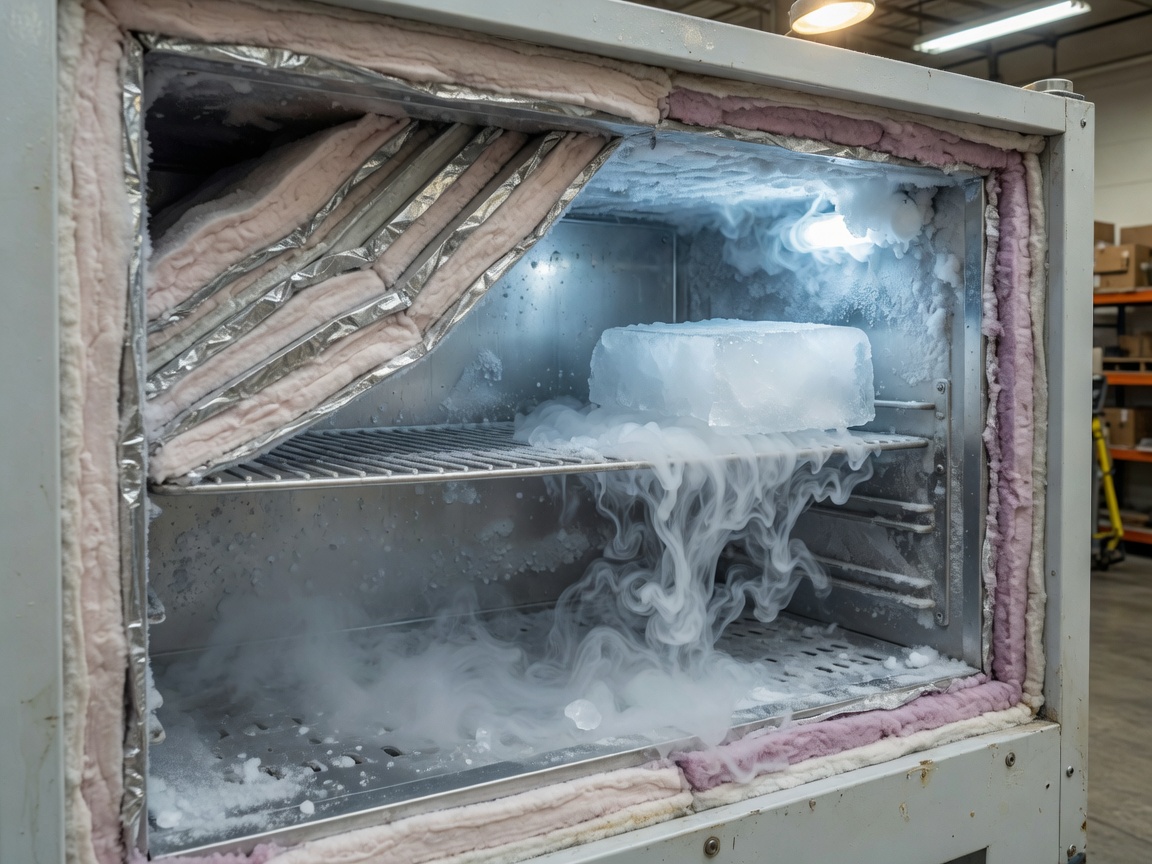
The operating principle of a dry freezer is thermodynamic, not mechanical. Dry ice sublimes at -78.5 °C at standard atmospheric pressure. When placed inside a well-insulated cabinet — typically constructed with vacuum-panel or expanded polyurethane (EPU) walls — the sublimation process absorbs heat from the interior, keeping stored materials at or below that temperature. The rate of cooling depends on the quantity of dry ice loaded, the ambient temperature, the insulation R-value, and how frequently the lid or door is opened.
The liquid nitrogen variant
Liquid nitrogen dry shippers operate differently. These units contain a porous sorbent material that absorbs liquid nitrogen. When the vessel is inverted or tilted, no free liquid spills — the nitrogen remains locked in the sorbent. The sample storage area sits in the vapour phase above the sorbent, maintained at temperatures approaching -196 °C. This makes them the preferred choice for cryogenic storage of cell lines, sperm, embryos, and other materials where even a brief temperature excursion could destroy viability. It is worth noting, however, that the sorbent material degrades over time. Real-world testing shows that an ageing dry shipper can lose 15–20% of its nitrogen-holding capacity after three to four years of active use, making periodic absorption capacity testing essential.
Heat transfer dynamics inside the cabinet
Why do so many buyers underestimate dry ice consumption? The answer lies in conductive and convective heat ingress. Each time the cabinet is opened, warm ambient air floods the interior. A 5-second door-open event in a 20 °C laboratory environment can introduce enough thermal energy to sublimate 30–40 g of dry ice in a standard 30-litre unit. For high-frequency-access applications, this consumption rate rapidly escalates. Designing your operational workflow around minimal access events — batch retrieval rather than individual sample pulls — is one of the most effective strategies for extending hold time between dry ice replenishments.
Types of dry freezer available in 2026
The 2026 UK market segments dry freezers into five principal categories. Each serves a distinct application profile, and selecting the wrong type is a common and expensive mistake.
1. Dry ice chest freezer (passive CO₂ cabinet)
The most widely stocked type in UK laboratory supply chains. Capacities range from 10 litres to over 200 litres. Insulation quality varies significantly between manufacturers — budget units from commodity suppliers may offer hold times of 24–36 hours per kilogram of dry ice, while premium models from established brands achieve 60–72 hours under equivalent conditions. Typical UK price range: £150–£900.
2. Liquid nitrogen dry shipper (LN₂ vapour-phase unit)
Designed specifically for cryogenic transport and short-term cryogenic storage of biological materials. These units are aviation-compliant (IATA Packing Instruction P650) when charged correctly, making them the standard choice for inter-laboratory sample transfer across the UK and internationally. UK price range: £400–£2,500 depending on capacity (0.4 L to 10 L of effective sample storage). Leading suppliers in the UK include Chart Biomedical and Worthington Industries distributors.
3. Phase change material (PCM) cold storage unit
PCM units use engineered eutectic materials — pre-frozen panels that absorb heat as they melt — to maintain a target temperature without any consumable gas. They are particularly attractive for organisations with inconsistent dry ice supply chains or strong ESG commitments, as they produce zero CO₂ emissions during use. The limitation is temperature range: most PCM systems target -20 °C to -40 °C, insufficient for applications requiring temperatures below -60 °C.
4. Portable dry ice transport box (aviation-compliant)
These compact units — typically 2 L to 15 L — are engineered to meet IATA Dangerous Goods Regulations, with dry ice quantities per package capped at 2.5 kg for passenger aircraft. They are widely used by UK pharmaceutical couriers and NHS transplant teams for short-duration sample preservation during transit. Expect to pay £80–£350 for a reliable unit with adequate insulation and a compliant labelling system.
5. Hybrid intelligent dry cabinet (IoT-enabled)
Emerging in 2026 as the premium tier of the market, these units combine passive dry ice or PCM cooling with integrated IoT temperature sensors, cloud logging, and automated alerts. They directly address FDA 21 CFR Part 11 and UK MHRA audit trail requirements for pharmaceutical freezer applications. Price range: £1,200–£4,500. Several UK-based cold chain technology firms now offer subscription-based monitoring services bundled with these units.
Key specifications to compare before you buy
Once you have identified the appropriate type, the next stage is specification comparison. The table below consolidates the most commercially relevant parameters across the five categories, based on data gathered from UK distributor catalogues and independent laboratory evaluations in 2026.
| Type | Temperature range | Typical hold time | UK price range | Best application |
|---|---|---|---|---|
| Dry ice chest | -78.5 °C | 24–72 hrs/kg dry ice | £150–£900 | Lab storage, sample dispatch |
| LN₂ dry shipper | Down to -196 °C | 7–21 days (charged) | £400–£2,500 | Cell lines, embryo transport |
| PCM cold unit | -20 °C to -40 °C | 48–96 hrs (pre-frozen) | £250–£1,400 | Vaccine, reagent transport |
| Portable transport box | -78.5 °C | 12–36 hrs | £80–£350 | Air freight, courier dispatch |
| IoT hybrid cabinet | -20 °C to -80 °C | Variable (sensor-managed) | £1,200–£4,500 | GMP pharma, MHRA audit |
Insulation efficiency: the metric most buyers overlook
Insulation performance is expressed as the "sublimation rate" in grams of dry ice consumed per hour per degree Celsius of temperature differential. A well-insulated 50-litre chest freezer for scientific use should achieve a sublimation rate below 80 g/hr at a 20 °C ambient. Units exceeding 120 g/hr will incur substantially higher consumable costs over a 12-month operational period — often adding £400–£600 to the total cost of ownership in a typical UK research laboratory setting.
Capacity and access configuration
Upright freezer configurations offer easier sample access and better organisation via drawer systems, but they sustain higher heat ingress on each opening than a top-opening chest freezer. For high-frequency-access environments, a frost-free freezer with fan-assisted air circulation is sometimes a practical alternative — though these require mains power and introduce vibration. For passive dry ice units used in a laboratory freezer context, top-opening chest designs consistently outperform upright configurations in hold time per kilogram of cooling medium.
Dry freezer vs. mechanical ULT freezer: which is right for you?
This is the comparison that most laboratory procurement officers in the UK are actually trying to resolve. Both a dry freezer and a mechanical ultra-low temperature freezer (ULT freezer) can store samples at -80 °C — but the operational, financial, and compliance implications differ substantially.
"Ultra-low temperature storage is not a single-technology decision. The correct choice depends on access frequency, consumable supply chain reliability, power infrastructure, and regulatory audit requirements — not simply on the temperature specification." — Consensus view, UK Laboratory Equipment Association guidance notes, 2026.
Running costs and total cost of ownership
A mechanical ULT freezer operating at -80 °C typically consumes 18–22 kWh per day. At UK commercial electricity rates of approximately 24–28 p/kWh (2026 average), that equates to £1,600–£2,200 per year in electricity alone. A dry ice chest freezer has zero electricity cost but requires a continuous dry ice supply. In most UK cities, dry ice can be sourced for £1.50–£2.50/kg. For a 50-litre cabinet consuming 1.5 kg/day, annual consumable cost approaches £820–£1,370. The crossover point depends heavily on access frequency and local dry ice pricing — buyers should model both scenarios with their actual usage parameters.
Reliability and power independence
One factor that consistently tips procurement decisions toward dry freezers in UK facilities is power independence. A dry ice cabinet or LN₂ dry shipper requires no electrical connection and functions identically during a power cut. For NHS trusts and university laboratories that have experienced sample losses during electrical infrastructure failures, this resilience argument carries considerable weight — more so than any cost calculation.
Common misconceptions about dry freezers
Despite their widespread use, dry freezers are surrounded by persistent misconceptions that lead to unsafe practices and poor procurement choices. Let us address the most consequential ones directly.
Misconception 1: "Dry means sealed — I can store it in a small enclosed room"
This is one of the most dangerous assumptions in laboratory settings. Dry ice continuously sublimes, releasing CO₂ gas. In an enclosed space — even a room of 15–20 m² — a 5 kg block of dry ice can elevate CO₂ concentration to hazardous levels within hours. The UK Workplace Exposure Limit (WEL) for CO₂ is 5,000 ppm (8-hour TWA). Dry ice storage areas must have active ventilation or, at minimum, CO₂ gas detection alarms. This is not optional — it is a legal obligation under COSHH regulations. Understanding the freeze drying process and its associated gas dynamics helps contextualise why ventilation protocols are non-negotiable.
Misconception 2: "A liquid nitrogen dry shipper has no liquid, so it cannot cause harm"
The absence of visible free liquid does not mean the unit is risk-free. The sorbent material in an LN₂ dry shipper holds significant quantities of liquid nitrogen in an absorbed state. If the sorbent becomes saturated — or if the vessel is damaged — liquid nitrogen can be released rapidly, causing severe cryogenic burns or asphyxiation. Proper guidance on ultra-low temperature storage consistently emphasises that dry shippers must be handled with cryogenic gloves, stored upright, and inspected for sorbent degradation at defined intervals.
Misconception 3: "All dry freezers work the same — brand doesn't matter"
Real-world case data from UK biorepositories tells a different story. In a 2025 evaluation involving three budget-tier and two premium-tier dry ice chest freezers run under identical laboratory conditions, insulation performance varied by up to 40% in hold time per kilogram of dry ice. That gap translates directly to consumable spend and — more critically — to sample safety margins during supply disruptions. Brand and build quality do matter, particularly for the pharmaceutical freezer and biological sample freezer segments where temperature excursions carry regulatory and liability consequences.
2026 trends shaping the dry freezer market
The global ultra-low temperature freezer market was valued at approximately £4.9 billion (equivalent) in 2023 and is projected to reach £8.5 billion by 2030, according to recent research data from Grand View Research. Within that broader market, passive dry ice and cryogenic storage solutions are growing at a disproportionately high rate, driven by two structural forces.
IoT integration and digital compliance
The integration of IoT temperature sensors and cloud-based data logging is no longer a premium feature — it is rapidly becoming a baseline expectation for any dry freezer used in a GMP-regulated UK pharmaceutical or clinical environment. MHRA inspection teams are increasingly scrutinising temperature records for cold storage units, and manual paper-based logs are viewed with scepticism. Buyers evaluating a pharmaceutical freezer or biological sample freezer for a regulated environment should verify that the unit either includes native data logging or is compatible with a validated third-party monitoring system. The standards governing lyophilization and cold storage infrastructure underscore the importance of validated, auditable temperature records across the full cold chain.
Sustainability and ESG-driven procurement shifts
ESG compliance is reshaping procurement criteria across UK universities, NHS trusts, and pharmaceutical companies. Mechanical ULT freezers using HFC refrigerants carry a Global Warming Potential (GWP) of 1,430–3,920 times that of CO₂ — a figure that is difficult to defend in a Scope 1 emissions disclosure. Dry ice-based units emit CO₂ during sublimation, but this is typically sourced as a by-product of industrial processes, meaning no incremental carbon extraction occurs. PCM and LN₂ systems carry zero direct GWP. As sustainability reporting requirements tighten under UK government procurement guidelines, expect dry freezer technologies to receive a structural preference boost in tender evaluations through 2026 and beyond.
How to choose the right dry freezer for your needs
Choosing the right dry freezer requires a structured decision process, not a single-specification comparison. The following steps reflect the approach used by experienced UK laboratory procurement managers when evaluating cold storage units for new or replacement installations.
- Define your temperature requirement. Confirm whether -78.5 °C (dry ice) is sufficient or whether your samples require cryogenic storage at -150 °C to -196 °C (LN₂). Do not over-specify — cryogenic units cost more to purchase and operate.
- Determine access frequency. High-frequency access (more than 5 openings per day) significantly increases consumable costs in passive dry ice units. If your team needs frequent sample retrieval, evaluate either a mechanical deep freeze cabinet with ULT capability or an IoT-managed hybrid system.
- Assess your dry ice supply chain. In rural UK locations, reliable daily dry ice delivery is not guaranteed. Model your hold-time requirements against a worst-case supply disruption scenario of 48–72 hours. Select a unit whose insulation performance covers that gap with a 25% safety margin.
- Confirm regulatory requirements. If the unit will store pharmaceutical products or clinical samples in a GMP environment, ensure it is compatible with your validated temperature monitoring system and that the supplier can provide a qualification package (IQ/OQ/PQ documentation).
- Calculate total cost of ownership over 36 months. Include purchase price, dry ice or LN₂ consumable costs, any monitoring subscription fees, and annual servicing. The lowest-purchase-price unit is rarely the lowest-TCO option.
- Verify safety compliance. Confirm that your storage location has adequate ventilation for CO₂ gas management, that staff have received COSHH training for cryogenic materials, and that gas detection alarms are installed if required by your institution's risk assessment.
Of course, there are situations where a standard recommendation does not apply cleanly. A field research team operating in a remote location without reliable electricity — and without consistent access to a dry ice supplier — may find that a high-capacity PCM cold storage unit, despite its temperature limitations, is the only operationally viable solution. Matching the technology to the real-world operating environment always takes precedence over matching it to an ideal specification on paper.
Questions to ask your UK supplier before ordering
When approaching a UK supplier — whether that is a national distributor like Fisher Scientific or a specialist cryogenics supplier — the following questions will help you qualify the product and the vendor simultaneously: What is the tested sublimation rate (g/hr) at 20 °C ambient? Does the unit come with a calibration certificate? What is the lead time for spare parts or replacement insulation panels? Is a UK-based technical support team available? Is the unit CE/UKCA marked? The answers to these questions differentiate a reliable long-term supply partner from a transactional commodity vendor.
A note on blast freezers and food-industry applications
It is worth clarifying one final category overlap. In commercial food production, a blast freezer — also called a flash freezer — uses high-velocity cold air at -30 °F to -40 °F to rapidly reduce product core temperature within 90 minutes. This is a fundamentally different piece of equipment from a dry freezer used in scientific or pharmaceutical settings. Blast freezers are essential for IQF food production and cook-chill catering operations, and they are not typically considered dry freezers in the laboratory or pharmaceutical supply lexicon. If your purchasing requirement sits in the food-production category, the specifications, suppliers, and compliance frameworks are entirely different.
Frequently asked questions
Selecting the right dry freezer ultimately comes down to four variables: required temperature range, access frequency, regulatory environment, and total cost of ownership over a realistic operating period. By mapping your specific application against the types, specifications, and comparison data in this guide, UK laboratory and industrial buyers can move from initial interest to a confident, evidence-based procurement decision — without overspending on capability they do not need or, critically, underspending on safety margins they cannot afford to compromise.
Keywords:
Inquiry
If you are interested in our products, please leave your email to receive a free product quote, thank you!
More information

Tel:
Sales E-mail: