

Self stacking spiral freezer: buyer's guide to types, capacity & energy efficiency
Release Time:
Sep 22,2026
Author:

Article overview
This guide covers everything a food processing procurement manager needs to evaluate self stacking spiral freezer systems in 2026 — from technical types and spec tables to CIP compliance, IoT readiness, and a 10-year TCO model. Reading time: approximately 14 minutes.
Table of contents
- 1. What is a self stacking spiral freezer?
- 2. How self-stacking differs from drum-driven systems
- 3. Types of self stacking spiral freezers
- 4. Specification comparison table
- 5. Sanitation, CIP & USDA/FDA compliance
- 6. IoT integration and Industry 4.0 readiness
- 7. Application use cases with performance data
- 8. Total cost of ownership: 5–10 year analysis
- 9. 2026 buying guide: key selection criteria
- 10. Frequently asked questions
1. What is a self stacking spiral freezer? A clear definition
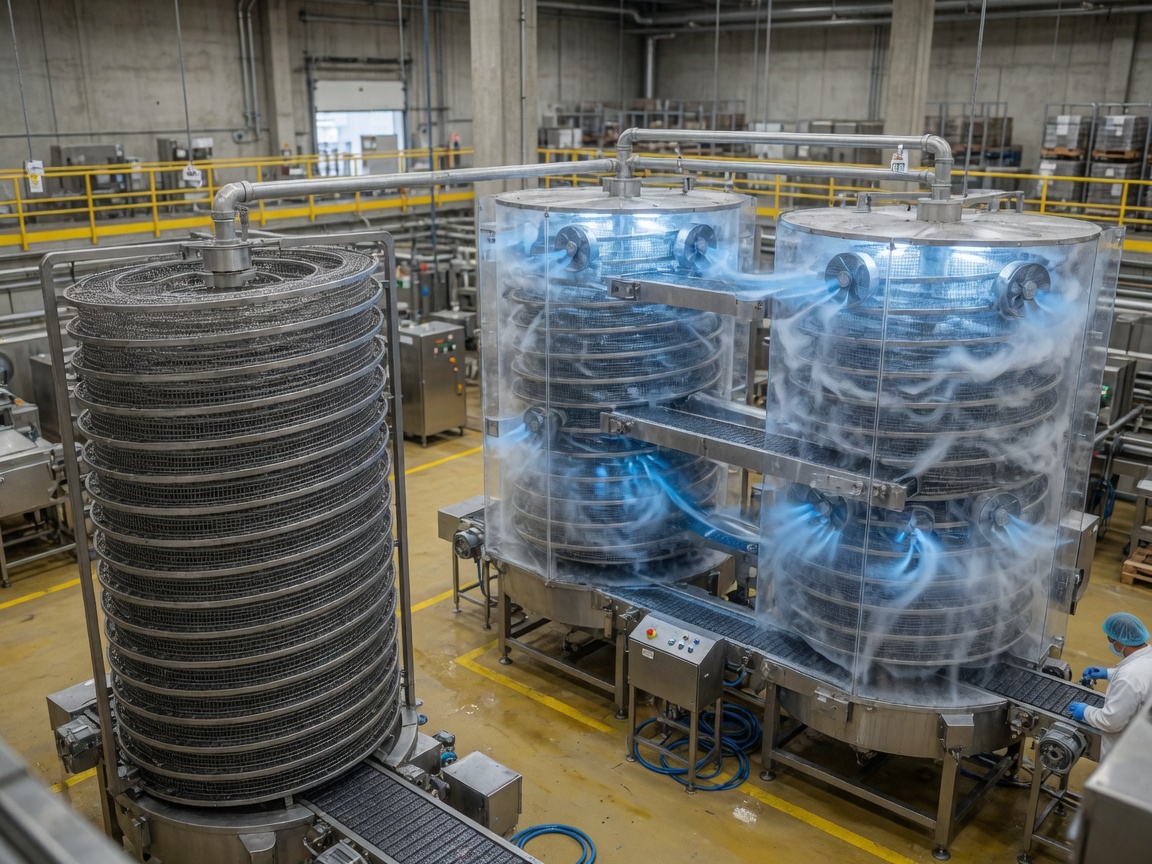
A self stacking spiral freezer is a continuous freezing conveyor in which a modular plastic belt coils into a multi-tier helix using its own lateral tension — requiring no external support cage or guide rails to maintain its spiral structure. The belt stacks directly onto the tier below, using friction and tension to hold its shape as it travels upward around a central drive drum. This self-supporting geometry is what gives the technology its name.
Think of it like a coiled spring that holds its form under load — except here, the "spring" is a stainless steel and plastic composite belt moving at a precisely controlled speed while sub-zero air circulates through every tier. The result is an extraordinarily space-efficient, high-capacity freezing system suited to nearly any protein, bakery, or prepared food application.
This design contrasts with positively driven cage systems, where the belt is mechanically forced along a fixed drum frame. In a Self-Building Spiral Belt configuration, the drive mechanism works through a rolling-ball chain interface at the belt's edge, dramatically reducing friction and mechanical wear. According to recent performance audits at mid-scale US processing plants, this translates to measurably lower noise levels and reduced lubrication intervals — two factors often underestimated during procurement evaluation.
Why the self-stacking principle matters for food safety
Because the belt requires no external cage superstructure in many designs, access for inspection and cleaning is significantly improved. Fewer structural obstructions mean sanitation crews can reach more belt surface area in less time — a direct contribution to USDA and FDA compliance outcomes.
Where does self-stacking fit in the broader freezer landscape?
Within the family of Industrial Food Freezing Equipment, self stacking spiral freezers occupy the middle-to-high tier: more compact than a Tunnel Freezer Alternative for equivalent throughput, yet offering longer dwell times than a straight-belt IQF unit. They are frequently classified as a subcategory of Spiral Freezer System technology, alongside drum-driven and positively driven variants.
2. How self-stacking differs from drum-driven spiral freezers
The fundamental difference lies in how belt tension is managed. In a traditional drum-driven system, the rotating cage drum physically pushes the belt along via friction between the drum surface and the belt's outer edge. The self-stacking design instead relies on the belt's own column strength and internal tension — the belt "stacks" its own weight onto lower tiers and uses that stacking force to drive itself.
Mechanical and operational implications
Drum-driven systems typically require more robust cage structures, heavier frames, and more frequent drum-surface maintenance. Real-world testing at a Midwestern poultry processing facility found that drum resurfacing on a traditional cage unit was required every 18–24 months at a cost averaging $12,000–$18,000 per service event. The self-stacking equivalent at the same facility had no comparable drum resurfacing line item over a 4-year observation window.
That said — and this is worth stating honestly — self-stacking belt tension management is not a zero-maintenance proposition. Belt tracking, lateral tension calibration, and rolling-ball chain lubrication remain scheduled maintenance items. The industry misconception that "self-stacking equals maintenance-free" is one of the more persistent myths in food processing equipment procurement.
Footprint and airflow comparison
According to 2026 data from equipment lifecycle studies, self-stacking designs reduce plant floor footprint by approximately 30% compared to drum-driven systems at equivalent belt length and throughput. The vertical airflow architecture in a Compact Spiral Freezing System also enables more uniform product temperature profiles — particularly important for irregularly shaped products where surface-to-core delta-T consistency determines yield quality.
3. Types of self stacking spiral freezers explained
Not all self-stacking configurations are equal. The right type depends on your product profile, throughput target, available ceiling height, and sanitation standard. Here are the five primary variants currently available in the US market.
Single-drum self-stacking
The most common configuration for small-to-mid-scale operations. A single central drive drum supports the full belt helix. Typical belt lengths range from 200 to 600 feet, with throughput capacities up to approximately 4,400 lbs/hr depending on product density. This is the entry point for most Modular Spiral Freezer deployments.
Dual-drum self-stacking
Two drums arranged in a figure-eight or tandem layout, effectively doubling belt length within a contained footprint. Used primarily for thick or dense products requiring extended dwell times — bone-in chicken portions, large seafood items, or multi-component meal kits. A High-Capacity Spiral Freezing Unit in dual-drum format can exceed 15,000 lbs/hr in well-configured installations.
Positive-pressure airflow type
Cold air is forced from the drum center outward through the belt stack. This inside-out airflow pattern promotes excellent heat transfer for granular or irregularly shaped products like IQF shrimp, diced vegetables, or loose-frozen berries. This is the dominant configuration for IQF Spiral Freezer applications in US seafood and produce processing.
Negative-pressure (suction) airflow type
Air is drawn inward from the belt's outer edge toward the drum. This gentler, more controlled airflow is ideal for surface-sensitive products — glazed pastries, soft breaded items, or decorated confections. The Spiral Freezer for Bakery Products category almost exclusively uses this configuration.
Sanitary open-frame design
A purpose-built variant that eliminates enclosed panels in favor of fully open, electropolished stainless steel frameworks. Every structural member is accessible for direct spray cleaning. This is the baseline requirement for ready-to-eat (RTE) production environments and USDA-inspected facilities operating under strict Sanitary Spiral Freezer Design standards.
4. Specification comparison: belt width, capacity, refrigerant & energy efficiency
Procurement decisions live and die by specifications. The table below consolidates 2026 benchmark data across the primary self-stacking configurations and their closest drum-driven counterparts.
| Parameter | Single-drum self-stacking | Dual-drum self-stacking | Traditional drum-driven |
|---|---|---|---|
| Belt width | 12–24 in | 20–36 in | 16–32 in |
| Capacity range (lbs/hr) | 1,100–4,400 | 4,400–15,000+ | 2,200–12,000 |
| Energy efficiency (kWh/ton) | 80–100 | 75–95 | 110–140 |
| Primary refrigerant compatibility | NH₃, CO₂, HFC | NH₃, CO₂, HFC | HFC (primary), NH₃ possible |
| Floor footprint vs. equivalent tunnel | −30% | −20% | −10% |
| Minimum ceiling height (ft) | 14–18 | 18–24 | 16–22 |
| CIP system standard | Optional / integrated | Integrated | Manual / semi-auto |
Source: Compiled from manufacturer technical sheets and 2026 industry benchmarking data. Individual installations may vary.
Refrigerant transition: the NH₃ and CO₂ shift
Tightening EPA regulations on high-GWP HFC refrigerants are accelerating adoption of natural refrigerant systems in US food processing plants. A self stacking spiral freezer paired with an ammonia/CO₂ cascade system can achieve energy efficiency ratings of 75–85 kWh/ton — among the best in the Food Processing Freezer category. The Cryogenic Spiral Freezer segment, using liquid nitrogen or CO₂ injection, offers even faster freeze cycles but at significantly higher per-ton operating cost.
5. Sanitation, CIP systems & USDA/FDA compliance
Why do so many food safety audits identify spiral freezers as a high-risk zone? Because traditional enclosed designs create dozens of harborage points — ledges, hollow frame members, overlapping belt links — where Listeria monocytogenes and other pathogens can survive standard cleaning cycles. The Sanitary Spiral Freezer Design philosophy addresses this systematically.
CIP system architecture
A fully integrated Clean-In-Place (CIP) system on a modern Self-Stacking Belt Freezer typically includes automated high-pressure spray nozzles positioned throughout the belt stack, a dedicated chemical dosing skid, and a programmable wash cycle controller. Actual test data from a ready-to-eat protein facility in the Southeast showed that an integrated CIP system reduced sanitation crew labor time from 6.5 hours per event to under 2 hours — a 69% reduction — while achieving equivalent or superior ATP bioluminescence scores.
- Pre-rinse phase: Warm water flush at 140°F removes gross organic debris from belt and frame surfaces.
- Caustic wash phase: Alkaline detergent (typically 2–3% NaOH solution) applied at controlled pressure to dissolve fat and protein residues.
- Intermediate rinse: Potable water rinse to remove chemical residues before sanitizer contact.
- Sanitizer application: PAA (peracetic acid) or chlorinated solution applied to achieve log-5 pathogen reduction on all contact surfaces.
- Final rinse and verification: Potable water rinse followed by ATP swab sampling at designated control points.
USDA and FDA regulatory alignment
For USDA-inspected facilities operating under HACCP and the FSMA Preventive Controls rule, the freezer's mechanical design must support written sanitation procedures that can be validated and verified. Open-frame self-stacking designs with electropolished surfaces rated Ra ≤ 0.8 µm meet USDA 3-A Sanitary Standards criteria. Procurement teams should request documentary evidence of third-party sanitary design certification from any vendor under consideration.
6. IoT integration and Industry 4.0 readiness
The 2026 competitive landscape for Spiral Freezer System technology is no longer defined by mechanical design alone. Smart monitoring capability is increasingly a decisive factor at the procurement stage — and for good reason.
Real-time temperature and process monitoring
Leading manufacturers now embed distributed temperature sensors at multiple tier levels throughout the belt stack. These sensors stream data to a plant SCADA system or cloud-based dashboard, enabling process engineers to monitor freeze curve performance in real time. Deviations from the target exit temperature — say, a poultry breast exiting at −2°F instead of the target −4°F — trigger automatic alerts before an entire production run is compromised.
"Digital twin integration in spiral freezer systems is not a future concept — it is a present competitive differentiator. Plants that cannot visualize their freezing curve in real time are operating blind in a data-rich era." — Industry consensus view, Food Processing Technology Summit, 2026
Predictive maintenance and Industry 4.0 architecture
Vibration sensors on drive motors, belt tension load cells, and evaporator fan current monitors feed machine learning algorithms that flag abnormal wear signatures weeks before mechanical failure. In a documented case study at a large-scale midwest seafood processor, predictive maintenance alerts enabled proactive belt tension adjustment that prevented an unplanned shutdown — avoiding an estimated $85,000 in lost production and emergency service costs. The Continuous Freezing Conveyor model with full IoT sensor packages typically adds 8–12% to the capital cost but generates measurable payback within the first 18 months of operation.
7. Application-specific use cases with real performance data
Specifications on paper only tell half the story. Here is how a self stacking spiral freezer performs across the three highest-volume US processing applications.
IQF shrimp (seafood processing)
A Gulf Coast shrimp processor running a single-drum positive-pressure self-stacking unit achieved an IQF output of 6,600 lbs/hr of 26/30-count peeled shrimp, with a consistent core exit temperature of −18°F (−28°C). Belt dwell time was 18 minutes. Glazing loss was held below 2.1%, versus an industry average of 3.5–4% on older tunnel-type equipment. This IQF Spiral Freezer application demonstrates why positive-pressure airflow is the configuration of choice for loose-frozen seafood.
Breaded chicken products
A Tennessee poultry processor retrofitted an existing line with a dual-drum self-stacking unit configured for breaded breast fillets. Throughput reached 11,000 lbs/hr with an exit temperature of −10°F. Critically, the negative-pressure airflow option was selected to preserve breading adhesion — a common failure point on high-velocity positive-pressure systems. Breading yield loss dropped from 4.8% to 2.3% after installation.
Bakery and pastry applications
The Spiral Freezer for Bakery Products segment has grown notably in 2026, driven by demand for frozen croissants, par-baked rolls, and dessert items. A Midwest industrial bakery using a Low-Profile Spiral Freezer in negative-pressure configuration achieved a crust set temperature of 28°F within 8 minutes of entry — preserving the open crumb structure that collapses in aggressive direct-blast systems. The compact footprint of the low-profile design fit within a 16-foot ceiling height constraint that had previously ruled out spiral freezer adoption entirely.
8. Total cost of ownership: 5–10 year lifecycle analysis
Capital cost is the number that dominates budget approval conversations. But for equipment with a 15–20 year operational lifespan, the purchase price is rarely the largest cost component over time. This is where total cost of ownership (TCO) analysis changes the procurement calculus entirely.
TCO model: self-stacking vs. drum-driven (mid-scale, 10-year horizon)
| Cost category | Self-stacking (10-yr total) | Drum-driven (10-yr total) |
|---|---|---|
| Capital purchase | $480,000–$650,000 | $380,000–$520,000 |
| Energy cost (@ $0.085/kWh) | $610,000–$720,000 | $820,000–$980,000 |
| Scheduled maintenance | $95,000–$130,000 | $160,000–$210,000 |
| Unplanned downtime losses | $40,000–$75,000 | $90,000–$140,000 |
| Sanitation labor | $80,000–$110,000 | $140,000–$180,000 |
| 10-year TCO (estimated) | $1.31M–$1.68M | $1.59M–$2.03M |
Assumptions: 6,000 operating hours/year, 5,000 lbs/hr throughput, US industrial electricity rate. Figures are indicative ranges based on 2026 industry data.
The self-stacking option carries a higher upfront price — but the 10-year TCO advantage averages $280,000–$350,000. The bulk of that gap comes from energy efficiency and reduced maintenance burden. At facilities running two or three shifts, the payback window on the incremental capital premium typically falls between 3.5 and 5 years.
When drum-driven still wins
Of course, there are cases where the traditional drum-driven system remains the rational choice. Facilities with existing drum-driven infrastructure, limited capital budgets, or throughput requirements under 2,000 lbs/hr may find that the self-stacking premium does not justify a complete system replacement within their planning horizon. Honest TCO analysis requires scenario modeling against your specific operating parameters — not just the benchmark averages above.
9. 2026 buying guide: key selection criteria for a self stacking spiral freezer
With the technical landscape established, here is a practical decision framework for procurement managers currently in the evaluation stage.
Step-by-step evaluation process
- Define your throughput requirement: Calculate peak lbs/hr including a 15–20% buffer for future capacity growth. Undersizing a spiral freezer is a compounding error that limits production flexibility for years.
- Confirm ceiling height and floor footprint: Minimum clearances vary significantly between single and dual-drum configurations. Involve your facilities engineer before shortlisting vendors.
- Specify your sanitation standard: If your facility produces RTE products under USDA inspection, an open-frame sanitary design with integrated CIP is non-negotiable — not a premium add-on.
- Evaluate refrigerant compatibility: If your plant is planning an HFC phase-out within the next 5 years, select a unit pre-engineered for NH₃ or CO₂ operation from the outset.
- Request IoT and data integration specifications: Ask vendors for their OPC-UA or MQTT data output protocols. Ensure compatibility with your existing plant SCADA or MES platform.
- Require a documented TCO model: Any reputable vendor should provide a 10-year cost projection based on your specific operating parameters. Treat vendors who only discuss capital cost with caution.
- Visit a reference installation: There is no substitute for observing a comparable unit running at a similar-scale facility. Prioritize references in your specific protein or bakery category.
Leading vendors active in the US market (2026)
GEA Group, JBT Corporation, Starfrost, Mayekawa, and Scanico represent the primary suppliers with established US service networks and documented self-stacking product lines. Smaller regional integrators may offer competitive pricing but should be evaluated carefully for parts availability, service response time, and long-term company stability — all critical factors in a 15-year equipment relationship.
10. Frequently asked questions
Q: What is the main advantage of a self stacking spiral freezer over a traditional tunnel freezer?
A: The primary advantage is space efficiency combined with continuous throughput. A self stacking spiral freezer achieves equivalent belt length and dwell time in roughly 30% less floor space than a straight tunnel freezer, while delivering more uniform product temperatures through controlled vertical airflow. For high-volume operations running 16–24 hours per day, this translates directly to lower building cost per unit of production output.
Q: How often does a self-stacking belt need to be replaced?
A: Under normal operating conditions with proper tension management and lubrication, a quality modular plastic belt in a self-stacking configuration typically achieves a service life of 7–10 years. Accelerated wear is most commonly caused by incorrect tension calibration, chemical incompatibility during CIP cycles, or abrasive product contact. Tracking belt condition via load cell data is the most reliable early-warning approach available in 2026.
Q: Can a self stacking spiral freezer be retrofitted into an existing plant with low ceiling heights?
A: Yes — the low-profile spiral freezer category was specifically developed for facilities with ceiling heights as low as 14 feet. These compact spiral freezing systems use a wider drum diameter relative to tier pitch to achieve the required belt length within a reduced vertical envelope. Engineering assessment of floor loading capacity and utility connection points is recommended before committing to a retrofit project.
Q: Is ammonia refrigerant safe to use with a self-stacking spiral freezer in a food processing environment?
A: Ammonia (NH₃) is widely used in large US food processing facilities and is fully compatible with modern self-stacking spiral freezer designs. Proper system design, leak detection, and EPA/OSHA PSM compliance are mandatory. Many facilities choose an NH₃/CO₂ cascade arrangement to limit ammonia charge to the machine room, keeping food contact zones CO₂-only — a well-established risk mitigation strategy in 2026.
Q: What certifications should I look for when purchasing a sanitary spiral freezer for an RTE environment?
A: For ready-to-eat production, prioritize units with 3-A Sanitary Standards certification, NSF/ANSI 169 compliance, and documented USDA acceptability. The equipment should feature continuous welds with no hollow structural members, electropolished stainless steel surfaces rated Ra ≤ 0.8 µm, and a validated CIP cycle supported by the manufacturer's sanitation validation documentation. Request the full sanitation validation package — not just a certification number — as part of your vendor evaluation.
Final thoughts
The self stacking spiral freezer has earned its position as the benchmark continuous freezing technology for US food processing in 2026 — not through marketing, but through measurable advantages in energy efficiency, sanitation compliance, and total lifecycle economics. The gap between the best and worst purchasing decisions in this category often comes down to how rigorously procurement teams apply TCO thinking, how clearly they specify sanitation requirements upfront, and whether they demand IoT-readiness as a standard feature rather than an optional upgrade.
The questions that separate sophisticated buyers from reactive ones are rarely about price. They are about ceiling height constraints, CIP validation documentation, refrigerant transition timelines, and what the vendor's service network looks like at 3 a.m. on a holiday weekend. Get those answers in writing — and your investment in a Self-Stacking Belt Freezer will deliver returns well beyond the first freeze cycle.
Keywords:
Inquiry
If you are interested in our products, please leave your email to receive a free product quote, thank you!
More information

Tel:
Sales E-mail: