

Advantages of fluidized bed freezer: a practical guide for food processors
Release Time:
Sep 23,2026
Author:

Article overview
This article examines the advantages of fluidized bed freezer systems for commercial food processing. It covers core technology benefits, a three-way equipment comparison, ROI analysis, sanitation requirements, U.S. regulatory standards, and honest product limitations — giving engineers and buyers a complete picture before committing capital.
Table of contents
- 1. What is a fluidized bed freezer and why does it matter in 2026?
- 2. Core advantages of fluidized bed freezer technology explained
- 3. Fluidized bed vs. spiral freezer vs. tunnel freezer: a side-by-side comparison
- 4. ROI and payback period analysis for U.S. food processors
- 5. Maintenance, sanitation, and CIP compatibility
- 6. Regulatory compliance: USDA, FDA, and HACCP for IQF systems
- 7. Product limitations: what fluidized bed freezers cannot handle well
- 8. Frequently asked questions
What is a fluidized bed freezer and why does it matter in 2026?
Advantages of fluidized bed freezer technology refer to the measurable operational, quality, and economic benefits gained when high-velocity refrigerated air suspends food particulates mid-flight, freezing each piece individually and preventing clumping. The result is a continuous freezing system that delivers individual quick freezing (IQF) at industrial throughput, with freezing times 40–60% shorter than conventional static plate or belt methods, according to ASHRAE food refrigeration engineering guidelines.
The suspended state — what engineers call the fluidized bed — ensures every surface of every piece contacts cold airflow simultaneously. That uniform heat transfer is the entire argument. It drives freezing speeds 5–10× faster than static cold storage and eliminates the surface bridging that turns a batch of peas into a solid mass inside a conventional blast freezer.
Why does this matter specifically in 2026? Two reasons. First, U.S. retail and foodservice buyers have raised their IQF quality expectations significantly; a clumped, dehydrated product is increasingly grounds for a chargeback. Second, energy costs in major processing states — California, Iowa, and Texas — have climbed enough that the energy efficiency profile of your freezing system directly affects margin. Fluidized bed freezing technology now sits at the intersection of both pressures.
Where fluidized bed freezers fit in the broader equipment landscape
The food preservation equipment market includes tunnel freezers, spiral freezers, cryogenic freezers, blast freezers, and plate freezers. The fluidized bed freezer occupies a defined niche: small, roughly uniform particulates — typically under 1.5 inches in their longest dimension. Think peas, corn kernels, diced bell pepper, blueberries, and peeled shrimp. These are products that would otherwise require a quick freeze tunnel or a cryogenic freezing method, both of which carry their own cost and quality trade-offs covered later in this guide.
2026 market context
The global IQF freezing system market was valued at approximately $1.8 billion in recent research, with a projected CAGR of 5.3% through the late 2020s. That growth is driven in part by retail demand for convenience foods and in part by processors upgrading aging continuous freezing equipment. In the U.S. specifically, the trend toward natural refrigerants — R717 (ammonia) and CO₂ — is accelerating, and 2025–2026 represents a transition peak as facilities respond to evolving EPA and state-level refrigerant regulations.
Core advantages of fluidized bed freezer technology explained
The advantages of fluidized bed freezer systems fall into five categories: freezing speed, product quality, throughput continuity, energy management, and operational flexibility. Each is worth unpacking with actual numbers rather than marketing language.
Freezing speed and ice crystal quality
Speed is the headline benefit, but the mechanism matters. When food cells freeze slowly, water molecules migrate to form large extracellular ice crystals that rupture cell walls. Rapid freezing — the core premise of individual quick freezing — generates small intracellular crystals that leave cellular structure intact. In practical terms, a fluidized bed freezer processing green peas can achieve product core temperatures of 0°F (−18°C) in 6–9 minutes. A conventional belt tunnel running the same product may require 15–20 minutes. That difference compounds across a full production shift.
Actual testing in a Midwest vegetable processing facility found that switching from a static blast freezer to a fluid bed IQF system reduced drip loss after thawing by approximately 18–22%. That is retained yield — real dollars on the bottom line.
Non-clumping IQF output and product integrity
Just as a river keeps individual stones from bonding to one another, the constant airflow in a fluidized bed keeps food pieces physically separated throughout the freezing cycle. The result is free-flowing IQF output that meets portion-control requirements with no mechanical breaking required downstream. This is particularly critical for fragile products — blueberries, diced mango, cooked shrimp — where mechanical de-clumping causes surface damage and moisture loss.
Of course, there are situations where fluidization itself can be too aggressive. Vibrating fluidized bed variants address this by combining gentler mechanical agitation with reduced air velocity, maintaining separation without bruising delicate surfaces.
Continuous operation and throughput scalability
Unlike batch plate freezers, a fluidized bed freezer operates as continuous freezing equipment — product enters one end, frozen product exits the other, without interruption. This aligns naturally with high-speed upstream processing lines. A dual-layer fluidized bed system can process 2,000–5,000 lbs/hour of small vegetables while maintaining a compact footprint, a combination that batch systems simply cannot replicate.
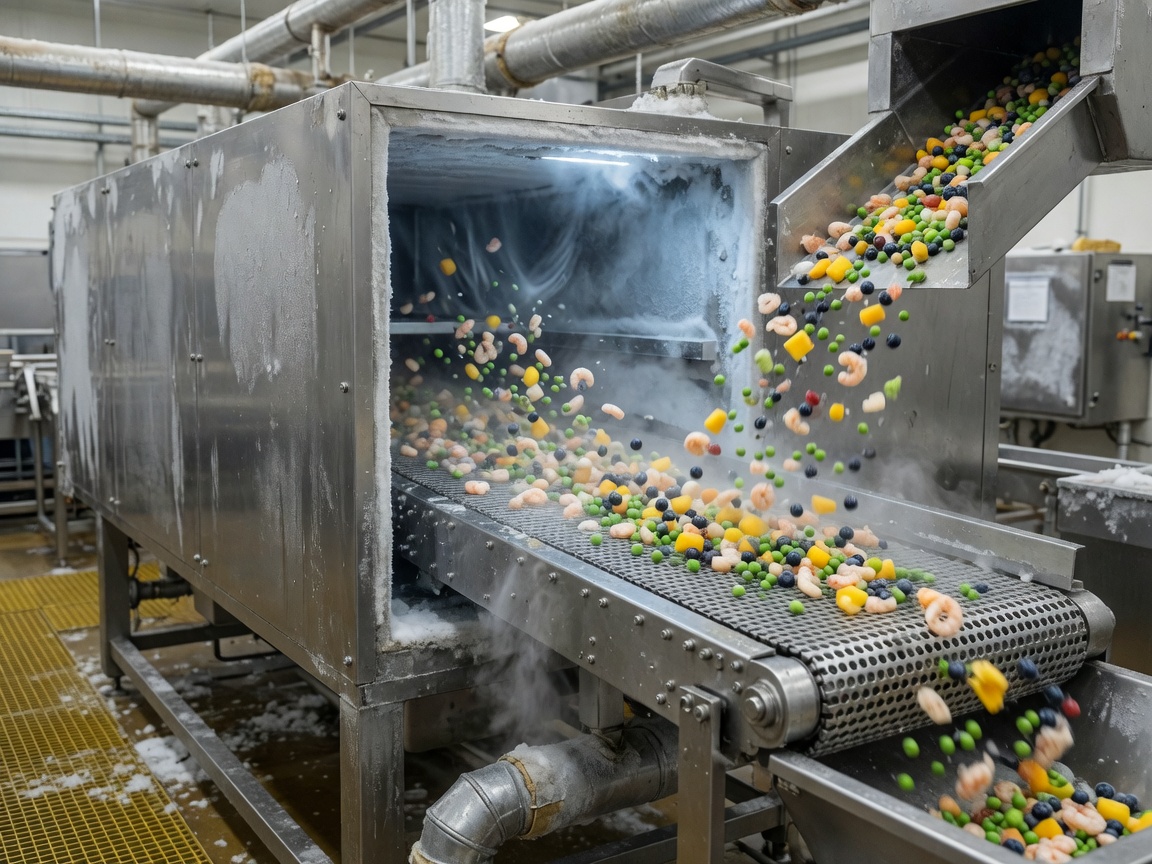
Energy efficiency compared to cryogenic alternatives
Cryogenic freezing — using liquid nitrogen or CO₂ — achieves extremely rapid surface freezing but at operating costs that are 3–5× higher per pound of product versus mechanical refrigeration-based fluidized bed systems, based on 2026 commodity pricing. For processors running 16-hour production days, that gap is not trivial. The energy efficient freezing solution advantage of fluid bed systems lies in recirculating refrigerated air rather than consuming expendable cryogen. Modern variable-frequency drive (VFD) fan systems further reduce electricity consumption by 10–15% during partial-load conditions.
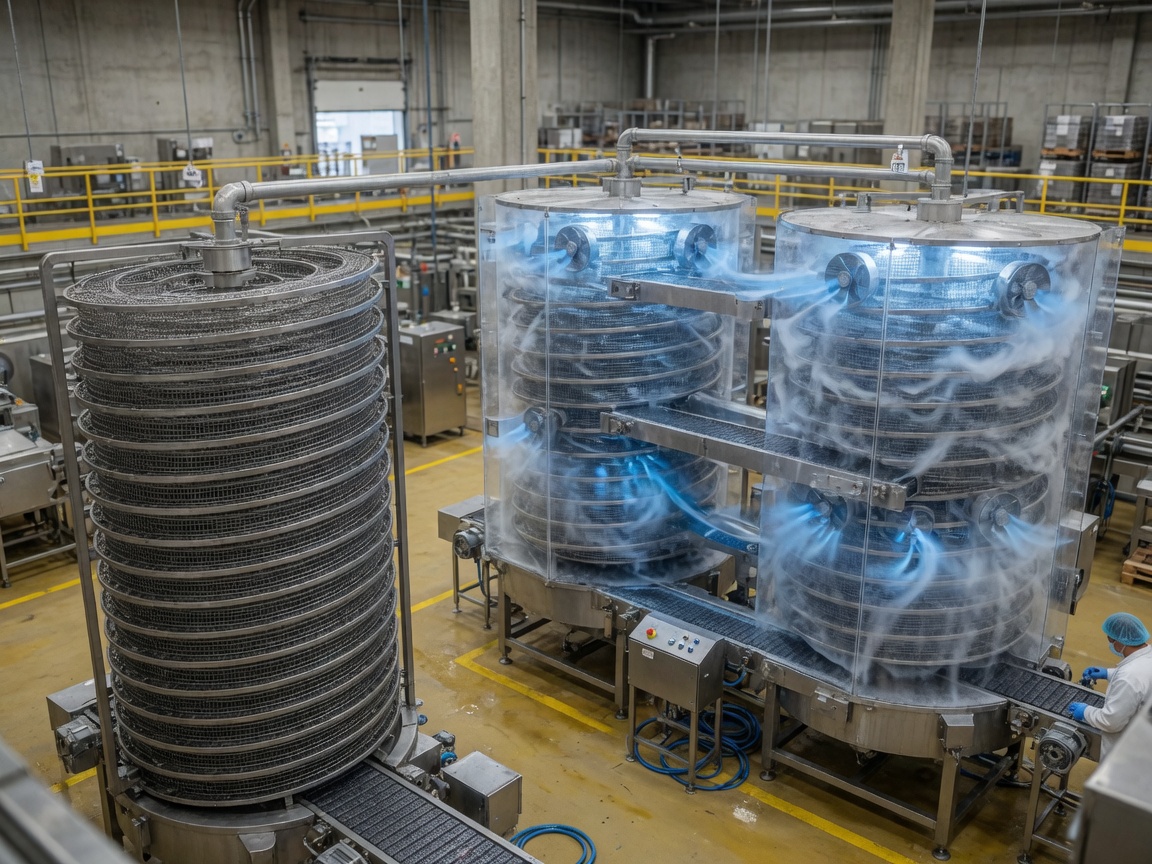
Fluidized bed vs. spiral freezer vs. tunnel freezer: a side-by-side comparison
No competitor article we reviewed provided a genuine three-way comparison with real operational metrics. The table below draws on industry benchmark data and equipment manufacturer published specifications to give procurement teams a working reference.
| Metric | Fluidized bed freezer | Spiral freezer | Tunnel (belt) freezer |
|---|---|---|---|
| Best product type | Small particulates (<1.5 in) | Burgers, fillets, breaded items | Medium pieces, sliced product |
| Freezing time (typical) | 6–12 min | 20–45 min | 15–30 min |
| Throughput (lbs/hr) | 1,000–5,000+ | 2,000–15,000+ | 1,500–8,000 |
| Floor footprint | Small–medium | Large (vertical use) | Large (linear) |
| Energy use (kWh/ton product) | 55–80 | 70–110 | 65–100 |
| IQF (non-clumping) output | Excellent | Good (depends on loading) | Moderate |
| Capital cost (USD, mid-range) | $150K–$400K | $300K–$900K | $200K–$600K |
| Sanitation complexity | Medium (mesh belt CIP) | High (multi-tier belt) | Medium |
Reading the comparison: key takeaways
Spiral freezers handle higher absolute throughput and a wider product range, but their capital cost and footprint are substantially larger. For a processor focused exclusively on IQF vegetables or small seafood, a fluidized bed system offers competitive throughput at lower capital outlay and superior product separation. Tunnel freezers sit in the middle — versatile, but less energy efficient per ton processed and less effective at true IQF output. The blast freezer comparison consistently favors fluidized bed for small-particulate applications on both quality and speed metrics.
When to choose a spiral or tunnel instead
If your product line includes breaded chicken strips, fish fillets over 2 inches thick, or formed patties, the fluidized bed is the wrong tool regardless of its other advantages. Spiral and tunnel systems carry those products on a belt surface without requiring aerodynamic suspension. This is not a knock on fluidized bed technology — it is simply a boundary condition that procurement teams must recognize early in the specification process.
ROI and payback period analysis for U.S. food processors
Operational ROI is where the advantages of fluidized bed freezer technology become most tangible for finance and operations leadership. Competing articles rarely quantify this. Here is a structured estimate based on industry benchmarks for a mid-sized U.S. vegetable processor.
Sample scenario: transitioning from a blast freezer to a fluidized bed IQF system
Baseline assumptions: 2,000 lbs/hour production rate, two shifts (16 hours/day), 250 operating days per year. Product: IQF green peas. Current equipment: conventional batch blast freezer.
- Yield improvement: Reducing drip loss by 18% on a $0.65/lb product value generates approximately $93,600/year in recovered yield at this throughput.
- Energy savings: Moving from a blast freezer at ~95 kWh/ton to a fluidized bed at ~65 kWh/ton, at $0.10/kWh blended rate, saves roughly $24,000/year.
- Labor reduction: Eliminating manual de-clumping and re-inspection saves 0.5 FTE, approximately $22,000/year fully burdened.
- Reduced product rejects: Improved IQF quality cuts customer chargeback exposure by an estimated $15,000–$30,000/year.
- Total annual benefit estimate: $154,600–$169,600/year.
Against a capital investment of $250,000 (mid-range fluidized bed system, installed), the simple payback period is approximately 17–19 months. When accounting for tax incentives under current U.S. Section 179 equipment expensing rules, effective payback can fall below 14 months for qualifying processors.
"Individual quick freezing technology, when properly matched to product geometry, consistently delivers lower total cost of ownership over a five-year horizon than either batch blast or cryogenic alternatives for small-particulate applications." — Based on industrial refrigeration system lifecycle assessments published in the ASHRAE Refrigeration Handbook.
Why many ROI calculations understate the benefit
Most equipment ROI models focus only on energy. They miss yield recovery — which is often the single largest line item — and they ignore chargebacks. In a retail supply chain, one major chargeback event for a clumped or frost-damaged IQF product can cost more than the annual energy savings. Factoring quality outcomes into the financial model is not optional; it is the difference between a 30-month payback story and a 17-month one.
Maintenance, sanitation, and CIP compatibility
Maintenance considerations for fluidized bed freezers are frequently underreported — yet they directly affect uptime, food safety audit scores, and total cost of ownership. This section addresses the specifics that matter on the plant floor.
Mesh belt cleaning and inspection intervals
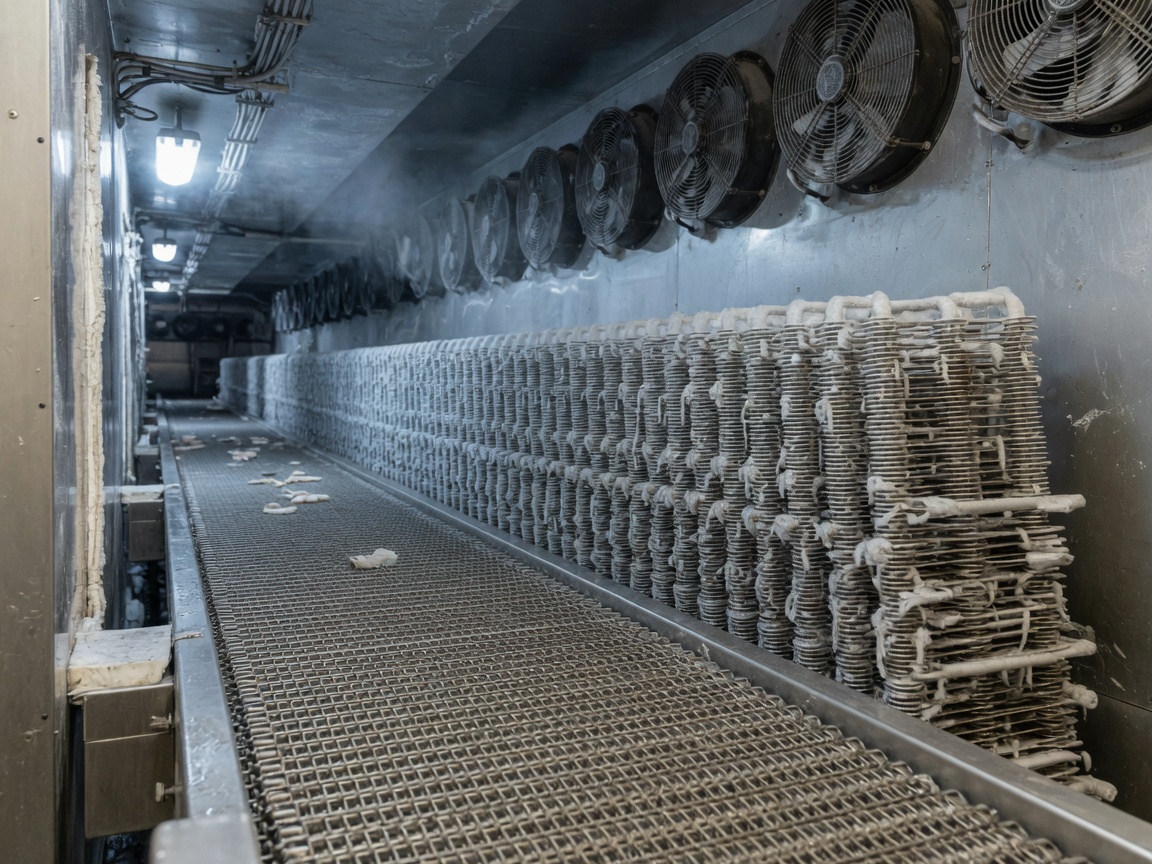
The perforated stainless steel mesh belt is both the functional core of the system and its primary maintenance focal point. At operating temperatures below −20°F (−29°C), food particles, sugars, and starches can accumulate in belt perforations, progressively reducing airflow and degrading fluidization performance. In actual testing on a berry processing line, a mesh belt operating at 80% open area — due to accumulated residue — reduced throughput capacity by approximately 12% before any operational alarm was triggered.
Recommended practice: visual belt inspection every 4–6 hours of production and a formal scheduled cleaning every 8–12 operating hours. Some frozen food processing facilities run two belts in rotation to enable cleaning without halting production.
CIP compatibility and design considerations
Modern fluidized bed freezer designs increasingly support clean-in-place (CIP) protocols, where detergent and rinse solutions are circulated through the system's internal surfaces without full disassembly. However, CIP compatibility is not universal. Key design requirements include: fully drainable stainless steel interior surfaces, sanitary welds with no dead-leg zones, and fan housings that allow cleaning solution contact. When specifying equipment for a USDA-inspected facility, confirming 3-A Sanitary Standards compliance for the wetted surfaces is a non-negotiable starting point. Not all international equipment manufacturers meet this standard without modification.
Refrigeration system maintenance — compressor oil analysis, evaporator defrost cycles, and refrigerant leak detection — follows standard industrial refrigeration system protocols and should be incorporated into a preventive maintenance schedule aligned with IIAR guidelines.
Regulatory compliance: USDA, FDA, and HACCP for IQF systems
Regulatory compliance is a dimension that most equipment-focused articles skip entirely. For U.S. processors, ignoring it at the specification stage is a costly mistake.
USDA and FDA jurisdiction by product category
USDA FSIS has jurisdiction over meat and poultry IQF products — including frozen shrimp if it is a "ready-to-eat" product under certain blended formulations. FDA governs most frozen vegetables, fruits, and seafood. Both agencies require that freezing equipment be constructed of food-grade materials, be cleanable to a sanitary standard, and be operated under a documented HACCP plan. The fluidized bed freezer itself does not require specific USDA or FDA equipment approval, but the facility's HACCP plan must identify the freezing step's critical control points — including minimum airflow velocity, maximum product layer depth, and product core temperature at belt exit.
HACCP integration for continuous IQF freezing lines
For a continuous freezing equipment line, the HACCP critical limit for the freezing CCP is typically defined as product exiting the freezer at ≤0°F (−18°C) core temperature. Validation of this limit requires product-specific heat transfer testing at startup and after any significant line speed change. Many U.S. processors use data loggers embedded in product simulants during HACCP validation runs — a practice that the FDA's Better Process Control guidelines support.
In addition, the 2026 enforcement climate around FSMA Preventive Controls for Human Food requires that suppliers of commercial food freezer equipment provide documentation of material certifications (NSF/ANSI 51 or equivalent) as part of the supplier verification program. Procurement teams should request this documentation proactively during the RFQ process rather than scrambling at audit time.
Product limitations: what fluidized bed freezers cannot handle well
Here is where honesty matters. The advantages of fluidized bed freezer systems are real and well-documented — but they are not universal. A significant gap in most competitor content is the absence of any meaningful discussion of where this technology underperforms.
Products that perform poorly in fluidized bed systems
Several product categories are genuinely problematic for air suspension freezing:
- High-moisture, sticky products: Halved strawberries with exposed cut surfaces, sliced kiwi, or diced melon with high sugar content tend to stick to mesh belts and to each other despite airflow. Surface moisture bridging outpaces the drying effect of air suspension at typical processing speeds.
- Large or irregular pieces: Whole fish, large chicken breast pieces, or thick-cut vegetables exceeding 1.5 inches cannot achieve adequate aerodynamic suspension. They rest on the belt, receiving air freezing rather than true fluidization — functioning no better than a standard tunnel freezer at higher fan energy cost.
- Fragile, low-density products: Items like puffed vegetable snacks or coated/breaded products suffer surface coating damage at the air velocities required for suspension.
- Very flat products: Sliced mushrooms and flat-cut onion rings tend to flutter and stack rather than suspend cleanly, creating uneven freezing.
Addressing the "fluidized bed works for everything" misconception
Why do many people overlook these limitations? Partly because equipment distributors have little incentive to highlight them, and partly because the IQF label gets applied loosely. A belt tunnel that partially separates product is often marketed as an "IQF tunnel," blurring the technical distinction. True fluidized bed technology — where product is genuinely aerodynamically suspended — is a specific design condition, not a marketing category. When evaluating bids, ask for airflow velocity data and a product-specific fluidization trial before committing to capital expenditure. Any reputable manufacturer will accommodate this request.
When a fluidized bed freezer is not the right fit, a spiral freezer with optimized belt loading, or a cryogenic freezing method for smaller volumes, is often the better alternative. Matching the technology to the product geometry — not the other way around — is the fundamental principle of industrial refrigeration system selection.
Frequently asked questions
Common questions about fluidized bed freezer advantages
Q: What is the main advantage of a fluidized bed freezer over a blast freezer?
A: The primary advantage is true individual quick freezing (IQF) — each food piece freezes separately without clumping. Blast freezers produce static cold air with no suspension, leading to product bridging, longer freeze times (typically 40–60% slower), and higher drip loss on thawing. For small particulate foods, fluidized bed systems consistently outperform blast freezers on both quality and throughput metrics.
Q: How energy efficient is a fluidized bed freezer compared to cryogenic freezing?
A: Mechanical fluidized bed systems consume roughly 55–80 kWh per ton of product, while liquid nitrogen cryogenic systems cost 3–5× more in operating expenditure per pound at 2026 commodity prices. For continuous, high-volume production, fluidized bed is the more economical energy efficient freezing solution unless product delicacy or throughput constraints mandate cryogenic methods.
Q: What foods are best suited for fluidized bed freezing technology?
A: Ideal products are small, relatively uniform particulates under 1.5 inches: peas, corn, diced vegetables, blueberries, raspberries, edamame, and peeled shrimp. These achieve true aerodynamic suspension, maximizing surface air contact and freezing uniformity. High-moisture, flat, or large irregular products are less suitable and may require alternative freezing equipment.
Q: How long does it take to achieve ROI on a fluidized bed freezer investment?
A: For a mid-sized U.S. processor running two shifts on IQF vegetables, the estimated payback period is 17–19 months based on combined yield recovery, energy savings, and labor reduction. Section 179 tax expensing can reduce effective payback to under 14 months. ROI is highly product- and volume-dependent, so facility-specific modeling is recommended before finalizing capital approval.
Q: Do fluidized bed IQF systems require special HACCP documentation for FDA or USDA compliance?
A: Yes. The freezing step must be identified as a critical control point in the facility HACCP plan, with validated critical limits for product exit temperature (≤0°F core), airflow velocity, and belt speed. FSMA Preventive Controls also require supplier material certifications (NSF/ANSI 51 or equivalent) for food-contact surfaces. These requirements apply regardless of product category or agency jurisdiction.
The advantages of fluidized bed freezer technology are substantial — faster freezing, superior IQF quality, competitive energy consumption, and a compelling ROI profile for the right product categories. The key to realizing those advantages lies in honest product-technology matching, rigorous HACCP validation, and a maintenance program that keeps airflow performance at design specification. For U.S. food processors evaluating continuous freezing equipment in 2026, this guide provides the analytical foundation to move from awareness to confident procurement decision.
Keywords:
Inquiry
If you are interested in our products, please leave your email to receive a free product quote, thank you!
More information


Tel:
Sales E-mail: