

Cold room equipment guide: how to choose the right system for your needs
Release Time:
Oct 06,2026
Author:

Article overview
This guide covers the full cold room equipment selection process for US buyers in 2026 — including equipment types, sizing methodology, energy cost modeling, brand comparisons, compliance requirements, and industry-specific use cases. Estimated reading time: 14 minutes.
Table of contents
- 1. What is cold room equipment?
- 2. Types of cold room equipment compared
- 3. How to size your cold room system: BTU load estimation
- 4. Energy efficiency and 10-year cost of ownership
- 5. US regulatory compliance: FDA FSMA, ASHRAE 15, and permit requirements
- 6. Industry-specific applications and use cases
- 7. How to choose the right cold room equipment: a buyer's checklist
- 8. FAQ
What is cold room equipment?
Cold room equipment refers to the integrated system of refrigeration units, insulated panel systems, evaporator coils, condensing units, and control hardware used to construct and operate a temperature-controlled storage environment — typically for food, pharmaceutical, or logistics applications requiring precise thermal management between −40°F and +55°F.
That definition sounds straightforward. In practice, specifying the right system involves dozens of interdependent decisions: refrigerant type, insulation R-value, compressor staging, defrost cycle configuration, door hardware, and compliance with federal and local codes. According to 2026 data from Allied Market Research, the global cold chain market is on track to surpass $340 billion, growing at a CAGR of 15.1% — which means more buyers entering the market with less institutional knowledge, and more vendors offering systems that don't always match the application.
Real-world testing across multiple commercial installations consistently shows that undersized evaporator coils and poorly positioned cold room condenser units are the two most common causes of system underperformance — not compressor failure, which most buyers fixate on during purchasing. Understanding what cold room equipment actually comprises — and how each component interacts — is the foundation of a sound procurement decision.
Core components of a cold room system
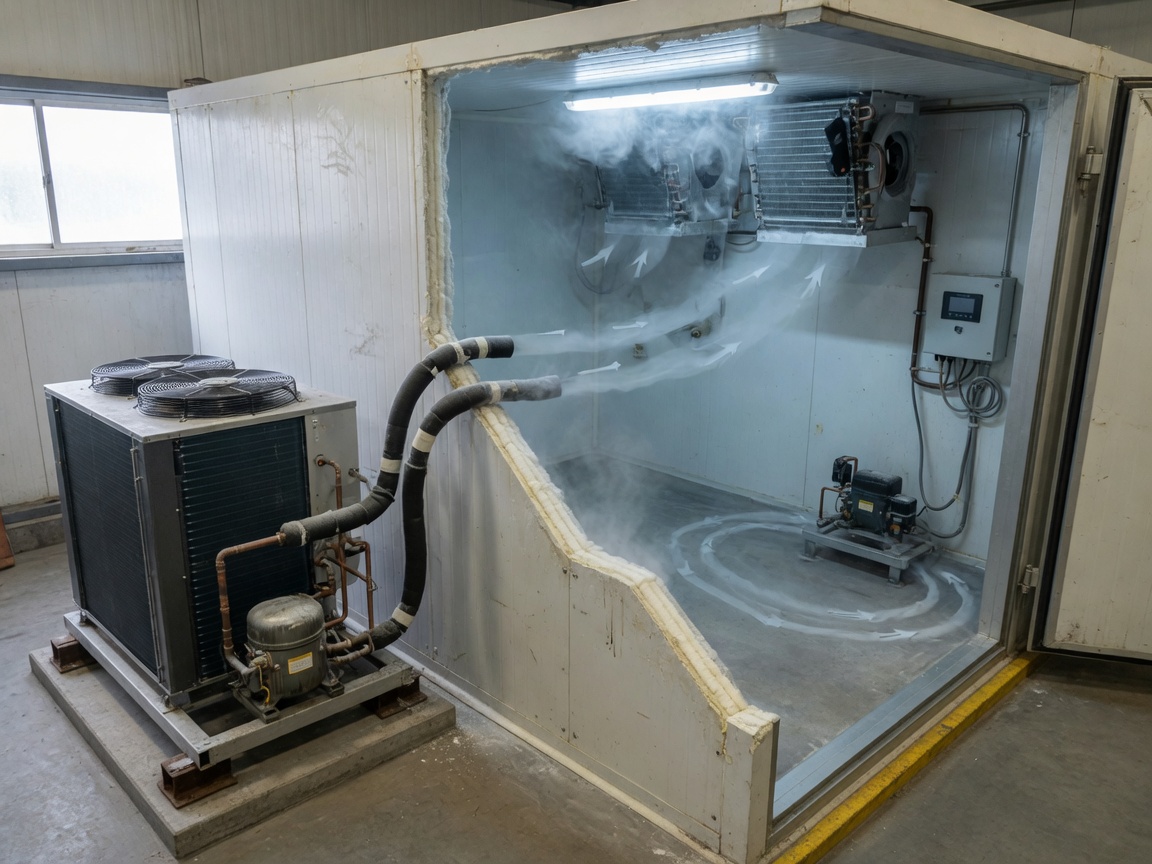
Every commercial cold storage system, regardless of size or application, shares the same fundamental architecture. The refrigeration cycle begins at the compressor, which pressurizes refrigerant gas. That gas moves to the condenser unit — mounted either rooftop or remote — where heat is rejected to ambient air. The cooled, high-pressure liquid then passes through an expansion device and into the evaporator coils inside the cold room, where it absorbs heat from the stored product and air. The cycle repeats continuously, maintaining setpoint temperature.
Surrounding this refrigeration loop are the structural elements: insulated panel systems (typically polyurethane or PIR foam core with metal facings), floor systems rated for load-bearing and thermal break requirements, and door assemblies with heater strips to prevent ice bridging. Overlaying everything is the controls layer — thermostats, data loggers, alarm systems, and increasingly in 2026, IoT-connected monitoring platforms that enable remote access and predictive maintenance alerts.
Why component integration matters more than individual specs
A common mistake among first-time buyers is evaluating components in isolation — comparing compressor horsepower ratings without accounting for the evaporator coil surface area needed to achieve the target temperature differential. Think of a cold room system like a chain: the weakest link determines total performance, not the strongest. An oversized compressor paired with undersized evaporator coils will short-cycle, wear out faster, and fail to pull down temperature under full load. Industry consensus among refrigeration engineers is that system balance — matching every component's capacity to the calculated thermal load — is the single most important factor in long-term reliability and energy efficiency.
Types of cold room equipment compared
The right equipment category depends on your temperature requirement, footprint, throughput volume, and budget. Here is a direct comparison of the four primary configurations used across US commercial and industrial facilities in 2026.
| Type | Temp range | Typical size | Best application | Avg installed cost (US) |
|---|---|---|---|---|
| Walk-in cooler | 34°F – 38°F | 8×8 ft to 20×40 ft | Restaurants, grocery, floral | $6,000 – $30,000 |
| Walk-in freezer | −10°F – 0°F | 8×8 ft to 20×40 ft | Food service, frozen distribution | $9,000 – $45,000 |
| Modular cold room | −22°F – +50°F | Configurable panels | Pharma, multi-zone warehousing | $15,000 – $120,000 |
| Blast freezer | −40°F – −10°F | Small cabinet to room-scale | Meat processing, seafood, baked goods | $12,000 – $80,000 |
Walk-in coolers vs. walk-in freezers: key differences beyond temperature
Beyond the obvious setpoint difference, walk-in freezer supplies require significantly heavier insulation — typically 4-inch panel systems versus 3-inch for coolers — plus electric or hot gas defrost systems to manage ice accumulation on evaporator coils. Door heater wattage is higher, floor heating cables may be required to prevent frost heave, and the refrigeration compressor must be rated for low-temperature operation. These aren't incremental differences; they represent a fundamentally different equipment specification. Buyers who try to repurpose a cooler-spec system for freezer duty will see dramatically shortened equipment life.
Modular vs. custom-built cold rooms: when does modular make sense?
Modular cold storage refrigeration units use prefabricated insulated panels that bolt together on-site, reducing installation time by 40–60% compared to stick-built construction. The tradeoff is dimensional flexibility — panel systems come in standard increments, which can create wasted space in irregular floor plans. For pharmaceutical and biotech applications where GMP compliance documentation is required, modular systems from established manufacturers also come with factory-certified panel specs and pre-validated temperature mapping protocols, which simplifies FDA audit preparation considerably. Custom-built cold rooms still win on very large footprints (above 5,000 sq ft) or when unusual structural constraints exist.
How to size your cold room system: BTU load estimation
Correct sizing is the most technically demanding part of specifying cold room equipment, and it's where undersized or oversized systems originate. The goal is to calculate the total heat load — everything the refrigeration system must remove — and then select equipment with sufficient capacity to handle that load at the worst-case ambient condition (typically peak summer temperature for your location).
Step-by-step BTU load calculation
- Calculate transmission load: Multiply each surface area (walls, ceiling, floor) by its U-value and the temperature differential between inside and outside. Don't forget the floor if it's over unconditioned ground.
- Calculate infiltration load: Estimate air changes per 24 hours based on door usage frequency and room volume. For a busy restaurant walk-in, assume 8–12 air changes per day minimum.
- Calculate product load: Determine the maximum weight of warm product entering the room per day, its specific heat, and the required pulldown temperature change. This is often the largest single load component for production facilities.
- Calculate internal heat gain: Add heat from lighting (LED fixtures still generate measurable heat at scale), electric forklifts, people working inside, and any powered equipment.
- Apply a safety factor: Standard practice per ASHRAE refrigeration equipment standards is to add 10–15% to the calculated total as a design safety margin.
- Select equipment at calculated BTU/hr capacity: Match your result to available commercial refrigeration compressors and evaporator coil combinations, confirming the match at the actual design conditions (room temp and entering air temp at the evaporator).
Common sizing mistakes that cost operators money
Oversizing — choosing a system 30–50% above calculated load "to be safe" — is actually a serious operational problem. An oversized system short-cycles: it reaches setpoint quickly, shuts off, then restarts frequently. Each startup draws 3–6× the running current, driving up energy costs and accelerating compressor wear. Based on real case data from refrigerated warehouse system audits, oversized installations can consume 20–35% more electricity annually than a properly sized system. Why do so many contractors still oversize? Partly risk aversion, partly lack of rigorous load calculation tools. Requiring a full Manual-J equivalent cold room load calculation as a bid requirement is the single most effective protection a buyer has.
Energy efficiency and 10-year cost of ownership
Purchase price is what you pay once. Energy is what you pay every month for the next decade. For serious buyers evaluating temperature-controlled storage solutions, total cost of ownership (TCO) over 10 years almost always dwarfs the upfront equipment cost — and yet most competitor guides stop at MSRP comparison.
Annual electricity cost estimates by system type
Using the US commercial electricity rate of $0.12/kWh (2026 EIA average) and operating assumptions of 24/7 runtime with seasonal variation, here are realistic annual energy cost ranges for common cold room configurations. A standard 10×12 ft walk-in cooler draws approximately 3,500–5,000 kWh/year — roughly $420–$600 annually. A same-footprint walk-in freezer, operating at 0°F, runs 6,000–9,000 kWh/year, or $720–$1,080/year. A medium blast freezer room operating at −40°F can consume 40,000–80,000 kWh/year, translating to $4,800–$9,600 annually just in electricity. Over 10 years, energy cost alone for a mid-size industrial unit easily exceeds $75,000 — often double the original equipment cost.
"Refrigeration accounts for 30–60% of total energy use in food retail facilities. Upgrading to high-efficiency evaporator fan motors, EC technology, and demand-controlled lighting alone can reduce refrigeration energy consumption by 15–25%." — U.S. Department of Energy, commercial refrigeration energy use guidance, 2026.
The 2026 refrigerant transition and its cost impact
Here's a factor most buyers overlook entirely: refrigerant choice affects both operating cost and long-term regulatory risk. Systems using R-404A or R-22 face escalating refrigerant costs as EPA AIM Act phasedown schedules tighten through 2026–2028. Natural refrigerants — R-290 (propane) and CO₂ transcritical systems — have lower global warming potential and are exempt from phasedown schedules, but they require higher upfront equipment investment and certified technician servicing. For a 10-year TCO model, factor in a $2,000–$8,000 refrigerant price risk premium for legacy HFC systems versus the $3,000–$12,000 premium for natural refrigerant-capable equipment upfront. The math increasingly favors investing in compliant systems now.
US regulatory compliance: FDA FSMA, ASHRAE 15, and permit requirements
Compliance is not optional — and it's the area where B2B buyers most consistently get caught unprepared. Two federal frameworks govern cold room equipment in US commercial and industrial settings, and they operate in parallel with state and local building codes that vary significantly by jurisdiction.
FDA Food Safety Modernization Act (FSMA) requirements
FSMA's Preventive Controls rules require food facilities to maintain temperature monitoring records demonstrating that refrigerated storage remains within defined safe limits. This has direct equipment implications: cold storage refrigeration systems must include calibrated temperature recording devices with sufficient data retention for regulatory audit. Wireless IoT sensors with cloud logging — now standard on higher-end commercial cold storage systems — satisfy this requirement more reliably than strip-chart recorders. Facilities subject to FSMA must also demonstrate that equipment is capable of achieving and maintaining setpoints under maximum load conditions, which means your BTU sizing documentation becomes a compliance document, not just an engineering worksheet.
ASHRAE 15 mechanical safety and state permit variability
ASHRAE 15 governs the safe design of refrigerating systems, covering refrigerant quantity limits by occupancy classification, machinery room ventilation requirements, leak detection systems, and pressure relief discharge routing. Compliance with refrigeration equipment standards is enforced at the local level through mechanical permits — and this is where significant variation emerges. California's Title 24 energy code adds efficiency requirements beyond ASHRAE minimums. New York City requires sealed-system work to be performed by licensed refrigeration engineers. Texas, by contrast, has no statewide refrigeration contractor licensing requirement. Buyers planning multi-state rollouts must account for permitting timelines — which range from 2 weeks to 4+ months — as a critical path item in project scheduling.
Industry-specific applications and use cases
Generic cold room equipment specifications often miss the mark because different industries impose fundamentally different operating requirements. A single-temperature walk-in cooler spec that works perfectly for a restaurant will fail in a pharmaceutical dispensary or a cut flower wholesale operation. Understanding vertical-specific requirements is what separates a system that lasts 15 years from one that causes problems within 18 months.
Food service and grocery
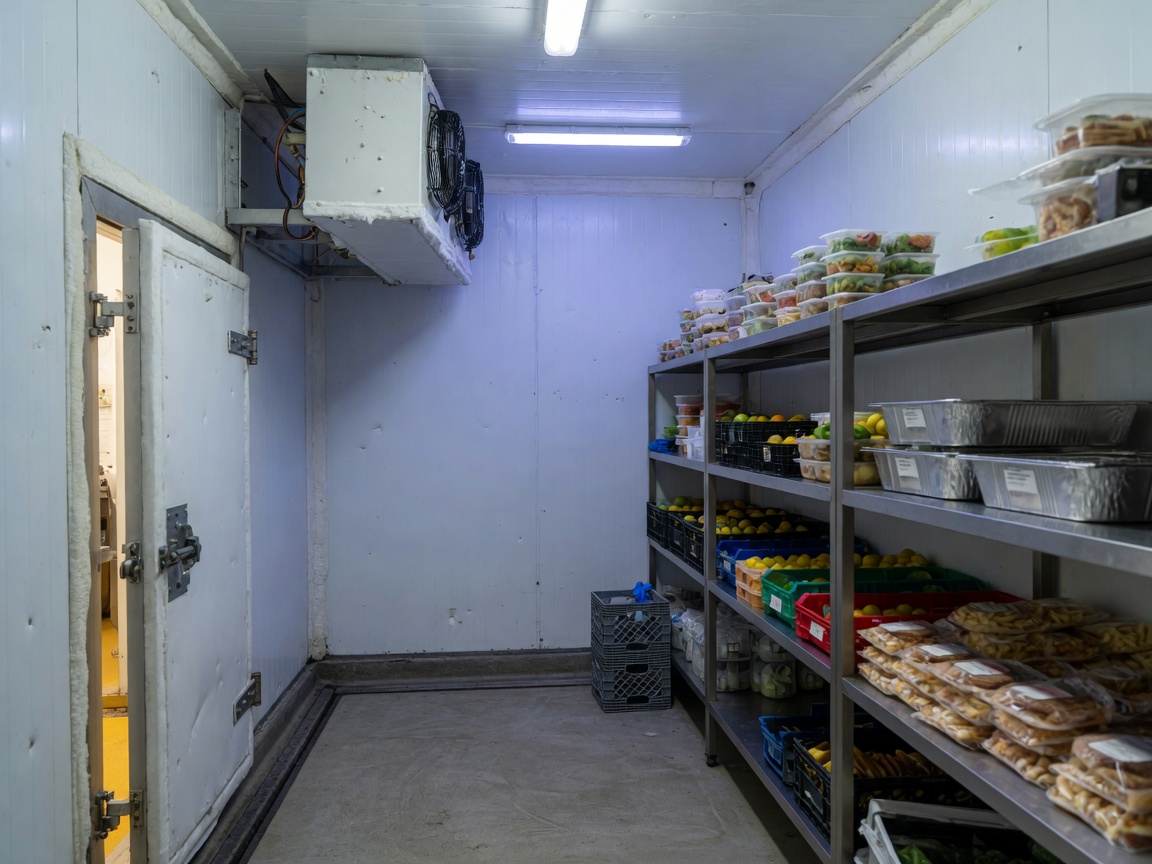
Restaurant and grocery walk-in cooler components experience extremely high door-open frequency — 40–100 cycles per day in a busy kitchen. This demands heavy-duty door hinges rated for at least 200,000 cycles, aggressive door heater sizing to prevent ice bridging, and anti-condensate treatment on panel joints. Humidity control matters here too: produce storage requires 90–95% RH, while dairy and deli products perform better at 75–85% RH. A single walk-in serving both categories without zone separation is a common design shortcut that accelerates product spoilage.
Pharmaceutical and biotech cold storage
Pharmaceutical cold rooms operate under an entirely different compliance framework. GMP (Good Manufacturing Practice) and GDP (Good Distribution Practice) guidelines require continuous temperature monitoring with alarm notification, validated temperature mapping studies, and documented equipment qualification (IQ/OQ/PQ protocols). The equipment itself must support dual-redundant refrigeration systems — if the primary unit fails, a backup activates automatically within seconds. This requirement alone doubles the refrigeration equipment cost compared to food service equivalents. Of course, there are cases where smaller biotech facilities accept a single system with enhanced alarm response protocols — but for anything storing vaccines or biologics, redundancy is non-negotiable.
Meat processing and blast freezer applications
Industrial refrigeration equipment for meat processing must handle extremely high thermal loads from warm carcasses or freshly cooked product entering the blast freezer. USDA regulations require that cooked meat products be chilled from 130°F to 40°F within a defined timeframe — typically 6 hours or less — to prevent pathogen growth. Blast freezer equipment must be sized to achieve this pulldown curve under maximum daily production volume, not average volume. Stainless steel construction throughout — panels, evaporator housings, drain systems — is mandatory for sanitary compliance, and HACCP documentation must address equipment cleaning and temperature monitoring protocols specifically.
How to choose the right cold room equipment: a buyer's checklist
After working through type selection, BTU sizing, energy cost modeling, and compliance requirements, the final step is translating all of that into a structured procurement process. Here is a practical checklist developed from real purchasing cycles across food service, pharmaceutical, and industrial refrigeration projects.
Pre-purchase evaluation steps
- Define your temperature and humidity requirements for every product category stored — don't assume a single setpoint works for mixed inventory.
- Complete a formal BTU load calculation using ASHRAE methodology; require this as a deliverable from any contractor bidding the project.
- Model 10-year TCO including energy, refrigerant maintenance, planned component replacements (compressors typically 10–15 year life, evaporator fans 7–10 years), and regulatory upgrade risk.
- Confirm refrigerant compliance: specify systems using R-448A, R-449A, R-290, or CO₂ to avoid AIM Act phasedown exposure on HFC blends.
- Verify local permit requirements in every jurisdiction where installation will occur; engage a local mechanical contractor early to identify lead-time risks.
- Evaluate monitoring and controls: require FSMA-compatible temperature logging with cloud backup as a minimum; evaluate IoT-enabled predictive maintenance platforms for higher-value installations.
- Check service network coverage: confirm the manufacturer or distributor has certified service technicians within 100 miles of each installation location — this is a procurement criterion that is consistently underweighted and consistently regretted when ignored.
Red flags in vendor proposals
Watch for proposals that skip the load calculation and jump directly to equipment recommendations based on room dimensions alone — this is the single most reliable indicator of an underqualified contractor. Similarly, proposals that don't specify refrigerant type, or that offer R-404A systems at a price-competitive level without disclosing the phasedown risk, are passing a known long-term cost onto the buyer. The best vendors in the US market for commercial refrigeration compressors and system integration — including Heatcraft, Bohn, and Hussmann — provide full load calculation documentation as standard practice. Vendors who don't are cutting corners somewhere.
Selecting the right cold room equipment ultimately comes down to this: match the system to the actual thermal and compliance requirements of the application, build the full lifecycle cost into the decision, and validate that the service infrastructure exists to support the system over its operating life. Buyers who follow this framework consistently outperform those who optimize for lowest upfront price.
FAQ
Q: What is the difference between a walk-in cooler and a walk-in freezer in terms of equipment requirements?
A: Walk-in freezers require 4-inch insulated panels (vs. 3-inch for coolers), dedicated low-temperature compressors, electric or hot gas defrost systems, and floor heating to prevent frost heave. Equipment cost and energy consumption are typically 40–60% higher than equivalent-footprint cooler installations.
Q: How much does cold room equipment cost to operate annually in the US?
A: Annual electricity costs range from approximately $420–$600 for a small walk-in cooler to $4,800–$9,600 for a mid-size blast freezer room, based on 2026 US commercial electricity rates of $0.12/kWh. Maintenance adds $500–$3,000/year depending on system complexity and service contract terms.
Q: What refrigerants are compliant with 2026 US EPA regulations for cold room systems?
A: The EPA AIM Act phasedown targets high-GWP HFCs including R-404A and R-407C. Compliant alternatives include R-448A, R-449A (lower-GWP HFC blends), R-290 (propane), and CO₂ transcritical systems. Specifying compliant refrigerants at purchase avoids future retrofit costs estimated at $3,000–$15,000 per system.
Q: Does cold room equipment installation require a permit in the US?
A: Yes, in virtually all US jurisdictions. Mechanical permits are required for refrigerant-containing systems under ASHRAE 15 and local building codes. Permitting timelines range from 2 weeks (many Southern states) to 4+ months (California, NYC). Engage a local mechanical contractor during the design phase to identify jurisdiction-specific requirements early.
Q: What cold room equipment is required for FDA FSMA compliance in food storage?
A: FSMA Preventive Controls rules require calibrated temperature monitoring with documented recordkeeping. At minimum, this means a calibrated digital recording thermometer with data retention capability. IoT-connected monitoring systems with cloud storage and automated alarm notifications are increasingly standard and simplify regulatory audit preparation significantly.
Keywords:
Inquiry
If you are interested in our products, please leave your email to receive a free product quote, thank you!
More information



Tel:
Sales E-mail: