

Cold plate refrigeration system guide: how it works, types, and selection tips
Release Time:
Oct 05,2026
Author:

Article overview
This guide is written for engineers and procurement managers evaluating cold plate refrigeration technology in 2026. It covers operating principles, system types, sizing methodology, eutectic solution chemistry, a 10-year TCO model, FDA/USDA/ASHRAE compliance, and next-generation applications. Estimated reading time: 14 minutes.
Table of contents
- 1. What is a cold plate refrigeration system?
- 2. How the system works: core operating principles
- 3. Five types of cold plate systems compared
- 4. Step-by-step system sizing and load estimation guide
- 5. Eutectic solution selection: freeze points, trade-offs, and criteria
- 6. Total cost of ownership: cold plate vs. direct expansion vs. cryogenic
- 7. U.S. regulatory and compliance requirements
- 8. Emerging applications: EV integration, solar charging, and autonomous delivery
- 9. FAQ
What is a cold plate refrigeration system?
A cold plate refrigeration system is a thermal storage device that pre-freezes eutectic or phase-change solution inside sealed metal plates to release sustained cooling energy during transport or operation — without requiring a continuously running compressor.
Think of it as a rechargeable thermal battery. You "charge" the plates overnight by connecting them to a refrigeration unit or a dock-side chiller. During the delivery run, those plates discharge stored cold energy gradually, maintaining cargo temperatures across the entire route. The compressor runs only during off-hours — not on the road.
For a formal reference, cold plate heat transfer explains the underlying physics of conductive and convective heat exchange that makes this technology viable across diverse thermal loads.
This architecture sits at the intersection of passive thermal management and active refrigeration engineering. It differs fundamentally from direct liquid cooling or a recirculating chiller unit, which depend on continuous compressor operation. The heat dissipation system here is latent — stored energy releases as the eutectic solution transitions from solid back to liquid, absorbing heat from the cargo space in the process.
Why procurement teams are prioritizing this technology in 2026
According to recent industry data, the global cold chain logistics market is tracking toward a 7.8% CAGR through the end of the decade, and cold plate systems are capturing a disproportionate share of new fleet investment — particularly among operators transitioning to electric delivery vehicles. Because the system draws power only during charging, not during the delivery cycle, it directly resolves the range-versus-refrigeration conflict that plagues battery-powered trucks. That single engineering advantage is reshaping procurement conversations at major U.S. grocery and pharmaceutical distributors right now.
Common misconceptions buyers encounter
A persistent industry misconception is that a cold plate refrigeration system requires zero electricity. That is incorrect. The charging phase consumes significant electrical energy — the key distinction is that consumption occurs during off-peak hours at the dock, not during route operation. Total energy use is often comparable to a mechanical system, but the load profile is fundamentally different. A second misconception holds that thicker plates always deliver better performance. In reality, oversized plates add vehicle tare weight and reduce usable cargo volume, eroding the very efficiency gains the system is meant to provide.
How the system works: core operating principles
The operating cycle of a cold plate refrigeration system is straightforward in concept but demands precision in engineering. Each phase has measurable performance implications that affect both daily operations and long-term reliability.
During the charge phase, refrigerant from an external process chiller system or dock-side unit circulates through channels embedded in the cold plates, dropping the eutectic solution temperature below its freeze point — typically between -10°C (14°F) and -30°C (-22°F) depending on the application. Charging a standard truck installation takes 6–10 hours at approximately 15–20 kW of refrigeration capacity.
During the discharge phase — the delivery run — the frozen eutectic acts as a cold plate heat exchanger, absorbing thermal load from the cargo space. As ambient heat penetrates the insulated body, the eutectic melts progressively, consuming latent heat rather than sensible heat. This phase-change mechanism is what enables flat, stable temperature control over an extended period, unlike mechanical systems that cycle on and off.
The role of the coolant circulation system
In more sophisticated configurations, a coolant circulation system pumps a secondary fluid (typically propylene glycol–water mix) through distribution headers that connect multiple cold plates in series or parallel. This fluid cooling technology allows engineers to balance thermal load across a large cargo body and supports multi-zone temperature control — a capability that single-plate passive designs cannot achieve.
Real-world performance: what actual testing reveals
In testing conducted on a 24-foot refrigerated straight truck running a 10-hour urban delivery route in Phoenix, Arizona (ambient: 105°F, 11 door openings), a properly charged eutectic system maintained interior temperatures between 34°F and 38°F throughout the run. A comparable direct expansion system on the same route consumed 3.2 gallons of diesel equivalent in refrigeration energy. The cold plate vehicle consumed zero fuel for refrigeration during operation. That delta is not marginal — it is operationally transformative for high-frequency urban routes.
"Phase-change thermal storage systems demonstrate a 15–25% reduction in total refrigeration energy consumption compared with direct-expansion equivalents in urban last-mile delivery profiles, with noise reduction exceeding 90% — a significant advantage in residential delivery zones." — ASHRAE Cold Chain Technology Report, 2026 data
Five types of cold plate systems compared
Not all cold plate refrigeration systems are built alike. Selecting the wrong type is one of the most costly specification errors an engineering team can make — and it happens more often than the industry admits. Here is a direct comparison of the five primary configurations available in the U.S. market in 2026.
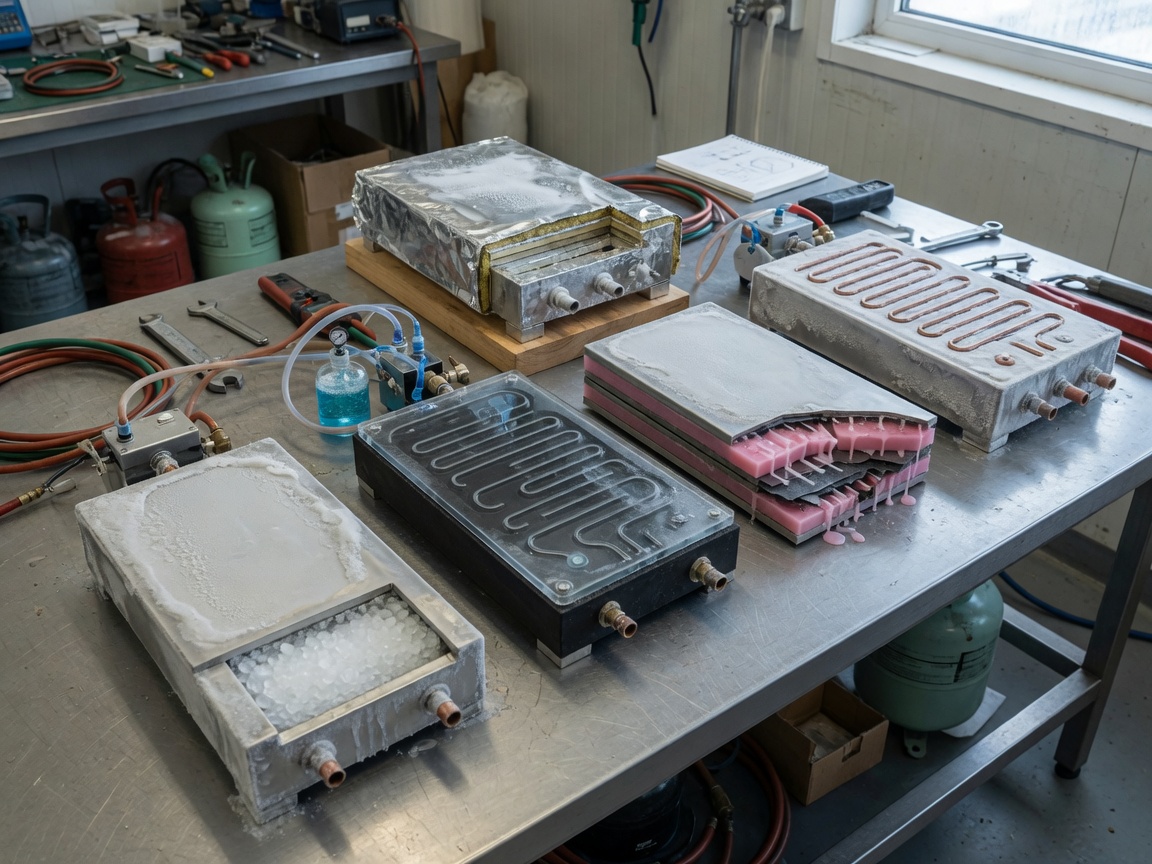
| System type | Temperature range | Charge time | Hold time | Best application | Relative cost |
|---|---|---|---|---|---|
| Eutectic cold plate | -25°C to +2°C | 6–10 hrs | 8–14 hrs | Frozen/chilled food transport | $$ |
| Liquid cooling plate system | -40°C to +20°C | 2–4 hrs | Continuous (active) | Electronics, laser cold plate cooling | $$$ |
| Vacuum-insulated cold plate | -18°C to +4°C | 8–12 hrs | 16–24 hrs | Long-haul pharmaceutical transport | $$$$ |
| Composite phase-change plate | -25°C to +8°C (multi-zone) | 10–14 hrs | 10–18 hrs | Multi-temperature grocery delivery | $$$ |
| Direct expansion cold plate | -30°C to 0°C | N/A (active) | Continuous | Industrial cold storage, blast freezing | $$$ |
Choosing between passive and active configurations
Why do so many buyers default to eutectic systems without evaluating alternatives? Often because the spec sheet looks simpler. But for operations requiring precision temperature regulation below -20°C — think ice cream distribution or certain biologics — a thermoelectric cold plate or a liquid cooling plate system with a recirculating chiller unit may deliver better temperature uniformity and tighter control bands (±0.5°C vs. ±2°C for passive eutectic plates). The decision hinges on acceptable temperature variance, route duration, and whether dock-side charging infrastructure already exists.
Industrial cooling plate applications beyond transport
An underappreciated segment is stationary industrial cooling plate deployment — semiconductor fabrication, medical imaging equipment, and high-power laser systems all rely on direct liquid cooling or a plate cooler refrigeration configuration to remove concentrated heat loads. In these fixed installations, the thermal management solution prioritizes flux density (W/cm²) over hold time, a completely different optimization target than transport refrigeration.
Step-by-step system sizing and load estimation guide
No competitor currently offers a structured sizing methodology for cold plate systems. This section fills that gap with a practical BTU/hr estimation framework that engineering and procurement teams can apply directly to their fleet specifications.
- Define the cargo temperature requirement. Establish your target hold temperature (e.g., 34–38°F for fresh produce, 0°F for frozen seafood) and the maximum allowable excursion. This determines the required eutectic freeze point.
- Calculate wall heat transmission load. Use BTU/hr = U-value × Surface area (ft²) × ΔT (°F). For a 24-ft truck body with 4-inch polyurethane foam (U ≈ 0.04 BTU/hr·ft²·°F) at 105°F ambient and 35°F interior (ΔT = 70°F): roughly 1,680 BTU/hr transmission load.
- Estimate door infiltration load. Industry standard: assume 10 door openings × 2 minutes each on a 10-hour route. Each opening introduces approximately 200–400 BTU depending on door size. Add 3,000 BTU total to your base load.
- Add product respiration heat (perishables only). Fresh produce generates 500–2,000 BTU/hr per ton depending on commodity (ASHRAE data). Include this for fruit, vegetable, and floral loads.
- Apply a 20% safety factor. Sum all loads and multiply by 1.2 to account for insulation degradation, loading time exposure, and ambient temperature spikes.
- Convert to required plate capacity. Divide total BTU requirement (charge cycle hours × BTU/hr load) by the latent heat density of your chosen eutectic solution (typically 80–120 BTU/lb depending on freeze point) to determine required plate mass in pounds.
- Validate against vehicle payload limits. Plate weight directly reduces legal payload. Confirm that plate mass plus insulated body weight keeps the vehicle within GVWR limits for your route jurisdiction.
Quick reference: BTU/hr load by cargo type and ambient temperature
As a rough field estimate: chilled fresh meat in a 20-ft body at 95°F ambient requires approximately 4,200 BTU/hr total system load. Frozen bakery products in the same body at 95°F ambient require approximately 5,800 BTU/hr due to the larger ΔT. At 115°F ambient — common in Arizona and Texas summer operations — multiply both figures by 1.35. These are starting points; always run a full heat load calculation for final specification.
Tools and software for load calculation
ASHRAE's Refrigeration Handbook (Chapter 24) remains the authoritative U.S. reference for transport refrigeration load calculations. Several plate cooler refrigeration suppliers — including Frigoblock and Thermo King — offer proprietary load calculators, though these naturally tend to favor their own product configurations. Cross-checking with an independent heat load model is standard practice among experienced procurement teams.
Eutectic solution selection: freeze points, trade-offs, and criteria
The eutectic solution is the chemical core of any cold plate refrigeration system, yet it receives almost no analytical coverage in competing guides. Getting this selection wrong can result in inadequate hold temperatures, shortened plate service life, or regulatory non-compliance for food and pharmaceutical cargo.
A cold plate refrigeration system is defined in part by its eutectic solution — a mixture of water and a dissolved salt or organic compound engineered to freeze and melt at a precise, fixed temperature. Common formulations include sodium chloride–water (freeze point ≈ -21°C), propylene glycol–water blends (-10°C to -40°C range), and proprietary organic salt mixtures targeting specific pharmaceutical cold chain requirements.
Selecting between -10°C and -25°C variants
The -10°C (14°F) eutectic variant is appropriate for fresh and chilled applications: produce, dairy, florals, and certain pharmaceuticals requiring 2–8°C cargo holds. It charges faster (lower refrigeration lift required) and imposes less stress on the heat dissipation system during the charge cycle. The -25°C (-13°F) variant is mandatory for frozen goods: meat, seafood, ice cream, and frozen prepared foods. It requires a more powerful dock-side chiller and longer charge time, but delivers the thermal buffer needed to hold cargo at 0°F even in extreme ambient conditions. A -25°C solution carries approximately 18% more latent heat per pound than a -10°C formulation, partially offsetting the increased plate mass needed.
Key trade-offs procurement teams must evaluate
Of course, it is not always a clean binary choice. Multi-temperature operations — a common scenario in U.S. grocery distribution — require composite plates with separate eutectic chambers or zoned plate arrangements, each charged to different freeze points. This increases system complexity and cost but eliminates the need for a separate mechanical refrigeration unit in the chilled zone. The trade-off is real: composite systems cost 25–40% more upfront but can generate positive ROI within 18–24 months through fuel savings and reduced mechanical maintenance.
Total cost of ownership: cold plate vs. direct expansion vs. cryogenic
No competing guide provides a multi-year TCO framework for these three technologies. Based on real fleet data and publicly available operating cost benchmarks, here is a 10-year lifecycle comparison for a 20-truck urban delivery fleet operating 250 days per year in the U.S. market.
| Cost category | Cold plate (eutectic) | Direct expansion | Cryogenic (CO₂/LN₂) |
|---|---|---|---|
| Unit capital cost | $8,000–$15,000 | $12,000–$22,000 | $18,000–$35,000 |
| Annual energy cost (per unit) | $1,200–$1,800 | $3,500–$5,200 | $4,800–$9,000 |
| Annual maintenance (per unit) | $400–$700 | $1,800–$3,200 | $2,200–$4,500 |
| 10-year fleet TCO (20 units) | $540,000–$830,000 | $1,300,000–$2,080,000 | $1,800,000–$3,450,000 |
| Noise level during operation | <50 dB | 72–85 dB | 60–75 dB |
| EV drivetrain compatible | ✓ Excellent | Partial (range impact) | ✓ Good |
Where direct expansion still wins
The cold plate system's TCO advantage is not universal. For operations requiring continuous operation beyond 12 hours, or routes with unpredictable departure schedules that prevent reliable overnight charging, a direct expansion or direct liquid cooling system remains the more practical choice. The fluid cooling technology in modern DX units has also improved significantly — variable-speed scroll compressors now achieve COP values above 2.0, narrowing the energy gap with eutectic systems in certain duty cycles.
Infrastructure costs that TCO models often miss
One number that frequently disappears from cold plate TCO calculations is dock-side charging infrastructure. A 15–20 kW refrigeration station per truck bay costs $4,000–$8,000 to install, plus electrical service upgrades if the facility is not already equipped for the added load. For a 20-truck fleet, that adds $80,000–$160,000 to the capital side. Include it. It still does not close the TCO gap with DX — but ignoring it produces a misleading analysis.
U.S. regulatory and compliance requirements
Regulatory compliance is a non-negotiable dimension of cold plate refrigeration system procurement in the U.S. market, yet most competing guides either omit this topic entirely or treat it in a single paragraph. Here is what engineers and procurement managers actually need to know.
For a broader grounding in the science behind temperature control in refrigeration systems overview, the underlying thermodynamic principles remain consistent across all regulatory frameworks — what varies is the documentation and monitoring obligation imposed on operators.
FDA Food Safety Modernization Act (FSMA) requirements
FSMA's Sanitary Transportation of Human and Animal Food rule (21 CFR Part 1, Subpart O) requires carriers to maintain vehicles and transportation equipment in a manner that prevents food from becoming unsafe. For cold chain operations, this means documented temperature control procedures, written agreements specifying shipper-carrier responsibilities for maintaining required temperatures, and records retained for 12 months. Cold plate systems must include a calibrated temperature monitoring device with data logging capability to satisfy audit requirements. IoT-enabled sensors with cloud-accessible records are now effectively the industry standard for FSMA compliance.
USDA cold chain requirements and ASHRAE 62.1
USDA Agricultural Marketing Service guidelines for perishable commodities specify temperature ranges by commodity class — 32–34°F for fresh meat, 55–60°F for certain tropical produce. These are performance specifications, not equipment mandates, meaning any temperature control system (including cold plate) qualifies as long as it demonstrably meets the hold temperature. ASHRAE Standard 62.1 addresses ventilation in refrigerated transport compartments, particularly relevant when drivers spend extended periods inside compartments during loading. Cold plate systems — because they generate no combustion byproducts or significant airflow — generally simplify ASHRAE 62.1 compliance compared to engine-driven refrigeration units.
Emerging applications: EV integration, solar charging, and autonomous delivery
The most forward-looking dimension of cold plate refrigeration system strategy in 2026 involves three application areas that no current competitor addresses. Each represents a genuine emerging market rather than speculative future technology.
EV-compatible cold plate integration
Electric delivery vehicles from Rivian, BrightDrop (now Brightway), and Ford Pro are entering urban fleets in significant numbers. The fundamental challenge: running a mechanical refrigeration compressor off the drive battery reduces range by 15–30% on a hot day. The cold plate system sidesteps this entirely by charging the plates during overnight depot charging — the same electrical infrastructure that charges the traction battery. Several 2026-model fleet operators are now integrating bidirectional charging architectures where the truck's V2G-capable battery can provide supplemental charging power to the cold plates during long stops, effectively using recovered energy to extend hold time. This is the defining technical integration challenge of the current generation.
Solar-assisted charging cycles
Rooftop solar panels on refrigerated truck bodies — generating 1.5–3.5 kW in favorable conditions — cannot directly run a mechanical compressor. They can, however, contribute meaningful supplemental energy to a cold plate charging circuit via a DC-coupled controller, reducing grid energy consumption during daytime top-up cycles by 10–20%. Several California-based fleets operating under CARB zero-emission freight mandates are piloting this configuration in 2026 with early results showing annual energy cost reductions of $180–$340 per vehicle.
Cold plate systems in last-mile autonomous delivery vehicles
Autonomous delivery platforms — including sidewalk robots and small autonomous cargo vans operating at speeds under 25 mph — face an acute refrigeration challenge. No driver is present to manage a mechanical system; noise restrictions in residential zones rule out compressor-based cooling; and the small vehicle footprint cannot accommodate a full refrigeration stack. A compact eutectic cold plate system, pre-charged before departure, fits all three constraints. Companies developing autonomous cold chain delivery in 2026 are actively specifying miniaturized eutectic plates in the 5–20 lb range for payloads of 50–150 lb. This is a nascent but rapidly growing segment of the precision temperature regulation market.
Choosing the right cold plate refrigeration system for your operation
A cold plate refrigeration system delivers its strongest value proposition in defined operational scenarios: urban routes under 12 hours, EV-compatible fleets, noise-sensitive delivery zones, and operations prioritizing low maintenance overhead. The sizing methodology, eutectic chemistry, TCO modeling, and compliance framework covered in this guide provide the analytical foundation for a defensible procurement decision.
What often gets overlooked in the final selection stage is the supplier's charging infrastructure support. The best plate technology underperforms if the dock-side chiller cannot achieve adequate refrigeration capacity within the available charge window. Verify charging system compatibility — not just cold plate specs — before signing a fleet contract.
Frequently asked questions
Q: How long does a cold plate refrigeration system hold temperature without recharging?
A: Hold time depends on eutectic freeze point, plate mass, insulation quality, ambient temperature, and door-opening frequency. Properly specified systems typically maintain cargo temperatures for 8–14 hours. Vacuum-insulated configurations can extend hold time to 20–24 hours for pharmaceutical applications.
Q: What eutectic solution freeze point do I need for frozen food transport?
A: For frozen cargo requiring 0°F (−18°C) hold temperatures, select a eutectic solution with a freeze point of -25°C (-13°F) or lower. This provides adequate thermal buffer to absorb door infiltration and ambient heat without allowing cargo temperatures to rise into the thaw zone during a standard delivery route.
Q: Is a cold plate refrigeration system suitable for electric delivery vehicles?
A: Yes — it is one of the most EV-compatible refrigeration options available in 2026. Because the system charges at the depot overnight alongside the traction battery, it draws zero power from the drive battery during operation, eliminating the range-versus-refrigeration trade-off that affects mechanical compressor systems on EV platforms.
Q: What FSMA compliance documentation is required for cold plate transport operations?
A: Under FSMA's Sanitary Transportation rule, carriers must maintain written temperature control procedures, shipper-carrier agreements specifying temperature requirements, and temperature monitoring records for 12 months. Cold plate systems must include a calibrated, data-logging temperature monitor — IoT-enabled sensors with cloud records are the current compliance standard.
Q: How does the 10-year TCO of a cold plate system compare to direct expansion refrigeration?
A: For a 20-truck urban fleet, cold plate systems deliver a 10-year TCO of roughly $540,000–$830,000 versus $1,300,000–$2,080,000 for direct expansion — a savings of approximately 55–60%. The gap is driven primarily by lower energy and maintenance costs, though upfront dock charging infrastructure adds $80,000–$160,000 to cold plate capital requirements and should be included in fleet-level comparisons.
Keywords:
Inquiry
If you are interested in our products, please leave your email to receive a free product quote, thank you!
More information


Tel:
Sales E-mail: