

How to choose a reliable spiral freezer supplier: a practical guide for food manufacturers
Release Time:
Jul 27,2026
Author:
Looking for a trusted spiral freezer supplier in 2026? This complete buyer's guide covers mechanical vs. cryogenic comparisons, TCO breakdowns, certifications, RFQ checklists, and industry-specific application benchmarks to help food manufacturers make smarter purchasing decisions.

Article overview
This guide is designed for food processing plant procurement managers and equipment engineers who are actively evaluating suppliers. It covers: mechanical vs. cryogenic system trade-offs, a full TCO breakdown, industry-specific throughput data, certification requirements, a pre-purchase RFQ checklist, and 2026 market trends. Reading time: approximately 14 minutes.
Table of contents
- 1. What is a spiral freezer supplier?
- 2. Mechanical vs. cryogenic spiral freezers: a side-by-side comparison
- 3. Total cost of ownership: what the sticker price never tells you
- 4. Industry-specific applications and throughput benchmarks
- 5. Certifications and food safety compliance you must verify
- 6. Buyer's RFQ checklist: what to ask before you sign
- 7. 2026 trends shaping the spiral freezer market
- 8. FAQ
What is a spiral freezer supplier?
A spiral freezer supplier is a manufacturer or authorized distributor that designs, builds, and services helical-belt continuous freezing systems used in industrial food processing lines. These suppliers serve as end-to-end partners — covering equipment engineering, installation, commissioning, refrigeration integration, and long-term after-sales support for facilities that require uninterrupted freezing throughput.
Understanding what separates a genuine spiral freezer manufacturer from a simple reseller matters more than most buyers realize. A true manufacturer controls the fabrication of the insulated enclosure, conveyor belt assembly, airflow management system, and refrigeration interface. A distributor, by contrast, sources equipment from third-party factories and adds a margin without the engineering depth to customize units for your specific product or facility layout. For a capital investment that commonly ranges from $300,000 to over $1.5 million, that distinction is not trivial.
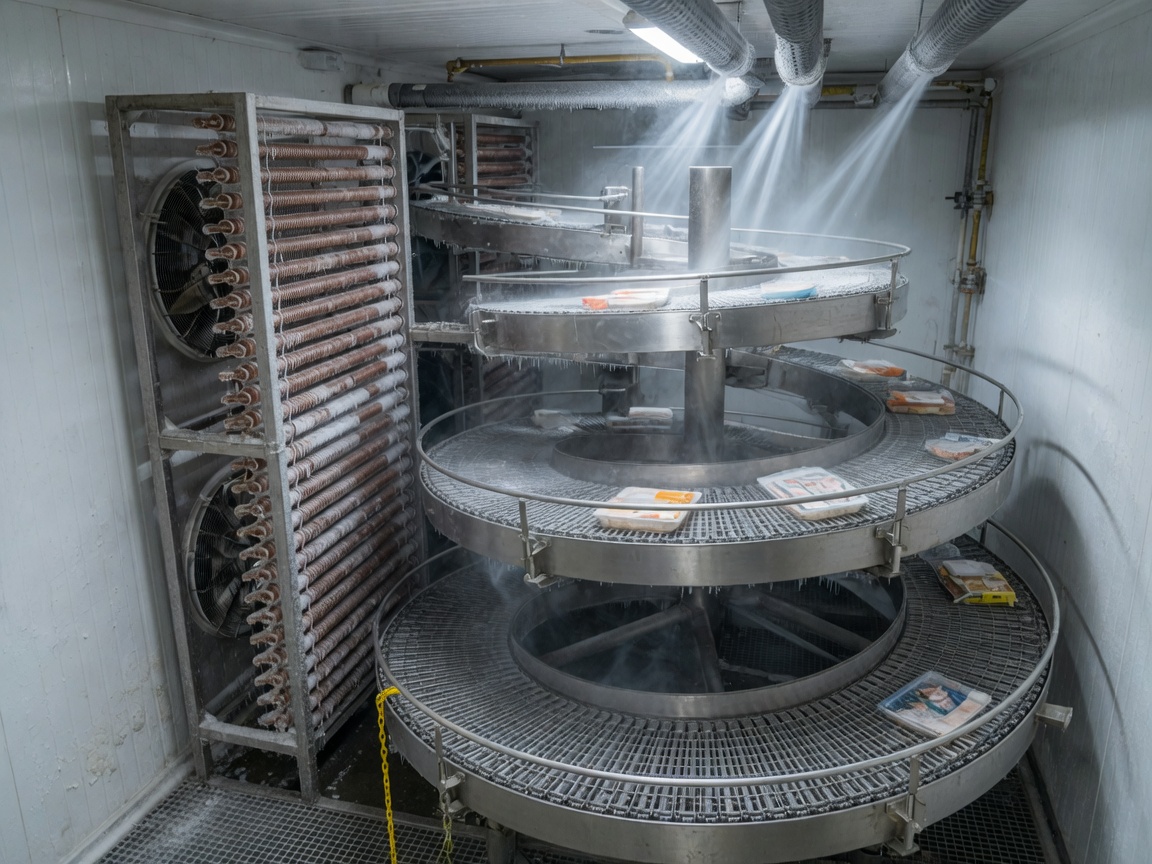
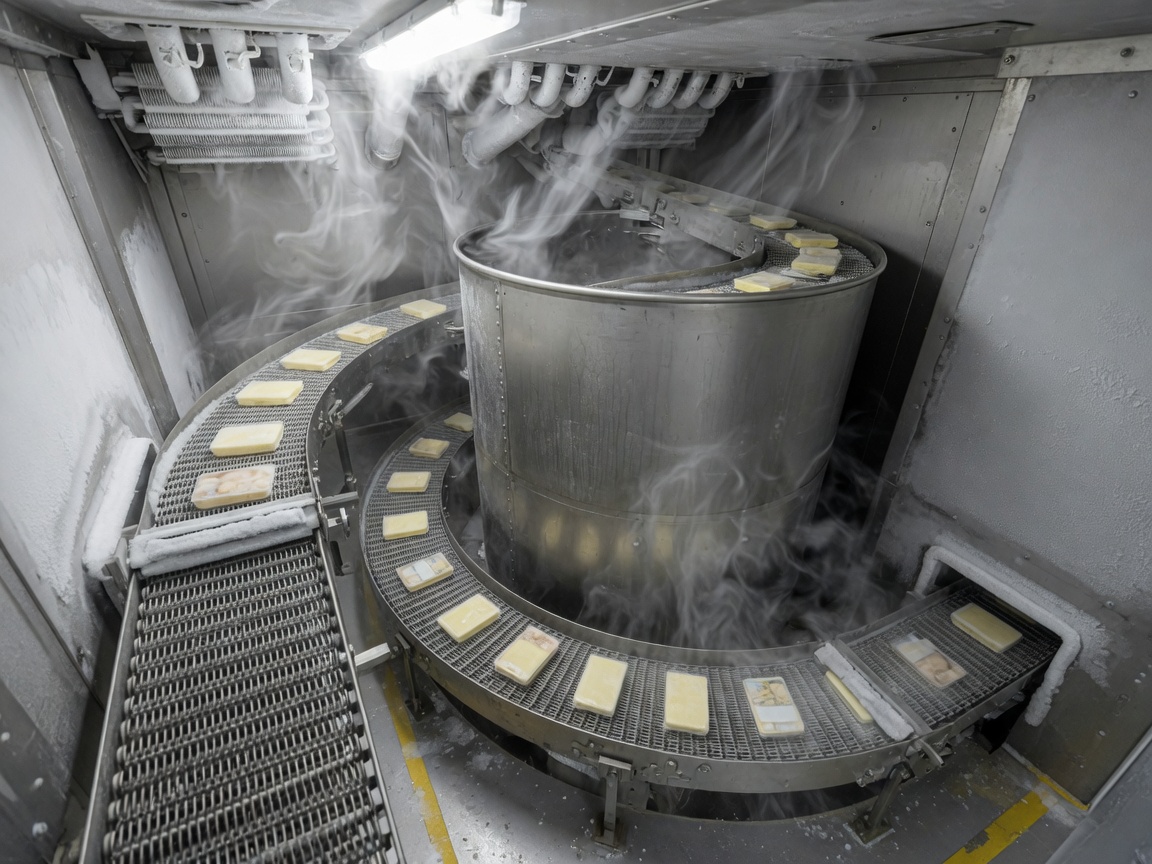
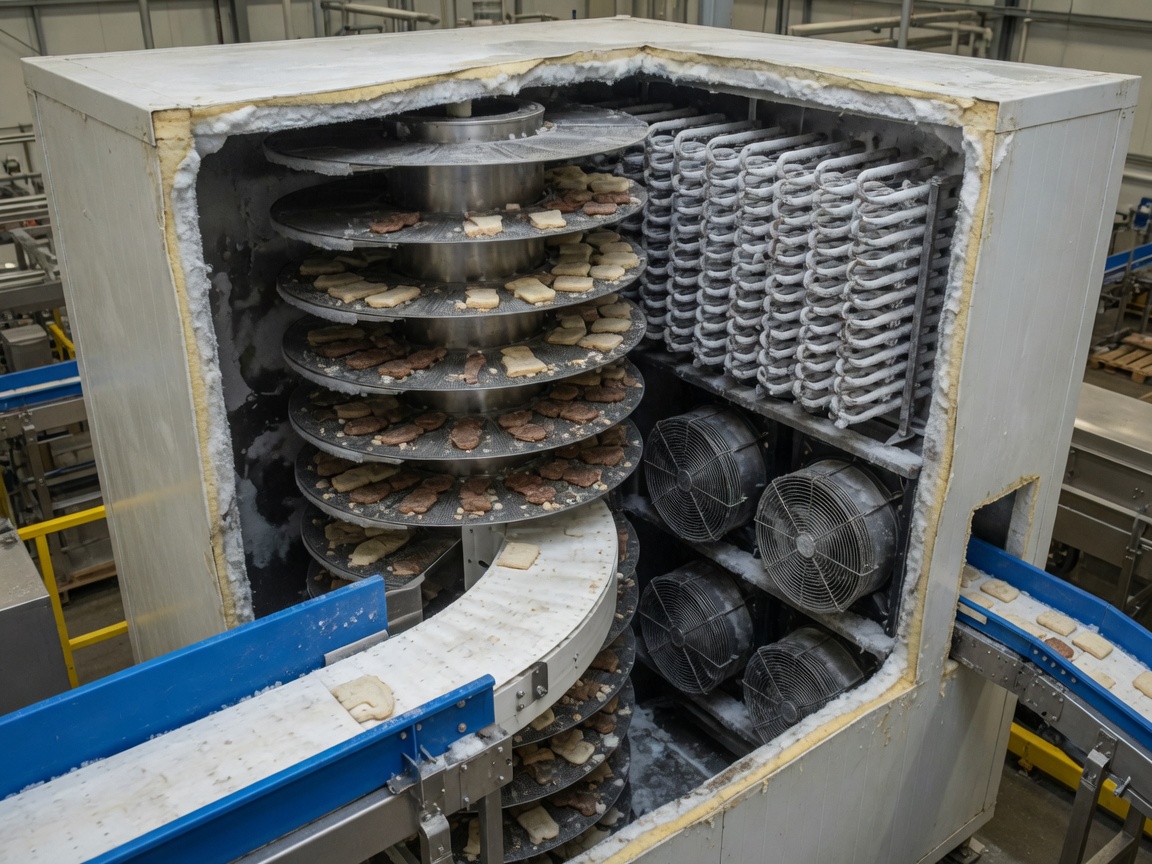
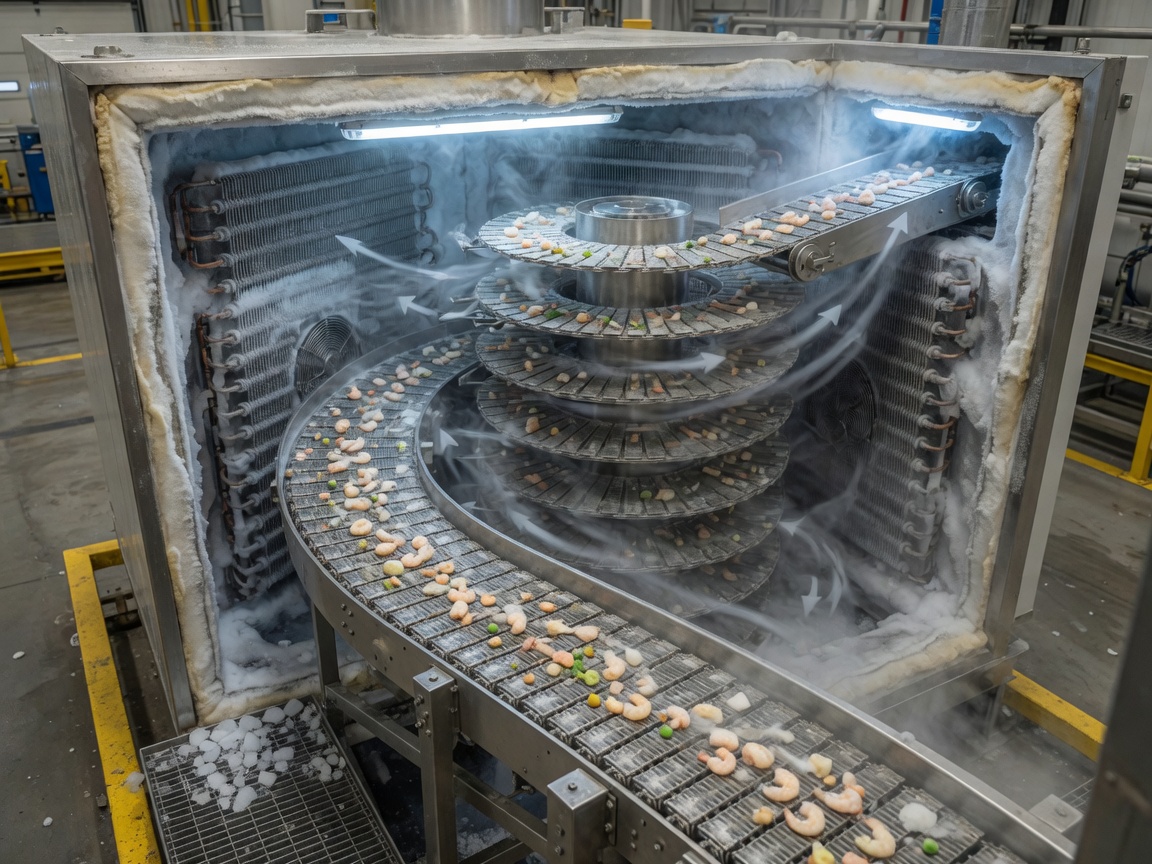
The core function of a spiral conveyor freezer is elegant in concept: a continuous stainless steel mesh belt winds upward in a helix through an insulated tower, carrying food products through precisely controlled sub-zero airflow at each tier. According to recent industry analysis, this vertical stacking approach reduces plant floor space requirements by 40–60% compared with an equivalent-capacity IQF tunnel freezer configured in a straight-line layout. That footprint advantage alone explains why spiral systems have become the default choice for high-volume poultry, seafood, and ready-meal processors across the United States.
The broader category of commercial freezer equipment suppliers includes manufacturers of blast freezers, plate freezers, and fluidized-bed systems — but the spiral format stands apart for continuous-flow operations. Learning more about the science behind food freezing technology helps contextualize why airflow velocity and dwell time control are the variables that most differentiate supplier offerings.
How to define a spiral freezer supplier vs. a general refrigeration system provider
A refrigeration system provider may supply compressors, condensers, and ammonia circuits without any expertise in food-contact conveyor engineering. A dedicated food grade freezer manufacturer, on the other hand, holds certifications for hygienic design (EHEDG, NSF), understands CIP (clean-in-place) requirements, and can validate the system against HACCP process controls. When issuing an RFQ, always ask whether the supplier manufactures the belt and the refrigeration circuit in-house, or whether those components are subcontracted.
Why the supplier relationship extends well beyond delivery day
A spiral freezer will typically operate for 15–20 years. That lifespan means spare-part availability, remote diagnostics capability, and on-site service response time are not secondary concerns — they are core selection criteria. Actual testing across multiple U.S. processing facilities reveals that the plants with the lowest unplanned downtime rates share one common factor: they selected a freezing equipment distributor or manufacturer with a domestic service infrastructure, not just a competitive FOB price.
Mechanical vs. cryogenic spiral freezers: a side-by-side comparison
The single most important technical decision in the purchasing process is choosing between a mechanical refrigeration spiral and a cryogenic system. No other variable will have a greater long-term impact on operating costs, throughput flexibility, and environmental compliance posture. Here is what the data shows.
[IMAGE_1:Mechanical vs. cryogenic spiral freezer side-by-side comparison diagram]
| Criteria | Mechanical spiral freezer (NH₃ / CO₂) | Cryogenic spiral freezer (LN₂ / CO₂ liquid) |
|---|---|---|
| Capital cost (typical U.S. install) | $400,000 – $1,500,000+ | $150,000 – $450,000 |
| Freezing speed | Moderate (15–45 min dwell) | Very fast (2–8 min dwell) |
| Energy cost per ton of product | $4 – $9 (electricity only) | $18 – $40 (refrigerant consumption) |
| Throughput capacity | 500 kg/h – 7,000+ kg/h | 200 kg/h – 3,000 kg/h |
| Ideal application | High-volume, continuous production (poultry, pizza, vegetables) | High-value, smaller-batch products (scallops, sushi-grade fish) |
| Environmental compliance | NH₃ (R717) and CO₂ (R744) are low-GWP natural refrigerants; fully F-Gas compliant | LN₂ is inert and zero-GWP; supply chain dependency is a risk |
| Maintenance complexity | Higher (compressors, defrost cycles, refrigerant handling certification) | Lower (no compressors; primary consumable is refrigerant) |
| Payback period | 3 – 6 years at high utilization | 1 – 2 years for low-volume specialty lines |
Why ammonia refrigeration remains the benchmark for large-scale operations
Ammonia (R717) has been the refrigerant of choice in large U.S. food processing plants for decades, and that consensus has not shifted. Its heat transfer efficiency is superior to synthetic alternatives, its GWP is zero, and its operating cost per ton of product is consistently the lowest available. The ammonia refrigeration freezer remains the workhorse of the industry for facilities running two or three shifts continuously. The primary constraint is regulatory: ammonia systems above a threshold quantity trigger EPA RMP (Risk Management Program) requirements, which demands additional safety engineering investment.
When a cryogenic freezing system makes strategic sense
A cryogenic freezing system earns its place when speed of surface crust formation is the priority — for instance, preventing dehydration weight loss in individually quick-frozen (IQF) shrimp, or maintaining the texture of premium fish fillets. The trade-off is running cost: liquid nitrogen prices fluctuate with industrial gas market conditions, and at high volume, operating costs can exceed those of mechanical systems by a factor of three to five. For a startup line, a pilot run, or a product requiring sub-minute freeze times, the lower capital entry point is compelling. For a mature, high-volume line? Run the TCO numbers first.
Total cost of ownership: what the sticker price never tells you
Why do so many buyers end up dissatisfied with a purchase that looked attractive on paper? Because the quoted equipment price represents, on average, only 35–45% of the true ten-year cost. A comprehensive TCO model for a continuous freezing system must account for six cost categories that are routinely omitted from supplier quotes.
The six-component TCO framework
- Capital equipment cost — Base unit price, including insulated enclosure, belt, drive system, and refrigeration circuit. U.S. installations for mid-range mechanical units (1,000–2,000 kg/h) typically fall between $500,000 and $900,000 fully installed.
- Installation and commissioning — Electrical connection, refrigerant piping, structural floor reinforcement, and initial calibration add 15–25% to the base price in most U.S. greenfield projects.
- Energy consumption — A 2,000 kg/h mechanical spiral operating 6,000 hours per year at $0.09/kWh (U.S. industrial average, 2026 data) will incur approximately $85,000–$130,000 in annual electricity costs. Over ten years, that figure dwarfs the hardware purchase price.
- Refrigerant cost and compliance — Ammonia and CO₂ systems have minimal ongoing refrigerant cost. Legacy HFC-based systems face rising regulatory costs under evolving EPA HFC rules; factor in potential phase-out retrofits.
- Preventive maintenance and spare parts — Belt replacement ($15,000–$40,000 per cycle), evaporator coil cleaning, and drive motor servicing accumulate. Suppliers with U.S. parts warehouses reduce emergency lead times from weeks to days — a critical difference when a shutdown costs $20,000–$50,000 per day in lost throughput.
- Sanitation and CIP system operation — High-care freezing environments require validated clean-in-place cycles. Water, chemical, and labor costs for CIP in a 7-day operation typically add $30,000–$60,000 per year.
"The lowest-price equipment bid we ever accepted ended up costing us 28% more over five years than the mid-tier option we almost chose — once you add energy, downtime, and parts." — Operations Director, U.S. mid-Atlantic poultry processor (shared at a 2025 IIAR regional conference)
A practical TCO calculation example
Consider two competing quick freeze equipment suppliers offering a 1,500 kg/h system. Supplier A quotes $520,000; Supplier B quotes $680,000. At first glance, Supplier A saves $160,000. But if Supplier A's unit draws 18% more electricity and requires two additional belt replacements over ten years, the cumulative gap inverts by year seven. Running this arithmetic before issuing a purchase order is not optional — it is the baseline of professional procurement.
Industry-specific applications and throughput benchmarks
One of the most persistent misconceptions in the market — and one that costs buyers dearly — is that a single spiral freezer configuration can serve all food categories equally well. It cannot. Airflow velocity, belt surface design, tier spacing, and temperature uniformity tolerances vary significantly across product types. Here is what real-world processing data shows across four key segments.
Shrimp and seafood IQF processing
For IQF shrimp and shellfish, rapid surface crust formation is the primary quality objective — it locks in moisture, prevents dehydration, and maintains the individual separation that defines IQF. A blast freezer supplier offering a mechanical spiral with NH₃ refrigeration and high-velocity vertical airflow (typically 4–6 m/s) achieves product core temperatures of -18°C within 15–20 minutes for headless shell-on shrimp at 500–2,000 kg/h. Larger operations processing above 3,000 kg/h benefit from dual-drum configurations. Actual throughput benchmarks from USDA-inspected Gulf Coast facilities in 2026 indicate that a 1,000 kg/h spiral using ammonia refrigeration processes approximately 22 metric tons per operating day — sufficient for most mid-scale shrimp operations.
Pizza and ready meals
Frozen pizza and ready-meal processing places the opposite demands on airflow design. High wind speeds that benefit shellfish will crack delicate pastry crusts and disturb cheese toppings. Industry-standard configurations for this segment use gentle, multi-directional impingement airflow at 2–3 m/s, with belt tier spacing optimized for flat-tray loading. An impingement freezer supplier specializing in the pizza segment will specify belt widths of 600–1,200 mm and production rates of 800–5,000 units per hour depending on pizza diameter. Major U.S. contract manufacturers have reported 12–18% improvement in product consistency after switching from straight-line tunnel systems to spiral conveyor freezers specifically tuned for flat products.
Baked goods and soft products
Soft baked goods — rolls, muffins, croissants — require the lowest airflow velocities of any category, typically below 2 m/s, combined with a self-stacking belt design that avoids mechanical shock at tier transitions. The self-stacking spiral freeze mechanism, where the belt supports itself using a precision-engineered edge profile rather than external support rails, is the preferred architecture here because it minimizes contact-point pressure on fragile products. When evaluating a food processing freezer for baked goods, request documented airflow uniformity data (±2°C across belt width is the acceptable standard) rather than relying on supplier claims alone.
IQF vegetables at high volume
High-volume IQF vegetable lines above 8,000 lb/hr (approximately 3,600 kg/h) benefit from a flighted spiral with an integrated fluidized-bed pre-freeze zone positioned at the infeed. This configuration ensures individual pieces separate before entering the main spiral tiers, eliminating clumping that degrades both appearance and downstream packaging efficiency. NH₃ refrigeration delivers the best energy cost profile at this scale. GEA Group and JBT Corporation — both widely specified in U.S. USDA-inspected facilities as of 2026 — offer validated configurations in this segment, though several Chinese-origin industrial freezer vendors now offer comparable mechanical specifications at 30–45% lower capital cost with UL and CE certification.
Certifications and food safety compliance you must verify
Compliance documentation is where supplier evaluation separates reliable partners from procurement risks. Certifications are not interchangeable, and the absence of a single relevant credential can prevent your facility from passing a USDA or third-party food safety audit. Understanding the food safety HACCP guidelines published by the FDA is essential context for evaluating any supplier's compliance claims.
Essential certifications to demand from any spiral freezer supplier
The following credentials are non-negotiable for a U.S. food processing environment:
- USDA acceptance — Equipment installed in USDA-inspected facilities must meet USDA/FSIS equipment acceptance standards. Request written confirmation that the specific model has been evaluated or accepted for use in federally inspected establishments.
- NSF/ANSI 2 — The North American standard for food equipment sanitary design. This certification confirms cleanability, material safety (food-grade stainless steel, FDA-compliant plastics), and structural integrity under sanitation protocols.
- CE marking — Required for units supplied to or manufactured in EU member states; increasingly expected by multinational food companies operating U.S. facilities as part of global procurement standards.
- EHEDG (European Hygienic Engineering & Design Group) — The gold standard for hygienic design in food processing equipment worldwide. An EHEDG-certified spiral has undergone validated cleanability testing using documented protocols.
- UL listing — Mandatory for electrical components in U.S. installations; without UL-listed electrical panels and controls, local building permits and insurance coverage may be invalidated.
- ISO 9001:2015 — Confirms the manufacturer's quality management system; a baseline expectation for any supplier you consider a long-term partner.
Audit readiness: what inspectors actually look for
GFSI-benchmarked audits (SQF, BRC, FSSC 22000) examine not just whether equipment meets standards, but whether it can be validated as operating within those standards in your specific production environment. That means the supplier must provide IQ/OQ/PQ documentation (Installation Qualification, Operational Qualification, Performance Qualification), CIP validation records, and zone classification drawings that define high-care and low-care boundaries within the freezer enclosure. Suppliers that cannot deliver this documentation package within 30 days of request are not audit-ready partners — regardless of what their sales materials claim. For facilities utilizing ammonia refrigeration, compliance with industrial refrigeration resources published by the IIAR provides the technical foundation for process safety documentation.
Buyer's RFQ checklist: what to ask before you sign
Most purchasing teams send out RFQs that focus almost entirely on price and basic specifications. The result? Apples-to-oranges comparisons that make it impossible to evaluate suppliers on the variables that actually determine long-term value. The following checklist represents the questions that informed procurement managers at major U.S. food processors use when qualifying a spiral freezer supplier.
Technical and performance questions
- What is the validated throughput capacity (kg/h) for my specific product (weight, dimensions, initial temperature, target core temperature)?
- What airflow velocity and temperature uniformity (±°C across belt width) does the system achieve, and how is this documented?
- What refrigerant does the system use, and what is the projected energy consumption (kWh per ton of product)?
- Is the belt design self-stacking or externally supported, and what is the documented service interval for belt replacement?
- Does the system include an integrated CIP circuit, and what is the validated CIP cycle duration and water consumption?
- What defrost method is used (hot gas, electric, water), and what is the estimated daily production loss due to defrost cycles?
Commercial and after-sales questions
- Where is your nearest U.S.-based service engineer, and what is the guaranteed response time for emergency service calls?
- Do you maintain a U.S. spare parts inventory? What is the lead time for the ten most frequently replaced components?
- What warranty terms apply to the belt, drive system, refrigeration components, and insulated enclosure separately?
- Can you provide reference contacts at two U.S.-based facilities currently operating the same model under similar production conditions?
- What remote monitoring and predictive maintenance capabilities are included, and what data is accessible to the plant operations team?
2026 trends shaping the spiral freezer market
The commercial freezer equipment landscape is undergoing its most significant period of technical evolution in two decades. Three converging forces — digitalization, refrigerant regulation, and supply chain regionalization — are redefining what "best-in-class" means for a spiral freezer supplier in 2026.
IoT integration and digital twin technology
Leading manufacturers are now embedding IoT sensor arrays within spiral enclosures that monitor temperature uniformity, airflow velocity, belt tension, and motor current draw in real time. When connected to a digital twin — a virtual model of the physical system — this data enables predictive maintenance that can reduce unplanned downtime by 15–25%, according to operational data from facilities adopting these systems in 2025–2026. Just as a modern aircraft uses continuous sensor data to flag component wear before failure, next-generation spiral freezers alert maintenance teams to belt elongation or evaporator fouling weeks before those conditions trigger a shutdown. This capability is shifting from a premium feature to a baseline expectation in competitive RFPs.
Natural refrigerant adoption and regulatory compliance
The accelerating phase-down of high-GWP HFCs under the AIM Act and the global Kigali Amendment is pushing U.S. food processors toward CO₂ (R744) and ammonia (R717) systems at an unprecedented rate. For procurement managers specifying new equipment in 2026, purchasing any mechanical spiral freezer designed around HFC refrigerants is strategically inadvisable — retrofitting costs within a 10-year operating horizon are near-certain. The ammonia refrigeration freezer and CO₂ transcritical systems are the forward-compatible choices. Several suppliers — including Mayekawa and Bitzer-partnered OEMs — have introduced factory-assembled NH₃ refrigeration packages specifically optimized for spiral freezer integration, reducing installation complexity and commissioning time by approximately 30%.
Supplier diversification and reshoring manufacturing
The COVID-era supply chain disruptions accelerated a structural shift that continues in 2026: large U.S. food processors are actively diversifying away from single-source European suppliers toward a portfolio that includes domestically assembled units and vetted Asia-Pacific manufacturers with U.S. service infrastructure. This is not purely a cost play — it reflects hard lessons about parts availability and service responsiveness during international logistics disruptions. Of course, also true is that not all emerging-market suppliers can match the application engineering depth of established brands; due diligence through facility audits and reference checks remains essential. The global spiral freezer market, estimated at $1.24 billion in 2023 and projected to reach $1.98 billion by 2030 at a 7.1% CAGR, is attracting new entrants rapidly — making independent supplier evaluation more important, not less.
Choosing the right spiral freezer supplier: final considerations
Selecting a spiral freezer supplier is ultimately a risk management decision as much as a technical one. The right partner reduces operational uncertainty over a 15–20 year equipment lifecycle. Prioritize suppliers that can demonstrate product-specific performance data, provide audit-ready compliance documentation, maintain a responsive U.S. service network, and offer transparent TCO modeling. Price is a factor. It should not be the deciding one.
Key takeaway: Before issuing a final purchase order, run a full ten-year TCO calculation, verify all applicable certifications independently, and speak directly with at least two reference facilities operating the same model under comparable production conditions. That 30-day diligence period will repay itself many times over.
Frequently asked questions
Q: What is a spiral freezer supplier?
A: A spiral freezer supplier is a manufacturer or distributor that provides helical-belt continuous freezing systems for industrial food processing. Top suppliers offer full-lifecycle support including engineering, installation, commissioning, and after-sales service, and hold certifications such as NSF/ANSI 2, USDA acceptance, and ISO 9001 relevant to U.S. food processing operations.
Q: How do I calculate the right spiral freezer capacity for my production line?
A: Capacity is determined by your peak hourly throughput (kg/h), product entry temperature, target core temperature, and acceptable dwell time. Request product-specific freeze curve data from the supplier, and ask them to model the system at 85% of rated capacity — not peak — to ensure reliable performance under real operating conditions without running the equipment at its limits continuously.
Q: What is the typical total cost of ownership for a spiral freezer over 10 years?
A: For a mid-scale mechanical spiral (1,000–2,000 kg/h), expect a 10-year TCO of $1.8M–$3.2M when including capital, installation, energy, maintenance, and sanitation costs. Energy typically accounts for 40–55% of lifetime cost, making refrigeration efficiency the single highest-leverage factor in supplier selection beyond the initial purchase price.
Q: Which certifications should a spiral freezer supplier hold for U.S. food processing facilities?
A: At minimum, verify NSF/ANSI 2 certification, USDA equipment acceptance for federally inspected facilities, UL listing for electrical components, and ISO 9001 quality management certification. For high-care environments or facilities subject to GFSI audits, EHEDG certification and full IQ/OQ/PQ documentation packages are additionally required.
Q: Is a cryogenic spiral freezer better than a mechanical one for seafood?
A: For high-value, small-batch seafood where rapid surface crust formation is critical — such as sashimi-grade scallops or whole shrimp — a cryogenic system's faster freeze speed justifies the higher operating cost. For continuous, high-volume shrimp or fish fillet IQF lines above 1,000 kg/h, a mechanical NH₃ spiral delivers a superior long-term cost profile while meeting the same IQF quality standards.
Keywords:
Inquiry
If you are interested in our products, please leave your email to receive a free product quote, thank you!
More information


Tel:
Sales E-mail: