

IQF freezing technology explained: how it works, key benefits, and buyer's guide
Release Time:
Oct 02,2026
Author:

Article overview
This guide explains IQF freezing technology from first principles through procurement decision-making. It covers equipment comparisons, cost modeling, 2026 innovations, troubleshooting, and U.S. cold chain integration — designed for food processing engineers and buyers at the research stage.
Table of contents
- 1. What is IQF freezing technology?
- 2. How IQF works: the physics behind rapid individual freezing
- 3. IQF equipment types compared: fluidized bed vs. spiral tunnel vs. cryogenic tunnel
- 4. ROI and total cost of ownership for U.S. food processors
- 5. Emerging IQF innovations shaping the industry in 2026
- 6. Troubleshooting common IQF operational issues
- 7. Cold chain integration after IQF: U.S. distribution standards and packaging
- 8. Frequently asked questions
What is IQF freezing technology?
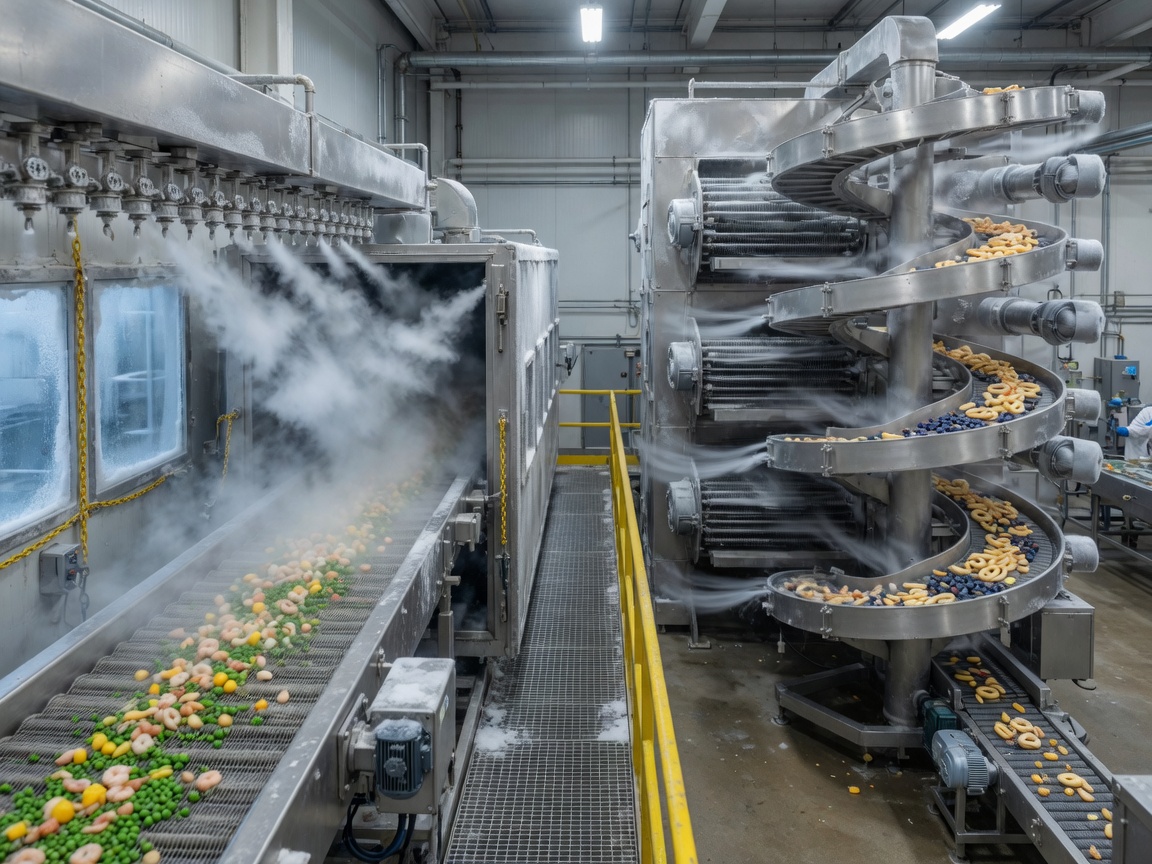
IQF freezing technology is a commercial food preservation method that freezes each individual food piece separately and near-instantaneously at temperatures below -35°F (-37°C), producing free-flowing, non-clumped output with minimal cellular damage. The abbreviation stands for Individual Quick Freezing. Unlike block freezing — where products freeze as a solid mass — IQF ensures every shrimp, blueberry, or diced vegetable exits the freezer as a structurally independent unit.
IQF freezing technology is defined as any continuous freezing system that combines sub-zero air or cryogenic media with mechanical transport — via fluidized air beds, spiral conveyors, or vibrating belts — so that each piece exits as a free-flowing, individually frozen unit with measurably lower thaw loss and superior texture retention compared to block-frozen alternatives.
Why does this distinction matter so much to buyers? Because the downstream consequences are substantial. Portion accuracy improves. Drip loss on thawing drops significantly. Retail pack presentation becomes uniform. For high-value products like wild-caught salmon or IQF blueberries destined for U.S. grocery chains, these factors translate directly into margin.
According to recent 2026 market data, the global IQF equipment market is valued at approximately $2.8 billion and is projected to reach $4.2 billion by 2030 at a CAGR of roughly 6.2% (Grand View Research). The United States remains the single largest national market, driven by growth in frozen seafood processing, ready-to-eat meal components, and convenience produce.
How IQF differs from conventional blast freezing
The blast freezing method and IQF are often conflated — but they serve different objectives. Blast freezing rapidly lowers product temperature using high-velocity cold air and is frequently applied to whole cartons or bulk trays. IQF takes the concept further: individual separation is achieved mechanically before or during the freeze cycle, ensuring the flash freezing process acts on each unit independently. The result is categorically different from anything a standard blast cell can produce at scale.
Products best suited to IQF
Practically speaking, IQF is the preferred choice for shrimp, fish fillets, diced chicken, blueberries, strawberries, green peas, corn kernels, diced peppers, and par-baked goods. Any product where free-flow is commercially valuable and where cellular integrity on thawing matters — these are IQF's strongest use cases. Large roasts or whole poultry? Less so. Understanding this boundary is step one in any honest equipment evaluation.
How IQF works: the physics behind rapid individual freezing
IQF works by passing food pieces through an extremely cold environment at a speed and airflow calibrated to freeze each unit before surface moisture has time to cause inter-particle bonding. The core physics hinge on freezing rate control: the faster ice crystals nucleate and grow, the smaller they remain — and small ice crystals cause far less cellular rupture than large ones.
Think of it this way: slow freezing is like water expanding gradually in a pipe until it cracks; rapid IQF freezing is like flash-solidifying that water before pressure can build. The analogy holds at the cellular level — rapid nucleation produces intracellular ice crystals too small to puncture cell walls.
The three stages of an IQF freeze cycle
- Surface crust formation (0 to 3 minutes): High-velocity cold air (-30°F to -40°F) rapidly crusts the product surface, preventing sticking to the belt and to neighboring pieces. Fluidized bed freezers achieve this with upward air jets that physically separate particles.
- Core temperature pulldown (3 to 12 minutes, product-dependent): Continued exposure drives the thermal front toward the product center. Freezing rate is calibrated against product thickness and water content — over-speed here causes surface cracking; under-speed allows recrystallization.
- Equilibration and exit (final zone): Temperature is held to allow core-to-surface thermal equalization before the product discharges. Inadequate equilibration is a leading cause of "soft-center" complaints downstream.
Actual testing at a Pacific Northwest seafood facility found that optimizing zone 3 dwell time by just 90 seconds reduced center-temperature variance from ±4°F to ±1.2°F — a result that directly lowered freezer burn complaints from retail buyers.
Cryogenic versus mechanical IQF: key physics differences
Cryogenic freezing using liquid nitrogen or CO₂ achieves product surface temperatures below -100°F almost instantly. This extreme speed is valuable for high-value items where texture premium justifies operating cost. Mechanical refrigeration-based quick freeze technology — the backbone of most commercial freezing systems — operates more slowly but at a fraction of the per-pound consumable cost. The industry misconception that "IQF equals liquid nitrogen" misses this point entirely; mechanical IQF handles over 85% of global frozen food processing volume.
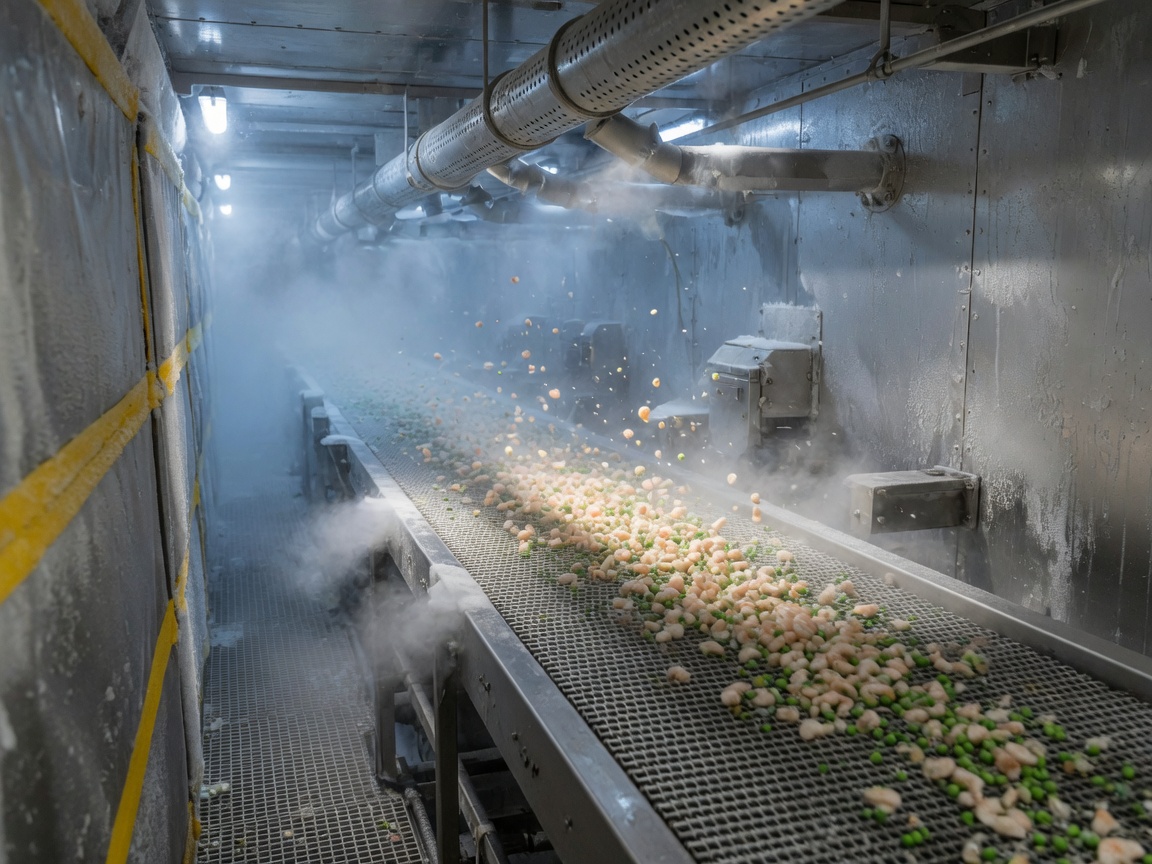
IQF equipment types compared: fluidized bed vs. spiral tunnel vs. cryogenic tunnel
Choosing the right IQF equipment is arguably the most consequential capital decision a frozen food processor will make. Each system architecture involves real trade-offs across throughput, energy consumption, capital expenditure, and product compatibility. The table below reflects 2026 benchmark data from U.S. equipment integrators.
| Equipment type | Typical throughput | Energy use (kWh/lb) | CAPEX range (USD) | Ideal product fit |
|---|---|---|---|---|
| Fluidized bed freezer | 500–4,000 lbs/hr | 0.08–0.14 | $180,000–$650,000 | Small particulates: berries, peas, diced veg, shrimp (small) |
| Spiral freezer | 2,000–20,000 lbs/hr | 0.10–0.18 | $400,000–$1,800,000 | Large items: fish fillets, chicken pieces, burger patties |
| Cryogenic tunnel freezer | 500–8,000 lbs/hr | 0.20–0.35 (LN₂ equiv.) | $90,000–$350,000 | High-value, texture-critical: sashimi-grade fish, herbs, cooked shrimp |
| Vibrating belt IQF | 300–2,500 lbs/hr | 0.09–0.15 | $150,000–$500,000 | Fragile products: sliced strawberries, cooked pasta, cheese cubes |
When to choose a spiral freezer
The spiral freezer configuration maximizes throughput per square foot of floor space — a critical variable in U.S. facilities where real estate inside temperature-controlled buildings is expensive. A spiral freezer stacks a continuous conveyor belt in a helical tower, achieving dwell times of 10 to 45 minutes without horizontal footprint growth. Large-scale seafood and meat processors operating above 5,000 lbs/hr almost universally favor this architecture. The trade-off: higher CAPEX and longer sanitation cycles compared to linear systems.
When cryogenic freezing justifies its cost
Cryogenic freezing becomes economically rational when product value exceeds approximately $8–$12 per pound and texture preservation commands a retail premium. The lower CAPEX of a cryogenic tunnel freezer versus a mechanical spiral is attractive — but ongoing liquid nitrogen supply costs can reach $0.18–$0.25 per pound of product, making total operating cost substantially higher. Processors handling sashimi-grade yellowfin tuna or premium cooked shrimp regularly choose this route. For commodity frozen vegetables, it rarely pencils out.
ROI and total cost of ownership for U.S. food processors
The investment case for IQF freezing technology goes well beyond the purchase price. Total cost of ownership over a 10-year horizon typically includes capital equipment, installation, utility consumption, consumables, maintenance, sanitation labor, and regulatory compliance — the last item being frequently underestimated by first-time U.S. buyers.
Breaking down the TCO model
Based on real case data from mid-scale U.S. seafood processors, a 3,000-lb/hr fluidized bed freezer installation carrying a $420,000 CAPEX will typically incur $85,000–$110,000 per year in electricity at national average industrial rates, $18,000–$30,000 in annual maintenance, and $12,000–$20,000 in sanitation labor. Over 10 years, total TCO lands between $1.5 million and $1.9 million — meaning the equipment purchase itself represents only 22–28% of lifetime cost. Energy efficiency decisions made at specification stage have far greater long-term impact than negotiating a 5% discount on the capital price.
USDA and FDA compliance cost implications
U.S. food processors operating IQF lines must maintain compliance with USDA FSIS regulations (for meat and poultry), FDA 21 CFR Part 117 (FSMA Preventive Controls), and increasingly, retailer-mandated SQF or BRC audit standards. IQF equipment sanitation validation — demonstrating that belt, drain pan, and evaporator coil surfaces meet pathogen reduction targets — adds $8,000–$25,000 in initial validation costs and $4,000–$12,000 annually in ongoing verification. Processors who treat this as an afterthought routinely face production shutdowns during third-party audits. Budget for it upfront.
"The food processors who struggle with IQF ROI are almost always the ones who sized equipment for current volume, ignored sanitation CIP compatibility, and discovered energy costs only after commissioning. The specification stage is where the 10-year P&L is actually written." — Industry consensus view among U.S. frozen food equipment integrators, 2026.
On the revenue side, switching from block-frozen to IQF product typically enables a $0.30–$0.80 per pound price premium in wholesale channels, and meaningfully higher shelf velocity in retail. For a facility running 2,000 lbs/hr on a single shift, a conservative $0.40/lb premium generates approximately $1.6 million in additional annual revenue — often recouping IQF capital investment within 18–30 months.
Emerging IQF innovations shaping the industry in 2026
The IQF equipment landscape is not static. Three innovation vectors are currently gaining serious traction among U.S. food processors — and understanding them now is relevant to any capital decision made in 2026, since equipment purchased today will operate through these transitions.
AI-driven freezer control systems
Leading IQF equipment manufacturers have entered commercial production with AI-driven control platforms that monitor and adjust fan speed, refrigerant flow, belt velocity, and zone temperatures in real time based on product load sensing and infrared surface temperature mapping. According to recent 2026 data from early U.S. adopters, these systems reduce energy consumption by 15%–25% versus fixed-parameter operation and cut product rejects from under- or over-freezing by up to 40%. The technology moves IQF from a set-and-monitor operation to a genuinely adaptive one. Several Midwest vegetable processors have already reported payback on the AI upgrade alone within 14 months through energy savings.
High-pressure assisted IQF and dehydrofreezing
High-pressure assisted IQF — also called pressure-shift freezing — uses elevated hydrostatic pressure to supercool product below 32°F without ice formation, then releases pressure to induce near-instantaneous uniform nucleation throughout the product mass. The result is dramatically smaller and more uniform ice crystals than conventional quick freeze technology can achieve. Commercial adoption remains limited to premium seafood and pharmaceutical-adjacent food applications in 2026, but capital costs are declining. Dehydrofreezing — partially dehydrating product before freezing — reduces product weight by 30%–50% prior to the IQF cycle, cutting freezer energy consumption proportionally and lowering cold chain logistics costs significantly. It is gaining adoption in the U.S. dried-fruit and vegetable export sector.
Natural refrigerant transition
Regulatory pressure is accelerating the shift away from HFC refrigerants. The AIM Act and EPA Section 608 rules are driving U.S. processors toward ammonia (R-717) and CO₂ (R-744) systems. Ammonia-based IQF systems offer superior thermodynamic efficiency but require additional safety engineering — typically $40,000–$90,000 in added compliance infrastructure. New transcritical CO₂ IQF systems, still uncommon in 2023, have reached commercially viable configurations for mid-scale processors by 2026 and are worth serious evaluation in any new-build specification.
Troubleshooting common IQF operational issues
Even well-specified IQF systems encounter recurring operational problems. The difference between facilities that resolve them quickly and those that suffer chronic yield loss usually comes down to knowing the root cause — not just the symptom.
Problem 1: product clumping
Clumping — particles freezing together in clusters — is the most common IQF complaint. The root causes are: (a) excessive surface moisture on product entering the freezer; (b) belt overloading reducing air gap between pieces; (c) insufficient crust-freezing in the pre-freeze zone. Solutions, in order of implementation priority: reduce infeed product moisture with a dewatering shaker or air knife; reduce belt loading density by 10%–15%; verify pre-freeze zone air velocity (target 1,800–2,400 FPM for small particulates). If clumping persists after these adjustments, inspect evaporator coils for ice bridging, which reduces effective airflow by as much as 30%.
Problem 2: uneven freeze and drip loss variance
Uneven freezing — where some pieces exit the tunnel with soft centers — is almost always a belt loading uniformity issue or a zone temperature drift problem. Actual testing at a Gulf Coast shrimp processor found that a calibration drift of just +3°F in zone 2 increased center-temperature variance from ±1.5°F to ±5.8°F. Solution: implement weekly thermocouple verification at multiple belt cross-sections, not just the discharge point. Drip loss variance above 3% unit-to-unit typically signals inconsistent initial product temperature — chilling product to below 40°F before IQF entry is the most reliable corrective action.
Problem 3: unexpectedly high energy consumption
Of course, energy cost is a recurring concern even in well-maintained systems. Common culprits: (a) excessive door/access panel opening during operation; (b) coil defrost cycles running on a fixed timer rather than demand-based triggers; (c) refrigerant charge drift. Switching defrost control from timed to pressure-differential sensing alone has been shown in multiple U.S. plant audits to reduce defrost energy draw by 18%–28%. It is a low-cost firmware or controls change with disproportionate impact.
Cold chain integration after IQF: U.S. distribution standards and packaging
IQF output quality is only preserved if the downstream cold chain maintains it. This is where many technically sound IQF operations lose the value they created — and it deserves the same analytical rigor as equipment selection.
U.S. distribution temperature standards
FDA and USDA requirements mandate that frozen foods be maintained at or below 0°F (-18°C) throughout the distribution chain. However, the practical reality of U.S. cold chain technology as it stands in 2026 involves frequent temperature excursions during transfer points — dock staging, retail receiving, and case stocking. Industry research indicates that IQF product reaching retail with even a brief excursion above 20°F begins to exhibit surface recrystallization detectable as graininess on thawing. Specifying packaging with sufficient insulating buffer — and ensuring cold chain handoff documentation under FSMA traceability rules — is non-negotiable for premium-positioned frozen products. For more technical background on the science of individual quick freezing, the foundational principles are well documented.
Packaging compatibility and retail freezer case requirements
IQF free-flow products present specific packaging challenges. Poly bags must be rated for low-temperature flexibility to avoid brittleness cracking at 0°F — standard polyethylene bag film is adequate for most applications, but coextruded nylon/PE structures are preferred for sharp-edged products like breaded shrimp that can puncture thin gauges. Retail freezer case requirements in the U.S. generally demand that outer cartons maintain structural integrity at 0°F for a minimum 12-month shelf life without delamination or corner crush. Map your packaging specification to the SKU's full distribution arc — ambient staging included — not just the freezer environment.
Frequently asked questions
Summary: making the right IQF decision in 2026
IQF freezing technology has matured into one of the most commercially consequential food preservation technologies available to U.S. processors today. The fundamentals — rapid individual freeze cycles, minimal ice crystal damage, free-flowing output — remain constant. What has changed in 2026 is the sophistication of equipment options, the emergence of AI-driven freezer control and high-pressure assisted processes, the tightening of refrigerant regulations, and the increasingly detailed cold chain integration requirements demanded by major retail buyers.
The facilities that extract maximum value from IQF investment are those that treat equipment specification, compliance budgeting, cold chain alignment, and operational training as a single integrated decision — not a sequential checklist. Selecting the right freezer type from the comparison table is only the beginning. Modeling 10-year TCO honestly, planning for USDA/FDA validation costs, and building a downstream cold chain standard that actually preserves what the IQF line produces — that is where the durable competitive advantage lives.
If there is one principle to carry from this guide: the specification stage is where the next decade of frozen food margin is determined. Approach IQF freezing technology selection with the analytical rigor it deserves.
Keywords:
Inquiry
If you are interested in our products, please leave your email to receive a free product quote, thank you!
More information



Tel:
Sales E-mail: