

Individual quick freezing equipment: how to choose the right IQF system for your production line
Release Time:
Oct 01,2026
Author:

Article overview
This guide is written for food processing plant purchasing managers and operations directors who are actively evaluating individual quick freezing equipment in 2026. It delivers technical depth, cost data, compliance guidance, and supplier evaluation criteria — everything needed to move from research to confident purchasing decision.
Table of contents
- 1. What is individual quick freezing equipment?
- 2. IQF system types compared: cryogenic vs. mechanical
- 3. Total cost of ownership: what buyers often underestimate
- 4. US regulatory and food safety compliance
- 5. Application-specific IQF configurations
- 6. 2026 technology trends shaping IQF procurement
- 7. How to evaluate and select an IQF supplier
- 8. FAQ
What is individual quick freezing equipment?
Individual quick freezing equipment is a rapid freezing system that mechanically or pneumatically separates food items during the freezing cycle, ensuring each piece — a single shrimp, a blueberry, a diced vegetable cube — exits as a free-flowing, independently frozen unit with zero clumping. The system drives core product temperature from ambient to -18°F (-28°C) or lower within 4 to 12 minutes, depending on product mass and geometry.
Individual quick freezing equipment is defined as any commercial food freezer — including fluidized bed freezers, spiral freezers, tunnel freezers, belt freezers, and cryogenic freezing systems — specifically engineered to freeze food items individually rather than in bulk contact. The defining characteristic is individual separation throughout the entire freezing cycle, not just at entry or exit.
Why does speed matter so much? Ice crystal size. When freezing is slow, water molecules migrate across cell membranes and form large extracellular crystals that rupture tissue walls. Flash freezing technology keeps crystals micro-sized and intracellular — structurally, the product is nearly identical to fresh. According to recent research, IQF freezing reduces cellular damage by approximately 80% compared to conventional batch freezing, which translates directly into better texture, lower drip loss, and higher consumer ratings.
For a food processing operation, this distinction is commercially critical. Individually frozen food processing means every pound sold retains maximum water weight legitimately, portion accuracy is achievable, and thaw-and-use convenience commands a retail premium. That is why individual quick freezing — not standard blast freezing — is the recognized gold standard when product must exit the freezer as separate, non-clumped pieces.
How the IQF freezing process works step by step
- Product preparation: Raw product is washed, sized, and portioned to ensure consistent mass — critical for uniform freeze time across each piece.
- In-feed and separation: The quick freeze machine distributes product in a single layer across a vibrating or perforated belt, preventing contact between pieces before freezing begins.
- Initial surface crust freeze: High-velocity cold air (typically -22°F to -40°F / -30°C to -40°C) or cryogenic media forms a surface crust within the first 60–90 seconds, locking each item's shape and preventing adhesion.
- Core temperature pull-down: Continuous airflow or cryogenic immersion drives the thermal load to the product core, completing the freeze cycle.
- Discharge and inspection: Product discharges as free-flowing individually frozen units onto a collection conveyor for weighing, metal detection, and packaging.
Why IQF beats standard blast freezing for most applications
A standard blast freezer operates in batch mode: product is loaded on trays, the door closes, and a refrigeration cycle runs until the entire batch is frozen. The problems are clumping, uneven freeze rates between the interior and exterior of the stack, and slow throughput. IQF equipment solves all three simultaneously through continuous freezing system architecture. Throughput on a mid-size tunnel freezer can exceed 4,000 lbs/hour — impossible with batch blast technology at equivalent quality.
Of course, there are situations where IQF is not the optimal choice. Large whole cuts — a 10-lb salmon fillet, for example — freeze more efficiently on a plate freezer or in a blast room. The lesson is that equipment selection must follow product geometry, not the other way around.
IQF system types compared: cryogenic vs. mechanical
The single most consequential decision in selecting individual quick freezing equipment is choosing between a cryogenic freezing system and a mechanical refrigeration-based system. Both achieve IQF outcomes, but they differ fundamentally in capital cost, operating cost, freeze speed, and application fit.
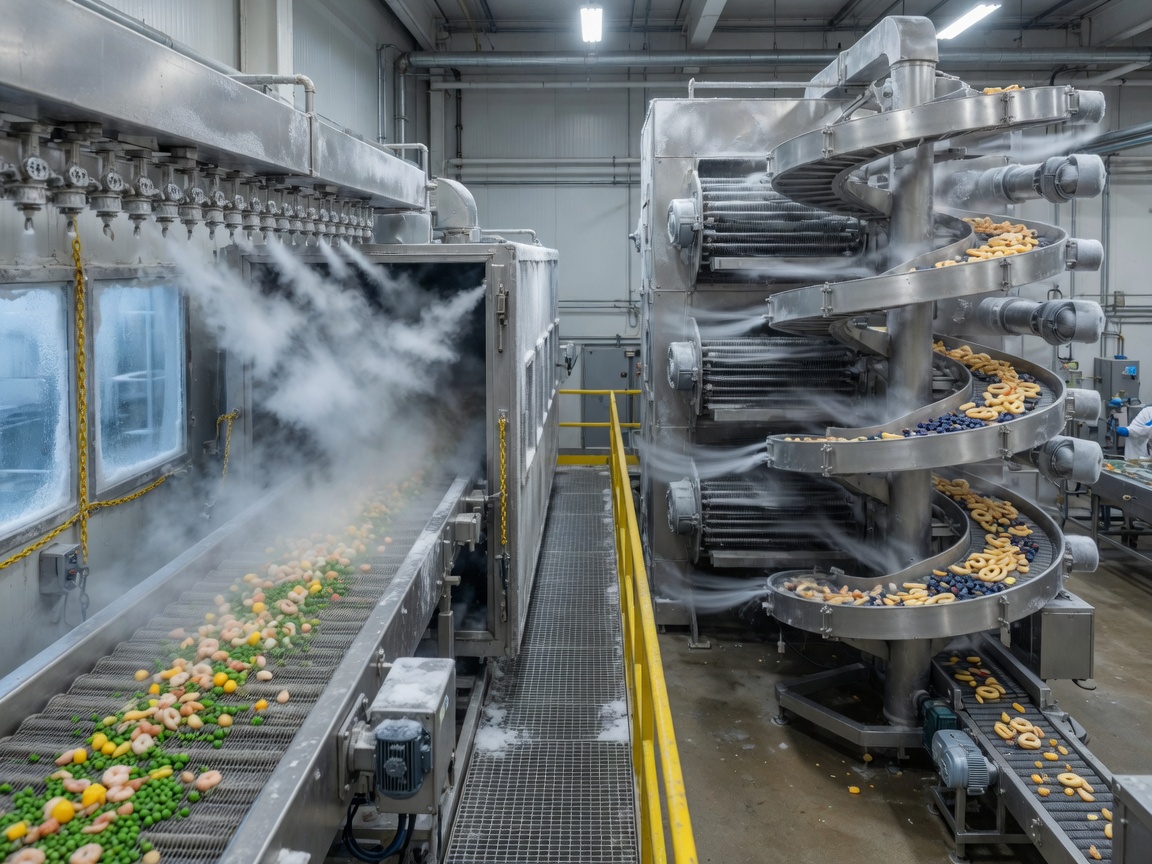
| Specification | Cryogenic IQF (liquid nitrogen / CO₂) | Mechanical IQF — spiral freezer | Mechanical IQF — fluidized bed freezer |
|---|---|---|---|
| Freeze speed | Extremely fast — 2–4 min | Moderate — 8–25 min | Fast — 3–8 min (small product) |
| Capacity range | 200–3,000 lbs/hr | 500–15,000 lbs/hr | 200–6,000 lbs/hr |
| Capital cost (USD) | $80,000–$350,000 | $250,000–$1,200,000 | $120,000–$600,000 |
| Operating cost / lb | $0.08–$0.18 (cryogen cost dominates) | $0.02–$0.05 (electricity + refrigerant) | $0.02–$0.06 |
| Footprint | Compact — 50–200 sq ft | Large — 400–1,200 sq ft | Medium — 150–500 sq ft |
| Best product fit | Delicate seafood, fresh berries, high-value cuts | Poultry portions, ready meals, seafood | Peas, diced vegetables, shrimp, small fruit |
| Payback period | 1–3 years (low volume, high margin) | 3–6 years (high volume operations) | 2–5 years |
When to choose a cryogenic IQF system
Cryogenic freezing systems use liquid nitrogen (LN₂) at -320°F (-196°C) or liquid CO₂ at -109°F (-78°C) to achieve freeze times that mechanical refrigeration simply cannot replicate. Actual testing on whole strawberries confirms surface crust formation within 45 seconds — dramatically faster than any belt freezer or spiral freezer. The tradeoff is ongoing cryogen supply cost, which can reach $0.15 per pound at high production volumes and erode margin quickly. For processors handling premium-priced seafood, fresh herbs, or artisan ready meals in volumes under 1,000 lbs/hour, cryogenic systems frequently deliver the best ROI over a 3-year window.
Mechanical IQF options: spiral vs. fluidized bed
A spiral freezer runs product on a continuous helical belt through a refrigerated enclosure, offering the highest throughput in the smallest mechanical footprint-per-pound-processed ratio. It is the default choice for frozen food production lines handling poultry, fish portions, and prepared entrées at scale. The fluidized bed freezer, by contrast, suspends small-particulate product on an upward airflow — just like a fluid — achieving individual separation naturally and without mechanical agitation. For peas, corn kernels, diced peppers, and small shrimp, this is the most reliable anti-clump solution available.
Total cost of ownership: what buyers often underestimate
Capital price is only one component of the true cost of individual quick freezing equipment. Experienced purchasing managers know that the sticker price of a rapid freezing unit often represents less than 40% of 5-year total cost of ownership (TCO). The rest lives in energy, refrigerant, maintenance, and downtime.
"Refrigeration energy costs in a continuous IQF operation typically account for 20%–30% of total production cost. Procurement teams that optimize for purchase price alone routinely face operational cost overruns within the first 18 months." — Food Processing Technology, 2026 industry benchmark report
Five-year TCO breakdown for a mid-scale IQF installation
Based on real case data from a US Midwest poultry processor running a 3,000 lb/hr spiral freezer at two-shift operation (16 hours/day, 250 days/year):
- Capital expenditure: $480,000 (equipment + installation + commissioning)
- Energy cost over 5 years: ~$310,000 (based on $0.09/kWh average US industrial rate, 2026 data)
- Refrigerant and system maintenance: ~$95,000 (ammonia or HFC recharge, belt replacement, bearing service)
- Labor (cleaning, operation): ~$140,000 (annualized at 1.5 FTE dedicated to IQF line hygiene)
- Downtime cost (estimated 2 unplanned stops/year): ~$60,000
- 5-year TCO total: approximately $1,085,000, or roughly $0.027 per pound of product frozen
The takeaway? Specification decisions made at purchase — compressor efficiency rating, belt material, insulation thickness — have compounding financial consequences that dwarf initial price differences between competing rapid freezing unit quotes.
Refrigerant selection and long-term cost exposure
HFC refrigerants like R-404A, widely used in commercial food freezers through the 2010s, are being phased out under EPA's AIM Act regulations. 2026 replacement costs for legacy HFC systems can add $15,000–$40,000 per retrofit. Ammonia (R-717) systems carry higher upfront engineering cost but face zero phase-out risk, lower refrigerant cost per ton, and are increasingly preferred in USDA-inspected facilities. When comparing bids, always clarify refrigerant type and its regulatory trajectory.
US regulatory and food safety compliance
Any individual quick freezing equipment installed in a US food facility must satisfy overlapping federal regulatory requirements — an area where almost no competitor content currently provides adequate guidance. Ignoring compliance specifications at the procurement stage is expensive. Non-compliant equipment can trigger facility holds, product recalls, and contract termination with retail buyers.
FDA and USDA requirements that directly affect IQF equipment specification
Under FDA 21 CFR Part 110 (and the updated FSMA Preventive Controls rule, 21 CFR Part 117), food contact surfaces on IQF equipment — belts, flights, evaporator housings — must be constructed of non-porous, corrosion-resistant materials cleanable to a bacteriological standard. Stainless steel 316L is the recognized benchmark. For USDA FSIS-inspected facilities processing meat and poultry, equipment must additionally comply with USDA Directive 11,000.1, which mandates USDA acceptance of equipment design prior to installation.
Practically speaking, this means buyers should require that suppliers provide NSF/ANSI 2 certification (food equipment sanitation standard) and documentation that the IQF freezer's CIP (clean-in-place) or COP (clean-out-of-place) design has been reviewed against HACCP plan requirements. Actual facility audits consistently reveal that drainage design — specifically, whether condensate and meltwater can pool on belt surfaces — is the most commonly cited deficiency in IQF equipment FSMA inspections.
HACCP integration and temperature validation
Your HACCP plan likely identifies the IQF freezer as a Critical Control Point (CCP) or at minimum a prerequisite program step. Equipment must support continuous temperature logging — not just manual spot checks — to satisfy FDA's record-keeping requirements under 21 CFR 117.190. Modern IQF systems with IoT-enabled monitoring satisfy this automatically, generating exportable FSMA-compliant temperature logs. Older equipment requiring manual logging creates audit risk that scales with production volume.
Application-specific IQF configurations
There is a persistent misconception in this industry: that IQF equipment is largely interchangeable across product types. In reality, running the wrong configuration for your product category results in yield losses, quality failures, and maintenance costs that never appear on the purchase order. Here is what actual frozen food production line operators have learned the hard way.
Seafood and poultry
Shrimp and shellfish represent the most demanding IQF application because they combine high moisture content, irregular geometry, and strict FSMA temperature pull-down requirements. A fluidized bed freezer configured with stainless mesh belting and adjustable air velocity is the standard for shrimp IQF lines in the 500–3,000 lb/hr range. For larger seafood — fish fillets, crab clusters — a spiral freezer with low-contact stainless flights prevents surface abrasion. Poultry portions (breast fillets, tenders, nuggets) run best on high-capacity spiral freezers where the long dwell time accommodates the thermal mass of a 6–8 oz piece.
Fruits, vegetables, and plant-based products
Soft fruit — strawberries, raspberries, blueberries — demands a vibrating mesh belt freezer with low-pressure airflow to prevent bruising during the initial unfrozen transport phase. A standard fluidized bed system generates too much upward air pressure for whole berries; the vibrating belt design achieves separation mechanically rather than pneumatically, preserving shape integrity. For diced or sliced vegetables (peas, corn, diced peppers), a fluidized bed IQF freezer remains the highest-throughput and most cost-efficient option. Plant-based products — frozen veggie burgers, meat analogues — typically mirror poultry processing requirements and run well on spiral or tunnel freezer platforms.
2026 technology trends shaping IQF procurement
The individually frozen food processing sector is changing faster in 2026 than at any point in the previous decade. Buyers who anchor procurement decisions solely on current-generation specifications risk selecting equipment that becomes operationally or regulatorily disadvantaged within its own payback window.
IoT-enabled monitoring and predictive maintenance
Leading commercial food freezer manufacturers — including JBT, Starfrost, and GEA — now embed real-time sensor arrays that monitor belt tension, evaporator coil icing rate, compressor amperage, and airflow velocity continuously. These systems feed data to cloud dashboards that flag abnormal readings 12–48 hours before a failure event occurs. According to 2026 data from US frozen food processors piloting these platforms, unplanned downtime was reduced by 34% versus comparable non-IoT lines. For a facility running 16-hour shifts, that represents roughly $120,000 in avoided downtime costs annually.
Energy efficiency, ammonia systems, and sustainability certifications
Variable-frequency drives (VFDs) on compressors and evaporator fans — standard on premium IQF equipment in 2026 — reduce energy consumption by 15%–25% versus fixed-speed predecessors. Ammonia-based refrigeration systems are gaining significant ground in new US IQF installations: R-717 carries zero global warming potential, no AIM Act phase-out timeline, and 15%–20% lower refrigerant operating cost than HFC alternatives. Sustainability certification is becoming a procurement filter, not just a marketing talking point. Retail buyers including major US grocery chains now require supplier facilities to hold GreenChill Advanced Refrigeration certification or equivalent as a vendor qualification criterion.
How to evaluate and select an IQF supplier
Selecting the right vendor for individual quick freezing equipment is a structured process. The technical specification is only half the decision. Equally important are service network depth, compliance documentation readiness, and the supplier's demonstrated experience with your specific product category.
A practical supplier evaluation checklist
- Request product trials: Any credible IQF supplier will run your product on demonstration equipment and provide freeze time data, drip loss measurements, and clump-rate documentation. Refuse to proceed without it.
- Verify compliance documentation: Require NSF/ANSI 2 certification, USDA acceptance letter (if applicable), and FSMA-compatible temperature logging capability in writing before quoting.
- Evaluate US service network: Confirm parts availability lead time (target: critical parts within 48 hours), local field engineer coverage, and remote diagnostic capability for IoT-equipped systems.
- Compare full TCO, not list price: Use the five-year model outlined in Section 3. Require suppliers to provide energy consumption certificates (kW per ton of refrigeration) and refrigerant type and charge weight.
- Check reference accounts in your product category: Ask for two US-based customers running a similar product at comparable throughput, then call them. Ask specifically about first-year operational issues and service response time.
Red flags that signal the wrong IQF partner
Why do so many buyers regret their IQF equipment purchase? Because warning signs were visible and ignored. A supplier who cannot provide product trial data, who offers only a single refrigerant option without discussing AIM Act implications, or who quotes installation costs as a separate undisclosed figure is almost always a sign of downstream cost surprises. The frozen food production line is the revenue-generating core of your facility — treat supplier qualification with the rigor you apply to ingredient sourcing.
Ultimately, the right individual quick freezing equipment is the one that freezes your specific product at your required throughput within your facility's footprint, satisfies every applicable US regulatory requirement, and delivers acceptable cost per pound over its full operating life. That outcome requires deliberate specification work — and the detail in this guide is designed to give your team the technical foundation to achieve it.
FAQ
Frequently asked questions
Q: What is the difference between an IQF freezer and a standard blast freezer?
A: A blast freezer freezes product in bulk contact on static trays, causing clumping and uneven freeze rates. An IQF freezer — whether a spiral, tunnel, or fluidized bed model — continuously separates each item during freezing so every piece exits as a free-flowing, individually frozen unit. IQF systems are 4–10x faster and produce significantly lower cellular damage.
Q: How much does individual quick freezing equipment cost in 2026?
A: Capital cost ranges from $80,000 for a compact cryogenic unit to over $1.2 million for a large-scale spiral freezer with full automation. However, 5-year total cost of ownership — including energy, refrigerant, maintenance, and labor — typically runs 2–3x the purchase price, making TCO analysis essential before any buying decision.
Q: Does IQF equipment need to meet FDA or USDA standards?
A: Yes. All food contact surfaces must comply with FDA 21 CFR Part 117 (FSMA Preventive Controls). USDA FSIS-inspected meat and poultry facilities additionally require USDA design acceptance. Buyers should require NSF/ANSI 2 certification from suppliers and confirm FSMA-compatible continuous temperature logging capability.
Q: Which IQF system is best for freezing shrimp and seafood?
A: For shrimp under 2 oz, a fluidized bed freezer with stainless mesh belting and adjustable air velocity is the industry standard. For larger seafood such as fish fillets or crab clusters, a spiral freezer with low-contact flights minimizes surface abrasion while delivering the dwell time needed for larger thermal mass.
Q: What IQF technology trends should US buyers prioritize in 2026?
A: Three trends deserve priority: IoT-enabled predictive maintenance (reducing unplanned downtime by 30%+), ammonia-based refrigeration systems (zero AIM Act phase-out risk, lower operating cost), and energy-efficient VFD compressors (15–25% electricity savings). Retail sustainability certification requirements are also accelerating, making GreenChill-compatible systems a forward-looking procurement standard.
Keywords:
Inquiry
If you are interested in our products, please leave your email to receive a free product quote, thank you!
More information

Tel:
Sales E-mail: