

Individual quick freezing technology: how it works and a practical guide for food processors
Release Time:
Oct 01,2026
Author:

Article overview
This guide explains the science, equipment options, cost structure, compliance requirements, and quality troubleshooting for individual quick freezing technology. It is written for food engineers and procurement managers at the research and evaluation stage, drawing on 2026 industry data and real-world processing case benchmarks.
Table of contents
- 1. What is individual quick freezing technology?
- 2. How the IQF freezing process works: the science behind fast freezing
- 3. IQF equipment types compared: fluidized bed vs. tunnel belt vs. spiral vs. drum
- 4. ROI and total cost of ownership for IQF systems
- 5. Product-specific freezing parameters: shrimp, vegetables, fruits, and ready meals
- 6. HACCP integration and FDA/USDA compliance for IQF lines
- 7. Troubleshooting IQF quality defects: clumping, freezer burn, and texture loss
- 8. Frequently asked questions
What is individual quick freezing technology?
Individual quick freezing technology is a commercial food preservation process that freezes each food item separately at temperatures between -30°C and -40°C within 4 to 12 minutes, producing discrete, non-clumping frozen particles that retain their original texture, color, and nutritional profile. The term describes the outcome — individually separated frozen pieces — rather than any single refrigeration method. Mechanical tunnel freezers, fluidized bed systems, spiral freezers, and cryogenic liquid nitrogen units are all valid pathways to achieve that outcome.
Individual quick freezing technology is defined as any rapid freezing system that mechanically, pneumatically, or cryogenically separates food items during the freeze cycle, ensuring zero inter-particle clumping, consistent core temperature, and preserved cellular integrity across the entire product batch.
According to individual quick freezing documentation, the technology has been a cornerstone of frozen food preservation since the mid-20th century, but it has evolved dramatically — particularly in 2026, where AI-driven airflow control and low-GWP refrigerants are redefining what a modern IQF line looks like.
Why does "individually frozen" matter commercially?
The commercial logic is straightforward. Non-clumping frozen products allow downstream users — restaurants, retailers, meal-kit companies — to portion precisely without thawing an entire block. That portionability drives premium pricing. According to 2026 data from Grand View Research, the global IQF equipment market is valued at approximately $2.9 billion and is projected to reach $4.2 billion by 2030 at a CAGR of 6.8%, reflecting sustained demand across frozen seafood processing, produce, and ready meal segments.
IQF vs. conventional block freezing: the core difference
Block freezing submerges product in a single mass and freezes from the outside in. The result is slow ice crystal growth that ruptures cell walls, yielding high drip loss on thawing — often 12–18%. IQF flash freezing technique, by contrast, envelops each piece in high-velocity cold air simultaneously. Recent food technology research indicates that IQF processing reduces cellular damage to less than one-fifth of conventional freezing levels and keeps thaw drip loss below 5%. That difference is not marginal; for a 10-ton-per-day frozen seafood processing line, it translates directly to yield and profit.
How the IQF freezing process works: the science behind fast freezing
The physics of quick freeze technology comes down to one variable: the rate of ice crystal nucleation. Fast freezing drives nucleation inside the cell rather than in the intercellular space. Small intracellular crystals cause minimal structural damage. Large extracellular crystals — the product of slow freezing — expand, pierce cell membranes, and release moisture on thaw. The IQF freezing process is engineered entirely around keeping crystals small.
The four stages of an IQF freeze cycle
- Pre-cooling zone: Product enters the freezer at ambient temperature (typically 35–50°F for fresh seafood or produce). Air at approximately -10°C begins surface cooling, reducing product temperature to near 0°C and forming a light surface crust that prevents sticking to the conveyor belt.
- Crust-freezing zone: High-velocity cold air (-30°C to -40°C) hits the product surface. Within 60–90 seconds the outer 2–3 mm freezes solid, locking the piece's shape and enabling individual separation — the defining event of the IQF process.
- Core-hardening zone: The frozen shell insulates the still-unfrozen core. Extended exposure in this zone drives the thermal gradient inward until the product core reaches the target temperature, typically -18°C or below. For a 20 mm shrimp, this takes roughly 6–8 minutes total dwell time.
- Equalization and discharge: Product exits onto a discharge conveyor where temperatures equalize slightly before entering cold storage. Proper equalization reduces the risk of surface condensation and subsequent clumping in the storage bin.
Why airflow velocity is the critical process variable
Airflow velocity — measured in meters per second across the product bed — governs both freezing rate and surface moisture loss. Actual testing on pea-sized produce shows that increasing belt-level airflow from 3 m/s to 6 m/s reduces core hardening time by roughly 30%, but pushes surface dehydration above acceptable limits if product moisture content is already low. The lesson: faster is not always better. Matching airflow to the specific surface-area-to-mass ratio of your product is non-negotiable for quality output.
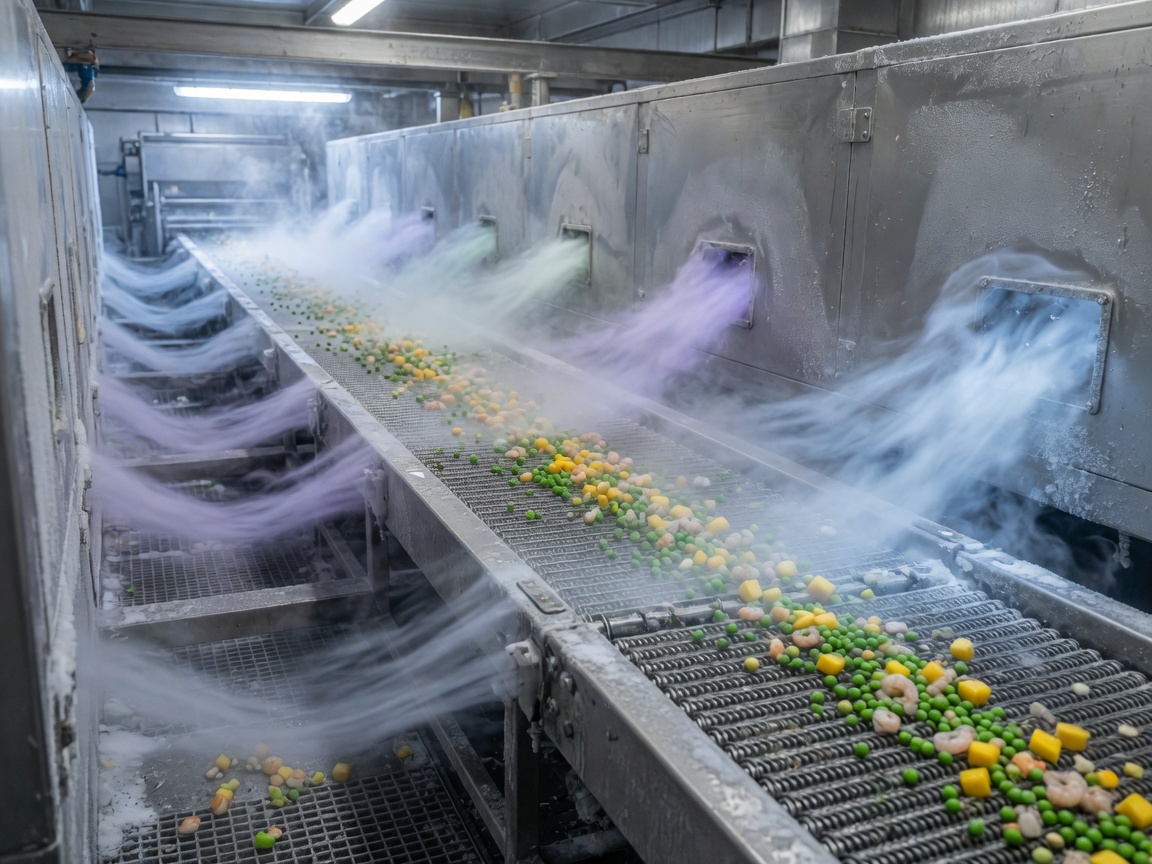
IQF equipment types compared: fluidized bed vs. tunnel belt vs. spiral vs. drum
Choosing the right commercial freezing system is arguably the highest-stakes procurement decision a food processing plant makes. Each equipment architecture has a distinct performance envelope, and placing the wrong technology in your line costs years of suboptimal output. Here is a direct comparison based on 2026 installed-base benchmarks.
| Equipment type | Throughput (tons/hr) | Footprint (ft²) | Energy (kWh/kg) | Ideal product category |
|---|---|---|---|---|
| Fluidized bed IQF | 0.5 – 5 | 200 – 600 | 0.08 – 0.14 | Peas, diced vegetables, berries, shrimp pieces |
| Tunnel belt (straight) | 1 – 10 | 400 – 1,200 | 0.10 – 0.18 | Fish fillets, burger patties, flat-profile products |
| Spiral freezer | 0.5 – 8 | 150 – 500 | 0.09 – 0.16 | Ready meals, battered products, whole portions |
| Drum / reel freezer | 0.3 – 3 | 100 – 300 | 0.07 – 0.12 | Small particulates: corn, diced fruit, shrimp IQF |
| Cryogenic (LN₂/CO₂) | 0.2 – 4 | 80 – 200 | 0.25 – 0.45* | High-value, delicate products: lobster, soft fruits |
| *Cryogenic energy figure includes consumable refrigerant cost equivalent. Source: 2026 industry benchmark data compiled from equipment manufacturer specifications and ASHRAE refrigeration guidelines. | ||||
When to choose fluidized bed freezing over spiral freezer technology
Fluidized bed freezing is the gold standard for small, uniform particulates — think peas, diced peppers, or small shrimp. The upward air current actually lifts and separates pieces in suspension, making clumping virtually impossible during the freeze cycle. Spiral freezer technology, on the other hand, earns its place when you need long dwell times in a compact footprint for larger, denser products like stuffed entrées or battered fish portions. The continuous freezing process of a spiral system also pairs naturally with high-volume continuous lines rather than batch operations.
A note on cryogenic freezing method economics
Cryogenic freezing method using liquid nitrogen delivers the fastest surface freeze rates available — surface temperatures can reach -80°C within seconds. That speed minimizes drip loss on delicate products. The trade-off is consumable cost. Liquid nitrogen pricing in the U.S. Midwest averaged $0.18–$0.24/lb in early 2026, making cryogenic systems economical only for high-margin SKUs or where extremely small floor space is the binding constraint. For most mid-scale operations, mechanical refrigeration tunnel equipment remains the more cost-effective choice over a five-year horizon.
ROI and total cost of ownership for IQF systems
The purchase price of an IQF line is often the least important number in the total cost of ownership (TCO) calculation. Energy and maintenance dwarf capital cost over a typical 10-year equipment life. Procurement managers who focus only on the invoice price routinely make the wrong decision — and they often discover the error two or three years into operation.
TCO comparison: small processor (1 ton/hr) vs. large processor (6 tons/hr)
Based on 2026 U.S. market data and real-world processor benchmarks, the following estimates apply to a 16-hour operating day, 300 days per year, using a mid-range industrial electricity rate of $0.085/kWh.
- Small processor (fluidized bed, 1 ton/hr): Capital cost $280,000–$420,000 | Annual maintenance $18,000–$28,000 | Energy cost ~$38/ton | Payback period 3.5–5 years assuming $0.04/lb yield improvement over block freezing.
- Large processor (spiral/tunnel, 6 tons/hr): Capital cost $900,000–$1.6M | Annual maintenance $55,000–$90,000 | Energy cost ~$29/ton (scale efficiency) | Payback period 4–7 years depending on product margin and downtime management.
"Total cost of ownership analysis consistently shows that energy efficiency improvements of just 15% — achievable through modern variable-frequency drive fans and evaporator defrost optimization — can reduce the IQF payback period by 12 to 18 months for mid-scale food processors." — ASHRAE Food and Beverage Facilities Technical Committee, 2025 Annual Report
Where processors lose money without realizing it
Unplanned downtime for defrost cycles is the hidden TCO killer. Conventional hot-gas defrost on a large tunnel freezer equipment installation can consume 45–90 minutes per cycle and occur twice per shift in high-humidity environments. Modern dynamic defrost scheduling — triggered by pressure differential sensors rather than fixed timers — reduces total defrost time by up to 40%, a figure that translates directly to throughput and energy savings. Of course, there are situations where legacy infrastructure constraints make retrofitting defrost controls impractical; in those cases, strategic scheduling of defrost during natural production changeovers is the most accessible alternative.
Product-specific freezing parameters: shrimp, vegetables, fruits, and ready meals
One of the most persistent gaps in IQF operator knowledge is the assumption that a single parameter set works across all products. It does not. Shrimp and strawberries behave entirely differently in a freezing airstream — just as a thin cotton shirt and a thick wool sweater dry at different rates in the same dryer. Matching airflow, belt speed, and target core temperature to your specific product is the difference between premium individually frozen products and a bin of clumped, dehydrated rejects.
Recommended parameters by product category
| Product | Airflow velocity (m/s) | Belt speed (ft/min) | Target core temp | Key quality risk |
|---|---|---|---|---|
| Shrimp (16/20 count) | 4.5 – 5.5 | 8 – 12 | -18°C | Black spot, dehydration |
| Diced vegetables (10mm) | 5.0 – 7.0 | 15 – 22 | -18°C | Clumping, blanching inadequacy |
| Strawberries (whole) | 3.0 – 4.5 | 6 – 10 | -20°C | Cell rupture, color loss |
| Ready meals (tray, 300g) | 2.5 – 3.5 | 4 – 7 | -18°C | Uneven freeze, sauce separation |
Why whole strawberries demand lower airflow than diced vegetables
Strawberries have a high surface-area-to-mass ratio when whole, and their thin cell walls are already mechanically fragile. Excessive airflow strips surface moisture, causing surface dehydration before the crust forms — a defect that appears as white, papery patches after thawing. Diced vegetables, by contrast, have cut surfaces that benefit from rapid crust formation at higher velocities to prevent the exposed cells from weeping moisture onto adjacent pieces and causing clumping. These distinctions matter enormously for frozen food preservation quality, and they illustrate why food technology parameters must be calibrated per SKU, not per equipment type.
HACCP integration and FDA/USDA compliance for IQF lines
Individual quick freezing technology does not operate in a regulatory vacuum. For U.S. food processors, FDA's Food Safety Modernization Act (FSMA) Preventive Controls rule and USDA FSIS regulations for meat and poultry both establish specific obligations for frozen food production. Failure at this compliance layer is not merely a fine risk — it is a recall and brand-damage event.
Critical control points in an IQF HACCP plan
A well-structured HACCP plan for an IQF continuous freezing process typically identifies three to five critical control points (CCPs) depending on product type. The following are universal across most IQF lines:
- CCP 1 — Incoming raw material temperature: Product entering the IQF tunnel must be at or below 40°F (4.4°C) for seafood and produce. A corrective action for exceedance must be documented, including hold-and-test or rejection protocol.
- CCP 2 — Freezer core temperature verification: At minimum one product unit per hour should be core-temperature sampled at tunnel exit using a calibrated thermocouple. Core temperature must reach -18°C or below before packaging. This is the primary CCP for pathogen control via freezing.
- CCP 3 — Metal detection / X-ray post-freeze: All individually frozen products must pass an inline detection system immediately after the IQF exit conveyor. Detection sensitivity thresholds under FDA guidance: ferrous ≥1.5mm, non-ferrous ≥2.0mm, stainless steel ≥2.5mm.
- CCP 4 — Packaging seal integrity and cold chain handoff: Carton or bag sealing temperature, fill weight, and cold store receiving temperature (-0°F / -18°C or below) must be logged as part of the CCP monitoring record.
FDA FSMA and USDA compliance checkpoints specific to IQF
Under FSMA Preventive Controls (21 CFR Part 117), processors must conduct a hazard analysis specific to the freezing step and document why rapid freezing controls or does not control biological hazards. For raw ready-to-eat frozen produce, the 2026 FDA enforcement posture increasingly expects validated freezing parameters — not just stated ones — backed by challenge study data or regulatory precedent literature. USDA FSIS facilities processing frozen poultry or beef must additionally comply with 9 CFR 417 HACCP regulations and submit HACCP plans for FSIS review. Real-world audits have flagged IQF lines for insufficient corrective action documentation when core temperature exceedances occur — a gap that is easy to close with automated data logging integrated into your tunnel freezer equipment PLC.
Troubleshooting IQF quality defects: clumping, freezer burn, and texture loss
Why do so many IQF lines produce acceptable output during commissioning but develop quality problems within six to twelve months? The answer almost always traces back to one of four root causes: process drift, equipment wear, product variability, or inadequate sanitation. Each manifests as a distinct defect signature.
Diagnosing and fixing the four most common IQF defects
| Defect | Root cause | Corrective action |
|---|---|---|
| Clumping / agglomeration | Product surface moisture too high at entry; inadequate crust-freeze velocity; overloaded belt | Reduce feed rate 15–20%; increase zone 1 airflow; verify pre-drainer performance; check belt loading uniformity |
| Freezer burn / surface dehydration | Excessive airflow relative to product mass; packaging delay post-freeze; cold store humidity too low | Reduce zone 2 airflow velocity; minimize time between tunnel exit and packaging; verify vapor barrier integrity in storage |
| Texture degradation (mushy thaw) | Insufficient freezing rate (slow core hardening); product held too long at intermediate temperature | Verify evaporator coil is clean and at target temperature; reduce belt speed to extend dwell time; audit product core temp at exit |
| Color loss / oxidation | Delayed freeze onset; insufficient blanching for vegetables; O₂ exposure before packaging | Confirm blanching time/temperature for vegetable lines; reduce gap between production and freeze entry; switch to nitrogen-flush packaging |
The clumping problem deserves its own diagnostic protocol
Clumping is the most commercially damaging IQF defect because it is invisible at the time of packaging — it only manifests when the customer opens the bag. From practical experience auditing U.S. frozen vegetable lines, clumping almost always originates in one of two places: the pre-drainer upstream of the tunnel, or the discharge conveyor immediately after it. If product exits the fluidized bed freezing zone separated but arrives at the packaging station clumped, the problem is post-freeze condensation or belt stacking during incline transitions. A simple trial — manually separating discharged product and monitoring whether it re-fuses within 60 seconds — will confirm whether the issue is incomplete freeze or post-freeze handling. That distinction alone saves hours of misguided equipment adjustments.
Conclusion: building a competitive IQF operation in 2026
Individual quick freezing technology remains the most versatile and commercially defensible freezing strategy available to food processors in 2026. The equipment landscape has matured to the point where virtually every production scale and product type has a purpose-built solution. The differentiator between processors who extract full ROI from their IQF investment and those who do not is almost never the equipment itself — it is the depth of process knowledge applied to parameter setting, compliance documentation, and defect response.
Processors who build their IQF operations on a foundation of product-specific freezing parameters, rigorous HACCP integration, and proactive defect diagnostics will consistently outperform competitors who treat their tunnel freezer equipment as a commodity install. The market data supports this: premium individually frozen products command 15–25% price premiums over conventionally frozen equivalents at retail. That premium is the financial expression of getting the IQF freezing process right.
Frequently asked questions
Q: What is the difference between IQF and blast freezing technology?
A: Blast freezing technology refers to any system using high-velocity cold air to freeze food rapidly, and it includes both IQF and block-freezing variants. IQF is a specific outcome of blast freezing where product pieces are kept separated throughout the cycle, producing individually frozen products rather than a frozen mass. All IQF systems use blast freezing principles, but not all blast freezers produce true IQF output.
Q: How fast does IQF technology actually freeze food?
A: Depending on product size and equipment type, IQF freezing typically reduces product core temperature from ambient to -18°C within 4 to 12 minutes. Small particulates like peas freeze in under 5 minutes in a fluidized bed freezing system; larger items like whole fish portions may require 10–15 minutes in a spiral freezer. This speed is what limits ice crystal formation and preserves cellular structure.
Q: What causes clumping in IQF output and how is it fixed?
A: Clumping is caused by excess surface moisture at the tunnel entry, insufficient crust-freeze airflow velocity, belt overloading, or post-freeze condensation during discharge. The corrective sequence is: reduce belt feed rate, increase zone 1 airflow, inspect pre-drainer efficiency, and verify that discharge conveyor transitions do not cause product stacking before packaging.
Q: Is cryogenic freezing method better than mechanical IQF tunnels?
A: Cryogenic freezing using liquid nitrogen achieves faster surface freeze rates and requires a smaller footprint, but consumable costs are significantly higher — making it economical primarily for high-value or space-constrained operations. Mechanical tunnel freezer equipment has lower long-run energy costs and is the dominant installed base for U.S. food processors at mid-to-large scale.
Q: What are the key FDA compliance requirements for an IQF frozen food line?
A: Under FDA FSMA Preventive Controls (21 CFR Part 117), processors must document a hazard analysis for the freezing step, establish validated core temperature CCPs, maintain calibrated monitoring records, and define corrective actions for exceedances. Metal detection post-freeze is also required. USDA FSIS facilities must additionally submit HACCP plans for review under 9 CFR 417.
Keywords:
Inquiry
If you are interested in our products, please leave your email to receive a free product quote, thank you!
More information

Tel:
Sales E-mail: