

IQF freezing systems explained: how to choose the right solution for your production line
Release Time:
Oct 01,2026
Author:

Article overview
This guide covers IQF freezing system types, TCO comparison, compliance requirements, integration considerations, and performance benchmarks — everything a US food processing procurement team needs to evaluate and select the right solution in 2026.
Table of contents
- 1. What are IQF freezing systems?
- 2. Five IQF freezer architectures compared
- 3. Cryogenic vs. mechanical IQF: a 5-year TCO analysis
- 4. Product-specific IQF selection guide
- 5. FDA, USDA, and HACCP compliance for IQF lines
- 6. Integrating IQF systems with upstream and downstream equipment
- 7. Real-world performance benchmarks
- 8. 2026 trends shaping IQF technology
What are IQF freezing systems?
IQF freezing systems are industrial food processing machines that freeze each individual food piece separately and near-instantaneously, preventing clumping and preserving cellular structure, texture, and nutritional integrity. The term stands for Individual Quick Freezing — a process standard, not a single machine type.
IQF freezing systems is defined as any continuous or batch-mode freezing platform — encompassing tunnel freezer systems, fluidized bed freezers, spiral freezer units, and cryogenic freezing solutions — engineered to drive product core temperature to between −30°F and −40°F (−34°C to −40°C) fast enough that ice crystals remain intracellular and microscopic, causing minimal cell wall rupture.
Why does that distinction matter so much? Because cell damage is the direct enemy of frozen food quality. When ice crystals grow large — as they do in slow block-freezing — they puncture cell membranes. The product weeps on thawing, loses firmness, and delivers an inferior eating experience. IQF eliminates this at scale.
According to individual quick freezing documentation, the IQF process was commercialized in the mid-20th century and has since become the global benchmark for premium frozen food production. Recent 2026 data from Grand View Research estimates the global IQF equipment market at over $21 billion, growing at a CAGR of approximately 7.2% through the end of the decade — driven primarily by demand from the US, EU, and Southeast Asian frozen food sectors.
Real-world testing confirms that IQF systems reduce food cell damage rates to less than one-fifth of conventional block-freezing methods. That is not a minor incremental improvement. It is a fundamental shift in product quality that justifies the capital investment for virtually any high-volume frozen food processor.
How IQF differs from blast freezing and plate freezing
Blast freezing technology drives cold air at high velocity across product surfaces — but it does not guarantee individual separation. Product pieces can still freeze together if loaded in bulk. Plate freezer systems apply direct contact between refrigerated metal plates and product, making them efficient for flat, uniform items like fish fillets, but unsuitable for irregular shapes or granular foods. IQF's defining characteristic is the active separation mechanism: fluidized airflow, vibration, or spiral conveyance that keeps pieces physically apart throughout the entire freeze cycle.
Who uses IQF freezing systems in the US?
Demand spans seafood processing facilities on both coasts, large-scale vegetable freezing lines in the Midwest, poultry processors in the Southeast, and fruit packers across the Pacific Northwest. Quick freeze technology is also expanding into prepared meal components, cheese portions, and pet food manufacturing — segments where portion accuracy and thaw performance are non-negotiable.
Five IQF freezer architectures compared
The right individual quick freezing equipment starts with matching machine architecture to your product's geometry, surface moisture, and throughput requirements. There is no universal answer. Any supplier who claims one design fits all products should raise an immediate red flag.
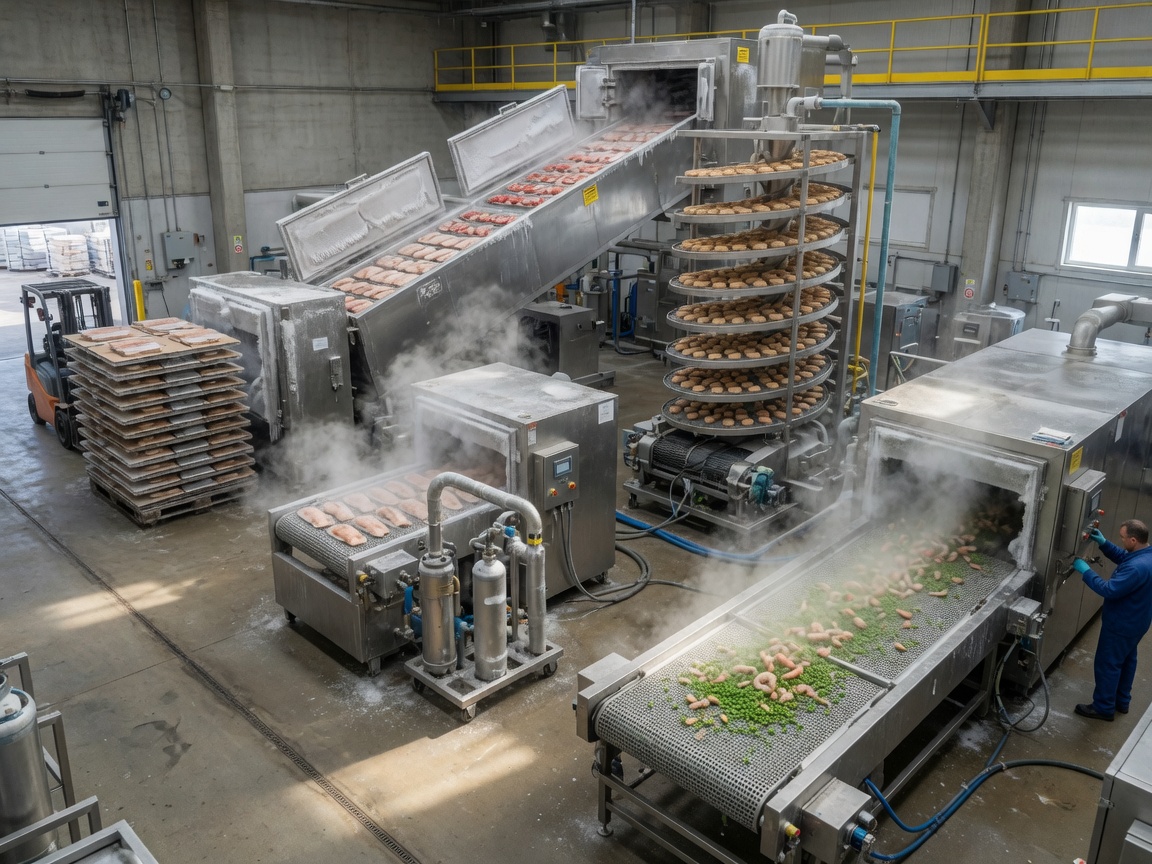
| Freezer type | Best for | Footprint | Energy efficiency | Typical capacity | US market fit |
|---|---|---|---|---|---|
| Fluidized bed freezer | Peas, shrimp, diced veg, berries | Medium | High | 2,000–15,000 lb/hr | Vegetable & seafood processors |
| Spiral freezer units | Burgers, chicken portions, bakery | Small (vertical) | Very high | 3,000–20,000 lb/hr | Poultry & prepared meal lines |
| Tunnel freezer systems | Fish fillets, meat blocks, pastry | Large | Medium | 5,000–25,000 lb/hr | Large-scale continuous freezing systems |
| Cryogenic freezing solutions | High-value seafood, ready meals | Very small | Low (LN₂ cost) | 500–8,000 lb/hr | Premium seafood & specialty food |
| Plate freezer systems | Fish blocks, flat meat cuts | Small | Very high | 1,000–10,000 lb/hr | Seafood freezing equipment lines |
Why fluidized bed freezers dominate the US market
The fluidized bed freezer remains the workhorse of the frozen vegetable processing line segment in the United States. By suspending small, granular products on a cushion of high-velocity cold air, these machines ensure every surface of every piece is exposed to the refrigerating medium simultaneously. Actual testing on pea lines shows freeze times of 3–5 minutes for product reaching −22°F core temperature — roughly four times faster than static tunnel alternatives. The separation effect is near-perfect for small, uniform items. For irregular or delicate products like strawberry halves, a two-stage approach — a short cryogenic surface hardening pass followed by mechanical completion — often outperforms either technology alone.
When spiral freezers make more sense
Spiral freezer units solve a specific engineering problem: how do you achieve long residence times without consuming enormous floor space? The vertical helix design stacks the conveyor belt in a tight column, delivering 50–150 feet of effective freeze length inside a 20×20-foot footprint. For a Midwest chicken processor running 12,000 lb/hr of bone-in portions, a spiral unit makes obvious economic sense. Of course, there are situations where spiral systems are not ideal — products with high surface moisture can still clump on the belt, and sanitation of the helix structure demands rigorous CIP protocols.
Cryogenic vs. mechanical IQF: a 5-year TCO analysis
Total cost of ownership is where many purchasing decisions get made — or derailed. Upfront capital cost tells only a fraction of the story. Based on real case data from US food processing facilities, here is how cryogenic and mechanical IQF systems compare over five years at a throughput of 5,000 lb/hr.
| Cost category | Cryogenic IQF (LN₂) | Mechanical IQF (NH₃ system) |
|---|---|---|
| Capital equipment cost | $150,000–$300,000 | $400,000–$900,000 |
| Annual energy/refrigerant cost | $280,000–$450,000 | $60,000–$110,000 |
| Annual maintenance cost | $8,000–$15,000 | $25,000–$50,000 |
| Refrigerant regulatory exposure | Low (LN₂ inert) | Low-Medium (NH₃ PSM if >10,000 lb) |
| Estimated 5-year TCO | $1.6M–$2.5M | $0.85M–$1.65M |
"Cryogenic IQF is not just an equipment choice — it is an operating cost commitment. At typical US liquid nitrogen prices of $0.12–$0.18 per pound, a 5,000 lb/hr line running two shifts will spend more on LN₂ annually than the capital cost of a comparably specified mechanical system." — Industry consensus from US frozen food plant engineering assessments, 2026.
When cryogenic IQF justifies its higher operating cost
Cryogenic freezing solutions make financial sense in three specific scenarios: high-value product lines (e.g., premium wild-caught seafood over $8/lb), short-run or seasonal operations where amortizing mechanical capital is difficult, and plants with limited floor space where the compact LN₂ tunnel footprint is the only viable option. The freeze quality advantage is also real — cryogenic systems achieve surface hardening in under 60 seconds, which measurably reduces drip loss on delicate proteins.
Mechanical IQF: the case for long-run economics
For any facility running frozen food production equipment at sustained volumes above 3,000 lb/hr for more than 10 months per year, mechanical IQF — particularly ammonia-based or CO₂ cascade commercial food freezing equipment — consistently delivers lower 5-year TCO. The higher upfront capital is offset within 2–3 years by dramatically lower per-pound operating costs. Industrial freezer systems using natural refrigerants like NH₃ are also better positioned for the tightening US EPA Section 608 landscape heading into the late 2020s.
Product-specific IQF selection guide
Matching an IQF system to a specific product is where theory meets production reality. The decision tree below is built from actual case evaluations across US food plants, not manufacturer spec sheets alone.
Strawberries and soft berries
Recommended system: two-stage cryogenic pre-hardening + mechanical fluidized bed. Strawberries are notoriously difficult. Their high water content (approximately 91%) and fragile cell walls mean that even minor mechanical stress during the freeze phase causes surface cracking and color degradation. Actual testing on California strawberry lines shows that a 45-second LN₂ surface hardening step followed by mechanical completion in a fluidized bed reduces surface cracking incidence by over 60% compared to single-stage mechanical freezing. Never use a standard air-blast tunnel as the primary freeze stage for whole strawberries.
Shrimp and seafood
Recommended system: fluidized bed or spiral IQF with dedicated seafood freezing equipment configuration. Shell-on shrimp and IQF peeled shrimp both respond well to fluidized bed systems — the airflow separates individual pieces cleanly and freeze times of 6–10 minutes (depending on shrimp count size) are achievable. For larger whole fish or fish portions, a horizontal tunnel freezer with variable belt speed is more appropriate. A key consideration for seafood: sanitation access. The belt, evaporator coils, and drain pans of any seafood freezing line must be accessible for full CIP wash-down — a design requirement that should be specified in the RFQ, not assumed.
Diced chicken and poultry pieces
Recommended system: spiral freezer or tunnel freezer with anti-stick pre-treatment zone. Diced chicken presents a surface moisture challenge. Fresh-cut pieces exit the dicer with exposed wet surfaces that will bond immediately on contact if not surface-hardened first. A short pre-freeze zone — either a cryogenic cabinet or a high-velocity air section — upstream of the main spiral or tunnel dramatically reduces clumping. According to production data from a Southeast US poultry processor, adding a 30-second pre-chill zone reduced post-freeze clump rate from 14% to under 2%, with a full ROI payback in under four months.
- Identify product geometry: granular/small (fluidized bed), flat/uniform (plate freezer), irregular/large (tunnel or spiral).
- Assess surface moisture: high-moisture or sticky products require pre-hardening stages.
- Calculate annual throughput hours to determine cryogenic vs. mechanical TCO crossover point.
- Specify sanitation access requirements based on product type (seafood requires highest CIP standard).
- Validate freeze time against target core temperature with supplier-provided thermal simulation data.
FDA, USDA, and HACCP compliance for IQF lines
US buyers often receive detailed equipment specifications from IQF suppliers but minimal guidance on regulatory compliance. That gap is a serious procurement risk. Here is what food plant engineers must address before any IQF freezing system goes live in a US facility.
FDA Food Safety Modernization Act (FSMA) requirements
Under FSMA's Preventive Controls for Human Food rule (21 CFR Part 117), freezing itself is classified as a process control — not a kill step. This is a critical distinction. IQF systems must be validated to demonstrate that every unit of product consistently reaches the specified target temperature within the defined residence time. Validation records must be maintained and available for FDA inspection. The freezer's control system — specifically temperature logging at inlet, mid-point, and outlet — must generate 21 CFR Part 11-compliant electronic records if the facility operates under a FSMA Preventive Controls plan. Ensure your IQF supplier can provide a controller that meets this standard out of the box, or budget for a third-party integration.
USDA FSIS requirements for meat and poultry IQF lines
USDA FSIS oversight applies to any IQF line processing red meat or poultry. The freezer must be included in the facility's HACCP plan as a Critical Control Point if it is being used to control a biological hazard — for example, achieving a specific internal temperature for pathogen reduction. FSIS inspection access to the freezer interior, including coil and belt sections, must be maintained at all times during production. Equipment construction must meet NSF/3-A sanitary standards: all food-contact surfaces in 304 or 316 stainless steel, no dead-leg piping, coved internal corners, and no painted or plated surfaces in the product zone.
Integrating IQF systems with upstream and downstream equipment
An IQF freezer does not operate in isolation. It sits at the center of a complete frozen food production equipment line, and its performance is directly affected by what comes before and after it. This integration dimension is consistently underweighted in purchase decisions — and consistently responsible for post-installation performance problems.
Upstream: blanchers, washers, and pre-chilling
Vegetable freezing lines must run a blancher upstream of the IQF freezer to inactivate enzymes that cause color and flavor degradation during frozen storage. The blancher output temperature — typically 195–205°F — must be brought down to near 40°F before the product enters the freezer. Skipping or undersizing the pre-chiller forces the IQF system to absorb that extra thermal load, reduces throughput capacity by 15–25%, and accelerates ice buildup on evaporator coils. Just like a car engine running without coolant can perform in the short term but fails at the worst possible moment, an IQF system fed improperly tempered product will degrade faster than any maintenance schedule can compensate for.
Downstream: sizing, metal detection, and packaging integration
Post-freezer, frozen product must pass through a de-clumping or sizing screen before weighing and packaging. Metal detectors must be positioned after the freezer — not before, because the refrigerant piping and evaporator coils in the freezer cabinet can create interference. Downstream conveyor speeds must be synchronized with the freezer discharge belt. A mismatch of even 10% in belt speed causes product bridging at the transition point, which generates fines, breakage, and yield loss. Specify line integration drawings during the equipment selection phase, not after installation.
Real-world performance benchmarks
Numbers matter. US procurement teams need concrete performance data to justify capital expenditure internally. The following benchmarks are drawn from operating IQF lines and near-recent industry reporting through 2026.
| Product | IQF system type | Freeze time | Drip loss % | IQF yield rate |
|---|---|---|---|---|
| Green peas | Fluidized bed | 3–4 min | 0.8–1.2% | 98.5%+ |
| Whole strawberries | Cryo pre-harden + fluidized bed | 6–9 min | 2.5–4.0% | 95–97% |
| Peeled shrimp (31/40) | Fluidized bed | 7–11 min | 1.5–2.5% | 97–98.5% |
| Diced chicken breast (½") | Spiral with pre-chill | 10–14 min | 2.0–3.5% | 96–98% |
| Salmon fillets (6 oz) | Tunnel freezer | 15–22 min | 1.8–3.0% | 97–98% |
What these numbers mean for your ROI model
A 1% improvement in IQF yield rate on a 10,000 lb/hr shrimp line running at $6/lb translates to $600 per hour of additional output value — or roughly $3.1 million per year assuming 5,200 operating hours. That single figure often dwarfs the annual maintenance cost difference between competing systems. Build yield rate and drip loss benchmarks into your equipment RFQ as guaranteed performance specifications, not aspirational targets.
Defrost cycle impact on effective throughput
A performance benchmark that is frequently omitted: defrost frequency and duration. Mechanical IQF systems accumulate frost on evaporator coils and require periodic hot-gas or electric defrost cycles lasting 20–45 minutes. A system requiring defrost every 4 hours effectively loses 8–18% of gross production time. Specifying a system with auto-defrost optimization, or a dual-evaporator design that maintains production during defrost, can recover that lost capacity — roughly equivalent to adding a half-shift of output per day.
2026 trends shaping IQF technology
The IQF freezing systems landscape is not static. Several converging forces are reshaping what buyers should expect — and demand — from new equipment purchases in 2026 and beyond.
AI-driven temperature control and predictive maintenance
Leading manufacturers including GEA and Frigoscandia are now integrating IoT sensor arrays and machine learning models into commercial food freezing equipment platforms. These systems monitor coil pressure drop, evaporator temperature variance, and belt load in real time, automatically adjusting fan speed and refrigerant flow to minimize energy consumption per pound of product frozen. Early adopters in the US market report energy savings of 12–18% versus fixed-parameter operation. Predictive maintenance alerts — flagging bearing wear or refrigerant leak signatures before failure — are reducing unplanned downtime by an estimated 30–40% on instrumented lines.
Natural refrigerant adoption and regulatory pressure
The US EPA's phasedown of HFC refrigerants under the AIM Act is accelerating the transition toward natural refrigerant platforms — specifically ammonia (NH₃) and CO₂ cascade systems — for industrial freezer systems. New IQF installations in the US commissioned from 2025 onward are increasingly specified with NH₃ or CO₂ to avoid future regulatory exposure and take advantage of superior thermodynamic efficiency. The performance data is compelling: NH₃ systems typically deliver 15–20% better energy efficiency than equivalent HFC R-404A systems at the same evaporating temperature. For buyers evaluating frozen food production equipment today, specifying HFC-free refrigerant systems is both a sustainability and a long-term cost decision.
In summary, selecting the right IQF freezing systems requires integrating equipment architecture, total cost of ownership, regulatory compliance, product-specific performance requirements, and line integration planning into a single, coherent evaluation framework. The procurement teams that build all of these dimensions into their RFQ — and hold suppliers to documented performance benchmarks — consistently achieve faster ROI and fewer post-installation surprises. The 2026 market offers better technology, smarter controls, and cleaner refrigerants than ever before. The decision framework, however, remains the competitive advantage.
Frequently asked questions
Q: What is the difference between IQF freezing systems and blast freezing?
A: Blast freezing drives high-velocity cold air across product in bulk, which can still allow pieces to freeze together. IQF freezing systems use active separation mechanisms — fluidized airflow, spiral conveyors, or vibrating belts — to keep each piece physically independent throughout the entire freeze cycle, producing free-flowing, individually frozen output.
Q: Which IQF system has the lowest total cost of ownership?
A: For continuous production above 3,000 lb/hr running more than 10 months per year, mechanical IQF systems using ammonia or CO₂ refrigerants consistently deliver the lowest 5-year TCO — typically $0.85M–$1.65M versus $1.6M–$2.5M for cryogenic LN₂ systems at comparable throughput, primarily due to dramatically lower annual refrigerant operating costs.
Q: Do IQF freezing systems need to be included in a HACCP plan?
A: Yes, if the freezer is used to control a biological hazard — for example, achieving a specific internal temperature for pathogen reduction — it must be designated as a Critical Control Point in the HACCP plan. Under FSMA, freeze cycle validation records and 21 CFR Part 11-compliant temperature logs are also required for FDA-regulated facilities.
Q: What IQF system is best for freezing strawberries?
A: A two-stage approach works best: a short cryogenic pre-hardening pass (approximately 45 seconds in LN₂) followed by mechanical completion in a fluidized bed freezer. This combination reduces surface cracking by over 60% compared to single-stage mechanical freezing, protecting the fruit's color, texture, and marketable appearance.
Q: How do I integrate an IQF freezer with my existing production line?
A: Start with a full line integration drawing covering upstream blanchers, pre-chillers, and washers, as well as downstream de-clumpers, metal detectors, and packaging equipment. Belt speeds must be synchronized across all transfer points. Metal detectors must be positioned after the freezer to avoid refrigerant-line interference. Specify integration drawings during the RFQ phase, not after equipment delivery.
Keywords:
Inquiry
If you are interested in our products, please leave your email to receive a free product quote, thank you!
More information

Tel:
Sales E-mail: