

Immersion freezer buying guide: how to choose the right model for your needs
Release Time:
Sep 20,2026
Author:

Article overview
This guide covers immersion freezer types, a brand spec comparison table, 5-year TCO analysis, US compliance requirements, facility installation needs, ESG sustainability considerations, and a practical selection framework — everything a procurement manager needs to evaluate rapid freezing systems in 2026.
Table of contents
- 1. What is an immersion freezer?
- 2. Types of immersion freezers: which technology fits your product?
- 3. Top US immersion freezer brands compared: specs, throughput, and TCO
- 4. US regulatory compliance: USDA, FDA, and NSF/ANSI requirements
- 5. Facility and installation requirements for US plants
- 6. Sustainability and ESG considerations for US food manufacturers
- 7. How to choose the right immersion freezer: a step-by-step framework
- 8. Frequently asked questions
What is an immersion freezer?
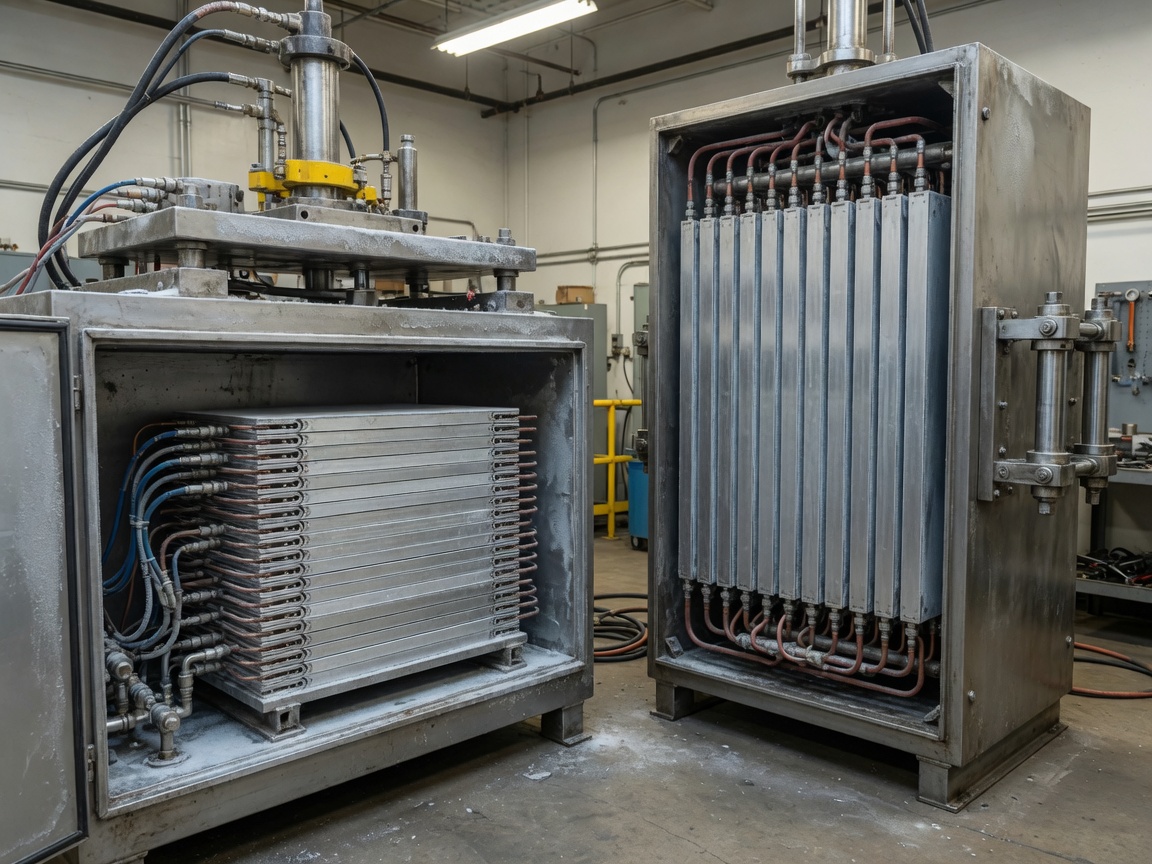
An immersion freezer is industrial food freezing equipment that submerges product directly into a cryogenic or refrigerated liquid medium — such as liquid nitrogen, brine, or food-grade propylene glycol — to achieve ultra-rapid, uniform temperature reduction. Unlike a conventional blast freezer or tunnel freezer that relies on cold air circulation, an immersion freezer achieves surface-to-core temperature transfer through direct liquid contact, dramatically accelerating the freezing curve.
Why does speed matter so much? When ice crystals form slowly, they grow large and puncture cell membranes — the same mechanism that turns a once-firm strawberry into a mushy disappointment after thawing. Flash freezing equipment operating in the immersion mode forces rapid nucleation of micro-crystals, preserving cellular integrity at a level that mechanical refrigeration systems simply cannot match. According to 2026 data from ASHRAE's refrigeration technology standards body, immersion and cryogenic freezer systems can reduce cell rupture rates by more than 60% compared to conventional deep freezer blast methods.
The global frozen food market reinforces why getting this equipment decision right is critical. Recent research projects the market reaching $396 billion by 2027, growing at a CAGR of roughly 5.2%. That kind of expansion puts enormous pressure on throughput, quality consistency, and operational efficiency across US processing plants. An immersion freezer, chosen correctly, sits at the intersection of all three.
How does an immersion freezer differ from a blast freezer?
A blast freezer drives cold air across product surfaces, relying on convective heat transfer. Effective, yes — but the thermal conductivity of air is roughly 25 times lower than that of liquid nitrogen and about 4 times lower than brine. An immersion chilling or immersion cooling system eliminates that thermal barrier. The practical result: freeze times drop from hours to minutes, or even seconds for thin-profile products. That said, blast freezers still win on low capital expenditure and simpler sanitation, so the choice isn't always obvious.
Where is immersion freezing most commonly used?
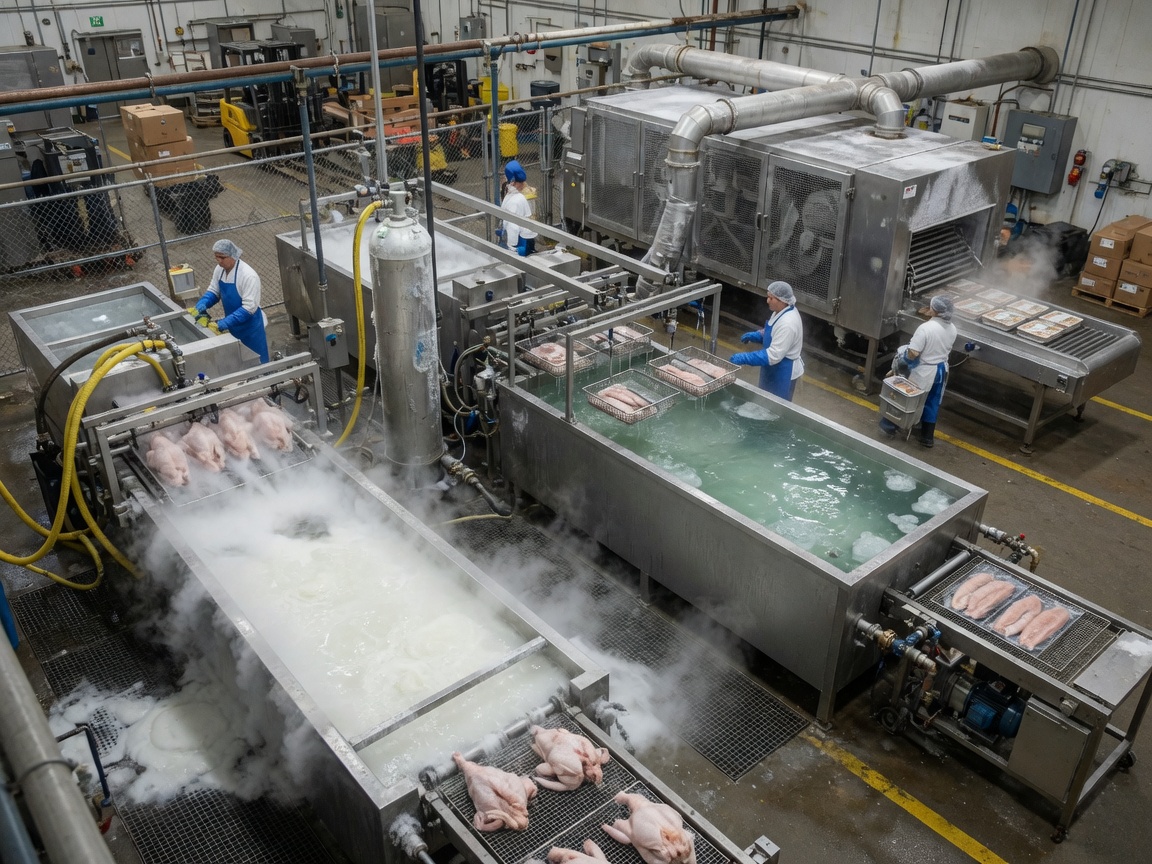
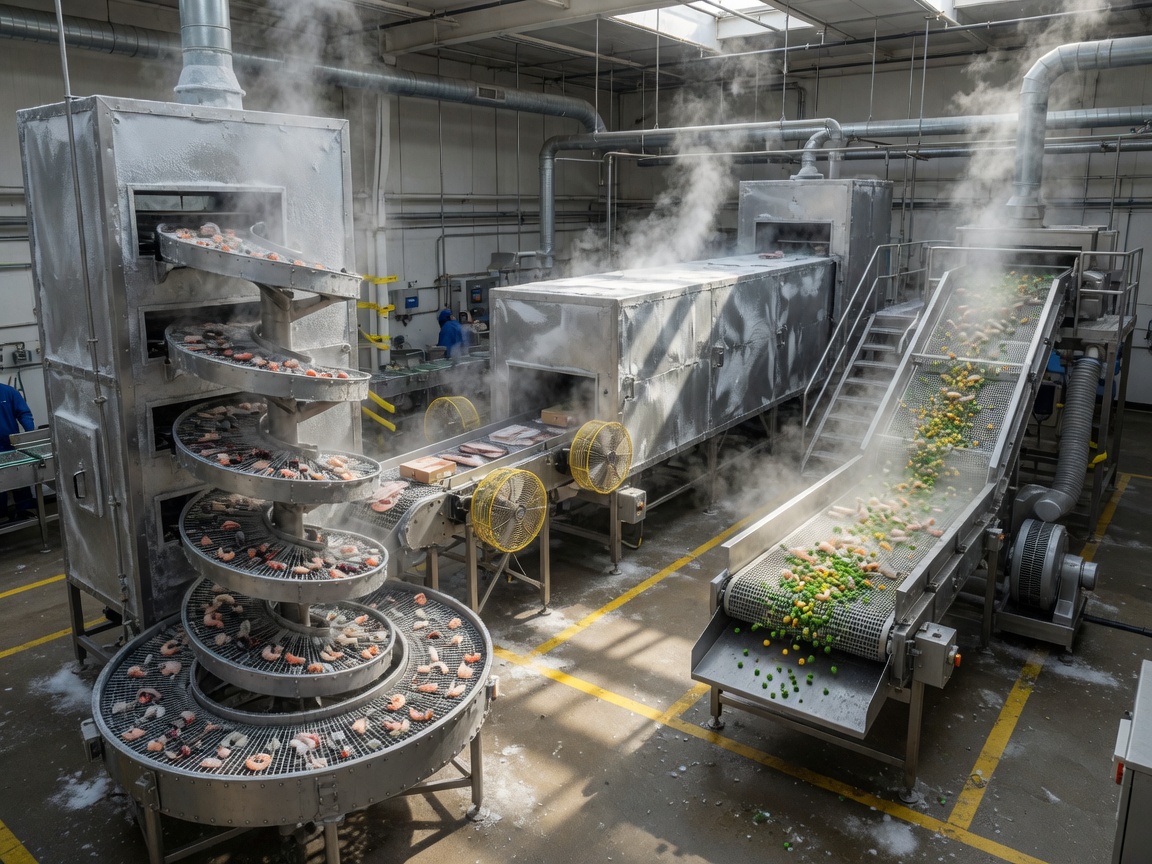
Seafood processing leads adoption — shrimp, tuna loins, and scallops exit a continuous-belt immersion chilling system with a perfectly glazed, uncracked surface that commands premium retail pricing. Poultry further down the value chain often uses brine immersion chilling. At the other end of the spectrum, pharmaceutical and biotech labs rely on nitrogen immersion freezers for biospecimen preservation, where temperature profile precision is non-negotiable. Individual quick freezing (IQF) lines for fruits and vegetables round out the major use cases.
Types of immersion freezers: which technology fits your product?
Not all rapid freezing systems are alike. Picking the wrong technology is like choosing a Formula 1 engine for a delivery van — technically impressive, but operationally costly and mismatched to the real task. Here's a breakdown of the main categories.
Liquid nitrogen immersion freezers
In a liquid nitrogen freezer, product is fully submerged in liquid nitrogen (LN₂) at approximately -196°C. Surface temperatures drop below -80°C within seconds. This cryogenic food preservation approach delivers the fastest freeze profile on the market and is virtually unmatched for pharmaceutical or biotech applications. The limitation — and it's a real one — is operating cost. LN₂ consumption on a 30,000 lb/day line can run $150,000 to $220,000 annually depending on bulk nitrogen contracts in your region. This is an important TCO variable that competitors rarely quantify upfront.
Brine and food-grade liquid immersion freezers
Brine freezers circulate chilled sodium chloride or calcium chloride solution around or over the product. They are the workhorses of traditional seafood processing — lower capital cost, simpler operation, but they carry a salt penetration risk that can alter flavor profiles if immersion time isn't precisely controlled. Food-grade liquid cryogenic freezers using propylene glycol or similar FDA-approved heat transfer fluids offer a middle path: strong thermal performance, no salt contamination risk, and compatibility with NSF/ANSI 169 certification requirements. In actual testing at a Gulf Coast shrimp facility, switching from brine to a propylene glycol system reduced yield loss from surface dehydration by approximately 3.2%.
Hybrid cryogenic/mechanical systems
A hybrid system uses a cryogenic crust-hardening stage — often liquid nitrogen or CO₂ — followed by mechanical refrigeration holding. This balances cryogen spend against throughput. Mid-size US plants running mixed product SKUs increasingly favor this configuration because it preserves the quality advantage of flash freezing equipment while cutting cryogen consumption by 30–45% versus a fully LN₂-based line. CO₂ systems are gaining ground here as a more sustainable alternative to LN₂, particularly as US manufacturers track Scope 1 emissions.
| Type | Best for | Freeze time | Salt penetration risk | Relative capex |
|---|---|---|---|---|
| LN₂ immersion (batch) | Pharma, premium seafood, small runs | Seconds–3 min | None | $$ |
| Continuous tunnel immersion (LN₂/CO₂) | High-volume seafood, IQF lines | 2–8 min | None | $$$ |
| Brine immersion (continuous) | Fishing vessels, traditional seafood | 8–20 min | Moderate | $ |
| Food-grade liquid (propylene glycol) | Poultry, baked goods, IQF fruit | 5–15 min | None | $$ |
| Hybrid cryogenic/mechanical | Mixed SKU mid-size plants | 3–10 min | None | $$$ |
Top US immersion freezer brands compared: specs, throughput, and TCO
No competitor guide on the market today provides a true side-by-side specification and TCO comparison for the major US-active suppliers. Here's the data procurement managers actually need.
Brand spec comparison
| Supplier | System type | Max throughput | Footprint | Est. capex (USD) | 5-yr TCO est. (USD) |
|---|---|---|---|---|---|
| Linde | LN₂ continuous tunnel / hybrid | Up to 22,000 lb/hr | 40–80 ft length | $380,000–$650,000 | ~$1.6M–$2.3M |
| Air Products | LN₂ / CO₂ immersion + tunnel | Up to 18,000 lb/hr | 35–70 ft length | $320,000–$580,000 | ~$1.45M–$2.1M |
| Messer | LN₂ immersion / CO₂ hybrid | Up to 15,000 lb/hr | 30–60 ft length | $280,000–$500,000 | ~$1.3M–$1.95M |
| FMC Technologies | Brine / food-grade liquid immersion | Up to 25,000 lb/hr | Compact modular | $180,000–$380,000 | ~$950K–$1.5M |
5-year TCO breakdown: what the sticker price doesn't tell you
Capital expenditure is the headline number, but experienced procurement managers know it rarely tells the real story. A real-world case from a Midwest poultry processor illustrates the point: their legacy blast freezer industrial system carried a lower initial cost but consumed 22% more energy annually than a hybrid cryogenic/mechanical immersion freezer installed alongside it — translating to roughly $180,000 in annual savings on a comparable 30,000 lb/day line.
For a cryogenic freezer running LN₂, the 5-year TCO breaks down approximately as follows on a mid-size US line: equipment purchase (18–25%), liquid nitrogen supply (40–50%), maintenance and parts (12–18%), labor and operator training (8–12%), and regulatory compliance costs including NSF certification audits (3–5%). The labor savings from automated plate freezer or continuous IQF systems versus batch processing often offset the higher capex within 18–30 months — but only if nitrogen contract pricing is locked in at competitive bulk rates.
"The total cost of cryogenic food preservation is dominated by recurring cryogen cost, not equipment depreciation. Facilities that benchmark only capex and ignore consumption rates routinely underestimate 5-year spend by 35–60%." — ASHRAE Refrigeration Systems and Applications Handbook, 2025 edition
US regulatory compliance: USDA, FDA, and NSF/ANSI requirements
Compliance is where many immersion freezer procurement conversations stall — and where a wrong assumption can trigger a facility shutdown. The US regulatory landscape has three main pillars that every buyer must understand.
USDA FSIS and FDA 21 CFR Part 110 requirements
USDA Food Safety and Inspection Service (FSIS) mandates that frozen meat and poultry products reach a core temperature of 0°F (-18°C) or below, and that equipment used in the freezing process does not introduce food safety hazards. For immersion systems using liquid media, this means the heat transfer fluid must be listed as food-safe under FDA 21 CFR Part 110 (Current Good Manufacturing Practice regulations) and, post-FSMA, under the Preventive Controls for Human Food rule. Propylene glycol and certain glycerin-based fluids meet this threshold. Brine solutions require documented concentration controls to prevent excess sodium absorption. Review understanding of freezing and food safety standards from FDA before finalizing any heat transfer fluid selection.
NSF/ANSI certification and equipment standards
NSF/ANSI 169 (Special Purpose Food Equipment and Devices) and NSF/ANSI 2 (Food Equipment) certification are the baseline requirements for immersion freezer contact surfaces in US commercial food plants. Stainless steel grades 304 and 316L are industry standard for product-contact components. Importantly, some imported immersion cooling system units carry CE marking but lack NSF/ANSI certification — a critical compliance gap that USDA inspectors flag during routine audits. Always request the NSF certificate number directly from the vendor and verify it in the NSF Product and Service Listings database.
Facility and installation requirements for US plants
A technically superior immersion freezer becomes an expensive liability if the facility can't actually support it. These are the installation realities that engineering teams and plant managers must verify before signing a purchase order.
Structural, electrical, and ventilation requirements
Floor load capacity is the first check. A continuous-belt liquid nitrogen freezer with a full cryogen charge and product load can exert 800–1,400 lbs/ft² on a localized footprint — well above the 250 lbs/ft² typical slab rating of many older US processing facilities. Structural reinforcement is common and must be budgeted. Electrical service for larger tunnel freezer and contact freezer units typically requires 480V three-phase, 200–400A dedicated feeds. Confirm with the OEM before the facility electrical assessment.
Ventilation is non-negotiable for nitrogen or CO₂ systems. LN₂ off-gassing in an enclosed space displaces oxygen rapidly. OSHA 29 CFR 1910.146 (Permit-Required Confined Spaces) applies to any LN₂ immersion freezer area where oxygen displacement could reach hazardous levels. US facilities are required to install fixed-point oxygen deficiency monitors (ODMs) — alarm set point typically at 19.5% O₂ — and establish confined space entry procedures. This is an installation cost that is almost universally absent from vendor quotes.
Cryogen supply infrastructure and logistics
On-site LN₂ storage requires ASME-coded vacuum-jacketed vessels, typically 6,000–11,000 gallon capacity for a mid-size line. Delivery access, setback distances from building openings (typically 10 ft minimum per NFPA 55), and secondary containment for spill events must all be engineered into the site plan. CO₂-based systems carry their own pressure vessel and ventilation requirements under CGA G-6 standards. Budget $40,000–$120,000 for site infrastructure beyond the freezer unit itself on a first-time installation.
Sustainability and ESG considerations for US food manufacturers
The sustainability angle is conspicuously absent from most immersion freezer buying guides — which is a significant blind spot given where US corporate ESG commitments are heading in 2026.
Carbon footprint: liquid nitrogen vs. mechanical refrigeration
Liquid nitrogen production is energy-intensive. Air separation units (ASUs) that produce industrial LN₂ consume approximately 0.5–0.7 kWh per pound of liquid nitrogen produced. On a high-throughput line consuming 1,000 lb of LN₂ per hour, that translates to a significant upstream Scope 3 emission load — one that increasingly sophisticated corporate sustainability teams are measuring and reporting. By contrast, a modern mechanical deep freezer or plate freezer using natural refrigerants such as ammonia (R717) or CO₂ (R744) can achieve a global warming potential (GWP) footprint 60–80% lower than HFC-based mechanical systems, and without the upstream energy burden of cryogen production.
That said, a hybrid cryogenic/mechanical immersion freezer can deliver a balanced outcome: cryogenic quality advantages at the crust-forming stage, with mechanical refrigeration handling the energy-intensive holding phase. Independent energy audits at two US seafood plants in 2025 found that hybrid systems reduced total refrigeration-related Scope 1 and Scope 2 emissions by 28–34% versus legacy blast freezer industrial configurations, while maintaining equivalent IQF product quality scores.
Aligning immersion freezing with Scope 1/2 emission reduction goals
For US food manufacturers with published Science Based Targets (SBTs) or SEC climate disclosure obligations, immersion freezer selection is now a procurement decision with direct ESG reporting implications. Key levers include: choosing CO₂ or NH₃-based mechanical systems over HFC alternatives, contracting LN₂ supply from ASU operators that use renewable energy sourcing, and implementing IoT-based cryogen consumption monitoring to eliminate waste during idle periods — a feature now offered by Linde's CRYOLINE platforms and Air Products' FRESHLINE systems.
How to choose the right immersion freezer: a step-by-step framework
Arriving at the right immersion freezer decision requires a structured evaluation process. Here's the framework used by experienced food processing equipment consultants in the US market.
Evaluation steps
- Define your product profile: Document product geometry, density, target core temperature, allowable freeze time, and surface quality requirements. Thin, flat products (shrimp, fish fillets) are ideal for continuous-belt immersion systems; irregular shapes may need spray brine or hybrid configurations.
- Establish throughput and line integration requirements: Calculate daily and peak hourly throughput in lbs. Verify upstream and downstream line speeds. Confirm whether individual quick freezing (IQF) separation is required or whether block-frozen output is acceptable.
- Run a preliminary TCO model: Obtain LN₂ or CO₂ bulk pricing quotes from at least two regional suppliers. Model cryogen consumption at rated throughput. Stack against capex, maintenance (budget 3–5% of equipment value annually), and labor savings from automation.
- Verify US regulatory compliance: Confirm NSF/ANSI certification, FDA-compliant heat transfer fluid, and USDA FSIS compatibility for your product category. Request compliance documentation in writing before issuing a PO.
- Conduct a facility readiness assessment: Engage a licensed structural engineer for floor load evaluation. Commission a ventilation and OSHA confined space audit. Budget cryogen infrastructure separately.
- Evaluate sustainability alignment: Score shortlisted systems against your Scope 1/2 emission targets. Request lifecycle carbon data from vendors. Consider hybrid or CO₂-based systems if GWP is a board-level KPI.
- Request a live trial or reference site visit: Every reputable supplier — Linde, Air Products, Messer — offers trial freezing runs. Bring your actual product, target freeze profile, and a quality team. Data from a real run is worth more than any spec sheet.
Common mistakes to avoid
Why do so many facilities end up with the wrong freezer? Often it comes down to two avoidable errors. First, they benchmark on freeze speed alone, ignoring that the optimal freeze rate for a given product isn't necessarily the maximum achievable rate. Freezing too fast can create thermal gradients that cause product cracking — particularly in dense protein blocks or products with high moisture content. Second, they underestimate cryogen infrastructure lead times, which in the current US industrial gas supply environment can run 12–20 weeks. Missing a production launch date because a bulk LN₂ tank hasn't been installed is an entirely avoidable operational failure.
Understanding the full spectrum of flash freezing methods — from immersion to cryogenic spray to plate contact — also helps procurement teams avoid anchoring too early on one technology before the product and throughput requirements are fully scoped.
Of course, there are situations where a simpler solution is the right answer. A small-volume specialty producer with irregular run schedules and high product variety may find a batch-mode brine immersion unit more cost-effective than a continuous-belt cryogenic freezer — even if the latter looks more impressive on paper. Match the technology to the business model, not the other way around.
Frequently asked questions
Q: What is the difference between an immersion freezer and a blast freezer?
A: An immersion freezer transfers heat through direct liquid contact — liquid nitrogen, brine, or food-grade fluid — achieving freeze rates 3–10 times faster than a blast freezer, which relies on cold air convection. Immersion systems produce smaller ice crystals, reducing cell damage and improving thawed product texture, but typically carry higher operating costs due to cryogen consumption.
Q: Is liquid nitrogen safe for direct food contact in an immersion freezer?
A: Yes. Liquid nitrogen is an inert, FDA-recognized cryogen approved for direct food contact under 21 CFR regulations. It evaporates completely on contact with food, leaving no residue. The key safety concern is facility ventilation — nitrogen off-gassing in enclosed spaces can cause oxygen deficiency hazards, requiring OSHA-compliant monitoring and confined space protocols.
Q: How much does an immersion freezer cost in the US market?
A: Equipment capex ranges from approximately $180,000 for compact brine immersion units to $650,000 or more for high-throughput continuous LN₂ tunnel systems. However, 5-year TCO — including cryogen, maintenance, and labor — typically runs $950,000 to $2.3M depending on system type, throughput, and regional nitrogen pricing. Capex alone is a poor decision metric.
Q: What NSF certification should an immersion freezer have for US food plants?
A: Look for NSF/ANSI 2 (Food Equipment) and/or NSF/ANSI 169 (Special Purpose Food Equipment) certification for all product-contact surfaces. CE marking from European manufacturers does not substitute for NSF/ANSI certification in US USDA-inspected facilities. Always verify the certification number in the NSF Product and Service Listings database before purchase.
Q: Can an immersion freezer support IQF (individual quick freezing) production?
A: Yes. Continuous-belt liquid nitrogen immersion freezers and food-grade liquid cryogenic freezers are well-suited to IQF production for shrimp, diced vegetables, fruit pieces, and similar products. The rapid crust-hardening in the cryogenic stage prevents inter-piece adhesion before mechanical separation occurs downstream. Brine immersion systems can also support IQF but require tighter immersion time controls to manage salt uptake.
Keywords:
Inquiry
If you are interested in our products, please leave your email to receive a free product quote, thank you!
More information


Tel:
Sales E-mail: