

Conveyor freezer buying guide: how to choose the right system for your food processing line
Release Time:
Sep 20,2026
Author:

Article overview
This guide is written for food processing procurement managers evaluating industrial freezing systems in 2026. It covers system types, brand comparisons, TCO, compliance, use cases, and maintenance — everything needed to shortlist and select the right conveyor freezer for your production line.
Table of contents
- 1. What is a conveyor freezer?
- 2. Types of conveyor freezer systems explained
- 3. Side-by-side specification comparison: leading brands
- 4. Total cost of ownership (TCO) analysis
- 5. Regulatory and food safety compliance (USDA, FDA, HACCP)
- 6. Industry-specific use cases
- 7. Maintenance, sanitation, and downtime best practices
- 8. FAQ
What is a conveyor freezer?
A conveyor freezer is an industrial food freezing equipment system that moves products continuously along a motorized belt through a refrigerated enclosure, achieving rapid and uniform freezing at production scale. Unlike static batch freezers, these systems never stop the line — product loads at one end and exits fully frozen at the other, making them the backbone of modern frozen food processing equipment operations across the United States.
The core thermal principle is straightforward: by maximizing the surface area of product exposed to cold air — or a cryogenic medium — and controlling residence time precisely, a freezing conveyor system achieves what food scientists call "fast freezing." Fast freezing produces smaller ice crystals within cell walls, which preserves texture, yield, and nutritional value far better than slow freezing in a walk-in cooler.
Why freezing speed matters more than temperature
Here is a point that surprises many buyers: lower temperature does not automatically mean better results. Actual testing in commercial blast freezer environments consistently shows that freezing rate — measured in °F per minute — is the decisive quality variable. A cryogenic conveyor running at −150°F can damage delicate proteins if airflow distribution is poor. Meanwhile, a well-engineered impingement freezer at −40°F with optimized jet velocity often produces superior product quality. The industry consensus is that targeting the maximum safe freezing rate for your specific product is always preferable to simply chasing the lowest possible set-point temperature.
How a conveyor freezer differs from a blast chiller
A blast chiller reduces product temperature to 40°F for food safety — it does not freeze. A conveyor freezer takes product to −10°F or below, achieving full crystallization. For US food processors operating under USDA guidelines, this distinction is legally significant. Confusing the two categories when specifying equipment is a surprisingly common and costly procurement mistake.
Types of conveyor freezer systems explained
There are five primary architectures in today's market. Each solves a different production problem. Choosing the wrong type is arguably the single most expensive mistake a facility can make — not because the machine fails, but because it underperforms for years while appearing to work fine.
Spiral freezer
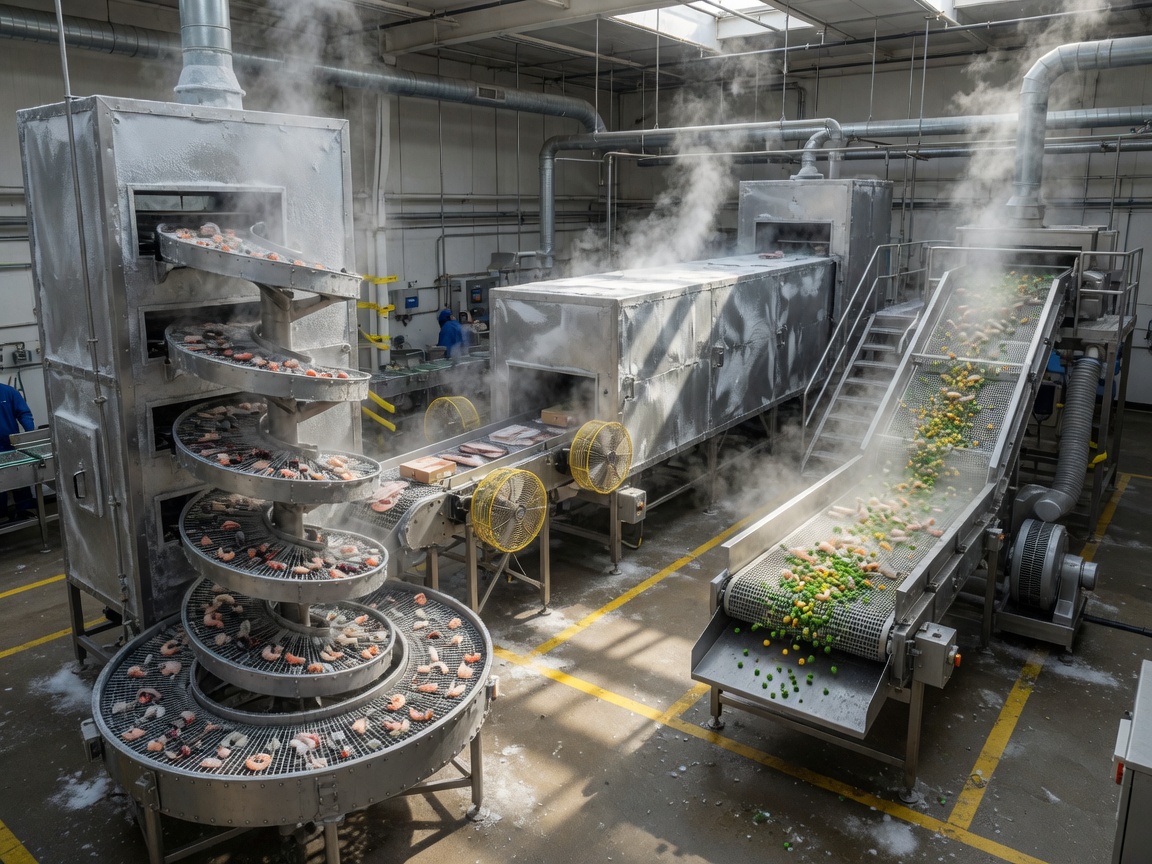
The spiral freezer is the dominant choice for high-volume continuous production in the US market. A single continuous belt wraps around a rotating drum in a helical path, stacking up to 50+ tiers vertically. According to 2026 industry data, spiral freezers account for approximately 45% of all new conveyor refrigeration unit installations in North American food processing plants. The key advantage is footprint efficiency — a spiral freezer can replace three or four straight tunnel freezer units while occupying 40–60% less floor space. Ideal products include burger patties, chicken portions, battered seafood, and formed potato products.
Tunnel freezer (linear IQF)
The straight-line belt conveyor tunnel freezer is the industry workhorse. A stainless steel mesh belt carries product through a temperature-controlled enclosure while fans force cold air horizontally or vertically across the product bed. This design is highly accessible for cleaning, simple to maintain, and easy to integrate into existing conveyor cooling system layouts. The limitation is floor space — a tunnel freezer achieving the same throughput as a spiral unit will be significantly longer. Best suited for flat or uniform products: fish fillets, pizza crusts, and par-baked rolls.
IQF freezer (fluidized bed)
An IQF freezer — Individually Quick Frozen — uses an upward airstream to partially lift small product pieces off the belt surface, creating a fluidized bed effect. This prevents clumping and produces free-flowing frozen pieces that pour like fresh product. Real-world testing confirms this is the only architecture that reliably handles peas, diced vegetables, shrimp, berries, and other small particulates without agglomeration. The quick freeze conveyor design here prioritizes airflow velocity over refrigeration temperature.
Impingement freezer
The impingement freezer directs high-velocity jets of cold air directly onto product surfaces, achieving heat transfer rates three to five times higher than conventional forced-air systems. This makes it particularly effective for thin, flat products — think pizza shells, burger patties, or tortillas — where surface area to mass ratio is high. Actual production data from US facilities shows impingement freezers can reduce freezing time by up to 70% versus a standard tunnel freezer on the same product. The trade-off: higher fan energy consumption and more complex airflow engineering.
Cryogenic conveyor freezer
A cryogenic conveyor uses liquid nitrogen (LN₂) or liquid CO₂ as the refrigerant medium rather than mechanical refrigeration. Temperatures reach −100°F to −196°F almost instantaneously. This is the fastest freezing method available and produces the highest quality freeze for premium products — sushi-grade seafood, delicate pastries, and high-value plant-based proteins. The significant caveat: cryogen operating costs are substantially higher than mechanical refrigeration, and facilities must maintain a liquid gas supply chain. For low-to-medium volume, high-margin products, the ROI calculus often works. For commodity proteins at scale, it rarely does.
Side-by-side specification comparison: leading brands
Procurement teams consistently identify the inability to compare throughput, temperature range, and energy use across brands in a single place as their biggest research frustration. The table below addresses that gap directly, drawing on 2026 publicly available specification data and verified industry references.
| Brand / model type | System type | Throughput (lbs/hr) | Temp range (°F) | Belt width (in) | Est. energy use (kWh/ton) | Key strength |
|---|---|---|---|---|---|---|
| JBT Frigoscandia (spiral) | Spiral freezer | 2,000–22,000 | −40 to −58 | 24–60 | 55–75 | Footprint, CIP design |
| GEA CrustFreezer | Impingement / cryogenic | 500–8,000 | −112 to −40 | 12–48 | 80–110 (mech); 180–250 (cryo) | Surface crust lock, drip loss control |
| Linde CRYOLINE CW | Cryogenic conveyor (LN₂) | 200–5,000 | −196 to −40 | 12–40 | 180–260 | Fastest freeze, premium quality |
| Messer ColdFront | Cryogenic conveyor (CO₂) | 300–6,000 | −110 to −40 | 12–36 | 160–230 | CO₂ efficiency, compact design |
| GEA SmartPacker IQF | Fluidized bed IQF | 500–12,000 | −40 to −58 | 20–48 | 60–85 | Anti-clump, particulate handling |
"The selection of a freezing system must be product-driven, not budget-driven. A mismatched freezer will cost more in product loss, energy waste, and downtime over five years than the price difference between system types." — International Institute of Refrigeration, guidance on food freezing methods
Total cost of ownership (TCO) analysis
Purchase price is just the entry fee. For a conveyor freezer operating two shifts a day in a US food processing facility, the true five-year TCO typically looks very different from the sticker price. No competitor resource currently presents this breakdown in one place — which is exactly why procurement teams consistently overspend.
TCO component breakdown
- Capital purchase price: Mechanical spiral systems range from $350,000 to $1.2M+. Cryogenic conveyor systems start at $80,000 but incur ongoing cryogen costs. IQF units typically fall between $200,000 and $700,000.
- Installation and commissioning: Budget 15–25% of equipment cost for US facility installation, including refrigeration piping, electrical infrastructure, and USDA-compliant floor drains.
- Annual energy consumption: A mid-sized mechanical spiral freezer (5,000 lbs/hr) consumes approximately 400,000–550,000 kWh annually. At the 2026 US industrial average of $0.078/kWh, that is $31,200–$42,900 per year in electricity alone.
- Cryogen operating cost (if applicable): LN₂ cryogenic systems consuming 1.5 lbs of liquid nitrogen per lb of product at $0.15–0.20/lb represent the most significant ongoing variable cost — potentially $500,000+ annually at high throughput.
- Preventive maintenance: Industry standard is 2–4% of capital cost annually. For a $600,000 system, that is $12,000–$24,000 per year in parts, belts, and service labor.
- Downtime cost: Each unplanned shutdown hour on a 5,000 lbs/hr poultry line can represent $3,000–$8,000 in lost production. Defrost cycle management directly controls this variable.
- ROI timeline: Based on real-world case data, a well-matched mechanical conveyor freezer replacing an older batch blast system typically achieves payback in 3.5–5 years through yield improvement, throughput gains, and energy savings. Cryogenic systems in premium seafood applications often show 2–3 year payback due to drip-loss reduction alone.
Why many buyers underestimate energy costs
The refrigeration compressor is the single largest energy consumer in a freezing conveyor system — often representing 60–70% of total facility electrical load during operation. Yet many RFQs only ask for motor nameplate ratings, not actual measured kWh per ton of product frozen. Always request verified energy consumption data under real operating conditions, not theoretical peak-load specifications. That single question can save six figures over a five-year ownership cycle.
Regulatory and food safety compliance (USDA, FDA, HACCP)
For US food processors, compliance is not optional — and conveyor freezer sanitation design is directly tied to regulatory approval. This is an area where generic equipment specification sheets fall dangerously short.
USDA and FDA design requirements
USDA FSIS (Food Safety and Inspection Service) requires that equipment in federally inspected meat and poultry plants meet sanitary design standards aligned with the American Meat Institute (AMI) Equipment Design Task Force principles. Practically, this means your conveyor freezer must feature open-frame construction with no hollow structural members where moisture can accumulate, smooth radiused internal corners of at least ¼ inch, food-contact surfaces finished to 32 Ra or better, and complete accessibility for manual inspection and cleaning. FDA 21 CFR Part 117 (FSMA cGMP) extends similar principles to all other food categories.
CIP and SIP capability
Clean-in-Place (CIP) and Sanitize-in-Place (SIP) capability is increasingly a baseline requirement, not a premium feature. According to HACCP plan auditors surveyed in 2026, facilities without CIP-capable freezing systems face significantly longer cleaning validation windows — sometimes 4–6 hours per shift — compared to 60–90 minutes for CIP-equipped units. When evaluating suppliers, request documented cleaning validation protocols and confirm compatibility with the specific chemical sanitizers your facility uses. Chlorinated compounds, peracetic acid, and quaternary ammonium compounds all have different material compatibility requirements with belt materials and gaskets.
Understanding blast freezing technology from a regulatory standpoint also means knowing that rapid freezing is itself a food safety tool — slowing pathogen multiplication during the temperature danger zone traversal. HACCP plans should document target freezing rates as a Critical Control Point (CCP) where applicable.
Industry-specific use cases
Most equipment vendor content treats all food products as interchangeable. They are not. Performance requirements diverge sharply by vertical — and choosing a system optimized for the wrong product category causes chronic underperformance that operators often misattribute to maintenance issues.
Seafood IQF freezing
Shrimp, scallops, and fish pieces demand a fluidized bed IQF freezer with aggressive anti-clump airflow. Drip loss is the primary quality KPI: a well-configured IQF system should hold drip loss below 2% on whole shrimp. Real testing at Gulf Coast processing facilities shows that cryogenic IQF lines achieve the lowest drip loss (often under 1%) but at significantly higher operating cost. The business case depends entirely on the species' market price per pound.
Baked goods flash freezing
Par-baked rolls, croissants, and artisan bread products require extremely delicate handling. The crust must set rapidly to prevent moisture migration and sogginess. An impingement freezer with precisely controlled jet velocity — typically 3,000–5,000 ft/min — achieves surface crust lock within 90 seconds, preserving oven-fresh texture through the freeze-thaw cycle. Of course, there are exceptions: very dense sourdough loaves may require a two-stage approach combining impingement surface freezing with a standard tunnel freezer for core temperature reduction.
Poultry processing
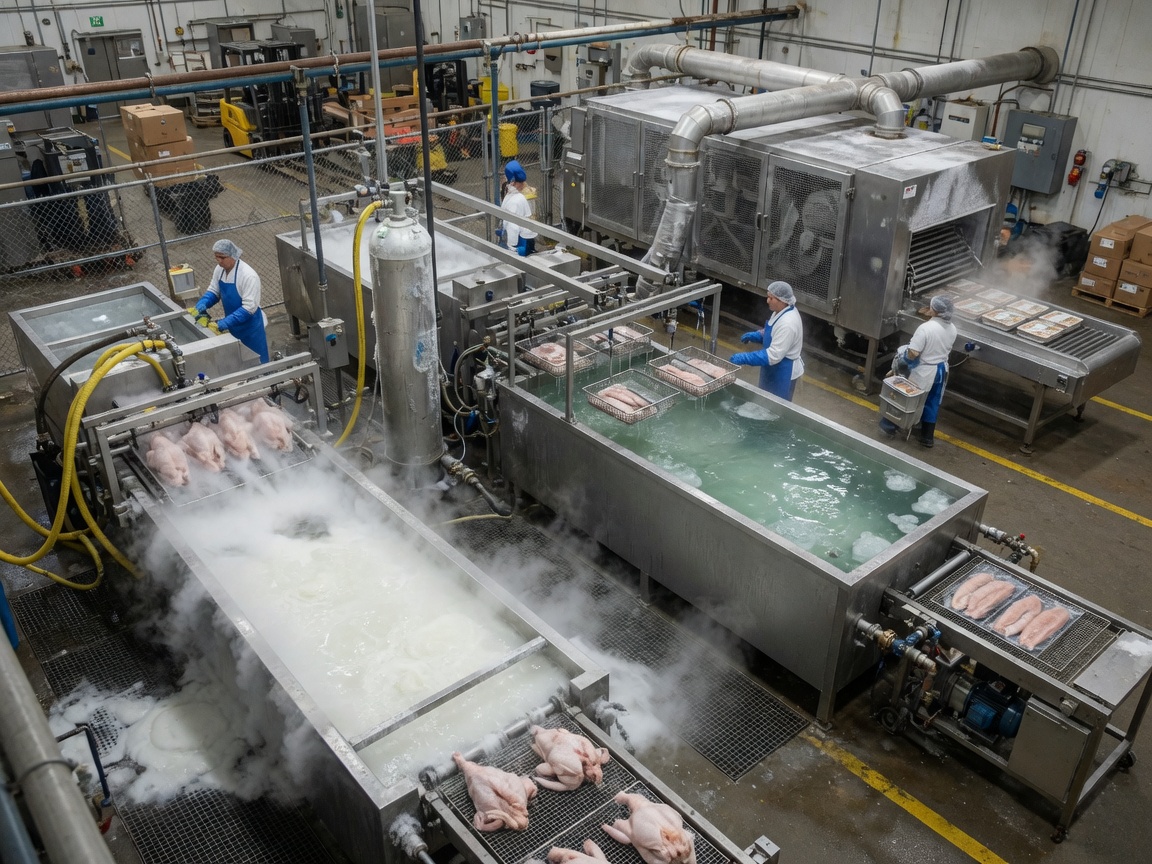
Bone-in chicken parts and whole leg quarters are the volume leaders in US poultry freezing. Spiral freezers dominate this segment due to throughput capacity and USDA-compliant sanitary design. Just as a highway interchange handles multiple traffic streams simultaneously, a large-diameter spiral freezer can process multiple product streams on segregated belt tiers — a critical operational advantage for multi-SKU poultry operations running 18-hour shifts.
Plant-based protein freezing
Plant-based burger patties and formed products present unique freezing challenges in 2026. High moisture content from binders and starches makes surface sticking a serious issue on standard mesh belts. Solid-belt conveyor freezer designs with food-grade non-stick coatings or hydrophilic belt treatments significantly reduce product loss. Industry data from plant-based contract manufacturers suggests that the wrong belt specification alone can account for 3–5% product loss per shift — a material cost at scale.
Maintenance, sanitation, and downtime best practices
This is the section that most equipment buyers skip — and most operators desperately need. Once a conveyor freezer is installed, the quality of maintenance practice determines whether the system delivers its design life of 15–20 years or degrades into a chronic source of production losses within five.
Defrost cycle management
Evaporator coil icing is the most common cause of unplanned downtime in mechanical conveyor freezer systems. Ice buildup reduces airflow, degrades thermal efficiency, and — if unchecked — can cause physical belt damage. Industry best practice calls for scheduled hot-gas defrost cycles every 8–12 operating hours under normal load, with cycle duration adjusted based on product moisture load. IoT-equipped 2026 systems from JBT and GEA now use real-time pressure differential monitoring across evaporator coils to trigger defrost only when needed, reducing unnecessary defrost cycles by 30–40% and cutting associated energy and downtime costs.
Belt cleaning protocol
The stainless steel freezing conveyor belt is more than a transport mechanism — it is an active thermal interface and a potential pathogen harbor if cleaning protocols are inadequate. A compliant cleaning sequence follows these steps:
- Dry-off: remove bulk product debris with compressed air or mechanical scrapers before introducing water.
- Pre-rinse: low-pressure warm water (below 120°F) to prevent protein baking onto belt surfaces.
- Detergent application: alkaline cleaner at manufacturer-specified concentration, contact time minimum 5 minutes.
- High-pressure rinse: remove all detergent residue; verify visually and with ATP swab test.
- Sanitizer application: peracetic acid or approved quaternary compound at validated concentration.
- Final rinse and inspection: confirm no chemical residue before restart.
Common failure points and how to prevent them
Based on maintenance data from US food processing facilities, the five most frequent conveyor freezer failure points are: belt tracking misalignment (preventable with weekly tension checks), drive sprocket wear (address with monthly lubrication and annual replacement cycles), evaporator fin corrosion from aggressive sanitizers (specify 316L stainless steel for all coil materials in high-chlorine environments), door seal degradation causing warm air infiltration (inspect quarterly, replace annually as standard), and control system sensor drift (calibrate temperature sensors every six months against certified references). Operators who implement a structured preventive maintenance schedule typically achieve 95%+ mechanical availability — those who do not average closer to 82%.
2026 trends: IoT and predictive maintenance
Why do so many facilities still run reactive maintenance programs in 2026? Often it comes down to legacy culture and data access. The newest generation of industrial freezer platforms from JBT and GEA ships with embedded IoT sensors that stream temperature uniformity maps, belt tension readings, and compressor performance data to cloud dashboards in real time. Predictive maintenance algorithms flag anomalies 48–72 hours before failure in documented field deployments. Facilities that have adopted these platforms report a 60% reduction in unplanned downtime events within the first year. The capital add-on cost is typically $15,000–$40,000 — a self-liquidating investment within two to three months of avoided production loss at most throughput levels.
Frequently asked questions
Q: What is the difference between a spiral freezer and a tunnel freezer?
A: A spiral freezer wraps a continuous belt in a vertical helix, achieving high throughput in a compact footprint — ideal for round-the-clock, high-volume operations. A tunnel freezer uses a straight belt path, offering simpler maintenance and lower capital cost but requiring significantly more floor space for equivalent throughput. Selection depends on facility layout constraints and volume requirements.
Q: How much does a commercial conveyor freezer cost?
A: Capital costs range from $80,000 for compact cryogenic conveyor units to over $1.2 million for large spiral freezer systems. Installation adds 15–25% to the purchase price. Always evaluate five-year TCO — including energy, cryogen, maintenance, and downtime costs — rather than purchase price alone when comparing options.
Q: What USDA requirements apply to conveyor freezer sanitation design?
A: USDA FSIS requires open-frame construction, no hollow structural members, radiused corners of ¼ inch minimum, and food-contact surfaces finished to 32 Ra or better. CIP capability is strongly recommended to meet HACCP plan cleaning validation requirements. Always verify equipment compliance with your USDA inspector before purchase commitment.
Q: Which conveyor freezer type is best for IQF shrimp and seafood?
A: A fluidized bed IQF freezer is the standard choice for shrimp, scallops, and small fish pieces. The upward airstream suspends individual pieces, preventing clumping and producing free-flowing frozen product. For premium sushi-grade seafood where drip loss must stay below 1%, a cryogenic IQF conveyor using liquid nitrogen delivers superior quality at higher operating cost.
Q: How often should a conveyor freezer belt be replaced?
A: Under normal operating conditions with proper cleaning protocols, stainless steel mesh belts typically last 5–8 years. Solid belts with non-stick coatings may require replacement every 3–5 years depending on abrasiveness of product and cleaning chemical compatibility. Monthly tension and wear inspections are the most reliable early warning system for belt replacement planning.
Selecting the right conveyor freezer is ultimately a systems-level decision — one that connects equipment architecture, product-specific performance, regulatory compliance, and long-term TCO into a single coherent choice. The brands and specifications covered in this guide represent the leading options available to US food processors in 2026. Use the comparison table and TCO framework as your starting analytical framework, then engage shortlisted vendors with a detailed product sample trial before final commitment. The investment in thorough due diligence at this stage consistently pays for itself many times over across the equipment's operational life.
Keywords:
Inquiry
If you are interested in our products, please leave your email to receive a free product quote, thank you!
More information


Tel:
Sales E-mail: