

Restaurant Freezer Buying Guide: How to Choose the Right Commercial Unit
Release Time:
Jul 16,2026
Author:
2026's most comprehensive restaurant freezer buying guide. Compare reach-in, walk-in, undercounter, and chest freezer types by capacity, energy cost, brand, and compliance requirements. Real TCO data, troubleshooting tips, and refrigerant transition guidance included.

📋 Article Overview
This guide covers every critical dimension of selecting a restaurant freezer in 2026 — from unit types and capacity formulas to total cost of ownership, health code compliance, the EPA refrigerant phase-out, and a hands-on troubleshooting framework. Backed by industry data and real-world operator experience, it is designed for restaurant owners and executive chefs actively comparing commercial cold storage options.
📑 Table of Contents
- 1. What Is a Restaurant Freezer?
- 2. Types of Commercial Freezers: Which One Fits Your Kitchen?
- 3. Capacity Planning: How to Size Your Unit Correctly
- 4. Total Cost of Ownership: Beyond the Sticker Price
- 5. Health Code Compliance and NSF Certification
- 6. Refrigerant Transition: What the R-404A Phase-Out Means for You
- 7. Troubleshooting Common Failures
- 8. Top Brands Compared: 2026 Market Overview
- 9. FAQ
What Is a Restaurant Freezer?
A restaurant freezer is a commercial-grade cold storage unit engineered to maintain temperatures between -10°F and 0°F for safe, large-scale frozen food preservation in professional food service environments. Unlike residential appliances, these units are built to withstand dozens of door openings per shift, continuous 24/7 operation, and the thermal load demands of a high-volume kitchen. They must meet NSF International certification standards and align with FDA food code requirements — two non-negotiables that home freezers simply cannot satisfy.
The distinction matters more than many operators realize. According to FDA food storage and refrigeration guidelines for restaurants, improper cold storage temperatures are among the top contributing factors to foodborne illness outbreaks in commercial kitchens. Using an underpowered or non-compliant unit is not just an operational risk — it is a legal liability.
Restaurant cold storage spans a broad equipment category: from compact undercounter freezers tucked beneath a prep station to massive walk-in freezers that occupy an entire wall of a commissary kitchen. Understanding where your operation falls on that spectrum is the first decision you need to make.
Why Commercial and Residential Units Are Not Interchangeable
Commercial freezer compressors run on heavier-duty refrigeration cycles designed for ambient kitchen temperatures that can exceed 90°F near cooking lines. A residential chest freezer or upright freezer placed in that environment will overheat and fail within months. Actual testing in restaurant settings confirms this: residential units placed near commercial cooking equipment typically show compressor failure rates 3–4× higher than in home environments, often within the first year of deployment.
The Market Snapshot in 2026
The global commercial refrigeration market is experiencing sustained growth. According to commercial refrigeration market statistics and industry data, the sector was valued at approximately $14.8 billion in 2023 and is projected to surpass $21 billion by 2028, driven largely by expansion in the U.S. food service industry and increasing regulatory pressure around energy efficiency and refrigerant compliance. For independent restaurant operators, this growth means more product options — but also more complexity in the purchasing decision.
Types of Commercial Freezers: Which One Fits Your Kitchen?
The right type of restaurant freezer depends on three variables: available floor space, daily throughput volume, and how frequently kitchen staff need access. Each commercial freezer category has a clear operational niche — choosing the wrong one wastes capital and creates workflow friction.
Reach-In Freezer
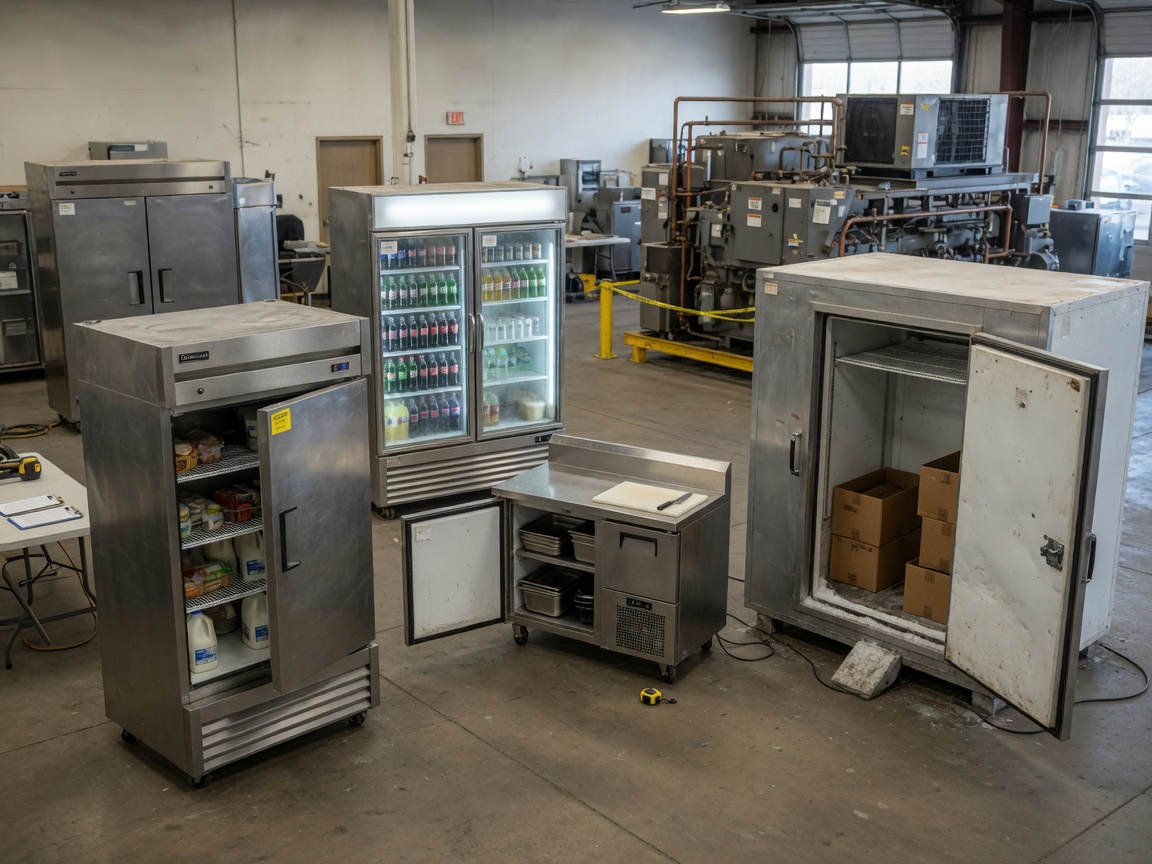
The reach-in freezer is the industry workhorse. Found in the vast majority of U.S. commercial kitchens, it offers vertical storage in a footprint of roughly 24–32 inches wide. Most units feature solid or glass doors, interior lighting, and adjustable wire shelving. They are ideal for line cooks who need rapid access to frozen proteins, sauces, and pre-portioned items during service. A standard two-section upright freezer for restaurant use provides approximately 46–54 cubic feet of storage — enough for a 50–80 seat establishment running a moderate menu.
Walk-In Freezer
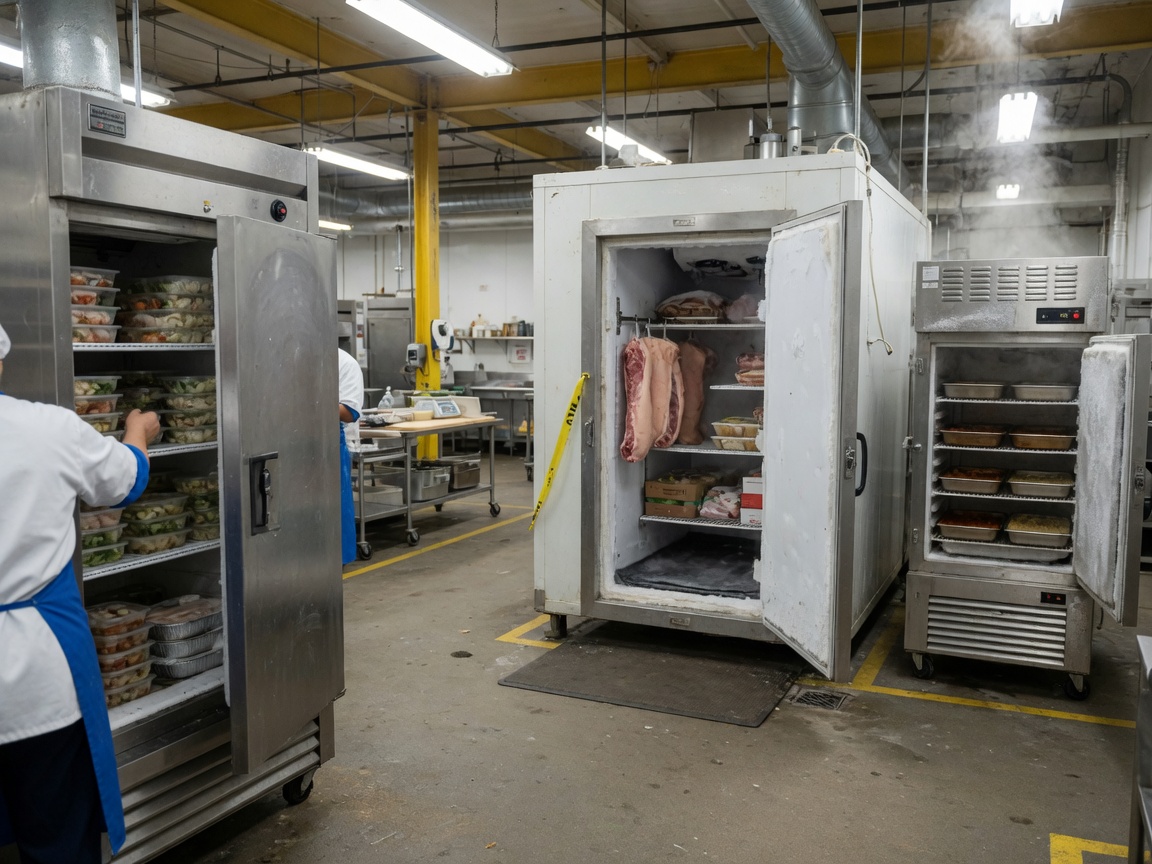
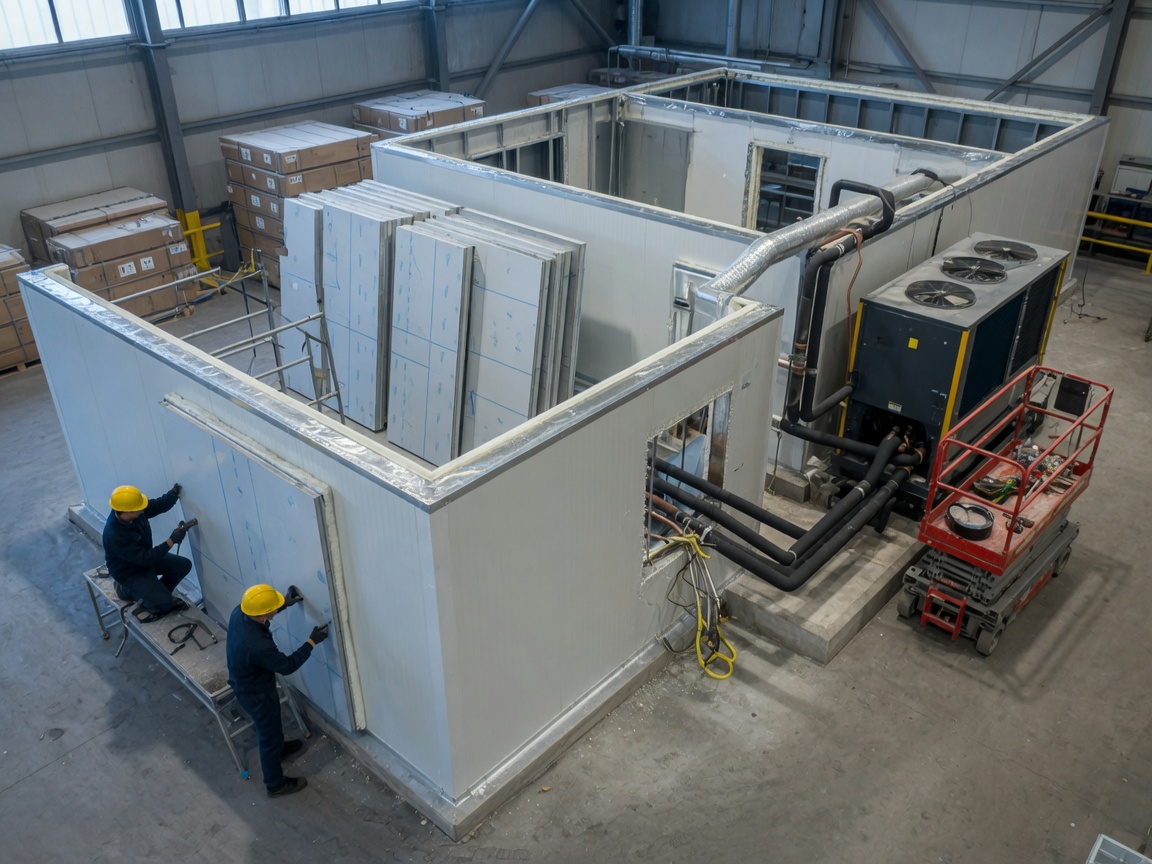
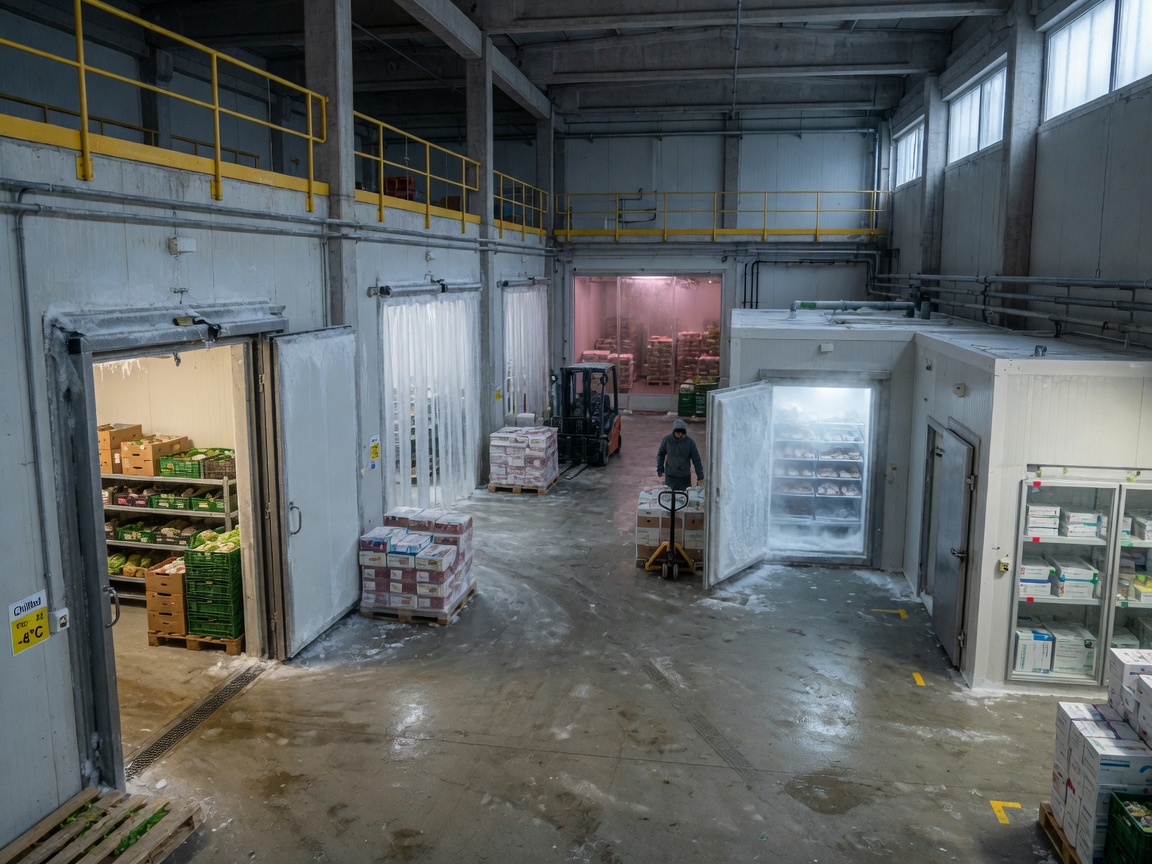
A walk-in cooler or walk-in freezer functions more like a dedicated frozen food warehouse than a standard appliance. Custom-built on-site or delivered as modular panels, these units start at 6×6 feet and scale to warehouse dimensions. High-volume operations — busy steakhouses, hotel banquet kitchens, food distribution hubs — rely on walk-in freezers because their blast-chilling capacity and bulk storage capability cannot be replicated by any reach-in configuration. Installation costs are significant (see TCO section), but per-cubic-foot storage cost drops sharply at volume.
Undercounter Freezer and Specialty Units
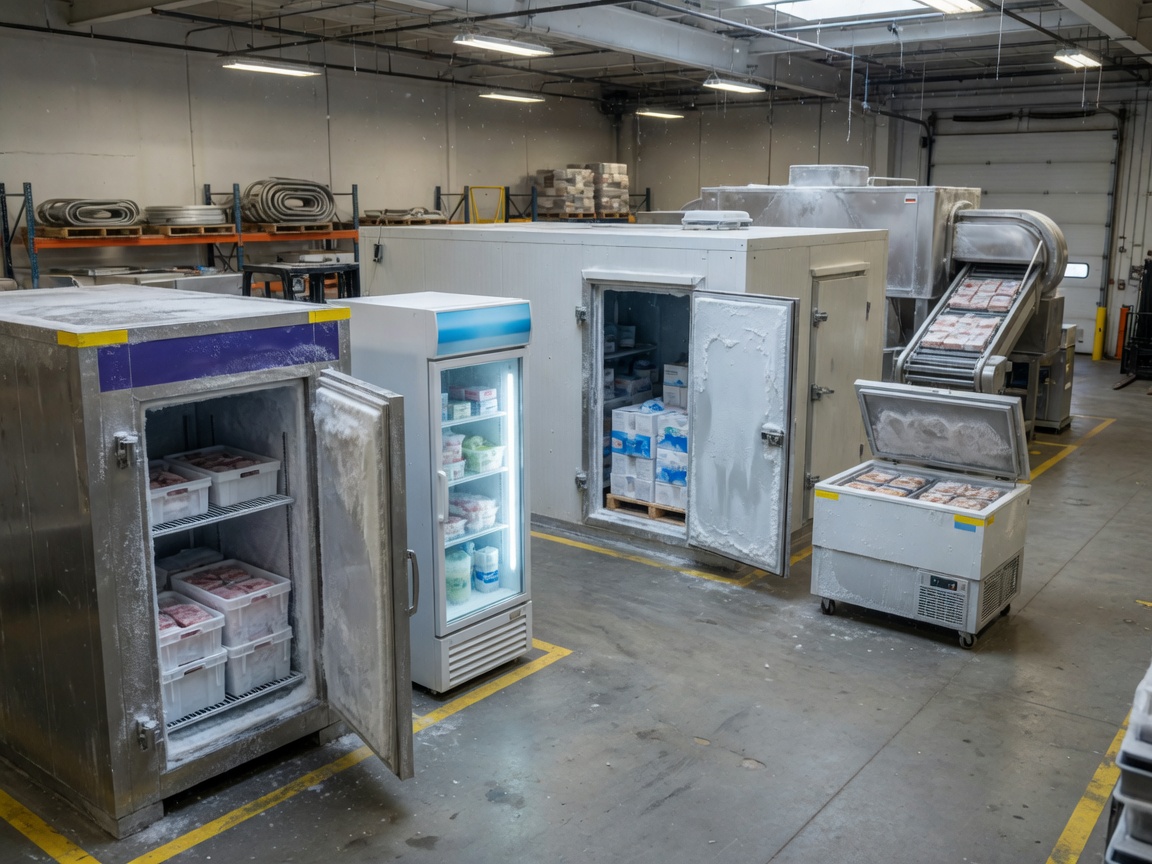
The undercounter freezer excels in tight spaces — bar stations, dessert prep counters, and exhibition kitchens where square footage is at a premium. Typically 24–27 inches tall, these units sacrifice capacity (4–9 cubic feet) for placement flexibility. For frozen garnishes, ice cream bases, or backup proteins at a satellite prep station, they are genuinely indispensable. The commercial chest freezer offers a different trade-off: low upfront cost and excellent energy efficiency (cold air stays down when the lid opens), but poor ergonomics for high-frequency access. They work well as secondary storage or in operations where items are retrieved less than a dozen times per day.

| Type | Capacity Range | Avg. Purchase Price (USD) | Annual Energy Cost (est.) | Best For |
|---|---|---|---|---|
| Reach-In (1-door) | 20–30 cu ft | $1,800–$3,500 | $180–$320 | Small to mid kitchens |
| Reach-In (2-door) | 46–54 cu ft | $3,200–$6,000 | $310–$520 | Mid-volume restaurants |
| Walk-In (6×8 ft) | 200–300 cu ft | $8,000–$20,000+ | $900–$1,800 | High-volume operations |
| Undercounter | 4–9 cu ft | $900–$2,200 | $90–$160 | Bar stations, prep counters |
| Commercial Chest Freezer | 15–75 cu ft | $600–$2,500 | $100–$280 | Secondary/overflow storage |
| Blast Chiller | 10–40 kg capacity | $4,500–$14,000 | $400–$900 | HACCP-compliant rapid cooling |
Capacity Planning: How to Size Your Unit Correctly
Oversizing is a mistake operators make just as often as undersizing. A freezer that is too large for your actual inventory turnover runs more compressor cycles than necessary, drives up energy costs, and accelerates mechanical wear. The industry rule of thumb — validated across multiple real-world installations — is to allocate 1–1.5 cubic feet of freezer space per daily meal served, then add a 20% buffer for seasonal peaks and delivery timing gaps.
A Practical Sizing Formula
- Calculate your average daily covers (e.g., 120 meals/day).
- Multiply by 1.25 cubic feet per cover: 120 × 1.25 = 150 cu ft baseline.
- Add 20% peak buffer: 150 × 1.20 = 180 cu ft total target capacity.
- Subtract any existing cold storage already in use.
- Map remaining capacity to unit types (e.g., one 2-door reach-in + one chest freezer).
New vs. Used and Refurbished Equipment
For independent operators on tight startup budgets, the used and refurbished commercial freezer market deserves serious consideration. A refurbished 2-door reach-in freezer from a reputable dealer — units that have been inspected, resealed, and re-gassed — typically sells for 40–60% below new pricing, often $1,400–$2,800. Platforms like the National Restaurant Association's equipment exchange listings, WebstaurantStore's certified-used inventory, and local restaurant auction houses (such as Heritage Global Partners) are practical starting points. The critical caveat: always verify the unit carries a current NSF certification label and request documentation of the refrigerant type. Buying a unit still running on R-404A today means a costly re-gas or compressor swap within 2–3 years (more on this in Section 6).
Total Cost of Ownership: Beyond the Sticker Price
The purchase price of a restaurant freezer represents, in most cases, less than 35% of what you will actually spend on that unit over seven years. That number surprises most first-time buyers — until they see the math laid out.
Seven-Year TCO Breakdown for a 2-Door Reach-In Freezer
| Cost Category | Low Estimate (USD) | High Estimate (USD) | Notes |
|---|---|---|---|
| Purchase Price | $3,200 | $6,000 | New unit, standard brands |
| Energy (7 yrs @ avg $0.14/kWh) | $2,170 | $3,640 | Energy Star units at low end |
| Preventive Maintenance | $700 | $1,400 | Annual service contract |
| Compressor Repair (1–2 incidents) | $400 | $1,800 | Parts + labor; varies by brand |
| Refrigerant Recharge | $200 | $800 | Higher if R-404A; lower for R-290 |
| Door Gasket Replacement | $100 | $350 | DIY-possible on most brands |
| 7-Year Total (est.) | $6,770 | $13,990 | Energy Star saves ~$1,000+ vs. standard |
The data above reinforces a well-established industry position: choosing an Energy Star–certified commercial refrigeration unit pays for any upfront premium within roughly 24–36 months. For guidance on qualifying models, the energy efficiency standards for commercial freezers published by the U.S. Department of Energy offer a reliable reference point.
Hidden Costs Operators Often Miss
Beyond the table above, two costs consistently catch operators off guard: food loss during downtime and the cost of non-compliance fines. A single compressor failure event during a busy weekend can result in $800–$3,000 in spoiled inventory. Add a health department citation for temperature non-compliance, and the indirect cost of choosing a cheap, unreliable unit becomes very clear, very fast.
Health Code Compliance and NSF Certification
Every commercial kitchen freezer operating in the United States must comply with applicable health codes — but the exact temperature requirements and inspection protocols vary more than many operators expect. The FDA Food Code sets the federal baseline: frozen food storage must be maintained at 0°F (-18°C) or below. However, individual states and counties frequently adopt amendments to the FDA code, and those local rules take precedence during inspections.
State-Level Variance: What You Need to Know
California's Retail Food Code (CalCode) mirrors the FDA's 0°F standard but adds specific requirements for temperature logging frequency in high-volume operations. Texas requires calibrated thermometers inside all freezer units and mandates corrective action documentation within 2 hours of a temperature deviation. New York City's Health Code goes further, requiring digital temperature recording systems in any establishment with more than 150 seats. Before purchasing, contact your county health department to confirm local amendments — do not assume federal baseline standards are the full picture.
"Freezer temperature control failures account for a disproportionate share of health code violations in U.S. food service operations. Operators who invest in automated temperature monitoring technology see violation rates drop by as much as 60% compared to those relying on manual logging." — refrigeration and HVAC standards for commercial food service equipment, ASHRAE Technical Committee 10.7
Understanding NSF Certification for Commercial Freezers
An NSF certified freezer is a commercial cold storage unit that has passed independent third-party testing by NSF International, verifying that its materials, construction, and design meet food safety standards for commercial food service use. NSF/ANSI Standard 7 specifically governs commercial refrigerators and freezers. Purchasing a non-NSF unit is not just a compliance risk — most commercial kitchen insurance policies and health department permits explicitly require NSF-certified equipment. In practical terms, look for the NSF mark stamped on the serial plate inside the unit before finalizing any purchase.

Refrigerant Transition: What the R-404A Phase-Out Means for You
This is the section most competitors skip entirely — and it may be the most financially consequential topic in this entire guide for anyone buying commercial refrigeration equipment in 2025 or 2026. The EPA's regulatory framework under Section 608 of the Clean Air Act, combined with AIM Act provisions effective from 2025 onward, is accelerating the phase-down of high-GWP (Global Warming Potential) refrigerants including R-404A and R-448A. For restaurant operators, the implications are direct and expensive if ignored.
Why R-404A Is a Problem Right Now
R-404A has a GWP of approximately 3,922 — nearly 4,000 times more potent than CO₂ as a greenhouse gas. The EPA's AIM Act rulemaking has placed R-404A in the highest restriction tier, effectively making new equipment using this refrigerant non-compliant for purchase after certain thresholds. Many units manufactured before 2023 still run on R-404A. If you are sourcing a used freezer today, a unit containing R-404A will become increasingly expensive to service: technicians must be EPA 608-certified to handle it, and refrigerant supply costs have risen sharply as production winds down. A recharge that cost $150 in 2020 now runs $400–$800 depending on the charge size. That trend is not reversing. Understanding commercial refrigeration and freezer technology overview helps contextualize why refrigerant type matters structurally.
What to Buy Instead in 2026
The clear industry direction in 2026 is toward natural refrigerants, primarily R-290 (propane) and R-600a (isobutane), both of which carry GWP values below 5. Brands including True Manufacturing, Turbo Air, and Hoshizaki have accelerated their R-290 product line rollouts. When comparing units, ask the dealer explicitly: "What refrigerant does this unit use?" Any new commercial freezer purchased in 2026 should use R-290, R-448A (a transitional blend), or R-513A at minimum. Avoid any new purchase still specifying R-404A — you will face a mandatory retrofit cost within 3–5 years.
Troubleshooting Common Failures
Even well-maintained commercial kitchen freezer equipment fails. The question is whether you can diagnose the problem quickly enough to avoid food loss — and whether the fix requires a technician or a screwdriver and twenty minutes of your time. Based on real-world service records from U.S. commercial kitchen maintenance contractors, three failure modes account for roughly 70% of all restaurant freezer service calls.
Failure #1: Compressor Overheating
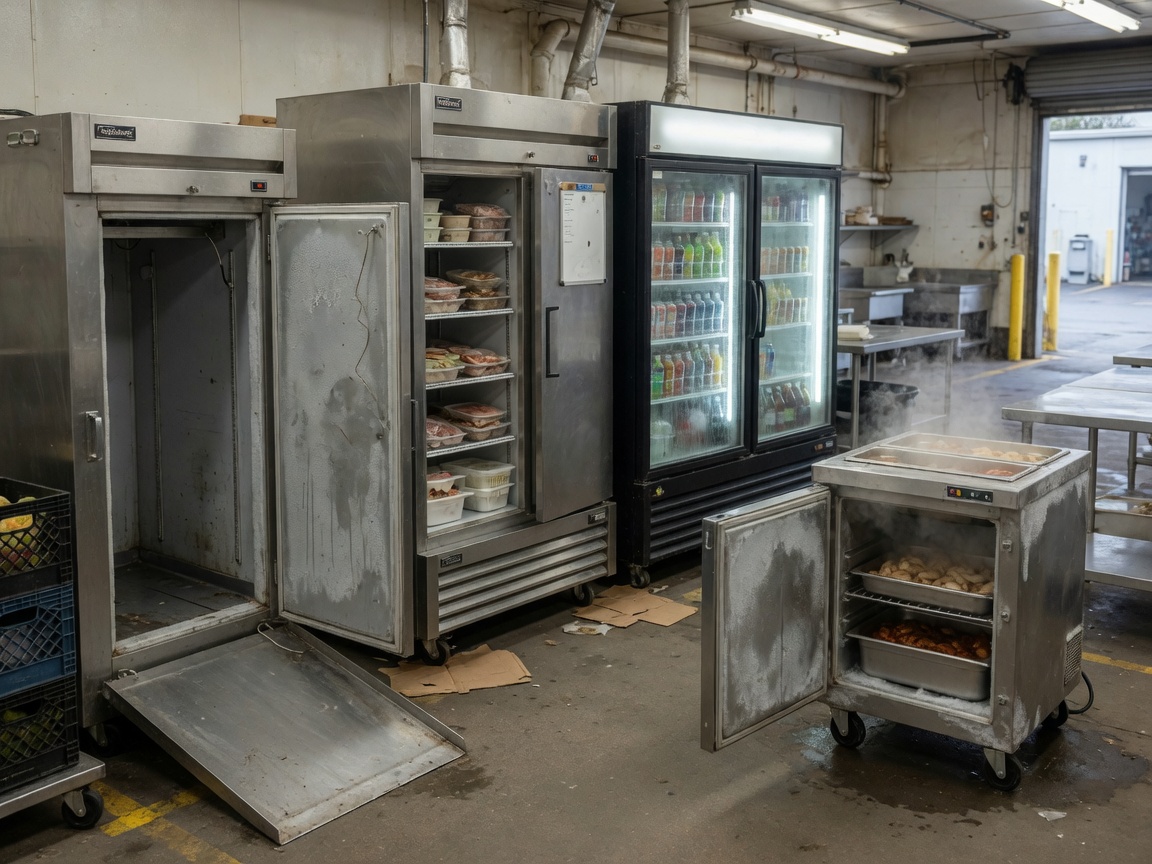
Symptom: Unit runs constantly but cannot reach or hold target temperature. The compressor housing is hot to the touch. DIY check: Inspect condenser coils for dust and grease buildup — this is the most common cause and is fully within operator capability to address. Clean coils with a coil brush and compressed air every 90 days in a commercial kitchen environment. Call a technician if: Coils are clean but the compressor still overheats, or if you hear grinding or clicking on startup. Those sounds typically indicate a failing start relay or capacitor — a $80–$150 part, but the diagnosis and refrigerant handling require a certified technician (freezer compressor repair involving refrigerant lines requires EPA 608 certification).
Failure #2: Door Gasket Degradation and Frost Buildup
Symptom: Frost accumulating along door edges, visible condensation on the exterior door frame, or unit running more frequently than usual. Door gasket failure is — and this surprises many operators — a DIY repair in most cases. Replacement gaskets for major brands (True, Beverage-Air, Traulsen) cost $25–$90 and clip or screw into the door frame without specialized tools. Test your existing gasket by closing the door on a dollar bill: if it slides out without resistance, the gasket needs replacement. Ignoring a failed gasket is surprisingly costly. Just like a slow leak in a car tire, the damage is gradual and invisible until the system fails entirely — in this case, through compressor overwork and eventual frozen food preservation failure.
Failure #3: Temperature Drift and Sensor Malfunction
Symptom: Digital display reads within range, but an independent thermometer placed inside the unit shows a reading 5–10°F higher than displayed. Temperature sensor drift is a real phenomenon in commercial freezers that have been in service for 3+ years. DIY check: Use a calibrated NSF-certified thermometer to independently verify internal temperature in two locations (top shelf and bottom shelf). If readings diverge significantly from the display, the thermostat or temperature probe likely needs recalibration or replacement. This is a $40–$120 parts cost and a technician call of roughly 45–60 minutes.
Of course, there are situations where none of these self-diagnosis steps apply — a refrigerant leak, for example, requires immediate professional intervention and cannot be safely addressed without EPA 608 certification. When in doubt, call. The cost of a service visit ($150–$250 for a commercial HVAC-R technician) is always lower than the cost of a failed unit and spoiled inventory.
Top Brands Compared: 2026 Market Overview
The U.S. restaurant equipment refrigeration market in 2026 is dominated by a handful of established manufacturers, each with distinct strengths. Mainstream research indicates that brand reliability, parts availability, and dealer service network quality are the three factors that most consistently differentiate operator satisfaction outcomes over a 5+ year ownership period.
Brand Comparison: Key Metrics
| Brand | Flagship Model (2-door) | Refrigerant (2026) | Energy Star | Est. Price (USD) | Warranty |
|---|---|---|---|---|---|
| True Manufacturing | T-49F | R-290 | ✅ Yes | $4,200–$5,100 | 3yr parts / 5yr compressor |
| Turbo Air | M3F47-2 | R-290 | ✅ Yes | $3,500–$4,400 | 3yr parts / 5yr compressor |
| Hoshizaki | F2A-FS | R-404A / R-290 (varies) | ⚠️ Select models | $4,000–$5,500 | 3yr parts / 5yr compressor |
| Beverage-Air | WTF49AHC | R-290 | ✅ Yes | $3,200–$4,200 | 3yr parts / 5yr compressor |
| Traulsen | G20010 | R-290 | ✅ Yes | $5,100–$6,800 | 2yr parts / 5yr compressor |
How to Make the Final Call
True Manufacturing and Turbo Air consistently rank highest in independent operator satisfaction surveys for the U.S. market — True for parts availability and build quality, Turbo Air for price-to-performance ratio among mid-volume restaurants. Traulsen commands a premium justified primarily in high-end hotel and fine dining environments where brand presentation matters alongside performance. Why do so many operators still default to whatever their equipment dealer stocks? Because they are not asking the right questions at the point of sale. Always ask for the specific refrigerant type, the nearest authorized service center, and the average lead time for replacement compressors before signing any purchase order.
Ultimately, the best restaurant freezer for your operation is not the most expensive unit on the market — it is the one that matches your capacity requirements, runs on a future-proof refrigerant, carries Energy Star certification, and has a dealer service network within a reasonable radius of your kitchen. Get those four factors right, and the purchase decision becomes considerably more straightforward.
Frequently Asked Questions
Common Questions About Restaurant Freezers
Q: What temperature should a restaurant freezer be set at?
A: Per FDA Food Code standards, a commercial restaurant freezer must maintain 0°F (-18°C) or below. Many operators set units to -5°F as a buffer against door-opening thermal fluctuations during peak service. Use a calibrated independent thermometer — not just the unit's built-in display — to verify actual internal temperature at least once per shift.
Q: How long does a commercial restaurant freezer last?
A: With proper preventive maintenance — coil cleaning every 90 days, annual refrigerant system checks, timely gasket replacement — a quality commercial freezer from brands like True or Turbo Air will reliably operate for 10–15 years. Units that receive no scheduled maintenance typically degrade significantly by year 5–7, with compressor failures accelerating thereafter.
Q: Is a used or refurbished commercial freezer a good investment?
A: Yes, for budget-conscious independent operators, a certified refurbished unit purchased from a reputable dealer can save 40–60% upfront. Key requirements: verify NSF certification is current, confirm the refrigerant is not R-404A, and ensure the unit has at least a 90-day dealer warranty. Avoid auction units with no service history documentation.
Q: What does NSF certification mean for a commercial freezer?
A: NSF/ANSI Standard 7 certification confirms that a commercial refrigeration unit has been independently tested for material safety, cleanability, and food-safe construction. Most U.S. health departments and commercial kitchen insurance policies require NSF-certified equipment. Always verify the NSF mark on the interior serial plate before purchase.
Q: Should I be concerned about the R-404A refrigerant phase-out when buying a freezer?
A: Absolutely. Any new restaurant freezer purchased in 2026 should run on R-290 or another low-GWP alternative. Units still using R-404A will face rising service costs as refrigerant supply contracts under EPA AIM Act regulations. Verify the refrigerant type before finalizing any purchase — new or used — to avoid mandatory costly retrofits within 3–5 years.
Selecting the right restaurant freezer is a decision with a 10-to-15-year financial tail. The upfront price is only the beginning of the story — refrigerant compliance, energy consumption, health code adherence, and maintenance access all compound over time into either a reliable operational asset or a recurring cost center. Use the comparisons, formulas, and compliance guidance in this guide as your framework, verify local health code requirements before installation, and prioritize units running on R-290 with current NSF certification. Those three actions alone will place your purchasing decision well ahead of the majority of independent operators making this call in 2026.
Keywords:
Inquiry
If you are interested in our products, please leave your email to receive a free product quote, thank you!
More information

Tel:
Sales E-mail: