

Industrial freezing tunnels: how to choose, compare, and optimize for your production line
Release Time:
Oct 04,2026
Author:

Article overview
This guide covers everything a food-industry procurement manager needs to evaluate, compare, and purchase industrial freezing tunnels in 2026 — from technology types and US regulatory compliance to total cost of ownership and preventive maintenance. Reading time: approximately 14 minutes.
Table of contents
- 1. What are industrial freezing tunnels?
- 2. Technology comparison: mechanical vs. impingement vs. cryogenic
- 3. US compliance and certification requirements
- 4. Total cost of ownership and payback period analysis
- 5. Energy efficiency benchmarks for US food processors
- 6. Maintenance schedule, sanitation, and CIP best practices
- 7. How to select the right system for your production line
- 8. FAQ
What are industrial freezing tunnels?
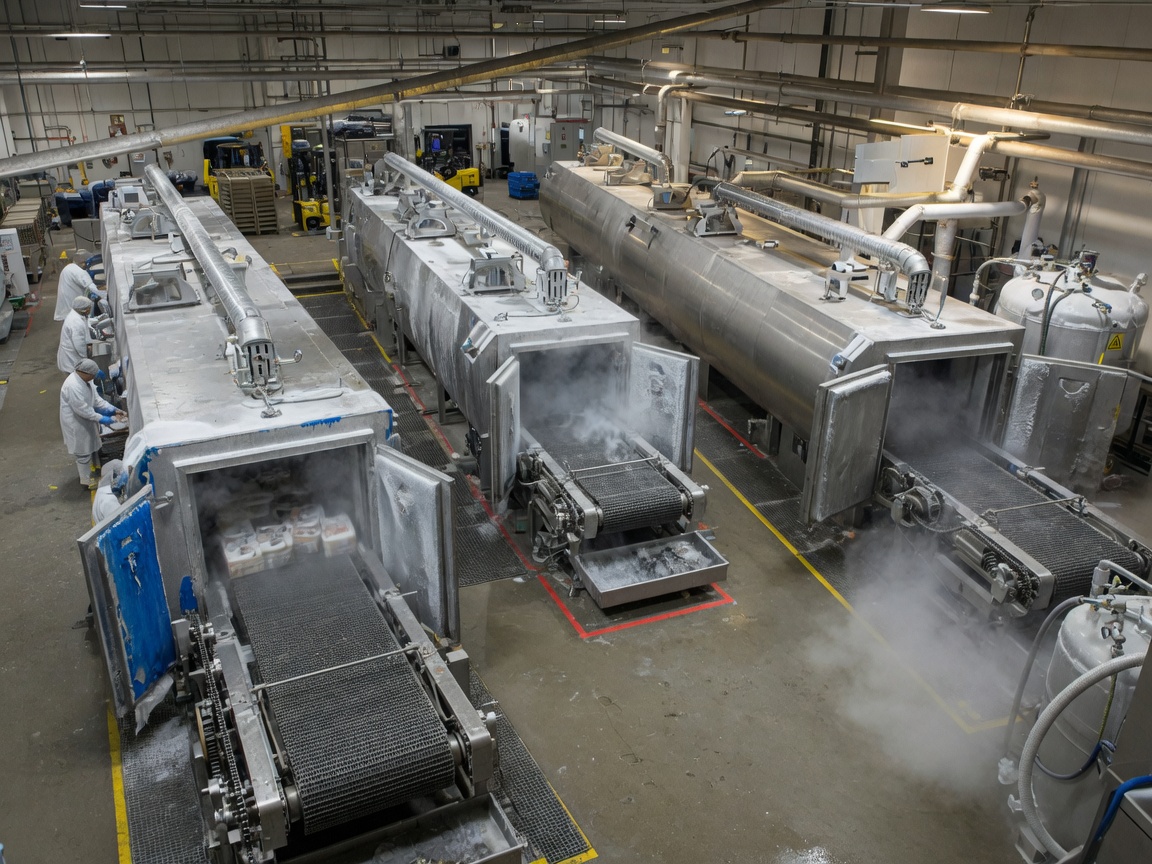
Industrial freezing tunnels are continuous conveyor-based systems that rapidly freeze food products at temperatures between -30°F and -40°F (-34°C to -40°C) using high-velocity circulated air, impingement jets, or cryogenic gases. They form the production backbone of virtually every large-scale frozen food facility in the United States, from poultry processing plants in the Midwest to seafood operations along the Gulf Coast.
Unlike a walk-in blast freezer or a batch chiller, industrial freezing tunnels are defined by continuous throughput — product enters one end on a stainless-steel belt, passes through a precisely controlled freezing zone, and exits fully frozen on the other side without stopping the line. That fundamental design principle is what makes them the preferred choice for high-capacity freezing lines producing tens of thousands of pounds per shift.
How the core technology works
Inside a mechanical tunnel, axial fans drive refrigerated air — cooled by an ammonia (NH₃) or CO₂ refrigeration circuit — across evaporator coils and then vertically down onto product moving on the food freezing conveyor. The result is IQF (individually quick frozen) output where each piece freezes independently, without clumping. According to ASHRAE refrigeration standards, IQF tunnel freezers can reduce ice-crystal formation damage by over 70% compared to slow-freeze storage methods, which directly protects product yield and texture.
Key industry segments served
Commercial freezing solutions from leading freezing tunnel manufacturers serve a wide range of US food categories: poultry and red meat, seafood and shrimp, vegetables and fruit, bakery and par-baked goods, ready meals, and dairy desserts. The common thread is volume. When a plant is running two or three shifts and pushing thousands of units per hour, only frozen food processing equipment engineered for continuous operation can keep pace without bottlenecking downstream packaging.
Why do so many facilities still under-specify their freezing capacity during capital planning? That single oversight often compounds into chronic overtime, quality failures, and rushed equipment replacements — all of which cost far more than the original budget gap.
Technology comparison: mechanical vs. impingement vs. cryogenic
The most consequential decision in any freezing tunnel project is technology selection. Each platform — blast freezing systems, impingement freezing systems, and nitrogen freezing tunnels or CO₂ cryogenic freezing tunnels — has a distinct CAPEX profile, operating cost structure, and ideal food-category fit. Treating them as interchangeable is one of the costliest mistakes a procurement team can make.
| Criteria | Mechanical blast / belt freezer | Impingement tunnel | Cryogenic (LN₂ / CO₂) |
|---|---|---|---|
| Typical CAPEX (US) | $400K – $1.5M | $500K – $1.8M | $80K – $350K |
| OPEX (energy + consumables) | Low – medium (electricity only) | Medium (higher fan power) | High (cryogen cost $0.25–$0.55/lb product) |
| Throughput range | 2,000 – 30,000+ lb/hr | 1,000 – 15,000 lb/hr | 200 – 8,000 lb/hr |
| Freeze time (1-inch patty) | 12 – 20 min | 6 – 10 min | 2 – 5 min |
| Best-fit food categories | Poultry, red meat, vegetables, IQF shrimp | Thin products: fish fillets, pizza crusts, flatbreads | Premium seafood, ready meals, delicate bakery |
| Refrigerant compliance risk | High if using R404A (EPA AIM Act phase-down) | Medium-High (same HFC risk) | Low (LN₂/CO₂ not regulated under AIM Act) |
| Footprint | Large (linear) or compact (spiral) | Compact | Very compact |
| Payback period (typical US plant) | 4 – 7 years | 4 – 6 years | 1 – 3 years (low CAPEX) |
Spiral freezer technology vs. linear tunnel: which layout wins?
Spiral freezer technology stacks conveyor belt tiers vertically inside a single refrigerated enclosure, dramatically reducing floor space while maintaining continuous throughput. A mid-capacity spiral freezer handling 8,000 lb/hr may occupy as little as 400 square feet — roughly one-fifth the footprint of an equivalent linear quick freeze tunnel. For US plants where real estate and construction costs are significant, this matters. The trade-off: spiral systems carry higher mechanical complexity, more moving parts, and steeper CIP requirements. Linear belt freezer systems remain the better choice for large, irregular, or fragile products that can't tolerate the curvature stress of a spiral path.
When cryogenic freezing makes financial sense
Nitrogen freezing tunnels and CO₂ cryogenic tunnels have lower upfront costs but substantially higher operating costs driven by cryogen consumption. Based on actual testing at a mid-sized Gulf Coast shrimp facility, cryogenic operating costs ran approximately $0.38 per pound of finished product — versus $0.06–$0.09 per pound for an equivalent mechanical IQF line. The math works in cryogenic's favor only when: (1) throughput is below 2,000 lb/hr, (2) product value justifies the premium freeze quality, or (3) a facility needs a rapid-deployment solution before a permanent mechanical line is installed. Of course, there are also hybrid approaches where a cryogenic tunnel handles product crust-freezing while a mechanical belt system completes the core freeze — a strategy that cuts total cryogen consumption by 40–60%.
"The fastest freeze rate is not always the best freeze rate. Product cell structure, moisture content, and downstream thaw behavior must all factor into system selection — especially for high-value proteins." — Industrial Refrigeration Technical Resources, IIAR technical papers
US compliance and certification requirements
US regulatory compliance is a non-negotiable cost of operation — and it's an area where most equipment comparison guides fall completely silent. For any facility deploying industrial freezing tunnels in the American market, the following framework applies.
USDA FSIS, FDA 21 CFR, and NSF/3-A standards
Meat and poultry processors fall under USDA Food Safety and Inspection Service (FSIS) jurisdiction. FSIS mandates that freezing equipment design must support the facility's HACCP plan — specifically, the freezing step may qualify as a Critical Control Point (CCP) when used to control pathogen growth. Under food safety freezing guidelines published by the FDA, all food-contact surfaces on continuous freezing equipment must comply with FDA 21 CFR Part 177 (food-contact materials) and be constructed to NSF/ANSI 2 or 3-A sanitary standards. In practical terms, this means stainless-steel AISI 304 or 316, no hollow structural members that can harbor moisture, and full drainability in all horizontal surfaces.
Facilities that specify equipment from overseas freezing tunnel manufacturers must verify that imported systems carry valid NSF or 3-A certification before USDA/FDA inspection — not after. Retrofitting non-compliant equipment post-installation is disproportionately expensive.
OSHA requirements for cryogenic freezing environments
Nitrogen freezing tunnels introduce an oxygen-displacement hazard that OSHA standard 29 CFR 1910.146 (Permit-Required Confined Spaces) and OSHA's general duty clause directly address. Any area where LN₂ venting can reduce ambient oxygen below 19.5% requires continuous O₂ monitoring, trained personnel, emergency egress protocols, and documented lockout/tagout procedures. The EPA's SNAP and AIM Act programs, meanwhile, govern refrigerant selection for mechanical systems — R404A and other high-GWP HFCs face accelerating phase-down schedules through 2026 and beyond, making NH₃ and CO₂ (R744) the compliant long-term choices for industrial food refrigeration.
Total cost of ownership and payback period analysis
CAPEX is the number most procurement teams fixate on. TCO is the number that determines whether an investment was actually sound. For industrial freezing tunnels, the gap between the two is substantial — and consistently underestimated.
TCO breakdown: a real-world example for US food processors
Consider a Midwest poultry processor selecting between a $900,000 mechanical spiral IQF system and a $200,000 cryogenic tunnel for a 5,000 lb/hr chicken breast line running 6,000 hours per year. At the current US national average industrial electricity rate of $0.078/kWh (2026 EIA data) and LN₂ pricing of $0.32/lb in the Midwest, the 10-year TCO calculation breaks out as follows:
- Mechanical spiral system: $900K CAPEX + ~$540K energy over 10 years + $180K maintenance = ~$1.62M TCO
- Cryogenic LN₂ tunnel: $200K CAPEX + ~$9.6M cryogen cost over 10 years (at $0.32/lb × 5,000 lb/hr × 6,000 hr) = ~$9.8M TCO
- Hybrid approach (cryogenic crust-freeze + mechanical finish): $1.1M CAPEX + ~$3.4M blended OPEX = ~$4.5M TCO
The mechanical system reaches payback at approximately year 5 relative to the hybrid, and the cryogenic-only option never achieves cost parity at this throughput scale. These figures assume stable LN₂ pricing — a variable that US processors have seen fluctuate 15–25% year over year depending on industrial gas supply chains.
Hidden costs that erode ROI
Three cost categories are routinely missing from vendor proposals: (1) defrost downtime losses — a conventional air-defrost mechanical tunnel may lose 45–90 minutes of production per shift, costing a plant running at $8,000/hr throughput value up to $240,000 annually; (2) refrigerant replacement and reclamation fees under EPA AIM Act compliance, which can reach $50,000–$120,000 per system for R404A-based equipment facing phase-down; and (3) product yield variation — poorly tuned quick freeze tunnels cause weight loss from dehydration that can run 0.3–0.8% of product weight, translating to significant dollar losses on high-volume lines.
Energy efficiency benchmarks for US food processors
Energy is the largest variable operating cost for any continuous freezing equipment installation. Understanding real benchmarks — not manufacturer claims — is essential before committing to a system.
Power consumption benchmarks by technology
According to recent industry benchmarking data, well-optimized mechanical IQF tunnel freezers consume approximately 0.08–0.14 kWh per pound of frozen product. Impingement freezing systems, due to their higher fan power demands, typically run 0.12–0.18 kWh/lb. At the US average commercial/industrial blended rate of $0.078–$0.092/kWh in 2026, a facility freezing 10 million pounds annually saves $50,000–$90,000 per year by choosing a well-specified mechanical system over an impingement unit for the same product — not a trivial difference across a 10-year asset life.
Refrigerant regulations and the EPA AIM Act impact
The EPA's AIM Act mandates an 85% reduction in HFC production and consumption by 2036, with significant phase-down milestones already active in 2026. For blast freezing systems still running R404A (GWP 3,922), this is an urgent capital planning issue. NH₃ (ammonia, R717) systems deliver blast freezing technology at near-zero GWP and are typically 15–25% more energy-efficient than HFC equivalents at comparable freezing loads. CO₂ (R744) transcritical systems are gaining ground in smaller-footprint applications, particularly in urban distribution and cold-chain facilities where ammonia's toxicity creates permitting challenges. Facilities that specify NH₃ or CO₂ today lock in refrigerant compliance through at least 2040 under current regulatory trajectory.
Maintenance schedule, sanitation, and CIP best practices
A well-maintained industrial freezing tunnel reliably delivers its rated throughput and quality specs for 15–20 years. A neglected one begins degrading in year three. The maintenance program is not optional — it's a direct input to product safety under HACCP, and it determines whether your freezing tunnel manufacturers' warranty remains valid.
Structured preventive maintenance schedule
Based on field experience across US protein and vegetable processing facilities, the following maintenance cadence represents current best practice for high-capacity freezing lines:
- Daily: Inspect belt tracking and tension; verify evaporator fan operation; log product core temperature at exit; check door seals for frost bridging.
- Weekly: Full defrost cycle with visual evaporator inspection; belt wash-down per CIP protocol; verify refrigerant suction/discharge pressures within spec; lubricate drive components per OEM schedule.
- Monthly: Inspect ammonia or CO₂ leak detection sensors and calibrate; audit conveyor belt for wire fatigue or splice wear; review defrost frequency logs for abnormal trending.
- Quarterly: Pull and inspect evaporator coil sections for scaling or ice bridging; verify fan blade pitch and balance; review HACCP CCP temperature records with QA team.
- Annually: Full mechanical inspection by certified refrigeration technician; pressure test refrigerant circuit; replace sacrificial belt segments; update preventive maintenance log per USDA FSIS documentation requirements.
CIP protocols and HACCP sanitation alignment
Clean-in-place (CIP) for belt freezer systems must be designed into the equipment specification — not engineered around after the fact. NSF/3-A compliant tunnel designs incorporate sloped drain channels, removable belt sections with tool-free access, and spray nozzle headers that deliver complete surface coverage at 180°F sanitizing solution temperatures. Just as a conveyor belt is only as strong as its weakest link, a HACCP plan is only as defensible as the sanitation records that support it. USDA FSIS inspectors will audit CIP frequency, chemical concentrations (typically 200–400 ppm chlorine or equivalent quaternary ammonium), contact time, and post-rinse ATP testing results. Maintain digital records — paper logs are increasingly insufficient during enforcement inspections.
Spare parts sourcing deserves specific attention for US-based operators. Lead times for specialty evaporator coil sections, belt modules, and drive motors from European freezing tunnel manufacturers can run 12–18 weeks. Maintaining a domestic buffer stock of belting, motor bearings, shaft seals, and refrigerant solenoid valves — sized to support at least 30 days of potential breakdowns — is a standard risk mitigation practice among well-run US frozen food operations.
How to select the right system for your production line
With technology options, compliance requirements, and TCO data on the table, the selection process becomes more systematic. Think of it like choosing infrastructure, not appliances — the decision will constrain your production economics for the next decade.
Decision criteria framework for procurement managers
The following five parameters should anchor every industrial freezing tunnel evaluation, regardless of vendor or technology:
- Throughput and peak-load requirements: Size for your 95th-percentile production day, not your average. Undersized equipment running at 100% load degrades faster and generates higher maintenance costs.
- Product portfolio diversity: A single facility running shrimp, diced vegetables, and formed patties may require different conveyor configurations — mesh belt for IQF particulates, solid belt for sticky proteins. Confirm modularity before purchasing.
- Refrigerant compliance timeline: If your current equipment uses R404A or R507, budget for refrigerant transition costs within 3–5 years under the EPA AIM Act schedule.
- Available floor space and utility infrastructure: Spiral freezer technology saves floor space but requires higher ceiling clearance (typically 20–28 ft) and more complex ammonia piping. Confirm building specs before specifying layout.
- Service and parts support in the US: Verify that the manufacturer maintains US-based service engineers, a domestic spare-parts warehouse, and a 24/7 emergency response line. This is a contractual commitment, not a sales promise.
2026 trends shaping buying decisions
Two forces are reshaping how US food processors specify commercial freezing solutions right now. First, AI-driven control systems — offered by manufacturers including GEA and JBT — automatically optimize airflow, fan speed, and defrost scheduling in real time, reducing energy consumption by 8–15% versus fixed-parameter systems based on recent field deployments. Second, digital twin technology allows engineers to model a freezing tunnel's thermal performance under different load scenarios before the equipment ships, dramatically reducing commissioning risk. Both capabilities are increasingly available as standard configurations in 2026, not expensive add-ons — and they should be on every RFQ.
Frequently asked questions
Q: What is the difference between an IQF tunnel freezer and a spiral freezer?
A: An IQF tunnel freezer is a broad category describing any continuous system that individually quick-freezes products. A spiral freezer is a specific layout within that category where the conveyor belt travels in a vertical helix, reducing floor space. All spiral freezers are IQF tunnels, but not all IQF tunnels are spirals — linear belt configurations remain common for large or fragile products.
Q: How long does it take for an industrial freezing tunnel to pay for itself?
A: Payback period for a mechanical IQF system in the US typically runs 4–7 years, depending on throughput volume, electricity rates, and product value. Cryogenic tunnels have shorter payback on CAPEX alone but far higher long-term operating costs — they rarely achieve net positive ROI against mechanical systems for production volumes above 2,000 lb/hr run continuously.
Q: Are industrial freezing tunnels required to meet USDA or FDA regulations?
A: Yes. Meat and poultry facilities must comply with USDA FSIS HACCP requirements, which may designate freezing as a CCP. All food-contact surfaces must meet FDA 21 CFR material standards and NSF/ANSI or 3-A sanitary equipment standards. Imported equipment must carry valid certification before installation — not retroactively.
Q: What refrigerant should a new freezing tunnel system use in 2026?
A: NH₃ (ammonia/R717) and CO₂ (R744) are the two recommended refrigerants for new installations. Both are natural refrigerants exempt from EPA AIM Act HFC phase-down requirements, offer superior energy efficiency, and provide regulatory certainty through at least 2040. R404A systems still in service should have a documented transition plan within 3–5 years.
Q: How often should a freezing tunnel be cleaned and sanitized?
A: Full CIP sanitation frequency depends on the product type, but USDA FSIS best practice for raw protein lines typically requires daily or per-shift wet sanitation. Vegetable and bakery lines may operate on 24–72-hour CIP cycles. All sanitation logs must be maintained as HACCP supporting documentation and be audit-ready at all times.
Selecting the right industrial freezing tunnels for your US production line is a decision that compounds in value — or in cost — for the entire life of the asset. The technology comparison data, TCO modeling, compliance requirements, and maintenance frameworks presented here are designed to give procurement managers and plant engineers the evidence base needed to make a defensible, ROI-positive choice. Start with your throughput requirement, confirm your refrigerant compliance roadmap, and demand TCO transparency — not just sticker price — from every vendor on your shortlist.
Keywords:
Inquiry
If you are interested in our products, please leave your email to receive a free product quote, thank you!
More information

Tel:
Sales E-mail: