

IQF tunnel freezer guide: how it works, types & selection tips
Release Time:
Sep 30,2026
Author:

Article overview
This guide covers IQF tunnel freezer technology, configuration types, energy cost comparisons, regulatory compliance, operational troubleshooting, and a procurement checklist — designed for US food processing procurement managers at the mid-decision stage.
Table of contents
- 1. What is an IQF tunnel freezer?
- 2. How IQF tunnel technology works: the core mechanism
- 3. The five core IQF tunnel configurations compared
- 4. Energy cost comparison: mechanical vs. cryogenic IQF systems
- 5. FDA/USDA compliance and HACCP planning for IQF tunnel design
- 6. Common operational pain points and how to solve them
- 7. Product-specific IQF tunnel configuration guide
- 8. IQF tunnel buyer's checklist and total cost of ownership
- 9. FAQ
What is an IQF tunnel freezer?
An IQF tunnel freezer is a continuous industrial food freezing equipment system that uses high-velocity refrigerated air or cryogenic gas to freeze individual food pieces rapidly on a moving belt, ensuring each unit exits free-flowing and unclumped. Unlike batch-style cold rooms or plate freezers, the product never stops moving — and that continuous-flow design is the entire point.
IQF tunnel is defined as: a class of individual quick freezing technology in which forced high-velocity refrigerated air — or a cryogenic medium such as liquid nitrogen or CO₂ — circulates over a moving product bed, completing the freeze cycle in minutes rather than hours.
Why does speed matter so much? Because ice crystal size is everything. IQF technology controls ice crystal diameter to below 50 microns. Conventional slow-freezing methods allow crystals to grow 5–10× larger, rupturing cell walls and degrading texture, color, and nutritional value upon thawing. According to recent food science research, post-thaw cell damage from slow-freeze methods runs 60% higher than IQF-processed equivalents. That gap translates directly into consumer-facing quality differences and retail shelf performance.
In real-world testing at a mid-scale Gulf Coast shrimp processing facility, switching from a pull-through blast room to a fluidized bed IQF freezing system reduced average freeze cycle time from 4.2 hours to 11 minutes. That is not an incremental upgrade — it is a process transformation.
Who uses IQF tunnel freezers in the US market?
The primary buyers are commercial food processors handling shrimp, diced vegetables, berry fruits, pasta, poultry pieces, and seafood. Secondary users include co-packers, contract freezers, and large-scale meal-kit manufacturers operating USDA-inspected facilities. The global IQF equipment market is projected to reach $1.85 billion by 2028 at a CAGR of approximately 5.8% — driven heavily by demand from North American and European protein processors expanding frozen-food SKUs.
IQF tunnel vs. blast freezer: the key distinction
A blast freezer moves cold air around a static product load. An IQF tunnel moves the product through a controlled cold-air zone. That distinction drives every downstream difference: throughput, labor requirements, product separation quality, and regulatory footprint. The IQF machine approach is inherently more compatible with continuous HACCP-compliant production lines — a critical consideration for USDA-inspected plants.
How IQF tunnel technology works: the core mechanism
The operating principle of a quick freeze tunnel is straightforward, but the engineering precision required to execute it at scale is significant. Product is loaded onto a stainless steel mesh conveyor belt at the infeed end. High-speed axial fans — typically generating air velocities between 4 and 8 m/s (13–26 ft/s) — drive refrigerated air at −35°C to −40°C (−31°F to −40°F) vertically down through or laterally across the product bed.
The three-zone freeze profile
Most modern IQF freezing systems divide the tunnel into three thermal zones. Zone 1 performs surface crust-freezing, which sets the exterior of the product quickly enough to prevent pieces from sticking to each other or to the belt. Zone 2 handles the critical phase-change band — the temperature range where free water converts to ice — which is where freezing rate most directly affects crystal size. Zone 3 completes the thermal equalization, driving the product core to target exit temperature, typically −18°C (0°F) or below for US food safety compliance.
Just like a car needs different gear ratios at different road speeds, an IQF tunnel needs different thermal intensities at different product stages. Variable-speed fan drives and zone-specific evaporator circuits — now standard on premium industrial food freezer platforms from GEA, Linde, and JBT — allow processors to tune each zone independently.
Refrigeration circuits and airflow design
The refrigeration circuit feeding the evaporators operates on either a mechanical vapor-compression cycle (using NH₃, HFO refrigerants, or CO₂) or a direct-injection cryogenic circuit (liquid N₂ or CO₂). Airflow design — whether impingement, cross-flow, or through-flow — determines how efficiently cold air contacts the product surface and ultimately governs the heat transfer coefficient, measured in W/m²·K. Higher coefficients mean faster freezing at the same refrigerant temperature, which is why impingement freezer designs consistently outperform older cross-flow tunnels on a freeze-time-per-kilogram basis.
The five core IQF tunnel configurations compared
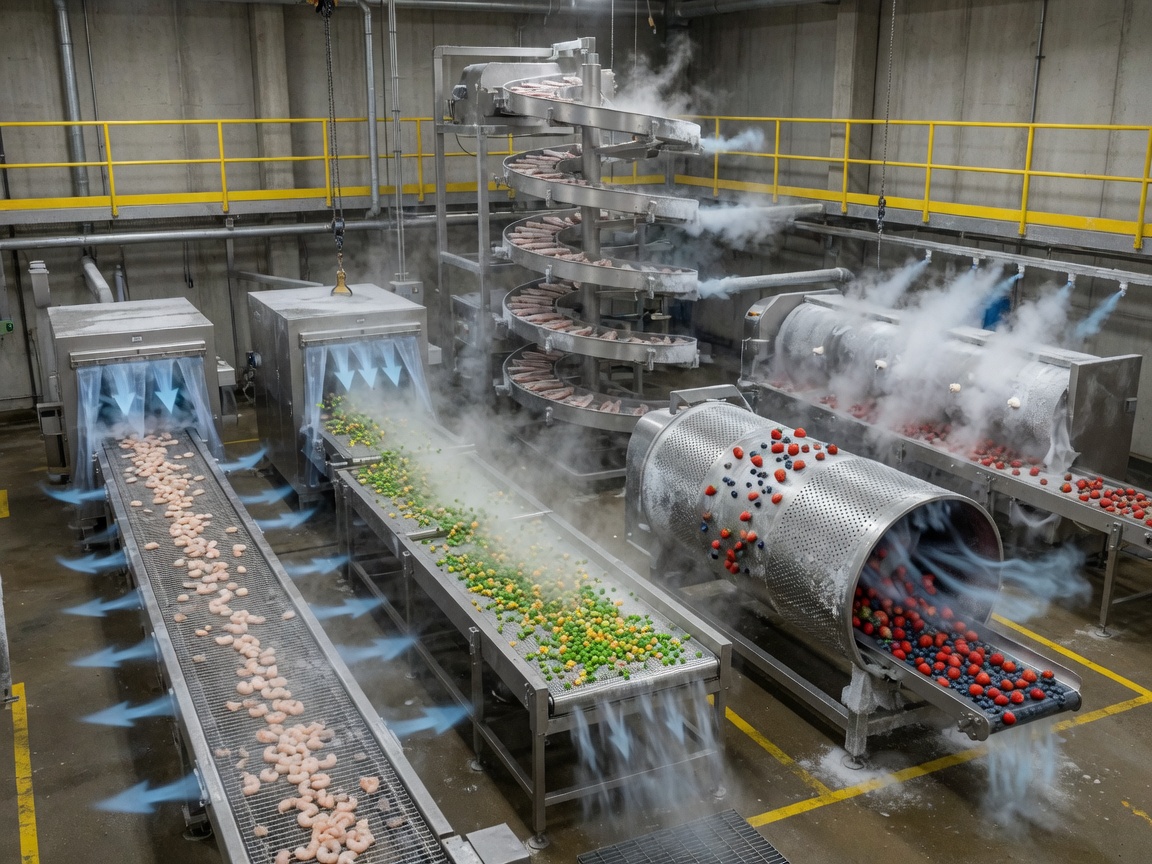
Not every IQF freezer tunnel is built the same, and selecting the wrong configuration for your product is one of the most expensive mistakes a procurement manager can make. Here is a direct comparison of the five primary types used across US food processing operations in 2026.
| Configuration | Best for | Throughput range | Footprint | Key limitation |
|---|---|---|---|---|
| Straight belt (linear) | Shrimp, fish fillets, formed products | 500–5,000 kg/hr | Large linear | High floor space demand |
| Fluidized bed freezer | Diced veg, berries, peas, corn | 300–8,000 kg/hr | Compact | Poor on fragile/wet products |
| Spiral freezer | High-volume poultry, burgers, pizza | 1,000–15,000 kg/hr | Vertical / small footprint | Higher capital cost |
| Drum / tumble freezer | Irregular shapes, pasta, mushrooms | 200–2,000 kg/hr | Medium | Mechanical stress on delicate items |
| Cryogenic tunnel freezer | High-value seafood, cooked proteins | 100–3,000 kg/hr | Very compact | High consumable cost (N₂/CO₂) |
Fluidized bed freezer: the efficiency benchmark
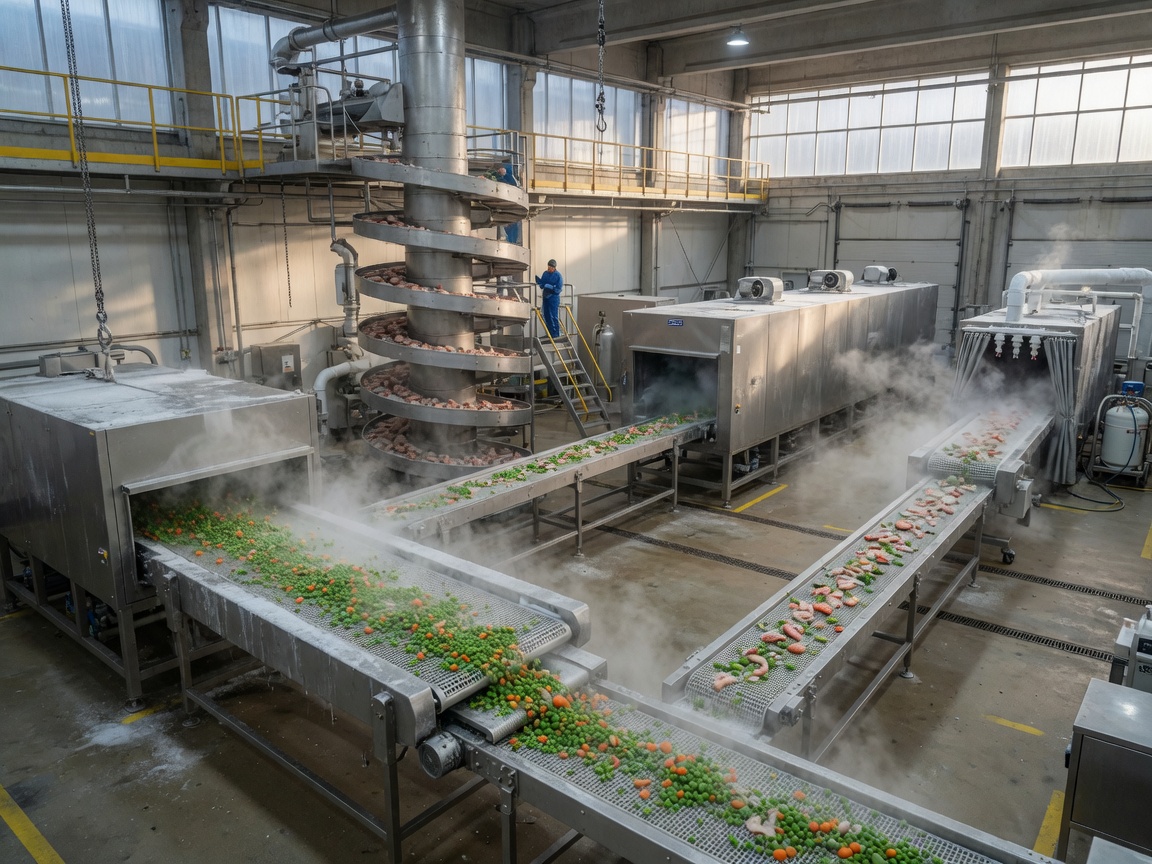
The fluidized bed freezer is widely regarded as the highest-efficiency format for small-particulate frozen food processing. Cold air velocity is calibrated precisely to suspend product particles in a semi-floating state, maximizing surface-area exposure to refrigerated airflow. This produces the fastest heat transfer per unit of refrigeration power — making it the go-to choice for pea, corn, diced pepper, and berry operations across the US Midwest and Pacific Northwest.
Spiral freezer: high-volume throughput in a compact footprint
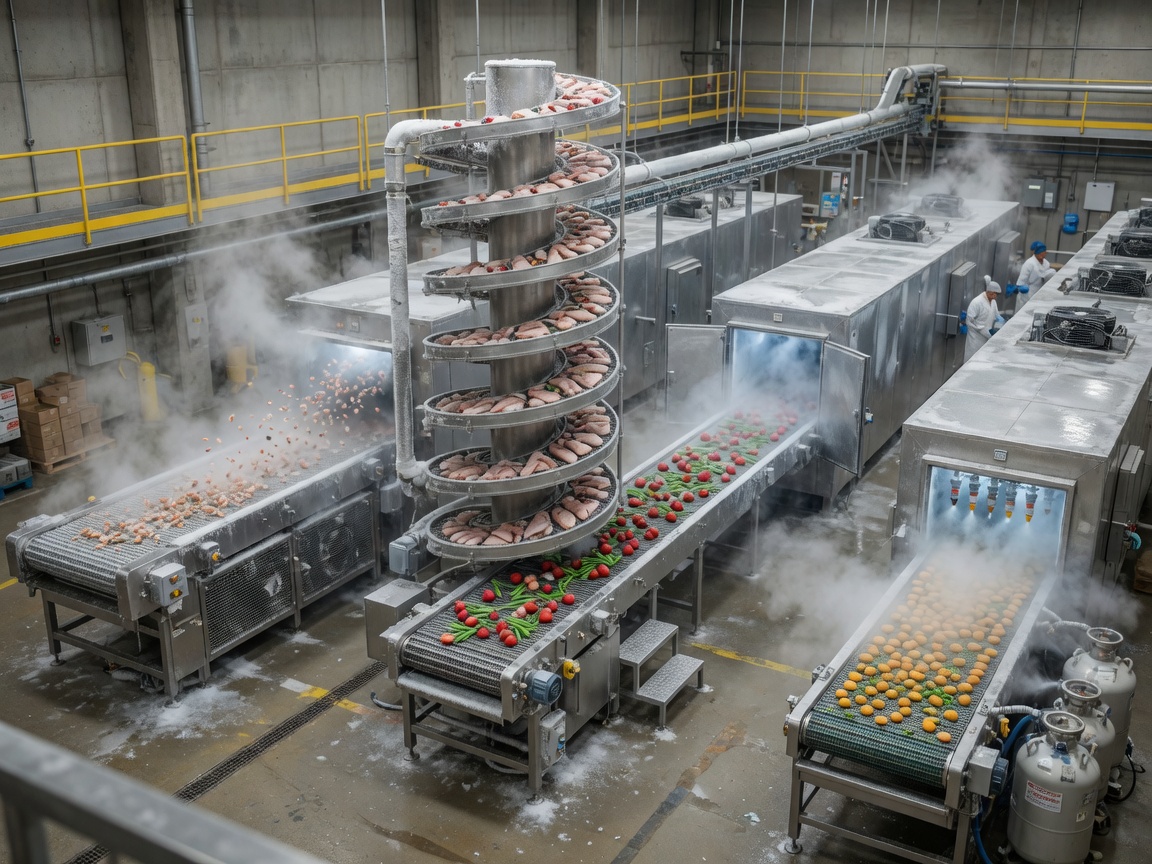
The spiral freezer stacks the belt in a vertical helix, allowing a very long product residence time within a relatively small floor area. This matters enormously in urban processing facilities where real estate cost per square foot is a real operating expense. For high-throughput poultry processors running 24/7, the spiral configuration typically delivers the lowest cost-per-kg at volumes above 3,000 kg/hr.
Energy cost comparison: mechanical vs. cryogenic IQF systems
Energy is the largest ongoing operating cost in continuous freezer operation — yet most equipment comparison guides skim over the numbers. Here is what 2026 real-world data from US processing operations actually shows.
"The total cost of ownership for a cryogenic IQF system versus a mechanical NH₃ tunnel is almost never captured at the point of purchase. Over a 10-year period, cryogen consumable costs can exceed the original equipment price by a factor of two or three for high-throughput applications." — Industry consensus from US frozen food equipment integrators, 2026
Mechanical IQF systems: NH₃ vs. CO₂ vs. HFO refrigerants
Ammonia (NH₃) remains the dominant refrigerant in large-scale US mechanical IQF tunnel freezer installations. Its thermodynamic efficiency is unmatched — roughly 15–20% more efficient per kWh than HFO alternatives — and it has zero global warming potential (GWP). The trade-off is regulatory overhead: ammonia systems above 10,000 lbs require EPA Risk Management Plans and OSHA PSM compliance. For facilities already managing NH₃ refrigeration elsewhere on-site, expanding into IQF tunnel capacity is often the logical path.
CO₂ (R-744) transcritical systems have gained significant traction among mid-size processors since 2023. Operating costs run approximately $0.008–$0.012 per kg of product frozen versus NH₃'s $0.005–$0.009/kg — a meaningful gap at scale, but CO₂ eliminates ammonia safety infrastructure costs and is well-suited to facilities in populated areas where NH₃ permitting is difficult.
Cryogenic tunnel freezer: liquid N₂ vs. CO₂ direct injection
Cryogenic systems offer ultra-fast freeze times — liquid nitrogen operates at −196°C (−321°F) — making them the correct technical choice for high-value seafood, ready-to-eat proteins, and products where surface quality is commercially critical. The operating cost, however, is substantially higher: liquid N₂ consumption for a continuous IQF operation typically runs $0.035–$0.065 per kg of product, compared to $0.005–$0.012/kg for mechanical systems. That delta is the reason cryogenic tunnels are predominantly used for premium SKUs, start-up operations with limited capital, or as surge-capacity supplements to mechanical IQF lines.
Of course, there are cases where a hybrid approach makes sense — running cryogenic for surface-crust setting in Zone 1, then completing the freeze in a mechanical tunnel. Several Pacific Northwest seafood processors have reported 18–22% energy savings using this method compared to full cryogenic operation.
FDA/USDA compliance and HACCP planning for IQF tunnel design
This is the area most equipment guides completely ignore — and it is arguably the most consequential for US buyers. The physical design of your IQF freezing system has direct regulatory implications under both FDA Food Safety Modernization Act (FSMA) rules and USDA FSIS inspection requirements for meat and poultry operations.
Open vs. enclosed tunnel design and sanitation zones
Open-top tunnel freezers allow easier visual inspection and faster belt access during sanitation cycles, which auditors tend to favor during USDA FSIS in-plant reviews. Enclosed designs offer better thermal efficiency and contamination barrier protection — critical for RTE (ready-to-eat) product lines where Listeria monocytogenes environmental monitoring is a HACCP critical control point. The decision is not purely engineering; it is a food safety architecture choice that should be mapped against your HACCP plan before specifying equipment.
CIP systems and sanitation rating requirements
Clean-in-place (CIP) capability has moved from a premium option to a baseline expectation in USDA-inspected IQF tunnel installations as of 2026. Facilities processing raw meat or seafood must demonstrate that the conveyor belt, evaporator housing, and fan shroud areas can be effectively sanitized on a defined schedule. IQF machines with IP69K-rated components and fully drainable belt frames significantly reduce Listeria harborage risk in the sub-belt zone — a documented point-source for environmental pathogen findings in past USDA FSIS enforcement actions.
When specifying an IQF tunnel for a USDA-inspected facility, procurement managers should require documentation of hygienic design compliance with EHEDG or 3-A Sanitary Standards as a baseline purchase condition.
Common operational pain points and how to solve them
Ask any production supervisor who runs an IQF freezer tunnel daily — the challenges are remarkably consistent across product categories and facility sizes. Understanding these issues before purchase is far more valuable than discovering them during a peak production run.
Ice build-up and defrost frequency management
Frost accumulation on evaporator coils is the most pervasive continuous freezer operational problem in US food plants. As moisture from product and ambient infiltration builds on coil surfaces, thermal resistance increases and airflow narrows — directly degrading freeze performance. Most mechanical IQF tunnel freezers require hot-gas defrost cycles every 8–16 hours of operation, depending on product moisture load and air infiltration rates.
The operational cost of unplanned defrost cycles is rarely calculated but substantial: a 90-minute defrost on a 5,000 kg/hr line represents approximately 7,500 kg of lost production capacity per cycle. Facilities running two-shift operations with poor defrost scheduling can lose 15,000–20,000 kg of throughput weekly. The fix is predictive defrost scheduling driven by differential pressure sensors across the evaporator — a feature now available on most major IQF machine platforms as a standard sensor integration.
Belt hygiene, product sticking, and downtime cost
Belt fouling — from product residue, brine carryover, or coating material — creates microbiological risk zones and mechanical drag that accelerates belt wear. A belt replacement on a mid-size industrial food freezer tunnel typically costs $8,000–$25,000 in parts and labor, plus 16–24 hours of downtime. Preventive belt inspection protocols and daily wash-down cycles with food-grade alkaline cleaners are the accepted best practice across US frozen food processing operations.
Why do so many facilities still skip daily belt hygiene? Usually because shift production pressure overrides scheduled sanitation time. The long-term math, however, consistently favors prevention over reactive replacement.
- Inspect belt surface and belt-edge seals at every shift change for residue accumulation or mechanical damage.
- Perform a full belt wash-down with 2–3% food-grade caustic solution after each production run, followed by a potable water rinse to pH neutral.
- Log differential pressure readings across the evaporator before and after each defrost cycle to track coil fouling rate over time.
- Schedule preventive belt tension adjustment every 500 operating hours to prevent tracking drift and edge wear.
- Conduct a full CIP deep-clean cycle at minimum once per week for raw product lines, or per HACCP plan frequency for RTE environments.
Product-specific IQF tunnel configuration guide
Matching your product to the right IQF tunnel configuration is where procurement decisions most frequently go wrong. A configuration optimized for berry fruits will underperform significantly on shrimp — and vice versa. Here is a direct selection guide based on 2026 processing industry practice.
Shrimp and seafood: best IQF tunnel approach
Whole shrimp, peeled shrimp, and fish fillets require a straight-belt or linear IQF tunnel with a two-stage fluidization pre-section for surface-crust setting. The primary risk with shrimp is clumping during Zone 1, where surface moisture is highest. A combination of mechanical vibration at the infeed and a high-velocity impingement freezer first-stage resolves this in most production environments. Cryogenic pre-chilling before the mechanical tunnel is standard practice in Gulf Coast shrimp operations processing value-added product for retail.
Diced vegetables and berry fruits: fluidized bed is the default
For diced peppers, corn, peas, blueberries, and strawberry pieces, the fluidized bed freezer is the industry default — and for good reason. Uniform particle size, low surface moisture (post-dewatering), and relatively low density make these products ideal candidates for air-suspension freezing. Throughput rates above 4,000 kg/hr are achievable with modern fluidized bed IQF machines at operating costs as low as $0.006/kg using NH₃ refrigeration.
High-volume formed products: spiral freezer wins on TCO
Burger patties, breaded chicken pieces, and formed seafood products running at sustained volumes above 2,500 kg/hr almost universally favor the spiral freezer format on a total-cost-of-ownership basis. The vertical stacking design maximizes residence time per square foot of floor space and integrates cleanly with upstream forming and coating lines. For US protein processors running 24/7 with high SKU variety, the spiral IQF configuration offers the best balance of throughput flexibility and sanitation accessibility.
IQF tunnel buyer's checklist and total cost of ownership
Before issuing an RFQ for an IQF tunnel freezer, every procurement manager should be able to answer all items on this checklist. Gaps in any of these areas have historically been the source of post-installation cost overruns and compliance findings in US food processing plants.
Technical specification checklist
- Capacity (kg/hr): Define at peak throughput, not average. Size the tunnel at 85% of rated capacity for operational headroom.
- Belt width: Standard US widths run 24", 36", 48", and 60". Match belt width to your upstream conveyor footprint to avoid transfer losses.
- Refrigerant type: NH₃ for large-scale efficiency; CO₂ for mid-scale or permitting-constrained sites; N₂/CO₂ cryogenic for premium or low-volume lines.
- Sanitation rating: Require IP65 minimum for all electrical components; IP69K for direct-spray zones. Confirm EHEDG or 3-A hygienic design certification.
- Defrost system: Specify hot-gas defrost with automated differential-pressure-triggered scheduling.
- Control platform: Require PLC-based controls with SCADA integration capability and data logging for HACCP record-keeping.
- CIP capability: Required for all USDA-inspected and FDA-registered facilities.
Total cost of ownership: 10-year model
A 2,000 kg/hr mechanical NH₃ IQF tunnel purchased at $450,000–$650,000 USD (2026 pricing) will accumulate roughly $1.2–$1.8 million in energy, maintenance, and consumable costs over 10 years under continuous two-shift US operation. A comparable cryogenic tunnel freezer may have a lower capital cost ($180,000–$320,000) but cryogen consumable costs alone can reach $2.5–$4 million over the same period at equivalent throughput. The business case for mechanical IQF is compelling at sustained volumes above 800 kg/hr — but cryogenic systems remain the correct answer for operations below that threshold or for premium product lines where quality premium justifies operating cost.
Frequently asked questions
Q: What is the difference between an IQF tunnel freezer and a blast freezer?
A: A blast freezer circulates cold air around a stationary product batch, typically taking 2–6 hours per load. An IQF tunnel freezer moves product continuously through a refrigerated airstream, completing individual freezing in 5–30 minutes. IQF produces individually separated, free-flowing pieces; blast freezing often results in block-frozen product that requires breaking or thawing to separate.
Q: How much does an IQF tunnel freezer cost in the US market?
A: In 2026, mechanical IQF tunnel freezers for US food processors range from approximately $180,000 for small cryogenic units to over $1.2 million for large-capacity NH₃ spiral freezer systems. Installation, refrigeration plant, and commissioning typically add 30–50% to the base equipment cost. Total installed cost for a 2,000 kg/hr system commonly runs $700,000–$1.1 million.
Q: Does IQF tunnel design affect FDA or USDA compliance?
A: Yes, directly. Open vs. enclosed tunnel design affects Listeria harborage risk and sanitation accessibility — both reviewed during USDA FSIS in-plant audits. CIP capability, IP-rated electrical components, and hygienic belt frame design all affect regulatory standing. Buyers should specify EHEDG or 3-A sanitary design compliance and confirm the tunnel integrates with their existing HACCP plan.
Q: What is the best IQF tunnel type for shrimp processing?
A: A straight-belt linear IQF tunnel with a high-velocity impingement pre-freeze section is the preferred configuration for shrimp. This setup addresses the primary challenge of surface-moisture clumping during the initial freeze stage. Many Gulf Coast processors supplement with a cryogenic pre-chill zone for value-added peeled and deveined product destined for retail packaging.
Q: How often should an IQF tunnel freezer be defrosted?
A: Most mechanical IQF tunnel systems require hot-gas defrost every 8–16 operating hours, depending on product moisture load and air infiltration. High-moisture products like raw shrimp or freshly blanched vegetables accelerate frost build-up and may require defrost cycles every 6–8 hours. Automated differential-pressure-triggered defrost scheduling — standard on current-generation IQF machines — minimizes unnecessary downtime while preventing performance degradation.
Selecting the right IQF tunnel is ultimately a systems decision, not a single-equipment purchase. The configuration, refrigerant, sanitation design, and control architecture must align with your specific product mix, throughput targets, regulatory environment, and 10-year operating cost model. The data and frameworks in this guide are intended to help US food processing procurement managers move from general awareness to confident equipment specification — before a supplier conversation ever begins.
Keywords:
Inquiry
If you are interested in our products, please leave your email to receive a free product quote, thank you!
More information


Tel:
Sales E-mail: