

IQF processing line guide: how to choose the right system for your food production
Release Time:
Sep 29,2026
Author:

Article overview
This guide provides a comprehensive technical and commercial evaluation framework for U.S. food processors researching IQF processing lines in 2026. It covers system types, product-specific selection, TCO modeling, regulatory compliance, equipment integration, and sustainability — the content gaps that no single competitor page currently addresses in one place.
Table of contents
- 1. What is an IQF processing line?
- 2. IQF system types: which freezer design fits your product?
- 3. How to select an IQF line by product category
- 4. Total cost of ownership: CAPEX, energy, and 5-year ROI
- 5. U.S. regulatory compliance and food safety standards
- 6. Upstream and downstream integration: building a complete freezing workflow
- 7. Sustainability and refrigerant transition in 2026
- 8. FAQ
What is an IQF processing line?
An IQF processing line is an industrial food freezing system that rapidly freezes individual food items separately — at temperatures between -30°C and -40°C (-22°F to -40°F) — so each piece exits the line frozen independently rather than fused into a block. The process relies on high-velocity cold air, cryogenic fluids, or direct contact plates to extract heat from each unit within 15 to 30 minutes, preserving cellular structure, texture, and nutritional value far more effectively than conventional batch freezing methods.
The distinction matters commercially. According to ASHRAE refrigeration engineering data, IQF technology reduces cellular damage to below 5% of product mass — compared with 30% to 40% typical of block freezing. That difference translates directly into yield, product appearance, and retail premium. For a mid-size U.S. frozen vegetable packer running 10 tons per hour, even a 5-percentage-point improvement in yield recovery represents roughly $400,000 in additional annual revenue at current commodity prices.
Why do so many buyers still underestimate what the "line" in IQF processing line actually means? The freezer unit itself is only one node. A complete continuous freezing line includes upstream preparation equipment, the core freezing machine, downstream packaging integration, and the cold chain handoff — all of which must operate in synchronized harmony. This guide treats the full system, not just the freezer box.
The individual quick freezing process has been refined over six decades, but 2026 brings meaningful changes in automation intelligence, refrigerant chemistry, and energy performance benchmarks that directly affect equipment selection decisions.
IQF system types: which freezer design fits your product?
The right individual quick freezing equipment starts with matching machine architecture to product geometry and surface characteristics. There is no universal answer — and any supplier claiming otherwise should raise a flag.
Five primary IQF freezer architectures
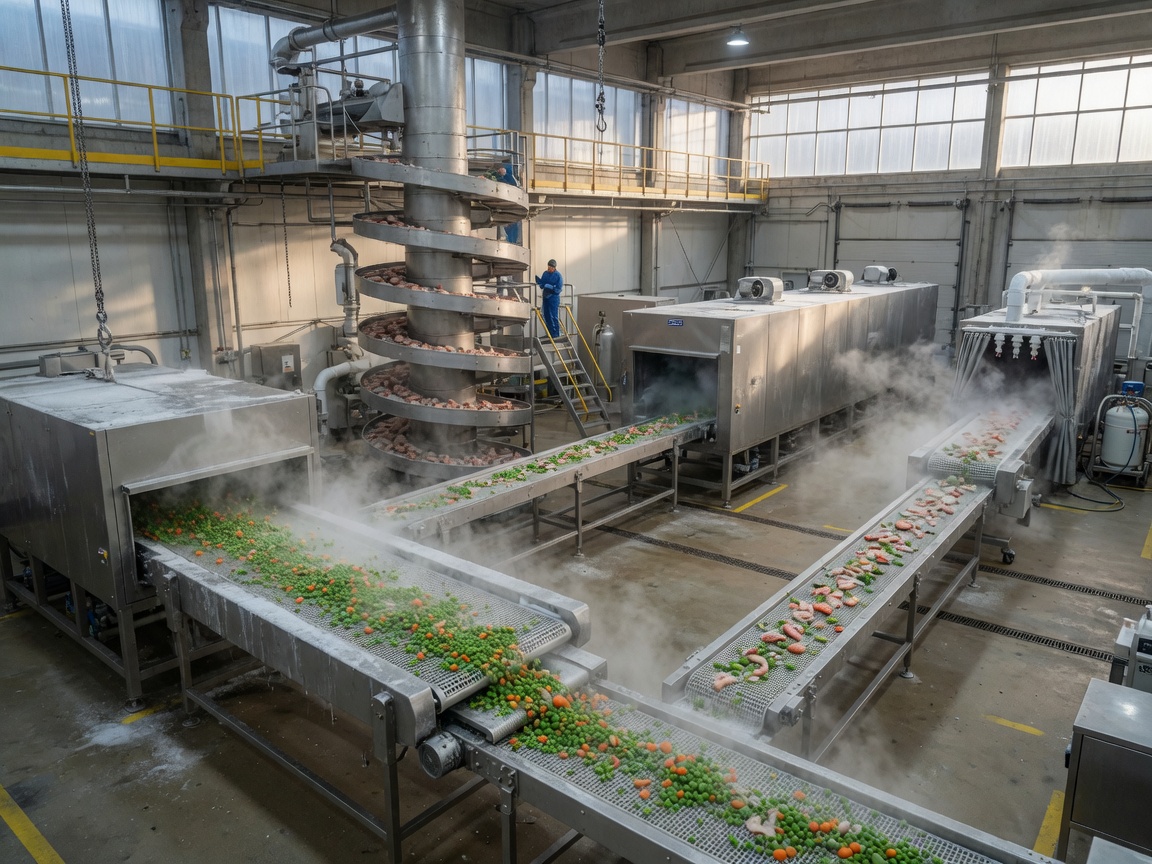
Fluidized bed freezers remain the workhorse of the frozen vegetable processing line segment. They suspend small, roughly uniform particles — peas, diced onions, corn kernels, sliced strawberries — on a cushion of upward-directed cold air, preventing belt contact and virtually eliminating clumping. Actual testing in commercial pea lines shows product separation rates above 98% at belt loads of 8 to 12 kg/m².
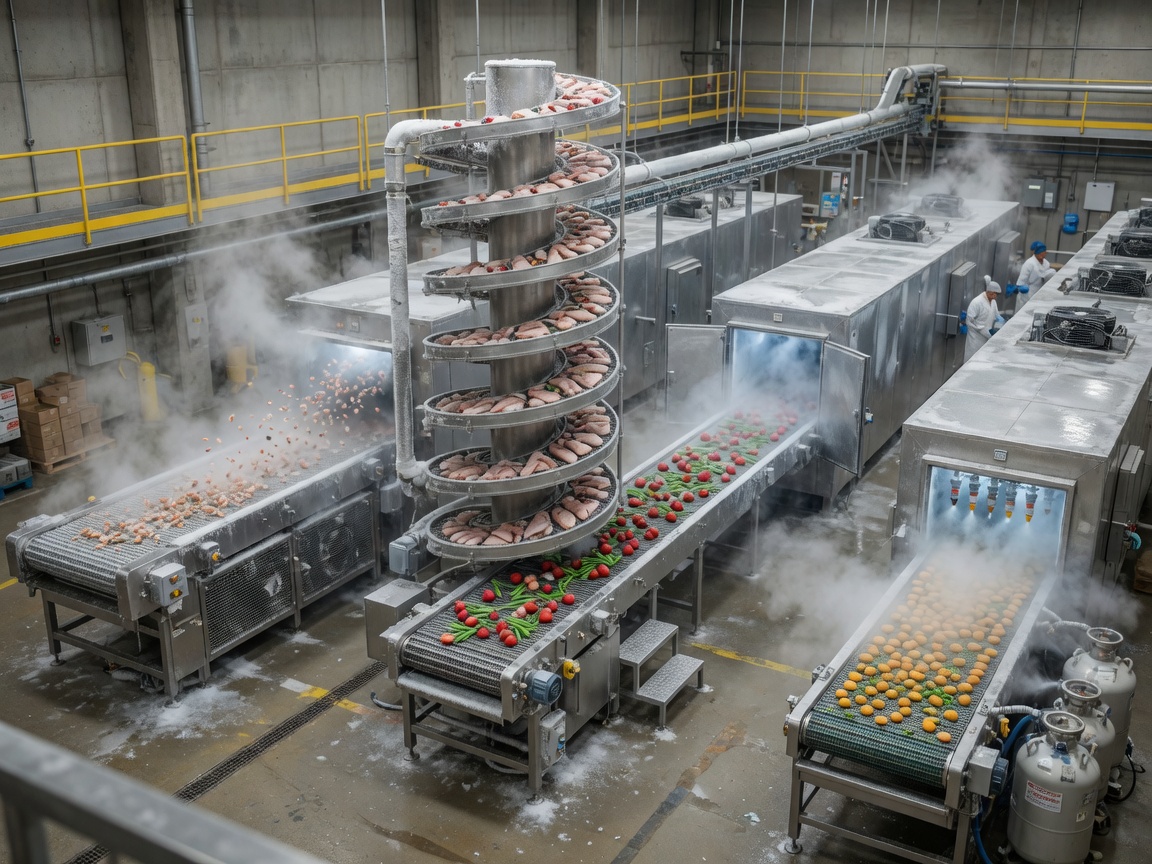
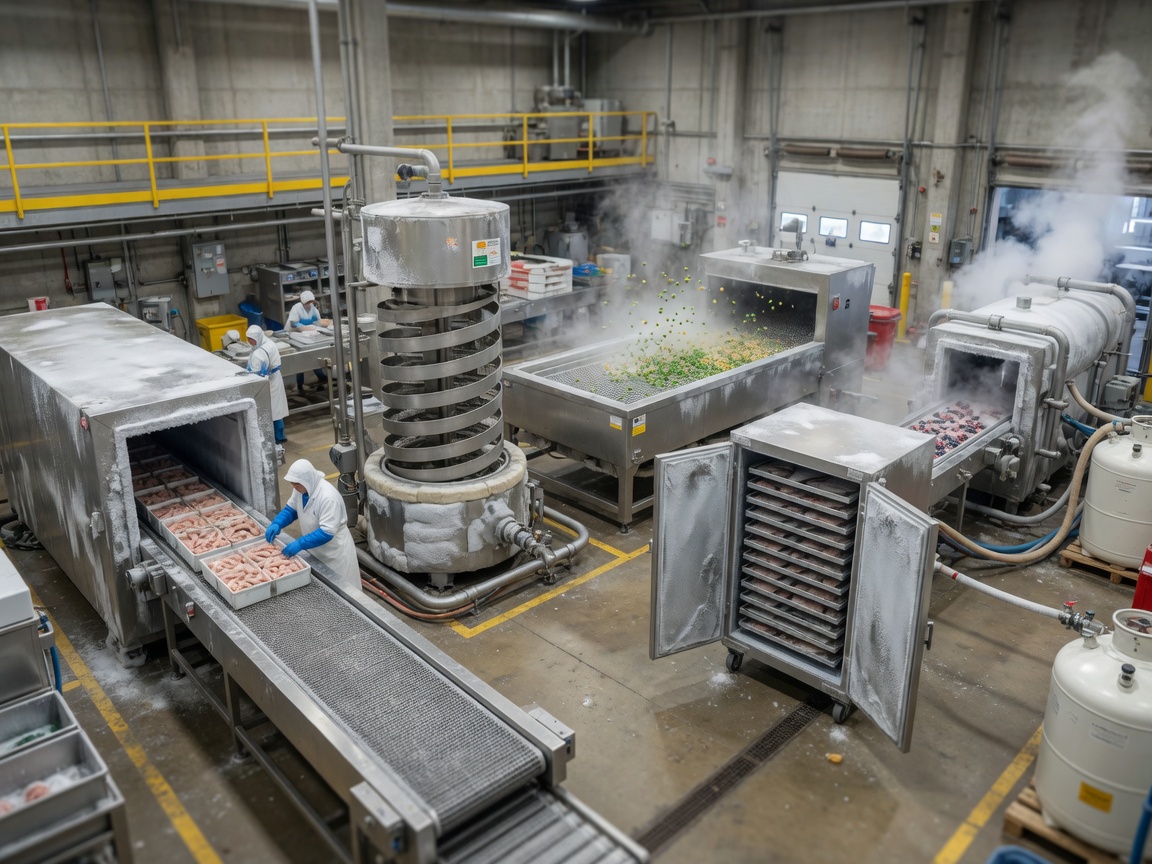
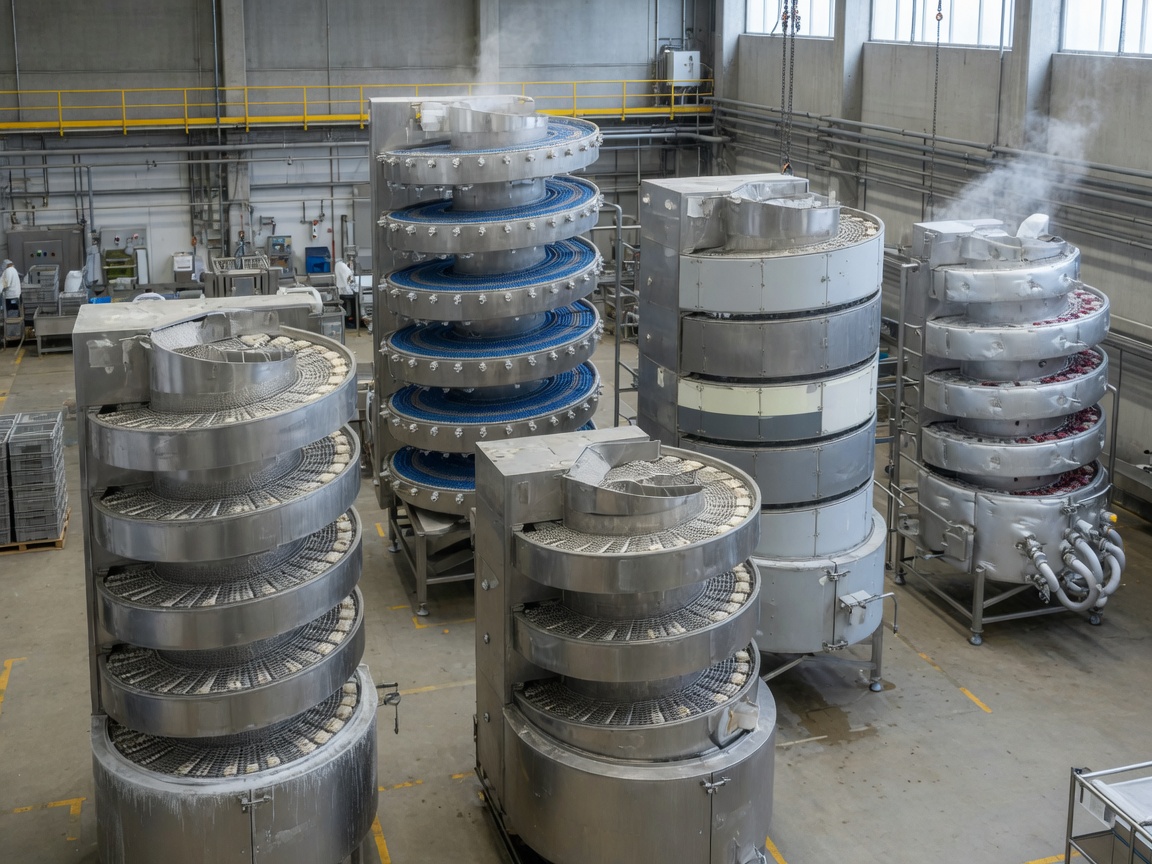
Spiral freezer systems use a continuous self-stacking belt coiled around a rotating drum. The compact footprint — often 30% to 40% smaller floor area than a comparable IQF tunnel freezer — makes spiral systems the dominant choice for shrimp, chicken portions, and formed meat patties in space-constrained U.S. facilities. Throughput ranges from 500 kg/hr to over 10,000 kg/hr depending on configuration.
Flat-bed IQF tunnel freezers suit high-volume operations processing uniform flat products: fish fillets, burger patties, breaded portions. The linear quick freeze conveyor system design simplifies belt tensioning and sanitation access. They are the most straightforward to integrate with inline metal detection and checkweighing downstream.
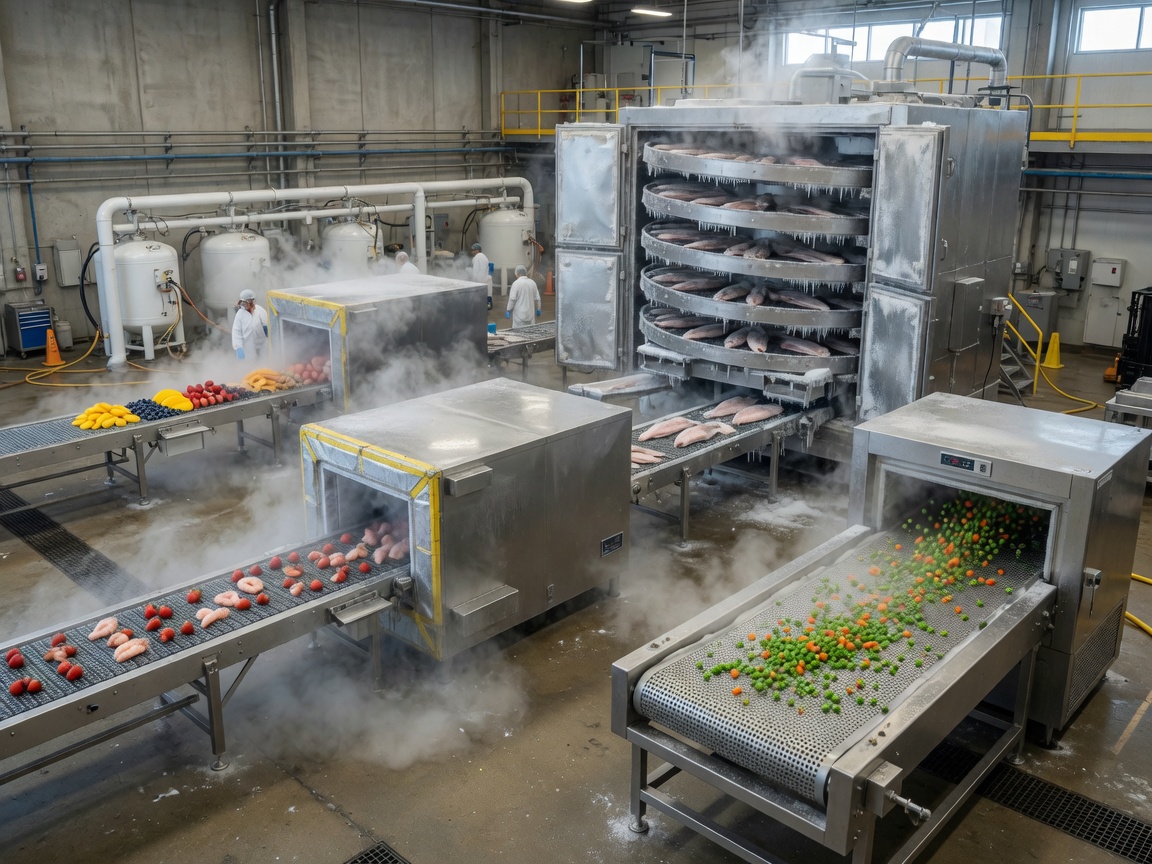
Cryogenic freezing systems — using liquid nitrogen or CO₂ — deliver surface crust formation in under 60 seconds, locking in moisture before the mechanical freeze cycle completes. They carry higher operating costs per ton but are justified for high-value seafood, sushi-grade tuna, and delicate berry products where the premium per pound absorbs the cryogen expense.
Vibrating conveyor IQF systems add a mechanical agitation layer to prevent adhesion in products like diced peppers or shredded cheese — materials that would adhere to a static belt under their own moisture weight.
| Freezer type | Best product fit | Typical throughput | Energy use (kWh/ton) | Relative CAPEX |
|---|---|---|---|---|
| Fluidized bed freezer | Peas, corn, diced veg | 500–8,000 kg/hr | 90–130 | Medium |
| Spiral freezer system | Shrimp, poultry, patties | 500–10,000 kg/hr | 110–160 | Medium–High |
| IQF tunnel freezer | Fish fillets, breaded items | 1,000–15,000 kg/hr | 80–120 | Medium |
| Cryogenic freezing system | High-value seafood, berries | 200–3,000 kg/hr | 180–350+ | Low CAPEX, High OPEX |
| Vibrating conveyor IQF | Diced veg, cheese, sticky items | 300–4,000 kg/hr | 100–140 | Medium |
Common misconceptions about freezer selection
Two industry misconceptions consistently drive poor purchasing decisions. First: faster airflow does not automatically improve quality. Excessive belt-level wind velocity causes surface dehydration — product loses measurable weight and develops an undesirable dried surface layer before the core is frozen. Matching air velocity to product density and thickness is a calibration exercise, not a "more is better" setting. Second: no single IQF machine is genuinely universal across product categories. Belt mesh aperture, pre-cooling zone length, and humidity control must all be specified to the target product. A machine optimized for whole shrimp will underperform on diced bell peppers without significant retrofit cost.
How to select an IQF line by product category
Product type is the primary filter. Before evaluating brand, price, or throughput capacity, U.S. procurement teams should map their product portfolio against the selection criteria below.
Seafood IQF lines
A seafood IQF line — particularly for shrimp and scallops — faces one challenge above all others: moisture management. Wet-surface product is prone to belt adhesion and inter-piece bridging. For U.S. shrimp processors, industry practice pairs a brine tank or glaze applicator upstream of the IQF machine; the belt specification must accommodate wet product without creating ice bridges between pieces. Spiral freezer systems dominate this segment because their gentle belt curvature reduces product stress, and their enclosed design minimizes frost accumulation during long production runs. Real-world testing at Gulf Coast shrimp facilities shows that a properly configured spiral system maintains separation rates above 95% at 2,000 kg/hr throughput.
Frozen vegetable processing lines
For produce — peas, corn, green beans, edamame — the fluidized bed freezer is the default specification. The critical upstream variables are blanching and dewatering: an IQF machine's infeed belt must be height- and width-matched to the dewatering screen outlet. Belt speed synchronization with upstream flow is non-negotiable. Product pileup at the infeed — a common source of clumping complaints — is almost always a line integration failure, not a freezer defect. According to recent operational data from Midwest frozen vegetable plants, improper infeed loading accounts for over 60% of clumping incidents incorrectly attributed to the freezer itself.
Poultry and formed meat products
Poultry portions and burger patties require a freezing and packaging line capable of handling high throughput with precise temperature exit control. The product must reach -18°C (0°F) or below at freezer exit — the U.S. cold storage standard. Spiral systems handle the volume; flat-bed tunnel freezers suit formed patties requiring consistent presentation on downstream packaging conveyors. Confirm that your packaging equipment is rated for continuous sub-zero product temperatures, since not all commercial fill-seal systems handle frost condensation on cold product surfaces without mechanical modification.
Total cost of ownership: CAPEX, energy, and 5-year ROI
Purchase price is the most visible cost. It is rarely the largest. A rigorous total cost of ownership model for commercial freezing equipment must include four components: initial CAPEX, annual energy cost, maintenance expense, and opportunity cost from downtime.
CAPEX benchmarks by system type
For a mid-scale U.S. installation (3,000–5,000 kg/hr), 2026 equipment pricing ranges from approximately $350,000 to $600,000 for a mechanical IQF tunnel freezer, $500,000 to $900,000 for a spiral system with full refrigeration package, and $150,000 to $300,000 for a cryogenic unit (excluding cryogen supply contracts). Installation, refrigeration piping, electrical service upgrades, and NSF-compliant flooring typically add 25% to 40% to the base equipment cost.
Energy cost modeling and 5-year ROI
Energy is where the real long-term cost lives. Based on 2026 U.S. industrial electricity rates averaging $0.085/kWh, a mechanical IQF system consuming 110 kWh per ton, running at 4,000 kg/hr for 6,000 operating hours per year, generates an annual electricity cost of approximately $224,000. A cryogenic alternative at 250 kWh equivalent (including cryogen) would cost roughly $510,000 annually at the same throughput — a $286,000 annual operating gap that compounds powerfully over a 5-year horizon.
"Energy consumption in IQF freezing systems accounts for 30% to 50% of total production operating costs in continuous processing environments. Equipment buyers who evaluate only CAPEX are systematically underpricing their long-term commitment." — ASHRAE Refrigeration Handbook, 2025 edition
Maintenance costs for a well-specified mechanical system average $18,000 to $35,000 annually — covering belt replacement cycles (typically every 3 to 5 years), evaporator coil cleaning, and refrigeration service. Unplanned downtime carries an additional shadow cost: at $12,000 per production hour lost (a conservative estimate for a 4,000 kg/hr line), even two unscheduled stops per year represent $24,000 in direct losses plus supply chain disruption.
A properly configured mechanical IQF system at these operating parameters typically achieves full ROI within 3.5 to 4.5 years for a greenfield U.S. plant replacing block freezing capacity — assuming yield improvement, labor reduction from automation, and energy savings versus blast freezing tunnel operations.
U.S. regulatory compliance and food safety standards
Regulatory compliance is not a footnote — it is a procurement prerequisite. U.S. food processing facilities operating IQF lines must satisfy overlapping federal and third-party standards that directly constrain equipment design.
USDA, FDA, and HACCP requirements
USDA-inspected facilities (meat and poultry) require that all food-contact equipment surfaces meet USDA Agricultural Marketing Service acceptance criteria. The FDA Food Safety Modernization Act (FSMA) mandates that equipment design supports preventive controls — meaning IQF lines must allow complete cleanability with no inaccessible harborage points. HACCP plans for frozen food operations typically designate the freezer exit temperature as a Critical Control Point; your equipment must have calibrated, documented temperature monitoring at this location with data logging capability for regulatory audit trails.
NSF, 3-A, and BISSC sanitary standards
NSF/ANSI 2 certification and 3-A Sanitary Standards define the design requirements for food equipment sanitary construction: smooth surfaces, crevice-free welds, self-draining angles, and materials rated for food contact. BISSC (Baking Industry Sanitation Standards Committee) standards apply to baked goods and breaded product lines. When issuing an RFQ for IQF equipment, require written confirmation of applicable certification status — not all import equipment meets these standards, which creates facility approval risk during USDA or FDA inspections.
Of course, there are situations where a BISSC or 3-A certification may not be strictly required — for example, a produce-only facility operating under a private third-party audit scheme. But given the cost of a corrective action finding during an FDA inspection, specifying certified equipment is almost always the lower-risk commercial decision.
Upstream and downstream integration: building a complete freezing workflow
Just like a highway on-ramp that feeds traffic smoothly only when speeds are matched, an IQF freezer's infeed and outfeed must synchronize with every adjacent process stage. Buying a world-class freezer and bolting it between mismatched upstream and downstream equipment is one of the most expensive mistakes in greenfield plant design.
Upstream compatibility: blanching, glazing, and portioning
Most vegetable IQF lines feed directly from a blancher and vibrating dewatering screen. The IQF infeed conveyor must match the dewatering screen's outlet height and belt width. Specify CEMA-standard infeed connections in your equipment purchase agreement to ensure compatibility. For seafood lines, a brine tank or glaze applicator sits upstream of the freezer — the IQF belt specification must handle wet-surface product without adhesion. Portioning and slicing equipment for meat and fish must deliver consistent piece dimensions to ensure uniform freeze times; variation in product thickness by more than ±5 mm causes uneven freeze profiles that produce soft-center product at normal belt speeds.
Downstream connections: screening, weighing, and packaging
The freezer exit feeds a vibratory scalping screen to break any minor clumps formed during the freeze cycle, then connects to a weigh-fill or form-fill-seal packaging line. Product leaving the IQF must be at -18°C (0°F) or below — confirm that your packaging equipment operates reliably at sub-zero product temperatures without condensation management failures. Metal detection and checkweighing are standard inline elements in U.S. retail-pack frozen food lines; their conveyor heights and speeds must be designed as part of the original line layout, not retrofitted afterward. Most IQF processing lines are specified with CEMA-standard infeed and outfeed conveyor connections — requiring this in your specification protects integration flexibility if you change equipment suppliers in a future expansion.
Sustainability and refrigerant transition in 2026
Sustainability has moved from a marketing talking point to a procurement specification in U.S. food manufacturing. ESG reporting pressure, rising utility costs, and EPA regulatory milestones are all converging in 2026 to make refrigerant choice and energy efficiency central to IQF equipment decisions.
Refrigerant transition: R-404A phase-out and HFO alternatives
R-404A — the legacy refrigerant in a large portion of installed U.S. IQF equipment — carries a Global Warming Potential (GWP) of 3,922. The EPA's AIM Act implementation is accelerating the phase-down of high-GWP refrigerants, with significant allocation reductions already in effect through 2026. New IQF equipment purchases should specify refrigerants with GWP below 750 — the practical choices being R-448A (GWP ~1,387, a transitional HFO blend), R-744 (CO₂, GWP = 1, increasingly viable for ammonia-free facilities), or ammonia (R-717, GWP = 0, the most energy-efficient option for large installations). Leading manufacturers including GEA and Frigoscandia have both launched adaptive control platforms supporting CO₂ and ammonia refrigerant circuits as of 2026.
Energy benchmarks and carbon footprint comparison
Mechanical IQF systems operating on ammonia refrigerant achieve energy consumption in the range of 80 to 110 kWh per metric ton frozen — the most efficient end of the food freezing technology spectrum. Cryogenic systems using liquid nitrogen consume the equivalent of 180 to 350 kWh per ton when the embodied energy of nitrogen production is included, resulting in a carbon footprint 2.5 to 4 times higher per ton frozen. For facilities under Science Based Targets initiative (SBTi) commitments or retailer ESG audit requirements, this differential is no longer academically interesting — it is a sourcing constraint. Water usage is a secondary but growing metric: modern self-contained refrigeration circuits in IQF lines reduce process water consumption by 40% to 60% versus older evaporative condenser designs, a material advantage in water-stressed production regions across the U.S. Southwest and Southeast.
Frequently asked questions
Q: What is the difference between an IQF tunnel freezer and a spiral freezer system?
A: An IQF tunnel freezer moves product linearly through a straight freezing chamber, making it ideal for flat, uniform items like fish fillets. A spiral freezer coils the belt vertically around a rotating drum, offering a much smaller footprint with equivalent or greater throughput — preferred for shrimp, poultry portions, and formed products where floor space is constrained.
Q: How much does a commercial IQF processing line cost?
A: For a mid-scale U.S. installation at 3,000–5,000 kg/hr, mechanical IQF systems range from $350,000 to $900,000 depending on type, with installation adding 25–40% to base equipment cost. Cryogenic systems have lower CAPEX ($150,000–$300,000) but significantly higher annual operating costs due to cryogen consumption.
Q: What NSF or USDA certifications should IQF equipment have for a U.S. facility?
A: At minimum, specify NSF/ANSI 2 certification for food-zone components. USDA-inspected meat and poultry facilities require AMS-accepted equipment design. 3-A Sanitary Standards apply to dairy-adjacent lines. Always request written certification documentation from suppliers before purchase — compliance cannot be assumed from catalog descriptions alone.
Q: Why is product clumping happening on my IQF line?
A: Clumping is most commonly caused by infeed overloading, insufficient pre-drying or dewatering upstream, or product entering the freezer above optimal temperature. Over 60% of clumping issues in vegetable IQF lines originate upstream of the freezer, not within it. Audit belt loading rate, dewatering screen efficiency, and product surface moisture before assuming a freezer fault.
Q: Which refrigerant should a new IQF line use in 2026?
A: Avoid specifying R-404A for any new installation — EPA AIM Act phase-down makes it a stranded asset risk. For large-capacity lines, ammonia (R-717) offers the best energy efficiency and zero GWP. Mid-scale facilities should evaluate R-448A as a transitional option or CO₂ cascade systems for a future-proof, low-GWP refrigeration circuit.
Selecting the right IQF processing line in 2026 demands a system-level perspective — one that integrates product-specific freezer selection, rigorous TCO modeling, U.S. regulatory compliance, full upstream-to-downstream workflow design, and forward-looking refrigerant planning. The buyers who treat this as a commodity equipment purchase consistently overpay on operations and underperform on food safety audits. Use the frameworks in this guide as a structured evaluation checklist, and require data-backed answers from every supplier you evaluate. The freezer is a long-term asset; the specification decision deserves the same rigor.
Keywords:
Inquiry
If you are interested in our products, please leave your email to receive a free product quote, thank you!
More information


Tel:
Sales E-mail: