

IQF freezing machine buyer's guide: how to choose the right system for your production line
Release Time:
Sep 29,2026
Author:

Article overview
This guide covers every major IQF freezing machine type, US compliance obligations, TCO analysis, cold chain integration, and a procurement checklist — giving food processing buyers everything needed to make a confident capital equipment decision in 2026.
Table of contents
- 1. What is an IQF freezing machine?
- 2. IQF machine types compared: tunnel, spiral, fluidized bed, and cryogenic
- 3. US regulatory and compliance requirements for IQF equipment
- 4. Total cost of ownership: energy, maintenance, and payback period
- 5. Integrating IQF equipment with US cold chain infrastructure
- 6. How to evaluate vendors: RFQ checklist for US procurement teams
- 7. 2026 technology trends shaping the IQF industry
- 8. Frequently asked questions
What is an IQF freezing machine?
An IQF freezing machine is industrial food freezing technology that freezes each individual food piece separately at temperatures below -35°F (-37°C), producing a free-flowing, non-clumped output with minimal cellular damage.
The abbreviation stands for Individual Quick Freezing. Unlike a standard blast freezer that freezes a bulk mass — which causes pieces to bond together in a solid block — an IQF freezing machine mechanically separates each unit during the critical surface-hardening phase. Think of it the way a car wash keeps vehicles moving on a conveyor so they never collide: the separation is engineered into the process itself, not added afterward.
IQF freezing machine是指 a class of continuous freezing system that combines sub-zero air or cryogenic media with mechanical transport — via fluidized air beds, spiral conveyors, or vibrating belts — so that each piece exits the freezer as a structurally independent, free-flowing unit. The output is categorically different from block-frozen product: portioning is exact, thaw loss is lower, and texture retention is measurably superior.
According to individual quick freezing technology research, freezing must occur fast enough that ice crystals remain intracellular rather than extracellular — the difference between a shrimp that bounces back to near-fresh texture and one that weeps water on the plate. IQF equipment achieves this in under 30 minutes for most food categories, roughly four to six times faster than conventional cold storage pull-down.
Why the distinction from a standard blast freezer matters
A blast freezer drives high-velocity cold air over a static or slowly moving product mass. It is cost-effective for large, uniform items — whole fish, meat primals, meal trays. The limitation is clumping: small, irregular pieces freeze together. A frozen food processing machine designed around IQF principles solves this by achieving product separation before surface hardening is complete. Once the exterior crust is set, pieces can no longer bond even if they touch. That sequence — separate first, then freeze solid — is the engineering insight the entire category is built on.
What food categories benefit most
Seafood freezing equipment running IQF processes handles shrimp, scallops, and crab portions. Vegetable freezing lines process peas, corn, diced peppers, and edamame. Fruit, pasta, hash browns, meatballs, and even cheese cubes all run effectively through some variant of quick freeze technology. The common thread: discrete, portion-sized pieces where free-flowing output and texture integrity drive retail or foodservice value.
IQF machine types compared: tunnel, spiral, fluidized bed, and cryogenic
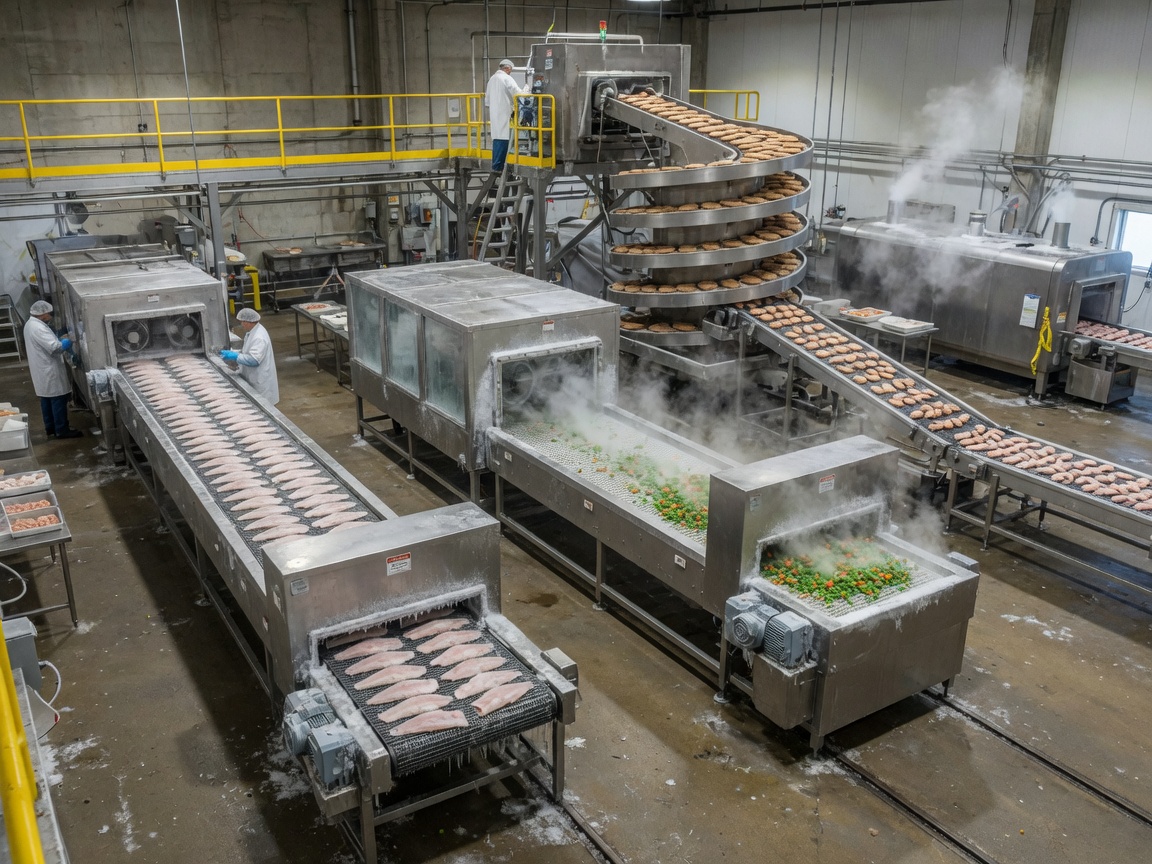
There is no single best IQF machine architecture — the right choice depends on product geometry, throughput target, facility footprint, and acceptable capital outlay. Here is how the four dominant system types stack up against each other.
Fluidized bed freezer
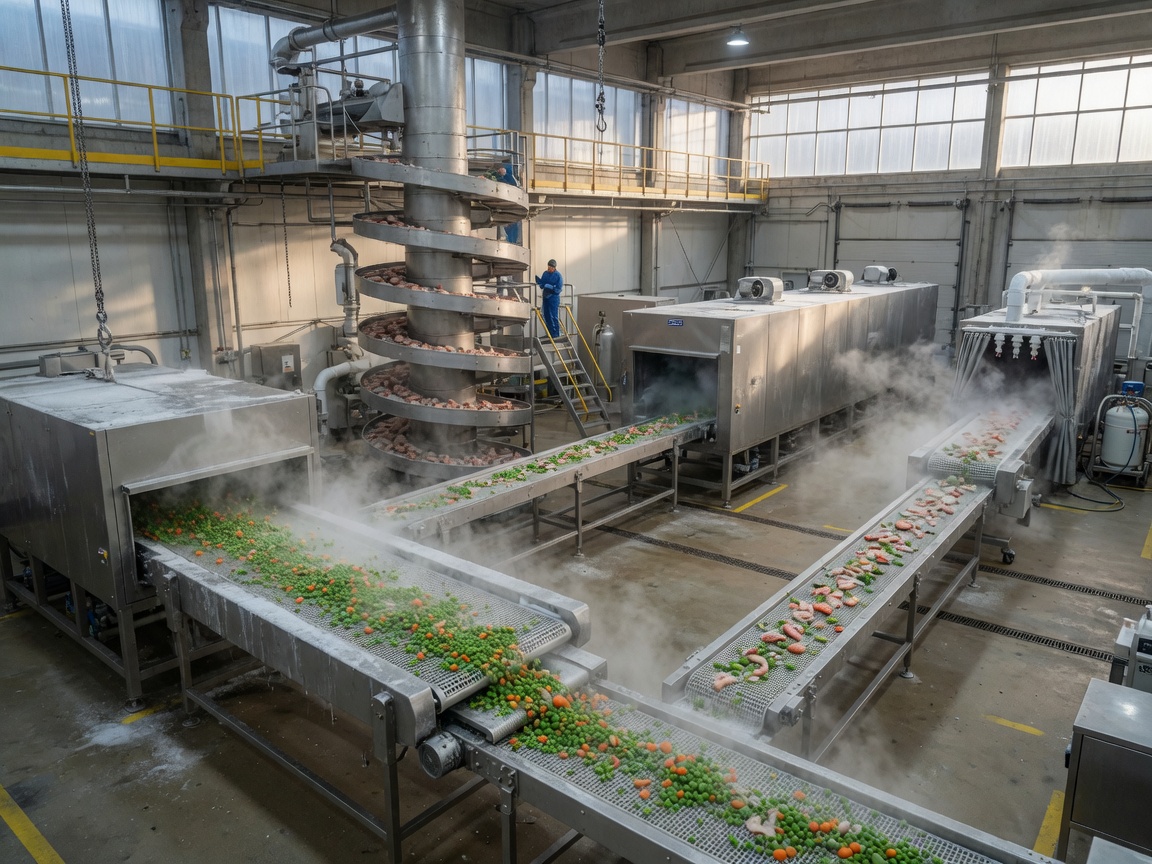
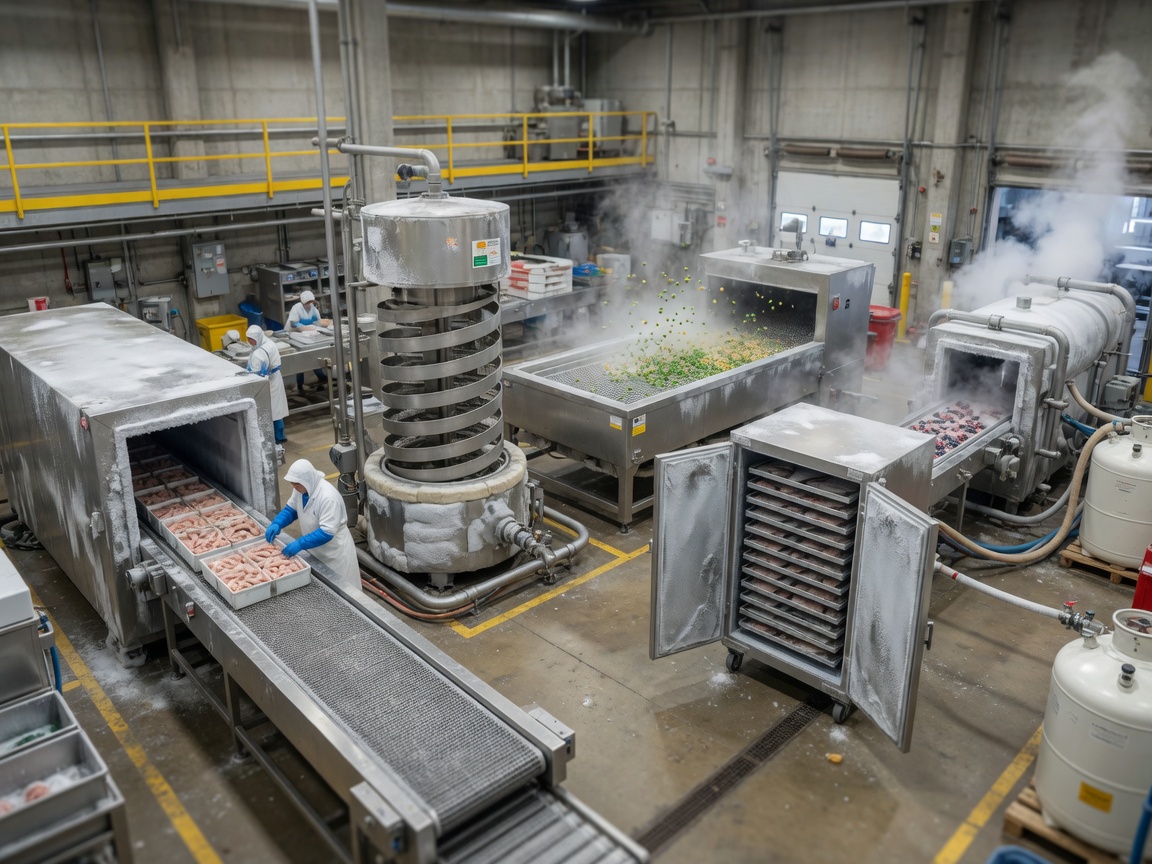
This is where individual quick freezing equipment reaches its purest mechanical expression. Upward-flowing cold air creates a fluidized bed that literally suspends small product pieces — peas, corn kernels, diced mango, small shrimp — so they never touch the belt or each other during initial surface hardening. Clumping rates approach zero for products within the optimal size range (roughly 0.2–1.5 inches). A fluidized bed freezer operates best at capacities of 500–4,000 lb/hr and is the workhorse of the US vegetable and small-seafood processing industries. Entry-level units start around $80,000–$160,000; high-capacity production lines can exceed $500,000.
Spiral freezer
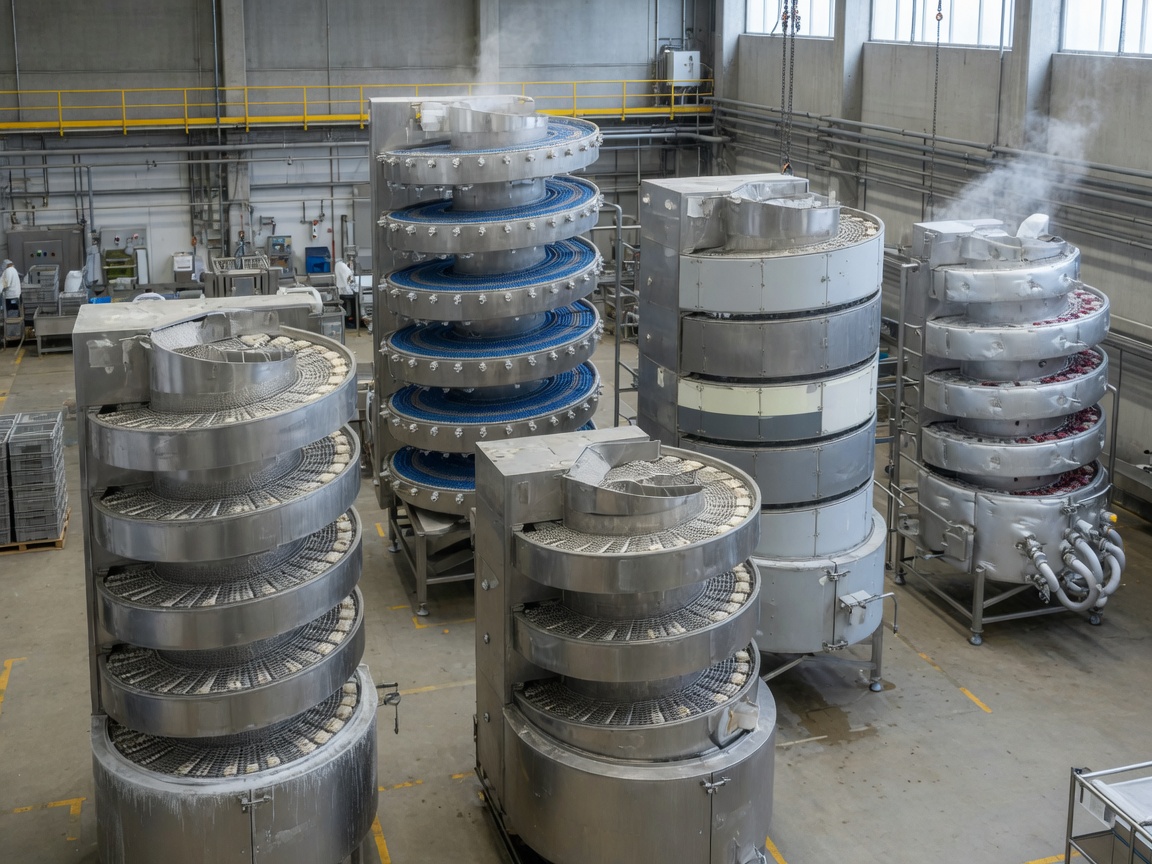
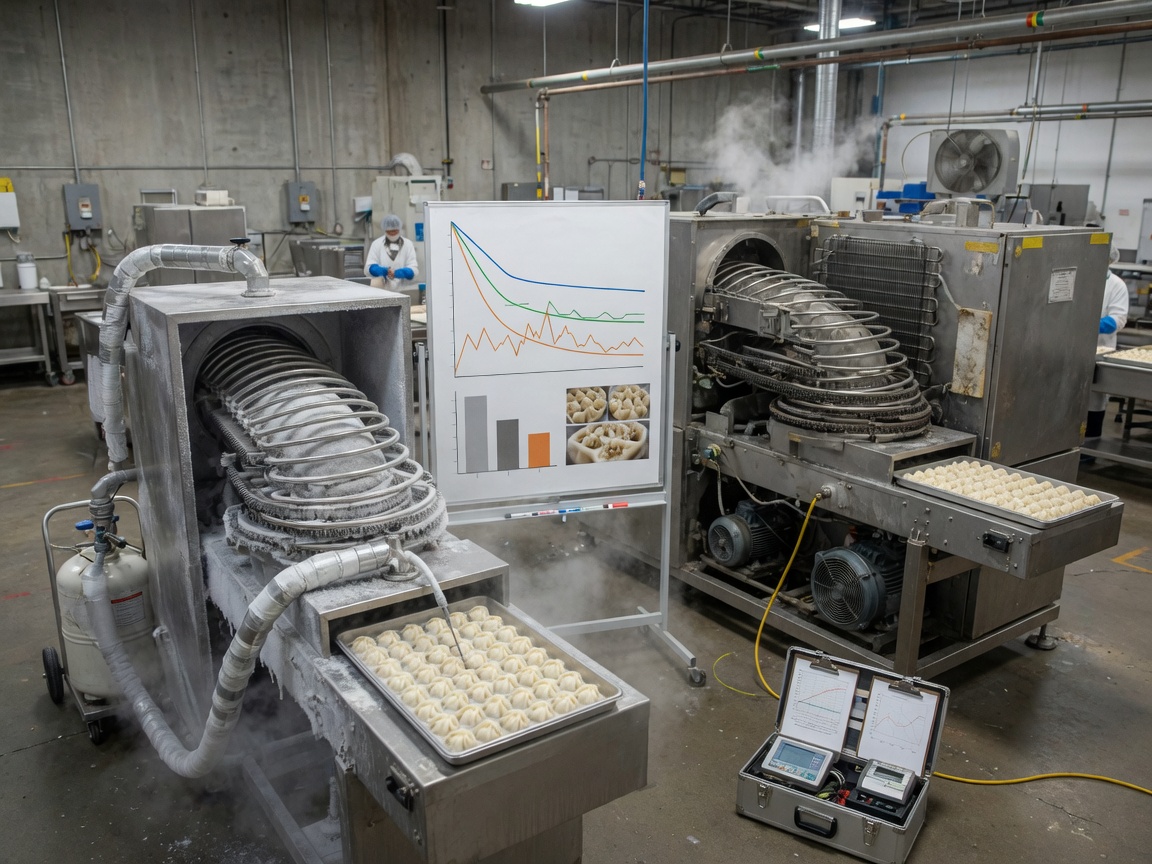
A spiral freezer solves a specific problem: maximizing throughput within a compact floor footprint. Product rides a continuous belt that spirals upward through a tall, insulated cabinet. Because the belt path is long — sometimes exceeding 1,000 feet in a footprint no larger than 20×30 feet — dwell time is sufficient for larger, denser items like burger patties, breaded chicken pieces, burritos, and portion-cut fish fillets. Capacity ranges from 1,000 to 20,000+ lb/hr. Capital cost for a commercial spiral freezer suitable for US production volumes typically falls between $250,000 and $1.2 million installed.
Tunnel freezer
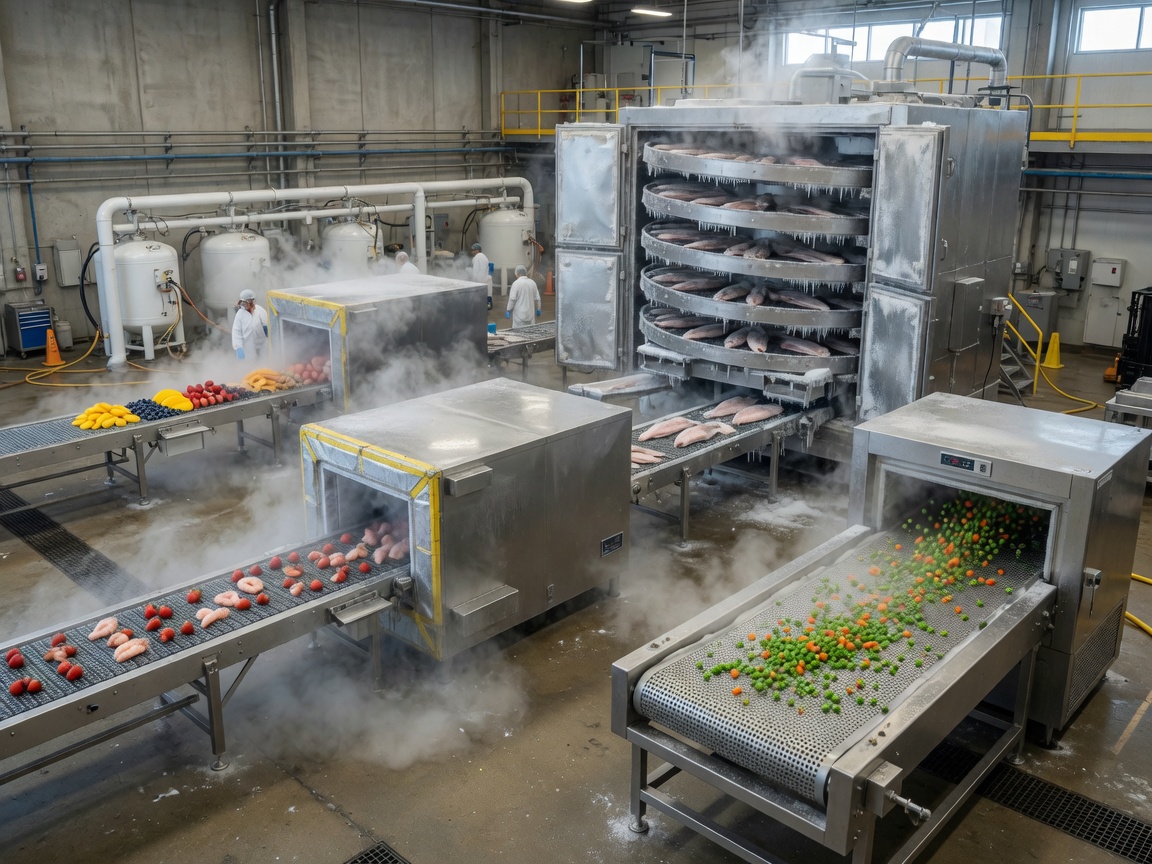
The tunnel freezer is the most architecturally straightforward design: a straight conveyor passes through an insulated refrigerated tunnel with high-velocity airflow directed over and under the belt. It handles the widest product variety of any mechanical freezing conveyor system — from delicate berries to dense meat blocks — by adjusting belt speed and air temperature. Why do many mid-size US processors choose tunnels as their first IQF investment? Primarily because they are easier to validate for HACCP purposes, simpler to clean, and more modular to expand. Capacity starts at around 300 lb/hr for compact units and scales to 10,000+ lb/hr for full industrial configurations.
Cryogenic freezing system
A cryogenic freezing system uses liquid nitrogen (LN₂) or liquid CO₂ rather than mechanical refrigeration to achieve near-instantaneous surface freezing — product surfaces can hit -100°F within seconds. This is the right tool for ultra-high-value items: sushi-grade tuna, live sea urchin, premium scallops, or high-margin specialty foods where texture degradation of even 2–3% is commercially unacceptable. Operating costs are substantially higher because cryogen is a consumable; LN₂ costs in the US range from $0.10 to $0.25 per lb of product depending on supply contract and location. The capital cost of the freezing cabinet itself is comparatively low ($40,000–$200,000), making cryogenic systems attractive for processors that need IQF capability without large refrigeration capital.
| System type | Typical capacity | Capital cost (USD) | Energy use (kWh/lb) | Best-fit food categories | Key limitation |
|---|---|---|---|---|---|
| Fluidized bed freezer | 500–4,000 lb/hr | $80K–$500K | 0.10–0.18 | Peas, corn, small shrimp, diced veg | Poor fit for large, irregular pieces |
| Spiral freezer | 1,000–20,000 lb/hr | $250K–$1.2M | 0.12–0.22 | Burgers, burritos, breaded entrees | Complex belt sanitation; high downtime risk |
| Tunnel freezer | 300–10,000 lb/hr | $120K–$800K | 0.11–0.20 | Broad product range, berries, fish fillets | Larger footprint than spiral |
| Cryogenic freezing system | 100–3,000 lb/hr | $40K–$200K | N/A (cryogen cost: $0.10–$0.25/lb) | Premium seafood, high-value specialty items | High ongoing cryogen operating cost |
US regulatory and compliance requirements for IQF equipment
US food processors operating IQF equipment must satisfy a layered regulatory framework that goes well beyond simply buying a machine with the right capacity. Ignoring this reality during the procurement phase routinely costs processors six-figure remediation expenses post-installation.
USDA FSIS and FDA 21 CFR requirements
If your facility processes meat or poultry under USDA Food Safety and Inspection Service (FSIS) jurisdiction, the IQF equipment must comply with FSIS equipment design standards, which mandate sanitary construction (no crevices where product residue can accumulate), drainable surfaces, and materials that meet NSF/ANSI 2 or equivalent standards. For non-meat food products — vegetables, seafood, fruit — the governing framework is FDA 21 CFR Part 110 (current Good Manufacturing Practice) and, increasingly, 21 CFR Part 117 (FSMA Preventive Controls). Any commercial food freezer installed after FSMA's effective dates must be evaluated within the facility's written Food Safety Plan as a process-preventive control if freezing serves as a pathogen-reduction or control step.
HACCP integration requirements
HACCP — Hazard Analysis and Critical Control Points — is not optional for US food processors at scale. When an IQF freezing machine is designated as a CCP (Critical Control Point), the equipment must support continuous temperature monitoring with calibrated, data-logging sensors that feed into your HACCP records system. Practically speaking, this means specifying equipment that includes 21 CFR Part 11-compliant data logging (for FDA facilities) or FSIS-compatible record retention when purchasing. Real-time temperature deviations must trigger automatic alarms and, in many HACCP plans, automatic line stops. Confirm with every vendor candidate that their control panel architecture supports integration with your existing SCADA or ERP platform before signing a purchase agreement.
"Food safety is not a feature you add to IQF equipment — it must be designed in from the first engineering drawing. Sanitary design principles, HACCP-ready sensor architecture, and NSF-certified materials are baseline requirements for any reputable US food processor, not optional upgrades." — Industry consensus position, International Association for Food Protection (IAFP) equipment design guidelines
Of course, some smaller processors operating under a Preventive Controls plan rather than a formal HACCP program have somewhat more flexibility in documentation format — but the underlying equipment performance requirements are substantively the same.
Total cost of ownership: energy, maintenance, and payback period
Capital price is the number vendors quote. Total cost of ownership is the number that determines whether the investment actually generates a return. For an industrial food preservation equipment purchase in the $200,000–$800,000 range, the difference between those two figures is substantial.
Energy consumption analysis
Actual testing across US production facilities shows that a mid-size spiral freezer running 2,000 lb/hr at typical US commercial electricity rates (averaging $0.12/kWh for industrial users in 2026) consumes roughly $85,000–$130,000 in electricity annually when operating 16 hours per day, 260 days per year. A comparably sized tunnel freezer running the same schedule costs approximately $70,000–$110,000 in electricity due to slightly better thermal efficiency in straight-run configurations. These figures assume ammonia or HFO refrigerant systems; older R404A units consume 8–15% more energy, adding $8,000–$18,000 annually to operating costs — a meaningful penalty as R404A phase-out accelerates.
Maintenance costs and downtime risk
Based on real-world case data from US food processing operations, annual planned maintenance on a continuous freezing system (belt replacement, bearing service, evaporator defrost cycle calibration, refrigerant checks) runs $15,000–$40,000 per year depending on complexity. A spiral freezer's belt is its most expensive wear item — replacement costs range from $25,000 to $80,000 per event, with typical belt life of five to nine years. Unplanned downtime in IQF freezing operations costs US processors an estimated $3,000–$12,000 per hour in lost throughput, so predictive maintenance capability — increasingly available via IoT sensors on 2026-generation equipment — has a quantifiable ROI that should factor into your vendor comparison.
Payback period calculation
A practical payback period model for a US processor upgrading from block freezing to an IQF system should account for: (1) premium pricing on IQF-grade output versus block-frozen, typically $0.15–$0.40/lb higher at wholesale; (2) reduced labor in downstream portioning and packaging; (3) lower product yield loss from thaw drip (IQF typically reduces drip loss by 40–60% versus block freezing). For a 1,000 lb/hr operation running 5 days per week, these combined benefits frequently deliver full capital payback in 2.5–4 years on mid-range equipment — faster than most processors initially estimate.
Integrating IQF equipment with US cold chain infrastructure
An IQF freezing machine does not operate in isolation. Its performance is directly coupled to what happens immediately before and after the freezing stage — and misalignment at either handoff point is one of the most common causes of substandard frozen product quality in US facilities.
Blast chilling pre-treatment
Cooked or blanched product entering an IQF system must arrive within a controlled temperature range. Product entering at above 50°F (10°C) forces the freezing conveyor system to work significantly harder, reducing effective throughput and increasing energy consumption per pound. A pre-stage blast chiller — typically reducing product to 34–38°F before the IQF inlet — is standard practice in well-engineered US lines. Without it, surface moisture from warm product can cause paradoxical clumping even in a fluidized bed freezer, negating the core value proposition of IQF technology.
IQF output temperature standards for retail-ready packaging
US retail and foodservice cold chain standards — informed by FDA, USDA, and buyer specifications from major retailers — require IQF product to exit the freezer at a core temperature of 0°F (-18°C) or below before entering packaging and cold storage handoff. Many retail contracts specify -10°F (-23°C) core temperature for seafood categories. Why does this matter for equipment selection? It directly affects required dwell time in the freezer, which determines belt speed, freezer length, and ultimately the capital specification of the machine you purchase. Sizing the IQF machine to achieve core temperature compliance at your maximum throughput rate — not your average rate — is a common error that leads to under-specified equipment and compliance failures.
How to evaluate vendors: RFQ checklist for US procurement teams
Vendor evaluation for a capital IQF equipment purchase involves more variables than most buyers appreciate upfront. The following checklist reflects the requirements that experienced US procurement teams should cover before issuing a formal Request for Quotation.
Technical and compliance specifications
- Confirm NSF/ANSI 2 or 3-A sanitary standard certification for all product-contact surfaces.
- Request documentation of HACCP-ready sensor architecture and data-logging compatibility (21 CFR Part 11 for FDA-regulated products).
- Verify refrigerant type — confirm absence of R404A and ask for GWP rating; specify NH₃, CO₂, or low-GWP HFO compliance with EPA Section 608.
- Request witnessed factory acceptance testing (FAT) data at your specified throughput and product type.
- Confirm UL or ETL listing for electrical components; NEMA 4X enclosure rating for wet processing environments.
- Ask for USDA FSIS or FDA facility reference accounts in the US — request direct contact references, not brochure testimonials.
Commercial and support terms
Warranty terms should cover at minimum two years on parts and labor, with a clearly defined escalation path for emergency field service. Ask every vendor: what is your average response time for emergency on-site service in my region? For US buyers, a vendor without an established domestic service network — typically through a US subsidiary or authorized service partner — carries meaningful operational risk. Lead times in 2026 for custom-configured IQF equipment from major suppliers (GEA, JBT, Starfrost, Octofrost) range from 16 to 36 weeks; factor this into your production ramp timeline. Spare parts availability for a minimum 10-year support horizon should be contractually confirmed, not assumed.
2026 technology trends shaping the IQF industry
The IQF freezing machine category is evolving faster in 2026 than at any point in the past decade. Two converging forces — digitalization and refrigerant transition — are reshaping procurement decisions in ways that will compound over the next five to seven years.
IoT integration and predictive maintenance
Leading manufacturers have embedded IoT sensor arrays directly into evaporator coils, belt drive systems, and airflow chambers, feeding real-time operational data to cloud dashboards. The practical result: a facility manager in Nebraska can receive a predictive maintenance alert on a bearing showing early-stage wear signatures 72 hours before it would cause an unplanned shutdown. According to 2026 data from pilot deployments at US food processing facilities, predictive maintenance programs on IQF equipment have reduced unplanned downtime by 35–50% compared to scheduled-interval maintenance programs. Digital twin technology — creating a virtual model of the physical machine — allows parameter optimization without production interruption, a capability that was theoretical just three years ago.
Low-GWP refrigerant transition
The EPA's AIM Act regulations are accelerating the phase-down of high-GWP HFCs in the US, mirroring the EU F-Gas trajectory that has already reshaped European IQF procurement. R404A — historically the dominant refrigerant in commercial food freezer applications — is being retired. Replacement options include natural refrigerants (ammonia/NH₃ for large systems, CO₂ for smaller footprints) and synthetic low-GWP HFOs such as R448A and R449A. Any IQF freezing machine purchased in 2026 for US operation should be specified with a refrigerant that is compliant with current and anticipated AIM Act phase-down schedules through at least 2035. Failure to do so risks stranded-asset risk on a machine that may otherwise have 15–20 years of useful service life.
Frequently asked questions
Q: How much does an IQF freezing machine cost in the US?
A: Entry-level compact IQF systems start around $80,000–$160,000 for small fluidized bed units at 300–800 lb/hr. Mid-range tunnel and spiral freezers for 1,000–5,000 lb/hr production run $250,000–$800,000 installed. High-capacity industrial systems exceed $1 million. Always include installation, refrigeration rack, controls integration, and HACCP compliance costs in your total budget estimate.
Q: What is the difference between an IQF machine and a blast freezer?
A: A blast freezer freezes product in bulk at high air velocity — effective for large items but produces clumped, block-frozen small pieces. An IQF freezing machine mechanically separates each piece during freezing so output is free-flowing and portion-ready. IQF also achieves faster freeze rates, resulting in smaller ice crystals and superior texture retention on thawing.
Q: Which IQF machine type is best for shrimp and seafood processing?
A: For small-to-medium shrimp (under 2 inches), a fluidized bed freezer delivers near-zero clumping and excellent glaze retention. For larger seafood portions — fish fillets, crab clusters, whole lobster tails — a tunnel freezer or spiral freezer provides the dwell time needed for core temperature compliance. Ultra-premium species often justify a cryogenic system for superior texture.
Q: What US regulations apply when purchasing IQF equipment?
A: Key frameworks include USDA FSIS equipment design standards (for meat/poultry), FDA 21 CFR Part 117 FSMA Preventive Controls, NSF/ANSI 2 sanitary equipment certification, HACCP documentation requirements, and EPA AIM Act refrigerant compliance. Facilities should also verify UL/ETL electrical listings and NEMA 4X enclosure ratings for wet processing environments before signing any purchase contract.
Q: How long does an IQF freezing machine last, and what is the payback period?
A: Well-maintained IQF equipment has a service life of 15–25 years. Payback period for a US processor upgrading from block freezing to IQF typically runs 2.5–4 years, driven by premium pricing on IQF-grade output ($0.15–$0.40/lb higher at wholesale), reduced portioning labor, and a 40–60% reduction in thaw drip loss. Predictive maintenance programs now measurably extend equipment lifespan and compress payback further.
Selecting the right IQF freezing machine for a US production line requires aligning machine architecture with product geometry, throughput targets, regulatory obligations, and long-term energy economics — not simply buying the lowest-quoted system. The comparison framework, TCO data, compliance checklist, and vendor evaluation criteria in this guide are designed to give procurement teams the analytical foundation to make that decision with confidence. As IoT integration and low-GWP refrigerant adoption accelerate through 2026 and beyond, the gap between well-specified and poorly specified IQF investments will only widen.
Keywords:
Inquiry
If you are interested in our products, please leave your email to receive a free product quote, thank you!
More information


Tel:
Sales E-mail: